ZENIT Interview in Italian now (some translation quirks… but… oh well…)

We are Italian now.

Well.. I am Italian in a sense already… but… the One Year Later interview I did with ZENIT (in two parts here and here) is now coming out in Italian.

Part 1 (Part 2 on Wednesday)

Samples:

C’è stata una grande richiesta della Messa tradizionale in latino dopo il motu proprio “Summorum Pontificum”?

Padre Zuhlsdorf: Sì e no. Non abbiamo visto orde di fedeli battere alla porta dei rettorati per chiedere la Messa in latino, ma c’è stato un costante aumento delle parrocchie in cui la Messa tradizionale in latino viene ora celebrata regolarmente.

Le gocce stanno formando un ruscello. …

There are some problems with the translation.  For example, where I said "rectories", they said "rettorati", which are really "rectorates", another idea entirely.  They would have done better to say "canoniche", which is a house where a priest lives.

Another example:


Molti Vescovi diocesani, incredibilmente, hanno posto ostacoli irragionevoli ai provvedimenti che il Santo Padre aveva generosamente promulgato. Questa resistenza si sta ora sgretolando sotto l’esame della gente e la pressione della Santa Sede. 


I did not say under the scrutiny of the "people", but under the scrutiny of the "blogosphere"… "blogosfera". 


Posted in SESSIUNCULA |
10 Comments

Church of England bishop will lead Anglicans to Rome

We are watching the Anglican implode this week.

No surprise.

But this is rather interesting.  Damian Thompson has this to report, as I picked up from my friend Fr. Blake:

[Church of England] bishop will lead Anglicans to Rome
Tuesday, July 8, 2008, 04:30 PM GMT

Church of England bishop will lead Anglicans to RomeThe Bishop of Ebbsfleet, the Rt Rev Andrew Burnham, is to lead his fellow Anglo-Catholics from the Church of England into the Roman Catholic Church, the Catholic Herald will reveal this week.

Bishop Burnham, one of two "flying bishops" in the province of Canterbury, has made a statement asking Pope Benedict XVI and the English Catholic bishops for "magnanimous gestures" that will allow traditionalists to become Catholics en masse.

He is confident that this will happen, following talks in Rome with Cardinal Levada, head of the Congregation for the Doctrine of the Faith, and Cardinal Kasper, the Vatican’s head of ecumenism. He was accompanied on his visit by the Rt Rev Keith Newton, Bishop of Richborough, the other Canterbury "flying bishop", who is expected to follow his example.

Bishop Burnham hopes that Rome will offer special arrangements whereby former Anglicans can stay worshipping in parishes under the guidance of a Catholic bishop. Most of these parishes already use the Roman liturgy, but there may be provision for Anglican prayers if churches request it.

Anglican priests who are already married will not be barred from ordination as priests, though Bishop Burnham would not be able to continue in episcopal orders, as he is married and there is an absolute bar on married bishops in the Roman and Orthodox Churches.

In his statement, Bishop Burnham explains why he is rejecting the code of practice offered to traditionalists by the General Synod last night. "How could we trust a code of practice to deliver a workable ecclesiology if every suggestion we have made for our inclusion has been turned down flat?" he asks.

"How could we trust a code of practice when those who are offering it include those who have done most to undermine and seek to revoke the code of practice in force for these last 14 years? …

"What we must humbly ask for now is for magnanimous gestures from our Catholic friends, especially from the Holy Father, who well understands our longing for unity, and from the hierarchy of England and Wales. Most of all we ask for ways that allow us to bring our folk with us."

I pray that these men, and the people who follow them, will have strength and courage to stand up to the pressure they will face now that they have made these statements.  

May they come to Rome.

They have with humilty asked for a magnanimous gesture from Pope Benedict. 

Can you think of anyone else who perhaps should be watching their good example?

Posted in SESSIUNCULA |
103 Comments

USCCB: “Dick and Jane” translation theory again triumphs for a day – Eerie!

I am caught in a dilemma. 

I am simultaneously filled with admiration of those bishops who know how to manipulate the rules of order for the Conference of Bishops, the "process", in order to delay something they don’t like (such as approval of the draft translation for the Proper of Seasons), … (hghghh!)

… over and against my desire to rain invective down on them for holding up the whole English speaking world and the use of a new translation of the Missal …. (hghghh!)

…all because a few of them think you are too stupid to understand the hard words or long sentences.

So perhaps the way to cope is to honor them with this piece from the Curt Jester.

By now I am sure that you have heard that the US bishops rejected the proposed translation of Roman Missal.  I do have an exclusive thought.  The bishops have sent along some guidance to the International Commission for English in the Liturgy (ICEL) as to what would be acceptable. The following are some actual example pages shown.

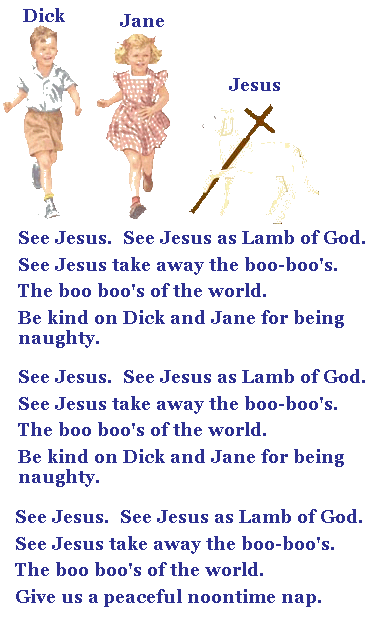
Dick and Jane Agnus Dei

Along with some rubrics for the GIRM.

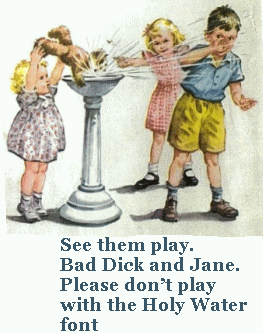
Dick and Jane play with Holy Water Font

Bishop Trautman called the sample changes "Great for both John and Mary Catholic and Dick and Jane Catholic."

Catholic blogger Father Z called these proposals ineffable and that he would rather be strung up on a gibbet than use this translation for Mass.

Darn right! 

Posted in SESSIUNCULA |
28 Comments

Simply wonderful: Novus Ordo 2.0

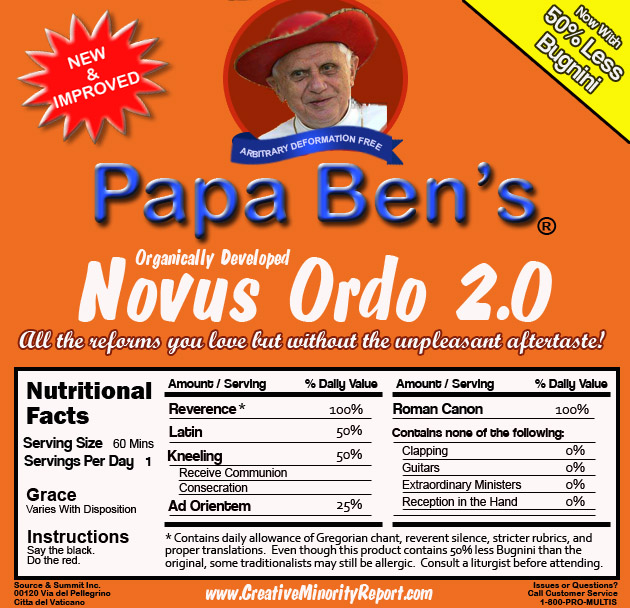
For the following, many thanks to the first in the trail of bread crumbs, His Hermeneuticalness, and then Creative Minority Report.  Kudos.

Simply wonderful: Novus Ordo 2.0

Notice the Instructions?

Simply wonderful: Novus Ordo 2.0
 

Posted in SESSIUNCULA |
38 Comments

Stalled again: USCCB fails to pass draft translation of Proper of Seasons

The USCCB says, the draft translation for the Missale Romanum texts for the "Proper of Seasons" failed to obtain a 2/3 majority of favorable votes.  Back to the drawing board.

I think we have reasons to be irritated about this. 

Bishops Reopen Consultation Process After Translation For Proper Of Seasons Fails To Meet Two-Third Majority

WASHINGTON—The U.S. bishops failed to approve the English translation of the Proper of Seasons prayers from the Missale Romanum, editio typica tertia, at the June general assembly of the United States Conference of Bishops, in Orlando, Florida. A two-thirds majority of Latin rite members of the Conference is needed for approval of the translation. The vote at the meeting was inconclusive and subsequent mail ballots from absent members kept the measure from passing.

This text, the “Gray Book” draft translation prepared by the International Commission for English in the Liturgy (ICEL), was submitted to the bishops of English–speaking countries for approval. A “Gray Book” is the second draft proposed by ICEL after the bishops of the participating English-speaking conferences have had the chance to review the initial draft (or Green Book). The Proper of Seasons is the second of twelve sections of the full text of the Roman Missal.

Bishop Arthur Serratelli, Chairman of the Bishops’ Committee on Divine Worship indicated that the Committee will now present the Gray Book to the bishops for renewed consideration, including the usual Conference process that allows bishops to submit modifications to the text for consideration. [Endless committees.  I think I want the Holy See to step in soon.] The Committee intends to present the text again for a vote at the November 2008 meeting in Baltimore. Should the text then receive an affirmative vote of two–thirds of the Latin Rite members of the USCCB, the text will be submitted to the Congregation for Divine Worship and the Discipline of the Sacraments for subsequent confirmation.

In addition to the Proper of Seasons, the Committee on Divine Worship plans to submit two additional “Gray Book” texts for consideration and vote this fall, in hopes that the USCCB will keep pace with the actions of other English–speaking conferences. If the texts receive an affirmative vote by the body of Bishops, the original timeline will still be maintained, and the final text of the complete Roman Missal will be presented for approval in November 2010.

Posted in Classic Posts, SESSIUNCULA |
143 Comments

Amato to Saints, Ladaria to CDF?

The intrepid Andrea Tornielli of Il Giornale has a solid on some changes.  Here is my fast translation:

Before Benedict XVI’s departure for the long trip to Australia, which will take place mext Saturday, the name of the new Vatican "minister" for saints will be announced, who will take the place of the Portughese Cardinal José Saraiva Martins. 

The new Prefect of the Congregation for Causes of Saints – the announcement will probably be Wednesday 9 July, will be the Salesian Archbishop Angelo Amato, Secretary of the Congregation for the Doctrine of the Faith since 2003 (where we was named as the successor to Bertone, promoted to the Archbishop of Genoa), who then will be put into the list of new cardinals for the next (but not imminent) concistory, together with the new Prefect of the Apostolic Signatura, the American Raymond Burke. 

Cardinal Saraiva, theologian and university professor, in Rome since 1950, chosen by John Paul II first as Secretary for the Congregation for Catholic Education and then as the head of the "saint factory", confirmed in his role by Benedict XVI, was the Prefect under whom there were proclaimed Blesseds and/or Saints, John XXIII and Pio IX, Gianna Beretta Molla, Padre Pio, Mother Theresa of Calcutta.  After the turn-about taken by the new Pope, who wanted to reserve to himself only canonizations, leaving beatifications as more typically a local undertaking, Cardinal Saraiva Martins has presided over many ceremonies for the Pope as his delegate. 

In the place of [Archbp] Amato at the former Holy Office, after months of uncertainty at last it seems the the candidacy of the Spanish Jesuit Luis Ladaria is becoming more firm, since 2004 Secretary of the International Theological Commission, theologian and anthropologist, professore of dogmatic theology at the Pontifical "Gregorian" University.  It was he, in May of last year, who explained the reasons which brought the committee to express itself about limbo and the salvation of babies who die without having been baptized.  The nomination of Fr. Ladaria, also, who worked on the draft of "Dominus Iesus", could be made known on Wednesday. 

Posted in SESSIUNCULA |
21 Comments

ZENIT and Fr. Z: “Summorum Pontificum” One Year Later (Part 2)

Yesterday, part 1 on an interview I did with ZENIT was published.  I have it here.

This is part 2, on ZENIT today. 

My emphases.

"Summorum Pontificum" One Year Later (Part 2)

Father John Zuhlsdorf Analyzes its Effects

By Annamarie Adkins

MINNEAPOLIS, Minnesota, JULY 7, 2008 (Zenit.org).- Even though Benedict XVI’s letter “Summorum Pontificum” on the traditional form of the Mass has been in effect less than a year, it has already made an impact, says an expert on liturgical translations.

Father John Zuhlsdorf, a former employee of the Pontifical Commission Ecclesia Dei, is a noted authority on both liturgical translations and the 1962 missal. He also writes the “What Does the Prayer Really Say?” column in The Wanderer newspaper, and is the author of a popular blog by the same name.

In Part 2 of this interview with ZENIT, he spoke with ZENIT about the impact “Summorum Pontificum” has had on the life of the Church life one year after its release.

Part 1 appeared Sunday.

Q: Benedict XVI stated in the letter accompanying “Summorum Pontificum” that he hoped each form of the Mass — ordinary and extraordinary — would mutually enrich the other. In particular, he desired that the extraordinary form would restore a sense of the sacred to the ordinary form, or Novus Ordo. One year after “Summorum Pontificum,” have you seen the extraordinary form exercise any "gravitational pull" on the Novus Ordo?

Father Zuhlsdorf: Yes, we can see this “pull” at work in some places, but there is a long way to go. Gravity exerts a steady pull, but inertia, especially momentum in the wrong direction, must still be overcome.

It has only been one year since the letter was issued, and only since September that it has been in force. Initially there were flurries of enthusiasm and vituperation, crowing and panic.

The text had to be read and absorbed. The Holy See had to clarify the authentic wording. Problems and questions are still being identified. A document with clarifications obviously remains on the drafting desk.

But the mere awareness of the provisions of “Summorum Pontificum” has made an impact. “Personal parishes” are being established for use of the older Mass and rites of sacraments. Books and training materials had to be created. They are now starting to be published. All this takes time.

Also, the Holy Father changed the conversation about liturgy and certain post-Conciliar practices by celebrating the Novus Ordo in a more traditional way, by using historic vestments, by returning to distributing Communion on the tongue to people kneeling, and so forth.

But the real pull of the older Mass and Benedict XVI’s efforts toward continuity with the Novus Ordo will be felt in the future.

For example, time and time again younger priests tell me that after learning the traditional Latin Mass they never say Holy Mass in the Novus Ordo the same way. There are things you learn about priesthood and Holy Mass from the traditional Latin Mass that you simply don’t pick up from the Novus Ordo, especially as it is usually celebrated in so many of our parishes and chapels.

How a priest says Mass affects a parish profoundly, at the level of reverence, vocations, everything.

Even though Rome wasn’t destroyed in a day, neither will it be quickly rebuilt. We have suffered a disastrous loss of basic priestly formation in Latin and theology and the culture that goes with them. This will take time to recover.

Seminaries need time to ramp up to meet the new needs the letter calls forth. Seminarians are eager to learn. Who will do the teaching?

In parishes young people more and more desire a greater continuity with the past. They are discovering their Catholic heritage and that they have been robbed. Eventually they will hold the positions of influence in parishes and Catholic schools.

On a concrete level, some bishops, priests, liturgists and musicians are rethinking the value of some common post-conciliar practices.

For example, a few days after Benedict XVI started to distribute Communion on the tongue to people kneeling, a bishop in the United States did precisely the same thing for Corpus Christi.

They are reassessing the great advantages of Mass celebrated "ad orientem," everyone facing the same direction toward the altar and the Crucifix. Latin is being reappraised. Musicians are dusting off the treasury of sacred liturgical music that has been hidden for decades.

The "motu proprio" is pulling, but there is still resistance, and laziness. Time, patience and open minds are needed to get things moving. The law of inertia in physics is that bodies in motion or at rest stay that way until another force works on them. The "motu proprio" is such a force.

Q: What have been some noteworthy, or perhaps unexpected, developments in the Church related to “Summorum Pontificum” since its release?

Father Zuhlsdorf: A noteworthy result must be the shift in attitude of and about people who desire traditional liturgy.

For so long the ecclesiastical establishment looked down on and marginalized more traditional Catholics, shoving them to the back of the bus because of their attachment to our tradition. Some of the more benign saw them as being like our family’s nutty but harmless aunt up in the attic.

On the other hand, many traditionalists, perhaps out of the deep hurts and disillusionment they felt after all the changes in the Church, the silly season of illicit innovations, the ash-canning of our beautiful churches, music, vestments, statues, devotions, you name it, wound up with an enormous chip on their collective shoulder.

As time went by, many of them knew no other way to “negotiate” with bishops and priests but simply to get in their face, make pushy demands, and arrogantly tell them what to do. It got to a point where even clerics who were open and sympathetic started to wince and back away whenever traditionalists approached. And so the waters of good relations froze.

Now, because some of the pain and alienation is starting to melt away in the hearts of many traditionalists, now that they can simply have what they should have been able to have all along, now that a little warm sunshine is being beamed in their direction by the Holy Father and others who share his vision, pastors of souls are starting to unclench as well.

The ice is breaking up and the water is flowing again. This was not an unexpected development. I fully believed this would happen because traditionalists are mostly good people who love Holy Church and want the best for their families, priests and bishops.

Bishops and priests, even when they are not personally inclined to traditional things, are mostly good men who love their flocks and sincerely desire their good. They all share common ground in what really matters. What I am surprised by is that the breaking of the ice dam — though there is a long way to go yet — is happening so quickly.

I underestimated the warmth of the sunlight and the openness of hearts, especially on the part of some bishops who, as a body, have not shown themselves in the past to be very friendly to traditional liturgy. This has made me rethink my own attitudes.
 

Posted in SESSIUNCULA |
18 Comments

7 July: Your reflections on Summorum Pontificum one year later

One year today the text of Summorum Pontificum was released.

I clearly recall having gathered the necessary bottles of Veuve Clicquot and getting up at oh-dark-hundred to use my access to the Holy See Press’ Offices embargo area to find the text and compare it to the advance copy just to be sure they matched.

Hitting that enter key to post about it was a real joy.  It was a joy that persists.

Every time I can post a positive story about the fruits of the implementation of Summorum Ponitificum I am a happy man.

Noteworthy among its fruits is how we see more and more what a great gift it is to priests.

When priests learn to say the older form of Mass, something inside them changes.

There are things in the older Mass which speak to priesthood, who the priest is at the altar and who he is for people, which simply are not discerned through the newer form of Mass.  The priest learns something vital about what Mass is and who he is in it and through it.

Once a priest learns to say the older Mass, he never says the Novus Ordo the same way again.

This, naturally, will create a ripple effect in parishes.

I focus on this one dimension of the fruits of the Motu Proprio, though there are many others we can distinguish, because I think it may be the most important of them all.

However, I would very much like to hear what you think are the fruits of Summorum Pontificum.

What has the Motu Proprio meant for you?

Even if you have not in a concrete way been able, yet, to benefit from the older Mass in your area, it still may be bearing fruits for you, even through what you hear others are doing.

Please share some of your thoughts.

Let’s make this one of those threads where you simply post your own reflections and thoughts without reacting directly to others to trying to engage them in conversation.   We had another thread like this, about your first experiences of an old Mass, and it was stunningly interesting.   Let’s do that same things here.

Your reflections on Summorum Pontificum one year later.  Brief, clear, and yours.


Posted in SESSIUNCULA | Tagged ,
193 Comments

On the road

I am away from the Sabine Farm for the next few days, so the attention I can give to the blog will be decreased.

Still, some of you might know how to send me messages if something noteworthy, requiring my attention, pops up.

However, I can tell you that where I am right now, this morning I spotted an Eastern Phoebe, distinctive by its bobbing tail.

Posted in SESSIUNCULA |
1 Comment

Rorate: rumor of a new Prefect for CDW becoming firmer

This is on Rorate.

[Antonio] Cardinal Cañizares Llovera, Primate of Spain [Archbp. of Toledo]: the new Prefect of the Congregation for Divine Worship and the Discipline of the Sacraments? The Spanish press, which had anticipated the move for months, does not consider it a rumor anymore, but as a certainty…

Quite a few of my people at the CDW are on the road at the moment, as am I.

However, later in the week I will be spending a couple days with Card. Arinze.  He is very discreet when it comes to these things, but perhaps if there is some solid news before he arrives where I will also be, he could shed some light.

Posted in SESSIUNCULA |
9 Comments