WaPo – R. Novak: For Pro-Choice Politicians, a Pass With the Pope

Whereas Card. Egan of New York has issued a press statement taking to task former NYC mayor R. Guiliani (R-NY) for receiving Communion at the Holy Father’s Mass at St. Patrick’s Cathedral, this is from the WaPo.

For Pro-Choice Politicians, a Pass With the Pope

By Robert D. Novak
Monday, April 28, 2008; A15

WaPo - R. Novak: For Pro-Choice Politicians, a Pass With the Pope In the aftermath of the U.S. visit by Pope Benedict XVI, traditional Catholics are asking a troublesome question: Did pro-choice politicians receiving Communion at the papal Masses indicate the pope had softened on the abortion question? The answer is no. On the contrary, it reflected disobedience to Benedict by the archbishops of New York and Washington. [Did you notice that "by the archbishops" and not "to"? ]

House Speaker Nancy Pelosi and Sens. John Kerry, Christopher Dodd and Edward M. Kennedy received Communion at Nationals Park in Washington, as did former mayor Rudolph Giuliani at Yankee Stadium in New York. Archbishop Donald Wuerl of Washington and Cardinal Edward Egan, archbishop of New York, invited them. [Were they really invited to receive?  Surely a prominent seat suggests something.  This is a realy why I think row by row Communion, though orderly, is a bad idea.] Given choice seats, they took Communion as a matter of course.

Vatican sources say the pope has not retreated from his long-held position that pro-choice politicians should be deprived of Communion, but the decisions in Washington and New York were not his. The effect was to dull the pope’s messages of faith, obligation and compassion. In his Yankee Stadium homily, he talked of "authority" and "obedience" — acknowledging that "these are not easy words to speak nowadays." They surely are not for four former presidential candidates and two princes of the church, representing Catholics who defy their faith’s doctrine on abortion.  [OUCH]

Benedict’s position was unequivocal when he was Cardinal Joseph Ratzinger, head of the Congregation for the Doctrine of the Faith. Asked in 2004 whether Kerry, as the Democratic presidential nominee, should be allowed to take Communion, he replied, "The minister of Holy Communion must refuse to distribute it."  [Remember how another prince of the Church, Card. McCarrick watered down Papa Ratzinger’s letter for USCCB consumption?]

Ratzinger’s demeanor necessarily has changed with his elevation from doctrinal enforcer [there’s that word] to global pastor, but he has not altered his position. When the pope arrived in Brazil a year ago, he declared: "The killing of an innocent human child is incompatible with going into Communion in the body of Christ."

Benedict did not reiterate that position in Washington and New York, because a pope traveling abroad is influenced by the stance of local church authorities. American bishops are [unfortunately] divided. Archbishop Raymond Burke of St. Louis leads those who believe pro-choice politicians cannot receive Communion. Cardinal [speaking of His Eminence…]Theodore McCarrick, Wuerl’s predecessor as archbishop of Washington, took the opposite position. Blessed with charm and political finesse, McCarrick was not about to clash with his archdiocese’s most famous parishioners.

Wuerl is considered less political than McCarrick, but he is hardly less averse to colliding with powerful laymen. He could have simply not invited the pro-choice politicians to a Mass where there was no room for the vast majority of Catholics who wanted to attend. The five pro-choice Catholics took Communion from the hand of Archbishop Pietro Sambi, [OUCH – and not true, at least in the case of Sen. Kerry (D-MA) and Sen. Chris Dodd (D-CT)] the pope’s representative to the United States as apostolic delegate.

In New York, Giuliani receiving Communion was even more remarkable.
Unlike Pelosi and Kennedy, who attend Mass regularly, the former mayor says he goes to church only "occasionally," usually for holidays or funerals. Abortion aside, Giuliani’s third marriage would make him ineligible for Communion because his second marriage was not annulled [er um… declared null] by the church. But Cardinal Egan is no more apt than Cardinal McCarrick was to offend the powerful, and Giuliani was invited to the Mass.  [So it seems that His Eminence’s hand may have been forced today?]

There are devout pro-life Catholics who oppose rejection of any worshiper at the Communion rail but believe bishops should publicly manifest disapproval of Catholic pro-choice politicians. The bishops of Washington and New York do not. During the Mass at which Wuerl was installed as archbishop of Washington in 2006, he shook hands with Kerry and Kennedy, seated side by side.

At Yankee Stadium, Benedict spoke of the "inalienable dignity and rights" of "the most defenseless of all human beings, the unborn child in the mother’s womb." In parishes across the country, the faithful hear their priests echo the Holy Father’s words. Those professions ring hollow when pro-choice politicians are honored as they were during the pope’s visit.


UPDATE: 1 May 23:29 UTC:

At the bottom of his column in today’s Post, Robert Novak states: http://www.washingtonpost.com/wp-dyn/content/article/2008/04/30/AR2008043003251.html


My April 28 column erred in saying that Archbishop Pietro Sambi, the apostolic delegate, was the priest who gave Communion to pro-choice politicians during the recent papal Mass in Washington.

Posted in SESSIUNCULA |
44 Comments

FLASH: New York’s Card. Egan: rebukes Giuliani for receiving Communion

This is just in from the Archdiocese of New York!  Super WDTPRS kudos to a super alert fast friend for alerting me so swiftly!

FLASH: New York's Card. Egan: rebukes Giuliani for receiving CommunionStatement of Cardinal Egan

April 28, 2008

FOR IMMEDIATE RELEASE: April 28, 2008

The following is a statement issued by Edward Cardinal Egan:

“ The Catholic Church clearly teaches that abortion is a grave offense against the will of God. Throughout my years as Archbishop of New York, I have repeated this teaching in sermons, articles, addresses, and interviews without hesitation or compromise of any kind. Thus it was that I had an understanding with Mr. Rudolph Giuliani, when I became Archbishop of New York and he was serving as Mayor of New York, that he was not to receive the Eucharist because of his well-known support of abortion. I deeply regret that Mr. Giuliani received the Eucharist during the Papal visit here in New York, and I will be seeking a meeting with him to insist that he abide by our understanding.

This raises the huge question.

What about other bishops who have prominent Catholics in their communion lines?

This may be a reaction to the piece by Robert Novak in the WaPo today!

Posted in SESSIUNCULA |
33 Comments

NLM: interesting video of Mass in vernacular

NLM has a great find:

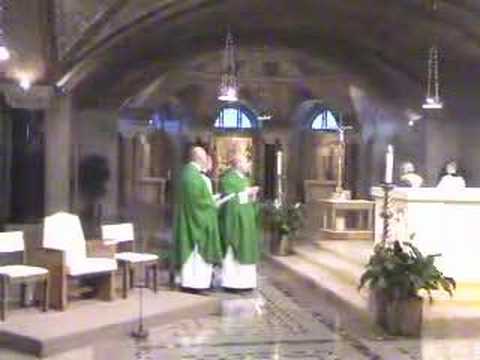
This bears watching as it illustrates the possibilities within the vernacular for Catholic Mass. This video was taken at the first Mass at the Sacred Music Colloquium at CUA last year. The video is long but it covers the full introductory rites, including the sung Confiteor.

Play video 

Posted in SESSIUNCULA |
24 Comments

Sistine secrets?

Just when you thought the DaVinci Code dopiness was settling down…. this is in from ABC News.

Was the Sistine Ceiling a Papal Insult?
New Book Asks If Michelangelo Embedded Hidden Messages in the Sistine’s Frescoes

April 28, 2008—

For centuries, people of all faiths have come to Rome and the Sistine Chapel to stare up at its immense ceiling and see Michelangelo’s stunning masterpiece. To most, it is a beautiful vision from the Old Testament, frescoes painted on wet plaster of the stories of the creation of the universe, Noah’s ark and Adam and Eve.

Dr. Arnold Nesselrath, the curator of the Vatican Museums, says people flock to the Sistine Chapel because "it’s one of the greatest works of mankind that were ever produced and it’s one of the greatest treasures of art."

But there are those who look at the 500-year-old frescos  and see hidden messages. [Insert sinister organ music here.]

"This, here, has so many layers of meaning upon meaning, and most of it, if not all of it, is from the Jewish tradition," says Roy Doliner, a Vatican tour guide. He and Rabbi Benjamin Blech, Associate Professor of Talmud, Yeshiva University, have written a book, "The Sistine Secrets: Michelangelo’s Forbidden Messages in the Heart of the Vatican."

They say that Michelangelo embedded powerful and dangerous [?] messages in the frescoes of the Sistine Chapel, that he encoded these messages using his knowledge of ancient Jewish texts, and that he intended some images as insults to the Pope himself.

Rabbi Blech says there’s a reason that all the figures on the ceiling are Jews, the ancestors of Christ and Christianity.

"By emphasizing only Old Testament figures in the entire ceiling & what he was trying to say was, why we have ignored our true roots?" [?]

Of course, 16th century Italy was a time and place that was overwhelming Catholic. But the authors say that Michelangelo was pointedly nudging the church to be kinder to Jews. [?] In Florence, where he was raised, the young Michelangelo grew up in the household of the great Renaissance leader Lorenzo de Medici. It was here, the authors believe, that the artist would have been [?] exposed to Judaism and its teachings.

One of the books the Medicis studied was at the center of an ancient form of Jewish mysticism: Kabbalah, [for pity’s sake] as trendy then as it is today.

According to Doliner and Blech, Kabbalah is the key to cracking the code of many of Michelangelo’s hidden messages. But their first clue didn’t come from a Jewish scholar. Rather, it came from a tourist from Indiana who looked up at the famous panel of The Creation at the figure of God.

"In the late 1970’s, a surgeon went into the Sistine Chapel, took a look at this [fresco]. He said to himself, wait, this is Anatomy 101 & this is actually a cross-section of the brain, the right hand side of the brain," Blech said.

If you look at the shape that frames God, and the flowing fabric that falls down from it  do you actually see a spinal cord?

"Now, what’s interesting is in Kabbalah we have different kinds of wisdom," said Doliner. "The right side of the human brain in Kabbalah means wisdom chokhma." And God is appearing from the right side of the brain in that fresco.

How about the fresco of Adam, Eve and the serpent in the garden? Most depictions of the Garden of Eden show an apple tree, but not on the Sistine ceiling. As in an ancient Jewish tradition, the tree is a fig tree.

Blech finds it another hidden message. "I think this is one of these powerful proofs, that not only did Michelangelo know Jewish texts, but he felt it important to incorporate the ideas of these texts into some of these frescoes."

Vatican Curator Nesselrath dismisses the Kabbalah references. "Well, we have all to remember that this is the palace chapel, the main chapel of the Vatican palace, and whatever Michelangelo is painting here had to be discussed with the Pope and his advisors."

And about that Pope  the authors of "The Sistine Secrets" claim that Michelangelo was furious at Julius II, who commissioned the work. Michelangelo was a sculptor, not a painter, and was angry to put his sculpture career on hold to paint frescoes. They say that anger caused the artist to paint hidden references on the ceiling to the corruption of the papacy of his time.

"All these things upset Michelangelo very much. My own personal feeling is that Michelangelo had to get this off his chest," Blech explained.

Just how badly behaved were the Popes of the Renaissance?  [Talk about a cliche!]

"There isn’t a Renaissance Pope that didn’t father plenty of children, and Alexander the Sixth had children but this was well known," noted Michelangelo scholar professor William Wallace says.

Monsignor Timothy Verdon of Florence concurs, but can’t imagine that Michelangelo gave it any thought. "Italians always understood that these men were human. If in their youth there had been a mistress or two, if there were illegitimate children, this was not really all that surprising. If the Pope went out of his way to favor his nephews & it was considered good policy & It’s a bit hard to think that Michelangelo could have been deeply concerned with great questions of church reform."

But the authors contend that there are insults hidden in plain sight right above the place where the Papal throne would sit. They point out the fresco of the Prophet Zachariah, directly above the Pope’s seat. They say it’s actually a portrait of the Pope himself.

"This is actually Julius II," said Blech. "Behind him, are little ‘putti,’ little angels. And this perhaps is the key to understanding Michelangelo’s courage, Michelangelo’s true feelings about the Pope, and the fact that Michelangelo did not hesitate to present us with messages that might’ve been offensive."

He says one of the putti is doing the Renaissance equivalent of giving the Pope’s portrait "the finger."

"There’s no doubt about it," he says, "this little putti, this beautiful little angel, is giving the finger not to Zachariah, but to Pope Julius."

He says the ceiling is full of insults, and that the hand gesture is seen again in the fresco of the Cumaean Sibyl.

"It happens a second time & Twice, that’s a statement."

On Friday May 2 at 8 p.m. ET, ABC News anchor Martin Bashir travels to Florence and Rome and talks to to renowned Michelangelo scholars and theologians to find out if the authors’ remarkable claims are true.


"But Father!  But Father!", I am sure some of you are saying.  "Isn’t this old news?"

Indeed.

Here is a story from back in 2005:

Michelangelo’s body of work seen in new light By Carlos DeJuana in Sao Paulo, Brazil
June 18, 2005

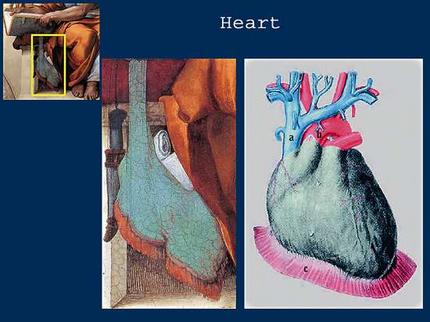
Putting heart and soul into it … illustrations from The Secret Art of Michelangelo show a depiction of a human heart in the Cumaean Sibyl.

Putting heart and soul into it … illustrations from The Secret Art of Michelangelo show a depiction of a human heart in the Cumaean Sibyl.

Two Brazilian doctors and amateur art lovers believe they have uncovered a secret lesson on human anatomy hidden by Michelangelo in the Sistine Chapel’s ceiling.

Completed almost 500 years ago, the brightly coloured frescoes painted on the Vatican’s famous sanctuary are considered some of the world’s greatest works of art.

They depict biblical scenes such as the Creation of Adam in which God reaches out to touch Adam’s finger.

But Gilson Barreto and Marcelo de Oliveira say in their book The Secret Art of Michelangelo that the artist also scattered his detailed knowledge of internal anatomy across 34 of the ceiling’s 38 panels. They say a tree trunk is not just a tree trunk, but also a bronchial tube. And a green bag in one scene is really a human heart.

The key to finding the numerous organs, bones and other human parts is to first crack a code they believe was left behind by the Florentine artist. Essentially, it is a set of sometimes subtle, sometimes overt clues, like the way a figure is pointing.

"Why wasn’t this ever seen before? First, because very few people have the sufficient anatomical knowledge to see these pieces like this," said Dr Barreto, a surgeon in the Brazilian city of Campinas.

Dr Barreto and his friend Dr Oliveira are not the first physicians to see depictions of human organs in the Sistine Chapel.

Fifteen years ago Frank Meshberger, an American, pointed out that the figure of God and his surrounding angels in the Creation of Adam panel resembled a cross-section of the human brain.

Dr Barreto came across Dr Meshberger’s theory when packing up to move house, and decided that if there was a brain there had to be other organs.

He searched through books and pictures of the chapel and found five or six other anatomical depictions which he showed Dr Oliveira.

The pair then spent the next three months looking for further evidence.

They discovered another US doctor, Garabed Eknoyan, had found the figure of a kidney in the panel titled Separation of the Earth from the Waters.

The pair came to believe Michelangelo had put coded messages in each panel to help viewers find the hidden body part.

Some clues are thematic, such as Creation of Adam or Creation of Eve, in which a tree trunk looks like a bronchial tube and God’s purple robe is a representation of a lung when seen from the side. One could say God was imparting the "breath of life" into Eve in the scene, Dr Barreto said.

In the scene Cumaean Sibyl a bag with a red frilly border and white rolled up scrolls inside hanging beside the Sibyl was a depiction of a heart, the diaphragm and the aorta, the doctors said.

Faced with the paintings and photographs of the anatomical body part side-by-side, the theory is conceivable, although some matches require a a bit of creativity.

Dennis Geronimus, a specialist on Renaissance art at New York University who examined some of Dr Barreto’s and Dr Oliveira’s "decoded" matches, said: "The problem, and art historians too are certainly often guilty of this, is simply that we often see what we want to see."

Reuters

Posted in SESSIUNCULA |
21 Comments

Panorama: claim that Pres. Bush may convert to Catholicism

Wanna read an article typical of much of the Italian press?

Check this out.

Ignazio Ingrao of the Italian Panorama (n. 18/2008) has a strange item (my translation):

Panorama: claim that Pres. Bush may convert to CatholicismGeorge W. Bush – The President of the United States, like Tony Blair, also about to covert to Catholicism.  A huge success for Papa Ratzinger.

After Tony Blair, there could be the turning of George W. Bush.  According to Washington voices, the President, a Methodist Christian, could be on the verge of converting to Catholicism like the Anglican Blair.  The prayer that the Pope and the Bush family recited together in the Oval Office of the White House could really be the sign of a conversion that has taken place, that the President of the United States would be waiting to communicate at the end of his term.  Jeb also, George’s younger brother, became Catholic years ago, thanks to his Mexican wife Columba.

Opportunism or conviction?  Certainly President Bush in 2004 was relected with the votes of Catholics, who preferred him to John Kerry, faithful to the Holy Catholic Church.  In any event, the President’s emotion when he greeting the Pope, when he had just arrived, beterayed sincere feelings.

Bush is surrounded by Catholics: the chief speechwriter, William McGurn, the bioethics consultant Edmund Pellegrino, the one charged with presidential initiatives concerning religion H. James Towey, two justices of the Supreme Court Samuel Alito and John Roberts, even the new Ambassador to the Holy See Mary Ann Glendon.

At home in the Oval Office is even the Canadian priest convert Richard John Neuhaus, director of the Catholic monthly First Things.  To these is added a New York priest who is helping Bush in his spiritual search.

Benedict XVI could in this way go down in history  as the Pope of famous conversions.  Bush’s case would be the most  impressive outcome of the trip of the German Shepherd in the United States.  But not the only one.  The visit signaled the end of violent antipapal Protestantism, fueled by clashes of John Paul II first with Bill clinton, on ethical issues, then with Bush on the war in Iraq.  Benedict XVI didn’t give on these two fronts, in line with his predecessor, but managed to win the esteem of Americans.  The "vintage" Pope as the Washington Post defined him, playing on his habits, managed to reverse the judgment of the press and public opinion.  A well-known anchor of CNN, Wolf Blitzer, Jewish, after greeting the Pontiff, said that he had never experience such an emotion.

America was lying in wait to confront him with the scandal of priest pedophiles and Benedict XVI didn’t retreat: four times in six days he confronted the issue, expressing shame and meeting victims.  He may have even given a task to the Congregation for the Doctrine of the Faith to examine the possibility of updating the norms of the Code of Canon Law about the matter, as victims are asking.

Two other gestures will remain in the hearts of Americans: the prayer at Ground Zero and the visit to the synagogue.  The Pope held up the USA as a model to be followed: a freedom that allows all faiths to be expressed and to offer contributions to democracy.  Ratzinger, in sum, doesn’t fear competition.  As a book of three economists explains, The market of Christianity, the free markett of faiths rewards the one advances clear and recognizable propositions.  As Benedict XVI did.


A lot of this article is pure fantasy. 

Posted in SESSIUNCULA |
28 Comments

NCReg: Interview with Msgr. Georg Ratzinger

There is a very interesting story at the National Catholic Register about the Holy Father’s brother Msgr. George Ratzinger.  My emphases and comments.

When Your Little Brother Is the Pope

Part I of our exclusive interview with the Holy Father’s sole remaining sibling

BY Robert Rauhut

Msgr. Georg Ratzinger remembers someone once asking him about his brother Joseph, three years his junior, “You are Ratzinger’s brother, aren’t you?”

“Ratzinger?” he said, “That’s me!”

Nowadays, he is “Pope Benedict XVI’s brother,” and can look back at an eventful and very full life, from his being forced to serve as a soldier to directing the world-famous Regensburger Domspatzen choir, which performed around the world.

The Register was granted a rare and in-depth interview with this warm, friendly and pious man. [I can back that up.  From time to time I would run into Papa Ratzinger and his brother Msgr. Georg on a stroll around the Borgo Pio area or out a little farther, on their way, perhaps, back to or from supper.  Msgr. G, as well as Papa, were always happy to chat for a moment (in German), especially about sacred music.] Days before Pope Benedict visited the United States, Robert Rauhut met and spoke with him in the little house in the historic center of Regensburg that has been his home for some time.

CHILDHOOD IN BAVARIA How did you and your brother and sister keep your faith during the difficulties of your childhood?

From the very beginning, the Mother of God has played an integral part in our spiritual life.

At our parents’ house we often prayed the Rosary, we knelt on the ground, leaning on chairs. That showed us very early how important the Mother of God is for a Christian.

We also observed the many Marian feasts. My mother and my sister were called Maria. Obviously, the name has been important in my family. We also traveled to Altötting [one of Europe’s greatest Marian shrines]. We know we are indebted to the Mother of God and can carry all our worries to her.

The Rosary, the midday prayers on Sunday, the festive Corpus Christi processions in Bavaria: These practices of popular piety makes one’s faith becomes personal — not abstract or formal, but personal, human, kind and precious, a faith which enters our life story and claims an essential place.

You and your brother were both conscripted into the German army as teenagers. How did you get through that experience?

Generally speaking, it was a time of restlessness, of waiting and hope, hoping that it would end and that one would survive. One didn’t focus on the present; one looked to the future. Let me give one example. During one night we were tasked with repairing telephone lines. The sky was lit by a fire, a giant forest fire, and we all thought: We need to survive this night. We hope to survive and live an ordinary, civil life, where we can realize our life plans, enter a profession, prepare for a career and then accomplish it — return to an ordered life.

At the end of the war, like your brother, you were briefly held captive. Your brother says he will never forget the joy of coming home.

I had been in American captivity, in South Italy, close to the Vesuvius, and we had no connection with the rest of the world. We only knew that everything was going in all directions in Germany, that the Americans were coming in, the Germans made last defense attempts. But I did not know if my parents were still alive, what was going on with my sister and brother. Is our house still standing? — I did not know anything.

At the beginning of July we were brought by ship to the north, and then by bus to Bad Aibling. (Bad Aibling was a huge camp for prisoners.) We were there a few days and then we were dismissed. Americans took us in their vans into the areas where we had lived. I was running home and wanted to know: “Is anyone alive? Are the same people there? Is my house there?”

My mother was standing at the well, my father was at home, my brother had returned from captivity, and my sister was also there. That was probably the sweetest moment in my life.

ON AMERICA

You have also visited the United States with the Regensburger choir. How do you remember that country?

It is a vast country with different facets. Our concerts particularly attracted Germans in exile. They were pleased to meet people from their homeland and hear songs that brought their homeland to them.

I remember a church service in Boston, in which we also sang. It was very human, friendly, unconstrained. We liked it very much. Those were the most important bits.

I also remember visiting a McDonald’s. It was quite surprising that you throw away all the dishes after the meal. [Genau!] But obviously you also have a culture of eating in the private sphere of American life, outside the fast-food restaurants.

Your brother is just visiting the country. Do you have any fears or expectations?

I do not have any particular fears that something could happen. In America there are hardly any assassination attempts. The fears are, if he will succeed in fulfilling the expectations of the population.

He has got the ability to talk to the people, to appear as a sympathetic human being. I hope this will be clear to all in the United States.

This visit has not only a human aspect, but in particular a religious one. I hope he will make our faith sympathetic, credible. That’s the real aim of this pastoral visit. It is not a matter of tourism.

That’s what I really hope, that in all the circles he gets to visit, that this will work. Maybe it can bring the Catholic Church in America a pastoral impetus.

VISITS WITH THE POPE

Now your brother has become Pope. How do you remember your last visit with him, at Christmastime?

Usually we celebrate Mass together in the morning. My brother is the main celebrant: The secretaries and I concelebrate. After the Mass there is silent thanksgiving. And then he reads the breviary to me; because of my eye problems, I cannot read the breviary anymore.  [Very sweet.  I bet the Pope could find someone else to read to his brother in German or Latin, but he does it himself.  Very nice.]

We also pray the lauds [morning prayer] and mid-morning prayer together. I have to be content with the Rosary. e reads the whole breviary in Latin.

Then we have breakfast, together with a few others. I go to my room. Often, Sister Christina reads something for me aloud. I listen to a lot of CDs.

A short time before lunch he comes to get me, and we go down together to eat. There we are together, also the secretaries. He pays attention to walks, to movement, because that is important for his physical condition.

I remember that once we were driven by car to the Lourdes grotto in the Vatican Gardens. My condition is too poor to walk there. And there we prayed the Rosary together. And then we talk a little bit and meet again for dinner.

After dinner we watch the news on RAI [Italian TV], then another little walk, compline [evening prayer] and the day ends.

Do you have a lot of time to talk together?

A little, but we spend the meal times together, the Celebration of the Eucharist, the afternoon Rosary and most of Sunday afternoon, after the siesta, especially in Castel Gandolfo.

For example, we sat close to the swimming pool there, [Which JPII had built.] where we read together and talked to each other. … At the end of the day there is usually little time. But the minutes spent together suffice.

Do you plan another visit?

I will be going down April 22 because on April 24 there is a concert organized by Italian President [Giorgio] Napolitano, and I will attend that. So I will stay a few more days.

Has something changed on a personal level after the election of your brother as Pope?

No. My brother was already 78 years old when he was elected Pope. Our personal relationship had already lasted 78 years by then.

So, fundamentally, nothing changes with regard to that.

But is it possible for you to distinguish your “little brother” from your Holy Father?

Certainly I have respect for him and one has to distinguish between the general human aspect, him being my brother, and the ecclesial one, that he is my superior in that regard. And there he also enjoys my particular admiration.

But in our personal conversation we are just the same as ever.

Do you talk about theology and ecclesial politics?

Hardly. Our conversation is everyday talk, but also remembrances. On ecclesial politics very little, because I generally do not want to interfere in his job and I do not want to influence him in any way.

Issues that are known generally are sometimes taken into the discussion, but generally little.

And theology?

I like reading his works, but talking about it is something different. Sometimes when I have read something, I will ask him about it so that he can explain it to me. But we … are together in a human way and talk about everyday human life.

He asks about people he knows from Regensburg and other places. He wants to know how they’re doing and what they’re up to.

Do you regularly talk on the phone?

It varies; there is no rule — generally, at least once a week.

First he wants to know what has been going on, and I tell him. And then vice versa. We do not talk very long.

What practical benefit is there for you when your brother is the Pope?

Obviously, I see its practical benefit when I visit my brother in Rome: I get very quickly from the airport to the Vatican — and if you know the traffic jams around Rome then you know that this is not easy.

There is also an important dimension in the Eucharist: Here is the Vicar of Christ celebrating Mass. There is a special atmosphere around that. But apart from that everything is similar.

BENEDICT’S LEGACY

Has your brother gotten used to the new office? I mean, he planned a different life.

He is very flexible. He can adapt well to a given situation. And he pays full attention to all that is demanded and expected of him. And this new requirement, new dimension of his everyday life, is something he has quickly adapted to.

Has the election of Pope Benedict changed the Church in Germany?

It is difficult to see any obvious difference. For those who already believe, it has definitely been a plus. For those who are standing at the edge, who are not against it, for them it has occasioned some pointed reflection.

In some it has led to a change of their personal attitude. Some have found a connection with the Church in some way — to what extent I cannot say. I have heard, for example, that the World Youth Day in Cologne has been very fruitful for pastoral work with young people in a parish — a growing interest, more positive attitudes, liveliness and willingness. That’s one testimony, but there are certainly many more.

Will your brother visit Germany again?

The desire is there. But he has the same obligation toward the whole world. He has already been to Germany twice. Now it’s the turn for other countries. So a question mark is wise. And on the other hand, traveling does not get easier with advancing age.

What plans and desires do you have for the evening of your life?

At our age, life is fulfilled. One has reached his aims, or missed them. One tries to live the last months or years, the days there are, in a way that does not cause problems, creates peace — to do one’s tasks as well as one can. The Pope got a new perspective, a new horizon, with his election, which has already lasted three years, and he also has no especially big plans but is confronted with a radically different reality and tries to find the right solutions for this reality. Dreams or desires? No, I do not have them now.

Robert Rauhut is
based in Munich.

Posted in SESSIUNCULA |
11 Comments

NYC: some TLM notices

Thanks to Hallowed Ground we know that:

There will be a Mass on the Vigil of the Ascension at the Church of Our Saviour at 6:00 (Fulfills the Obligation for Ascension Thursday).

There will be a Mass at Our Lady of Good Counsel (290 East 90th St. – 4, 5, 6 Train to 86th St.) on Thursday at 7:30pm (Ascension Thursday).

There will be a Mass on Thursday at Mt. Carmel Church in the Bronx at 8:30 AM. Also:

sacred-1-1.jpg picture by kking_8888

Posted in SESSIUNCULA |
14 Comments

Spero: For the pope, all questions must be entertained

Here is an interesting perspective from Spero with my emphases and comments.

For the pope, all questions must be entertained

Much of what Pope Benedict XVI said was obscured by the media’s focus on his response to sexual abuse by clerics. The pope fills a new role in a life story of integrity and dialogue.

By Martin Barillas 

The April 15-20 visit of Pope Benedict XVI to the United States offered Americans, and the rest of the world, grist for further evaluation of the pontiff not only as a man but also as a messenger. Caricatures of Cardinal Joseph Ratzinger, who became the current pope, have abounded.

As prefect of the Congregation of the Doctrine of the Faith, a Vatican office that oversees the orthodoxy of priests, prelates, and theologians, he was called “the pope’s Rottweiler”, “Inquisitor”, and even “Nazi”. As pontiff, he has been called “panzer pope” and “enforcer”, among other epithets.

Benedict is the third pontiff to tread American soil and has a much more avuncular appearance than his detractors had heralded. While he may not have delivered as much as some of his detractors, and fans, had wished

Brennan Pursell, author of Benedict of Bavaria and associate professor at DeSales University, Pennsylvania, offered in an interview some insights into the pope and his message to the United States. Pursell said Benedict, as pope, is consistent with his life story and a life teaching theology and philosophy. He has served variously as parish priest, professor, academic administrator, Cardinal-Archbishop, and personal advisor to Pope John Paul II.

When Pursell was asked whether the man who was Cardinal Ratzinger is different from the man who is now Pope Benedict XVI, he quoted Hans Kung, a former Catholic theologian and colleague, as saying “Oh no, there is only one Ratzinger. He now has a different role”.

In visiting Americans, the pope’s intention, said Pursell, is “to uplift and to get their eyes off the ground…It is a challenge to step out of their comfort zone and to point out things they should not be doing.” Moreover, said Pursell, “The dimensions and complexity of one’s comfort zone is the measure of a person’s self-love.” The pope means to demonstrate that “We cannot improve ourselves if we don’t abandon self-love”.

The pope was not addressing merely Catholics, said Pursell, but all Americans so that they might examine policies and practices at odds with Judeo-Christian values of justice and charity. Hence, the pope had to bring up the scandal of sexual abuse at the hands of Catholic priests and others, said Pursell. Even before the pope landed in the US, he brought up the issue with reporters on board his plane. Later, to assembled bishops, he said that the clergy sex abuse scandal had sometimes been "very badly handled”.

Pursell says that bringing up the issue of sexual abuse was necessary for Benedict XVI, just as it was necessary for him to bring up the issue of immigration: a controversial issue of much concern to the pope since it impacts families. The pope is saying that the family is an underpinning of society that “is prior to the State”, averred Pursell.

The pope, therefore, is making a special plea in favor of families divided through the irregular application of immigration law by Federal and local governments. In the interview, Pursell assured that the pope is not challenging the legalities of immigration to the US but is pleading for humane treatment for all immigrants.

That some of the pope’s statements caused discomfort among Americans was brought to the fore by CNN’s Lou Dobbs who, in reference to the pope’s exhortation about immigration said that the pontiff showed “bad manners” on his visit. Other commentators expressed wishes that he had said more, or done more, about sexual predators or relations with other religions.

But much of what the pope said may have been obscured by the media attention to the issue of clerical sexual abuse, said Pursell. In the intellectual sphere, the pope’s message about dialogue is at least equally important. Dialogue with other religions, especially with Judaism, is also at the heart of the pope’s message. The pope spoke to Catholic intellectuals and educators while on his visit and exhorted them to take seriously their Catholic identity. Pursell commented that Benedict is asking them “to figure out a way to uphold academic freedom, yet protect the Catholic faith and all things holy from broadsides and denigration in all forms. He pointed out a way”.

One way then is that “all questions must be entertained”, said Pursell. “But for statements, speeches, exhibitions, and performances, there has got to be limitations on speech as there are at other universities.” As Pursell points out, there is no place anywhere for Holocaust deniers. So, there is no absolute freedom even in the academic sphere. He added, “But there can be no restriction on questions because the questioner shows himself or herself to be open to further correction and dialogue”, in the pope’s view.

Pursell said that it is his hope that the pope’s visit will engender sympathy among Catholics and non-Catholics for the Church’s view that it cannot simply “say yes to everything new. By giving its blessing to all innovations, it would simply cease to be”.  [This is a good and important point.]

Another analyst of the papacy, Matthew Bunson – Senior Fellow at St. Paul Center for Biblical Theology and General Editor of Our Sunday Visitor’s Catholic Almanac – gave some insight into the pope’s visit. When asked about the significance of the meetings with members of the Jewish community, Bunson noted that as Cardinal Joseph Ratzinger, the pope was a “known quantity” in discussions between Catholics and Jews worldwide.

“He is respected as a Biblical scholar” and “one of the leading voices of Catholic-Jewish relations”. With these established credentials, Benedict XVI “hopes to add to the furtherance of good relations as pope”.

Despite some objections to Summorum Pontificum, an encyclical [No, it is an Apostolic Letter motu proprio data.] released in July 2007 that granted greater freedom in the use of the Tridentine liturgy and certain prayers used on Good Friday, the pope, said Bunson, wishes to reassure “that the Catholic Church has no desire to step back in Catholic-Jewish relations”.

Despite the objections of some members of the Jewish faith who find unacceptable the Tridentine Rite Good Friday prayers for the conversion of Jews, Bunson said there remains considerable “common ground with some members of Islam and Orthodox Judaism”.

“Especially among Orthodox Jews”, said Bunson, the pope hopes to emphasize common ground in values placed on human life and family life and in the wider concern to promote “a culture of life”.

Said Bunson of the pope, “He is firmly convinced that there has to be found a place [and basis] for building peace and harmony amongst the nations.” The pope is concerned over the power of religious extremism [cf. Pope Benedict’s Message for the 2006 World Day of Peace.  I think anyone who wants to grasp what Pope Benedict’s view of the greatest threats to society and peace are should read this Message.] in the world today, and wants to emphasize a return towards the Judeo-Christian roots of culture and away from the “toxic effects of secularism and rampant consumerism – what his predecessor John Paul II called ‘the culture of death’”.

While the clerical sexual abuse scandal was not the only issue touched upon by the pope, Bunson called it “perhaps the worst crisis to face the Church in over one hundred years.” Bunson said that under Pope John Paul II, the former Cardinal Ratzinger “played a very significant role in the Vatican response to paedophile abuse” and is seeking “authentic justice for the victims.”

For the pope, the abuse of children is “unacceptable”. But the pope’s aim is also to bolster the morale of good priests and bishops who have been faithful. He seeks to encourage the priesthood, rather than engaging in reprobation.

“Remember,” said Bunson, “the overarching theme of the visit for Pope Benedict is hope. The title of the visit is ‘Christ is Our Hope’”.

The visit served to “offer hope and optimism to American Catholics and to remind them of the hope and joy that can be found in an authentic Catholic identity.” Benedict’s presence in the US, said Bunson, offered a “great opportunity for spiritual and emotional closure to what could be termed a major crisis in American Catholicism.”

Martin Barillas is a former US diplomat and human rights observer. He is an editor at Spero News.

Posted in SESSIUNCULA |
5 Comments

Prayer request

I am pretty tired right now. 

My mind is flat lined.  

I read, … oh how I read, … but I wonder what I am absorbing. 

I write, but I wonder if anything I write makes sense.

I am mentally pretty worn out. 

I am dragging.

Posted in SESSIUNCULA |
52 Comments

Watching Rev. Wright

Rev. Wright is speaking at the NAACP meeting in Detroit.

He is an engaging speaker, though not great or profound.  I also wasn’t terrible thrilled by his anti-Catholic comments, but… so what’s new, really.  Lana caprina… if that isn’t to European a reference.  I also wasn’t very enthusiastic of his notion that there should be differing standards for students.  If this addresses differing way of learning, fine.  But somewhere along the lines the bottom line of learning stuff has to come together.

Rev. Wrights basic idea, which which he wound up, here is that Black people and European descendant do thing, think, feel, etc., is different, but one is not superior to the other.  It’s a right brain, left brain thing.  I wonder.  But… okay.

And then he comes to his main, concluding point …

Along with the theme of the meeting, that Change is Gonna Come, people are going to, must learn to, work to, treat each other differently.

Great!

However, he made this speech while making fun of, mocking, white people.  I find that odd.

Posted in SESSIUNCULA |
Comments Off on Watching Rev. Wright