“Behold, I make all things new.”

US HERE – UK HERE

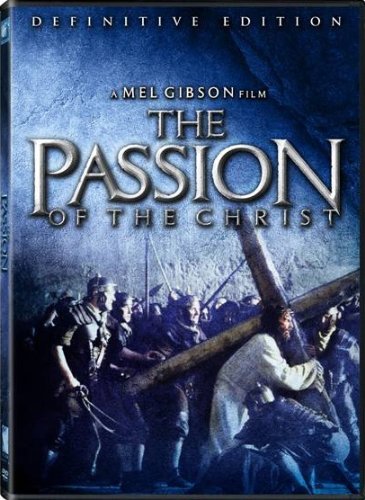
The moment which, every time, nearly overwhelms me to the point of not being able to breathe is when Christ falls and His Mother has her flashback.  She – past and present – rushes to Him.   He quotes the not-yet-written Revelation 21:5:

“Behold, I make all things new.”

Of course He was saying what would be written would be spoken.

Posted in Four Last Things | Tagged ,
15 Comments

#GoodFriday and You: Prayers for Holy Souls in Purgatory and Plenary Indulgences

Something which would enormously help every aspect of the life of the Church in the modern world is a revival of classic devotions and the return to a style of prayer which, to our ears, seems quite formal and, at times, florid. Spontaneous prayer is good. Spontaneous prayer that has been shaped and formed and rests on a solid foundation of well-crafted and classic prayers is better.

Today, Good Friday, there is a devotional prayer of St. Bridget for the Poor Souls, Holy Souls in Purgatory. It was revealed to St. Bridget that if this prayer is said devoutly 33 times on Good Friday, 33 souls would be released from Purgatory and 3 souls on ordinary Fridays.

THE GOOD FRIDAY PRAYER FOR THE HOLY SOULS

I adore Thee, O Holy Cross, which has been adorned with the tender, delicate and venerable hands and feet of my Savior, Jesus Christ, and immured with the Precious Blood. I adore Thee, my God, nailed to the Cross for me. I adore Thee again, O Holy Cross, for the love of my Lord and Savior, Jesus Christ. Amen.

You don’t have to do them all at once.

Also, you have the opportunity to gain plenary indulgences under the usual conditions on Good Friday.

From the Handbook of Indulgences:

“A plenary indulgence is granted to the faithful who

  1. Devoutly assist at the adoration of the Cross in the solemn liturgical action of Good Friday; or

  2. Personally make the pious Way of the Cross, or devoutly unite themselves to the Way of the Cross while it is being led by the Supreme Pontiff and broadcast live on television or radio.”

Posted in "How To..." - Practical Notes, Hard-Identity Catholicism | Tagged , , ,
2 Comments

Good Friday Reminder: Fasting, Abstaining, and You

Tomorrow is Good Friday. Let’s review our obligations before the day arrives so that we aren’t taken by surprise.

Two days of the year we modern Latin Church Catholics are asked both to fast and to abstain from meat.

According to the 1983 Code of Canon Law for the Latin Church, Latin Church Catholics are bound to observe fasting and abstinence on Ash Wednesday and Good Friday.

Here are some details. I have posted them before, and I am sure you know them already, but they are good to review.

FASTING: Catholics who are 18 year old and up, until their 59th birthday (when you begin your 60th year), are bound to fast (1 full meal and perhaps some food at a couple points during the day, call it 2 “snacks”, according to local custom or law – two snacks that don’t add up to a full meal) on Ash Wednesday and Good Friday.

Since we are Unreconstructed Ossifed Manualists, we pay attention to old manuals.  Prümmer suggests that for the morning snack a piece of bread and 2 ounces of nourishing food is sufficient, and that for the afternoon or evening snack, 8 ounces of nourishing food is permitted to all.  “Sufficient” for what is not entirely clear.  There is a difference between working construction and working at a computer.  This is greatly simplified by taking Good Friday off… if possible.

There is no scientific formula for this. Figure it out.

ABSTINENCE: Catholics who are 14 years old and older are abound to abstain from meat on Ash Wednesday and on all Fridays of Lent… and Good Friday in the Triduum.

In general, when you have a medical condition of some kind, or you are pregnant, etc., these requirements can be relaxed.

For Eastern Catholics there are differences concerning dates and practices. Our Eastern friends can fill us Latins in.  As I understand, the Byzantine (Ruthenian) Catholic Church in these USA has followed the Latin rite to a certain extent.  Abstinence from meat is required on all Wednesdays and Fridays of Great Lent, with the the strict fast (abstinence from meat and dairy) on Clean Monday and Good Friday.

You would do well to include works of mercy, both spiritual and corporal.

I also recommend making a good confession. Let me put that another way:

GO TO CONFESSION!

“But Father! But Father!”, some of you are saying anxiously, “What about my Mystic Monk Coffee? I can drink my Mystic Monk Coffee, can’t I? Can’t I?”

You can, of course, with and as part of your full meal and two “snacks”(portions that wouldn’t make a full meal) . No question there.

How about in between?

The old axiom, for the Lenten fast, is “Liquidum non frangit ieiuniumliquid does not break the fast”, provided you are drinking for the sake of thirst, rather than for eating. Common sense suggests that chocolate banana shakes or “smoothies”, etc., are not permissible, even though they are pretty much liquid in form. They are not what you would drink because you are thirsty, as you might more commonly do with water, coffee, tea, wine in some cases, lemonade, even some of these sports drinks such as “Gatorade”, etc.

Again, common sense applies, so figure it out.

Drinks such as coffee and tea do not break the Lenten fast even if they have a little milk added, or a bit of sugar, or fruit juice, which in the case of tea might be lemon.

Coffee would break the Eucharistic fast (one hour before Communion), since – pace fallentes – coffee is no longer water, but it does not break the Lenten fast on Ash Wednesday or Good Friday.

You will be happy to know that chewing tobacco does not break the fast (unless you eat the quid, I guess), nor does using mouthwash (gargarisatio in one manual I checked) or brushing your teeth (pulverisatio – because tooth powder was in use back in the day).

If you want to drink your coffee and tea with true merit I suggest drinking it from one of my coffee mugs. I’d like to offer an indulgence for doing so, but that’s above my pay grade.

There’s always the Liquidum non frangit ieiunium mug.

Click!


Posted in "How To..." - Practical Notes, Canon Law, Our Catholic Identity | Tagged , , ,
14 Comments

TMSM: Holy Thursday Mass with the new vestments

UPDATE:

A good photographer also captured some moments from the Mass last night.  The gallery is HERE.

Example:

During the sermon…. you get a sense of the beauty of moment. We are trying to do something beautiful for God.

Click for a larger image.

JComm Enterprises LLC: Holy Thursday 2019 &emdash;

____

Some images from Holy Thursday with the TMSM. We used our new vestments.

If these are a little out of order, please excuse.


Posted in Liturgy Science Theatre 3000 | Tagged ,
14 Comments

A good article in Crisis about France. Fr. Z adds a short rant.

From the onset I have hoped that the burning of the Cathedral of Notre-Dame will “spark” the Faith in Paris and in France.  And I don’t think that it is a mere “coincidence” that the famous church burned.   It may have been a construction machine glitch or it may have been a human act or it may have been the act of a human, but, as Chesterton observed, coincidences are God’s puns.   These events mean something.

At Crisis today there is a thoughtful piece by William Kilpatrick about the fire.  A couple of points.  I really like the quote from Flannery O’Conner.

In the Bible, the destruction of a city or a temple is often linked to immorality or unbelief. The fire and brimstone that was rained down on Sodom was punishment for the sins of its people. Likewise, Jesus warned the people of Capernaum and other cities that their fate could be worse than Sodom’s because they did not repent despite the “mighty works” he had performed in their midst (Matt. 11:20-24). When Jesus wept over the city of Jerusalem, he prophesied that its enemies “will not leave one stone upon another in you, because you did not know the time of your visitation” (Luke 19:41-44).

The “sign” of Notre Dame ablaze comes on top of other disturbing signs. Since the beginning of the year, dozens of churches in France have been vandalized, desecrated, and torched. In 2018, 1063 attacks on Christian Churches or symbols were registered in France—a 17 percent increase over 2017 when “only” 878 attacks were registered. Other signs that the times are out of joint are not hard to find.  Among the more horrific were the massacre at the office of the Charlie Hebdo publishers, the Bataclan Theatre attack, the truck jihad in Nice, and the Christmas Market massacre in Strasbourg.

Church desecrations and terror attacks are not confined to France, but since France is one of the most aggressively secular states in Europe, it may be more in need of signs than most.  And it may require more spectacular signs to call France—once considered the “eldest daughter of the Church”—back to the faith.

When asked why her stories were full of grotesque characters and shocking violence, Flannery O’Connor replied: “When you write for the blind, you have to write in big letters.” Those who live in overly-secularized societies, such as France, often become blinded to what is truly important in life, and may, therefore, require fiery signs to wake them up to reality.

The truth is that unbelief in France is probably as great as, if not greater, than in the Biblical cities and towns cited in Christ’s warning to the unrepentant. Only four percent of French Catholics attend Sunday Mass on a regular basis, and in the larger cathedrals, the number of tourists far exceeds the number of worshippers.

After visiting several Churches in France, including Notre Dame, Mark Steyn was struck by their emptiness: “One gets the sense that a living, breathing faith is just becoming, actually, a museum, an art gallery, a storage facility.” The cathedrals of Europe are truly magnificent and awe-inspiring, but the awe is for achievements that we no longer seem capable of because we lack the requisite faith.

The damage to Notre Dame is a wakeup call not only for Christians who have let their faith lapse, but also for dyed-in-the-wool secularists.

[…]

I’ll add an observation.  For a while now I’ve written about my own experiences in Paris.  I’ve gotten to Paris one or two times a year now for several years after a long hiatus of visiting the City of Lights.  I’ve noticed, over the last few years in Paris, that the churches have gone from being closed and dirty to open more often and being cleaned.  The lights are on and people more are praying in them.  I’ve seen the Blessed Sacrament exposed more often.

Also, I think that the revival of the Traditional Mass is playing a part.  How could it not?

And attacks, especially by Islamic terrorists are on the rise.

We must not forget that we are involved in a war on many levels, including the spiritual.  The Devil and his demons have human agents.   They will not be idle in the face of the revival of the Faith.  They will not be idle in the provocation – through signs – of their pawns.

God permits evils and brings glory from them.

Don’t forget, during your Triduum observances, to pray to the angels of France and to the Mother of God to help the awakening of Faith in the people of that ancient core of Christendom.

Posted in Our Catholic Identity, The Coming Storm, The future and our choices, The Religion of Peace, Turn Towards The Lord, Wherein Fr. Z Rants | Tagged ,
17 Comments

So a guy with gas cans walks into @StPatsNYC in Midtown Manhattan…

…. No!  Really!

The NYPost reports – and I have verified through a NYPD source that this is for real – a guy with gas cans walked into St. Patrick’s Cathedral in midtown Manhattan today and got his crazy ass arrested by NY’s finest.

No, the gas cans were not empty and he wasn’t looking for gas for his lawn mower.   Presumably, there was gas in the gas cans.  The photos suggests also bottles of bbq fire starter and lighters.  HERE

Story HERE

There is a 24/7 NYPD post at St. Pat’s.

My 24/7 kudos to the NYPD.   And I think they just had a new class of officers sworn in today.  Congratulations!

I hope that every priest or layman working for every church and chancery out there will bring up discussion of an “action plan” in the case of arson.

  1. Where do you go?
  2. What do you get out?
  3. What’s your fire plan?
  4. Have you spoken with the Fire Department?

It’s always someone else… until it’s not.

Semper paratus.

UPDATE

Posted in "How To..." - Practical Notes, ACTION ITEM!, Semper Paratus, The Coming Storm, The future and our choices, The Religion of Peace | Tagged
6 Comments

PRAYERCAzT: What does the Latin Exorcism really sound like? FOR PRIESTS ONLY – UPDATED

St. Margaret beating the Devil with a hammer.

UPDATE 17 April 2019:

A while ago I had a request from an exorcist of a US diocese for a recording not only of Chapter 3, but also of Chapter 2.  “Euge! Euge!”, quoth I, “It is, however, long.   But I’ll tackle it.”

It’s long, alright.  I broke it into three files.  Actually, four, since I snipped off the final prayer into its own file.  I did NOT, as last time, provide a half-speed version.  Too much.  And if you are at this point, Father, where you need half speed for the Latin, you might need more than my recordings, if you get my drift.

I will NOT give these to lay people, so don’t even ask.   I will give them to priests who are “on the job”, as it were, especially working as exorcists.

Drop me a line: HERE 

Put in the email subject line: LATIN EXORCISM RECORDING [Exactly that, please, if you want me to respond]. Tell me who you are and where you are and WHICH CHAPTER you need.  

The new recording is NOT half speed, but I speak quite deliberately, compared to my usual pace.  I try to be precise, especially in the exorcism prayers.   There are… whew… a lot of psalms and I might speed up a little.

Again, bishops and priests only.

I will not divulge who asked.  So, even if you are a bishop whose Latin isn’t great, I won’t give you up.

BTW… Once upon a time, I asked an an exorcist about my comment (below) about demons mocking bad Latin.  He related to me what another exorcist told him.  The demon mocked the bad Latin but said that, even as bad as it was, it was still killing him!

The Devil hates Latin.

So, now I have both the entirety of Title XI Chapter 2 and Chapter 3.

___ Originally Published on: Sep 30, 2016

Dunstan 1 - Devil 0

Dunstan 1 – Devil 0

UPDATE:

From a priest reader:

I have been a priest of the archdiocese for 32 years and I am a good friend and co-worker in exorcism and deliverance ministry with….  Demons frequently mock and ridicule poor pronunciation of Latin when they manifest during the rite. We are tired of this distracting tactic.

Original Published on: Sep 30, 2016
___

This is the time of year when we give special attention to the Holy Angels, who do so much for us.   At the same time, we also remember the vile work of the Enemy of the soul and the fallen angels, who hate us with brilliant and undying malice.

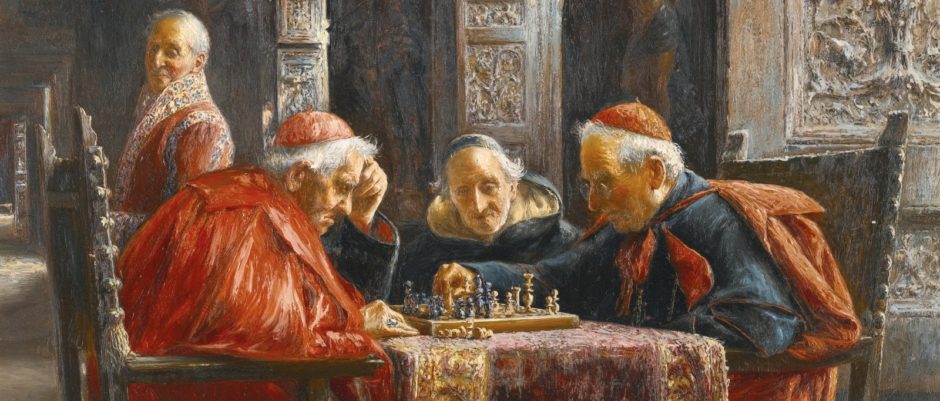
On that last note, I was contacted by a priest friend who is doing some training of exorcists.  He asked me to record in Latin the Chapter 3 of Title XI from the Rituale Romanum, used for exorcisms of infested places, etc.  This is not the exorcism of possessed persons.  That’s Chapter 2.

The rubrics at the beginning of this chapter say:

Sequens exorcismus recitari potest ab Episcopis, nec non a Sacerdotibus, qui ab Ordinariis suis ad id auctoritatem habeant.

The following exorcism can be pronounced by bishops, as well as by priests who have  authorization for this from their Ordinaries.

The Devil and fallen angels hate Latin.  Exorcists will often say that the older rite, from the Rituale Romanum in Latin is more effective.  I have also heard them say that demons mock badly used Latin.   Consider how a soldier drills and drills with his weapon, even stripping it down and reassembling it blindfolded, so that when he uses it, it functions properly and he doesn’t do more harm than good with it.  It is important to get it right.   The higher the stakes and the more potent the weapon, the more important it is to get it right.

This is my little contribution to exorcists so that they can be more effect in the field.

I will make my recordings available to priests, with the understanding that they use them properly and with the support of their Ordinaries.   Remember that “Ordinary” can mean many things in law.  A Vicar General of the Diocese is an “Ordinary”.  The rubric says “Ordinary”, not the Diocesan Bishop.  There are times when there is not diocesan bishop in a diocese, but there are ordinaries.  But I digress.

If you are not a priest or bishop, don’t bother asking for the recording.  Period.  If I get an email that says something like, “I’m not a priest, but…”, I will delete it.  If I get an email saying, “I’m Father’s parish secretary.  Father asked me to write to you because he doesn’t use email”, I’ll delete it.

“But Father! But Father!”, some of you might be complaining.  “I’m not a priest, but I want to hear this!  You have to make this available to everyone! We have RIGHTS, but you hate Vatican II, don’t you.  Give us these recordings NOW!”

No.

“But Father! But Father!”, you persist.  “We’ll complain that you aren’t sharing!  We’ll write nasty letters to your bishop and make incessant phone calls just like certain writer for the Fishwrap!  We’ll….”

I gave my short answer.  Here’s my longer anser.

Nooooooooo.

I made two recordings. I have a recording of

  • Chapter 3 read deliberately, pedantically, with careful pronunciation.  I omit rubrics, which you would not read aloud.
  • that same recording of Chapter 3 slowed down to 0.7 speed.

I did these recordings in mp3 at 128 bits, but I also saved them in 64 bits, slightly lesser quality but also less bulky, easier to send.

Drop me a line: HERE 

Put in the email subject line: LATIN EXORCISM RECORDING [Exactly that, please.]. Tell me who you are and where you are.  Again, bishops and priests only.  

BISHOPS NB: I won’t tell anyone who wrote to me, so if you are not comfortable yet with Latin, your secret is safe with me.  It seems to me that some of you avoid traditional rites in Latin because you don’t want to be seen not to be comfortable with it.  Don’t let that stop you.  Also, if you need to do something in Latin, CONTACT ME and I’ll record it for you, speaking or singing.  Entirely sub stola.

If there is need for Chapter 2, let me know and I’ll see what I can do.

Moderation queue is ON.

PS: Once upon a time I had a bit of a series for priests called PRAYERCAzTs.  I am not averse to reviving it, if there is interest.
Posted in "How To..." - Practical Notes, ASK FATHER Question Box, PRAYERCAzT: What Does The (Latin) Prayer Really Sound L | Tagged
31 Comments

Fundraising idea for #NotreDame

I’ve been chatting with a friend.  Here’s an idea.

Those who are responsible for Notre Dame Cathedral might sell cubes of charred wood and vault from the burned roof.   Say, 1 cm (5 cm for a lot more).   This would give non-billionaires the chance to participate in the restoration.

Of course, the fabric of the building must be fixed before anything else can be done.

Our forebears gave their “widows mites” for the building of the cathedral in the first place.  Why not do it again, from all over the world.

Who would not want a small piece of these ancient and significant timbers?

 

Posted in "How To..." - Practical Notes, ACTION ITEM! | Tagged
25 Comments

VIDEO: Interview with Fr. Jean-Marc Fournier

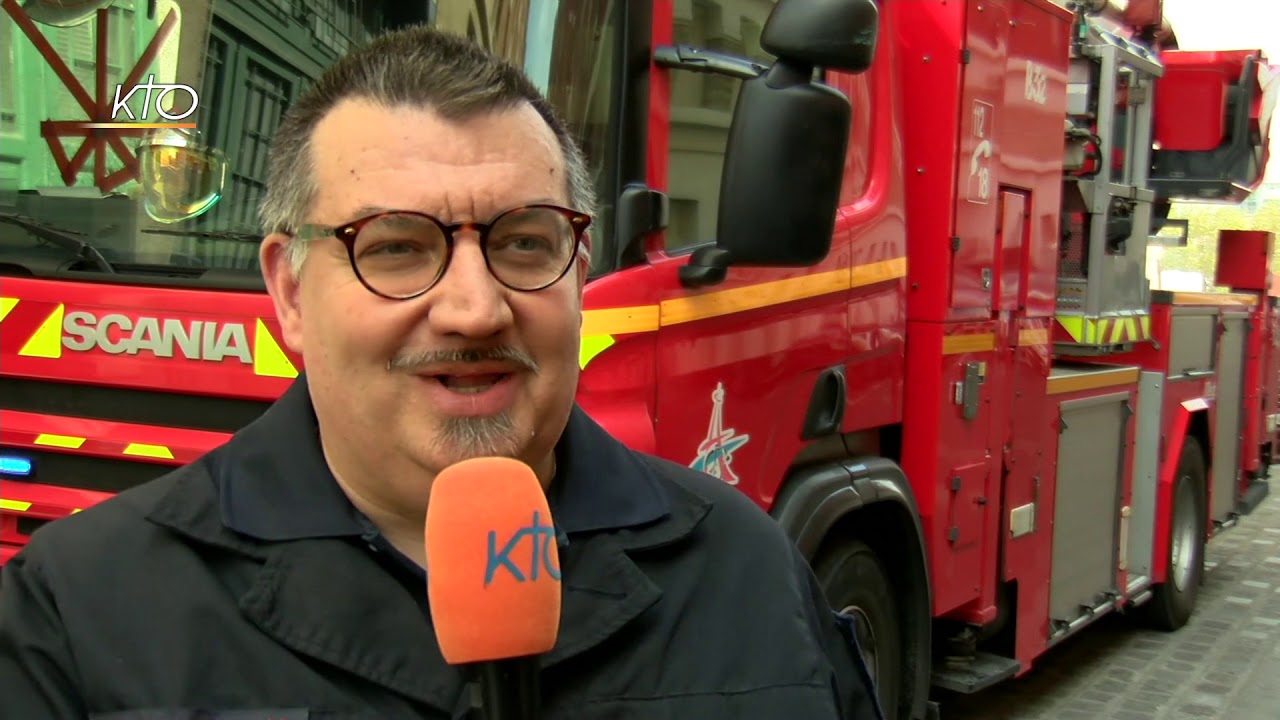
Here is an interview with Fr. Jean-Marc Fournier, the priest military chaplain to the firefighters of Paris.  He was a member of the FSSP.

YouTube thumbnailYouTube icon

Generally accurate translation (by someone out there):

‘I am Father Fournier, chaplain-major at the Paris Fire Brigade and I was the chaplain on duty this 15th of April when an extraordinary fire occurred in the Notre Dame cathedral.

As I was on duty, I was called on the scene, and right away two things must absolutely be done : save this unfathomable treasure that is the crown of thorns, and of course Our Lord present in the Blessed Sacrament.

As I entered the cathedral, there was little smoke and almost no heat, but we had a vision of what hell may be : like waterfalls of fire pouring down from the openings in the roof, due to the downfall not only of the spire but also of other smaller debris in the choir.

I was escorted by a senior officer; the difficulty was in finding the holder of the code to the safe that sheltered the Crown of Thorns. This took us much time, and during this quest for the code a team of firefighters was trying to break open the safe, and they did just as I got a hold of the keys.

The relic was then extracted [from the building] and guarded by police officers.

Everybody understands that the Crown of Thorns is an absolutely unique and extraordinary relic, but the Blessed Sacrament is Our Lord, really present in his body, soul, divinity and humanity and you understand that it is hard to see someone you love perish in the blaze. As firefighters we often see casualties from fire and we know its effects, this is why I sought to preserve above all the real presence of Our Lord Jesus Christ.

[Something about Macron and the fact that there were 400 up to 600 firefighters on scene…]

[Compliments to the general officer commanding the Paris fire brigade who showed exceptional leadership]

The time when the fire attacked the northern bell tower and we started to fear losing it, was exactly the time when I rescued the Blessed Sacrament. And I did not want to simply leave with Jesus: I took the opportunity to perform a Benediction with the Blessed Sacrament.

Here I am completely alone in the cathedral, in the middle of burning debris falling down from the ceiling, I call upon Jesus to help us save His home.

It was probably both this and the excellent general maneuver of the firefighters that led to the stopping of the fire, the ultimate rescuing of the northern tower and subsequently of the other one.

We started Lent by imposing ashes and saying “remember you are dust”, and truly this was a miniature Lent: the Cathedral went to ashes, not to disappear, but to emerge stronger, as we Christians are, after the Resurrection of Our Lord Jesus Christ.’


Posted in Just Too Cool, Mail from priests | Tagged ,
4 Comments

WDTPRS – Spy Wednesday, the last Collect of Lent

Judas Vitrail_Cathédrale_de_MoulinsThe term “Spy” Wednesday is probably an allusion to Christ’s betrayal by Judas.

This prayer was the Collect for this same day in the 1962 Missale Romanum. It was also in the ancient Gregorian Sacramentary in both the Hadrianum and Paduense manuscripts.

COLLECT

Deus, qui pro nobis Filium tuum
crucis patibulum subire voluisti,
ut inimici a nobis expelleres potestatem,
concede nobis famulis tuis,
ut resurrectionis gratiam consequamur.

This is an austere prayer, a razor, cutting to the heart of the matter.

The impressive and informative Lewis & Short Dictionary informs us that patibulum (deriving from pateo, “to open, stretch out, extend”) is “a fork-shaped yoke, placed on the necks of criminals, and to which their hands were tied; also, a fork-shaped gibbet”. In turn, English “gibbet” means “an upright post with a projecting arm for hanging the bodies of executed criminals as a warning”.  The patibulum is “the stretcher”, and not in the carrying sense.

The verb subeo in its basic meaning is “to come or go under any thing” and by logical extension “to subject one’s self to, take upon one’s self an evil; to undergo, submit to, sustain, endure, suffer”. The L&S explains that “The figure taken from stooping under a load, under blows, etc.)” There are other shades of meaning, including “to come on secretly, to advance or approach stealthily, to steal upon, steal into”. Keep this one in mind.

Consequor is very interesting. It signifies “to follow, follow up, press upon, go after, attend, accompany, pursue any person or thing” and then it extends to concepts like “to follow a model, copy, an authority, example, opinion, etc.; to imitate, adopt, obey, etc.” and “to reach, overtake, obtain”. Going beyond even these definitions, there is this: “to become like or equal to a person or thing in any property or quality, to attain, come up to, to equal (cf. adsequor).” I know, I know – mentio non fit expositio. Still it is interesting to make connections in the words, which often have subtle overlaps. Remember that interesting meaning of subeo, above?  There are shades of “pursuit” and “imitation” in the prayer’s vocabulary.

Finally, a gratia is a “favor” or “reward”, but we Christians hear in it God’s freely given gift to us which we don’t on our own merits deserve.

WDTPRS LITERAL TRANSLATION:

O God, who desired Your Son to undergo
on our behalf the yoke of the Cross
so that You might drive away from us the power of the enemy,
grant to us Your servants,
that we may attain the grace of the resurrection.

OBSOLETE ICEL:

Father,
in your plan of salvation
your Son Jesus Christ accepted the cross
and freed us from the power of the enemy.
May we come to share in the glory of his resurrection
.

CURRENT ICEL:

O God, who willed your Son to submit for our sake
to the yoke of the Cross,
so that you might drive from us the power of the enemy,
grant us, your servants, to attain the grace of the resurrection
.

Judas TheLastSupperdetailBy our sins we are in the clutches of the enemy, who mercilessly attacks us.

Christ freed us from dire consequences of slavery to sin by His Passion.

The ancient Romans forced their conquered foes pass under a yoke (iugum), to show that they were now subjugated. Their juridical status changed by that “going under”.

Christ went under the Cross in its carrying and then underwent the Cross in its hideous torments.

In his liberating act of salvation, we passed from the servitude of the enemy to the service of the Lord, not as slaves, but as members of a family.

We are not merely household servants (famuli), we are according the status of children of the master of the house, able to inherit what He already has.


Posted in LENT, Liturgy Science Theatre 3000, WDTPRS | Tagged ,
2 Comments