Liberal Ass. of U.S. Catholic Priests is now pushing for the ordination of women

I read at Church Militant that the renegade, liberal Ass. of U.S. Catholic Priests is now pushing for the ordination of women, first to the diaconate.   This is not going to happen, but the confusion sown by such support warrants correction.

From Church Militant…

AUSCP uses diaconate as stepping stone

The Lepanto Institute has been ringing the alarm bell about the Association of United States Catholic Priests (AUSCP) and its unrelenting push to undermine Catholic teaching for several years now. In the past, we’ve reported on this group for its alliance with sexually deviant organizations and agendas, its work with an international network of heretical organizations, and its call for “priestless parishes.”

The AUSCP’s scandalous work even elicited a warning from its own bishop, Bp. Daniel Thomas, who said that any association with the AUSCP “may be a source of grave concern due to the confusion and scandal they have caused.”

Now the AUSCP is taking action to push for the ordination of women to the permanent diaconate with an eye toward ordination to sacramental priesthood.

In an April newsletter, the AUSCP urged its priest members to visit a website called www.Discerningdeacons.org and participate in a “Discerning Deacons Week of Action,” saying: “Help us launch and spread the good news about the active discernment of our Church about women in diaconal ministry. Our goal is to invite 100 supporters to join us in small daily actions to get the word out.”

[…]

The Ass. is peddling a lie.

Women cannot be ordained to any of the three Holy Orders.

The Sacrament of Orders is one sacrament, not three.  There are not three distinct sacraments for the three ordinations to the tri-partite hierarchy, episcopate, presbyterate, diaconate.  As Ott explains, the Sacrament of Orders imprints a character on the recipient (De fide).  The Sacrament of Orders is in three grades, each of which has its own character, bearing with it a permanent spiritual power.  The bishop receives the power of ordination, the priest receives the power of consecration and absolution.  The deacon receives the power of serving the bishop and the priest at the Eucharistic Sacrifice and of distributing Holy Communion.

The Sacrament of Orders cannot be conferred on women.  Women cannot be ordained to the episcopate.  They cannot be ordained to the priesthood.   The Church teaches infallibly that women cannot be ordained to the priesthood. (Ordinatio sacerdotalis HERE and the CDF’s response to a dubium HERE) The impossibility of ordaining women belongs to the “substance of the sacrament” of Orders (HERE).  If they cannot be ordained to any one of the orders, they cannot be ordained to any of the orders. They cannot be ordained to the priesthood, hence they cannot be ordained to the diaconate.  This is not merely a matter of discipline, it is a matter of irrevocable doctrine.

BTW… Sunday 22 May was the 27th anniversary of Ordinatio sacerdotalis.


Posted in Deaconettes | Tagged , , ,
7 Comments

A Pentecost Monday lesson

It was a terrible mistake to eliminate the Octave of Pentecost in the Novus Ordo.

It could be restored.

REPOSTED:

Years ago I told this Pentecost Monday tale and it has made the rounds.  It has made the rounds everywhere, but I am the origin of the anecdote, which I published years ago in the pages of The Wanderer and also on the now defunct Catholic Online Forum in its Compuserve days.  (Remember Compuserve? I’ve been at this since 1992.) Lots of people have picked it up.

It bears repetition.

This stands as a lesson for what happens when we lose sight of continuity.

Take this for what it may be worth.

Some years ago … gosh, it was decades now… I was told this story by a retired Papal Ceremoniere (Master of Ceremonies) who, according to him, was present at the event about to be recounted.

You probably know that in the traditional Roman liturgical calendar the mighty feast of Pentecost had its own Octave.  Pentecost was/is a grand affair indeed, liturgically speaking.  It has a proper Communicantes and Hanc igitur, an Octave, a Sequence, etc. In some places in the world such as Germany and Austria Pentecost Monday, Whit Monday as the English call it, was a reason to have a civil holiday, as well as a religious observance.

The Novus Ordo went into force with Advent in 1969.

The Monday after Pentecost in 1970, His Holiness Pope Paul VI went to the chapel for Holy Mass. Instead of the red vestments, for the Octave everyone knows follows Pentecost, there were laid out for him vestments of green.

Paul queried the MC assigned for that day, “What on earth are these for?  This is the Octave of Pentecost!  Where are the red vestments?”

Santità,” quoth the MC, “this is now Tempus ‘per annum’.  It is green, now. The Octave of Pentecost was abolished.”

“Green? That cannot be!”, said the Pope, “Who did that?”

“Holiness, you did.”

And Paul VI wept.

….

[And now it’s another thing: HERE]

For more on that era check these PODCAzTs:

093 09-11-16 40 years ago… Paul VI on the eve of the Novus Ordo
094 09-11-20 40 years ago… Paul VI on the eve of the Novus Ordo (Part II)
095 09-11-24 40 years ago… Paul VI on the eve of the Novus Ordo (Part III)

Posted in Linking Back, Liturgy Science Theatre 3000, Save The Liturgy - Save The World | Tagged
6 Comments

WDTPRS: Pentecost Monday – from bondage to freedom, from anxiety to peace

Today is Pentecost Monday, during the Octave of Pentecost.  It is also called Whit Monday, a reference to the white garments of the newly baptized.

We observe the Octave in the Traditional Roman calendar.  It was tragically, ridiculously, foolishly eliminated in the post-Conciliar calendar.

The Roman Station is S. Peter in Chains.

Listen to a PODCAzT for the days of the Octave of Pentecost which I made some years ago.

Octaves are mysterious times during which the liturgical clock stops.

We have an opportunity to rest in the mystery, reflect on it during the 8th day – an echo of God’s rest continuing after the Creation and foreshadowing of the eschatological rest we will have in the Beatific Vision.

For Mass we sing the Pentecost Sequence, and use the Preface of the Holy Spirit, as well as a proper Communicantes and also Hanc igitur, as for Easter since Pentecost was also a time of baptism.

Let’s have a look at the Collect for today’s Mass of Pentecost Monday.

COLLECT (1962MR):

Deus, qui Apostolis tuis Sanctum dedisti Spiritum: concede plebi tuae piae petitionis effectum; ut, quibus dedisti fidem, largiaris et pacem.

I found this prayer in the 8th c. Liber sacramentorum Gellonensis.

I like that elegant splitting of Spiritum Sanctum with dedisti.

Our trusty Lewis & Short reminds us that effectus, us, (efficio) means basically “a doing, effecting; execution, accomplishment, performance; with reference to the result of an action, an operation, effect, tendency, purpose”.  Blaise & Dumas offers that effectus has to do with the “realization of a prayer”.

LITERAL VERSION:

O God, who gave the Holy Spirit to Your Apostles, grant to Your people the realization of their dutiful petition, that you may bestow also peace upon those whom you have given faith.

What immediately jumps into my mind are the references to peace in the ordinary of the Mass and also in the modern form for sacramental absolution.

Allow me to stretch to a connection, in view of the Roman Station.

Christ is our Lord and Liberator.  After His Ascension he sent our Counselor and Comforter.  Our Com-forter, who is our Strengthener.

Together, under the eternal aegis of the Father, the Son and the Spirit bring us from bondage to freedom, anxiety to peace.  We need not fear our judgment.

This is accomplished through the ministry and mediation of the Church.

As a People who are members of Christ’s Body the Church we approach God’s mercy with a sense of filial duty, petitioning both the immediate effect of Christ’s merits and also the long-term effect of heavenly peace.

In the words of the Church’s worship, Christ Himself strikes from our limbs the heavy chains of our oppression.

True oppression is from sin.  True freedom comes from grace.

As we hear today in the Gospel from John 3:

God so loved the world that He gave His only-begotten Son, that those who believe in Him may not perish, but may have life everlasting. For God did not send His Son into the world in order to judge the world, but that the world might be saved through Him.

Posted in Liturgy Science Theatre 3000, WDTPRS | Tagged ,
1 Comment

Daily Rome Shot 167

Posted in SESSIUNCULA |
Comments Off on Daily Rome Shot 167

ASK FATHER: Can I baptize myself?

From a reader…

QUAERITUR:

I know in an emergency someone who is not Catholic can perform a baptism, provided they have the requisite intent, the right words, and water on the head.

Does that mean a person can baptize himself? Can he say, “I baptize me in the name of the Father, and the Son, and the Holy Spirit”?

No. You cannot baptize yourself.

The Church teaches about three different kinds of baptism, by water, by blood (martyrdom), by desire.

Baptism by desire implies an implicit baptism, that would have taken place, had a person – who is sincerely seeking for and living for the Truth – had the chance to be baptized. Such a person would have been baptized had they had the chance, because they would have accepted Christ as God and would have lived according to the Commandments and in the Church He founded. This is what was also thought about catechumens who were committed already but who had not yet been baptized. Cyprian of Carthage (+258) was confident that catechumens martyred before baptism were baptized with another baptism. The Angelic Doctor holds the same in the Summa (III, q. 82. a .2).  St Robert Bellarmine writes of it.  Innocent III based on Augustine’s De baptismo writes of it.

Hence, it is possible to obtain the justification and sanctification which are the effects of baptism through true desire for them.

That doesn’t mean that baptism is not necessary. Some kind of baptism is necessary, by water, by blood or by desire. Baptism is necessary for salvation.

This is one of the reasons why it is cruel not to try by the most charitable and prudent means to bring people to the light of the true Faith and into the Church by baptism.

As Pope Pius XII explained in Mystici Corporis Christi, his encyclical letter on the nature of the Church as the Mystical Body of Christ, and as the Second Vatican Council reaffirmed in its magisterial document Lumen gentium, everyone who tries to do God’s will in the light of what he sincerely believes that will to be possesses already by that very fact, connection with Christ, an imperfect connection, fragile and insecure, but a connection nevertheless, since the very core of God’s will is acceptance of and obedience to His only, begotten Son.

Such an imperfect connection with Christ – what Pope Pius XII called “an implicit baptism of desire” – fragile and insecure as it is, ideally should be reinforced and brought to perfection by a formal and complete membership in Christ’s Church, with full participation in the life of grace.  In the Church alone is the fullness of truth that Christ revealed, a fullness guarded by the Holy Spirit against error and loss. The Holy Spirit, the Spirit of Truth, in accordance with Christ’s promise, dwells within the Church to guide and guard her defense of that truth forever.

Only in the Church of Christ is to be found the full range of resources for healing and strengthening the human soul, the full panoply of the seven sacraments that combine to provide an inexhaustible fountain of forgiveness and grace.

No.  You can’t baptize yourself with water.

If you are concerned about this…. DO SOMETHING ABOUT IT.

And about Pius…

Posted in ASK FATHER Question Box, Liturgy Science Theatre 3000, Our Catholic Identity | Tagged
3 Comments

ASK FATHER: Did John Paul II really say that not to know Latin is “disgraceful”?

From a reader…

QUAERITUR:

Father, on the sidebar of your blog you have a quote from St. John Paul II about it being a disgrace not to know Latin.  First, where does that come from?  Did he really say that?  And, second, I don’t know Latin well. Does that mean I’m partly a disgrace?

Good questions both.

Let’s start with the first.  What did John Paul say?

“Let us realize that this remark of Cicero (Brutus  37, 140) can be in a certain way referred to [young lay people]: ‘It is not so much a matter of distinction to know Latin as it is disgraceful not to know it.'”  – St. John Paul II

If you don’t know Latin, are you a disgrace?  John Paul quotes Cicero in Brutus on the matter, which means that Cicero was talking about his own day.  Today we might say that anyone who does not know English is a disgrace.   Does this literally mean “anyone”?   Cicero’s Brutus is a dialogue work about Roman oratory.   So, already we are narrowing things down to those who ought to be schooled in rhetoric, not the average fishmonger at the docks near the Tiber.

Let’s put this another way.   There are those who are obliged to know certain things pertinent to their trade.  For example, electricians need to know about watts and amps and volts and different types of wire and their uses as well as how to connect things together.  You would hold in contempt an electrician who couldn’t talk to you about amperage.  Consider a Chemistry teacher.  Would you respect a Chemistry teach who hadn’t learned how to describe the table of elements?  How about a surgeon who doesn’t know gross anatomy.

What about a Roman Catholic priest who doesn’t know a) his Latin Rite (because he doesn’t know the Extraordinary Form) and b) Latin (the language of his Rite).

We could extend that to just about anyone in a teaching profession in a serious field such as history, any languages, literature (not “gender studies”, etc.): Latin is fundamental stuff.  It was.  It is.  It shall ever be.

Latin doesn’t only open up new sources of learning, it opens up new pathways of thinking.

Would a housewife be a disgrace without Latin?   She would be immensely improved by it, especially if she has children to educate.

No one is improved by the lack of Latin.

Next question, where did John Paul II write that quote?  In an address to participants in the annual Certamen Vaticanum in 1978, early in his pontificate.  HERE

Let’s read the text together, shall we?  My emphases:

ADDRESS OF HIS HOLINESS JOHN PAUL II
TO PARTICIPANTS IN THE “CERTAMEN VATICANUM”

Monday, 27 November 1978

Our revered Brother and dear Sons, who devote yourselves to cultivating and promoting the Latin language, we willingly greet you individually: our revered Brother Cardinal Pericle Felici, who is known to be an expert in the language of the Romans; the Council and members of the Foundation called “Latinitas”, which was set up with a certain foresight by our predecessor of happy memory Paul VI. Some of these in our Secretariat of State are engaged in drawing up documents in Latin. We greet also the winners of the 21st competition “Certamen Vaticanum”.

We highly praise this “Certamen Vaticanum” which in the past was established with the approval and assistance of Pius XII, since it encourages the study of Latin so that one may deepen one’s knowledge of it and promote its use.

There is no one who is ignorant of the fact that this age is less favourable to the study of Latin, when men today are more interested in science and technology and consider the vernacular to be more expressive. Nevertheless we do not wish to ignore the important documents of our predecessors who time and again emphasised the importance of Latin even in this age, especially in so far as the Church is concerned. For Latin is in a way a universal language cutting across national boundaries and as such the Apostolic See still constantly makes use of it in letters and acts addressed to the whole Catholic family.

One must also point out that the sources of the ecclesiastical disciplines are for the most part written in Latin. But what must be said of the outstanding works of the Fathers and other writers of importance who use this tongue? One ought not to be considered a master of learning who does not understand the language of these writers, but who must rely only on translations, if any exist. These rarely bring out the full meaning of the original text. For this reason the Second Vatican Council rightly advised students of sacred studies that “they should acquire a command of Latin which will enable them to understand and use the source material of so many sciences, and the documents of the Church as well” (Optatam Totius, 13).

We address ourself especially to young men so that in this age in which as is well known the study of Latin literature and of the humanities is neglected, they should readily accept this Latin heritage, as it were, which the Church considers very important, and work hard to make it fruitful. They should realize that this quotation from Cicero applies in a certain sense to them: “It is not … so great a distinction to know Latin as it is a disgrace not to know it” (Brutus, 37,140).

We exhort all of you here present and those who are helping you. to continue this noble work and to hold high the torch of Latin, which is also a bond between men of different tongues, although it is confirmed within narrower limits than it was in times past. Be assured that successor of Saint Peter in the supreme apostolic ministry wishes every success in your efforts, is helping and encouraging you. The Apostolic Blessing which we willingly impart to each and everyone of you in the Lord is a sign of this.

And, of course, it is available in LATIN.  HERE

Latin cuts across physical boundaries and the separation of time.  Since it is now no longer developing, as modern languages do, its stability is a great advantage for conveying clear concepts.

I remind the priestly readers that when giving blessings in the older, traditional manner, you must use Latin of the blessing is invalid (so says the Rituale Romanum).

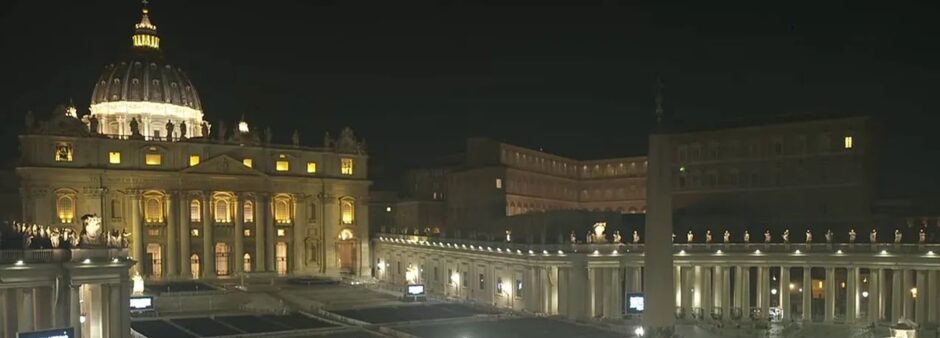
Noverint ii hoc Ciceronis effatum ad se quodam modo referri: “Non… tam praeclarum est scire Latine, quam turpe nescire”.
Posted in Latin | Tagged , ,
5 Comments

Your Sunday Sermon notes – Pentecost 2021

Was there a GOOD point made in the sermon you heard at the Mass for your Sunday (obligation or none), either live or on the internet? Let us know what it was.

Too many people today are without good, strong preaching, to the detriment of all. Share the good stuff.

Also, are your churches opening up? What was attendance like? In a lot of places today the dispensation from Mass attendance was ended, so you were obliged to go.

If you are involved with preparing coffee and donuts after Mass (yes, this is returning) consider using Mystic Monk Coffee.  Use my link. You help the monks, you help yourselves, you help me.  A pretty good deal.

Posted in SESSIUNCULA |
7 Comments

Daily Rome Shot 166

Posted in SESSIUNCULA |
Comments Off on Daily Rome Shot 166

ASK FATHER: Appurtenant pasta for a Pentecost repast – REPOSTED

From a reader…

QUAERITUR:

Since Pentecost is known for tongues as of flame descending upon the faithful, is there an traditional linguini dish often served on this feast day?

Good for you for asking in advance.  As of this writing, Pentecost is some three weeks away.

Firstly, let’s clarify that the plural is linguine, which in Italian means “little tongues”.   You don’t usually see the singular of spaghetti (uno spaghetto) or of linguine (una linguina – “una lingua”).  This is all feminine, so let go of that “liguini”.

Pentecost brings to mind imagery of tongues of fire.   Hence, linguine and some sort of treatment which is spicy hot.

One classic way to use this shaped pasta is linguine all’astice, that is linguine with lobster and/or other mud critters.  Get the live critters if you can.

You have some choices to make.  In Italian astice and aragosta are different animals.  Astice are the “red lobster” and aragosta are “rock lobster”.   You might also try big prawns, gamberi, though you won’t get the color.

You will need a large pan.  They turn a lovely red when cooked.  I’d use lots of pomodorini, little tomatoes.  Lots of garlic and (red) hot pepper, peperoncino.  You could add some thin slices of red bell pepper.  Abundant chopped Italian parsley.   Also, think basics: really good olive oil, white wine for the preparation, pepper, lemons.

Presentation: split all the parts, including the claws, before you plate it.  It might be good to make one great platter to serve family style.

Wine: Falanghina… Greco di Tuffo… Vernaccia…. Gavi dei Gavi La Scolca… (black label)

Variant: use saffron


Posted in Fr. Z's Kitchen | Tagged
6 Comments

Daily Rome Shot 165

Posted in SESSIUNCULA |
Comments Off on Daily Rome Shot 165























