Inquisition at the Liturgy Congregation?

According to La Nuova Bussola, on 15 March an investigation (“Visita Apostilica”) of the Congregation for Divine Worship will begin.

The writer says that the man appointed for the investigation, head of the bishops conference liturgy office, leans liberal and may have been accused of covering up some problem with a priest.

He is clearly favored by Francis. Sarah is clearly associated closely with Benedict XVI and his liturgical vision.

The visitation is odd, since this is a dicastery of the Curia, not a diocese, seminary or religious institute. I don’t remember anything like this.

The article brings up the fact that, recently, Card. Sarah’s (routine) resignation was at last accepted without a successor being appointed. Arch.

It also points to the recent suppression of individual Masses in San Pietro and the de facto marginalization of the TLM. These are two things that one can easily imagine Card. Sarah strenuously opposed.

NB: We must not jump to conclusions, however it strikes me that there could be a parallel here to what some want to happen to anyone who worked in the Trump administration or who supported him: Get ’em! Cancel ’em! Investigate and ruin ’em! Make sure they’ll never work again!

That’s how they roll.

Posted in I'm just askin'..., Liberals, Liturgy Science Theatre 3000, SESSIUNCULA, The Drill |
5 Comments

Post-Brexit, Europe needs a new official language. If only there were one that stood for historic European unity….

A priest friend sent this.  From TRTWorld.com with some emphases and comments.

French call to replace English with Latin as Europe’s official language

Met with scorn for now, the sentiment against English language is moving from the fringes to mainstream politics.

An anti-English movement is brewing in France. Clement Beaune, French Minister for European Affairs led a campaign for “European linguistic diversity” last month, where he emphasized the lack of need for English after Brexit.

“Let’s get used to speaking our languages again,” he said.  [Maybe someone in the CHURCH will read this.]

Faced with fierce critics, even domestically, Frexit advocate Francois Asselineau criticized the minister for failing to understand France’s position within the EU.  [What about Uscitalia?]

“To believe that French would once again become the first language in Europe after Brexit is not to understand that the EU is a geopolitical unit under the domination of the USA and NATO for 75 years,” writes Asselineau.

But many were on the sidelines of this debate, or found the idea even a little enticing, Asselineau one of them.

“To give the French language its full place in the world, France must regain an independent diplomacy from the USA, redirect its cooperation of all kinds towards Africa, Russia, Asia, and Latin America, and strengthen its industry, research, defence, and education,” he adds. [Yeahhh…. that’s going to happen.]

The minister was joined by French right-wing commentator Eric Zemmour, who called for a post-Brexit boycott of English, which he believes has “crushed” French.

[…]

More recently, an article published in Le Figaro magazine makes the case that English should be done away within the EU, if not for French, then oddly enough, for Latin.

This is rooted in the struggle faced by non-native speakers of English, who claim that it gives native speakers an unfair advantage and hold over them.

[…]

The Le Figaro article, penned by Sundar Ramanadane, claims Europe’s divorce from the English is complete, and says the feeling that French should be Europe’s lingua franca is hardly unique, pointing to articles by Germans that asks whether German should be the EU’s foremost language.

But for Ramandane, Latin is ideal. How does one revive an ancient, largely dead language? The case of Israel’s revival of Modern Hebrew is used as proof that it’s possible.

This is perceived as crucial and necessary if Europe will ever fulfil its dream of becoming more than a common market. The issue is an identity based on a common language and past, and this can never materialize in the status quo, he says.

Latin, he argues, is a natural choice. This is particularly given that every shared historical political experience in Europe leads back to Latin. From the Roman Empire and Christianity, to the Renaissance and Enlightenment, Latin was present throughout it all.  [And it still is.]

It’s not lacking for culture either, says Ramandane, used through nearly 2000 years of history as the only common link between European minds, leaders and scholars. He goes on to argue that it’s no stranger to modern languages, having shaped them deeply.

More importantly, he argues, Latin is well-suited to politics. In fact, some of the greatest orators and legal experts spoke in Latin, and one that will make it possible to train political leaders and civil servants in rhetoric and logic, much like ancient Greece and Rome.

The biggest reason of all would be symbolic unity. A single language could unify Europe and let it evolve into the next great political union, rather than a loose scattering of states brought together by shared financial interests.

Unmentioned by the writer, Latin was actually the primary language of Europe until it was killed off by renaissance scholars who complained that Modern Latin was nowhere near the strength of classical Latin. Their efforts saw the language relegated to museums and the study of ancient classics, as it changed into the modern romantic languages of today.  [It was killed off the THE CATHOLIC CHURCH against the clear will of an Apostolic Constitution Veterum sapientiae.]

Drivers of nationalism also believed in the development of alternative languages to English, which gave to the nation-state’s identity.

The idea that Latin also teaches better rhetoric is debunked by many, who argue that Latin doesn’t hold a monopoly on logic.

Another reason Latin went extinct was because of how difficult and complex it is. [B as in B. S as in S.  Or rather T ut T et S ut S.] The language is by design, highly affected by vocal inflexion. That means nearly every spoken word can be modified based on context, voice, mood, person, number, gender, tense, and delivery. With no central authority governing what was  authentic Latin, it quickly fell out of everyday usage.  [There are all sorts of languages harder than Latin.  This is gross ignorance.  As my old mentor in Latin use to say, and he would also say it in Latin, even the cats, dogs and hookers in Rome spoke Latin.]

While Europe does lack a uniform language, Latin critics argue, is not any better suited to its needs than English and is difficult to learn for all Europeans.

I like it.

Posted in Just Too Cool, Latin | Tagged , ,
13 Comments

Card. Burke reacts to the St. Peter’s Mass Suppression: rescind it immediately

UPDATE:

Card. Burke’s statement can be read at his page: HERE


At the National Catholic Register (which is a Catholic paper and not to be confused with the Fishwrap), there is a piece by Ed Pentin about Raymond Leo Card. Burke’s reaction to the move to suppress individual priests’ Masses in the Vatican Basilica and force priests to concelebrate, as well as marginalizing the growing number of priests saying the Traditional Latin Mass.  The horrid order issued 12 March goes into effect on 22 March.

Card. Burke in one the Church’s eminent canonists.  He is the former head of the Church’s supreme court, the Apostolic Signatura.

Burke says that the suppression should be rescinded because it violates the Church’s universal law.   Firstly, there is no protocol number, which I noted in my original post, and there is no signature.  Burke also points out that the Secretariat of State, which issued the decree, is not the competent dicastery for the liturgical life of the Basilica.  Also the decree was not directed to the man in charge of the Basilica, the Archpriest, but rather to the Fabbrica which maintains the structure.

However strange the decree was, which prompted some to think it was fake, it wound up on the door of the sacristy of the Basilica, thus showing that someone means business.

Burke also noted that the decree was a violation of Can. 902:

Can. 902 Unless the benefit of Christ’s faithful requires or suggests otherwise, priests may concelebrate the Eucharist; they are, however, fully entitled to celebrate the Eucharist individually, but not while a celebration is taking place in the same church or oratory.

He also notes the point in SC 57, which I mentioned in my original post. The Fathers of the Second Vatican Council wrote in the Constitution on the Sacred Liturgy, Sacrosanctum Concilium, 57, §2: “Nevertheless, each priest shall always retain his right to celebrate Mass individually…”.

Burke underscores that according to Summorum Pontificum a priest in good standing does not need “authorization” to use the 1962 Missale Romanum. This bad decree says that “authorized” priests may say the TLM, only in the Clementine Chapel, at certain times… which I assume they would have to share with priests who want to say the Novus Ordo.

Card. Burke makes a good point about the weasel words at the top of the decree, the excuse given for the draconian suppression: to foster an “atmosphere of recollection and liturgical decorum”… as if that wasn’t already the case in the Basilica with the individual Masses at the different altars. Yeah, even once in a while there would be some visiting priest who, not being used to say Mass near other priests saying Mass, would get a little too loud, but that was not usually the case. I said Mass in the Basilica for many years, for a long while at the same time when then Msgr. Burke and other American priests were also saying Mass there. We know what we are talking about.

The Pentin article states that “this is a change some in the Vatican have been pushing for many years, going back to when Cardinal Virgilio Noè was archpriest of the basilica from 1991 to 2002.” And, yes, I can confirm that this is much like those days. I was ordained in 1991 and I started saying the TLM right away. They bullied me in the sacristy and harassed me, but they couldn’t really do much of anything to me: I reported them to Card. Mayer, the President of the Pontifical Commission “Ecclesia Dei” and they eventually left me alone, though they were frosty. Eventually sacristans changed and time passed and things eased up.

It will be interesting to see what happens from all of this.

One thing is certain: there is still a lot of hatred for the Traditional Latin Mass among those in power. But the clock is ticking on them, just as it is on everyone else. Eventually, they will be replaced. And among their future successors are a lot of priests who respect and venerate the Traditional Mass and celebrate with the older Missale. This recent attack is going to galvanize men in their determination to defend Tradition for the sake of the good of the Church.

Posted in ¡Hagan lío!, Liberals, Liturgy Science Theatre 3000, Pò sì jiù, Save The Liturgy - Save The World, Si vis pacem para bellum!, SUMMORUM PONTIFICUM, The Coming Storm, The Drill, The future and our choices | Tagged , , , , ,
17 Comments

Daily Rome Shot 101

Photo by Bree Dail.

Posted in SESSIUNCULA | Tagged
1 Comment

ASK FATHER: Must I go to a Novus Ordo Mass and receive on the hand to fulfill my “Easter Duty”?

From a reader…

QUAERITUR:

Our churches in the Diocese of ___  have been allowed to have public Masses offered with 15% capacity of the fire code regulations, but with very strict restrictions from the bishop (more strict than the government’s restrictions).

This Sunday marks the one year anniversary of public Masses being suppressed, and thus the one year mark of our Latin Mass Community being able to receive communion. While we can attend Mass now (except we can’t have a Triduum with the current restrictions since we need altar servers ), we still can’t receive communion because the bishop has banned communion on the tongue…. Even the government has now given directives on how to safely distribute communion on the tongue, but it’s still banned and our priest’s attempts to contact the bishop about this go unresponded to.

With Easter just around the corner, thus the requirement to receive communion once during the Easter season, since it’s possible to receive communion by going to one of the OF Masses and receiving in the hand, does this mean that Catholics who normally attend Mass in the EF are canonically bound to receive communion in the hand at a Mass in the OF to fulfill the precept and stay out of mortal sin?

Two canons in the 1983 Code of Canon Law deal with the obligation to make a good confession and to receive Communion.

can. 920 §1. After being initiated into the Most Holy Eucharist, each of the faithful is obliged to receive holy communion at least once a year.
§2. This precept must be fulfilled during the Easter season unless it is fulfilled for a just cause at another time during the year.

can. 989 After having reached the age of discretion, each member of the faithful is obliged to confess faithfully his or her grave sins at least once a year.

Catholics are obliged to receive Communion at least once a year.  They are not obliged by law to receive more often.    It is NOT obligatory to receive Communion at all Masses.  It is obligatory to do so once a year.  That will usually require making a good sacramental confession beforehand (can. 989 – “once a year”).  One would not want to receive Communion in the state of mortal sin, so the annual Communion will normally be preceded by annual confession.

It is in general NOT GOOD for people to go to confession only once a year.  As a matter of fact, it is in general stupid not go to confession more often.  A daily examination of conscience is the key to discerning how often one should go.

Can. 920 says that this annual Communion is to be received during the “Easter season”.   Easter Season lasts from Easter until Pentecost.

Moreover, take note of that “for a just cause at another time during the year”.

Easter Season is fitting and customary and mentioned in the canon.  However, you can fulfill your obligation at another time of the year for a “just cause”.

It may be that your local bishop has issued addition local legislation about this.

You have a just cause right now.  The lockdown orders during time of pandemic have made it virtually impossible for people to attend Mass at all, much less receive Eucharistic Communion, or receive in a way that is important to them.

There are a couple of principles in law which help us understand our obligations.

First,  ultra posse nemo obligatur… no one is obliged to act beyond his powers.  Put another way, nemo ad impossibilia tenetur… no one is held to the impossible.

If there is no Mass to attend, or if there is no way to make a confession or to receive Eucharistic Communion, then there is not obligation.   You can’t go to Masses that are not available.  You can’t receive Communion when it is not being distributed.   No one is obliged to the impossible.

It seems to me that it is between you and your confessor to determine whether you should or must go to a Novus Ordo Mass and receive in on the hand.  The law permits you to receive in the hand, even though it is a wretched practice that should be phased out.  You are free to attend Novus Ordo Masses and receive Communion or not.   You are obliged to receive Communion once a year, and that can be done, for a just cause, at another time of the year.  We have to interpret the law as favorably for you as we can when it comes to that “just cause” issue.   If you honestly conclude that attending a Novus Ordo Mass and the prospect of reception in the hand, even seeing reception in the hand, is perhaps morally impossible or strongly sub-optimal, or an occasion for irreverent distraction or sin for you (or someone with you), then you probably have a just cause.

Remember what you recite in your Act of Faith: “I believe these and all the truths which the Holy Catholic Church teaches, because Thou hast revealed them, Who canst neither deceive nor be deceived.”

We can’t fool God.

Work this out with the advice of your confessor, the text of the canons, self-knowledge and the application of good common sense.

Let’s pray that all of this upheaval passes while we are in the Easter season.

I invite everyone reading this to pray my prayer asking God for a miracle: the total, sudden, and lasting elimination of the Coronavirus.

HERE

And GO TO CONFESSION!

UPDATE:

A correspondent noted to me that the canon does not say anything about the obligation to receive annual or “Easter Duty” Communion during Mass.  It would be possible to fulfill the obligation by reception of Communion outside of Mass.  That, perhaps, can be arranged with a helpful priest: confession and Communion.

Posted in "How To..." - Practical Notes, ASK FATHER Question Box, Canon Law, GO TO CONFESSION, Our Catholic Identity | Tagged , , , ,
18 Comments

Wherein doubt about the St. Peter’s Mass Suppression Decree is suppressed

Yesterday news broke about a decree from the Vatican’s Secretariate of State which suppresses individual Masses by priests in the Vatican Basilica and grossly restricts the location for the Traditional Latin Mass to the Clementine Chapel.  I wrote on it HERE.

The images of the decree that circulated are odd, because there is no protocol number or full signature from the “Affari Generali” section.

Some raised the question of the genuine nature of the decree.

A friend of mine sent me this photo from Rome today.  I guess that pretty much does it.

UPDATE: It seems that this was originally somewhere on Fakebook, but I don’t know who posted it.  It got it in a text message.

And…

RESTORE THE 54!

Posted in B as in B. S as in S. | Tagged
7 Comments

St. Peter’s Basilica – Individual morning Masses SUPPRESSED

UPDATE:

A couple curious things.  There is no full signature.  There is no protocol number.

And, as an email correspondent pointed out, Vatican II’s Constitution on the Sacred Liturgy, Sacrosanctum Concilium, 57, §2 reads, “Nevertheless, each priest shall always retain his right to celebrate Mass individually…”.

UPDATE:


For years I said my daily Mass each morning in the Basilica of St. Peter. I was there as a regular for so long that I had my own niche, a locked cabinet with my own chalice, alb, amice, books, etc. It was helpful, because we didn’t have to wait for some priest to return from saying Mass. The sisters who cared for the sacristy took care of our gear.  I shared my niche with the late Fr. Goswin Habets, a good friend, may he rest in peace.

There was something, especially among the old timers and more traditional priests of the perennial clerical etiquette one observes in passing each other on the way to or coming back from the altar. Not just in theory, but in living practice.

Many were the mornings when, accompanied by one of the altar boys from the minor seminary, we’d walk across the nave and there would not be another person in sight, like being alone in the basilica. Sometimes individuals or groups would wait outside the sacristy for priests to follow to an altar for Mass. Sometimes they would ask about the language the priest would use. “Latino” always picked up a few.  But people would usually have the chance to follow a priest about to celebrate in French or Spanish or German or Italian or English, etc.

For decades thousands upon thousands of resident priests and student priests and curial priests and pilgrim priests said their Masses at the many altars of the Basilica.

That’s gone. Suppressed to force priests to concelebrate, which is absolutely APPALLING.

What does that letter say?

To the Most Excellent Extraordinary Commissioner of the Fabbrica di San Pietro
To the Canons of the Vatican Chapter
To the Service Team of Liturgical Celebrations of the Basilica

The time of Lent invite us to return to the Lord with all our heart (cf John 2:12), giving great centrality to hearing the Word of God and to the Eucharistic celebration.  In such a sense, desiring to assure that Holy Masses in the Basilica of St. Peter are carried out in a climate of reflection and liturgical decorum, from now on the following is ordered:

  1. individual celebrations (of Mass) are suppressed;
  2. priests and faithful who hasten daily to the Basilica for Holy Mass have the possibility to participate at the following celebrations: 7:00 in the Chapel of the Choir, 7:30 at the Altar of the Cathedra, 8:00 in the Chapel of the Choir, 9:00 at the Altar of the Cathedra.  The schedule of the other Holy Masses remains unchanged.  On the occasion of a memorial of a Saint whose remains are kept in the Basilica, one of the Holy Masses can be celebrated at the respective altars.  On Sundays and Solemnities, the appropriateness of maintaining the schedule will be evaluated.
  3. Concelebrations will be liturgical animated with the assistance of lectors and cantors;
  4. for groups of pilgrims accompanied by a bishop or priest there will be assured the possibility of celebrating Holy Mass in the Vatican grottos (the crypt);
  5. Concerning the extraordinary rite, authorized priests can celebrate at 7:00, 7:30, 8:00 and 9:00 in the Clementine Chapel in the Vatican grottos.

The present arrangement will go into effect on 22 March of this year, Monday of the 5th week of Lent.

From the Vatican, 12 March 2021

What does the letter really say?

Firstly, remember that the old Archpriest of the Basilica, Card. Comastri, was recently replaced with a Franciscan, Card. Gambetti, OFMConv.   It is not entirely out of the question that this Cardinal brings with him certain liturgical proclivities peculiar to his order, such as the practice of daily concelebration in their houses rather than individual Masses.   That’s normal for him, perhaps, and, therefore, by gum, it’s gonna be the new normal in the Basilica too.   The Letter comes from the Secretariat of State, but it happened because the new guy wanted it this way.  And was only appointed on 20 February, less than a month ago.

Also, for the Novus Ordo Masses, there will be lectors and cantors and you can bet your bottom Euro they will all be lay people and mostly women.   And everything will be in Italian.

Ever since the Council there has risen and subsided in waves a kind of mania about concelebration.   For years priests were pretty much forced to concelebrate.  Then it subsided for a while (Benedict factor?).  It seems to be back.  That’s not good.  Concelebration should be safe, legal and rare, in my opinion, for the good of the priest himself.

One of the interesting things about those mornings at the Basilica were the other Catholic Rites you would see.   Eastern priests of varying Churches were often present, celebrating in their way.

The TLM, Extraordinary Form was on the rise in the Basilica.  I used to say the traditional Mass in the Basilica, lo those many years ago, and a few of the sacristy goons, now visible in basilica ceremonies, detested me for it, but they really couldn’t do anything to me.  Others managed to creep around to do it, but back in the time when Noè was Archpriest, he would send the sanpietrini, basilica workers, around like secret police to spy on priests to make sure that no one got out of line.  Those were the days when the Roman vestments disappeared from the sacristy and the nasty polyester chasubles were foisted on everyone, often without color choice for a votive Mass, etc.   Eventually things loosened up a bit, after Noè.  Then came Summorum Pontificum and there was a new ball game.

These new provisions ironically drive the TLM literally underground.  The handful of dirt being thrown in the direction of the priests who desire the older, traditional ROMAN Mass is that the Cappella Clementina was set aside.  This is the tiny chapel directly under the main altar of the basilica. It is up again the wall of Peter’s tomb.  It is where I said my First Mass.  Usually you would have to reserve the altar long in advance.   This is where the Extraordinary Form will be. What about those guys who want to use that chapel but who say the Ordinary Form?   My guess is that the Ordinary Form will be permitted there and if there isn’t a spot open on the reservation schedule, Fr. TLM is out of luck.  And he won’t be permitted to say Mass elsewhere in the vast basilica or crypt with is many altars.   He will be “unauthorized”.

If you are of an Eastern Church, I guess you are out of luck.  I didn’t see any provisions for them, unless maybe they come in a group.

What does “authorized priests” mean anyway? Authorized in the sense that they reserved a time slot in the Clementine Chapel?  Authorized by…. the sacristan?   Authorized by …?  I suspect that this means that priests of the SSPX who have gone to the Basilica for Mass will no longer be permitted.

This is not a good development.  Forcing uniformity is not a good thing.

Anecdote: One morning I was heading back to the sacristy from the other side of the Basilica, the far transept, and one of the basilica workers confronted me saying that I wasn’t suppose to say Mass in Latin because “people might be confused by something so different”.  Just at that moment, at a nearby altar, a Syro-Malabar (I think) priest in hot pink chiffon and gold lame, waving a cloth, exited through the gate at his altar, walked about for bit with the cloth, and then returned to his altar.   I continued, untroubled, on my way to the sacristy.

This is one more concrete sign that Catholics who desire tradition are the single most systematically marginalized group in the Church.

And lastly… I would ask the new Archpriest of the Basilica…

WHAT ARE THOSE ALTARS FOR?

I was in the Basilica the morning the sanpietrini, at the orders of Card. Noe, tore out the REAL altar of the Chair, under Bernini’s masterpiece in bronze.  They didn’t get their work done in the night and some of them were posted to forbid photos.  They TORE OUT the Altar of the Chair, which was a theological sign of the unity of the teaching office of Peter with the Sacrifice of Calvary.

Will they now start tearing out the unused daily Mass altars?

The letter.
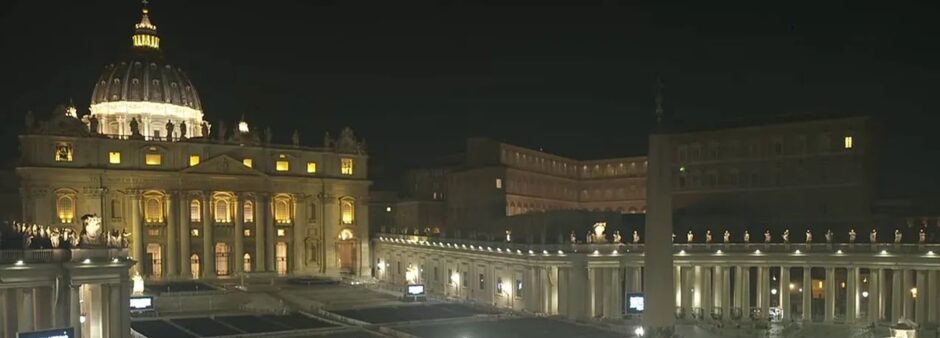


Posted in Liberals, Liturgy Science Theatre 3000, Pò sì jiù, The Coming Storm, The Drill, The future and our choices | Tagged ,
33 Comments

Daily Rome Shot 100

Photo by Bree Dail.

Posted in SESSIUNCULA | Tagged
2 Comments

Fr. Z’s Kitchen: Lenten Lentils

My post about Benedictines making wine (France) and beer (Italy) reminded me that I once posted a great Lenten recipe for lentils.  I recall that there was some controversy about the use of chicken stock.

I made the lentils last year (I had to improvise a little) and they were really good.  I’ll give it another try tomorrow.  The excess freezes well.

Here’s the recipe from the monks at Norcia, which they sent out in their newsletter.

St. Benedict’s Lenten Lentils

Serves 4-6 People

INGREDIENTS
Olive oil
1 minced carrot
1 rib of minced celery
1 minced white onion
4 minced garlic cloves
17.6 oz (500g) of small brown lentils -Italian or Umbrian if possible (Lenticchie di Castellucio)
5 1/4 cups of vegetable or chicken stock
1 bay leaf
1/2 of a 28 oz can of peeled, whole Italian tomatoes (diced)
Salt

PREPARATION
1. Sauté the minced carrot, celery, onion and garlic in olive oil for 10 minutes.
2. Add stock, lentils, bay leaf; bring to a boil and then simmer gently for 20 minutes, stirring occasionally.
3. Add diced tomatoes and salt to taste, continue cooking for at least 15 more minutes, until lentils are tender and have slightly thickened.
4. Remove the lentils from the heat source and let them sit covered for 10 minutes (this will help thicken them).
5. Serve drizzled with olive oil and accompanied by toasted bread.

Posted in Fr. Z's Kitchen, Lighter fare, Linking Back | Tagged
9 Comments

JUST TOO COOL: 700 year old papal vineyard in France revived by Benedictine Monks

I occasionally post about the wonderful, traditional Benedictine monks and nuns of Le Barroux in Provence.  Their monasteries are little slices of paradise.   You can hear live online or on demand the men chanting the liturgical hours HERE.

I saw a piece at the National Catholic Register, that they have rehabilitated the Avignon Pope Clement V’s papal vineyard.   This wine, the article says, “was particularly appreciated by his successor, Pope John XXII, who continued to serve it to its most distinguished guests.”  As you might recall, John XXII dodged being a heretic by hair’s breadth.  After WWI the land was worked again and in the 70’s the wine obtain the status of “AOC Ventoux”.  Then the monks built their monastery nearby in 1986.  They’ve teamed up with their neighbors in the production of Via Caritatis grand cru wines since 2016.

They’ve recently been allowed to export to these USA!  (Must get some.)

Have a look at the piece at NCReg (not Fishwrap!).  There are good photos.

And… there is a link to an order form!

Remember, too, that the Benedictines of Norcia, Italy, are making great beer.  They have a beer club to which you can subscribe.

The monks reached out to me and said that for every FIVE new Club members who sign up and reference “Father Z” in the “Notes about your Order” line, I will get a free case! I share it with my friends.  Everyone likes it.  With savory sausages and cheeses it simply can’t be beat.   Lent won’t last forever.  Order some now.

CLICK!


Posted in Just Too Cool, Lighter fare, Our Catholic Identity | Tagged ,
1 Comment
























