
 Years ago, I was – for my sins – sent by the pastor of the parish to attend a Thanksgiving Day “ecumenical” breakfast. When I entered the place, a young man in clerical cloths and a tag identifying himself as the pastor of the area’s Missouri Synod Lutheran Church made a bee line at me and asked,
“Are you the priest at St. Raphael’s who tells non-Catholics that they shouldn’t receive Communion at your church?”
“Yes, indeed I am!”, I said.
To which he responded, “Thank you! Some priests don’t get that we Lutherans don’t all have Communion with each other, much less with Catholics.”
We sat together and had a great conversation.
Ecumenical encounters should be based on clarity and honesty.
However, when we ourselves drop the ball as Catholics and go to the zoo on basic issues, we sow confusion not only in our own ranks, but among non-Catholics as well.
That’s scandalous.
Today I read a piece by a Lutheran pastor on his blog, Pastoral Meanderings, who cited a piece at First Things by a good friend of mine, a German priest, about how the Germans are going to the zoo about inter-Communion. This Lutheran pastor offers a steaming hot cup of reality.
The Lutheran schools the German Catholic bishops about Communion.
Let’s see what he has to say with my usual emphases and comments:
Ya’ll Come. . . or maybe ihr kommt. . .
In an article by Msgr. Hans Feichtinger over at First Things, the German bishops have announced that they will soon publish new guidelines for reception of the Holy Eucharist. In the future, non-Catholics married to Catholic spouses and attending Mass with their families could, in certain cases, be admitted to communion if they profess the Catholic faith in that sacrament. By this the Roman Catholics (at least some of the ones in Germany) are doing two things that have become super problematic for us in the Missouri Synod. [NB] They have individualized belief AND made belief in the Real Presence the prerequisite for receiving the Sacrament. Both of these have made close(d) communion one giant hassle for those in the LCMS and now the German Roman Catholic bishops seem intent upon following the same playbook.
The problem with this is that the faith is not one person wide and one person deep. It is the faith that transcends the ages, confessed in time in creed, and defined by doctrine held in common. Our faith is not a “me’n’Jesus” faith but a communion of saints, transcended in time and expanded in space. The marks of the Church are not individual piety but the Means of Grace. Where the Word and Sacraments are, the Church is there and the Church exists where the Means of Grace are. Through the waters of baptism, one becomes joined to the many because they are united with Christ (and through Christ to all who share this new birth of water and the Word). Sure, there are irregular situations in which one may rightly believe, having heard the Word in which the Spirit is at work, but not yet be baptized AND there may be those who are baptized who have refused the Spirit and do not believe, but these are not normative. And the baptized, who join in common confession of what it is that they believe, confess, and teach, are gathered also around the Table of the Lord.
[Watch this…] The other problem with this is that the Catholic faith in the Sacrament (the Real Presence and ???) cannot be isolated out of the whole of what is believed, confessed, and taught in such manner that those who do so, despite other differences, are united enough, at least, to eat together the flesh and blood of Christ. The bishops are not promoting irresponsible inter-communion. [I don’t know about that!] No, they certainly would suggest that pastors (stewards of the mysteries) should make a reasonable effort to discern in each individual case whether their admission as a non-Catholic to communion would be permissible. According to these bishops, those who would desire to receive Holy Communion must profess the Catholic faith in the Eucharist. How odd, however, since that Catholic profession, at least until now, pretty much said that no non-Catholic may receive communion in a Roman Catholic Church. In order for them to receive Holy Communion as a non-Catholic, it would be required that they at least belong to a church in which all sacraments are considered such and valid (the list is not long here), and that one must be in the state of grace, which in normal parlance means going to confession once in a while (sooner rather than better [sic… later?] is also better). [The Catholic Faith is entirely interconnected. Pull on one thread and you loosen the entire thing.]
Ahhhh, the problems of trying to be ecumenical! No one wants to be an inhospitable host — not even to people who disagree with your faith and may, in other circumstances, wish a pox upon your house. So most churches have given up. Faith is one person wide and one person deep. As long as you believe Jesus is somewhere in the room, it is enough to chomp down with us. It is so terrible mundane. It makes Jesus and His meal so ordinary. It makes it seem as if it is no big deal — not what you believe nor what you eat!!! It is just appearances. And if it is just that, then why bother — to hell with it (one of my favorite Flannery O’Connor quotes). [Do I hear an “Amen!”?] If welcoming those who do not share the faith or who have not been examined and absolved and can receive rightly the gift is preferred over being true to what the Sacrament is, then O’Connor is correct. To hell with it. But that is what the German Roman Catholic bishops and some within the LCMS (one of the few remaining non-Roman churches to retain a semblance of close(d) communion seem to want to make it — nothing all that important at all.
If it’s just a symbol, to hell with it.
Fr. Z kudos to this Lutheran pastor. If we ever meet, friend, I’ll buy you a beer.
When I see what is going on with Communion in some places and circles these days, I wonder if the people – at least the bishops and priests – there belong to the same Church and religion that I do.
In so many places Communion has been reduced to a sign that you are okay just as you are. It’s the moment when they put the white thing in your hand and you feel good about yourself and then you sing a song together.
It’s liquid church for liquid society.
I say, “NO!” Furthermore, I say:
I firmly embrace and accept each and every definition that has been set forth and declared by the unerring teaching authority of the Church, especially those principal truths which are directly opposed to the errors of this day.
And first of all, I profess that God, the origin and end of all things, can be known with certainty by the natural light of reason from the created world (see Rom. 1:90), that is, from the visible works of creation, as a cause from its effects, and that, therefore, his existence can also be demonstrated:
Secondly, I accept and acknowledge the external proofs of revelation, that is, divine acts and especially miracles and prophecies as the surest signs of the divine origin of the Christian religion and I hold that these same proofs are well adapted to the understanding of all eras and all men, even of this time.
Thirdly, I believe with equally firm faith that the Church, the guardian and teacher of the revealed word, was personally instituted by the real and historical Christ when he lived among us, and that the Church was built upon Peter, the prince of the apostolic hierarchy, and his successors for the duration of time.
Fourthly, I sincerely hold that the doctrine of faith was handed down to us from the apostles through the orthodox Fathers in exactly the same meaning and always in the same purport. Therefore, I entirely reject the heretical misrepresentation that dogmas evolve and change from one meaning to another different from the one which the Church held previously. I also condemn every error according to which, in place of the divine deposit which has been given to the spouse of Christ to be carefully guarded by her, there is put a philosophical figment or product of a human conscience that has gradually been developed by human effort and will continue to develop indefinitely.
Fifthly, I hold with certainty and sincerely confess that faith is not a blind sentiment of religion welling up from the depths of the subconscious under the impulse of the heart and the motion of a will trained to morality; but faith is a genuine assent of the intellect to truth received by hearing from an external source. By this assent, because of the authority of the supremely truthful God, we believe to be true that which has been revealed and attested to by a personal God, our Creator and Lord.
Furthermore, with due reverence, I submit and adhere with my whole heart to the condemnations, declarations, and all the prescripts contained in the encyclical Pascendi and in the decree Lamentabili, especially those concerning what is known as the history of dogmas. I also reject the error of those who say that the faith held by the Church can contradict history, and that Catholic dogmas, in the sense in which they are now understood, are irreconcilable with a more realistic view of the origins of the Christian religion. I also condemn and reject the opinion of those who say that a well-educated Christian assumes a dual personality—that of a believer and at the same time of a historian, as if it were permissible for a historian to hold things that contradict the faith of the believer, or to establish premises which, provided there be no direct denial of dogmas, would lead to the conclusion that dogmas are either false or doubtful. Likewise, I reject that method of judging and interpreting Sacred Scripture which, departing from the tradition of the Church, the analogy of faith, and the norms of the Apostolic See, embraces the misrepresentations of the rationalists and with no prudence or restraint adopts textual criticism as the one and supreme norm.
Furthermore, I reject the opinion of those who hold that a professor lecturing or writing on a historico-theological subject should first put aside any preconceived opinion about the supernatural origin of Catholic tradition or about the divine promise of help to preserve all revealed truth forever; and that they should then interpret the writings of each of the Fathers solely by scientific principles, excluding all sacred authority, and with the same liberty of judgment that is common in the investigation of all ordinary historical documents.
Finally, I declare that I am completely opposed to the error of the modernists who hold that there is nothing divine in sacred tradition; or what is far worse, say that there is, but in a pantheistic sense, with the result that there would remain nothing but this plain simple fact—one to be put on a par with the ordinary facts of history—the fact, namely, that a group of men by their own labor, skill, and talent have continued through subsequent ages a school begun by Christ and his apostles. I firmly hold, then, and shall hold to my dying breath the belief of the Fathers in the charism of truth, which certainly is, was, and always will be in the succession of the episcopacy from the apostles. The purpose of this is, then, not that dogma may be tailored according to what seems better and more suited to the culture of each age; rather, that the absolute and immutable truth preached by the apostles from the beginning may never be believed to be different, may never be understood in any other way.
I promise that I shall keep all these articles faithfully, entirely, and sincerely, and guard them inviolate, in no way deviating from them in teaching or in any way in word or in writing. Thus I promise, this I swear, so help me God. . .
Thank you, dear readers, for your kind attention in this matter of great importance.
 Today, in the traditional Roman Rite, is Good Shepherd Sunday.
 From a reader…
 From a reader…



 Over at the excellent
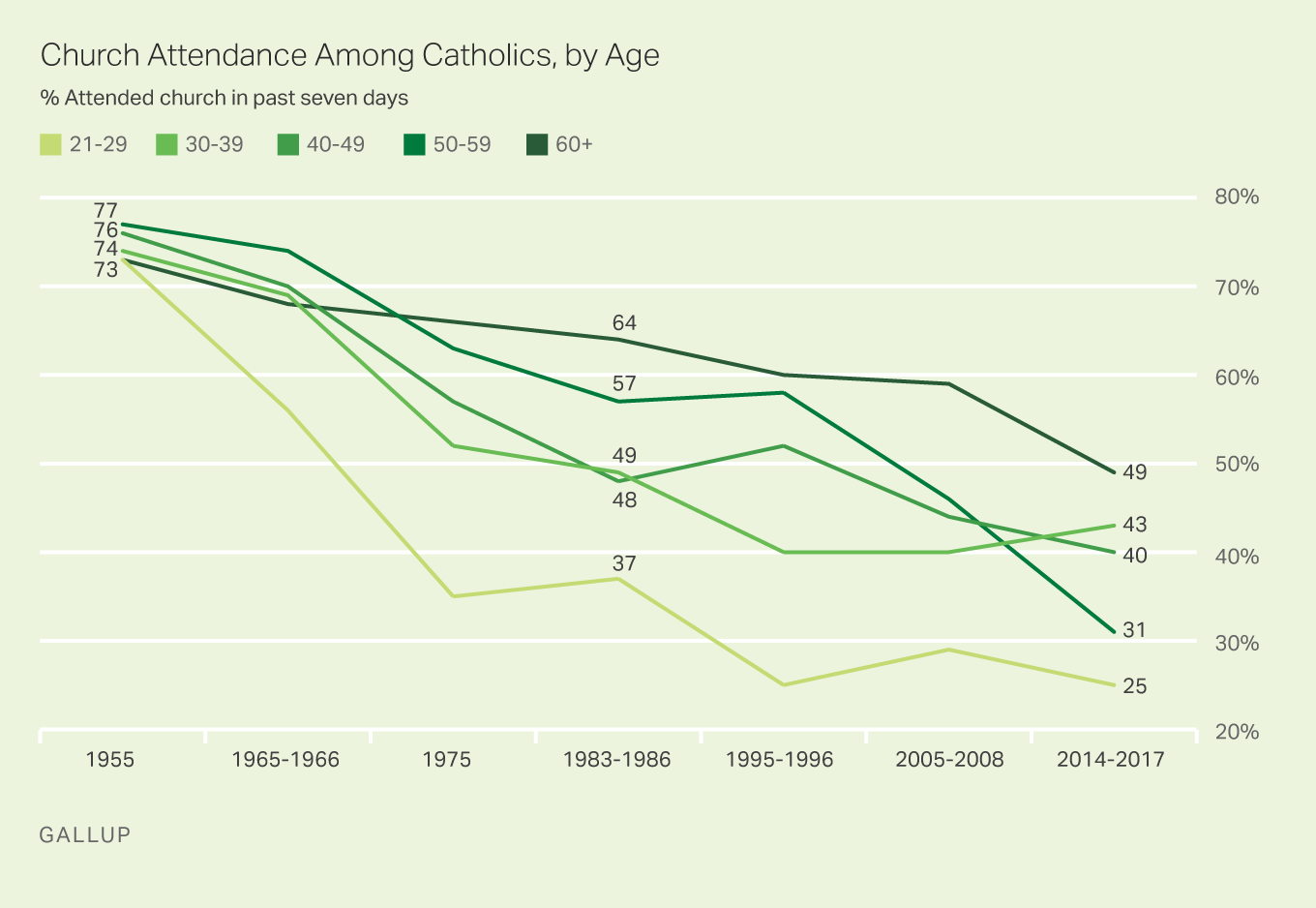 We are wobbling on the edge of a point where two demographic cliff faces converge.




























