Relics of St. Francis Xavier to go on tour in….

As I write… US HERE – UK HERE – It seemed appropriate.

In Rome, one visits the Gesù, the great church of the Jesuits (of yore) in the heart of the Centro.  There one venerates the relics of mighty saints, Ignatius and the missionary Francis Xavier.

What an amazing saint is Francis Xavier.  Who can tell how many he preached to with the intention of converting them from their pagan ways to Christianity (=  proselytize), and then baptized and instructed?

The arm that did that preaching and instructing and baptizing will soon be brought to Canada.  There’s good article about this at the CBC HERE.

Check out the itinerary below to find out when and where you can see the relic for yourself:

  • Jan. 3: Quebec City.
  • Jan. 5: St John’s.
  • Jan. 7: Halifax.
  • Jan. 8: Antigonish, N.S.
  • Jan. 10: Kingston, Ont.
  • Jan. 12-14: Toronto.
  • Jan. 16: Winnipeg.
  • Jan. 18: Saskatoon.
  • Jan. 20: Regina.
  • Jan. 21-22: Calgary.
  • Jan. 24-25: Vancouver.
  • Jan. 27: Victoria.
  • Jan. 29-30: Montreal.
  • Feb. 2: Ottawa.

Let us ask God to raise up a holy people, sorely need.

However, let us also ask Him to raise up mighty saints, visible game changing saints.

Holy Church has bequeathed two special gifts to the whole of humanity: art and saints.

One of them reflects goodness, truth and beauty – God – in matter, the other reflects them in persons.

The greatest forge of both art and saints that human history has known must be the Holy Mass of the Catholic Church.

To produce great art and saints we need again the foundry of the Holy Mass to be restored and fired again.  This is why Summorum Pontificum is so important for our future.  Through the expanded use of the traditional Roman Rite – which forged saints like Ignatius and Francis Xavier – we will see the impurities of the newer Rite fall away like slag, as tradition corrects it.  As our sacred liturgical worship is purified and raised up, the whole of the life of the Church in every sphere will, too, be purified and raised up.  For art and saints to bloom, we need to rekindle the sacred liturgical bloomery.

(I think my old friend Archbp. Sample – with his degree in metallurgy – meta-liturgy? – would like that analogy!)

Posted in Just Too Cool, Saints: Stories & Symbols | Tagged
3 Comments

VIDEO: FSSP Gregorian Chant disc. Wherein Fr. Z rants.

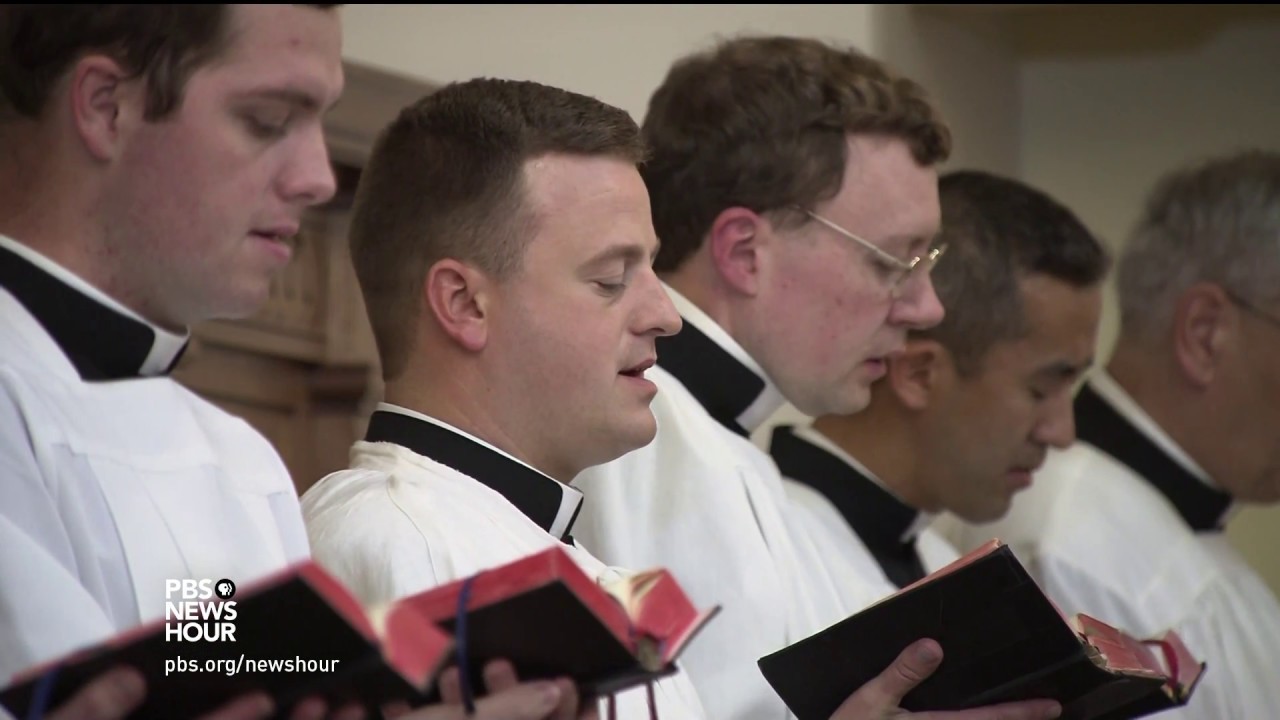
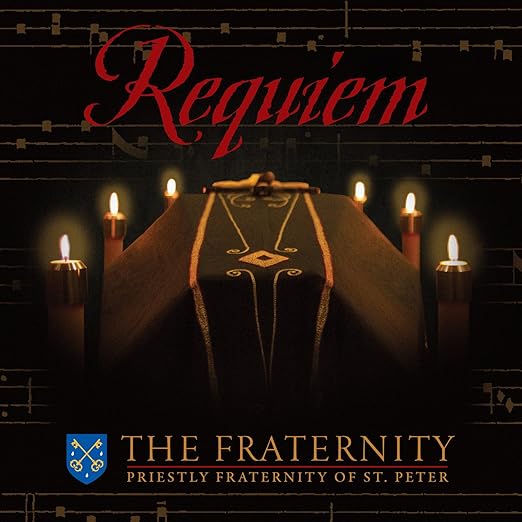
There is a video about the new Gregorian chant disc released not long ago by the FSSP, with chants for the Requiem Mass.

YouTube thumbnailYouTube icon

“Gregorian Chant has found a new audience.”, the voice over says towards the end of the video.

ROFL!

It seems that every time one of these discs comes out, it hits the charts and stays there. I remember when the disc from the monks of Silos came out. People went bananas. The wonderful discs of the Benedictine Sisters in Missouri have also been best sellers.

Telling.

So… ROFL!

At the same time… GRRRRR!

Generations have been robbed robbed ROBBED! Cheated of their patrimony! The libs who controlled the interpretation of the Council on liturgy and music stole from us our treasury of sacred music and, in doing so, opened our liturgical worship up to tinkeritis and ditties so bad that not even a radical cephalectomy could remove the bad taste. When they destroyed Latin worship, the doors of our treasury were slammed shut and, into the vacuum, rushed slapped together dreck inspired by commercial jingles and sitcom tunes.

But I digress.

I would like for one of these groups systematically to record the chants for ordinaries and propers for feasts.

Here is the disc in question. It would be a great gift.

US HERE – UK HERE

Posted in Liturgy Science Theatre 3000, Pò sì jiù, Wherein Fr. Z Rants | Tagged , ,
10 Comments

ASK FATHER: One Mass for the obligation for Sunday, Christmas Eve and Monday, Christmas Day?

Under another post someone asked:

Father, would can. 1248.1 apply to the case of a double obligation, e.g., an evening Mass for Sunday also satisfying a Holy Day obligation for Monday (as Christmas this year)?

I’ve written about this situation before and I have had a change of position.  I was of the mind that, in this situation, one Mass in the evening could satisfy two obligations.  It just makes sense.  However, I’ve learned that this has been ruled on.

In 1970, Paul VI approved a response to a “dubium” – those were the days – about double fulfillment by one Mass which bridges two days of precept: negative. We have two days of precept. That means two Masses.

There are the usual exceptions for the sick and shut in, etc. Also, parish priests can give individual dispensations for real necessities, as always.

No, we have to attend two Mass for the two obligations.

However, you could attend a Mass in the morning on Sunday, Christmas Eve Day, and fulfill that obligation, and then go again in the evening of the same day and fulfill the Christmas Day obligation.

Furthermore, if you go to Mass twice on Sunday (for the two obligations), you can also receive Holy Communion at both of those Masses.  Canon Law says you can receive twice in a day, so long as the second time is in the context of Mass.  So, if you went to two Masses in the morning on Christmas Eve Day, you could receive twice.  You would have fulfilled your obligation.  But if you went again, to a third Mass, in the evening of Sunday, Christmas Eve, you could fulfill your Christmas Day obligation, but you could not go to Communion a third time… unless you were in danger of death.   Merry Christmas!

Or, just be a regular person who lets Sunday be Sunday and Christmas be Christmas and go on both Sunday and on Christmas.  Right?

To make this more interesting, on Christmas, priests can celebrate three Masses and keep all three stipends!  However, while the priest saying Masses can receive Communion three times on Christmas Day, you can’t.  If you are at all three of Father’s Christmas Day Masses, you get Communion twice, not thrice.

Clear, right?


Posted in "How To..." - Practical Notes, ASK FATHER Question Box, Canon Law, Liturgy Science Theatre 3000 | Tagged , , ,
8 Comments

ASK FATHER: “Anticipated” Traditional Latin Mass on Saturday evening with Sunday’s texts

From a reader…

Is it licit to celebrate Traditional Latin Masses in an anticipatory manner (i.e., an evening Mass but using the following day’s propers)?

I’m asking because a recent Rorate article implies the contrary yet I know priests who commonly say Sunday TLMs the evening before, probably because of their duties as diocesan priests they have to attend to on the actual Sunday (or Holy Day).

Ehem.. the “actual Sunday” is just as “actual” in the Extraordinary Form as in the Ordinary.  I would say even more “actual”, since they have the long, proven track record.  But I digress.

Is it licit to “anticipate” the next day’s Mass on the evening before in the TLM (Extraordinary Form).

From what I understand, that is not to be done.

Back in the day, there were no “anticipated” Masses.  No matter what time of day it was, Father would say the Mass of the day.  Moreover, evening Masses were not common, particularly in the days of the longer Eucharistic fast, and in years when there was no electric lighting (Holy Church was around before electrification).  Pius XII allowed for evening Masses for people who had to work in the morning.  So, evening Masses are new-fangled, to say the least.

Celebrating a “anticipated” evening Mass with the next day’s texts is… strange, and not strictly licit.

However, I suppose that, in the spirit of the “mutual enrichment” foreseen by the Legislator in Summorum Pontificum, there could be some sort of accommodation made in with consultation with the Pontifical Commission “Ecclesia Dei”.  That said, the rubrics don’t provide for an “anticipated” Mass in the Extraordinary Form.

Mind you, were a Mass of the Saturday to be celebrated on Saturday evening (after, say, 4 PM), that Mass would satisfy one’s Sunday obligation according to can. 1248.1:

The precept of participating in the Mass is satisfied by assistance at a Mass which is celebrated anywhere in a Catholic rite either on the holy day or on the evening of the preceding day.

So, barring consultation and the permission of the PCED, “No!”  We cannot, now at least, use the Sunday texts on Saturday evening.

Posted in "How To..." - Practical Notes, ASK FATHER Question Box, Liturgy Science Theatre 3000, SUMMORUM PONTIFICUM | Tagged ,
7 Comments

Washington DC – Wed 6 Dec – Free @ActonInstitute conference – live stream

I received this from a nice people at ACTON INSTITUTE:

We have a free conference event coming up in Washington, D.C. this Wednesday. Father Sirico will be speaking at it, as well as Dr. Sam Gregg.  HERE

[The topic is Reclaiming the West: Public Spirit and Public Virtue – it looks like a great opportunity]

I don’t know how much of your blog readership is based on the East Coast, but I thought if you were amenable, you might mention it on your blog or Twitter? We’re always happy to pick up any last minute registrants and it is shaping up to be a wonderful event. And for those who can’t attend but would like to watch it, we will be livestreaming the event beginning at 9 a.m. on Wed at this link:https://acton.org/live

Meanwhile…

This is another bit of ACTON news from one of my friends:

This is the event we did in Rome at the Greg last week. It was standing room only. The biggest conference ever done at the Gregorian.

https://livestream.com/ActonInstitute/Rome2017

I suspect MSW will be deeply disturbed by this development. Deeply disturbed.

That conference in Rome was: Globalization, Justice, and the Economy: The Jesuit Contribution

The conference aims to pay tribute to early and late modern scholasticism, specifically the Jesuit contributions, to the development of modern market economies.

While the modern economy is often identified with Adam Smith, many of the key ideas about basic institutions of the free economy were first identified and developed by Jesuit scholastic thinkers such as Cardinal Juan de Lugo, Leonardo Lessio, Juan de Mariana, and Luis de Molina. In his monumental History of Economic Analysis, Joseph Schumpeter even described these scholastics as the founders of modern economic science.

This conference will explore the contributions to such thinkers to the development of arguments about, among other things, free trade, price-theory, the charging of interest, and the state’s role in the economy.

I heard from my spies that it was marvelous.

MSW (aka the Wile E. Coyote of the catholic Left) of the Fishwrap really hates ACTON INSTITUTE and nearly swoons when it’s name is mentioned.  Hence, it is a good thing and to be supported.

Posted in ¡Hagan lío!, Events, The Campus Telephone Pole | Tagged
Comments Off on Washington DC – Wed 6 Dec – Free @ActonInstitute conference – live stream

Your Good News

Do you have good news for the elevation and edification of the readership?  Let us know.

Here’s a piece of good news.

I had an email from the head of the Latin Liturgy Association in these USA.  He sent me to a PDF of their recent newsletter, which I read with attention.

There’s a lot of good news in it.

Even though we are “connected” by the interwebs, etc., … are we?   It seems to me that the sort of connections we can make today can also be alienating and atomizing.  Hence, it was good to look over the newsletter from the LLA (which I haven’t seen for a long time – I would not be displeased to receive a hard copy).   There are a lot of good things going on out there.  When they are gathered together into one place, the impact is strong.

BTW… I noted the name of someone from my past life when I was studying Latin in Rome with Fr. Foster: NS of ND.  If you see this, drop me a line.

That’s what I try to do with “Your Good News” and “Your Sunday Sermon Notes” posts.

At the end of the newsletter, I saw a prayer:

Orátio pro Missa Latíne Celebránda

O mundi Regnátor, qui te omni lingua hóminum angelorúmque laudári voluísti; tríbue, qu?sumus, ut étiam in diébus nostris, sacrifícium dilécti Fílii tui immaculátum assídue lingua Romána in oratóriis gentis nostrae omniúmque permúltis tibi offerátur a pópulo ad te toto corde convérso: per Christum Dóminum nostrum. Amen.

Cum licéntia Ordinárii, Baton Rouge, LA August 8, 1994

Prayer for the Celebration of the Mass in Latin

O Sovereign of the world, who have willed that you be praised in every language of men and of angels; grant we beseech you, that now too in our days, the unblemished sacrifice of your beloved Son may be incessantly offered to you in the language of the Romans in many churches of our land and of every land by a people turned to you with all their heart. Through Christ our Lord. Amen.

Posted in ¡Hagan lío!, "How To..." - Practical Notes, Just Too Cool, Liturgy Science Theatre 3000 | Tagged ,
9 Comments

UPDATED: Ed Peters provides refreshing clarity about force of odd papal letter to Argentinian bishops

UPDATE:

Joseph Shaw has some observations about the appearance of the Pope’s letter to the Bishops of Buenos Aires in AAS.  HERE

Among other things he states:

There is, however, more to making something part of the magisterium, and therefore binding on the consciences of Catholics, than simply asserting that it is magisterial. The content of the document is also relevant. ‘Legal positivists’ claim that laws are valid just by virtue of a valid procedure approving them, but this is false and has never been accepted by the Church. Even in the case of human laws, a law will fail to bind in conscience if it is impossible to follow, for example if it is incomprehensible, retroactive, or totally unreasonable. In those cases it fails to be a binding law, or, really, a law at all. Law is by definition something which guides action, and such putative laws are incapable of doing that.

In a similar way, if we are to talk of a papal magisterial act binding Catholics to believe something, then it must be in accordance with the existing magisterium, and it must be possible to understand what it means. […]

And…

[T]here is no act this or any pope can perform which can free Catholics from the obligation to believe those truths of Faith and Morals which are taught infallibly by the Ordinary and Extraordinary Magisterium.

Read the whole thing there, to get a fuller view.

____ Originally Published on: Dec 4, 2017

People who pay attention are pretty disturbed about this.  I was rather troubled.

I am less troubled now.

That doesn’t mean that this is over.

Ed Peters tries to untangle it.  HERE

On the appearance of the pope’s letter to the Argentine bishops in the Acta Apostolicae Sedis

Some three months ago I predicted that Pope Francis’ letter to the Argentine bishops, approving their implementation of Amoris laetitia, would make its way into the Acta Apostolicae Sedis. Now it has. An accompanying note from Cardinal Parolin states that the pope wishes the Argentine document to enjoy “magisterial authority” and that his endorsement thereof  has the status of an “apostolic letter”.

Fine. Let’s work through some points. [Thank you!]

CLICK ME

1. Canon 915.  [There it is.] It is crucial to understand that, today, what actually prevents ministers of holy Communion from distributing the Eucharist to divorced-and-remarried Catholics is Canon 915 and the universal, unanimous interpretation which that legislative text, rooted as it is in divine law, has always received. Canon 915 and the fundamental sacramental and moral values behind it might be forgotten, ignored, or ridiculed, even by ranking officers in the Church, but unless and until that law is revoked or modified by papal legislative action or is effectively neutered by pontifically approved “authentic interpretation” (1983 CIC 16), Canon 915 stands and, so standing, binds ministers of holy Communion.Neither the pope’s letter to the Argentines, nor the Argentine bishops’ document, nor even Amoris laetitia so much as mentions Canon 915, let alone do these documents abrogate, obrogate, or authentically interpret this norm out of the Code of Canon Law. Granted, little or nothing in these documents endorses or reiterates Canon 915, either, and the apparently studied silence that Canon 915 suffers these days is cause for deep pastoral concern. But law does not wilt under the silent treatment. [However…. We are living in an age when the Pope grants faculties to the SSPX – apparently – to receive sacramental confessions and validly absolve, even though there is no clear juridical document with clear language about just how that is.  He sort of mentions it, and, so let it be written, so let it be done.  And does law wilt?  I am thinking about how we got altar girls, etc.  Sure, eventually there was an “authentic interpretation” of the canon that dealt with who might substitute for an acolyte… but that only happened because the law withered.]

2. Apostolic letter. An “apostolic letter” is a sort of mini-encyclical and, however much attention encyclicals get for their teaching or exhortational value, they are not (with rare exceptions) legislative texts used to formulate new legal norms. Typically “apostolic letters” are written to smaller groups within the Church and deal with more limited questions—not world-wide questions such as admitting divorced-and-remarried Catholics to holy Communion. Even where a special kind of “apostolic letter” is used to make changes to the law—such as John Paul II did in Ad tuendam fidem (1998), as Benedict did in Omnium in mentem (2009), or as Francis did in Magnum principium (2017)—the “apostolic letter” used in such cases carries the additional designation “motu proprio” (i.e., on the pope’s own initiative, and not in response to another’s action), and the changes made to the law thereby are expressly identified by canon number, not simply implied or surmised, especially not by silence. [Summorum Pontificum was an AP MP.]

The pope’s letter to the Argentines appears simply as an “apostolic letter”, not as an “apostolic letter motu proprio”, and it references no canons.

3. [NB] Authentic magisterium. Many people use the term “magisterium” as if it were tantamount to “Church governing authority”, but in its canonical sense “magisterium” generally refers to the Church’s authority to issue teachings on faith and morals, not to the Church’s authority to enforce discipline related to matters of faith and morals.  [A good distinction, but one that will be lost on libs, who are determined to find their own way in that uncertain mulligan stew of sort-of-law that is flowing.]

While Francis—albeit about as indirectly as is possible (through a memo to a dicastery official concerning a letter written by an episcopal conference)—has indicated that his letter to the Argentines and even the Argentine conference letter itself are “magisterial”, the fact remains that the content of any Church document, in order to bear most properly the label “magisterial”, must deal with assertions about faith and morals, not provisions for disciplinary issues related to faith and morals. [THERE IT IS.] Church documents can have both “magisterial” and “disciplinary” passages, of course, but generally only those teaching parts of such a document are canonically considered “magisterial” while normative parts of such a document are canonically considered “disciplinary”.

Francis has, in my opinion, too loosely designated others of his views as bearing “magisterial authority” (recall his comments about the liturgical movement), [Yes, we recall those comments.] and he is not alone in making, from time to time, odd comments about the use of papal power (recall John Paul II invoking “the fullness of [his] Apostolic authority” to update the by-laws of a pontifical think-tank in 1999).  [The Saint Pope also invoked his “Apostolic authority” when he “commanded” in his Apostolic Letter Motu Proprio Ecclesia Dei adflicta that respect be shown to those who wanted the traditional Roman Rite and that bishops were to be generous in the application of existing laws.  That happened, right?   So, libs will not demand that this thingy be obeyed, even though is it less clear that John Paul’s requirement.]

But that inconsistent usage only underscores that the rest of us [because we are not psychics] must try to read such documents in accord with how the Church herself usually (I wish always, but I’ll content myself with “usually”) writes them, and ask, here, are there “magisterial” assertions in Amoris, the Buenos Aires document, and Francis’ endorsement letter? Yes. Plenty, running the gamut from obviously true, through true-but-oddly-or-incompletely phrased, to a few that, while capable of being understood in an orthodox sense, are formulated in ways that lend themselves to heterodox understandings (and for that reason should be clarified for the sake of the common ecclesial good).  [If only some well-informed and competent Cardinals would submit a series of questions or dubia to the Holy Father….!]

In any case, such teaching statements, to the extent they make assertions about faith or morals and come from bishops and/or popes acting as bishops or popes, already enjoy thereby at least some (relatively little) level of ordinary magisterial value, a value not augmented by sticking the label “magisterial” on them.  [I’m not trying to be flippant here, sincerely.  However, the image of “lipstick” popped into my mind when I read that.]

And, are there “disciplinary” assertions in Amoris, the Buenos Aires document, and Francis’ endorsement letter? Yes, a few. [NB] But as I have said before, in my view, none of those rather few disciplinary assertions, even those ambiguous and capable therefore of leaving the door open to unacceptable practices, suffices to revoke, modify, or otherwise obviate Canon 915 which, as noted above, prevents the administration of holy Communion to divorced-and-remarried Catholics. [That’s it.  There it is.]

Conclusion. I wish that Canon 915 were not the sole bulwark against the abandonment of the Eucharist to the vagaries of individual, often malformed, consciences. [Wow.  A little scary, that.  So, HURRAY FOR 915!] I wish that a lively, pastorally-driven sense of the liberating permanence of Christian marriage, the universal need for Confession to reconcile those in grave sin, the power of the Eucharist to feed souls in the state of grace and to condemn those who receive irreverently, sufficed to make invocation of Canon 915 unnecessary in pastoral practice. But apparently, in much of the Catholic world these days, such is not the case and Canon 915 must be pointed to as if it were the only reason to bar reception of holy Communion in these situations.

But what can one say? Unless Canon 915 itself is directly revoked, gutted, or neutered, it binds ministers of holy Communion to withhold that most august sacrament from, among others, divorced-and-remarried Catholics except where such couples live as brother-sister and without scandal to the community.

Nothing I have seen to date, including the appearance of the pope’s and Argentine bishops’ letters in the Acta Apostolicae Sedis, makes me think that Canon 915 has suffered such a fate.

And yet we all know that if a priest, or the rare bishop, sticks to what the Church has always said and done in these matters, soon he will be hanged in the sight of the mercy-wielding libs, who, in their mercy, will then mercifully slash open those priests, draw out their living guts, show them to them, in mercy, and then mercifully hack their limbs off for merciful distribution to the four corners of the diocese.

Posted in 1983 CIC can. 915, Canon Law, The Coming Storm, The Drill | Tagged , , , ,
38 Comments

Controversial Book about Pope Francis: “The Dictator Pope”

UPDATE:

I am just about done with this.  It’s quite a read.  Among other things it is a summary of events of the last few years.

At the pace of the modern world, one forgets.

It is in English, too.  Links below.

Originally posted 1 Dec:

I have had many emails asking me about the new book by the pseudo-anonymous “Marcantonio Colonna” called Il Papa Dittatore (The Dictator Pope).

In Italian – US HERE – UK HERE

It is available IN ENGLISH

US HERE – UK HERE

It is not flattering.  Some of it resonates with what I have picked up in my last visits to Rome and conservations with friends who still labor there.  There is a really bad environment in Rome right now.  The tension is so thick that you could cut it with chainsaw… maybe.

REMEMBER: Most of you do not have to read this stuff.  Some of us do.  Most do not.  Be wary, in yourself, of the vice of curiositas.  Yes, there is a kind of “curiosity” which leads to sin.

Also, I think this is only for Kindle.

So… here’s your chance to get a Kindle!

If you don’t have one already, what’s up with that?

There are several to choose from.  This is the Paperwhite.  I have one of these and it is marvelous.

US HERE – UK HERE

There are several iterations of the gizmo.  Some connect only to WiFi, others also to cellular data (its a great feature for travel, but it costs more).  Some have “ads” some don’t (its cheaper if you allow the “rest” screen to suggest books).

It’s “backlit”.  The battery lasts for many hours.  Books download in a jiffy.  You can share most books, and with a level of membership you can read many titles for free.

If you have have more than one Kindle, which will also play audiobooks from Audible, they will “sync” with each other, so you can start on another instrument without searching for your page.  Spiffy.

I dearly love “real” books.  However, I read a lot more books now than I did before.  The Kindle is light and small and stores zillions of titles.   Also, there are some books which I don’t want to buy and have lying around afterward.  I have so many books in my place and in storage that it could be a set for a scene in a dystopian movie.  (Yes, squirrel away a Kindle with lots of “survival” and reference materials in a Faraday cage while you can.)

Anyway, back to the book in question.

You don’t have to tell me about it, I already have it (I was provided with it a while ago).

I am told that there will be an English language version.  I don’t know when.

No, I won’t tell you the author’s real name (a question that has come up several times in email).  Won’t. Do. It… unless the author says it’s okay, and by then it will be out anyway.  So, stop asking that, please.

UPDATE

Fr. Hunwicke has some comments.

Posted in Francis, REVIEWS, The Drill | Tagged ,
19 Comments

INTERNET PRAYER UPDATE: ICELANDIC!

I’t a banner day when I get a new language!

New readers here may not know that The Internet Prayer, which I wrote in Latin a zillion years ago now, has been put into many languages. I have gathered all that I have found onto one page. Some translations have been given approval by bishops, and some have been offered by people of good will. For example, I haven’t yet been able to obtain ecclesiastical approval for the Klingon version. Check it out. HERE

I received an email with a translation of The Internet Prayer into

ICELANDIC

Bæn á undan innskráningu á internetið:

Almáttugi og eilífi Guð, sem skapaðir okkur í þinni mynd og skipaðir okkur að leita alls þess sem er gott, satt og fagurt, sérstaklega í guðdómlegri persónu þíns eingetna Sonar, Drottins vors Jesú Krists, gef okkur, þess biðjum við, að fyrir fyrirbænir HeilagsÍsidórs, biskups og kirkjufræðara, megum við á ferð okkar um netheima beina höndum okkar og augum aðeins að því sem þóknast þér og að við komum fram af kærleika og þolinmæði við allar þær sálir sem verða á vegi okkar. Fyrir hinn sama Krist, Drottin vorn. Amen.

Very cool. Prof. Tolkien would be pleased, even though it involves this new fangled internet thing (which will never catch on).

I welcome new translations. Please also send THE TITLE in the other language.

Also, if you are a native speaker, please record it too! I’m still waiting for the update to the Klingon version.

Posted in "How To..." - Practical Notes, Just Too Cool | Tagged ,
Comments Off on INTERNET PRAYER UPDATE: ICELANDIC!

VIDEO @Michael_Voris makes an appeal. ACTION ITEM!

In the last couple of years I’ve written more than once about the Church’s attribute of indefectibility.  In a nutshell, the Church’s members may err or fail, but the Church cannot.

Which leads me to advance a video that Michael Voris made.

He makes a good appeal. Have a listen.

I think that Michael struck the right tone here.  We are in seriously troubling times.  However, the troubles of these times also present opportunities for learning well and reasserting and articulating with conviction all that the Church teaches.

We need everyone to get on board with dedicated spiritual programs of prayer and mortifications.

Learn your Faith.

Pray.  Pray especially before the Blessed Sacrament.  Pray the Rosary.  Pray to St. Michael and other saints who are you personal and local patrons.

GO TO CONFESSION.

Posted in ACTION ITEM!, Hard-Identity Catholicism, Si vis pacem para bellum!, The Campus Telephone Pole, The Coming Storm, The Drill, The future and our choices | Tagged ,
16 Comments