WDTPRS – 23rd Sunday after Pentecost: SNIP!

During his Sunday Angelus address today, 12 Nov, the Pope asked the sort of question that Popes ought to ask, especially at this time of the liturgical year, when we focus more and more on the Four Last Things and the End of the World: “One day will be the last. If it was today, am I prepared?”

Here is today’s Collect from Holy Mass in the older, traditional Roman Rite:

Absolve, quaesumus, Domine, tuorum delicta populorum, ut a peccatorum nexibus, quae pro nostra fragilitate contraximus, tua benignitate liberemur.

In the pre-Conciliar Missale Romanum this prayer was in the ancient Veronese Sacramentary in the month of September, a time of fasting. It was a bit different: Absolue, domine, quaesumus, tuorum delicta populorum, et quod mortalitatis contrahit fragilitate purifica; ut cuncta pericula mentis et corporis te propellente declinans, tua consolatione subsistat, tua gratia promissae redemptionis perficiatur hereditas.  It also was used on a weekday of Lent.  Unusually, it survived to live on in the Novus Ordo book, as well.

A nexus, from necto (“to bind, tie, fasten; to join, bind, or fasten together, connect”), is “a tying or binding together, a fastening, joining, an interlacing, entwining, clasping” and thence, “a personal obligation, an addiction or voluntary assignment of the person for debt, slavery for debt”.  Nexus is used to indicate also “a legal obligation of any kind”.  It is not uncommon to find somewhere near nexus the word absolvo, which is “to loosen from, to make loose, set free, detach, untie”.  In juridical language it means “to absolve from a charge, to acquit, declare innocent”.

Here is a truly fascinating piece from the mighty Lewis & Short Dictionary for absolvo: “to bring a work to a close, to complete, finish (without denoting intrinsic excellence, like perficere; the fig. is prob. derived from detaching a finished web from the loom“.

Contraho in this context is “to bring about, carry into effect, accomplish, execute, get, contract, occasion, cause, produce, make”.  Blaise/Dumas indicates that contraho means “to commit sin”.

LITERAL TRANSLATION

Unloose, O Lord, we implore, the transgressions of Your peoples, so that in Your kindness we may be freed from the bonds of the sins which we committed on account of our weakness.

ICEL version:

Lord,
grant us your forgiveness
and set us free from our enslavement to sin.

When you see an English version that is shorter than the Latin original, your alarms bells should ring.  18 words in Latin, 14 English words in the obsolete ICELese.  Gosh!  Did they leave something out?

Think of sin as a web which we both weave and then get caught in.  As Hamlet says the engineer is “hoist with his own petard”.  Finish the proverb: “Oh, what tangled…”.

When our First Parents committed the Original Sin, they contracted (contraho) the guilt and effects for the whole human race.  At that point our race was bound by justice.   To be “justified” again, and to be unbound from our guilt and set to right with God, reparation had to be made.  Thus, the New Adam allowed Himself to be bound by His tormentors, and be bound to the Cross, and then unbind His soul from His Body and die.

The Sacrifice of the Lord was aimed not just at a few chosen or privileged people.  It was for all peoples.  The Sacrifice was “for all”, though “all” will not accept its effects.  Some will refuse what Christ did to free us from our sins and the punishments of eternal hell they deserve.  “Many” will be saved as a result of Christ’s Passion and Death.

Which side of the reckoning will you be on?  If today is the day… are you ready?

Returning to the image of the loom, which is woven into today’s vocabulary, I have in mind the incredible phrase from the Book of Job:

“My days are swifter than a weaver’s shuttle, and come to their end without hope.  Remember that my life is a breath; my eye will never again see good.”

Our days are indeed like a shuttle.

Zip Zap Zip Zap Zip Zap…

Some years ago I met a women who wove cloth with a large loom.  She showed me how it worked.  In her practiced hands, the shuttle lashed swiftly back and forth, back and forth, back and forth, while the loom packed the threads together.  The cloth “grew” as it was woven, slowly, but surely.  The shuttle snapped back and forth with increasing speed as she found her rhythm and settled into it.

So, too, the days and years of our lives.

At the end… SNIP… the thread was cut.  Absolutely.

Absolved?  Unabsolved?

GO TO CONFESSION.

YouTube thumbnailYouTube icon

Posted in Four Last Things, Liturgy Science Theatre 3000 | Tagged , , , ,
1 Comment

ASK FATHER: How much “work” on Sunday?

From a reader…

QUAERITUR:

I know we are to abstain from unnecessary servile (manual) labor on Sundays. How strict should we be with discerning whether the labor is “necessary” or not? For example, can mere convenience justify a small amount of light manual labor? How do we respect the Holy Day without being Pharisees?

The Third Commandment of the Decalogue instructs us, for our own good, to honor the Lord’s Day – now Sunday – and to keep it holy.  We do this in two ways.  Positively, we offer God pleasing worship, especially through Holy Church’s sacred liturgy.  Negatively, we avoid activities that are considered “servile labor”.  What “servile labor” is is a matter for debate for most of us.

Man is born for work.  Work is good.  Not all work is toil.  Recreations can be “work”, but they aren’t toil.  Not all “servile” work is physically strenuous.   What to do?

The original intent behind labor that “servile” was to allow for common people, even serfs, servants, slaves, to be able to fulfill the commandment.  Hence, it was strenuous, physical labor.  These days lots of labor is less physical and more mental: desk work.  However, if it is a matter of employment, it probably constitutes “servile” labor and should be avoided unless it is necessary and we avoid scandal.  Farmers at a critical point in the harvest can work.   Being an emergency law enforcement dispatcher is not manual labor in the old-fashioned sense, but it is something that is necessary.  Being a firefighter is okay. Being a checkout gal at a grocery store is not overly physical, but it is servile labor and should be avoided, unless she is trying to feed her children in hard times, etc.

We should avoid activities that hinder us from rendering God what is His due according to the virtue of religion.

Household chores are probably to be avoided, unless you have to patch the roof because water is coming in.  Some people find gardening a pleasure and even meditative.   I don’t think that taking out the trash constitutes a violation of the Lord’s Day, though shifting concrete blocks for the new shed or taking down that dead tree on the south forty probably would be.

I think we have to use common sense.

Common sense is reiterated on our old manuals of theology!

For example, in Sabetti-Barrett I read:

Licita sunt opera liberalia, opera communia et opera aliqua quae videntur servilia, sed requiruntur ad quotidianum usum, victum, necessitatem et dispositionem corporis, vestium vel domus, ut coquere cibos, sternere lectos, verrere domum, et alia quae commode differi vel anticipari aut non possunt aut non solent.  Ita ex praxi communi et sensu fidelium.

Liberalis, an adjective, means “things concerning man’s free condition; noble, honorable; bountiful, generous”.   It can also mean “concerning Liber” the Roman name for Bacchus, the god of drink.. which opens up some possibilities.

Permitted are uplifting works, common works and some works which seem to be servile, but which are required for daily utility, sustenance, the need and ordering of the body, of clothing or the home, like cooking food, making beds, sweeping the house, and others which cannot or should not be conveniently differed or anticipated.  So, according to common practice and the sense of the faithful.

“Common practice and sense of the faithful”… well… that doesn’t help much these days.

It goes on to say:

Inter liberalia connumerandus est usus machinae ad typis scribendum aptatae.

Among the uplifting there can be counted the use of typewriters.

I suppose that means for writing letters and so forth, but not for work.  These days it also surely means use of the computer for writing good things and phones for texting good things.

The same manual permits sculpting and painting (not the garage).  You can probably (probablius) also grind grain!

There is some discussion of how much time one can do chores or labor.  If the work is really hard, two hours cold be allowed.  If not so hard, then three.

There are also some things which one can in in charity.  For example: taking care of the sick, burying the dead, helping a particular poor person though probably not “the poor” in general, which is an interesting distinction.  I recall that one of Screwtape’s tactics was to get people interested in “the poor”, rather than the needy person next to you.

Some things we can do out of piety.  For example, working in the church to clean or decorate, but not to construct or make the ornamental features of the church building.

Would working on a Sunday for parish festival fit in this category?  Hmmmm.

There are things we can do out of necessity.  You can form your own examples.   A surgeon can operate to save a life, for example.

So, consider all the elements and make the choice!

Posted in "How To..." - Practical Notes, ASK FATHER Question Box, Our Catholic Identity | Tagged , , ,
15 Comments

Challenge Coin Update – Catholic War Veterans – #VeteransDay

You may recall that I had challenge coins made. I’ve been giving and exchanging here and there, as well as receiving from kind readers.

One just came in from an interesting organization: Catholic War Veterans. Appropriate.

I was unaware of this organization.

Many thanks for the challenge coin!

Posted in Just Too Cool | Tagged , ,
6 Comments

Happy 242nd Birthday, USMC!

Raising a glass.

‘rah!

Carrying this with me today…

Posted in Lighter fare | Tagged
5 Comments

Rereading “Lord Of The World” by Robert Hugh Benson – Brrrrr!

I am once again – after many years – into the dystopian and prophetic Lord Of The World by Robert Hugh Benson.

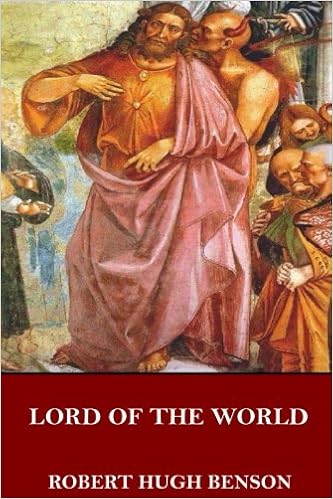
A taste:

“Briefly,” [Mr. Templeton] said, “there are three forces–Catholicism, Humanitarianism, and the Eastern religions. About the third I cannot prophesy, though I think the Sufis will be victorious. Anything may happen; Esotericism is making enormous strides–and that means Pantheism; and the blending of the Chinese and Japanese dynasties throws out all our calculations. But in Europe and America, there is no doubt that the struggle lies between the other two. We can neglect everything else. And, I think, if you wish me to say what I think, that, humanly speaking, Catholicism will decrease rapidly now. It is perfectly true that Protestantism is dead. Men do recognise at last that a supernatural Religion involves an absolute authority, and that Private Judgment in matters of faith is nothing else than the beginning of disintegration.

And it is also true that since the Catholic Church is the only
institution that even claims supernatural authority, with all its
merciless logic, she has again the allegiance of practically all
Christians who have any supernatural belief left. There are a few faddists left, especially in America and here; but they are negligible. That is all very well; but, on the other hand, you must remember that Humanitarianism, contrary to all persons’ expectations, is becoming an actual religion itself, though anti-supernatural. It is Pantheism; it is developing a ritual under Freemasonry; it has a creed, ‘God is Man,’ and the rest. It has therefore a real food of a sort to offer to religious cravings; it idealises, and yet it makes no demand upon the spiritual faculties. Then, they have the use of all the churches except ours, and all the Cathedrals; and they are beginning at last to encourage sentiment. Then, they may display their symbols and we may not: I think that they will be established legally in another ten years at the latest.
“Now, we Catholics, remember, are losing; we have lost steadily for more than fifty years.


Have you read it?

In 2013 and 2015 Pope Francis suggested it.

In 1994 Card. Ratzinger spoke of it.

Benson describes, already in 1907, a world in which “the euthanatisers are the only priests” and the antichrist is here.

How much he got right is rather disconcerting.

I have a wonderful Baronius Press Classic edition, but right now I am listening to the novel, read by the brilliant Simon Vance (who also read all the indispensable Aubrey/Maturin novels).  Get it through Audible.   US HERE – UK HERE

US HERE – UK HERE

For an inexpensive book version…

US HERE – UK HERE

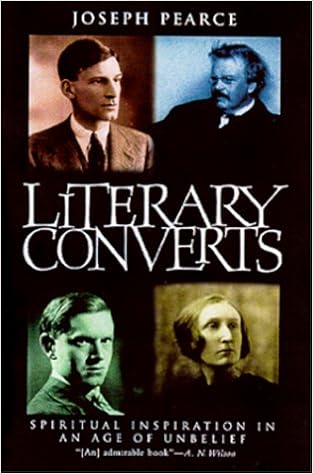
If you want to know more about the author, Msgr Robert Hugh Benson, this is a great read.  Joseph Pearce’s Literary Converts.

US HERE – UK HERE

Pearce writes of a fascinating chain reaction of English converts to the Catholic Church.

In any event… this is stuff that every Catholic should know.

And Lord Of The World is a book that every Catholic should have read.


Posted in Semper Paratus, The Coming Storm, The future and our choices, The Last Acceptable Prejudice | Tagged , ,
19 Comments

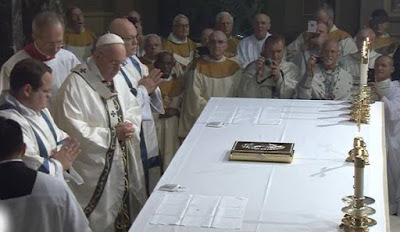
More about photos during Mass and Pope Francis’ admonisment

The other day Pope Francis spoke out again taking photos at Mass or other liturgical moments.

Greg DiPippo at NLM has a good piece about this HERE.

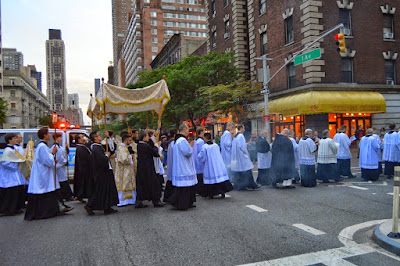
He makes the distinction between this…

And this…

I would add any of myriad photos of beautiful sacred liturgical moments, Masses and more.

Two observations.

First, if Pope Francis doesn’t want all the photos during Masses etc., he might set an example by avoiding doing things like this, which surely fuel the photo flashing frenzy in his presence and elsewhere.

But we know that, selfies or not, nothing is going to turn this around.  Mobile phones are now the thing.

Next, we live in a time when beautiful sacred liturgy has been nearly forgotten or has, frankly, never been experienced by many.   Photos give people who have never known or nearly forgotten what the Church can offer to God as sacred liturgical worship are invaluable to instruct and, hopefully, inspire.

Provided that the photo takers are discreet, so as to not disturb others, I see no problem with taking the occasional pic.  However, then The Precious™ should be stowed and focus should be wholly in the sacred action.

As Greg put it over at NLM:

We do not live in a normal age in the Church’s life, and one of the things that makes it abnormal is the very widespread phenomenon of badly done and ugly liturgies; their ugliness is often far more distracting than any photographer, however poorly behaved. Photography is an extremely useful tool, I would say even a necessary one, for presenting people with models of liturgies which are well-done and beautiful. As long as they are taken with discretion, in a way that does not intrude upon the congregation’s ability to pray, I see no reason why we should have a problem with photographs taken during the liturgy. NLM will continue to publish such images, and we encourage others to do so. Photographs that have a documentary, historical, instructional or apologetic purpose, and serve as part of the Church’s evangelical outreach are one thing; photographs taken in function of the addictive selfie culture and digital tourism are another matter entirely.

Posted in "How To..." - Practical Notes, Liturgy Science Theatre 3000 | Tagged
9 Comments

A “tour de force” about Protestants and Martin Luther

One priest in an email to me referred to this as a “tour de force” about Protestants and Martin Luther.

All I can say is… “Whew!”

Go to Crisis and read “Calling a Spade a Spade” by Angelo Stagnaro.

Sample:

I can forgive Protestants and Protestantism for most things.

I can forgive Protestants for the Know-Nothing Party and their murderous Philadelphia Nativist Riot, the Intolerable Acts, Bloody Monday and the Orange Riots in New York City in 1871 and 1872. I forgive them for the “Blaine Amendments” which forbade tax money be used to fund Catholic parochial schools.

I can also forgive them for the KKK and for funding the Mexican atheist genocidal maniac Plutarco Ares Calles in his efforts to kill Catholics during the Cristero Wars. I can forgive them for calling any, and all, popes, the “Anti-Christ(s)” and “Whores(s) of Babylon.”

I also forgive them for supporting Henry VIII’s Act of Supremacy by which the Church gained many of her modern martyrs. In addition, I forgive them for the Recusancy Acts and the fictitious, so-called “Popish Plot.” I forgive them also for the fact that as a Catholic, I shall never sit upon the British Throne though literally everyone else is allowed to do so.

I can forgive Protestants for The Troubles in Ireland and Oliver Cromwell and his engineered Potato Famine and the slaughter and military occupation of that country. I forgive them for the enslavement of 50,000 men, women and children who were forcibly removed from Ireland and sent to Bermuda and Barbados as indentured servants?America’s first slaves.

[…]

It goes on and on and on and on…

This puts into perspective the lack of enthusiasm some of us have regarding “celebration” of the 500th anniversary of the revolt.

Posted in The Drill | Tagged ,
3 Comments

ACTION ITEM – Petitions in Support of @BishopMorlino @MadisonDiocese

UPDATE 10 Nov:

See Church Militant… but before you do that… sign the petitions!

First, at LifeSite…. HERE    [as I write – 5253]

Then, at Change… HERE    [as I write – 5,469]

C’MON!!

___ Originally on: Nov 4, 2017

If you are not up to speed about the horrid attacks underway against Bishop Robert C. Morlino of the Diocese of Madison (aka The Extraordinary Ordinary), you might start HERE and read backwards.

There is an online petition at Change.org, started be a hard-core lib authority hater (when that authority isn’t liberal). They are fantasizing that their petition could get Bp. Morlino removed. They have no clue at all about how things work, and they have zero interest in the truth about the person or situation they are protesting, but they haven’t let those deficits slow them down. They are simply trying to hurt someone… and that’s called BULLYING.

If you see that petition, read the comments to see what sort of folks they are.

I know of two counter petitions, in support of B. Morlino. Your ACTION ITEM… SIGN THEM.

First, at LifeSite…. HERE

Right now the petition stands at 2448. Let’s see how fast we can make that rocket. Send the link around to all your friends. Bloggers, pick this up.

Next, a petition at the site of The Remnant. HERE They have a supportive article.

They’re link sends to to a petition at Change.org, the same place where the smear attack petition is found. HERE

As I write, that petition is at 2299

OKAY!  You have your marching orders.   Be swift.

https://www.churchmilitant.com/news/article/faithful-catholics-back-bp.-robert-morlino-with-new-petition

Fun fact.  At the Change.org petition, you can see the votes come in in real time.

Go! Do your thing and tell your friends.  Let’s make this move.


Posted in "How To..." - Practical Notes, ACTION ITEM! |
10 Comments

@JamesMartinSJ and “downward-facing dog”

In 2015 Pope Francis said:

“You can take a million catechetical courses, a million courses in spirituality, a million courses in yoga, Zen and all these things. But all of this will never be able to give you the freedom” of being a child of God.”

The long-time chief exorcist of the Diocese of Rome, Fr. Gabriel Amorth, was convinced that yoga summoned and opened people up to demons.  If there is the slightest chance that he was right – and he seems to have known his stuff – yoga should be avoided.

The CDF issued a document some years back in which yoga is mentioned in the context of “New Age” issues.

This showed up in my email this morning.  A screenshot, clearly, from someone’s mobile Twitter app.  From the feed of homosexualist activist James Martin SJ (just try to imagine St. Peter Canisius’ reaction to the news of this “retreat”):

Perhaps Martin is into “downward-facing dog”.

On the other hand, he doesn’t say that he is involved with this Jesuit Yoga Retreat, does he.


Posted in Sin That Cries To Heaven, You must be joking! | Tagged , ,
5 Comments

ASK FATHER: Venial sins forgiven during Mass?

From a reader…

QUAERITUR:

Thank you for all of your efforts here, as it really brings strength to many of us during our sojourn.

A priest at our local university gave a homily a few days back wherein he spoke of the absolution given at the end of the penitential rite as being efficacious for the forgiveness of venial sins. I know that reception of the Eucharist will forgive venial sin, but I had never heard this before. Is this correct? Of course, the priest did say we needed sacramental confession for mortal sin.

Father is correct on both counts.  While mortal sins are forgiven in the Sacrament of Penance (and in Baptism and in emergencies through the Sacrament of Anointing), there are various ways by which we obtain forgiveness of venial sins.

To review, there are two kinds of actual sins which we commit: mortal and venial.

Mortal sins kill the life of grace, sanctifying grace, in the soul.  Mortal sins must be of serious matter, committed with knowledge of their serious nature and with consent of the will.  They deserve the eternal punish of separation of God which is Hell.

Venial sins are lesser offences against God and His laws.  They do not deprive the soul of sanctifying grace. If the matter is not grave or when one doesn’t fully grasp how serious it is, or if consent of will is lacking, the sin can be venial rather than mortal.  Venial sins can be forgiven through certain works and in moments of the Mass, etc.

Let’s be clear about something: venial sins are SINS.  They offend God, Mary and the saints and angels.  They endanger our souls because they can lead to worse sins or the deadening of our minds and hearts about the true nature of sin’s horror.  Moreover, as one goes more deeply into the spiritual life and successfully roots out serious faults, then the smaller sins take on more importance.  St Teresa of Avila says that the first great obstacle she had to overcome in advancement of her spiritual life was carelessness about sin.

An Act of Contrition, use of sacramentals such as Holy Water, recitation of the Rosary, reception of Communion, etc., are ways by which we obtain forgiveness of venial sins.

While we are obliged to confess all mortal sins in both kind and number, yes number, we can but are not strictly obliged to confess venial sins.  It is a good thing to confess venial sins, especially if you find in the course of ongoing examination of conscience that a pattern is developing in you which can more easily lead to the commission of mortal sins.

The Catechism of the Catholic Church says:

CCC 1458 “Without being strictly necessary, confession of everyday faults (venial sins) is nevertheless strongly recommended by the Church. Indeed the regular confession of our venial sins helps us form our conscience, fight against evil tendencies, let ourselves be healed by Christ and progress in the life of the Spirit. By receiving more frequently through this sacrament the gift of the Father’s mercy, we are spurred to be merciful as he is merciful”

During the older, traditional form of Holy Mass in the Roman Rite, there have been identified nine moments when forgiveness of venial sins is offered to one who participates with full, conscious and active, actual participation:

During the Prayers at the Foot of the Altar, Father gives an absolution, which in truth has many intentions, including forgiveness of venial sins.

The priest says the Aufer a nobis as he ascends the altar steps: “Take away from us our iniquities, O Lord, we beseech You, that we may enter with pure minds into the Holy of Holies. Through Christ our Lord.” and he says the Oramus te, Domine.  In the Canon Father prays the Nobis quoque peccatoribus famulis tuis.  At Communion time there are several prayers, including the Libera nos.  Just before Communion we say the Domine, non sum dignus.  After Communion the priest has ablution prayers which ask for forgiveness.  For example, “May Your Body, Lord, which I have eaten, and Your Blood which I have drunk, cleave to my very soul, and grant that no trace of sin be found in me, whom these pure and holy mysteries have renewed. You, Who live and reign, world without end. Amen.”

We can obtain forgiveness of venial sins in many ways.   Mortal sins must be confessed in both kind and number.

So, for everyone out there reading this who has not gone for a while, for whatever reason…

Examine your consciences and…

GO TO CONFESSION!

What happens when you make your sincere confession? What happens even if you sincerely can’t remember every thing?

WHAMO! All your sins will be forgiven, taken away, gone.  They aren’t simply overlooked, or covered over.  They are eradicated, washed clean in the Blood of the Lamb, never to be held against you when you come to your judgment.

Also, and this is important, there is no sin so horrible that we little mortals can commit that God will not forgive provide we ask for forgiveness.

Though your sins be red as scarlet, they will become as white as snow.

Dear readers, look at your life with honesty, and go to confession. That’s it. Then you will be able to go to Communion again just as if it were your First Holy Communion all over again.

If you are nervous, or don’t know quite what to do, just say that to the priest: “Father, it’s been awhile and I’m not quite sure how to start.  Could you give me a hand?”  Easy.

Remember that you, and not the priest, are your own prosecuting attorney.

To repeat, there is no sin that we little mortals can commit that is so bad that our almighty, loving God will not forgive, provided we confess our sins and ask for forgiveness.

God’s mercy is magnificent and it is ours for the asking.

GO TO CONFESSION!

Posted in GO TO CONFESSION, Liturgy Science Theatre 3000 | Tagged
6 Comments