England and Wales to celebrate Ascension THURSDAY and Twelfth Night!

I saw at the site of the Bishops Conference of England and Wales, that Epiphany and Ascension Thursday, are to be celebrated on their proper days!

Huzzah!

Although, they waffled a little with Epiphany.

Screen Shot 2017-09-01 at 17.46.35

No more Ascension Thursday Sunday in England.

As I wrote in my column the UK’s best Catholic weekly, the Catholic Herald:

In some places the celebration of the Ascension of the Lord (it was a Thursday), has been transferred to Sunday, which makes it “Ascension Thursday Sunday”. The dislocation of such an important and ancient feast falls into the category of “Really Bad Idea”. The celebration of Ascension on Thursday is rooted in Scripture. It reflects the ancient practice of both the Eastern and Western Churches. Nine days, not six, intervened between the Lord’s physical ascent and the descent of the Holy Spirit at Pentecost.

And also:

Speaking of blessings, we have lovely seasonal blessings in our Latin Church to confer at Epiphany. Keep in mind that real Epiphany remains on 6 January. Various bishops conferences have determined that you apparently have enough to do in your lives during the week and, hence, you shouldn’t have to rearrange anything quotidian to allow time to participate at Holy Mass. Ergo, they transfer your Epiphany obligation to Sunday, which is already a day of obligation. But I digress.

Fr. Z kudos to the Bishops and to the CDW.

Posted in Liturgy Science Theatre 3000, Our Catholic Identity | Tagged , ,
13 Comments

Card. Sarah schools Jesuit homosexualist activist James Martin

Cardinal_Robert_SarahRobert Card. Sarah has corrected homosexualist activist Jesuit James Martin, SJ., in the pages of the Wall Street Journal.

How Catholics Can Welcome LGBT Believers
It’s possible to stay faithful to the church’s teachings without turning away millions.
By Cardinal Robert Sarah

The Catholic Church has been criticized by many, including some of its own followers, [including Jesuit James Martin, SJ] for its pastoral response to the LGBT community. This criticism deserves a reply—not to defend the Church’s practices reflexively, but to determine whether we, as the Lord’s disciples, are reaching out effectively to a group in need. Christians must always strive to follow the new commandment Jesus gave at the Last Supper: “Love one another, even as I have loved you.”

To love someone as Christ loves us means to love that person in the truth. “For this I was born,” Jesus told Pontius Pilate, “to bear witness to the truth.” The Catechism of the Catholic Church reflects this insistence on honesty, stating that the church’s message to the world must “reveal in all clarity the joy and demands of the way of Christ.

Those who speak on behalf of the church must be faithful to the unchanging teachings of Christ, because only through living in harmony with God’s creative design do people find deep and lasting fulfillment. Jesus described his own message in these terms, saying in the Gospel of John: “These things I have spoken to you, that my joy may be in you, and that your joy may be full.” Catholics believe that, with the guidance of the Holy Spirit, the church draws its teachings upon the truths of Christ’s message.

Among Catholic priests, one of the most outspoken critics of the church’s message with regard to sexuality is Father James Martin, an American Jesuit. In his book “Building a Bridge,” published earlier this year, he repeats the common criticism that Catholics have been harshly critical of homosexuality while neglecting the importance of sexual integrity among all of its followers.

Father Martin is correct to argue that there should not be any double standard with regard to the virtue of chastity, which, challenging as it may be, is part of the good news of Jesus Christ for all Christians. For the unmarried—no matter their attractions—faithful chastity requires abstention from sex.

This might seem a high standard, especially today. Yet it would be contrary to the wisdom and goodness of Christ to require something that cannot be achieved. Jesus calls us to this virtue because he has made our hearts for purity, just as he has made our minds for truth. With God’s grace and our perseverance, chastity is not only possible, but it will also become the source for true freedom.

We do not need to look far to see the sad consequences of the rejection of God’s plan for human intimacy and love. The sexual liberation the world promotes does not deliver its promise. Rather, promiscuity is the cause of so much needless suffering, of broken hearts, of loneliness, and of treatment of others as means for sexual gratification. As a mother, the church seeks to protect her children from the harm of sin, as an expression of her pastoral charity.

In her teaching about homosexuality, the church guides her followers by distinguishing their identities from their attractions and actions. First there are the people themselves, who are always good because they are children of God. Then there are same-sex attractions, which are not sinful if not willed or acted upon but are nevertheless at odds with human nature. And finally there are same-sex relations, which are gravely sinful and harmful to the well-being of those who partake in them. People who identify as members of the LGBT community are owed this truth in charity, especially from clergy who speak on behalf of the church about this complex and difficult topic.  [Do I hear an “Amen!”?]

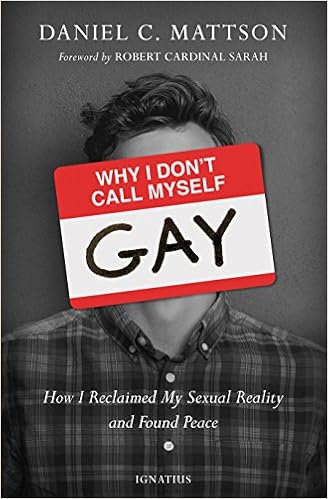
It is my prayer that the world will finally heed the voices of Christians who experience same-sex attractions and who have discovered peace and joy by living the truth of the Gospel. I have been blessed by my encounters with them, and their witness moves me deeply. I wrote the foreword to one such testimony, Daniel Mattson’s book, “Why I Don’t Call Myself Gay: How I Reclaimed My Sexual Reality and Found Peace,” [US HERE – UK HERE] with the hope of making his and similar voices better heard.

These men and women testify to the power of grace, the nobility and resilience of the human heart, and the truth of the church’s teaching on homosexuality. In many cases, they have lived apart from the Gospel for a period but have been reconciled to Christ and his church. Their lives are not easy or without sacrifice. Their same-sex inclinations have not been vanquished. But they have discovered the beauty of chastity and of chaste friendships. Their example deserves respect and attention, because they have much to teach all of us about how to better welcome and accompany our brothers and sisters in authentic pastoral charity.

Cardinal Sarah is prefect of the Congregation for Divine Worship and the Discipline of the Sacraments.

Appeared in the September 1, 2017, print edition.

As a counterpoint, Jesuit-run organ of Jesuitical apologetics, Amerika Magazine, has Fr James Martin’s response to Card. Sarah’s WSJ piece.  Here is some.

First, Martin declared victory because someone listened to him.  Well, whoopdeedo.

Then…

“Cardinal Sarah’s op-ed inaccurately states that my book is critical of church teaching, which it is not. Nor am I,” Father Martin said.

Is that so?

Martin thinks that the language of the Catechism of the Catholic Church ought to be changed, that’s all.  Of course, change the language, and you change the meaning of the paragraph.

What Martin proposes is that the Church stop calling homosexual acts disordered and rather call them “different”.  The are “differently ordered”.

UPDATE:

At Catholic World Report an Evangelical writer responded to Martin in regard to the “Nashville Statement”.

[…]

Martin’s tweets confirm the by-now widely held perception, reinforced repeatedly by Martin himself, that his raison d’etre involves undermining the Catholic Church’s upholding of Jesus’ teaching on a male-female foundation for sexual ethics, upon which Jesus’ teaching about the binary character of marriage (twoness) is based.

A consideration of Martin’s “seven ways” of responding to the Nashville Statement (an evangelical declaration that affirms “that it is sinful to approve of homosexual immorality or transgenderism and that such approval constitutes an essential departure from Christian faithfulness” (Article 10)) underscore the truncated gospel (or even anti-gospel) with which Martin operates.

[…]

The bottom line is this: Fr. Martin is using—or even abusing—his office to undermine what for Jesus was a foundational standard for sexual ethics.


Posted in Sin That Cries To Heaven, The Drill | Tagged , ,
17 Comments

Pope Francis saw a psychoanalyst every week for six months

14_12_22_Francis_Curia_01His Holiness of Our Lord has made an interesting revelation. See the story at the UK’s best Catholic weekly (for which I also write), the Catholic Herald.

Pope Francis saw a psychoanalyst every week for six months when he was 42, he has revealed.

The Pope made the disclosure during a series of interviews with French sociologist Dominique Wolton, head of research at CNRS (National Centre for Scientific Research) in Paris. [interviews with a sociologist?  I guess that makes sense.  After all, sociology is sort of like journalism in slow motion.]

The interviews are recorded in a new book, Pope Francis: Politics and Society.

In extracts published by Le Figaro, the Pope said: “I consulted a Jewish psychoanalyst. For six months, I went to her home once a week to clarify a few things.

Jorge Mario Bergoglio had finished his six-year term as provincial superior of the Argentine Jesuits, and was named the rector of the Philosophical and Theological Faculty of San Miguel in San Miguel the following year, in 1980.

Pope Francis continued: “She was a doctor and psychoanalyst, and she always knew her place. Then one day, when she was about to die, she called me.”

She didn’t want to receive the sacraments, since she was Jewish, but for a spiritual dialogue. She was a very good person. For six months, she helped me a lot when I was 42.”

The revelation is likely to provoke comment. [Indeed.] Although the Vatican never officially condemned psychoanalysis, Sigmund Freud’s work faced disapproval from Catholic thinkers at the time. Strikingly, literary critic Frederick C Crews, a professor of English at the University of California, claims in a new work, ‘Freud: The Making of an Illusion’, that Freud was deliberately anti-Christian.

Obviously none of us are privy to the private conversations of the Argentinian Jesuit and Jewish Psychoanalyst and we should be very careful about how to view this bit of news.

However, the first thing that occurred to me was how some will react.

I can it hear it now.  Libs will say something like, “Isn’t it wonderful that the Pope has made this revelation?  He’s sooooo humble.”

On the other hand, had someone like Card. Sarah or Card. Burke or Pope Benedict revealed that, some decades ago, they saw a psychotherapist, they would shudder with paroxysms of glee and scream, “SEE!  He’s NUTS!  This calls into question everything they have ever done!”

You know down to your bones that that’s exactly what they would do, were a conservative to make such a revelation.

So, dear readers, don’t run around in circles flapping your arms over this news. Prudence.

The moderation queue is ON.

Posted in Francis | Tagged
28 Comments

The young want the patrimony of which they have been defrauded!

17_05_31_PontMass_Queenship_07One of my perennial tropes is that generations of Catholics have been robbed.  They have been cheated out of their patrimony.  They have been defrauded of their inheritance.   When the libs “reformed” the Church’s liturgical worship with little regard for the few true mandates of the Council Fathers, they both slammed the treasury doors shut and hide the key and then brought edifice down to hide its existence from sight.

They thought that they got away with it.

Here is something of interest from the UK’s best Catholic weekly, The Catholic Herald (for which I have for years written a weekly column… print edition only) with my emphases and comments.

The kids are old rite
by Matthew Schmitz

Young Catholics feel they have been denied their inheritance. Where do they go from here?

Last week, in a speech to Italian liturgists, Pope Francis appeared to set in stone the liturgical changes that came at the time of Vatican II. “After this magisterium, after this long journey,” he said, “we can affirm with certainty and with magisterial authority that the liturgical reform is irreversible.” Liberal commentators celebrated his comments as a blow to the “the re-emergence of a certain neo-clericalism with its formalism” and rejoiced that the “restorationist movement in liturgy is being reversed”.

Liberals have reason to be glad: Francis has shown that he is sympathetic to their desire for a liturgy that feels more like a communal meal than an ancient sacrifice. [Hence, the nadir we have reached in some places where Communion is reduced to “they put the white thing in my hand and then we sing a song”.] But does Francis’s declaration mean that after millennia of development liturgical evolution has arrived at a final state and now must stop?  [I don’t think that is what Francis meant.  What he meant isn’t entirely clear to me, but I don’t think that’s it.  Sure, however, his ghostwriter (at least) was showing his animus for any sort of “mutual enrichment” of the Novus Ordo by traditional forms.  That suggests who really wrote it.  HINT: He can’t stand Benedict XVI.]

In a word, no. One might as well magisterially declare that spilt milk can’t be put back in the carton, or dogmatically define that Humpty Dumpty can’t be reassembled, [or forbid the tide to rise] as proclaim that liturgical reform cannot be reversed. It is like proudly stating that one cannot undo a grave mistake. The observation is incontestable, even if shame would be preferable to boasts. The question is not whether we can undo past blunders, but rather how to clean up the mess.  [Before you can correct something, you have to see that there is a problem.]

Francis’ remarks are yet another sign of his anxiety over the traditional direction in which young Catholics are carrying the Church. We have seen this before, in the stories he tells about young priests who shout at strangers and play dress-up, unlike the wise, old, compassionate (and liberal) monsignori. Francis has played variations of John Lennon’s Imagine: “We are grandparents called to dream and give our dream to today’s youth: they need it.” [Okay.  I’m getting the impression that the writer is not a huge fan of Pope Francis.] Maybe so, but the youth do not seem to want it.

As any young progressive or old traditionalist will tell you, age does not dictate whether one prefers dogma or liberty, ritual or casualness. Yet across much of the Catholic world, young traditionalists are competing against old progressives. [Competing?  Really?  I wonder if young trads know that they are competing with old libs?  The libs know that this is now a race against the clock, against the Biological Solution and that they are losing.  Thus, they fury.] Ironies abound, as youths who revere the venerable face off against elders who chase the up-to-date, and progressives who fear the future battle with traditionalists who loathe their immediate forebears.  [Again, I wonder about that “loathe”.  Loathe?  That’s more the stuff of libs.  I think that traddies tend to loathe what the libs have done, especially in robbing us of our patrimony.  Libs, however, don’t just loathe what traditionalists want, they loathe the people who want Tradition.  I think that’s the major different.  Sure the combox at some more traditional site can get a little sharp.  I try to tamp all that down.  But any sharpness on the more conservative side is nothing compared to the sheer nastiness and anger of the combox at, say, Fishwrap.]

Anyone who doubts the reality of the conflict should visit a monastery or convent, where young monastics will almost invariably be more traditional than their elders. In France, in 20 years’ time a majority of priests will celebrate exclusively the traditional Latin mass. Wherever one looks, the kids are old rite.  [Some years ago a friend of mine opined that he thought that, over time, the Novus Ordo would pretty much die out and that the Traditional Form would be again the dominant form.  I pooh-poohed that at the time.  Now I am not so sure.]

Few have spoken as eloquently about the changes the Church is undergoing as Fr René Dinklo, provincial of the Dutch Dominicans, and the only member of his order from Generation X. One of Fr Dinklo’s earliest memories is of a confessional filled with the drums used by the youth choir. By the time he joined the order in the early 1990s, the Dutch Dominicans had discarded their traditional prayers and come to believe that the order would be transformed into an assembly of laymen. He had reason to think he would be the last priest in a province that had lasted for 500 years.

Then the province began to get vocations. The young Dutch Dominicans were eager to reconstitute the forms of life and prayer their elders had dismantled. “We are on the brink of far-reaching changes,” Fr Dinklo observed in an address last year. “In this situation tensions between generations may arise.” The younger men want to wear the habit and “re-discover a number of religious practices, rituals, forms of singing and prayer from the tradition which the older generation has set aside”. In order to avoid generational conflict, these young men are being established in a new house.  [Is this what has happened the Eastern Province of the Dominicans in these USA?  The London Oratory? I was talking with a priest friend last night and the topic of dying communities of women religious came up.  It was suggested that a group of young women should organize and then one by one join some order that is nearly extinct and take them over as inexorably as the rising tide.]

In a 2010 address, Archbishop Augustine DiNoia described the experiences of these young traditionalists. “My sense is that these twenty- and thirty-somethings have been radicalised by their experience … in a way that we were not.” After “God-knows-what kinds of personal and social experiences”, they have come to know “moral chaos, personally and socially, and they want no part of it”. A sense of narrow escape guides their vocations. “It is as if they had gone to the edge of an abyss and pulled back.”

DiNoia’s generation sought to unite the Church and the world, [Gaudium et spes, luctus et angor…] but the young priests believe the two are finally opposed. “It may be hard for us to comprehend, but these young people do not share the cultural optimism that many of us learned to take for granted in the post-conciliar period.” [This is a good point: false optimism.  I could be that, back in the halcyon 60’s there was an overly optimistic view of a) mankind (which made them lean towards anthropocentrism) and b) the world.  Of course the three eternal enemies of man are the world, the flesh and the Devil.  Have you heard much about these over the last 50 years or so?] They lament the “Church’s own internal secularisation”, particularly “the disenchantment of the liturgy”. This explains their enthusiasm for the 1962 missal. [By “disenchantment” he probably is referring to the way that nearly every sign that points to the transcendent were systematically and brutally stripped from our liturgical worship of God by those modernist immanentists… okay, tautology, I know.]

DiNoia is anxious for the priests of his generation. Despite their talk of being open to the future, “I am not certain that we … are entirely ready for the kind of radical rejection of the ambient culture on the one hand, and, on the other, the radical commitment to the Dominican-Catholic alternative way of life that we recognise in the young men.” [And that is not just in the Dominicans.  It is also found in the diocesan presbyterates, for sure.  There is a generational gap.  And it must be truly threatening to some of these older guys.  Many of them sense in the younger generation’s desire for tradition an implicit attack on their own persons, a criticism of their whole life’s work.  They were conditioned in those halcyon days of change and revolution to the point that they and their goals have forms a kind of mythic icon.  The sight of a biretta, a black chasuble, ad orientem triggers a violent flashback.]

Many young Catholics feel that they have been denied an inheritance that was rightly theirs. [“Say the magic woid, win a hunnad dahlahs.”] They have had to reassemble piecemeal something that should have been handed to them intact. [RIGHT!  And does that irritate me!  Think about how much money has been squandered because they, worse than the VANDALS ever did, rampaged through our churches trashing what the People of God paid for with their hard-earned offering. As the head of the TMSM I am constantly reduced to begging you all for money so that we can have the vestments necessary for the celebration of Holy Mass in the Roman Rites paradigmatic form: the Pontifical Solemn Mass. Think of the cost there was to tear out those altars.  Think now of the cost require to try to make wreckovated churches look like churches again.  WHAT A WASTE.  If that doesn’t make you angry, then you need a new… a new…. angry thing.] An English academic recently told me of his attempt to obtain a copy of the Dictionnaire de théologie catholique, a reference book that went from impeccable authority to liber prohibitus at the time of the Council. He contacted a Belgian who helped declining religious houses dispose of their libraries. This Belgian found a Franciscan community that was willing to sell its set – but at the last moment took a different course. The monks decided to burn the books, “to prevent them getting into the hands of traditionalists”.  [When I was in seminary one bastard of a priest – vice-rector who left the priesthood after my second year – told us seminarians to haul all the old vestments to the dumpster… chalices, altar stones, etc.  They were duly taken to the dumpster… and not dumped.  But you get my drift.  But imagine burning something like the classic Dictionnaire for that reason.]


[…]

That’s enough.  You get the main point.

My Spidey Sense is tingling.

I sense that there is a big storm just over the horizon.  We had better clear the decks, reef the topsails, batten down the hatches and prepare to run before the wind.

¡Hagan lío!

Posted in ¡Hagan lío!, Hard-Identity Catholicism, Liberals, Liturgy Science Theatre 3000, The Coming Storm, The Drill, The future and our choices |
52 Comments

Giant space rock hurtling towards your planet! Fr. Z opines and advises.

asteroid_Earth_impactSome of my friends in our SMS exchanges will at times long for the big meteor to put us out of our misery.

Today I read at Space.com that there is a big asteroid – hopefully not meteor – coming.

A space rock is approaching Earth! And although it would be irresponsible to shout “Incoming!” in a hypothetical movie theater and create a panic, asteroid 2012 TC4 will pass quite close to Earth’s surface when it zips safely by our planet later this year.

Teams of scientists from NASA and the European Space Agency (ESA) that monitor the locations of near-Earth objects have been tracking asteroid 2012 TC4 with various instruments, including the ESA’s Very Large Telescope Observatory. Those observations have made it possible to better predict when the asteroid will make its flyby of Earth, and just how close it will get to the planet. Observing close flybys like this also helps prepare teams to detect a near-Earth asteroid whose course might pose a threat to Earth.

2012 TC4 will fly by Earth on Oct. 12 at a distance of about 27,000 miles (43,500 kilometers), or about one-eighth the distance to the moon. Previous observations suggested the space rock might come to within 4,200 miles (6,800 kilometers), according to a statement from NASA.

Scientists are interested in this asteroid not only because of its close approach, but also because of its size: The asteroid is between 30 and 100 feet (10 and 30 meters) across, or the same general size as the rock that exploded above the Russian city of Chelyabinsk in February 2013.

[…]

Two things.

Firstly, one of these days, something will come at the planet on a collision course.  One of these days, it’ll be a big asteroid.  One of these days, it will be a hyuuuuge Coronal Mass Ejection (cf. Carrington Event).

On a smaller scale, one of these days, a car might not stop when you are in the way.  A tree, one of these days, could come through your roof.  It may happen that you will get caught in some civil disturbance or violence, one of these days.

We do not know the day or the hour.  Examine your consciences and…

GO TO CONFESSION!

Next, Spaceweather.com says, speaking of CME, that:

AURORAS LIKELY THIS WEEK: For reasons researchers do not fully understand, the weeks around equinoxes have more geomagnetic disturbances than any other time of year. Data prove it: Auroras love equinoxes. We are now just weeks away from the northern autumnal equinox and, right on cue, the auroras have appeared.  […]  More auroras are in the offing this week. A canyon-shaped hole in the sun’s atmosphere is spewing solar wind toward Earth. Estimated time of arrival: Aug. 31st.  NOAA forecasters estimate a 30% chance of polar geomagnetic storms (G1-class) when the gaseous material arrives.

Posted in Look! Up in the sky! | Tagged , ,
9 Comments

The crisis of priestly vocations: good advice from a smart priest

More on the issue of vocations to the priesthood.  Allow me, first, to say that the “crisis” of vocations was created and it’s perpetuation is also not only tolerated but, in some places, fostered.  That said, it is probable that in most places the presuppositions and vocational views of those in charge are so bent in one particular direction, that they are nearly incapable of turning their heads to look for solutions in another direction.

Consider the following diagram:

angles

If you travel along the ray that extends from A through points D and E, are you getting closer or farther away from the ray that points to “More good priestly vocations”?

If you want to arrive at, say, St. Ipsidipsy parish in Tall Tree Circle in the Diocese of Black Duck for supper with Msgr. Zuhlsdorf (NB: I’ve discerned myself to be an Internal Forum Monsignor and now you are obliged to “accompany” me), but instead you discover that you have taken the road toward Engendering Togetherness Community of Welcome over in Libville where Bp. Fatty McButterpants gloomily reigns, do you continue down the road to Libville or to you turn around and go back to correct your course?

Here is something I picked up from Liturgy Guy, written by a priest of Bridgeport.  He nails some important points.  My emphases and comments:

One Priest’s View on the Vocations Crisis

The following guest post was written by Fr. Donald L. Kloster, a priest of the Diocese of Bridgeport, Connecticut who has served (for over 6 years) as the pastor of 36,000 faithful in the poorer parish of Maria Inmaculada Eucarisitica in the Archdiocese of Guayaquil, Ecuador.

Father Kloster graduated from St. Charles Borromeo Seminary Philadelphia, PA in 1995, having completed his Master’s Thesis in Moral Theology. He is a native of Texas and graduated from the University of Texas at Austin in 1989. In addition, Fr. Kloster spent two years as a student (and then novice) at the 7th century est. Benedictine Abbey of Disentis, Switzerland.

As someone who has lived on 3 continents and in 11 U.S. dioceses during my adult life, I have seen a lot where vocations are concerned. The Liturgy Guy said it well recently when he noted that the answer to increased vocations isn’t beyond our capability. Unfortunately, our chanceries have often spent too much time and money searching for vocations in all the wrong places.  [My old pastor Msgr. Schuler, speaking of the horrid situation of the seminary and vocations back in the 80’s and 90’s used to say that the Powers That Were couldn’t answer three fundamental questions: 1) Who is Christ?  2) Who is the Church?  3) Who is the priest?  Get those wrong, or waffle, and you are done for.]

Increasing vocations is not a matter of more conferences, retreats, publications, advertising, and slide shows. These things have minimal effects. It is as if hand wringing will do the Church any good at all. It is as if the powers that be really aren’t interested in true solutions. [Another thing that Msgr. Schuler used to say: “It’s as if they sit around and talk about how to starve to death together instead of getting up and planting more potatoes.”]

From my observation deck, there seems to be a lot of a priori suppositions that inhibit a true rise in vocations. There is a communal reluctance to admit wherein the vocations successes are gaining traction. Traditional dioceses and Traditional Orders are producing the lion’s share of vocations.  [Do I hear an “AMEN!”?]

Coca Cola famously introduced New Coke in 1985. It lasted just 77 days. Only 13% of Coke drinkers even liked it. Did that company double down on the New Coke promotional ads? They had, after all, spent millions of dollars to introduce the product. No, they did an about face and reintroduced Coca-Cola Classic! [BINGO!] By comparison, our Bishops have done the exact opposite when it comes to vocations. They are continuing in methods that are proven failures.

I humbly submit that there is a spiritual connection between the height of vocations in 1965 and our vocations dearth that has continued for 52 years now.

[QUAERITUR:] Just exactly what have we been doing wrong? I’m afraid that a great many of our modern Prelates do not want to hear the real answer because it does not fit in with their narrative; they stubbornly clung to ideology. [Again, some of them are sheer ideologues. Others simply are bewildered and don’t have a clue.   Alas, some of the latter are surrounded by ideologues.]

First, we need an exclusively masculine sanctuary. [Remember my POLLS?] Vatican II never envisioned an army of Extraordinary Ministers. It never envisioned altar girls. It never envisioned the (almost) exclusive reading of the Old Testament and Epistles at Mass by women. [All these things were rammed down our throats, mostly against law and common sense.]

There is only one diocese in all of the United States that is obedient to even the most recent 2011 General Instruction of the Roman Missal. The GIRM calls for instituted acolytes and lectors. It is a gross abuse that in the more Solemn Masses at almost any Cathedral in the nation, there are instituted seminarian lectors that are many times prohibited from fulfilling their installed liturgical privilege.  [In some places I’ll wager that bishops and their coteries do not want to “install” lectors and acolytes because, frankly, they are afraid of women.]

We have largely evicted men from the sanctuary (as sextons and ushers too) at the peril of vocations. Men will almost always take a back seat if they perceive it is a duty reserved to women.

Second, we need a more visibly identifiable clergy. The most proper dress of a priest is the cassock. Next comes the clerical suit. A priest should normally always wear his jacket or at least have it with him. In former days, there was also a regulation to carry one’s biretta or hat. I cannot tell you how many times I have been stopped for a question, blessing, or confession. If I am not visibly identified, I am invisible as an available priest. If I were to walk around in street clothes regularly, I communicate to others with my dress a certain lack of importance invested in my vocation. The police wear their uniforms for a reason. We are their spiritual equivalent, except that we are never “off duty.[On a side note, it seems most frequently the duty of the cop to say “No.”, just as it is of the father of children and, of course, the priest.]

Third and most importantly, we need a communal obligatory penance to help promote vocations. [YES!] Perhaps it means a return to abstinence on Fridays. Perhaps every Catholic under pain of venial sin should visit a monstrance or a tabernacle for 10 minutes weekly. Perhaps a monthly day of fasting under the usual conditions like Ash Wednesday and Good Friday.

Lincoln, Nebraska and Guadalajara, Mexico are perhaps the best two Dioceses in the Americas at promoting vocations. [HEY!  MADISON!] Why aren’t all of the other dioceses copying them? My frustration is that it seems collectively as a Church we are content to have a continually declining priest to faithful ratio.  [I was recently told that a large Archdiocese I visited had 17 major seminarians, but half of them were foreign born.  In relatively tiny Madison there are 16 major seminarians and 2 of them were born elsewhere.]

As in most situations in life, if something isn’t working you abandon it. It’s only logical. Tradition is not a bad word. [That depends, of course, on your audience.] Mother Teresa of Calcutta once famously refused to send her nuns to Albania without priests. “Without priests we do not have the Mass.”  [And without strong bishops who really want more vocations, and who treat their priests well, and who stay close with all the seminarians… no vocations.]

Vocations are not just a pious part of a “wish list.” They are the basic need of our survival as a Church. The sooner vocations begin to (significantly) increase again, the sooner we will witness a spiritually healthier Catholic Church again.

Fr. Z kudos.

Of course you have anticipated what I am about to write.

No initiative which we undertake in the Church will succeed without an renewal and revitalization of our sacred liturgical worship.  That includes vocations to the priesthood.

We are our rites.

There is a direct bond of nerve ganglia and blood vessels in the Body of Christ which tie together Holy Mass and vocations to the priesthood.  If you wound those nerves and arteries, you inflict profound damage extending beyond the local laceration.  That is what happened in the post-Conciliar reforms.  A huge wound was inflicted in the nerves and vessels of the Body of Christ, such that we are now dangerous enervated and bloodless.

We need many more celebrations of Holy Mass in the traditional Roman Rite side by side with the Novus Ordo.  Happily, younger priests and seminarians really want to use the traditional Roman Rite.  This will create a tremendous knock on effect through their revitalized ars celebrandi.  The spreading use of the traditional forms – along with the strong priestly identity advocated by the writer above – will be like the introduction of clotting agents, transfusions of blood, mending of nerves, application of antibiotics, better diet and supplements, and supportive therapy.  The effect will surely be beneficial.

Also, I will urge pastors of parish to get their congregation down on their knees explicitly to pray for vocations.   I warmly urge the use of the Vocations Prayer I’ve written about many times on this blog.  Get it.  Print it.  Implement it as is… without tinkering with it.  It is effective.

And read these…

The moderation queue is ON.

Posted in "How To..." - Practical Notes, Hard-Identity Catholicism, Liturgy Science Theatre 3000, Mail from priests, Priests and Priesthood, Seminarians and Seminaries, Semper Paratus, The Coming Storm, The future and our choices, Turn Towards The Lord | Tagged , ,
29 Comments

18-22 Sept 2017: Conference on liturgical formation!

traditional-latin-mass-altar-your-viewThere is to be an interesting liturgical conference in W. Peabody, Mass, in September.  Priests and seminarians should pay particular attention.

Culmen Et Fons 2017: On Liturgical Formation

Fons et culmen” concerns the famous phrase about the Eucharist being the “source and summit” in Sacrosanctum Concilium.

Description excerpts:

The scope and the topics of the conference correspond precisely to the needs set out with characteristic clarity by Cardinal Robert Sarah, Prefect of the Congregation for Divine Worship and the Discipline of the Sacraments in his 2016 London Address and in his remarks made in June 2017 at the Sacra Liturgia conference in Milan, Italy.

[…]

The conference, moreover, will help participants who are in holy orders the better “to interiorize the mystery of faith that is being celebrated” in both uses of the Roman-rite Mass and to enhance their own ars celebrandi of the Mass according to both usages “by emphasizing the best features that characterize them.”

This looks like a good one.

17_08_29_Culmen_et_Fons

Posted in Liturgy Science Theatre 3000, The Campus Telephone Pole | Tagged
4 Comments

29 August 1997 – Happy Birthday SKYNET!

Skynet

I hope you realize that this is a subtle message never to attempt to delete my blog from your daily reading list.


Posted in Lighter fare | Tagged
2 Comments

Speaking Truth To Power

salome-with-the-head-of-saint-john-the-baptist-onorio-marinariWe celebrate liturgically the births of Our Lord (25 December), His Blessed Mother (8 September) and the prophet who was more than a prophet, the greatest man ever born of a woman (Matthew 11:9-11; Luke 7:28), St John the Baptist (+24 June 28-29).  On 29 August we celebrate the Beheading of St John, murdered by a feckless politician, the pusillanimous Tetrarch Herod. John was imprisoned because he denounced Herod’s illicit, sinful “marriage”.  Herod then had John killed because, blinded by lust for his niece, he was too craven to back down from a rash offer he blurted in his lechery.

St Augustine of Hippo (+430) in s. 380 reflects on how John was martyred for Christ because he was murdered for the Truth.  England’s own Venerable Bede (+735) preached, “St John gave his life for [Christ]. He was not ordered to deny Jesus Christ, but was ordered to keep silent about the Truth”.

Speaking the truth to power, and to wider society, about sexual mores, about illicit and immoral unions, can earn you a close haircut.  In the Church, asking too many questions about objectively confusing problems can earn you a … shave.

michelangelo_caravaggio_beheading

And yet, the “greatest man ever born of a woman” bore witness to the Truth.  It is the right thing to do.  The lives of martyrs are no less examples for imitation today than they were when they were fresh models to our ancient forebears in the Faith.

In 2012, Benedict XVI taught about the martyrdom of the Baptist in a General Audience.  He said,

“Celebrating the martyrdom of St John the Baptist reminds us too, Christians of this time, that with love for Christ, for his words and for the Truth, we cannot stoop to compromises. The Truth is Truth; there are no compromises. Christian life demands, so to speak, the ‘martyrdom’ of daily fidelity to the Gospel, the courage, that is, to let Christ grow within us and let him be the One who guides our thought and our actions. However, this can happen in our life only if we have a solid relationship with God.”

Speaking of speaking truth to power, to paraphrase Edmund Burke (+1797), in Thoughts on the Cause of the Present Discontents (1770), the only thing necessary for the triumph of evil is for good men to do nothing.  United in prayer and our Faith, we must together bear witness to the Truth in our troubling times, as martyrs and confessors did in theirs.

Herodias with head of John Baptist Boston

You might momentarily be deceived into thinking that this is a portrait of a certain writer at the Fishwrap, prone to swoons.  Instead, however, it is

Herodias with the Head of Saint John the Baptist

The ecstatic adulteress is in the very act of mutilating with a pin the tongue that named her sin.

Francesco del Cairo (1598–1674)

Posted in ¡Hagan lío!, Liturgy Science Theatre 3000, Saints: Stories & Symbols | Tagged ,
3 Comments

Eyewitness account of struggle over post-Conciliar liturgical reform, which “reversed” centuries

Marcel-LefebvreI think that some day many more people will know about the life and work of the late French Archbp. Marcel Lefebvre.  He, a Holy Ghost Father, was a great missionary in Africa whose influence is still strongly felt there.  He was also a bishop at the Second Vatican Council, about which he writes in his memoirs.


Oh yes, he also founded the SSPX.

At One Peter Five there is a post about Lefebvre’s view of a powerful influence on Popes John XXIII and Paul VI.

Here is a bit of the post about the liturgical reform with my emphases and comments:

[…]

I had the occasion to see for myself what influence Fr. Bugnini had. [Annibale at the gate] One wonders how such a thing as this could have happened at Rome. At that time immediately after the Council, I was Superior General of the Congregation of the Fathers of the Holy Ghost and we had a meeting of the Superiors General at Rome. We had asked Fr. Bugnini [to] explain to us what his New Mass was, for this was not at all a small event. [litotes] Immediately after the Council was heard of the Normative Mass, the New Mass, the Novus Ordo. What did all this mean?

It had not been spoken of at the Council. [The Council Fathers had mandated a few points, but the Consilium (a committee entrusted with the reform) went waaaaay beyond the mandates.] What had happened? And so we asked Fr. Bugnini to come and explain himself to the 84 Superiors General who were united together, amongst whom I consequently was.

Fr. Bugnini, with much confidence, explained what the Normative Mass would be; this will be changed, that will be changed and we will put in place another Offertory. We will be able to reduce the communion prayers. We will be able to have several different formats for the beginning of Mass. We will be able to say the Mass in the vernacular tongue. We looked at one another saying to ourselves: “But it’s not possible!”

He spoke absolutely, as if there had never been a Mass in the Church before him. He spoke of his Normative Mass as of a new invention.  [Keep in mind that Bugnini had been given the heave-ho by the Sacred Congregation for Rites from his position at the Lateran University.  From that point onward, he had it out for just about everyone and everything.  And the 1955 changes to Holy Week was just the warm-up.  Who he was and what he was about was clear.]

Personally I was myself so stunned that I remained mute, although I generally speak freely when it is a question of opposing those with whom I am not in agreement. I could not utter a word. How could it be possible for this man before me to be entrusted with the entire reform of the Catholic Liturgy, the entire reform of the Holy Sacrifice of the Mass, of the sacraments, of the Breviary, and of all our prayers? Where are we going? Where is the Church going?

Two Superiors General had the courage to speak out. One of them asked Fr. Bugnini: “Is this an active participation, that is a bodily participation, that is to say with vocal prayers, or is it a spiritual participation? In any case you have so much spoken of the participation of the faithful that it seems you can no longer justify Mass celebrated without the faithful. Your entire Mass has been fabricated around the participation of the faithful. We Benedictines celebrate our Masses without the assistance of the faithful. Does this mean that we must discontinue our private Masses, since we do not have faithful to participate in them?”

I repeat to you exactly that which Fr. Bugnini said. I have it still in my ears, so much did it strike me: To speak truthfully we didn’t think of that,” he said! [I wonder.]

Afterwards another arose and said: “Reverend Father, you have said that we will suppress this and we will suppress that, that we will replace this thing by that and always by shorter prayers. I have the impression that your new Mass could be said in ten or twelve minutes or at the most a quarter of an hour. This is not reasonable. This is not respectful towards such an act of the Church.” Well, this is what he replied: “We can always add something.” Is this for real? I heard it myself. If somebody had told me the story I would perhaps have doubted it, now I heard it myself.  [Remember what Joseph Ratzinger said: an artificial creation.  No wonder such a shock slammed the Church and wounded her for these many decades.]

Afterwards, at the time at which this Normative Mass began to be put into practice, I was so disgusted that we met with some priests and theologians in a small meeting. From it came the “Brief Critical Study,” which was taken to Cardinal Ottaviani. I presided [at] that small meeting. We said to ourselves: “We must go and find the Cardinals. We cannot allow this to happen without reacting.”

So I myself went to find the Secretary of State, Cardinal Cicognani, and I said to him: “Your Eminence, you are not going to allow this to get through, are you? It’s not possible. What is this New Mass? It is a revolution in the Church, a revolution in the Liturgy.

Cardinal Cicognani, who was the Secretary of State of Pope Paul VI, placed his head between his hands and said to me: “Oh Monseigneur, I know well. I am in full agreement with you; but what can I do? Fr. Bugnini goes in to the office of the Holy Father and makes him sign what he wants.” It was the Cardinal Secretary of State who told me this! Therefore the Secretary of State, the number two person in the Church after the Pope himself, was placed in a position of inferiority with respect to Fr. Bugnini. He could enter into the Pope’s office when he wanted and make him sign what he wanted.

Does not such a professed sense of powerlessness (and paralysis) – as described here with reference to Cardinal Cicognani – remind us of our own current situation, where we are told my high-ranking prelates and even prefects of congregations that they cannot do anything about the revolutionary things that are happening in the Vatican? Here it might be worthwhile to add another example given by Archbishop Lefebvre:

A third fact, of which I was myself the witness, with respect to Fr. Bugnini is also astonishing. When permission was about to be given for Communion in the hand (what a horrible thing!), I said to myself that I could not sit by without saying anything. I must go and see Cardinal [Benno Walter] Gut – a Swiss – who was Prefect of the Congregation for Worship. I therefore went to Rome, where Cardinal Gut received me in a very friendly way and immediately said to me: “I’m going to make my second-in- charge, Archbishop Antonini, come that he also might hear what you have to say.”

As we spoke I said: “Listen, you who are responsible for the Congregation for Worship, are you going to approve this decree which authorizes Communion in the hand? Just think of all the sacrileges, which it is going to cause. Just think of the lack of respect for the Holy Eucharist, which is going to spread throughout the entire Church. You cannot possibly allow such a thing to happen. Already priests are beginning to give Communion in this manner. It must be stopped immediately. And with this New Mass they always take the shortest canon, that is the second one, which is very brief”

At this, Cardinal Gut said to Archbishop Antonini, “See, I told you this would happen and that priests would take the shortest canon so as to go more quickly and finish the Mass more quickly.”

Afterwards Cardinal Gut said to me: “Monseigneur, if one were to ask my opinion (when he said “one” he was speaking of the Pope, since nobody was over him except the Pope), but I’m not certain it is asked of me (don’t forget that he was Prefect for the Congregation for Worship and was responsible for everything which was related to Worship and to the Liturgy!), but if the Pope were to ask for it, I would place myself on my knees, Monseigneur, before the Pope and I would say to him: ‘Holy Father, do not do this; do not sign this decree.’ I would cast myself on my knees, Monseigneur. But I do not know that I will be asked. For it is not I who command here.”

This I heard with my own ears. He was making allusion to Bugnini, who was the third in the Congregation for Worship. There was first of all Cardinal Gut, then Archbishop Antonini and then Fr. Bugnini, President of the Liturgical Commission. You ought to have heard that! Alas, you can now understand my attitude when I am told: you are a dissident and [a] disobedient rebel.

Scripta manent.

The moderation queue is ON.

Posted in Liturgy Science Theatre 3000 | Tagged , , ,
32 Comments