ASK FATHER: Can’t get “Liturgy of the Hours” in Latin – Wherein Fr. Z RANTS

17_02_07_Jesuit_breviaryFrom a seminarian…

QUAERITUR:

I am a seminarian for ___, and I have been looking for a 4 Vol. Latin Breviary [Liturgia Horarum] … I emailed the Libreria Editrice Vaticana and received this response:

Dear Mr. __,

I’m sorry to inform you that all the volumes of the Liturgia Horarum in Latin language are no longer available and at the moment there is not a reprinting plan.

Best regards

Dott. Alfredo Maria Ottaviani
Ufficio Commerciale
Libreria Editrice Vaticana

Tel: +39 06.6988.1032
Fax: +39 06.6988.4716
Email: commerciale@lev.va
www.libreriaeditricevaticana.va

Why aren’t they printing these volumes anymore? What can we do if we want a book-version? I don’t even think MTF is printing their version anymore.

I can imagine a couple reasons.

First, market forces: If the demand drops, the publisher won’t print it.  If the demand returns they will reprint.  This is the most obvious reason.  For the Vatican Press, it’s all about money.

Second, ideology: There has been a concerted effort to wipe out Latin.  This has been going on since before Pope St. John XXIII’s Apostolic Constitution Veterum sapientia.  I think that there may also be an ideological reason because, were some other publisher want to take on the task, the LEV would probably deny them permission.

I remind the readership, especially those readers who are diocesan bishops, that the Code of Canon Law, can. 249, requires – it doesn’t suggest or recommend or propose, but requires – that seminarians be “very well skilled” in the Latin language: “lingua latina bene calleant“. Not just calleant, says can. 249, but bene calleant.

Calleo is “to be practiced, to be wise by experience, to be skillful, versed in” or “to know by experience or practice, to know, have the knowledge of, understand”. We get the word “callused” from this verb. We develop calluses when we do something repeatedly. So, bene calleant is “let them be very well versed”.

Review also Sacrosanctum Concilium 36 and Optatam totius 13, just to point to documents of Vatican II. … unless you “HATE VATICAN II!”, as the libs throw about.

Latin is necessary.  Its benefits are so numerous that they shouldn’t have to be enumerated.  And yet we are faced today with a clergy of the LATIN Church who are nearly totally ignorant of Latin!

I ask you, Reverend and Most Reverend gentlemen, what does it mean for our Catholic identity if our clergy don’t know the language – and therefore what goes with the language – of their Rite and Church?

Do you think that that’s a problem?

“But Father! But Father!”, some of these priests and bishops will respond, “We have so many more pressing problems to address!”

Is that so.

Our Catholic identity has been severely enervated over the last half dozen decades.  Let’s do something about this, starting with elementary and high schools!  Let’s do something about this starting in homeschooling!  We have to recover these lost tools or we will, shortly, begin to pay massively for the wounds to our identity.

Oh… and by the way… when rectors or others stand up during ordinations to attest before God that the men to be ordained for the Latin Church have been properly trained…. is that true if they have no Latin?


Posted in "How To..." - Practical Notes, ASK FATHER Question Box, Liturgy Science Theatre 3000, Our Catholic Identity, Wherein Fr. Z Rants | Tagged , , , ,
49 Comments

Card. Caffarra – RIP

carlo-caffarra-con-benedetto-XVIHis Eminence Carlo Card. Caffarra has died.  He is the second of the Four Cardinals of the Five Dubia to have gone to the Lord – in two months – without having read answers from Pope Francis.

And then there were two.

One of my Roman correspondents wrote this morning of a reliable priest’s account:

“His last words were of encouragement as the Lord will not forsake the Church and he will rebuild it with the few who will endure these times and to pray to St. Athanasius.  He said, have faith, hope and love.”

Stop and say a prayer for Carlo Caffarra today.  We hope that he is now, or will be soon, an intercessor in heaven.


Posted in PRAYER REQUEST | Tagged , ,
19 Comments

Wherein Fr. Z responds to Fr. H’s “brick by brick” comment

popebenedictbrickbybricknew5tranwebThis from the inimitable Fr. Hunwicke at his always gratifying page with my Usual Treatment™:

How to introduce the Vetus Ordo to a country church overnight

For weeks before my induction I had been in the parish seeing people in their homes and in the fields … endeavouring to prepare the minds of all who would listen for the changes I contemplated making in the services.

“All had been made ready for the solemn offering of the Mass. Nicholas Peters had learnt to swing the censer, Peter Curnow … to make the responses, when on that first Sunday after my induction the people of St Hilary flocked to the church and found, in the place of a clergyman reading Dearly beloved, a strange figure in vestments at the altar with a little boy who knelt at his side. Many were watching for the first time the drama of the Mass. They were there as spectators who watch a play with a symbolism and language unknown to them. Man cries for redemption, Kyrie eleison, Christe eleison, Kyrie eleison. God answers man’s despairing cry in the opening words of the Gloria in excelsis, proclaiming the advent of the promised Saviour, but still they do not understand.

“‘Whatever is he doing up there now?’ they say. ‘Can ‘e make it out at all?’ The summit of the drama is reached when, the whole company of heaven having been summoned to man’s aid, the words of consecration are spoken and the bread and wine become the Body and Blood of Jesus who offered Himself on the Cross at Calvary. They are aware of the silence, broken by the ringing of a bell. ‘Did ‘e hear the bell? What is that for, my dear’ they whisper. The bell rings again at the Domine non sum dignus. There are a few who kneel in wonder at what is being accomplished; it is for them a moment of prayer such as they have never experienced before. But for many who crowd the church the great drama of the Mass remains without meaning.”

I know what readers are thinking … “That’s not very brick-by-brick”.

Sed contra, dear Father.  That’s brick by brick indeed.

There was preparation beforehand. Moreover, in building the structure – one “made of living stones” – not all the bricks and stones were lain at the same time.  As in that congregation described, some kneel in wonder, some wonder what’s going on.  Some sense the moment, some are distracted by externals.  At the next offering of the Holy Sacrifice, more bricks will be prepared and set in place.

As he works, the bricklayer, the stonemason, must dress the stones and bricks, chipping here, smoothing there.

Furthermore, there are those entirely familiar with every aspect of the liturgical actions down to the last jot and tittle who nonetheless do not have an encounter with the Mystery tremendum et fascinans because they are absorbed in whether or not the missal stand was placed at their approved angle when the server shipped it from the Epistle to the Gospel side.  They participate lacking in wonder, because they are listening for errors in pronunciation or of pitch.  Their principle active participation is to measure up the liturgical action against their own expectations.   Those who know less, some times rise to greater and actual participation.

Hence, the priest in the account above has a great advantage in the continuance of his work brick by brick.  He can dress the stones who, at that Mass, found no meaning, even while he builds with those who knelt in wonder.

True “brick by brick” work has to have a beginning.  That was a beginning.

Posted in "How To..." - Practical Notes, Brick by Brick, Liturgy Science Theatre 3000, Mail from priests | Tagged ,
5 Comments

Worship, Memory and You

This morning at NLM Peter Kwasniewski makes some points about liturgy and memory, memorization, which are quite good… so good that I have made them myself in the past.  Here is a good bit:

This requirement [for priests who say the Extraordinary Form, Usus Antiquior] of memorization, far from being a mere guarantee of efficiency, has its own profound value: it is one more way in which the ancient liturgy demands that the celebrant “put on the mind of Christ” — or better, enter His Heart — by means of “knowing by heart” certain prayers of the Church that mold him into the image of their sentiments.

Prayers run the risk of remaining external to the celebrant as long as they are merely written in the Missal, because their location is an external book. Memorized prayers, on the other hand, are already internal(ized) and, as such, are more available as a wellspring of piety within. The heart has become the book, the living book from which the Mass is celebrated.

The same must be said for catechism and children (or adult converts).  I have related in the past how at a hospital I was confronted by a woman whose father was dying.  She was very angry at God and everyone else.  “Why would a God make us just to wind up like this!”, was the essence of her anger and sorrow.  I asked her, “Why did God make you?”  She calmed down and gave the precise Baltimore Catechism answer, which then helped her to deal with her father’s death.

Once you have it inside then it is yours.

I have also often opined that priests should memorize at least one set of texts for a Mass, perhaps a Votive of the Blessed Virgin: there might come a day when you, in hiding, have no books, etc.

Have a look at Peter’s thoughts.  There is a lot to discuss.


Posted in "How To..." - Practical Notes, Hard-Identity Catholicism, Liturgy Science Theatre 3000 | Tagged ,
15 Comments

Fr. Z heading to Rome for Summorum Pontificum, also asks for input

A few items as the Labor Day weekend winds to a close.

First, I will be in Rome for the Summorum Pontificum Pilgrimage. I’m only there for a week and I will be REALLY BUSY for a lot of it. Just FYI before people get all worked up. The whole thing will be like a blognic anyway.

I will be saying Masses for my benefactors daily while I am in the Eternal City.

Second: When in Rome, I will stop at Gammarelli to check on another project, this time personal.  For a while now I’ve been wanting to have “travel” vestments made to go along with my wonderful portable altar made by St. Joseph’s Apprentice (aka The ULTIMATE Gift For A Priest -received for my 25th) HERE. Since I travel a bit, I’ve gotten good use from it so far.  (Note to the carpenter: the bookstand… I have feedback for you.) I have a couple trips lined up for it in the future, for which I got a hard Pelican case (thanks to a reader).

I am presently on a trip with friends and it is set up for daily Mass:

What I lack are travel vestments in the liturgical colors.

I had an idea: were some readers interesting in helping with the vestments, I would find a way to have your name embroidered on them or on their pouch so that you would be remembered in prayer as I (or a priest who inherits them) vests.

At the moment, I am contemplating an order or dupioni or shantung silk.  If I do it tomorrow, I could probably get it in time to take to Rome with me.  Otherwise, I might buy it in Rome to keep the cost down.   A reversible travel vestment with all the parts from Gammarelli would be about €600 (c. $715).  [To be clearer: €600 is for one reversible vestment, with two colors.  That’s for each set.  A couple of you asked about that in email.] Buying the fabric will, I think, cut the cost.  I may even have little antependia made, which would be fun.  The chalice veil and burse would have to be about half size, I think: I use a miniature chalice and paten from an old Mass kit.  The great altar cards are from SPORCH.

So, I also have to figure out the best combination of colors.  Considering that they are reversible, and that I use the Usus Antiquior when I have this altar with me, I was thinking

White – Red
Violet – Rose
Black – Green

Perhaps priests could jump in about the best combinations.  I tend also to use Votive Masses that need violet.  But we also have lots of saints who need white or red.  So, perhaps,

White – Red
Violet – Green
Black – Rose

Which would help because I’d need mainly two vestments.  But what about Requiem Masses?  Another possibility would be to add a couple more colors into the mix: Gold and Blue, or Gold and (repeated color).  Interesting permutations occur.  Trim will probably by silver all around.  It unlikely that I would be traveling with this altar for Gaudete and Laetare…. so… rose?  How about throw blue into the mix, for fun.

White – Red
Violet – Green
Black – Blue
___
Rose – Gold

Dunno.

I invite input.

Meanwhile, in the U.P. of Michigan, I visited the grave of a JESUIT!  Yes, I know.

This is Fr. Marquette, the great missionary.  Many of us in the northlands know his name because things in our cities are named for him.

Here is Fr Marquette waving goodbye to all the modern Jesuits, even as he wonders where on Earth they think they are going.

Meanwhile, which drink is mine?

Posted in On the road, What Fr. Z is up to | Tagged
20 Comments

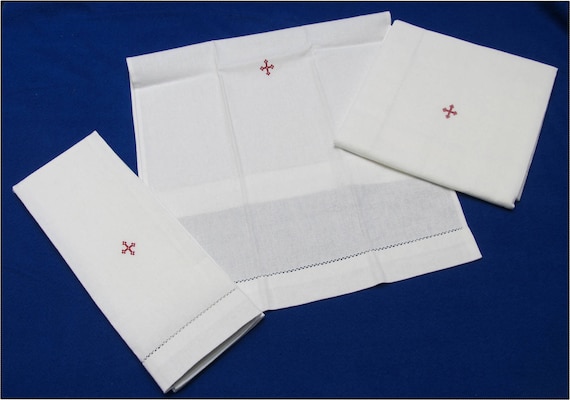
Help Carmelite nuns who make altar linens

There are several groups of sisters whom I like to support.  I just received a note from another: the Carmelites of Port Tobacco.

Frankly, I had to look that up to see if it was a real place and group.  It is!  HERE

They wrote that they have handmade altar linens available for sale.  HERE

May I make a suggestion?  Find out if your priest has an upcoming birthday, or anniversary, or some such, and get him a set of linens.

Posted in "How To..." - Practical Notes, The Campus Telephone Pole, Women Religious | Tagged , ,
3 Comments

ASK FATHER: EMHC’s at a Communion rail

From a reader…

QUAERITUR:

Can a lay person who is commissioned as an EMHC distribute Holy Communion to communicants kneeling at a Communion rail under the Novus Ordo?

Allow me to remind the readership of the 1997 document which ought to frame every questions concerning “Extraordinary Ministers of Holy Communion”.   Everyone involved in that activity should review the Congregation for the Clergy’s “ON CERTAIN QUESTIONS REGARDING THE COLLABORATION OF THE NON-ORDAINED FAITHFUL IN THE SACRED MINISTRY OF PRIEST” [HERE].   This authoritative document says that “the habitual use of extraordinary ministers of Holy Communion at Mass thus arbitrarily extending the concept of ‘a great number of the faithful’” is “to be avoided and eliminated.

In the rubrics (i.e., the “law”) the determination of the usefulness of EMHC’s is left to the priest to decide.  That said, the local bishop could issue a law restricting or delimiting their use.

Is it wrong to use EMHC’s at a daily Mass with 10 people, or a Sunday Mass with 150? Yes.

Is it against the law? No.

To the question.  EMHC’s are allowed by law.  Kneeling is an acceptable way to receive, arguably the best way.  Nothing in the law says that the “conga line” method is how Communion must be distributed.  Nothing in the law say that the ENHC has to stand in one place.   I surmise that an EMHC could move along a Communion rail.  However, it is one thing for a priest to do this, who has years of experience, and an EMHC who might do this only occasionally.  I would say that, if it is determined that EMHC’s will used, they would need specific instructions and close oversight.

Again, it seems to me that most of the situations in which EMHC’s are employed don’t really call for EMHC’s.

Meanwhile here is an EMHC at a “Communion rail” at a Pope Francis mega-Mass.


Posted in "How To..." - Practical Notes, ASK FATHER Question Box, Canon Law, Liturgy Science Theatre 3000 | Tagged ,
33 Comments

ASK FATHER: Can a Pope name his own successor?

popes_posterFrom a reader…

QUAERITUR:

If a Pope wanted to ensure that the next holder of his office would be of like mind and continue his policies, is there any moral or theological impediment to his naming his own successor before his death?

Interesting theoretical question.  I am unaware of any opinions by good, specific writers on the topic, though it is possible that someone like St Robert Bellarmine has already worked through the issues.   I’ll take a stab anyway, animi caussa.

So, can a Pope do this, or has a Pope done this, or should a Pope do this?

There are a couple things to be held in tension.   First, the Pope has from God full, supreme, and universal power over the whole Church, which he can always exercise unhindered. The Pope enjoys, by divine institution, supreme, full, immediate, and universal power in the care of souls. Next, we mustn’t exaggerate or overestimate what the Pope can do. He is still bound in some ways.

The way by which Popes, Bishops of Rome have been chosen has changed over the centuries, though for a long while now it has been pretty standardized: he is elected by the body or college of “hinge-men” or Cardinals, who are technically the special clergy of Rome.   Keep in mind that Peter was, yes, the first “Pope”, but he also wasn’t.  The office of “Pope” who is the Bishop of Rome and Successor of Peter is a reality that has taken on more manifest work and institution than what Peter concerned himself with.  While scholars are divided, it is probable that Peter chose his successor – probably Linus – by consecrating him.  It is possible that Pope may have consecrated others.  However, we generally go with Linus.  So, Peter seems to have designated the one he wanted to succeed him and it seems that the Church of Rome followed his wishes.  I don’t know if that is the same as choosing your successor or not, since the historical circumstances were entirely different. As the Church grew in number and in freedom and became more institutionalized, the method of choosing the leader changed.   We must avoid anachronism problems.

Later, however, when the Pope really had become Pope in the more modern sense, I think there is the case of Felix IV who tried to designate his successor, a Boniface II.  However, the secular state, the Senate forbade discussion of a successor and Felix was thwarted as the clergy of Rome objected and another was elected.  As it turned out they sort of shared the role for a bit and then Boniface was duly elected in his own right.   So, yes, Felix IV named his successor, but, no, it didn’t work… until it did.

Today, Popes are the Legislators in the Church.  They literally lay down the law for how Popes are elected.  Also, the state is completely out of the picture since the odd events of the conclave in which St. Pius X was elected. Now, every Pope can change his predecessors laws and procedures, though in fact they have remained pretty much the same for a long time, so long that it is nearly unthinkable to do it otherwise.   Hence, Popes have a kind of moral bond, at least, to follow the same.

That said, the Pope, who has full authority, could theoretically step by step abrogate the laws of election of a Pope.  He could, I suppose, even reprobate those laws, that is, abolish them in a such a severe way as to make it impossible to appeal to custom.  Say a Pope did that and then completely wiped out the College of Cardinals, forbidding it, etc.  Then I suppose he could establish a new office of Coadjutor Bishop of Rome with right of succession.  That Pope could say, “Upon my death, Coadjutor Bishop of Rome John Zuhlsdorf will immediately succeed me and you shall prostrate yourselves three times as you approach him and then kiss his right shoe.”  On the death of that Pope, I would take new name “Father Z I” or else “Clemente XIV Ganganelli I”, but I would defer the foot kissing thing for a while for reasons which should be obvious: by the time I get done with my first acts, many fewer people would have to kiss the sacred slipper.

But you asked if there were moral or theological impediments.  I think there is certainly a moral impediment, unless the circumstances were so dire for the Church that something had to be done as the End Times drew to a close.  But then, ironically, the Church of Rome might be more like it was in the beginning than it has become. Theological impediment?  I don’t see one, given how the very earliest Bishops of Rome were chosen, or at least strongly indicated. However, it could be that the length of time and the association with the papal office of elections by a College of Cardinals is, by now, so deep, that that method could even have become its own theological locus.

So, yes, I think that a Pope cannot do this.  Popes don’t have the moral authority to wipe out aspects of the Church’s life which are so deeply part of her marrow.   I’m sure you can think of a few of those aspects (HINT: liturgy).  It hasn’t clearly been done in the past and it would go directly contrary to how Popes have been chosen for a very long time.  It would be an exercise of raw power that would not go unchallenged.  No Pope would be stupid enough to try and I suspect that even the Holy Spirit could be bothered to intervene against a move like that.

Posted in "How To..." - Practical Notes, ASK FATHER Question Box | Tagged , , ,
19 Comments

Another young person’s reaction to Pope Francis about liturgical reform

st agnes church st paulA young woman at my home parish, St. Agnes in St. Paul, MN, penned a piece for the National Catholic Register in reaction to Pope Francis’ recent curious statements about liturgical reform.

As you may recall, the Pope (or, better, his ghost writer) seemed to pour cold water (and gasoline, it turns out) on the desire of those for a so-called “reform of the reform” even as he seemed to be invoking the Magisterium in saying that forward progress cannot be reversed.

What makes one scratch one’s head is that what drives movements in the Church (such as that which drove the Liturgical Movement and which will, inexorably drive further developments in in our sacred liturgical worship) don’t seem to be the object of magisterial declarations.

To make an analogy, King Cnute the Great famously instructed his sycophant vassals, who greasily said that even the tide would obey him, that there were limits to what he could command. In their presence, Cnute ordered the tide not to come in.  Of course the tide did come in.  He told his fawning nobles, “How empty and worthless is the power of kings, for there is none worthy of the name other than He whom heaven, earth, and sea obey by eternal laws.” After that, the King hung his crown upon a crucifix and never wore it again.

Similarly, people can claim that all day that there is “no going back” when it comes to liturgical reform, but they simply can’t know that.  We can strongly suspect that the impact of Vatican II (and many of the things wrought in the name of the Council) will never be reversed, but we can’t know that.

Popes don’t command the tide.  Their enthusiastic and imprudent and papalatrous supporters, like the toadies who told Cnute that even the tide would obey him, have to learn this soon before they do harm to souls.

cnute_tidePope Benedict, in issuing his monumentally important Summorum Pontificum, ensured that there would be a dialogue of the two forms, traditional and post-Conciliar. There is now a channel for the forward flow.  However, Benedict hoped for mutual enrichment of the forms.  He issued his norms and then, at the end of the instructive letter to the world’s bishops that accompanied the Motu Proprio, entrusted those norms to the Blessed Virgin.  Did you know that?   Benedict entrusted his project to Mary.

Neither Benedict nor Francis command the tide any more than King Cnute.  We can only channel it.  That’s what Summorum Pontificum is: it’s like a channel.  Channels guide the flow.

Of course it is possible to hack away at the banks channels to create chaos and destruction.

To use another simile, the Motu Proprio is like a gravitational force introduced to act on a body that is moving in its trajectory.  Remember your physics?  Bodies in motion tend to stay in motion unless another force works on them to change their course.   So too, side by side celebrations of the traditional form with the Novus Ordo will exert a strong influence particularly on the Novus Ordo, since the traditional form has far more “gravitas“.

Will tradtional gravitas entirely turn around and reverse the course of the Novus Ordo?   I doubt it.  I can’t know one way or another.  I am sure that the gravitas by which the traditional faithful conduct themselves will be a factor. But I digress.

As I have been saying on this blog for many years, the Novus Ordo is not going to go away any time soon.  Moreover, we now see many fruits of Benedict’s bold and overdue move.  That has spooked some people who are now flailing about trying to stop the tide, trying to  spur Francis to command the tide that he cannot command.

Back to the piece that NCRegister.  Here’s a short taste of the writer said (my emphases and comments):

[…]

[M]ost of the Catholic Church has been reeling ever since the introduction of the New Mass, and it seems to me that the waves from the rocks thrown into the water are settling down, and the things worth having are floating back to the surface. A lot of younger Catholics, raised since the 80s are fishing out of the water the beautiful things left to sink to the bottom. So, I say, let us not reverse what has been done, let us move forward. [I respond: “Forward” is the only gear that the tank has.]

The pope gave three keys in his speech to having a “living” liturgy. These were to have a focus on the lively presence of Him who ‘dying has destroyed our death, and by rising, restored our life,” to be not clerically focused but “an action for the people, but also by the people,” and to transform one’s life—it should bring us into relationship to God. The pope said that, “There’s a big difference between hearing that God exists, and feeling that he loves us, just as we are, here and now.” (quotations from Crux).  [ALL of those things are possible and even carried out in a superior way in the older, traditional form of Mass, especially when celebrated ad orientem.  Think about this: Would Catholics have gone to Mass or  have tolerated he dearth of these elements for centuries?  Of course not.]

These points Pope Francis made are important and can be fully practiced in the OF and the EF. It is not weak human beings that can make a “living” liturgy, but the action of the Holy Spirit—and by simply gathering in Christ’s name, he has promised to be there (Mt 18:20). Christ makes himself lively and present, we can call upon him to help us at whatever form of liturgy is celebrated. Even at the barest bones liturgy when the priest’s heart is not in it—if he says the right words of consecration, Christ is there. In my experience, each individual at Mass has to choose to focus on the lively presence of God—it cannot be forced. And more often than not a quiet, simple liturgy is much more conducive to prayer and worship than one interrupted by much chatter. Yet, no matter what the liturgy is like, it is up to each individual member of the faithful to enter fully into the Mass.

The pope said that the liturgy should be an action “for the people” and “by the people.” The practice of the priest leading us in prayer with us all facing the same way towards a crucifix (ad orientem), facing reverently Jesus’ Real Presence in the tabernacle, is much more suited to a mass “for the people” than one in which the priest speaks facing the laity (versus populum). [Exactly.] When done this way, the priest is no longer the center of attention. He does not have to “perform”, but can simply enter into the person of Christ that he is for the Church at that moment. He is able to allow the liturgy to no be about himself front and center at Mass, but face his Lord and act as Christ at the Last Supper for the people. The people at this time must actively participate by bringing our own internal offerings to the sacrifice—uniting our sufferings and joys and bringing sorrow for our sins which are the very cause of Christ’s death and resurrection. The liturgy should facilitate this internal participation to match the actions on the altar as we all worship Our Lord as a united body.

[…]

I see that, after all these years, the ars celebrandi so carefully fostered at St. Agnes is still bearing fruit.


Posted in Liturgy Science Theatre 3000 | Tagged , , , , ,
5 Comments

Pres. Trump proclaims Sunday, 3 Sept a National Day of Prayer

Pres. Trump issued a proclamation that Sunday 3 September should be a National Day of Prayer Texas and for the victims of Hurricane Harvey and the subsequent Rescue, Relief and Recovery effort.

BY THE PRESIDENT OF THE UNITED STATES OF AMERICA

A PROCLAMATION:

Hurricane Harvey first made landfall as a Category 4 storm near Rockport, Texas, on the evening of August 25, 2017. The storm has since devastated communities in both Texas and Louisiana, claiming many lives, inflicting countless injuries, destroying or damaging tens of thousands of homes, and causing billions of dollars in damage. The entire Nation grieves with Texas and Louisiana. We are deeply grateful for those performing acts of service, and we pray for healing and comfort for those in need.

Americans have always come to the aid of their fellow countrymen — friend helping friend, neighbor helping neighbor, and stranger helping stranger — and we vow to do so in response to Hurricane Harvey. From the beginning of our Nation, Americans have joined together in prayer during times of great need, to ask for God’s blessings and guidance.

This tradition dates to June 12, 1775, when the Continental Congress proclaimed a day of prayer following the Battles of Lexington and Concord, and April 30, 1789, when President George Washington, during the Nation’s first Presidential inauguration, asked Americans to pray for God’s protection and favor.

When we look across Texas and Louisiana, we see the American spirit of service embodied by countless men and women. Brave first responders have rescued those stranded in drowning cars and rising water. Families have given food and shelter to those in need. Houses of worship have organized efforts to clean up communities and repair damaged homes. Individuals of every background are striving for the same goal — to aid and comfort people facing devastating losses. As Americans, we know that no challenge is too great for us to overcome.

As response and recovery efforts continue, and as Americans provide much needed relief to the people of Texas and Louisiana, we are reminded of Scripture’s promise that “God is our refuge and strength, a very present help in trouble.” Melania and I are grateful to everyone devoting time, effort, and resources to the ongoing response, recovery, and rebuilding efforts. We invite all Americans to join us as we continue to pray for those who have lost family members or friends, and for those who are suffering in this time of crisis.

NOW, THEREFORE, I, DONALD J. TRUMP, President of the United States of America, do hereby proclaim September 3, 2017, as a National Day of Prayer for the Victims of Hurricane Harvey and for our National Response and Recovery Efforts. We give thanks for the generosity and goodness of all those who have responded to the needs of their fellow Americans.

I urge Americans of all faiths and religious traditions and backgrounds to offer prayers today for all those harmed by Hurricane Harvey, including people who have lost family members or been injured, those who have lost homes or other property, and our first responders, law enforcement officers, military personnel, and medical professionals leading the response and recovery efforts.

Each of us, in our own way, may call upon our God for strength and comfort during this difficult time. I call on all Americans and houses of worship throughout the Nation to join in one voice of prayer, as we seek to uplift one another and assist those suffering from the consequences of this terrible storm.

IN WITNESS WHEREOF, I have hereunto set my hand this first day of September, in the year of our Lord two thousand seventeen, and of the Independence of the United States of America the two hundred and forty-second.

~ DONALD J. TRUMP

Posted in PRAYER REQUEST | Tagged ,
12 Comments