Note from the Apostolic Penitentiary on the Confessions, the Sacrament of Penance in the COVID-19 pandemic

This is from the Penitenzieria Apostolica, the tribunal of the Holy See which is concerned with matters of the internal forum and the granting of indulgences.

  • First, this is a NOTE.  It doesn’t change anything, but it clarifies.
  • It repeats that individual confession is the normal method.
  • It repeats that general absolution can be given in conditions of real need, danger of death, etc., which the diocesan bishop determines.
  • It repeats that a person must have the intention to make an individual confession as soon as possible after having received general absolution and that priests must inform about this.
  • It repeats the obvious, that priests should be prudent about how they hear confessions now.
  • It suggests setting up confessionals outside.
  • It suggests general absolution with voice amplification from entrances to hospital wards.
  • It suggests that people who can’t get to a confessor make a perfect Act of Contrition with the intention of going to confession as soon as possible.

From the Bolletino:

Note from the Apostolic Penitentiary on the Sacrament of Reconciliation in the current pandemic, 20.03.2020


«I am with you always»

(Mt 28: 20)


The gravity of the present circumstances calls for reflection on the urgency and centrality of the Sacrament of Reconciliation, together with some necessary clarifications, both for the lay faithful and for ministers called to celebrate the Sacrament.

Even in the time of COVID-19, the Sacrament of Reconciliation is administered in accordance with universal canon law and with the provisions of the Ordo Paenitentiae.

Individual confession is the ordinary way of celebrating this sacrament (cf. can. 960 CIC), while collective absolution, without prior individual confession, cannot be imparted except where there is an imminent danger of death, since there is not enough time to hear the confessions of individual penitents (cf. can. 961, § 1 CIC), or a grave necessity (cf. can. 961, § 1 CIC). 961, § 1, 2 CIC), the consideration of which is the responsibility of the diocesan bishop, taking into account the criteria agreed upon with the other members of the Episcopal Conference (cf. can. 455, § 2 CIC) and without prejudice to the necessity, for valid absolution, of votum sacramenti on the part of the individual penitent, that is to say, the purpose of confessing serious sins in due time, which at the time could not be confessed (cf. can. 962, § 1 CIC).

This Apostolic Penitentiary believes that, especially in the places most affected by the pandemic contagion and until the phenomenon recedes, the cases of serious need mentioned in can. 961, § 2 CIC above mentioned, will occur.

Any further specification is delegated by law to diocesan bishops, always taking into account the supreme good of the salvation of souls (cf. can. 1752 CIC).

Should there arise a sudden need to impart sacramental absolution to several faithful together, the priest is obliged to warn the diocesan bishop as far as possible or, if he cannot, to inform him as soon as possible (cf. Ordo Paenitentiae, n. 32).

In the present pandemic emergency, it is therefore up to the diocesan bishop to indicate to priests and penitents the prudent attentions to be adopted in the individual celebration of sacramental reconciliation, such as the celebration in a ventilated place outside the confessional, the adoption of a suitable distance, the use of protective masks, without prejudice to absolute attention to the safeguarding of the sacramental seal and the necessary discretion.

Furthermore, it is always up to the diocesan bishop to determine, in the territory of his own ecclesiastical circumscription and with regard to the level of pandemic contagion, the cases of grave necessity in which it is lawful to impart collective absolution: for example, at the entrance to hospital wards, where the infected faithful in danger of death are hospitalised, using as far as possible and with the appropriate precautions the means of amplifying the voice so that absolution may be heard.

Consideration should be given to the need and advisability of setting up, where necessary, in agreement with the health authorities, groups of “extraordinary hospital chaplains”, also on a voluntary basis and in compliance with the norms of protection from contagion, to guarantee the necessary spiritual assistance to the sick and dying.

Where the individual faithful find themselves in the painful impossibility of receiving sacramental absolution, it should be remembered that perfect contrition, coming from the love of God, beloved above all things, expressed by a sincere request for forgiveness (that which the penitent is at present able to express) and accompanied by votum confessionis, that is, by the firm resolution to have recourse, as soon as possible, to sacramental confession, obtains forgiveness of sins, even mortal ones (cf. CCC, no. 1452).

Never before has the Church experienced thus the power of the communion of saints, raising to her Crucified and Risen Lord her vows and prayers, especially the Sacrifice of Holy Mass, celebrated daily, even without the presence of the people, by priests.

Like a good mother, the Church implores the Lord that humanity may be freed from such a scourge, invoking the intercession of the Blessed Virgin Mary, Mother of Mercy and Health of the Sick, and of her Spouse Saint Joseph, under whose patronage the Church has always walked the world.

May Mary Most Holy and Saint Joseph obtain for us abundant graces of reconciliation and salvation, in attentive listening to the Word of the Lord, which he repeats to humanity today: “Be still and know that I am God” (Ps 46: 10), “I am with you always” (Mt 28 :20).

Given in Rome, from the seat of the Apostolic Penitentiary, on March 19, 2020,

Solemnity of St. Joseph, Spouse of the Blessed Virgin Mary, Patron of the Universal Church.

Mauro Cardinal Piacenza

Major Penitentiary

Krzysztof Nykiel

Regent

Posted in GO TO CONFESSION | Tagged ,
Comments Off on Note from the Apostolic Penitentiary on the Confessions, the Sacrament of Penance in the COVID-19 pandemic

Decree of the Congregation for Divine Worship concerning, dates, rites of Triduum and Easter during COVID-19

The decree is self interpreting.

HERE

Posted in "How To..." - Practical Notes, Liturgy Science Theatre 3000 | Tagged
7 Comments

ASK FATHER: “Are Satan and his demons ramping up any new strategies of attack?” Wherein Fr. Z rants.

St. Margaret opens a can of whoop-ass on the Devil.

From a reader…

QUAERITUR:

With so many sudden changes to our daily lives (how, where, and with whom we spend our time), do you think Satan and his demons will be ramping up any new strategies of attack and temptation against the faithful? Curious what you think.

OF COURSE Satan is active.  The Enemy is active at all times.

We are constantly being warred upon, from within and from without, by “the world, the flesh and the Devil”.

One of the things we must militate against in our lives, with the grace of God, is to resist resist resist. “Fratres: Sóbrii estóte, et vigiláte: quia adversárius vester diábolus, tamquam leo rúgiens círcuit, quaerens quem dévoret: cui resístite fortes in fide…. Be sober, be watchful. Your adversary the devil prowls around like a roaring lion, seeking some one to devour. Resist him, firm in your faith…” (1 Peter 5:8-9)

The Devil wants us prostrate in anxiety and fear. But joy is one of the Fruits of the Holy Spirit. If we don’t manifest joy, it may be that we should examine our consciences and get to confession soon. Yes, it is possible to get to confession for most people. Otherwise, try to make a perfect Act of Contrition.

Count it all joy, my brethren, when you meet various trials, for you know that the testing of your faith produces steadfastness. And let steadfastness have its full effect, that you may be perfect and complete, lacking in nothing. (James 1:2-4)

The Church has for centuries, rightly, connected the demonic with illness.  Very often when the Lord and the Apostles healed, they also expelled demons.   The Church’s prayers very often emphasize salus corporis et animae… health of body and soul.

I think that bishops should exorcise their dioceses using the Rituale Romanum with Title XI Chapter III, the long St. Michael Prayer.

Bishops should give permission to all their priests to use the Rituale Romanum with Title XI Chapter III even publicly.  (They can use it now privately.  It must be done in Latin.  I have some help for that. HERE  For priests only.

Priests should go around all the buildings of their parish grounds and bless them and the grounds.  They should go through every room of their rectories and every nook and cranny of their churches.  Say the exorcism (in Latin) and bless with Holy Water (properly blessed in Latin with the Rituale Romanum).

Some might be saying, “Why can’t they do it in English?  Isn’t that better than nothing?”

I respond, yes, it is better than nothing.  But is that really where we are at today?   WAR requires the best weapons.   Use Latin.   Is Latin hard?  Okay!  It’s hard.  So what?   Do priests have a lot to do right now?  Perhaps this downtime is an opportunity.

This is a time for care of soul and body.   Let priests, who have a special ability in the spiritual plane of this WAR, to do what they are uniquely empowered to do!

We need to use ALL our spiritual weapons.

Posted in ¡Hagan lío!, ACTION ITEM!, Be The Maquis, Hard-Identity Catholicism, Semper Paratus, The Coming Storm, The future and our choices | Tagged ,
6 Comments

DESPICABLE: priests, lib website attack Spiritual Communion, private Masses, adoration, processions, video during #Coronavirus #SocialDistancing

This ridiculous garbage is just what you would expect from Germany and from the ultra-liberal, modernist, Pray Tell.

This, in the time of Coronavirus

Private Mass Does Not Fit with a Contemporary Understanding of Eucharist

By Albert Gerhards, Benedikt Kranemann, Stephan Winter
[FROM THE BOTTOM OF THE POST: The liturgical scholars who wrote this text are Albert Gerhards (Bonn, retired), Benedikt Kranemann (Erfurt), and Stephan Winter (Münster). This article is reprinted with kind permission of katholisch.de. Translation awr. “awr” is the editor, a monk of the wacky St. John’s Collegeville.]

[…]

So priests celebrated Masses alone. In some pastoral letters it was stated, among other things, that these Masses take place vicariously for the people, with intercession for the needs of the community affected by the pandemic. In some places and in some social media this was welcomed and encouraged.

The Mass is not the private possession of the priest

But does this befit the circumstances and does it comport with a contemporary understanding of liturgy? Clearly not. It disregards e.g. division of roles, which of course for theological reasons should apply not only to the celebration of the Eucharist. In the liturgical reform of the Second Vatican Council it is expressly made clear that the liturgy is enacted communally and publicly by all the baptized (Sacrosanctum Conciliium, 7). Thus the Church came and comes entirely into its own when a local community gathers for worship in its differentiated membership, above all on Sundays and feast days. Private celebration in particular is not compatible with this understanding of Eucharist.

[…]

One sees the extent to which obsolete understandings surface again in the current crisis in some diocesan guidelines, local practices, and telltale language. Private Masses as described above are strongly encouraged – and admittedly, one can appeal to the church law in force (canon 904 in the 1983 Code of Canon Law). When such Masses are broadcast on social media, we see the painful and possibly fateful resurrection of things rightly done away with. Concerning what happens in secret in the sense of spiritual connectedness, we easily come to a double exclusion via social media presentation: within, the priest exclusively celebrating and communicating; without, the laity reduced to virtual presence and “spiritual Communion.”

One also comes across the suggestion in this connection to expose the Host in the monstrance in open churches; there are even videos of clergy processing through the city with the monstrance. A connection to the celebration of the Eucharist, which is a prerequisite for eucharistic devotion, is no longer present here. This is no longer acceptable today and does damage to the liturgy.

[…]

These … modernists say that private Masses and Eucharistic processions and Eucharistic adoration are doing damage to the liturgy. It is hard not to conclude that they don’t believe in the Catholic Faith.

I do not at the moment have the time to craft an longer expression – lacking inappropriate language – of my contempt for these despicable propositions or the willingness of people to post them in this time of need.

This is the embodiment of the modernist mentality: the reduction of the supernatural to the natural.

They even attacked making a “Spiritual Communion”.

?!??!?!

Please… as you find sites with live streaming of Eucharistic adoration or of live private Masses, please say a prayer for these benighted souls. I don’t think they are malicious. But they are nevertheless acting as agents of the Enemy of the soul.

Fathers… multiply private Masses. We need MORE processions. We need MORE adoration.

UPDATE:

Peter Kwasniewski responds to the dopey Germans.  HERE

Posted in ¡Hagan lío!, "How To..." - Practical Notes, ACTION ITEM!, B as in B. S as in S., Blatteroons, Hard-Identity Catholicism, Liberals, Pò sì jiù, The Coming Storm, The future and our choices | Tagged , , ,
17 Comments

Tinkering with hymns = avoidable disaster

My old pastor used to lament both the deeply awful translations of Scripture used at Mass and changes to standard, traditional hymns. As Christmas rolled around each year he would line both up and say, “Imagine singing, ‘Away In A Feedbox'”.

How about “God Rest You Happy Gentlefolk”?

Woke enough?

My pastor’s disgust underlined the problem with those who incessantly tinker and update, those who think that liturgical worship should be relentlessly updated to keep up with how people talk (and think). They think people are stupid. And they may be increasingly right, given the disaster that public (at least) education has become. But the real problem is the arrogance of the tinkerers.

At Catholic Thing today, Anthony Esolen has a good piece that addresses this.

The Vandals in the Choir Loft

any readers will recall renovations their churches suffered in the 1970’s, ripping out the Communion rails, tossing statues of saints into the dump, whitewashing walls once decorated with stenciled designs, reducing altars to rubble, or tearing down the buildings whole, to replace them with – things. It’s hard to know what to call them.

In my experience, fewer people are clear about what was done to the music, and almost nobody knows what has been done to the texts of such traditional hymns as remain in Worship, Glory and Praise, Gather, and other instruments of stupidity. If that sounds harsh, I beg the reader to consider how much easier it is to ruin things that people only hear rather than see, or not even hear but retain vaguely in the memory.

I have vowed eternal enmity against the liturgically and poetically stupid. The hymnals I have named give me plenty to work with. Make no mistake. God is not well praised by what is slovenly and stupid; and bad taste often slides over into bad theology. When they mess around with old hymns, the editors do not want so much that we shall feel or think what they like, but that we shall not feel or think what they dislike. They subtract.

Look at one fine Lenten hymn, spoiled by the editors of Worship. Here are the first two stanzas, as they appear in old hymnals:

Forty days and forty nights
Thou wast fasting in the wild;
Forty days and forty nights,
Tempted, and yet undefiled.

Shall we not Thy sorrows share,
And from earthly joys abstain,
Fasting with unceasing prayer,
Glad with Thee to suffer pain?

There’s nothing difficult about those lines. Any child who prays the Hail Mary and the Our Father will have no trouble with thou, thy, and thee.

[…]

He goes on to compare those lyrics with the bowdlerized version excreted by the tinkerers who publish hymnals and missalettes. He digs into more than one hymn.

They edit the hymns for content not just for style.

That’s what happened with the prayers for the Novus Ordo.

For the Novus Ordo, older prayers were edited for content.  Certain concepts were systematically stripped out, so that nary a mention of themes like propitiation, sin, guilt, judgment and sacrifice remain.  The emphasis was shifted to happy thoughts about the life to come, eschatological bliss with only rare traces of eschatological judgment.  Only 17% of the orations from the traditional Missale Romanum survived unscathed in the Novus Ordo edition.   There were in the older Missale 1182 orations.  For the Novus Ordo, 760 were expunged.  Of the remaining 422 (36%), half were edited.  And there were orations that were revived from ancient sacramentaries or cobbled up from bits and pieces of older prayers. They were edited for content.   What you find removed from the old or missing from the new are teachings that any well-trained boy or girl would once have learned from their basic catechism.

Remember: We are our rites.

If we pray a certain way, we come to believe the content of what we pray.  If we believe in certain things, our prayers reflect those beliefs.  This is a constant interplay.  It is at the heart of the phrase from Prosper of Aquitaine, “ut legem credendi lex statuat supplicandi”… which gives us the catch phrase “Lex orandi lex credendi“… the law of what is to be prayed is the law of what is to be believed”.

Decades of praying prayers whose content was shifted to ignore whole swathes of belief and certain doctrines – and decades of really bad translations – have produced an only vaguely Catholic people with an increasing percentage who don’t know or believe what the Church teaches about faith or morals.

Wrapping up, Esolen gives us this image, sure to stick in your head as you heave that copy of Worship or Gather.

Black mold does not weigh much. But would you want it on your walls?

Posted in Liturgy Science Theatre 3000 | Tagged , , ,
10 Comments

19 March 2020: Feast of St. Joseph – Hope of the sick,  Patron of the dying,  Terror of demons,  Protector of Holy Church! 

Glorious St. Joseph.

Hope of the sick,
Patron of the dying,
Terror of demons,
Protector of Holy Church, 

Back in 2009 I made a PODCAzT – ELEVEN YEARS AGO?!? – about the hymn sung in the Liturgy of Hours in honor of St. Joseph.

That post eventually was augmented with photos sent by The Great Roman™ of a terrific procession in honor of St. Joseph in the streets of Rome.  HERE  Happier times.

And last year from the Great Roman… I don’t think he will easily get them this year.

Bigne di San Giuseppe

Check it out! 

I drilled into a beautiful Gregorian chant hymn to St. Joseph in the Liturgia Horarum, the Liturgy of the Hours.

The hymn is Te, Ioseph celebrent and it is in the Liber Hymnarius for 1st and 2nd Vespers for the Feast of St. Joseph.

Also of note, Fr. Hunwicke has comments about his hymn at his fine blog, HERE.

Also we listened to an indulgenced prayer written by Pope Leo XIII, Ad Te Ioseph.

Finally, we hear St. Bernardine of Siena (+1444) preach on our Patron of the Universal Church who is Patron of the dying.

Buy a Liber Hymnarius!  US HERE UK HERE

Posted in Liturgy Science Theatre 3000, Saints: Stories & Symbols | Tagged
6 Comments

Doing what bishops ought to do in the time of COVID-19

The Archbishop of Milwaukee got out there and did what bishops ought to do. Anyone can spout like a CDC official. Priests and bishops have a role that cannot be replaced.

March 18, 2020

To the Faithful of the Archdiocese of Milwaukee,

Beginning at 9 a.m. on Wednesday, March 18, 2020, at the Cathedral of St. John the Evangelist, Archbishop Listecki consecrated the Archdiocese of Milwaukee to St. Joseph and then traveled to 11 locations across the archdiocese to pray for healing from CoVID-19 and protection from evil. This blessing occurred on the first day of suspension of public Masses in the archdiocese.

In these challenging times, when the Church cannot gather for worship, Archbishop Listecki wishes to make it clear to the Church and to the world that prayer remains effective and God’s power is unsurpassable, despite prudent efforts to slow the spread of CoVID-19. As the local shepherd of the flock, Archbishop Listecki went out to the entire Archdiocese of Milwaukee to formally lift up the Church in prayer. Through his witness to prayer and God’s care for His people, Archbishop Listecki invites everyone to deepen their confidence in Divine protection and blessing.

Upon leaving the Cathedral, the Archbishop traveled with the Blessed Sacrament and two priests in procession to one parish in each of the 11 deaneries of the archdiocese. At each parish, he blessed the entire deanery and its people to communicate the reality that Jesus Christ abides in our midst in the Eucharist and is true to His promise: “Behold, I will be with you until the end of the age” (Matthew 28:20). The itinerary was as follows.

9 a.m. – The Cathedral of St. John the Evangelist
Racine Deanery – St. Lucy Parish, Racine
Kenosha Deanery – St. Anne Parish, Pleasant Prairie
Walworth Deanery – Immaculate Conception/St. Mary, Burlington
Waukesha West Deanery – St. Leonard Parish, Muskego
Waukesha East Deanery – St. John Vianney Parish, Brookfield
Dodge/Washington Deanery – St. Peter Parish, Slinger
Fond du Lac/Sheboygan Deanery – St. John the Baptist Parish, Plymouth
Ozaukee/Milw NE Deanery – St. Monica Parish, Whitefish Bay
Milwaukee NW Deanery – Christ King Parish, Wauwatosa
Milwaukee SE Deanery – Blessed Sacrament Parish, Milwaukee
Milwaukee SW Deanery – St. John the Baptist Parish, Greenfield

On the eve of the Solemnity of St. Joseph, husband of the Blessed Virgin Mary, and during this difficult time for our world, let us remain steadfast in prayer, and confident in Christ’s power to deliver us from all evil.

These times require strong measures.

Exorcisms using Title XI Ch 3.

Blessings.

Masses.

Processions.


Posted in ¡Hagan lío!, "How To..." - Practical Notes, Be The Maquis, Hard-Identity Catholicism, Just Too Cool, The Coming Storm, The future and our choices | Tagged , ,
3 Comments

ASK FATHER: If a priest keeps hearing confessions, contracts Coronovirus and dies, is he a martyr?

From a reader…

QUAERITUR:

Father, if a priest catches China Flu while hearing confession and dies of it, is he not a martyr? Why the fuss; mask up, disinfect, wash hands, hear confession. If my priest believes what the Church teaches, he will hear my confession. If he reads up on the subject, he would know that social distancing does not work as effectively as a pair of gloves, soap and water, and a spray bottle of disinfectant.

This is a good question.

Before anything else, I must underscore that a priest and penitent could use mobile phones for confession provided that they are fairly close together, so they can see each other and are at least morally present to each other.  This doesn’t work for you when you are across town.  You have to be close.

Is a priest a martyr if he hears auricular confessions, at close distance, even taking precautions.

No.  Not unless the person or persons who went to the priest, knew they were infectious and wanted purposely to give the disease to the priest because they hated Christ, the Christian Faith, or some necessary aspect of the Faith.  In that case, they could stab, shoot, or give the priest a disease with the intention to kill him from hatred for the Faith.  That would be martyrdom, even if it takes a while for the priest to die.

On the other hand, there is another path to beatification between the cause of a servant of God who lived the life of heroic virtue and the cause of a martyr for the Faith.

There is now a path called vitae oblatio… offering one’s own life, having lived a life of virtue at least in an ordinary way.  [Motu Proprio Apostolic Letter]

The offering of life, in order that it be valid and efficacious for the beatification of a servant of God, must correspond to the following criterion:
a) the free and willing offering of life and heroic acceptance propter caritatem of a certain death and in a brief time limit;
b) the exercise, at least in an ordinary degree, of the Christian virtues before the offering of life and, thereafter, until death;
c) the existence of reputation of holiness (fama sanctitatis) and signs, at least after death;
d) the necessity of a miracle for beatification, taking place after the death of the servant of God and through his intercession.

This sort of iter or path to beatification is between that of a confessor and a martyr.

This sort of iter would be helpful for cases such as that of St. Maximilian Kolbe, beatified by Paul VI as a confessor, but canonized by John Paul II as a martyr.

This would be the case of, say, a woman, trying to live a devout life, who refuses to have an abortion even though the pregnancy might kill her, like St. Gianna Beretta Molla.  She wasn’t a martyr.  It would not have been necessary to demonstrate a life of heroic virtues.

This would apply to Fr. Vincent Capodanno, the heroic Navy Chaplain killed in Vietnam while trying to give last rites to a wounded Marine.  Yut! He wasn’t killed for hatred of the Faith, so he wasn’t a martyr.  It would not be necessary to demonstrate all the virtues lived in a heroic way.  “Heroic” here has nothing to do with his heroism in the fire fight during which he was killed.  It has to do with the way he lived all the identifiable virtues.

We have the ancient teaching about “red” or bloody martyrdom for the sake of charity whereby the martyr dies giving witness in the face of hatred for the Faith.  There is also a long tradition of identifying “white” martyrdom, coined by St. Jerome, whereby a person gives witness through an ascetic life, withdrawal from the world, pilgrimages involving great sacrifice, or who suffers greatly for the Faith but who does not die in bearing witness. There is also a “blue” (or “green”) martyrdom, involving great penance and mortifications without necessarily the sort of withdrawal from life that a hermit or a cenobite might live.  Gregory the Great in his Dialogues, writes of different kinds of martyrdom, bloody, public martyrdom in time of persecution and secret martyrdom, not in time of persecution.  He wrote that secret martyrs are no less worthy of honor, because they also endured sufferings and the attacks of hidden enemies, but they persevered in charity.

A priest who puts himself in danger of contagion by hearing confessions could be in this category.

However, it would have to be demonstrated that he still did exercise the virtue of prudence.  Thus, he would have to take precautions and not simply ignore the real threat of the virus being transmitted to him from penitents and… the other way around… once infected transmitted it to penitents.  Unless the situation was incredibly dire, like to that of plague in the past with overwhelming numbers of bodies and remaining obligation to care for the sick, the priest would not be prudent.

In that matter, I think of St. Aloysius Gonzaga, a saint who, I hope, will inspire young people today.  HERE  He was from one of the most powerful and wealthy of families, and was inflexible and selfish.  He joined the Jesuits and was in Rome in the time of plague.  He eventually was so moved by the suffering of the sick and dying that he spent great energy and time helping them.  He too died of plague at 23 years old.

St. Charles Borromeo gave Aloysius his First Communion and St. Robert Bellarmine was his confessor.

Holiness pays it forward.

Posted in Modern Martyrs, Saints: Stories & Symbols, The Coming Storm, The future and our choices | Tagged , ,
2 Comments

In time of Coronovirus a priest foolishly suggests confession by phone. FAIL!

UPDATE 28 March 2020:

The CDW instructed the USCCB that mobile phones should not be used to amplify vocal exchanges between confessor and penitent, when the penitent is at least a little distant from, but still with, the priest.  CNA has a story HERE.

The primary concern is integrity of the Seal and possible tapping of the phone conversation, etc.

I would, however, make a distinction: even if this method were to be used, the absolution would still be valid.  The concern is about privacy, not validity.

___ Originally Published on: Mar 18, 2020

I read an INCREDIBLY IRRESPONSIBLE comment from an Italian priest, unhappily now a prof at my “alma mater” the Pontifical Lateran University.

In a story at CNS, Fr. Giorgio Giovanelli, suggested that Francis could – and should – give permission for priests to receive sacramental confessions by phone.

NO!  FAIL!

This is also reported on an Italian site, Vita.  Sadly, the Italian site confuses the issue by also writing about making a perfect Act of Contrition to obtain forgiveness of sins.  That’s a different topic.

First, it is impudent to suggest this, because some people will take it wrongly, and that that this is possible or already permitted.   They will ask for this and be angry and disillusioned if they don’t get it.

Next, it is always possible to make a confession by phone, and, as a matter of fact, to anyone!   It is only possible to receive valid absolution from a priest with faculties.   You can confess to a bartender, even by phone, but he can’t absolve you.

You can confess to the imprudent Fr. Giovanelli by phone, but he can’t absolve you.  You are not present.

Giovanelli makes an absurd argument. If one person is standing in one corner of a large room, like a sacristy, and other person is in the far corner, then are they really more present to each other than they would be by telephone?

The short answer is: YES!  OBVIOUSLY YES.  They are in the same room.

Giovanelli seems happy that this idea is out in the world now.  He tweeted about the coverage.

In the early 17th century a question was raised about absolution by writing.  There is a not unknown decree of the Holy Office of 20 June 1602 which states that Clement VIII, of happy memory, condemned absolution in writing in very strong terms.  Things were far less squishy then.

Denziger 1088 (or else DS 1994):

His Holiness . . . condemned and forbade as false, rash, and scandalous the proposition, namely, “that it is lawful through letters or through a messenger to confess sins sacramentally to an absent confessor, and to receive absolution from that same absent confessor,” and orders in turn that that proposition thereafter not be taught in public or private gatherings, assemblies, and congresses; and that it never in any case be defended as probable, be given the stamp of approval, or be reduced in any way to practice.

A penitent must be physically or at least morally present for valid absolution.

Moral presence means within a reasonable distance, some meters or yards, at least within earshot.  Think of the example of a priest absolving a man drowning in a river who cannot be reached, or who has fallen into a mine shaft, or on a battlefield where it is too dangerous to move.  The one being absolved is not physically present next to the priest, but he is morally present insofar as they could communicate even by a shout.  An exception might be of a large body of men such as in an army about to charge and where hearing is difficult.  This also concerns the absolution of a penitent who gets out of the confessional before absolution as is already at some distance and cannot be recalled to the box for absolution.  That does happen, by the way.  Don’t leave the confession before you are absolved!

Telephone or radio produces an artificial sound of the voice, not the actual voice of the absolving priest.  It is forbidden and invalid to convey absolution by writing, which is what electronic means do: a real voice is changed, written, to digital code or analog waves and is reconstructed elsewhere to produce a likeness to the original.  This is even more remote and impersonal than the use of a microphone for a large crowd of people who are actually there, though far enough that they couldn’t easily hear without amplification.  Telephone, etc., is not amplification in that sense.  Absolution using these means of long distant communication is merely absolution attempted by a more sophisticated method of writing.  It is therefore invalid.

No matter how convincing the illusion of presence is, the other person is not present.  I am away that people watching or listening to a broadcast of, say, the Urbi et Orbi blessing can gain the indulgence when not physically present.  But this concerns the matter of sacramental absolving sins, not the absolution of temporal punishment due to sin.  A different thing.

I wrote recently of confessionals that have electronic means for the hearing impaired and situations like jail visiting rooms with glass partitions and a phone for conversation.  Those are acceptable.  The person is right there, even though there is a barrier.  There should be barriers in confessionals anyway.

In 2002, the Pontifical Council for Social Communication explained in The Church and Internet something well (for a change).  This applies to telephone, as it does to uses of the internet.  My emphases:

[T]he virtual reality of cyberspace has some worrisome implications for religion as well as for other areas of life. Virtual reality is no substitute for the Real Presence of Christ in the Eucharist, the sacramental reality of the other sacraments, and shared worship in a flesh-and-blood human community. There are no sacraments on the Internet; and even the religious experiences possible there by the grace of God are insufficient apart from real-world interaction with other persons of faith.

In any event, this sort of thing should be responded to by the Congregation for the Doctrine of the Faith.   I suspect that they will not pronounce on it, which means that things will stay exactly as they are: NO CONFESSION by phone over long distances where the persons are not at least morally present to each other.  No internet.  No writing or messaging from a distance.

HOWEVER, as I wrote elsewhere, a middle way might be possible.   Say I, your confessor, is sitting in the doorway of the church, or anywhere else, for that matter, even by a window of the rectory.   You drive up or walk close enough so we can see each other, perhaps even raise our voices and converse.  So you are not shouting your sins to the neighbors, could you in this situation use your mobile phone?  YES.  But you are present.  This would be like using equipment in a confessional for the hearing impaired.
Perhaps priests could do something along these lines.   Perhaps advertise a time and place where people can drive up or walk to.  Put a sign up with the number to call (perhaps a parish number with “PRESS 9 for …” that forwards to Father’s phone.   The penitent and the priest are morally present to each other and the phone helps preserve secrecy of the content of the confession.  The priest can absolve, by raising his voice a little, if necessary.  VALID and in these circumstances licit.

And NOT imprudent and foolish and invalid.

Dear readers… if you have a chance….

GO TO CONFESSION!

Have I not been saying this all along?

Posted in "How To..." - Practical Notes, GO TO CONFESSION, Hard-Identity Catholicism, Liturgy Science Theatre 3000, Mail from priests | Tagged , ,
11 Comments

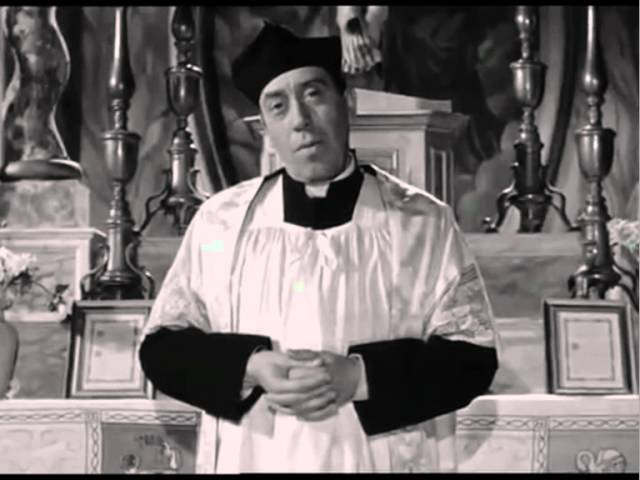
Don Camillo’s stands fast as the flood rises.

From the movie made from Giovannino Guareschi’s “Return of Don Camillo“.

Don (the title of a diocesan priest in Italy) Camillo is the pastor of a village by a river, which is in flood stage.  The people have fled to higher ground.  He is sad that he can’t celebrate services.   He is going to stay where he is until the flood subsides.  And it will subside.  This is not the first time that the river has driven them from their homes.  We now forget out differences.  When we want to die, we’ll try to smile. The sun will shine again and the flowers will bloom again.  Our village will again be a little paradise.   While the people flee, don Camillo will stay and ring the bells when things improve.

“May God be with you. Amen.”

YouTube thumbnailYouTube icon

Posted in ¡Hagan lío!, Be The Maquis, Hard-Identity Catholicism, Just Too Cool, The Coming Storm | Tagged ,
Comments Off on Don Camillo’s stands fast as the flood rises.
























