Fun with papal reporting!

Friday needs a little fun.

Sometimes Homer nods and sometimes Google translate applies the soporific!

From the other day via Google and Katolisch.de HERE

17_04_28_screenshot_02

Ummm… something was lost in translation.  Thanks, Google, for the chuckle!

And there’s this, which I picked up via my friend Greg DiPippo.  In Vatican Insider we find coverage of the Pope’s trip to parts Egyptian. And this isn’t with Google’s help (at least on my “end”).

17_04_28_screenshot_03

Okay, Holy Father. I promise never to do asses, or even a single ass, on Christian perfection.

Seriously, the Italian text said: “non fate esami di perfezione cristiana… don’t give quizzes in Christian perfection”.

That said, I think the clergy should set bars that are… not low.

Posted in Lighter fare |
8 Comments

ASK FATHER: In Communion Services to do people “self communicate”?

elevation mass host 05From a reader…

QUAERITUR:

Is anyone other than a Priest allowed to self-Communicate as in a “Communion” service? Thank you.

GUEST PRIEST RESPONSE: Fr. Tim Ferguson

Herein we get some fairly complicated liturgical law, and this is one of those situations where having a Code of Liturgical Law for the Roman Rite would be helpful.

In the 2004 Instruction Redemptionis Sacramentum, the Congregation for Divine Worship and the Discipline of the Sacraments clarified that, at Holy Mass, “It is not licit for the faithful ‘to take…by themselves… and, still less, to hand … from one to another’ the sacred host or the sacred chalice.”

This is an instruction (see canon 34), which does not make law, but rather sets out the provisions of the law and says how the law is to be applied. As an Instruction, it cannot change law (note, however, for those playing the home game, that not everything that is called, in English, an “Instruction” is really an instruction – the “General Instruction of the Roman Missal” is actually the “Institutio Generalis Missalis Romani,” an Institution, which makes law, not an Instruction which applies or clarifies the law).

For the law, we have to go back to the 1988 Directory for Sunday Celebrations in the Absence of a Priest by the Congregation for Divine Worship (issued by the late, lamented Paul Augustin Cardinal Mayer, OSB, and his secretary, then-archbishop Vergilio Noe). In this Directory, we are informed, that, “for the communion rite, the provisions given in the Roman Ritual for Communion outside Mass are to be observed.”

For this, we are sent back to the Roman Ritual, issued in 1973 from the Congregation for Divine Worship, which says, (paragraph 33), “If the minister receives communion, he says quietly, ‘May the body of Christ bring me to everlasting life.’ He reverently consumes the body of Christ.”

Redemptionis Sacramentum clarifies (a bit) further, stating that (paragraph 165) if there is not a priest or deacon present to led this service, “various parts be distributed among several faithful rather than having a single lay member of the faithful direct the whole celebration alone. Nor is it ever appropriate to refer to any member of the lay faithful as ‘presiding’ over the celebration.”

So, where does that leave us?

As far as I can tell, there’s been no further clarification on the rubrics of such a service since the Roman Ritual of 1973, instructing the “minister” to “reverently consume the body of Christ.” A lay person who, in such an instance, is serving as an Extraordinary Minister of Holy Communion, even if, in keeping with Redemptionis Sacramentum, is not directing the whole celebration alone, can reverently consume the Eucharist.

At the same time, I note the condition added in the Roman Ritual, “If…” So it would seem that the rubric envision the possibility of a minister leading a service of Holy Communion and not himself receiving. I think one who leads such a service in the absence of a priest could legitimately say that, owing the the clear indication that, during Holy Mass the faithful ought not self-communicate, and not wishing to cause any scandal among the faithful, he would refrain from self-communicating at these times.

I would further add that any service of the distribution of Holy Communion outside of Mass, especially one directed by lay people, should include significant and devout prayers for an increase in priestly vocations so that these types of services might become absolutely unnecessary.  [Do I hear an “Amen!”?]

Posted in "How To..." - Practical Notes, ASK FATHER Question Box, Liturgy Science Theatre 3000 | Tagged , , , ,
11 Comments

Swiss Guards: Armor and “the most powerful weapon that exists”

Many of you will remember that project we had to make fitted armor for one of the Swiss Guard.  HERE

I was alerted to a great photo at the National Catholic Register of the Guard in his splendid armor…. made by some of you reader/donors.

That’s our guy on the right.  On the breastplate he had engraved St. Joseph and St. Joan of Arc.

17_04_28_Swiss_Guard_armor_01

And you may also remember that the Swiss Guard also were given and carry the “Combat Rosary” in the gun-metal finish, modeled on the military-issued rosaries of yesteryear.  These are prepared by my friend Fr. Heilman.  A couple years ago, we had an project to put these rosaries into the hands of the Guards.  The Commandant spoke about them at last years swearing in ceremony on 6 May 2016.    The Guards were discussing this new tense time of security both for the Holy Fathers and for the Guards themselves:

At the right time, at the beginning of the year, a generous donor has surprised us with a gift. He sent the Swiss guard the most powerful weapon that exists on the market: the ‘Combat Rosary’, Literally, the rosary for the fight. Now it was given in allocation to all the guards. It is important that we find the path of prayer, especially the prayer of the Rosary. Our life, our works and our actions are in the hands of God. However, this does not mean that we can give up to arms and to exercises. God uses us as instruments to ward off evil in some situations. This is why we need a faith, faith in God and prayer.

16_05_07_Swiss_Guard_Rosary_01a 940

Cooler than that is hard to find.

UPDATE:

What I was talking about.  And it’s just about the same color as other things in my “daily carry” set.

Posted in Just Too Cool, Linking Back | Tagged , ,
8 Comments

Of Prisoners and Devotions

If we want to succeed in our initiatives in the Church, initiatives directed both ad intra and ad extra, we must revitalize our Catholic identity.  To revitalize our Catholic identity, we need, first and foremost, a renewal of our sacred liturgical worship, primarily of Holy Mass but also of the office and other rites.   And, in addition to our liturgical worship, we need to revive, recover, restore old devotions.

For example, at my home parish there was on every Tuesday evening, the Novena to Our Lady of Perpetual Help followed by Benediction, followed by confessions.  It was always well-attended.

Fr. Hunwicke reminded me of another devotion, very French I think, in a recent post.  HERE

I suspect that many of you haven’t heard of the devotion to the “Divine Prisoner”, or “Prisoner in the Tabernacle”.  I believe this was a strong devotion of St. Thérèse.

Here is one prayer:

O JESUS, DIVINE PRISONER present always in the Tabernacle as a ransom for my sins, look on me a prisoner, too, bound by my own guilt. O, relieve me from the shackles of my sins that I may give myself to the service of Thy Love.

Deliver me from the shackles of my pride, sweet Jesus, from my vanity, sloth and anger, melt the stiffness of my will, break the tyranny of my passions, open wide the door of my dungeoned soul and dispel the darkness of my sins and ignorance.

Have pity, O Divine Prisoner! Have pity on this poor prisoner. Help me to escape from sin so that I may always be with Thee … forever Thy prisoner! My mind chained by Thy Truth! My will chained by Thy Law! My heart chained by Thy Love! Chain me to Thee, living and dying. And may I die, dear Jesus, a prisoner in Thy Sacred Heart. Amen.

Some may tut at the old-fashioned language.  I respond that there is nothing wrong with old-fashioned!

Let the prayers of our forebears be ours as well.

And…

GO TO CONFESSION!

So, if you would have Faith, pray.

Prisoner_Tabernacle_Eucharist

How wonderful it would be to find a cache of these old-fashioned prayer cards.   I especially want a really good copy of the card (and statue) of Our Lady Queen of the Clergy.  I looked around in shops in Paris, but to no avail.   Perhaps they could be an opportunity for some entrepreneur.


Posted in ¡Hagan lío!, "How To..." - Practical Notes, GO TO CONFESSION, Hard-Identity Catholicism, The future and our choices | Tagged ,
6 Comments

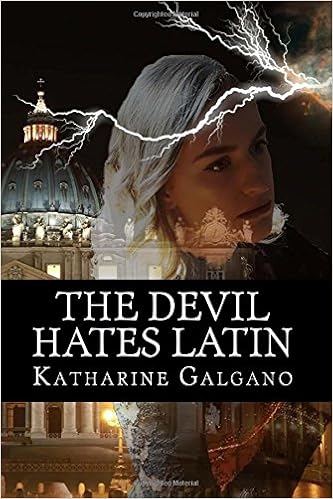
BOOK: The Devil Hates Latin

The title of this book intrigued me from the start, since it is a phrase that I have written many times.  It came out last year (I’m surprised that I wasn’t alerted, frankly).

The Devil Hates Latin by Katherine Galgano (which strikes me as a nom de plume).

US HERE – UK HERE

A Kindle version is available.  Do you not have a Kindle yet?  Sheesh. US HERE – UK HERE

Here is a quick read which will appeal immediately to the more traditional among you, but which could be a strong cup of wake up for the more liberal among you.

It strikes me as having been written with a heavily female ex-pat perspective, which is fine. Women stress some things that men don’t.  As someone who lived in Rome as long as I did, I see what’s going on pretty easily and she get’s a lot right.  The plot takes a while to develop, as many characters are introduced one by one, each one having grim circumstances.  It’s hard, at first, to see how the threads will eventually come together.

BTW… you’ll probably not want to live in Rome after reading a few pages of this book.  As a matter of fact, it deals with some awful stuff.  The line, “Hopelessness, cynicism and disappointment bit deeply into the fabric of Italian life, and like some airborne malaise, drifted through the windows of the Pirisi’s third floor apartment.”  Thus, also the book.   It paints a not very rosy picture of the state of modern society and of the Church… the liberal-run Church.  There’s this:

“But the Church has broken down here in Italy to the point where it can no longer perform these vital tasks. Old clergy still parrot the exhausted ideas of the sixties, speaking mainly to the elderly in fast-emptying pews. There are no vocations. The few committed Catholics here are isolated in the ghettos of their various ‘movements’ which help them find work and, sometimes, raise their children among like-minded people. But they have very little influence on the larger culture. If you are unlucky enough to be a pregnant young woman in a ‘normal’ Italian family, you will probably choose to abort. The evil is everywhere, Your Excellency.”

But with a title like The Devil Hates Latin you wouldn’t expect fluffy kittens and dancing smiley flowers.

Much like Malachi Martin does in Windswept House (US HERE – UK HERE) she creates not very subtly veiled characters, such as Alexander Card. Portland, described as “an intelligent bishop who actually believed” and “the real thing”. He is a composite.  There is an African Pope (a good guy).  The conclave dodged a German and “a Filipino with an infectious grin”.

And Latin, of course, figures in the book. She gets some Latin and Italian wrong, and in my Kindle version there were some typographical problems, but I give lots of points to those who try. You’ll find some not entirely convincing “action” moments.  But, there’s Latin for Masses and exorcism: what’s not to like? Happily, there are mentions of the traditional parish in Rome, Ss. Trinità dei Pelegrini and the traditional Mass.  And one line I agreed with entirely: “He thought reflexively for the thousandth time about how one of the benefits of being Roman Catholic was, no doubt, the food.”

A good thing in the book is the emphasis on how people get into serious spiritual trouble and what sort of disasters result from liberalism and indifferentism in the Church.

There is a very strong defense in the book of the unborn, while describing some sad circumstances.

Many of you will enjoy this quick read.

UPDATE:

From a reader…

This is a Non Sequitur from the post, but I thought you may find it interesting.

My ten year old reported to me that when he was trying to pray the rosary one night, Our Lady kept interrupting him saying, “Say your prayers in Latin” or some thing to that effect. He knew the Hail Mary, but wanted to learn ALL of it in Latin.

He’s not a child given to making up stories….his little brother, if he’d have said it I would have just raised my eyebrows and kept going, he’s a little B.S.er…..definitely our future lawyer!

But Paddy is a straight shooter.

Posted in REVIEWS, The Campus Telephone Pole | Tagged , ,
14 Comments

St. Peter Canisius, pray for the Jesuits!

peter_canisius_smToday is the Feast of St. Peter Canisius (+1597), a Jesuit priest and Doctor of the Church.  There is a good write up about this great son of Ignatius HERE.

Peter was a great counter-Reformation saint who worked tirelessly in German speaking lands for the Faith.  This is exemplary:

From his earliest youth, God had specially protected him, and had markedly endowed him with a tender fervency in prayer and a predilection for heavenly things. He also had the advantage during his years of study, of a most excellent director, who guided him onwards in the path of holiness, and to whom he on his part daily confided with a generous humility his actions, words, and even his most secret thoughts. Eventually it was God’s will that he should become acquainted at Mayence, with Father Peter Favre, and by his means led to join the Society of Jesus. He had already, as a young priest at Cologne, given proofs of extraordinary zeal, which had won public recognition. Herman von Wied, the misguided Archbishop of Cologne, had at that time invited some of the innovators into the city, thus bringing ravening wolves into Christ’s fold. The firmness with which Canisius opposed the heresies of the new teachers, and the high esteem in which he was already held, caused him to be sent by the clergy and people to the Emperor, to ask help against their false pastor; and he fulfilled his mission so well, that shortly afterwards the hireling, for he was no longer a shepherd, was deservedly deposed and excommunicated.

Ravening wolves.

When shall we see Jesuits like him again?

I would rather see the company repressed again than foster the likes of THIS and the article and doings behind it at a Jesuit-run school.

NB:

Clement_XVI_Mug_01 Clement_XVI_Mug_02

For all the selections click

>HERE<<

UPDATE:

Meanwhile Jesuits at the Jesuit-run Jesuit School of Theology in Berkeley they’ve invited a woman to speak who claims that she has been ordained.  HERE

Jesuits.

Posted in Liberals, Saints: Stories & Symbols | Tagged ,
11 Comments

Happy Birthday Universe!

Johannes_KeplerFun!

This is from History:

On this day in 4977 B.C., the universe is created, according to German mathematician and astronomer Johannes Kepler, considered a founder of modern science. Kepler is best known for his theories explaining the motion of planets.
Kepler was born on December 27, 1571, in Weil der Stadt, Germany. As a university student, he studied the Polish astronomer Nicolaus Copernicus’ theories of planetary ordering. Copernicus (1473-1543) believed that the sun, not the earth, was the center of the solar system, a theory that contradicted the prevailing view of the era that the sun revolved around the earth.
In 1600, Kepler went to Prague to work for Danish astronomer Tycho Brahe, the imperial mathematician to Rudolf II, emperor of the Holy Roman Empire. Kepler’s main project was to investigate the orbit of Mars. When Brahe died the following year, Kepler took over his job and inherited Brahe’s extensive collection of astronomy data, which had been painstakingly observed by the naked eye. Over the next decade, Kepler learned about the work of Italian physicist and astronomer Galileo Galilei (1564-1642), who had invented a telescope with which he discovered lunar mountains and craters, the largest four satellites of Jupiter and the phases of Venus, among other things. Kepler corresponded with Galileo and eventually obtained a telescope of his own and improved upon the design. In 1609, Kepler published the first two of his three laws of planetary motion, which held that planets move around the sun in ellipses, not circles (as had been widely believed up to that time), and that planets speed up as they approach the sun and slow down as they move away. In 1619, he produced his third law, which used mathematic principles to relate the time a planet takes to orbit the sun to the average distance of the planet from the sun.
Kepler’s research was slow to gain widespread traction during his lifetime, but it later served as a key influence on the English mathematician Sir Isaac Newton (1643-1727) and his law of gravitational force. Additionally, Kepler did important work in the fields of optics, including demonstrating how the human eye works, and math. He died on November 15, 1630, in Regensberg, Germany. As for Kepler’s calculation about the universe’s birthday, scientists in the 20th century developed the Big Bang theory, which showed that his calculations were off by about 13.7 billion years.

Well… a billion here a billion there…

Posted in Lighter fare | Tagged ,
9 Comments

ASK FATHER: Non-standard form for Confirmation – valid?

12_03_12_confirmationFrom a reader…

QUAERITUR:

Yesterday I acted as sponsor for a person receiving Confirmation. I noticed that the bishop, at the moment of anointing the candidates with the sacred chrism, did not say the standard formula. The bishop (a native English speaker, speaking in English) said, “Be sealed in the gifts of the Holy Spirit.” (He repeated this same nonstandard formula over and over for dozens of candidates. I heard him both through the microphone and directly up close.) Is that sufficiently similar in meaning to the prescribed formula to be valid? The bishop did all sorts of other nonsense during the Mass that made a mockery of Catholic liturgy, and I was very annoyed by it, but is this change to the essential sacramental formula bad enough that I should report it to the appropriate congregation at the Vatican?

Let’s review, because reviewing helps.

All sacraments have both matter and form.  For the Sacrament of Confirmation the matter is the laying on of hands and the anointing with chrism.  In 1971, Paul VI issued in his Apostolic Constitution Divinae consortium naturae a new rite of Confirmation and he designated as the form: Accipe signaculum doni Spiritus Sancti… Be sealed with the Gift of the Holy Spirit.”  In the Byzantine East the form is virtually the same, including singular  “gift” (??????, genitive of ? ?????) except that different parts of the body are anointed.  The older, traditional Latin Church form is also valid: “Signo te crucis: et confirmo te Chrismate salutis, in nomine Patris, et Filii, et Spiritus Sancti. … I sign thee with the Sign of the Cross, and I confirm thee with the Chrism of salvation, in the Name of the Father, and of the Son, and of the Holy Ghost. Amen.”

The Catechism of the Catholic Church covers the Sacrament of Confirmation in 1285 ff.  Everyone should own a copy.  More HERE.

Does “Be sealed with the gifts of the Holy Spirit” mean the same thing as “Be sealed with the Gift of the Holy Spirit”?

In general, the “gifts of the Holy Spirit” are understood to be, “Wisdom, Understanding, Knowledge…”, etc., which are bestowed with the indwelling of the Holy Spirit in the soul with sanctifying grace.  They are a result of the indwelling of the Spirit.  “The gift of the Holy Spirit” could include the “gifts of the Holy Spirit”, and more.  Each sacrament has its effects. In the CCC 1303 we read that one of the effects of the sacrament of Confirmation is that “it increases the gifts of the Holy Spirit in us”. I suppose that we can conceive of all the effects to be one with the Holy Spirit’s indwelling. But…the Latin form has singular “doni”, genitive singular of donum.  The Greek has the singular. I don’t know if “gifts” is valid or not.  Perhaps you could – respectfully – ask the bishop if it means the same thing before you write to the Congregation.  In general, which every Catholic always has immediate recourse to the Holy See in these matters, it is best to work your way up with questions rather than start at the top.

It grieves me some priests and bishops do not use the sacrament form as it is written in the book. People who are in attendance can read it in the book or the handout.  People who are paying attention and who have basic catechism scratch their heads when the book says one thing while the minister of the sacrament says another.

Catholics with a fundamental knowledge of their basic catechism know that our sacraments have both matter and form and that the form matters, if you get my drift.  For a sacrament to be valid, a valid form – the words spoken – must be used.  The valid form is laid down by the Church.  It is not up to individual priests or bishops to determine what the valid form is.  Priests and bishops are obliged by law and all that is good and holy to use the proper form.

I don’t think that most bishops and priests who screw around with sacramental forms are being malicious.  I think that, for the most part, they are trying to make the rite more “meaningful”, even though they have zero authority to change the words.

If it comes to their attention that people are confused by what they do, then it is a horrible lack of charity to continue to upset people by using a non-standard “form” for sacraments, thus raising doubts in their minds:

“Was I really absolved?  Was I really confirmed?  Is that really the Eucharist up there?  Was my child really baptized?”

Fathers, please just stick to the book for the form of sacraments.

If you have to review, then, for the love of God, review.  Just…

Say the Black Do the Red

The moderation queue is ON.

UPDATE:

My dear friend Fr. Tim Finigan, His Hermeneuticalness, has picked up on this post and, at his place (HERE), added good remarks, including:

I have another quibble with the form of Confirmation in our current English version. Simply put, it is not a correct translation of the Latin text.

[…]

“Be sealed with the Gift of the Holy Spirit.” I do not think that it is pedantic to point out that “Be sealed with the Gift of the Holy Spirit” is not the same as “Receive the seal of the Gift of the Holy Spirit.”

[…]

The seal is something that is given and received. In the Roman army, recruits were marked on the hand or the forearm with an abbreviation of the name of the general. This tattoo was called the signaculum. (In the film Gladiator, Maximus has the mark on his upper arm and cuts it away with a flint while he is being transported to be sold into slavery.) In Greek the word would be sphragis and there is a rich vein of material in the Fathers of the Church that brings out the significance of this in the rite of Baptism and Confirmation. Danielou in his “The Bible and the Liturgy” devotes a chapter to it.

The signaculum or sphragis was an indelible seal, a mark of belonging to Christ, of being incorporated into the Church, a mark of protection, and a mark of enlistment into the army of Christ. The notion of being a soldier of Christ did not originate with Faustus of Riez, it was there in St John Chrysostom. The military metaphor was made more explicit by the Roman use of signaculum, of course.

So using the phrase “Be sealed with the gift of the Holy Spirit” in our current translation is not the same as “Receive the seal of the Gift of the Holy Spirit” which is what the Latin original means.

[…]

Go over there and read the rest.  It is very good.

Fathers, you priests of the Latin Church: Just Use Latin!

Posted in "How To..." - Practical Notes, ASK FATHER Question Box, Liturgy Science Theatre 3000 | Tagged , ,
16 Comments

Disaster. Vocations. Identity. Liturgy. Prayer. ACTION ITEM and Fr. Z rants.

See the end of the post!

See the end of the post!

A while back I wrote that people get the priests that they deserve.  Collectively, at least.  Priests don’t just spring full grown from the heads of… cabbage.

Recently, a writer at hyper-liberal Commonweal suggested that vocations are down because his grand vision of the spirit of Vatican II was stifled by the baaaaad Popes John Paul and Benedict.  If only we had more visionaries like Card. Kasper, we’d have more wonderful “presbyters” and sunshine and happy little puppies and more hugging, etc.

The problem is, in those places where his vision of the Church has been implement in full force, hardly anyone goes to Church anymore and there are no vocations.  What a wonderful success!  Take Belgium, for example: 5% Mass attendance.

I remember some time back when there were no men admitted for one year to a major seminary for an archdiocese, they crowed about how effective their screening process was.  Another success!

Many years ago my old pastor, Msgr. Schuler, commenting on the liberal trend in the archdiocese at that time and about how the powers-that-were were talking about priest-less parishes, quipped that they were like the Irish, sitting around talking about how to die rather than figuring out how to plant more crops.

Now I read this, about Ireland, another place where the liberal modernist spirit has for decades ravaged the land.  This is from the Irish Times (with my emphases and comments):

No Mass to take place in Limerick diocese next Tuesday
Fall-off in Catholic priesthood vocations leads to unprecedented situation

Masses will not be said at any church in the Diocese of Limerick next Tuesday, April 25th – the first time since Catholic Emancipation in 1829 that this has happened in any Irish diocese.
Instead, there will be only lay-led liturgies of the Word (readings) and public prayers in churches, with no Mass and no Communion on that day. The lack of services in the Limerick diocese is directly related to the fall-off in priestly vocations, despite major efforts by the diocese to best use existing priests.  [This is the reporter writing, granted, but note… “existing priests”.]
Communion will not be distributed on Tuesday, but this is not to suggest it might never be so distributed at future lay-led liturgies, especially, for instance, on Sundays in nursing homes, said a diocesan spokesman.
Last November, Bishop Brendan Leahy warned that a chronic shortage of priests, coupled with falling Mass attendances, could lead to “some churches” having Mass “every second Sunday or one Sunday a month”.
Limerick diocese has a Catholic population of 184,340 in 60 parishes, with 94 churches. It has 83 active priests, made up of 45 parish priests and 38 curates, with just 10 of them under the age of 50.
“All over the world, when priests are not available, the liturgy of the Word is celebrated in parishes without the distribution of Communion. We are, in many respects, going back to the future[?!?] as not that long ago people would attend weekly Mass without receiving Communion, which was largely a sacrament received only occasionally,” Bishop Leahy said.  [Good grief!  The problem with this is that when, back in the day, people didn’t receive Communion as often when they went to Mass… THEY WENT TO MASS.  And the thing they went to was MASS and not some “liturgy”.   Ohhhh how I detest the use of the generic word “liturgy” instead of “Mass”.  It has helped to erode, over time, the sense of what Mass is.]
Chronic shortage
The chronic shortage of priests next Tuesday is because priests across the diocese will attend a one-day training course, The Irish Times understands.  [The writer should go back to school.]
Last year, a 400-strong diocesan synod, 300 of them lay,  [?!?] acknowledged the need for greater involvement by the laity, [What a surprise!] including situations where lay people would lead prayers in church.
Noting that the synod had strongly supported this, Bishop Leahy said: “We need to prepare for a time when, even though priests are not available, each local community will be prepared to arrange for moments of public prayer.
“No parish should find itself in a position where it is not prepared for such a possibility, so it makes sense for us to begin right now,” he said.  [Yep.  That’s the spirit.]
There are currently 67 men studying for the priesthood – 55 at St Patrick’s College Maynooth and 12 at the Irish College in Rome. [NB:  That’s for Ireland not for just Limerick.] Maynooth was designed to cater for 500 seminarians. It has just over a tenth of that number now. Meanwhile, the average age of the Irish Catholic diocesan priest hovers at around 67. They retire at 75.  [One of my priest friends told me that in 5 years time they project that in their US diocese they will lose 50% of their priests to retirement or death.]
A 2013 study found that three-quarters of Ireland’s priests were then aged between 45 and 74, with the largest proportion (27.1 per cent) in the 65-74 age group. Altogether in 2013, 64.9 per cent of Irish priests were over 55, while, as the study put it, “the proportions of priests in the sub-44 age groups are decreasing”. In 2013 that latter figure was 11.9 per cent.
No resident priest
Last month, the Bishop of Ardagh and Clonmacnois Francis Duffy said three parishes in his diocese no longer have a resident priest: “This trend of a declining number of clergy is set to continue.”
He said that “by 2030, over the next 13 years, 28 of our 53 diocesan priests will reach the retirement age of 75 years”. There would then be 25 priest to serve 41 parishes.
The Dublin archdiocese does not have a priest under the age of 40.[Did you get that?] In 2014 there were a total of 419 priests serving its 1,159,000 Catholics in 199 parishes with a total 238 churches. In 13 years’ time, by 2030, there are expected to be 192 priests under 75 (retirement age) in the archdiocese.
The number of diocesan priests in the decade 2002 to 2012, went from 3,203 in 2002 to 2,800 in 2012, a fall of 403, while the number of religious priests – members of congregations and orders – dropped from 2,159, to 1,888 in 2012. For the female congregations, the drop in numbers was bigger, down from 8,953 in 2002 to 6,912 in 2012 – a fall of 2,041.

A number of things now come to mind.  First, I remember well what Pope Benedict XVI wrote to the Irish people after the clerical sexual abuse crisis exploded there. HERE He wrote, among other things, that in Ireland there should be greater Eucharistic adoration and reparation for sins and an increase of the sacrament of penance.  I wonder if that has been done, as the Pope asked.   Wanna place any bets?

Next, I get the sense that certain bishops and priests don’t give a damn about vocations. They want the lay-run church in which the rare priest occasionally comes around to provide the white thing that gets handed out before they sing the song together.

Isn’t that what Communion has become for so many catholics?  They put the white thing in our hand and then we sing the song.  And don’t we feel good about ourselves?

Is that going to produce priests and religious vocations?

There is no lack of priestly vocations where bishops and priests project solid clerical identity and where they teach perennial Catholic truth in charity and in clarity.

Moreover, in this matter of priestly and religious vocations, no initiative will succeed unless we have a top down and bottom up revitalization of our sacred liturgical worship.

That means a wide-spread, wholesale return to traditional practices including, especially, ad orientem worship (Card. Sarah is right!) and the elimination of Communion in the hand.

We must restore to our worship an ars celebrandi which favors an encounter with mystery rather than fostering an encounter with ourselves in self-affirmation.

FATHERS! BISHOPS!

We have to get down on our knees constantly and pray for vocations to the priesthood and religious life.  Let’s not pray for generic “vocations”, lumping them all together.  No.  We need a public, manifest, constant call for vocations to the priesthood from our own homes and families, not someone else’s.

At the parish where I serve, the pastor and I had cards printed with an old prayer for vocations used at my home parish, where there was on average a First Mass every year.   From now on, at every Sunday and Holy Day Mass, after the Gospel and before the announcements and sermon, everyone will kneel and say this prayer:

LEADER: Please kneel for our prayer for vocations.  Let us ask God to give worthy priests, brothers and sisters to His Holy Church.

ALL: O God, we earnestly beseech Thee to bless this (arch)diocese with many priests, brothers and sisters, who will gladly spend their entire lives to serve Thy Church and to make Thee known and loved.

LEADER: Bless our families. Bless our children.

ALL: Choose from our homes those who are needed for Thy work.

LEADER: Mary, Queen of the Clergy!

ALL: Pray for us. Pray for our priests and religious. Obtain for us many more.

A friend back home – whom I miss rather a lot – sent me one of the original holy cards, which I prize.

20131210-104023.jpg

20131210-104032.jpg

Note that key line:

Choose from our homes those who are needed for Thy work.

We had cards made with beautiful artwork on the front and this very prayer on the back.  Soon it will be so much a part of the regular Sunday and Holy Day practice that everyone will know it by heart.  It will ring in the ears of young people and keep the idea of a religious vocations constantly present and active.  I don’t doubt the outcome.

This is an ACTION ITEM.   Fathers, consider implementing this in your parishes.  And don’t junk the prayer up with additions about “married life” or “single life” or “permanent deacons”.  Just leave it as it is.  We’ve done the heavy lifting by already printing the cards if you want to drop a line.

Lay people!  Especially you who are in sound parishes!  Go to your priests with this post and ask them to implement a prayer for vocations to the priesthood.  Keep at them.

Posted in "How To..." - Practical Notes, ACTION ITEM!, Priests and Priesthood, Seminarians and Seminaries, Semper Paratus, The Coming Storm, The future and our choices, Turn Towards The Lord | Tagged , , ,
31 Comments

BOOK RECEIVED: Traditional LECTIONARIUM from Fraternity Publications

I recently received a new, old Lectionarium from Fraternity Publications, the publishing arm of the FFSP, Fraternity of St. Peter.  This liturgical book is used during Solemn Mass in the traditional Roman Rite.  It contains the texts of the Epistles and the Gospels to be sung by the subdeacon and deacon.

It is bound in red leather cover and is approximately 10″ x 14″ x 1 7/8″.  It has , two high ribbon markers.   The edges of the pages are gilded.

The spine.

There is a nice colored plate at the beginning.

It’s bona fides.

The type face is a little more ornate than I would prefer but it is easily legible.

The ribbons have a couple nice touches. First, the are reinforced at the connection to the  spine.  Also, they are finished at the end.  They are designed, with care, to last.

The notation for the Exsultet is included, which is fitting, since it is something to be sung by a deacon.

By way of comparison, this is a shot of my other, older Lectionarium.  Again, this is an older book…

Now back to the new volume.  A shot with items… just for scale.

The book is not inexpensive, but it is a one time purchase.

If your TLM community needs one, consider getting it and donating it.  However, check with the priest before you get it.  Make sure that a) they don’t have one and b) that there isn’t something more urgent to acquire.

Our liturgical books should be elegant, as well as useful.

One thing might improve the volume, even though it was not included in older editions. It would perhaps be helpful to include templates with Gregorian notation for the chants of the readings.

There are modes that have become standard in the Roman Rite and every seminarian and cleric should know them.  Alas, I have not heard of any seminary out there where they are taught.   I would love to be corrected.  I hope seminarians will drop me a line.  I’ll protect your identity, of course.

There is a huge lacuna in liturgical training in all things Latin in this our ailing Latin Rite Church.  And yet the Code of Canon Law clearly states that seminarians should be very well-trained in Latin (can. 249).  Their training of Latin matters liturgy should be thorough.

The Fathers of the Second Vatican Council mandated that pastors of souls should make sure that their flocks should be able to both sing and speak the parts that pertain to them in both Latin and their mother tongue.  But if that is a requirement of the Conciliar reform for lay people in the pews, how much more important is it that their clergy know how to sing the parts that pertain to them in Latin, which is the language of their Rite?

The templates for singing the orations and readings for Mass are found, for example, in the Liber Usualis.  I think they ought to be included in the Lectionarium, even if they were not included in the past.  We need them today.  And we need people to teach the seminarians and clergy what those tones are.  Many of them can’t read music.  And there are also some who don’t hear the difference between whole and half steps.  They should be helped to hear and sing the correct intervals.  That means practice.

Practice.

This brings to mind a book from the Canons at St. John Cantius which has all the variations of tones of orations and of the readings in chant notation.  I wrote about it HERE.   The Cantius book, Canticum Clericorum Romanum, is a helpful book, to be sure.  It is great for practice.  It is far better that seminarians and clergy know their chants without using this… “cheat sheet”.  They should more properly use the elegant, liturgical book, such as this Lectionarium from Fraternity Publications.


Posted in "How To..." - Practical Notes, Liturgy Science Theatre 3000 | Tagged , , ,
11 Comments