Two “Moments” with Bp. Hying during his ad limina visit. He has good insights.


Yesterday’s travel was complicated by horrid weather and even more horrid construction around LGA.
“When will you have an end?!?”, cried Julius II. I hope the new airport is a masterpiece of design. I’m not holding my breath. I understand that it’ll gain a runway.
45 minutes to get by bus from the terminal to the place where you now grab taxis.

And now for a massively important question.
Last night I went with a couple to a “red sauce” restaurant. Both of them are of Italian or Sicilian heritage. There ensued a discussion of terminology…
SAUCE or GRAVY?
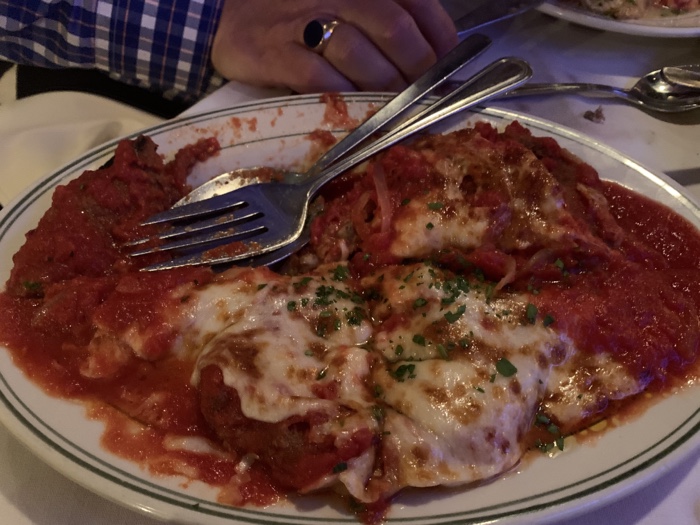
Is that sauce or is it gravy?
Above, is what is billed as “Eggplant Parmisan”. I have to engage in a form of mental conditioning and preparation for these restaurants and remind myself, “I’m in America… I’m in America… Don’t compare it to Italy… You are not in Italy. They are not pretending we are in Italy.” What really gripes my cookies is when restaurants put on airs and try to pass themselves off as “authentic” when the only thing that is authentic might be that they reproduced on an industrial scale something like the cook’s grandmother, who had never set foot in the old country, remembered from her childhood in Howard Beach or North Beach. So, once I was able to throw the switch in my head for American mode, I was good and enjoyed the food.
BUT… the question remains.
So, SAUCE or GRAVY.
Discuss.
Yesterday we had, in Madison, a Pontifical Mass at the Throne celebrated by His Eminence Raymond Leo Card. Burke. The Mass was at St. Mary’s in Pine Bluff, executed through the agency of the TMSM.
Alas, I was very tired yesterday and had to be up at 4 AM for my (awful ) flight(s) today and so I forgot to bring with me the memory card with most of the photos. Grrr. I will capture some from elsewhere. Thanks to those who posted.
In such a small space we have to park sacred ministers on the altar steps, as is done also in Rome.
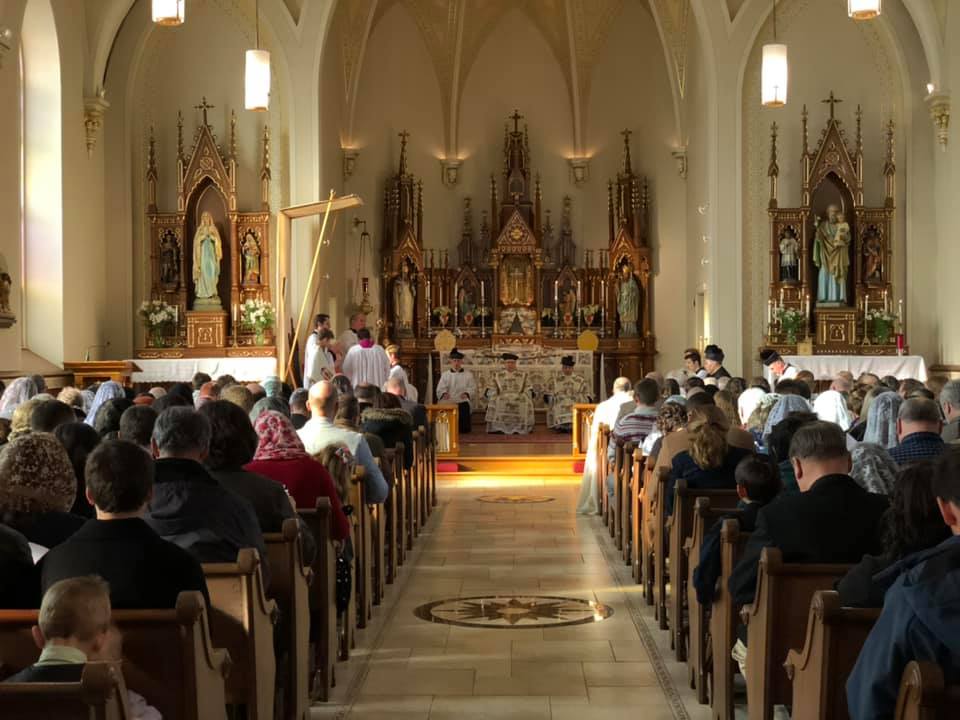
Thanks giving after Mass.
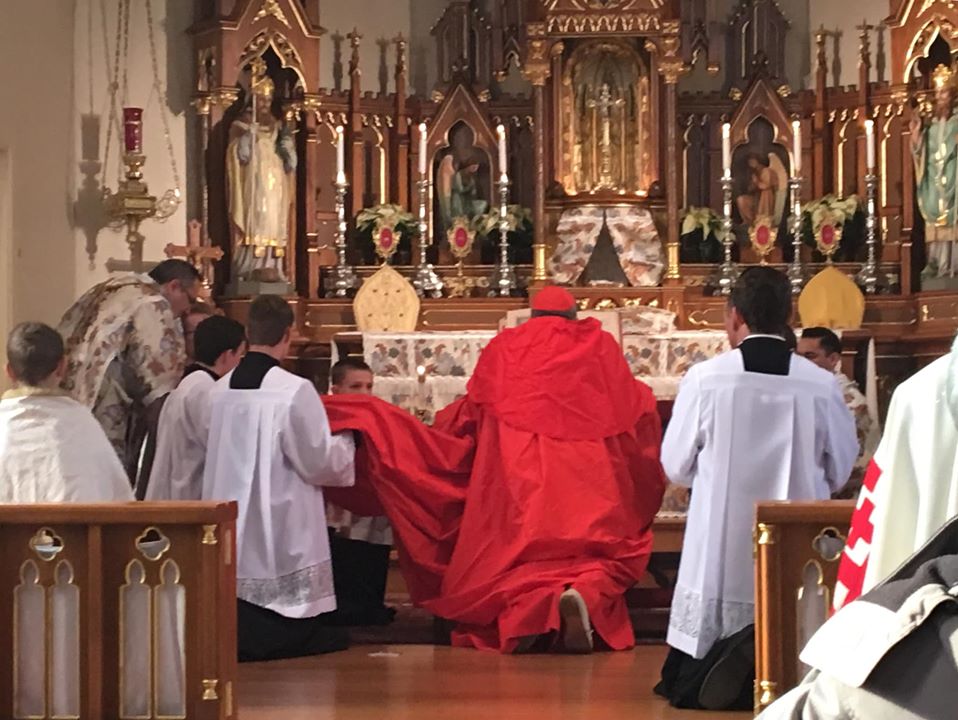


For fun: How to keep your cappa clean!
https://www.facebook.com/eswesthoff/videos/10157874363154042/
 I am posting this mainly for bishops and priests to read over and ponder.
I know… I know… “I’m tooooo busyyyyy to reeeeead anything morrrrrre.”
No, not this time. You should pay attention to this one.
Here is something, frankly, alarming and precisely zero surprise at all.
For a while I’ve been ranting about the massive demographic sinkhole that is about to open up under the Church. Here is another aspect to consider.
Not just the Church.
At kirkdurston.com (rummage a little on his site – he has an organized mind) there is an article which invoked the studies in a somewhat dated 1934 book, but still useful, Sex and culture [electronic resource] by Joseph Daniel Unwin, a 600 page summary of his 7 volumes of studies.
[…]
Unwin examines the data from 86 societies and civilizations to see if there is a relationship between sexual freedom and the flourishing of cultures. What makes the book especially interesting is that we in the West underwent a sexual revolution in the late 1960’s, 70’s, and 80’s and are now in a position to test the conclusions he arrived at more than 40 years earlier.
[…]
I have prepared a 26-page collection of quotes from his book that summarize his findings; but even that would leave you with a significant under-appreciation of the rigour and fascinating details revealed in data from 86 cultures. Here are a few of his most significant findings:
Effect of sexual constraints: Increased sexual constraints, either pre or post-nuptial, always led to increased flourishing of a culture. Conversely, increased sexual freedom always led to the collapse of a culture three generations later. [Do the math!]
Single most influential factor: Surprisingly, the data revealed that the single most important correlation with the flourishing of a culture was whether pre-nuptial chastity was required or not. It had a very significant effect either way.
Highest flourishing of culture: The most powerful combination was pre-nuptial chastity coupled with “absolute monogamy”. Rationalist cultures that retained this combination for at least three generations exceeded all other cultures in every area, including literature, art, science, furniture, architecture, engineering, and agriculture. Only three out of the eighty-six cultures studied ever attained this level.
Effect of abandoning prenuptial chastity: When strict prenuptial chastity was no longer the norm, absolute monogamy, deism, and rational thinking also disappeared within three generations. [Listen to young people and the Left.]
Total sexual freedom: If total sexual freedom was embraced by a culture, that culture collapsed within three generations to the lowest state of flourishing — which Unwin describes as “inert” and at a “dead level of conception” and is characterized by people who have little interest in much else other than their own wants and needs. At this level, the culture is usually conquered or taken over by another culture with greater social energy. [Nĭménhăo!]
Time lag: If there is a change in sexual constraints, either increased or decreased restraints, the full effect of that change is not realized until the third generation. (Note: I’ve added a clarifying footnote at the end of this article. See footnote #13)
[…]
Unwin wrote:
The history of these societies consists of a series of monotonous repetitions; and it is difficult to decide which aspect of the story is the more significant: the lamentable lack of original thought which in each case the reformers displayed, or the amazing alacrity with which, after a period of intense compulsory continence (sexual restraint), the human organism seizes the earliest opportunity to satisfy its innate desires in a direct or perverted manner. Sometimes a man has been heard to declare that he wishes both to enjoy the advantages of high culture and to abolish compulsory continence. The inherent nature of the human organism, however, seems to be such that these desires are incompatible, even contradictory. The reformer may be likened to the foolish boy who desires both to keep his cake and to consume it. Any human society is free to choose either to display great energy or to enjoy sexual freedom; the evidence is that it cannot do both for more than one generation. [Certainly this is evident in some sectors of the Church.]
[…]
Unwin found that when strict prenuptial chastity was abandoned, absolute monogamy, deism, and rational thinking disappeared within three generations of the change in sexual freedom. [NB] So how are we doing as we enter the second generation since our own sexual revolution at the end of the 20th century? [Ask James Martin, SJ. He’ll tell you that we’re doing just fine.]
[…]
Summary of where our culture is going, given Unwin’s findingsFor the first part of the 1900’s, mainstream Western culture was rationalist and experienced enormous technological advances — from horse-and-buggy to cars; from hot air balloons to supersonic flight and spacecraft landing people on the moon; from slide rules to computers. Unwin’s three main predictions — the abandonment of rationalism, deism, and absolute monogamy — are all well underway, which makes the ultimate prediction appear to be credible … the collapse of Western civilization in the third generation, somewhere in the last third of this century.
[…]
Bishops, especially, and priests. QUAERITUR: What is your role in this?
He brings in the studies of Mary Eberhard on the rise of Mass killings, suicides, etc.
Her research indicates that increased sexual freedom led to the decimation of the family, which resulted in the loss of family identity, which produces Eberstadt’s ‘primal screams’—a massive increase in mental health issues, mass killings, and the rise of extreme identity groups at war with each other … all symptoms of a society rapidly spiraling into collapse. This appears to have greater explanatory power than Unwin’s psychological suggestion, although the two may actually be closely related, given what Eberstadt shows.
Both Unwin and Eberstadt provide substantial evidence that a sexual revolution has long-term, devastating consequences for culture and civilization. As Unwin states, “The history of these societies consists of a series of monotonous repetitions,” and it appears that our civilization is following the same, well-travelled road to collapse.
[…]
There is a lot of food for thought here.
Was there a good point made in the sermon you heard at the Mass that fulfilled your Sunday Obligation? What was it?
For my part, I heard Card. Burke, at our parish, during our Pontifical Mass at the Throne.
I’ll try to post his sermon…. later.
I’m on my way to NYC for friends, museums and an event.

I saw this alarming sign in the airport. My markup.

Who else is listening? SkyNet?
One step closer.
UPDATE
WELCOME TO ALBANY!
Except I’m supposed to be at LGA.
Diverted due to weather. Serious annoyance factor. And after flying around in circles forever of course we are waiting for a gate.
UPDATE
They got us off the plane for about 10 minutes.

My tour of NY state airports continues. The last time I was diverted from LGA we went to Syracuse.
Where next?
We are refueled and ready to try for…. BUFFALO?
UPDATE
They loaded crews from other flights on our plane so I think we are going.
On 8 December 2005, I posted this photo. This blog project began.
Today is the 14th anniversary of this blog.
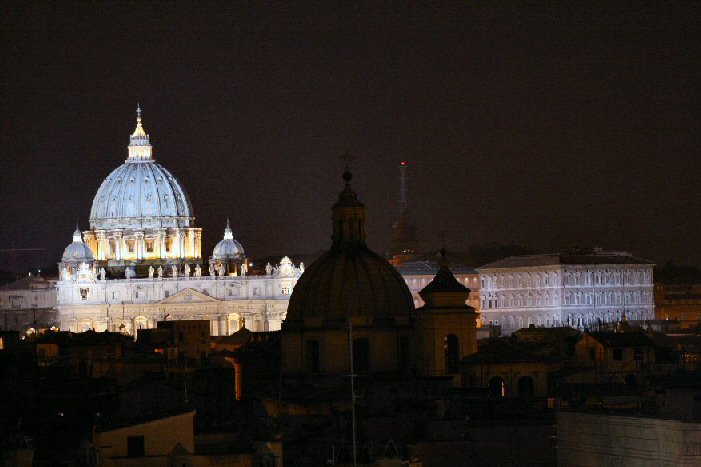
This photo was a shot from my apartment window in Rome on the evening of the day Pope Benedict was elected.
I started it with the original intention of it being an archive for articles I was writing for The Wanderer about liturgical translations. Thus, it’s original name. That column, by the way, began before the release of Liturgiam authenticam.

That was the intention, but the blog rapidly took on a life of its own.
Since I started keeping stats, on 23 November 2006, I have had about 95 million page views and 62.6 million unique visits.
Dear readers, please accept my thanks for everything, your comments and feedback, your prayers and your patience with me.
Because tomorrow morning I will be deacon for a Solemn Mass at the Throne with Cardinal Burke today, Sunday, I will say Mass privately as soon as possible for you donors and benefactors.
This is what the blog looked like back then. A screen shot from about a month after its inception.

And more from Germany… it’s always Germany…
The story in German at KathNet.
Bischöfe mit Wissenschaftlern einig: Homosexualität ist etwas Normales
Ist das lehramtliche Verbot praktizierter Homosexualität noch zeitgemäß? Ist Homosexualität eine normale sexuelle Ausrichtung? Ist eine sexuelle Beziehung nach einer Scheidung “schwere Sünde”? Darüber diskutierten deutsche Bischöfe mit Experten.Bishops agree with scientists: Homosexuality is something normal
Is the doctrinal prohibition of practiced homosexuality still timely? Is homosexuality a normal sexual orientation? Is a sexual relationship after a divorce a “serious sin”? German bishops discussed this with experts.
Who wants to bet that they are discussing this in the same way that Dems discussed impeachment the day after the 2016 election?

 From a reader…
QUAERITUR:
I have become increasingly convinced by those who say that Pope Benedict XVI purposefully performed an invalid resignation of the papacy.
Does this belief potentially place me in a state of serious sin? I do not besmirch Francis and largely keep these thoughts to myself.
I know that ideally I simply would adopt some medieval peasant piety and worry only about my own prayer life and soul and not Church politicking, but now that the “Genie is out of the bottle” so to speak, I am finding it very hard to put it back.
I am not going to get into the arguments on either side of the issue. Personally, I am carefully weighing what I read. What I can say is this in general terms.
Writing about his struggle with the Anglican Church and his conversion to the Catholic Faith St. John Henry Newman wrote in his Apologia, “Ten thousand difficulties do not make one doubt.” He is writing about doctrine, but it applies also to the issue at hand. Let’s see the context with some emphases.
Many persons are very sensitive of the difficulties of Religion; I am as sensitive of them as any one; but I have never been able to see a connexion between apprehending those difficulties, however keenly, and multiplying them to any extent, and on the other hand doubting the doctrines to which they are attached. Ten thousand difficulties do not make one doubt, as I understand the subject; difficulty and doubt are incommensurate. There of course may be difficulties in the evidence; but I am speaking of difficulties intrinsic to the doctrines themselves, or to their relations with each other. A man may be annoyed that he cannot work out a mathematical problem, of which the answer is or is not given to him, without doubting that it admits of an answer, or that a certain particular answer is the true one. Of all points of faith, the being of a God is, to my own apprehension, encompassed with most difficulty, and yet borne in upon our minds with most power.
Sorting out the arguments about the resignation of Benedict, though they touch on the theological, ecclesiological reality of the Petrine Ministry and the indefectibility of the Church as guaranteed by Christ, are really juridical issues. That doesn’t make them unimportant, but it shifts our questioning into a different category. As Newman wrote, above, there is a difference between the annoyance we can have in struggling to understanding God and in understanding a mathematical problem. It seems to me that this is more a math kind of problem than a God kind of problem.
The effects of Original Sin force us to struggle with vexing questions in the tangle of our minds. However, we also have the help of proper authorities (e.g., forebears, experts, Scripture, the Magisterium, etc.). Our task is made more complicated when our questions concern authority’s authority, not whether some authority is doing a good job or not, but if it is indeed proper authority. In most cases we are argue the rightness and wrongness of something on its merits. But when rightness also flows from an office, and when the legitimacy of the office itself is in question, we are in a hard place.
At this point I want to bring in another point upon which is anchored our traditional Act of Faith: “O my God, I firmly believe that Thou art one God in three divine persons, Father, Son … Thou hast revealed them, Who canst neither deceive nor be deceived.”
Let us also attend to the Apostle to the Gentiles, writing to the Galatians: “Be not deceived, God is not mocked. For what things a man shall sow, those also shall he reap. For he that soweth in his flesh, of the flesh also shall reap corruption. But he that soweth in the spirit, of the spirit shall reap life everlasting.”
As I said before, we struggle with certain questions in the tangle of our minds even as we make use of authority.
We had better be pretty sure about our motives if we are going to raise questions or even perhaps stand firm against something which seems to most people to be clear. And the more important the issue, the more urgently, unswervingly we must test ourselves.
Sincere questions are not sins. Still in the matter of doctrine, there is a distinction between doubts which are involuntary and doubts which are voluntary.
The CCC 2088 distinguishes, “hesitation in believing, difficulty in overcoming objections with the faith, or also anxiety aroused by its obscurity” (CCC 2088) from what arises when you “disregards or refuses to hold as true what God has revealed and the Church proposes for belief.”
That has to do with articles of Faith. I think we have to apply this also to the less doctrinal and more juridical issue of Benedict’s resignation. One can have questions and doubts and then, with complete sincerity, struggle to work them out, seek answers now from here now from there, looking at all possible angles with honest appraisal while seeking wise authority’s help.
On the other hand, it is also possible to engage in subtle self-deception, by a reluctance or maybe even stubborn refusal to consider the other side of the question. That kind of voluntary doubt is an attack on truth. An attack on truth is an attack on God and is sinful.
There are a lot of smart people on both sides of the questions that surround Benedict’s abdication. They deserve a respectful hearing. I’ve heard good arguments on both sides. Most of them seem to be trying sincerely to get to THE TRUTH of the matter. Some have come down on one side because they simply don’t like Francis. That’s not a good enough reason. Others are really drilling. They have to be taken seriously.
There is something tangibly diabolical in the way that this has all transpired, which is evident from the obvious division and distress that is swelling in the Church in many sectors.
It is particularly distressing that the very office Christ created within the Church, the Petrine Ministry, intended to be a focal point of unity and a source of certainty, has become, in both respects, less unifying and less calming than the other popes of this century and of the last.
Whatever it is that do with your questions or doubts or convictions, test them and do not engage in any self-deception. God is not mocked and God cannot be deceived. God knows you better than you know yourself. God is closer to you than you are to yourself.
Finally, if you sense that you might be placing yourself in a state of spiritual peril by getting into these matters, then put them aside.
Frankly, I am not convinced that we are going to be able to sort out your question any time soon and that the troubling effects of the doubts will continue to grow for sometime, at least until the end of this pontificate. But remember always that hundreds of generations of Catholics went through their whole lives hardly even knowing the name of the current Pope. They lived and died in their Catholic vocations and now enjoy the bliss of heaven barely aware of the concrete details of the papacy or the Roman Curia or maybe even who the bishop was, since often the bishop resided far away even from the diocese.
We don’t have to know every little thing that goes on. There is a sin called curiositas. We humans by nature desire to know things. But when that desire becomes immoderate, for the sake of the knowledge of things itself rather than for the good that can come from knowledge, we stray into the realm of sin. It may be better for many people to “fast” and “abstain” from current Church news, lest the taste of that which titillates the palate of the new, the now, the scoop and skinny draws us into dwelling on questions that none of us can solve, at least with speed and ease.
You yourself must police your conscience in these matters. When it comes to your topic, what could be sinful for one, might be still sound for another.
Comment moderation is ON.
At Crisis Austin Ruse has a thoughtful piece about altar rails. He writes:
[…]
It seems to me that among the most harmful innovations that happened in the Church at mid-century was doing away with the altar rail and caving in to those who insisted on standing and receiving in the hand. I can’t prove it, but I firmly believe that the decline in belief in the Real Presence can be traced to the inevitable lack of reverence that comes with standing and certainly by handling the Sacred Host in our own grubby paws.
The decline in Eucharistic belief was also precipitated, I think, by doing away with other Eucharistic traditions like Adoration and Corpus Christi processions. Thanks be to God all these things are coming back. Hundreds now participate in Corpus Christi processions through the streets of our big cities. Adoration is popping up everywhere—usually attended by new altar rails.
I had thought there was magic in the altar rail itself, but I was wrong. There is a kind of divine magic, however, in a priest using the altar rail. It is like the Eucharist itself: the bread and wine do not become the Body and Blood on their own. The priest must confect them. Similarly, the altar rail is a dead thing unless and until the priest stands over to one side and says, “We are going to start using it. We are going to line up along the rail. You can choose to stand or kneel. It’s up to you.” Watch. Something magical happens. I’ve seen it with my own eyes.
[…]
Ruse says, rightly, that the priest should indicate by his own choice that people should and can use the rail.
I have another suggestion. Make and attach housling cloths. Have servers turn the housling cloths over the rail during the recitation of the Our Father and then turn them back after Communion.
At the parish where I am the visiting fireman on Sundays, after going ad orientem the pastor had a rail put in. The society I run, the TMSM, had housling cloths made and they were immediately put into use. It didn’t take long. As a matter of fact it was an astonishingly fast transition from people standing and receiving in the hand to virtually everyone kneeling and receiving on the tongue. It happened with very little urging. At the time, I explained in strong terms in sermons my thoughts and preferences but also stressed the law for the Novus Ordo and for the TLM. I did that maybe a couple times. I suspect the pastor did too. It seems to me that, once it was explained, and that once we highlighted the rail especially with the housling cloths (i.e. HINT HINT… KNEEL HERE… KNEEL HERE…) the transition was smooth and swift.
For you priests out there, and bishops, here are some notes about Communion rails and definition of the liturgical space of a church.
First, however, just for fun, here are some pics.
This is what the sanctuary and nave looked like after going ad orientem but without the housling cloths on the rail.
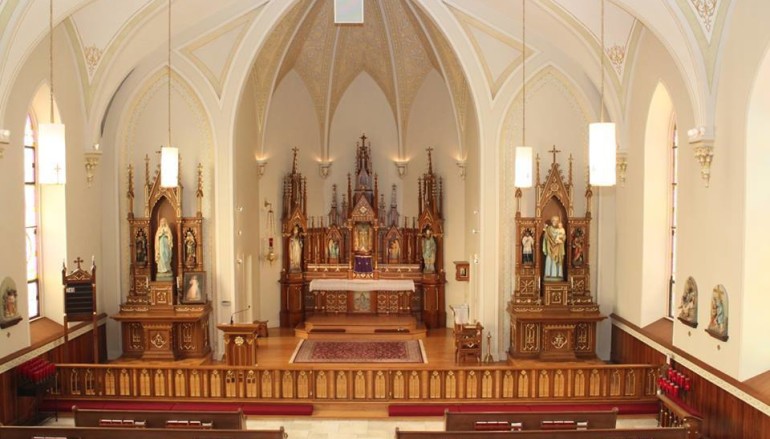
Not too bad.
This was taken during a Pontifical Mass with the Extraordinary Ordinary for the centenary of Our Lady of Fatima’s final apparition. Note the housling cloth behind the rail.

A server turning the cloth at the Our Father.

The turning of the cloths gives a powerful emphasis to the rail.
A screenshot from last Sunday’s stream:

Now, some thoughts.
A church is a sacred place, made sacred by consecration. The whole church is sacred. Within the holy space, there is a “holy of holies”, just as there was in the ancient Temple.
From another point of view, it is useful to consider what St. Augustine of Hippo (+430) explained concerning Christ speaking in every word of the Psalms. For Augustine, in the Psalms sometimes Christ speaks with His voice as Head of the Body which is the Church, sometimes He speaks as the Body. At times He speaks as Christus Totus, the Body with the Head, together.
The true Actor of the sacred action of Holy Mass is Jesus Christ the High Priest, who -through us His members, having different roles – raises words and deeds to the Father. Sometimes He acts and speaks in the person of the alter Christus the priest (Head), sometimes in the words and actions of the congregation (Body), sometimes when the priest and people act and speak together (Christus totus). Christ makes our hands and voices His own in the sacred action, but He is the actor and speaker.
The church building itself ought to manifest this three-fold distinction.
The sanctuary, at the head of the floor plan, is the place where Christ the Head of the Body speaks and acts, the nave is the place of the congregation, the Body.
A communion rail is not only practical. It defines the holy of holies. It underscores the dignity of the liturgical actors, priest and congregation.
Some might claim that the Communion rail then becomes a barrier for the laity in the congregation to keep from away from the holy of holies. That is false. The rail helps to point out that, in the church building’s layout, the congregation has its own proper character and dignity that must not be compromised or violated by “invasion”, so to speak, by the priest – except in those defined moments such as the Asperges or Vidi aquam or a procession with the Blessed Sacrament.
The lack of a clear delineation of space blurs all our liturgical roles.
If the priest and people are invading each others space and roles, then proper worship is crippled. Lay people receive mixed signals which erode their identity and the priest devolves into a mere “presider”.
The congregation has its own important role and this is defined in the building.
Dragging lay people into the sanctuary is a clericalism of the very worst sort. It signals to lay people that they have to be given the duties and place that pertain to the priest in order to elevate their status. “You aren’t good enough unless you are permitted – by me – to do what I can do.” I hate that clericalist attitude.
Kneeling at the Communion rail is not only a sign of reverence in the Real Presence before reception of Communion, but – for that close and indeed mysterious encounter of priest (head) and congregation (body) – is a reverent acknowledgement of the Christus totus in action in the sacred mysteries.
Consider what we profess that we believe is happening during Mass: there is a mysterious nexus of the divine and earthly. Sometimes we say that heaven comes down to Earth, or God is called down to our altars. How is that “easy”? This is hard, difficult stuff to get our heads around. We need the physical symbols of the delineated spaces that provide a concrete and defined point of contact between Christus caput with Christus corpus and that mystical moment of Communion, that connection and unity which is Christus totus. And I think that that is also more clearly underscored by Communion on the tongue rather than – admit it – self-communication by Communion in the hand.
This is a useful way to understand in a healthy way something more about the outward expression of “active participation” during Holy Mass, and the meaning of altar rails and sanctuaries.
This is yet another reason why Summorum Pontificum is so important. We need its gravitational pull. We need what the older form of Mass offers – and all that goes with it – to revitalize our Catholic identity which flows first and foremost from our baptism and liturgical worship.
More altar rails! Define our sanctuaries!
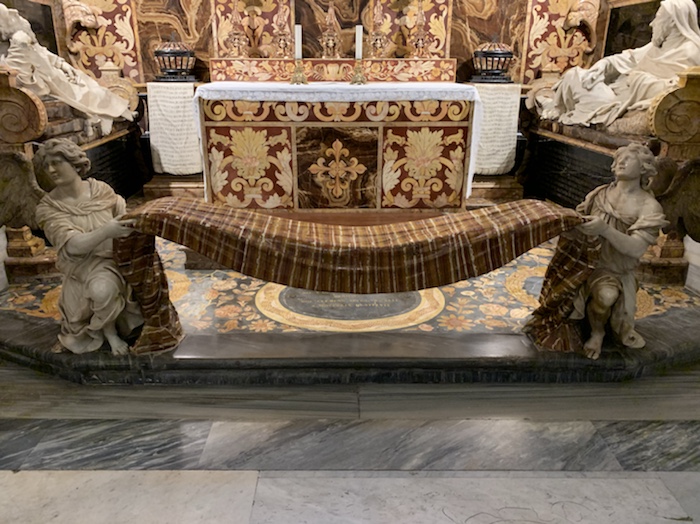
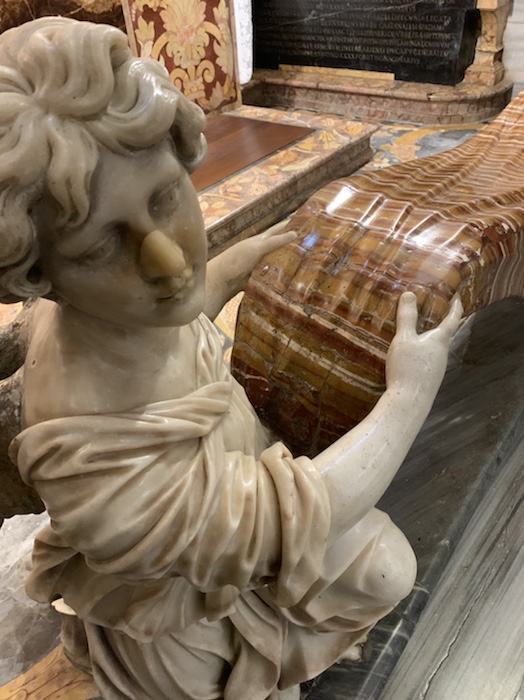
And just for fun, here is a shot of a beautiful altar rail in a church in Rome, which is actually carved like a housling cloth.
Here’s the Spada Chapel in San Girolamo della Carità.



Coat of Arms by D Burkart
 fac on My Annual St Crispin’s Day roundup with Henry V speech!: ““We few. We happy few. … You know your places. God be with you.””
 on ROME 26/10– Day 25: King things: “It should be noted that Bob Uecker’s lifetime batting average against Sandy Koufax was .400.”
 on Summorum Pontificum Pilgrimage 2026… *sigh*… Vatican Bars Annual TLM Pilgrimage from ENTERING St. Peter’s Basilica: “https://x.com/MountainButorac/status/2114352253251297776?s=20”
 on My Annual St Crispin’s Day roundup with Henry V speech!: “Father, while I do cherish this annual tradition, I believe your post to be incomplete without a reference to the…”
 on Your Sunday Sermon Notes – Feast of Christ the King (N.O.: 30th Ordinary): “NO. we often see the Pharisees in a purely negative light, when in point of fact they were trying to…”
 on Your Sunday Sermon Notes – Feast of Christ the King (N.O.: 30th Ordinary): “Driving back to Houston last Sunday, I stopped at a church just off I-45 in the Diocese of Tyler for…”
 on Your Sunday Sermon Notes – Feast of Christ the King (N.O.: 30th Ordinary): “NO. Pastor preached on setting a good example, riffing on Saint Josemaria and the Epistle to the Thessalonians. Challenge people…”
 on Summorum Pontificum Pilgrimage 2026… *sigh*… Vatican Bars Annual TLM Pilgrimage from ENTERING St. Peter’s Basilica: “The ironic thing – if Pope Leo was so worried that allowing another Latin Mass in St. Peter’s would be…”

A Daily Prayer for Priests








They find you a pro-life agent in your area who commits to giving a portion of the fee to a pro-life group!

PLEASE subscribe via PayPal if it is useful. Zelle and Wise are better, but PayPal is convenient.
A monthly subscription donation means I have steady income I can plan on. I put you my list of benefactors for whom I pray and for whom I often say Holy Mass.
In view of the rapidly changing challenges I now face, I would like to add more $10/month subscribers. Will you please help?
For a one time donation...



Help Monks in Wyoming (coffee – UPDATED LINK) and Norcia (beer) and the wonderful "Soap Sisters" of Summit, NJ!


Please follow me on Twitter!










Visits tracked by Statcounter
since Sat., 25 Nov. 2006:
