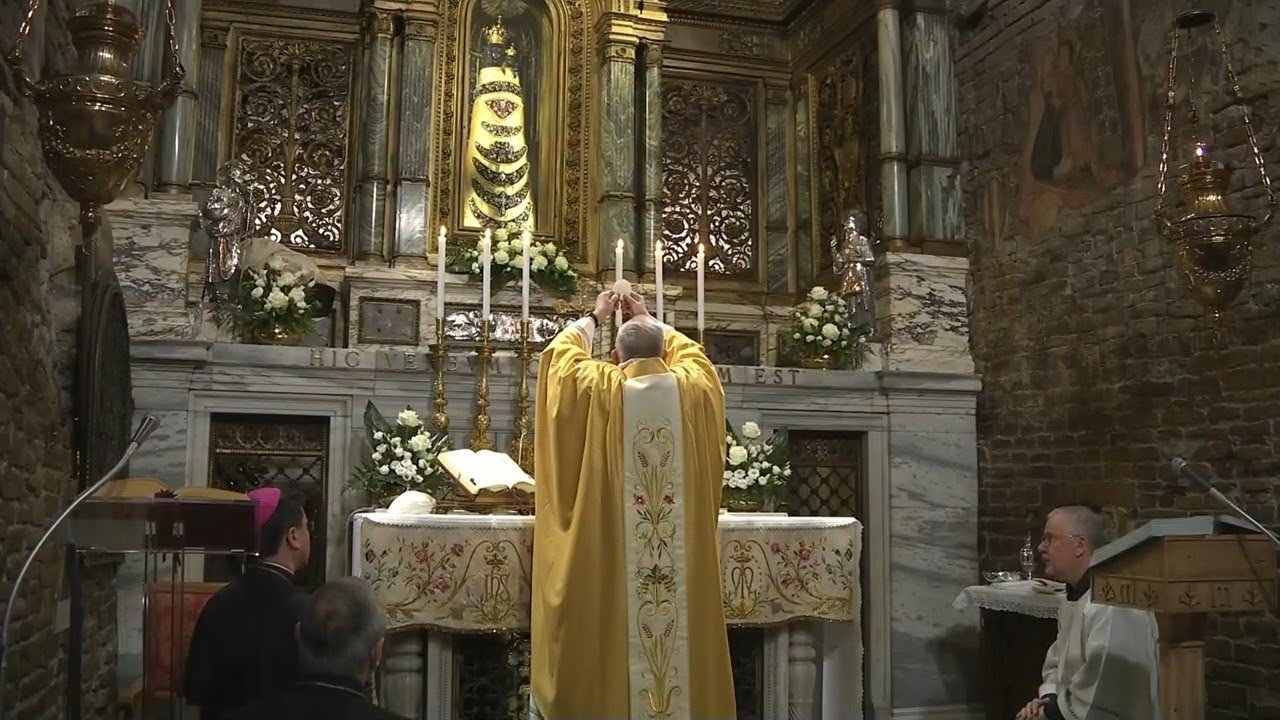
VIDEO: Francis’ Mass ad orientem at Loreto and… something else

Two videos of Francis at Loreto, where the Holy House is venerated.

First, the whole Mass Francis celebrated… ad orientem.   Take careful note of the dreadful music, with which Italians are regularly afflicted.  Mass starts at about 14:00. No concelebration. Refreshing.

YouTube thumbnailYouTube icon

And notice how, with the faithful, he deals with people who want – quite properly – to kiss his ring. I can’t figure out how to embed this. HERE

Comment moderation is ON.

UPDATE:

UPDATE:

Allow me to add a note, based on personal experience and common sense.

Consider the experience of a public figure. Everyone wants to shake your hand. Imagine you are, say, a politician, pressing the flesh. In a campaign, the repetitive stress of handshakes is horrendous. Watch how public figures, after a while, tend to offer their hands: they protect them by offering just a few hooked fingers, which is bad enough.

I’ve had a few experiences at conferences where many people want to shake my hand. I’ve gotten it crunched a few dozen times by happy well-wishers. It’s the repetition that causes the problems.

Just a thought as we watch this rather ghastly video. I am not saying that I know for sure that Francis is trying to protect his hand. I think he is trying to keep people from kissing his ring. On the other hand – *cough* – that’s the hand that everyone goes for.

Posted in Francis, Turn Towards The Lord |
24 Comments

25 March: Feast of The Good Thief, St. Dismas

Titian_Christ_Good_Thief_Dismas_smToday is Lady Day, the Feast of the Annunciation, the instant of the Incarnation.

However, 25 March is also the Feast of the Good Thief, St. Dismas!

Fulton Sheen famously quipped of this theif saint that he “stole heaven”.

Luke 23:39-43:

And one of those robbers who were hanged, [Gesmas] blasphemed him, saying: If thou be Christ, save thyself and us. But the other [Dismas] answering, rebuked him, saying: Neither dost thou fear God, seeing thou art condemned under the same condemnation? And we indeed justly, for we receive the due reward of our deeds; but this man hath done no evil. And he said to Jesus: Lord, remember me when thou shalt come into thy kingdom. And Jesus said to him: Amen I say to thee, this day thou shalt be with me in paradise.

It makes the heart ache, to read these words addressed to that penitent sinner.  Would that they were address to each one of us.

But wait!  They can be.

Holy Church has the Lord’s own authority to forgive sins, to loose and to bind!

It is exercised by His bishops and priests!

GO TO CONFESSION!

There is, by the way, a legend that, during the Holy Family’s flight from Herod to Egypt, they ran into Dismas, who was exercising his trade of thievery.

Dismas was going to rob them, but seeing the Infant Jesus, he instead gave them shelter in his lair and let them go on their way without harming them.  Dismas would continue to be a nefarious ne’er-do-well.  His intellect still darkened by sin on Calvary kept him from recognizing Christ’s Mother.

Sin makes you stupid.

Finally, Fathers, mark on your calendar that in the back of your traditional Missale Romanum there is a Mass formulary for the 2nd Sunday of October  in honor of the Good Thief for use in prisons and in houses of reform of mores and of the discipline of amendment

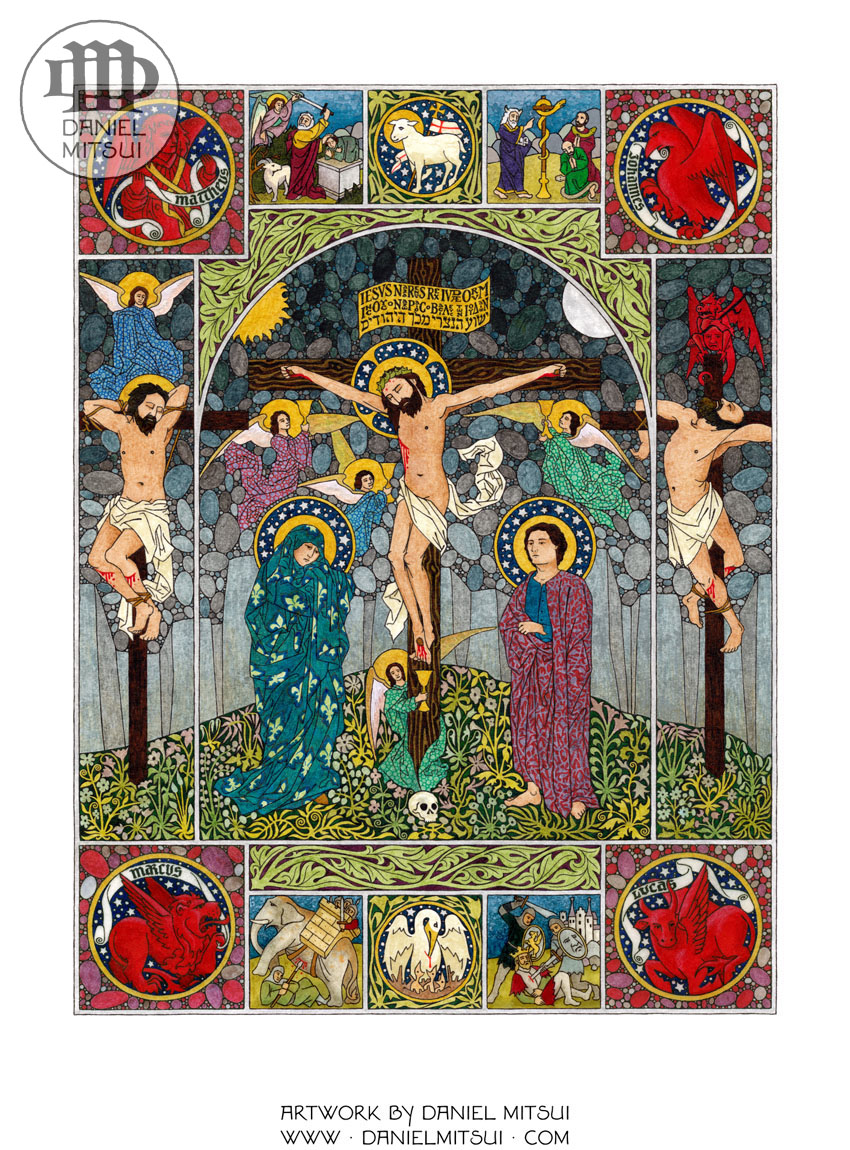
Daniel Mitsui – Crucifixion


Posted in GO TO CONFESSION, Liturgy Science Theatre 3000, Saints: Stories & Symbols | Tagged ,
4 Comments

Fr. Z’s Kitchen: Pasta e ceci … with a quiz

I had a strong desire for pasta e ceci… a commonly made thickish soup of chickpeas and small cut pasta. Romans make it with generous black pepper, rosemary and anchovy.

I simply made it without consulting recipes because… well… I know what it is supposed to be and I can do that.

A common sofrito or mirepoix began it, into which I added some pancetta.  I used the little processor to make it fairly fine.

Some white wine, to evaporation.

A key ingredient.  You need good, aromatic rosemary.  Save a sprig for a garnish.

I had some little tomatoes that needed consumption, so what the heck.  And, yes, you find pasta e ceci with tomato.  Sometimes it’s the paste that disappears into the mix.

Another shot of salt and pepper and in goes our chick peas and broth.

Don’t forget the anchovy.  You could add this at the sofrito stage, buy it won’t make much difference.

I kept out some of the chickpea and pureed them with broth, to thicken the soup.

Short cut pasta, such as cannolichi are great.  These are ditalini.   The Great Roman’s grandmother would break bucatini into small pieces.  Good idea.

This is going to need more broth.

Here’s a nice bowl of pasta e ceci.   It really hit the spot.  I had enough to share with my clerical neighbor.

Did you know that the Latin word for chickpea is “cicer“?  Like the orator?  I suppose that some ancestor in his family had one of those chickpea like growths in a visible place.

Also, in Italian, a “cicerone” (chee-chair-OH-neh) is a guide, like a tour guide, someone who shows you around.  Why?  Because Virgil was Dante’s guide through Hell.   Yes… give it a couple minutes and you’ll work it out.

BTW… Cicero was born in Arpinum.

Can you think of another famous “novus homo… new man” who was from Arpinum?

Friends, good food doesn’t have to be complicated.  Just do it!

Posted in Fr. Z's Kitchen | Tagged
13 Comments

ASK FATHER: Bishop forces priest to use table altar instead of high altar for Extraordinary Form

From priest…

QUAERITUR:

Recently my bishop refused to let me celebrate a Solemn High Mass at the high altar of the Church, insisting altar that is used in the Ordinary Form should be used. So I celebrated the Solemn High on that altar, ad orientem, in obedience. [Praiseworthy.] The argument given was that GIRM #303  [Ooops!] says that once a new altar is consecrated the old high altar should no longer be used for offering of the Holy Sacrifice of the Mass. Secondly the bishop wanted there to be an expression that though there are two forms, the substance of the Roman Rite is the same: the Sacrifice of Calvary.

I’m wondering if that means that the Extraordinary Form must be celebrated on the “Novus Ordo Altar”?

My first though is that this rubric is from the GIRM and thus is for the Ordinary Form of the Mass and not applicable to the Old Rite. [Exactly.] Secondly, most of the time the space around the high altar is better suited for the celebration of say a Solemn High Mass, because the space was designed for that form of Mass.

So my question: is the bishop right that the Mass must be offered on the same altar, as GIRM 303 says?

Short answer: The bishop is wrong and you are right. However, that might not be much consolation because the bishop, if he is a bully, can hurt you in a thousand ways and you are pretty much defenseless.

Long answer.

You are correct in that the current GIRM does not apply to the Vetus Ordo.  The current GIRM applies to the Missal for which it was written, namely, the Ordinary Form of the Roman Rite.     The Rubricae Generales apply to the Missal for which they were written, the Extraordinary Form of the Roman Rite.

I assume that in this situation, there is an old “high altar” which has the requisite steps, and that the new altar, freestanding, is on the flat surface of the sanctuary.  Priests something try to make this work by standing just outside the sanctuary for the Prayers at the Foot of the Altar, so that then they can step up one or two steps onto the floor of the sanctuary and thus approach the freestanding altar.  However, the former rubrics would normally not allow for a priest to be outside of the sanctuary once the Mass has begun.

Therefore, if there is an altar with the requisite steps, that is the altar that should be used for the Extraordinary Form, as that is the rubric which pertains to the EF.

The interpretive Instruction from the Holy See for the EF is Universae Ecclesiae.  Let’s have a look.

24. The liturgical books of the forma extraordinaria are to be used as they are. All those who wish to celebrate according to the forma extraordinaria of the Roman Rite must know the pertinent rubrics and are obliged to follow them correctly.

[…]

27. With regard to the disciplinary norms connected to celebration, the ecclesiastical discipline contained in the Code of Canon Law of 1983 applies.
28. Furthermore, by virtue of its character of special law, within its own area, the Motu Proprio Summorum Pontificum derogates from those provisions of law, connected with the sacred Rites, promulgated from 1962 onwards and incompatible with the rubrics of the liturgical books in effect in 1962.

When it comes with ecclesiastical discipline, we follow the 1983 Code.  For example, who has faculties to say Mass in the Latin Church, etc.  When it comes to how the Mass is celebrated, the rubrics of the 1962 Missale (and now, it seems, previous – but not later editions) are to be followed.  Hence, Communion may not be distributed in the hand during Mass in the Extraordinary Form, and those movements pertaining to the altar should be observed.

What do the rubrics really say?  Let’s have a look.

VIII – The Various Parts of the Mass
A. The psalm Iudica me, Deus, the Confiteor and the incensing of the altar
424. The psalm Iudica me, Deus with its antiphon, and the Confiteor with the absolution, are said before the steps of the altar in any Mass, whether sung or low.  [Two altars?  One with steps and the other… none?  Hmmm.]

XI – The Preparation of the Altar for Mass  [For the rest, which does this more accurately describe?]
525. The altar on which the most holy sacrifice of the Mass is to be celebrated must be wholly of stone, and duly consecrated; or at least it must have a stone slab, or an altar stone, likewise duly consecrated, large enough to hold the host and the greater part of the chalice; or again, by apostolic indult, an antimension, duly blessed.
526. The altar must be covered by three cloths, duly blessed, of which one must be long enough to hang to the ground at the sides.
527. On the altar, at the middle, there must be a cross of adequate size with the image of the Crucified, and on each side of it candlesticks with lighted candles, to the number required by the kind of Mass. The so-called “tables of secret prayers” or altar cards are to be put on the altar also, but only for the time of the Mass; and, at the epistle side, a cushion or a lectern for supporting the Missal.
528. At the epistle side, on a table meant for this purpose, cruets of wine and water with a dish and a towel should be prepared, also a little bell, and a paten for the communion of the faithful.
529. Nothing whatsoever is to be put on the altar which does not pertain to the sacrifice of the Mass or to the adornment of the altar itself.
530. Where the custom prevails of lighting a candle, near the altar, from the consecration to the communion, that custom should be preserved.

Anyway, the local bishop appealed to the GIRM, which doesn’t pertain to the EF.  He might have argued from the principle of the importance of the unicity of the altar in a sanctuary.  That, however, doesn’t work very well in the Roman Rite in either form, given that the principle is regularly violated in Rome, the preeminent locus of the rite.  That suggests a certain praxis which goes against what the bishop demands.

Also, when there are two altars and one of them is best suited to the EF and the other is not, insisting that the EF be at the less suitable altar is not only disrespectful toward the Mass itself, and its ends (to which the bishop made an appeal – renewal of the Sacrifice of Calvary) but it’s just plain silly.

Meanwhile, I guess you have to tug your forelock to your clerical overload, because he holds power and you don’t.

Thanks for being diligent and trying to do the right thing!


Posted in "How To..." - Practical Notes, ASK FATHER Question Box, Liturgy Science Theatre 3000, Mail from priests, SUMMORUM PONTIFICUM, Universae Ecclesiae | Tagged ,
14 Comments

STOP THE PRESSES: Young people sing in the Illinois State Capitol

I have written about the

breath-taking,
throat-choking,
eye-blurring

composition of Philip Stopford, “Lully, Lulla, Lullay”.

This is the “Conventry Carol” about the Holy Innocents, a carol in some ways so heart-piercing that it seems out of step with Christmastide, except that the joyous season embraces also Childermas, and that the wood of the crib foretells the wood of the Cross.

The words of this lullaby of perfect pain are:

Lully, lullay, Thou little tiny Child,
Bye, bye, lully, lullay.
Lullay, thou little tiny Child,
Bye, bye, lully, lullay.
O sisters too, how may we do,
For to preserve this day
This poor youngling for whom we do sing
Bye, bye, lully, lullay.
Herod, the king, in his raging,
Charged he hath this day
His men of might, in his owne sight,
All young children to slay.
That woe is me, poor Child for Thee!
And ever mourn and sigh,
For thy parting neither say nor sing,
Bye, bye, lully, lullay.

A choir from St. John Cantius in Chicago, of young people, went to the Illinois state capitol building and sang it in the rotunda.

As you know, Illinois is working on hideous laws, extreme Party of Death laws.

Dems. Herodians.

https://www.facebook.com/SJCantius/videos/591325034668885/

Fr. Z kudos.

And…

UPDATE 26 March 2019:

This came to my email:

I saw your recent post on the singing of the Coventry Carol in the Illinois capitol building and thought you might be interested in this.

After hearing about the recent developments in NY and elsewhere of increased abortion and infanticide, I developed a small website about devotion to the Holy Innocents for the cessation of these evils. It’s based on the Redemptorist tradition of celebrating Little Christmas on the 25th of each month, only this is for a Little Innocents Day on the 28th of each month. There are resources (currently in progress) for liturgical and devotional prayers, locations where these devotions are celebrated publicly, a monthly reminder email list, etc. I hope to contact ordinaries as I get the time, or at least encourage priests to do so for their own ordinaries, to ask them to allow their priests to celebrate a Votive Mass and/or Office of the Holy Innocents on this day as well. The website is

http://littleinnocents.org.

Posted in ¡Hagan lío!, "How To..." - Practical Notes, Emanations from Penumbras, Fr. Z KUDOS | Tagged
18 Comments

Study Commission: no evidence women were ordained to the diaconate

At LifeSite there is a story related to the final report of the study commission set up by Francis to look into the historical issues of female deacons, deaconesses, deaconettes, whatever.

It was not the job of the commission to make a recommendation about the possibility of reviving deaconettes. They were simply to look into historical questions.

The commission found that there is no evidence that women were ordained to the diaconate, in the same way that men were ordained.

We knew that. And we know that ordination of women to the diaconate is not possible because of the harmony of the three grades of the Sacrament of Holy Orders. Only men can receive that sacrament.

Of course the inflexible hard-line dissenters, such as the darling of Beans, Peter Hünermann, will continue to press for deaconettes.

In vain. It’s not going to happen.

Professor Manfred Hauke [commission member], in recent comments to LifeSiteNews, further strengthened this position when he said: “We cannot identify the consecration of deaconesses with the ordination of deacons. It was not sacramental ordination that can be identified with the Sacrament of Orders (for bishops, priests, and deacons).” He added: “The history of the institution of deaconesses offers no solid basis, therefore, for the introduction of a sacramental female diaconate. The ancient Church was unacquainted with a female diaconate equivalent to the male diaconate.”

Posted in SESSIUNCULA | Tagged , , ,
8 Comments

Your Good News – UPDATED

Do you have some personal good news for the readership?

Yesterday, I found daffodils on sale. One of my favorite flowers.

Here, “Still Life with Extinguished Candle, Daffodils and Ganganelli Mug“.

There’s an allegory in there somewhere, just as in Zurbaran’s “Still Life with Lemons, Oranges and a Rose”

Meanwhile, remember, that our trials here are only temporary. This fellow from a medieval illumination shows us the way.

Happy Friday in Lent! Memento Mori.

UPDATE:  

More good news.

I had the chance today to sample Chick-fil-a’s Lenten fish sandwich offering.  Just on Fridays.

The place was absolutely jammed.

In the restaurant, there were large images of various scenes in which their products played a part.  Here is a Navy chaplain, probably coming home and getting a snack.

The other good news is that, just as I was leaving, I saw a local cop at the counter getting some chow on his break.   I stepped over and asked him if I could buy him lunch, and his partner too, if he had one.

Thanks, cops, everywhere!

And now I have all the ingredients I need to make pasta e ceci after a consultation with The Great Roman about the use of anchovy.

It’s a good day.

UPDATE:

And now it is an even better day.

I had a note from a young priest.  In his missive, he wrote:

Anyway…the truth works, and I’m more and more convinced that the truth is ad orientem worship.  My own experience of celebrating Mass this way has been the most edifying and fulfilling part of my priesthood.

You, of course, have been a TREMENDOUS help for me (and others)…during my years of seminary, reading your blog, and now as a priest. I’ve been regularly saying the Novus Ordo in Latin on my day off, and have been reading O’Connell’s “The Celebration of Mass” to get the EF rubrics down.  Soon, and very soon, I’ll be practicing that Mass and offering it.

OORAH!

Posted in Four Last Things, Lighter fare |
21 Comments

Dots to connect

Another post providing more dots to connect.  What they mean and how they line up and where they point… who knows.  I suspect that we are entering the phase when the Church will begin to shine with the light of the Lord’s Passion.

In France, attacks on Church’s are becoming more frequent.  Officials say they don’t know why.  Yeah, right.  There was even a fire set in Saint Sulpice in Paris, which I often visit when there.  I’ve noticed an uptick of the practice of the Faith in Paris over the last few years.  Churches are being cleaned and more people are praying in them.

In Montreal, on a priest was stabbed at St. Joseph’s Oratory during Mass on Friday morning – today as I write.  Pray for Fr. Claude Grou, whose injuries were not severe but certainly troubling.

Meanwhile, the numbers of Masses in the Extraordinary Form continues to rise.

  • My friend Fr. Shawn Tunink in KC, KS, has worked up what sounds like a fine celebration of a Solemn Mass for the Annunciation, 25 March, in Leawood, KSHERE
  • In Boise, there is now a regularly scheduled TLM at St Paul Catholic Church in Nampa, IdahoHERE
  • In Santa Barbara area, Montecito, CA, at the beautiful Our Lady of Mount Carmel – I was just there a few weeks ago to speak to a Legatus Chapter and I visited that lovely church – there will be a monthly TLM.  Hopefully more to come.  HERE
  • In Vero Beach, FL, there is now a regular Sunday Low Mass at Saint John of the Cross.  I get to Vero occasionally.  It seems likely that I will pitch in when I am in the area.   On Laetare Sunday they will have a Missa Cantata.  HERE

Friends, review your lives and determine if there is some addition act of reparation for sins that you could perform.

Also, examine your consciences and…

GO TO CONFESSION!

Posted in GO TO CONFESSION, Si vis pacem para bellum!, The Coming Storm, The future and our choices |
6 Comments

“Dear Fathers, dear seminarians…” Wherein Fr. Z rants.

I was sitting in an airport one day, waiting for a flight. A young family approached the gate area. A youngster, seeing an empty place, jumped into it. It was next to me. Mom pulled the kid by an arm out of the seat hissing, “Not next to him.” The look on her face was not very agreeable.

There is a piece at LifeSite about Card. Sarah’s upcoming book, Le soir approche et déjà le soir baisse (“It is nearly evening, and the day is almost over”). The great Cardinal will address The Present Crisis.

In the LifeSite preview piece I read…

Cardinal Sarah goes on to warn his fellow priests that they will all be tainted by accusations that are true only for a minority. But “may your hearts not be troubled,” he added, recalling that Christ himself was taunted with the words “Crucify him!” and begging them not to be troubled by “biased research” that presents the pastors at the head of the Church as “irresponsible churchmen with an anemic interior life.”

“Priests, bishops and cardinals without morals will not in any way tarnish the luminous witness of more than 400,000 priests in the world who each day loyally, joyously and in a saintly manner serve the Lord. Despite the violence of the attacks that she weathers, the Church shall not die. That is the promise of the Lord, and her word is infallible.”

The Church is not immune to persecution. Her Lord had His Passion. The Church must have hers. A priest, as alter Christus, is not exempt.


But, dear Fathers, dear seminarians, this life is short in view of the future glory of Heaven. Very short. And the days and years fly of the pages of our calendars like dry grass upon which the Lord has blown (Is 40:6-8).


While we breathe, let us do our little little best, in season and out, in this troubled time where God chose to place us, precisely the right place and time for who we are.

Posted in Cri de Coeur, Hard-Identity Catholicism, Priests and Priesthood, Seminarians and Seminaries, Wherein Fr. Z Rants |
21 Comments

George Weigel on “Two Georges” and future persecution

Do you remember what the late Card. George of Chicago said about future, successor bishops?

George Weigel makes a connection is a recent piece.

Makes you think.

[…]

The acceleration of Cardinal George’s prediction of cardinals-in-jail should also give pause to those who blame the abuse crisis on “clericalism.” Clericalism – the evil misuse of the respect those in Holy Orders rightly enjoy because of their sacred office – facilitates abuse; it doesn’t cause it. Like the charge of abuse, the “clericalism” trope has been weaponized by the Church’s enemies, to the point where it is becoming difficult for any Catholic cleric charged with misconduct to receive a fair hearing or a fair trial. The vicious public atmosphere on display in Australia whenever the words “George Pell” are spoken is not improved by senior churchmen, in Rome and elsewhere, blaming abuse on “clericalism.”

From his present station in the Communion of Saints, I have no doubt that Francis George is interceding for George Pell, and for the vindication of justice by the judges who will hear the Australian cardinal’s appeal – even as the American cardinal regrets how prescient he was.

Posted in The Coming Storm, The Drill, The future and our choices, The Last Acceptable Prejudice | Tagged
20 Comments