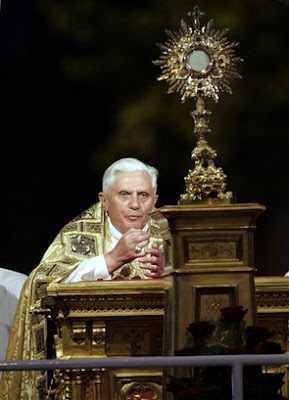
AUSTRIA: Woman carried monstrance, read Gospel, blessed faithful on Corpus Christ

It is probable that widespread Exposition of the Blessed Sacrament and many Masses coram Sanctissimo preserved Austria from the Protestant revolt, or so I have been told.

Now, it seems as if every story about anything Catholic that comes out of Austria is nutty.

Alas, Austria.  What a tragedy.  What a lesson.  What a warning.

All of Europe, really.  Nicht wahr?

From gloria.tv:

Last Thursday, in the municipality of Kirchbach, St Pölten diocese (eastern Austria), pastoral assistant Sabine Latzenhofer, carried the monstrance below a baldachin for the Corpus Christi procession. Latzenhofer also read the gospel and blessed the faithful with holy water.

St Pölten diocese is run by Opus Dei Bishop Klaus Küng (76).

VIDEO HERE

Posted in SESSIUNCULA, You must be joking! |
15 Comments

ASK FATHER: Can lay people baptize?

From a reader…

QUAERITUR:

May a lay natural father baptize his own child? As an expectant father, I have heard conflicting views on this practice. Obviously, the priest is the proper and ordinary authority for this, I was simply curious. (P.S. I appreciate any anonymity you can provide).

I’d happily provide anonymity for you, but I don’t know who you are.

First, congratulations.

That said, your question is a little puzzling.

If you are not trapped in a hunting lodge surrounded by wolves 30 miles from the road during the winter when your wife gives birth, I’d wait for the baptism to be in church by the priest.  If you are trapped, however, by all means, administer baptism right away.

Lay people can baptize.  In fact, non-Catholic and non-believers can baptize, provided they use water and intend to do what the Church intends by using the proper Trinitarian form.

Sometimes lay people must baptize, as in the your case of being trapped in the hunting lodge.

May lay people baptize?  That’s more complicated.  Sometimes, in the absence of ordinary ministers of the sacrament, the Church will provide that some appointed person, such as the village catechist, should do the baptisms.   Otherwise, while still understanding that “can” and “must” and “emergencies”, etc., in general lay people may not baptize.  That is what bishops, priests, and deacons – the ordained – do.

This is particularly important in when the traditional Roman rite of baptism is used, because of the additional elements in the rite.  Those additional elements of the exorcisms and so forth are considered important enough that, after emergency baptisms, they were ritually “supplied” after the fact.

And let’s not forget the importance of witnesses: baptisms need to be done properly and documented in the parish register.

And let’s not forget the important of godparents, who aren’t in the hunting lodge with you… unless your child is to be raised by the circling wolves.

I am glad you are concerned for your child’s baptism.   I warmly recommend having the priest do it, without much delay.

Posted in "How To..." - Practical Notes, ASK FATHER Question Box, Liturgy Science Theatre 3000 | Tagged
9 Comments

ASK FATHER: Do I have to say “Amen” for weird Prayers of the Faithful at Mass?

From a reader…

QUAERITUR:

Are we required to join in the prayers of the faithful at Mass?

Sometimes these can be excruciatingly political and occasionally downright wrong.

For instance, on the recent solemnity of Our Lady Help of Christians (I’m Australian and she is one of our national principal patrons), my wife and I attended Mass. During the prayers of the faithful, most were in keeping with the feast and had a Marian slant as you would expect, however one said (paraphrased, but not exaggerating) “We pray for Muslims, that we can come to value their understanding, faith and courage”[Huh?  “for Muslims…. that WE…”.  Stupid.]

Given the whole Our Lady of Victories thing, surely this is not just out of place, but offensive on such a feast. Which brings me to my point. My wife and I both said nothing during the response, but is this licit? Are we required to join in a prayer that is obviously out of keeping with the faith? What should we do? Our parish is the cathedral for our diocese, by the way.

Thanks as always – my wife loves your answers, particularly the regular GO TO CONFESSION refrain. We need it!

Prayers of the faithful…. oh boy.

When I’ve been at a church as a visitor and the prayers of the faithful are coming at us, as inescapable as a train in a tunnel, I invariably think: “How bad is this going to be?”  If I don’t hear something inept, or dumb, or just plain strange, I’m relieved.

We’ve all heard weird prayers of the faithful during Masses.  Some of them are head-pounding-on-the-pew stupid.  The spontaneous ones are The Worst™.

There are, I believe, templates provided for prayers of the faithful.  While not “handcrafted” for this community, they tend to be a) brief and b) not heretical.

The recommended order for intentions given in the Missal is as follows.

  1. For the needs of the Church
  2. For the world
  3. For those in need
  4. For the local community

It doesn’t have to be complicated.

Heck, I’d consider saying, “For the needs of the Church, we pray to the Lord… Lord, hear our prayer.  For the world, we pray to the Lord…” and so forth.

Do you have to say “Amen!” to something that you know is off the wall?

No.

However, if the prayer is in the least reasonable, as the first part of the prayer you mentioned was reasonable, then you probably should say “Amen” and sincerely mean it.

It seems that a lot of these prayers start with something or someone worthy of prayer.  For the …. X…. the poor, dying, sick, our nation, the Pope, vocations, travelers, elected politicians, etc.  It is in the second part that the writer can often go to the zoo.

Let’s have a POLL.

There are many possible options, but pick the one that best fits your situation.  Anyone can vote.  Registered users can comment… and I hope you will.

Prayers of the Faithful during Novus Ordo Masses

View Results

And let me just say: GO TO CONFESSION!

Do I hear and “Amen!”?

Posted in "How To..." - Practical Notes, ASK FATHER Question Box, Liturgy Science Theatre 3000, POLLS | Tagged
36 Comments

Fr. Tom “If you can’t beat ’em, join ’em!” Reese, SJ, shills for Big-Business Abortion

This is about par for the Jesuit course.

From Breitbart:

Jesuit Priest Tells Catholics to Fight Abortion by Electing ‘Pro-Choice Democrats’

Writing for Religion News Service (RNS)— Father Reese, the former editor-in-chief of [Jesuit] America Magazine—says that “pro-lifers must consider voting for candidates, even pro-choice Democrats, who will reduce the number of abortions by supporting programs that help mothers and their children.”

In his political propaganda piece aimed at discrediting President Trump’s recent moves to partially defund Planned Parenthood, Father Reese abandons his role as a Catholic cleric to stump for the Democratic Party.  [Jesuit Reese, fundraiser for big-business abortion?]

Closing Planned Parenthood clinics “that provide health care and birth control to women before replacements are up and running is irresponsible and counterproductive,” he writes. [So, support organizations that provide sound alternatives to big-business abortion!]

Employing convoluted logic meant to assuage the consciences of Christians who support pro-abortion legislators, Reese makes the claim that Democrats like Hillary Clinton who support Planned Parenthood and abortion-on-demand are actually better for the pro-life cause than Republicans who attempt to install pro-life justices or draft legislation aimed at restricting abortions.

“Pro-life voters must choose between Republican rhetoric and Democratic results,” he writes, in bold advocacy for the party that applies a pro-abortion litmus test to all its potential political candidates. [The Party of Death.]

Reese’s “argument” goes something like this: Abortion will never be illegal, and pro-lifers must accept this fact. They must, therefore, abandon efforts to rescind or limit laws permitting abortion and devote themselves, instead, to enacting more expansive government programs that support women so they will not choose to have abortions.

“Trying to preserve anti-abortion laws or trying to reverse the legalization of abortion is simply not working,” Reese writes, citing the recent Irish abortion referendum as a case in point.  [Ahhh, Ireland.  The gift that keeps on giving.]

Thinking that abortion could ever be illegal is “simply ignoring reality,” he contends. “Time is on the side of the pro-choice movement.”  [Tom “If you can’t beat ’em, join ’em!” Reese, SJ]

Pro-life advocates should, instead, “strongly support programs that give women a real choice — increasing the minimum wage, free or affordable day care for working and student moms, free or affordable health care for mothers and their children, parental leave programs, education and job-training programs, income and food supplements, etc.” he writes.

Had he lived a century-and-a-half ago, Father Reese would have found himself among the shameful Christian clerics who argued that since abolition was impossible and black slavery would never be illegal, efforts should be made to help slaveowners treat their human property as nicely as possible. Such political “realism” has ever been the ally of moral cowardice.

In direct opposition to the U.S. Bishops, Reese further asserts that “the contraceptive mandate of the Obama administration will do more to reduce the number of abortions than all of the legislative gimmicks of Republican legislators.” [pro pro-abortion politicians, pro contraceptives]

“If European Catholic institutions can pay money into national health programs that perform abortions, then American Catholic employers can pay for insurance programs that pay for birth control,” he insists. [Okaaaaay… if someone robs a bank, commits a murder, burns a hospital down, I can do it too!]

The pro-life movement “has to support birth control as a means of avoiding unwanted pregnancies,” he insists, and those, like the Catholic church, “who consider artificial contraception to be wrong must also recognize that abortion is a greater evil. When forced to choose, one must choose the lesser of two evils.”

What Father Reese may forget from his seminary lessons in moral theology, the concept of choosing a “lesser evil” never justifies choosing any moral evil so that good may come from it. It refers, rather, to opting for an imperfect—but not immoral—solution to a problem when a perfect solution is unavailable.

Father Reese’s love affair with the Democratic Party and his willingness to sacrifice moral truth for political gain is reminiscent of the conduct of his confrère, Jesuit Father Robert Drinan (D-MA), who served in the House of Representatives from 1971 to 1981.

A vocal advocate of abortion rights, Father Drinan notably supported President Bill Clinton’s veto of the Partial-Birth Abortion Ban Act in 1996.

Soon after, the redoubtable archbishop of New York, Cardinal John O’Connor, rebuked Drinan in his weekly column in Catholic New York. “You could have raised your voice for life; you raised it for death. Hardly the role of a lawyer. Surely not the role of a priest.”

One can only hope that, similarly, moral clarity will prevail in the present case. If Father Reese wishes to speak for the Catholic church, he had best get his story straight.

Posted in Dogs and Fleas, Emanations from Penumbras, Sin That Cries To Heaven, You must be joking! | Tagged ,
13 Comments

27-29 July great Hispanic events @GuadalupeShrine in Wisconsin – plan a pilgrimage

I had notice of an upcoming event at the Shrine of Our Lady of Guadalupe near La Crosse, Wisconsin.

If you have never visited this beautiful shrine, you might consider a summer road trip pilgrimage.  Also in Wisconsin is the shrine of the only officially approved Marian apparition in these USA.

However, at the Shrine of Our Lady of Guadalupe in the Diocese of La Crosse, there is an event on 29 July 2018 for Hispanic communities.

Msgr. Eduardo Chavez, Postulator for the cause of St. Juan Diego, and His Eminence Norberto Cardinal Rivera Carrera, Archbishop Emeritus of Mexico City, will be at the Shrine of Our Lady of Guadalupe in La Crosse, Wisconsin and will offer a presentation on Our Lady of Guadalupe – Mother of the Civilization of Love and a Pontifical Mass in Spanish.  (I assume that is Novus Ordo, rather than TLM.)

There is no cost to attend and registration is not necessary.  However, seating will be first come-first serve so pilgrims should arrive early.  Large groups should notify.

There will also be a conference on Our Lady of Guadalupe in English, with His Eminence Raymond Leo Cardinal Burke, on July 27-28.  Registration for that can be found HERE.

If you haven’t visited the Shrine, it is worth the effort.

Posted in Events, Our Solitary Boast | Tagged , ,
2 Comments

Benedict XVI on three purposes for Corpus Christi

In 1986 the English edition of Joseph Ratzinger’s Feast of Faith was published by Ignatius Press.  US HERE – UK HERE In that volume Benedict XVI reflected on the feast of Corpus Christi.

His Holiness juxtaposed the sad decline of Eucharistic devotions after the Second Vatican Council with what the Council of Trent taught.  Although the anti-triumphalism of some post-Conciliar liturgists had repressed Eucharistic exposition, adoration and processions,

the Council of Trent had been far less inhibited.  It said that the purpose of Corpus Christi was to arouse gratitude in the hearts of men and to remind them of their common Lord. (cf. Decr. desc. Euch., c. 5; DS 1644).  Here in a nutshell, we have in fact three purposes: Corpus Christi is to counter man’s forgetfulness, to elicit his thankfulness, and it has something to do with fellowship, with that unifying power which is at work where people are looking for the one Lord.  A great deal could be said about this; for with our computers, meetings and appointments we have become appallingly thoughtless and forgetful (pp. 128-9).

Let us consider Trent again for a moment.  There we find the unqualified statement that Corpus Christi celebrates Christ’s triumph, his victory over death. Just as, according to our Bavarian custom, Christ was honored in the terms of a great state visit, Trent harks back to the practice of the ancient Romans who honored their victorious generals by holding triumphal processions on their return.  The purpose of Christ’s campaign was to eliminate death, that death which devours time and makes us cultivate the lie in order to forget or “kill” time.  … Far from detracting from the primacy of reception which is expressed in the gifts of bread and wine, it actually reveals fully and for the first time what “receiving” really means, namely, giving the Lord the reception due to the Victor.  To receive him means to worship him; to receive him means precisely, Quantum potes tantum aude – dare to do as much as you can.  (p. 130).

What strikes me in this today – I’ve read it many times over the years – is the stress on reception in connection with doing.  There is a logical priority to reception.  This is precisely the dynamic present in all of our properly understood “full, conscious and active participation” in our sacred liturgy.

Receptivity is not necessarily passive.  Our liturgical receptivity is decidedly active.   We participate – ideally – with active receptivity.  That means engaging the will in a disciplined way to connect our attention, focus, heart, mind on the gestures and the texts, which are by and from Christ, the true Actor in the Church’s worship.

Everything Christ offers is transformative.

Posted in Liturgy Science Theatre 3000, New Evangelization | Tagged ,
1 Comment

The latest front cover of the UK’s best Catholic weekly

May I recommend to the readership that you would benefit from a subscription to the Catholic Herald?

HERE

Posted in SESSIUNCULA | Tagged
7 Comments

PHOTOS @MadisonDiocese – Corpus Christi Mass with Procession – Traditional Pontifical Mass at the Throne

Yesterday evening, real Corpus Christi, we had a Pontifical Mass at the Throne with a Eucharistic Procession at St. Norbert’s in Roxbury, WI, a beautiful little church in a deeply German area of the diocese.

Here are a few photos to give you a taste of the event.

To put yourself more fully into it, it is about 90°F in the church, no AC, and very humid.

Ecce Sacerdos Magnus, qui in diebus suis placuit Deo

The painting above the altar was a gift to the parish by King Ludwig of Bavaria.

Note the fans.

Lots of vestments!


The Bishop gives the pax to a newly ordained deacon of the diocese, participating as 2nd Assistant at the Throne.

Just for nice!

The first priests carries the Blessed Sacrament.  Note that both our ombrellino and the canopy match our Pontifical set.

The first altar.

The second priests carries the Blessed Sacrament back to the church.

The Extraordinary Ordinary gives the final Benediction.

Getting the recessional organized.  We had the participation of Knights of Columbus and Knights and Dames of the Holy Sepulcher.  There were priests in choir from the Society of Jesus the Priest.

It was a great Mass, though we were pretty wilted by the end.

At the end, there was a potluck supper for the congregation.

¡Hagan lío!

Posted in ¡Hagan lío!, "How To..." - Practical Notes, Liturgy Science Theatre 3000, New Evangelization | Tagged , , ,
3 Comments

Resources for more solemn traditional ceremonies

Today we will have a Pontifical Mass at the Throne, followed by a Eucharistic Procession for Corpus Christi.

Please ask God to give us good weather!

I know that many communities are getting familiar with more solemn liturgy. There are good resources now, such as videos of Masses available.

Having a couple good books really helps. For example, are these parts, I consult a couple manuals of ceremonies. Keep in mind that they will have variations, because the authors had to find solutions for their particular settings. For example, in some places the Assistant Priest carries the bookstand to the altar at the offertory, in others the MC carries it. Hence, we should be a little flexible and not read every direction in the manuals as if they were chiseled in stone. Where you are you will have problems to solve. Figure it out! But, first, read widely and get your mind and heart into the genius, the logic of the Roman Rite.

A few books that I find useful for the 1962 rites are:

Manual of Episcopal Ceremonies Based on the Caaremoniale Episcoporum Decrees of the Sacred Congregation of Rites and Approved Authors by Aurelius Stehle

US HERE – UK HERE

The Ceremonies of the Roman Rite Described by Adrian Fortescue, J.B. O’Connell, Alcuin Reid

US HERE – UK HERE

And there are the great volumes of Jeffrey Collins.  Today, for example, I reviewed

The Roman Catholic Ceremonial. Volume II: The Pontifical Ceremonies by Jeffrey Collins

I wrote about the first volume HERE.

Alas, these seem not to be in print at the moment.  I hope they will be again soon.  I’ll drop a note to the author.

In any event, thanks to the Extraordinary Ordinary, we’ve been having these Pontifical Masses for a while now and we have started to get comfortable with it, and with our slight variations.  Ritus Madisonensis?

Posted in "How To..." - Practical Notes, Liturgy Science Theatre 3000 |
4 Comments

WDTPRS – Body and Blood of the Lord: His yoke is “sweet” and “light”

In the traditional Roman calendar for the 1962 Missale Romanum today, Thursday, is the Feast of Corpus Domini, or Corpus Christi.  In the post-Conciliar Missal’s calendar today is also Corpus Christi.

In the Novus Ordo and the traditional calendar many people will observe Corpus Christi on Sunday, which ensures that more people will participate.

I don’t object as much to the transference of Corpus Christi to Sunday as I do to the appalling removal of Ascension Thursday to Sunday.  Ascension Thursday is, after all, Scriptural and of very ancient observance.  Corpus Christi is a comparatively new development: it was established in the 13th century.

In any event, there can be “external” celebration of Corpus Christi on Sunday in the Extraordinary Form as well.

ASIDE: Attached above is a photo I took a few years ago in the Vatican Gardens during a Corpus Christi procession.  That great edifice in the background is back of St. Peter’s Basilica.  It isn’t often you get Swiss Guards to carry the canopy.

Some history….

In 1246 the Bishop of Liège, Robert of Thourotte instituted in his diocese a feast now known as Corpus Christi at the request of an Augustinian nun, Juliana of Cornillon, who composed liturgical texts for it.  A few years later, following a great Eucharistic miracle in which a priest suffering doubts witnessed a Host become flesh and bleed on the linen corporal, Pope Urban IV in 1264 ordered the feast of the Body of Christ to be celebrated by the universal Church on the Thursday after Trinity Sunday.  The Angelic Doctor, St Thomas Aquinas (d 1274), composed the feast’s Mass and Office.

There’s a story that St. Bonaventure, who was together at the papal court with Thomas, also was composing texts for the new feast.  When he read was Thomas was working on, he tore up his own.

The Collect for today’s Mass, also used at Benediction of the Blessed Sacrament, was assumed into the 1570 Missale Romanum.  It has remained unchanged.

Deus, qui nobis sub sacramento mirabili passionis tuae memoriam reliquisti, tribue, quaesumus, ita nos Corporis et Sanguinis tui sacra mysteria venerari, ut redemptionis tuae fructum in nobis iugiter sentiamus.

Iugiter, an adverb, is from iugum, “a yoke or collar for horses”, “beam, lath, or rail fastened in a horizontal direction to perpendicular poles or posts, a cross-beam”.  Iugiter means “continuously”, as if one moment in time is being yoked together with the next, and the next, and so on.

LITERAL TRANSLATION:

O God, who bequeathed to us under a wondrous sacrament the memorial of Your Passion, grant to us, we implore, to venerate the sacred mysteries of Your Body and Blood in such a way that we constantly sense within us the fruit of Your redemption.

CURRENT ICEL (2011):

O God, who in this wonderful Sacrament have left us a memorial of your Passion, grant us, we pray, so to revere the sacred mysteries of your Body and Blood that we may always experience in ourselves the fruits of your redemption.

In the 1980’s we seminarians were informed with a superior sneer that, “Jesus said ‘Take and eat, not sit and look!’”  Somehow, “looking” was opposed to “receiving”, “doing”.  This same error is at the root of false propositions about “active participation”: if people aren’t constantly singing or carrying stuff they are “passive”.

Younger people no longer have that baggage, happily.  They desire the all good things of our Catholic patrimony.  They want as much as Holy Church can give.  They resist passé attempts to make Jesus “smaller”.

After the Second Vatican Council, many liturgists (all but a few?) asserted that, because modern man is all grown up now, Eucharistic devotions are actually harmful rather than helpful.  We mustn’t crawl in submission before God anymore.  We won’t grovel in archaic triumphal processions or kneel as if before some king.  We are urbane adults, not child-like peasants below a father or feudal master.  We stand and take rather than kneel and receive.

How this lie from Hell has damaged our Catholic identity!

Some details of society have changed like shifting sandbars, but man doesn’t change.  God remains transcendent. We poor, fallen human beings need concrete things through which we can perceive invisible realities.

The bad old days of post-Conciliar denigration of wholesome devotional practices may linger, but the aging-hippie priests and liberal liturgists have lost most of their ground under the two-fold pincer of common sense and the genuine Catholic love people have for Jesus in the Eucharist. There is also the deep influence of Summorum Pontificum, which is spurring a recovery of our patrimony.  The customs of Corpus Christi processions, Forty Hours Devotion, and Eucharistic Adoration seem to be returning in force.

People want and need these devotions.  They help us to be better Catholic Christians through contact with Christ and through giving public witness to our faith.

The iugum (whence iugiter) was a symbol for defeat and slavery.  A victorious Roman general compelled the vanquished to pass under a yoke (sub iugum, “subjugate”) made of spears.  Prisoners were later yoked together and paraded in the returning general’s triumph procession.

In worldly terms, crosses and yokes are instruments of bitter humiliation.

Jesus says His yoke is “sweet” and “light”.

Christ invites us to learn His ways through the image of His yoke upon our shoulders (Matthew 11:29-30).  True freedom lies precisely in subjugation to Him.  His yokes are sweet yokes.  He did not defeat us to give us His yoke. He defeated death in us to raise us by His yoke.  In honoring the Blessed Sacrament we proclaim with the Triumphant Victor Christ, “O death, where is thy victory? O death, where is thy sting?” (cf 1 Cor 15:54b – 57).

Proponents of true, or authentic “liberation theology” take Christ the Liberator into the public square. In the sight of onlookers, we march in His honor, profess His gift of salvation, and kneel before Him.

We cannot honor enough this pledge of our future happiness in heaven, the Body and Precious Blood of Christ.

I affirm my subjugation to Christ, Victor over death, hell and my sins.

Before the Eucharist, Jesus my God and King, I am content to kneel until with His own hand He raises me.

Posted in Liturgy Science Theatre 3000, WDTPRS | Tagged , ,
6 Comments