WDTPRS – Body and Blood of the Lord: His yoke is “sweet” and “light”

In the traditional Roman calendar for the 1962 Missale Romanum today, Thursday, is the Feast of Corpus Domini, or Corpus Christi.  In the post-Conciliar Missal’s calendar today is also Corpus Christi.

In the Novus Ordo and the traditional calendar many people will observe Corpus Christi on Sunday, which ensures that more people will participate.

I don’t object as much to the transference of Corpus Christi to Sunday as I do to the appalling removal of Ascension Thursday to Sunday.  Ascension Thursday is, after all, Scriptural and of very ancient observance.  Corpus Christi is a comparatively new development: it was established in the 13th century.

In any event, there can be “external” celebration of Corpus Christi on Sunday in the Extraordinary Form as well.

ASIDE: Attached above is a photo I took a few years ago in the Vatican Gardens during a Corpus Christi procession.  That great edifice in the background is back of St. Peter’s Basilica.  It isn’t often you get Swiss Guards to carry the canopy.

Some history….

In 1246 the Bishop of Liège, Robert of Thourotte instituted in his diocese a feast now known as Corpus Christi at the request of an Augustinian nun, Juliana of Cornillon, who composed liturgical texts for it.  A few years later, following a great Eucharistic miracle in which a priest suffering doubts witnessed a Host become flesh and bleed on the linen corporal, Pope Urban IV in 1264 ordered the feast of the Body of Christ to be celebrated by the universal Church on the Thursday after Trinity Sunday.  The Angelic Doctor, St Thomas Aquinas (d 1274), composed the feast’s Mass and Office.

There’s a story that St. Bonaventure, who was together at the papal court with Thomas, also was composing texts for the new feast.  When he read was Thomas was working on, he tore up his own.

The Collect for today’s Mass, also used at Benediction of the Blessed Sacrament, was assumed into the 1570 Missale Romanum.  It has remained unchanged.

Deus, qui nobis sub sacramento mirabili passionis tuae memoriam reliquisti, tribue, quaesumus, ita nos Corporis et Sanguinis tui sacra mysteria venerari, ut redemptionis tuae fructum in nobis iugiter sentiamus.

Iugiter, an adverb, is from iugum, “a yoke or collar for horses”, “beam, lath, or rail fastened in a horizontal direction to perpendicular poles or posts, a cross-beam”.  Iugiter means “continuously”, as if one moment in time is being yoked together with the next, and the next, and so on.

LITERAL TRANSLATION:

O God, who bequeathed to us under a wondrous sacrament the memorial of Your Passion, grant to us, we implore, to venerate the sacred mysteries of Your Body and Blood in such a way that we constantly sense within us the fruit of Your redemption.

CURRENT ICEL (2011):

O God, who in this wonderful Sacrament have left us a memorial of your Passion, grant us, we pray, so to revere the sacred mysteries of your Body and Blood that we may always experience in ourselves the fruits of your redemption.

In the 1980’s we seminarians were informed with a superior sneer that, “Jesus said ‘Take and eat, not sit and look!’”  Somehow, “looking” was opposed to “receiving”, “doing”.  This same error is at the root of false propositions about “active participation”: if people aren’t constantly singing or carrying stuff they are “passive”.

Younger people no longer have that baggage, happily.  They desire the all good things of our Catholic patrimony.  They want as much as Holy Church can give.  They resist passé attempts to make Jesus “smaller”.

After the Second Vatican Council, many liturgists (all but a few?) asserted that, because modern man is all grown up now, Eucharistic devotions are actually harmful rather than helpful.  We mustn’t crawl in submission before God anymore.  We won’t grovel in archaic triumphal processions or kneel as if before some king.  We are urbane adults, not child-like peasants below a father or feudal master.  We stand and take rather than kneel and receive.

How this lie from Hell has damaged our Catholic identity!

Some details of society have changed like shifting sandbars, but man doesn’t change.  God remains transcendent. We poor, fallen human beings need concrete things through which we can perceive invisible realities.

The bad old days of post-Conciliar denigration of wholesome devotional practices may linger, but the aging-hippie priests and liberal liturgists have lost most of their ground under the two-fold pincer of common sense and the genuine Catholic love people have for Jesus in the Eucharist. There is also the deep influence of Summorum Pontificum, which is spurring a recovery of our patrimony.  The customs of Corpus Christi processions, Forty Hours Devotion, and Eucharistic Adoration seem to be returning in force.

People want and need these devotions.  They help us to be better Catholic Christians through contact with Christ and through giving public witness to our faith.

The iugum (whence iugiter) was a symbol for defeat and slavery.  A victorious Roman general compelled the vanquished to pass under a yoke (sub iugum, “subjugate”) made of spears.  Prisoners were later yoked together and paraded in the returning general’s triumph procession.

In worldly terms, crosses and yokes are instruments of bitter humiliation.

Jesus says His yoke is “sweet” and “light”.

Christ invites us to learn His ways through the image of His yoke upon our shoulders (Matthew 11:29-30).  True freedom lies precisely in subjugation to Him.  His yokes are sweet yokes.  He did not defeat us to give us His yoke. He defeated death in us to raise us by His yoke.  In honoring the Blessed Sacrament we proclaim with the Triumphant Victor Christ, “O death, where is thy victory? O death, where is thy sting?” (cf 1 Cor 15:54b – 57).

Proponents of true, or authentic “liberation theology” take Christ the Liberator into the public square. In the sight of onlookers, we march in His honor, profess His gift of salvation, and kneel before Him.

We cannot honor enough this pledge of our future happiness in heaven, the Body and Precious Blood of Christ.

I affirm my subjugation to Christ, Victor over death, hell and my sins.

Before the Eucharist, Jesus my God and King, I am content to kneel until with His own hand He raises me.

Posted in Liturgy Science Theatre 3000, WDTPRS | Tagged , ,
6 Comments

MADISON 31 May – Corpus Christi – Pontifical Mass at the Throne and Procession

On Thursday, 31 May at St. Norbert’s Church in Roxbury, WI at 6 PM, His Excellency, Most Rev. Robert C. Morlino, Bishop of Madison – the Extraordinary Ordinary – will celebrate a Pontifical Mass at the Throne in the Extraordinary Form of the Roman Rite for the Feast of Corpus Christi.  A traditional Eucharistic Procession will follow.

All the lay faithful are welcome and clerics are invited to participate in choir dress (cassock, surplice and biretta).

Here is the musical line up.

The Mass repertoire is as follows:

Ordinary:
Missa octavi toni, Orlando di Lasso;
Credo III

Proper: Gregorian Chant.
and
Offertory: Sacerdotes Domini, William Byrd
Communion: Quotiescumque, William Byrd

Motets:

Offertory: Ego sum panis vivus, Giovanni Pierluigi da Palestrina
Communion: Ave verum corpus, William Byrd

Posted in "How To..." - Practical Notes, ACTION ITEM! | Tagged ,
1 Comment

Why were so many churches wreckovated?

This could answer the question of why bishops and priests wreckovated so many churches. From The Week.

Baptist church says it is removing a statue of Jesus because it looks ‘Catholic’

An artist who created a seven-foot statue of Jesus for the Red Bank Baptist Church in Lexington, South Carolina, received a curious letter in the mail from the church’s pastor, who warned him that the work of art would soon be removed because it looked too “Catholic.”

In addition to carving the statue of Christ, Delbert Baker Jr. also created several reliefs surrounding it, showing scenes from the life of Jesus. Pastor Jeff Wright sent Baker a letter that said the statue and reliefs were coming down because “we have discovered that there are people that view the art as Catholic in nature,” The Guardian reports. The letter also stated that Baker had until Thursday to remove the outdoor statue and reliefs himself, otherwise everything would be destroyed.

Baker responded by explaining that the statue of Jesus is “represented as though he is stepping outside of the building, not just confined to the idleness of inner walls. Under each arm, the reliefs depict scriptural and historical events that we as Christians believe represent the life of Christ.” He said it made no sense for the statue to be removed, and because he had been “obedient to my Lord in creating it,” he had to “respectfully decline to take part in its removal.”

Posted in Lighter fare, Liturgy Science Theatre 3000, Our Catholic Identity | Tagged
19 Comments

YOUR URGENT PRAYER REQUESTS

Please use the sharing buttons! Thanks!

Registered here or not, will you in your charity please take a moment look at the requests and to pray for the people about whom you read?

Continued from THESE.

I get many requests by email asking for prayers. Some are heart-achingly grave and urgent.

As long as my blog reaches so many readers in so many places, let’s give each other a hand. We should support each other in works of mercy.

If you have some prayer requests, feel free to post them below.

You have to be registered here to be able to post.

I still have three pressing personal petitions.

The moderation queue is ON… for ALL posts.

Posted in SESSIUNCULA |
13 Comments

Prefect of CDF reconfirms male only Sacrament of Holy Orders

In the 30 May number of the Italian, daily, L’Osservatore Romano you find a piece by soon-to-be-Cardinal Luis LadariaPrefect of the Congregation for the Doctrine of the Faith, about the “Definitive Character of the Doctrine of ‘Ordinatio sacerdotalis‘.

Ordinatio sacerdotalis is John Paul II’s 1994 document that ended – should have ended – the debate about the ordination of women to the priesthood.

John Paul taught definitively (i.e., we must accept and believe) that the Church has no authority to ordain women.  That is to say that, in addition to the ontological aspect of the question (Christ chose only males because He is male and a priest must be alter Christus and the spouse of the Church, etc.) there is the example and authority question (Christ chose only males and they in turn chose only males etc., and that must have meaning.  It is part of the Apostolic Tradition.  Hence, we can’t take it upon ourselves do otherwise).

Then the CDF under Card. Ratzinger issued a reply to a dubium – those were the days – and an explanatory document about the reply about OS, affirming that this teaching in OS is not just definitive but also – and already – the infallible teaching of the Church.

Now, because there are those who continue to push for the ordination of women, or who claim that we don’t have to accept the Church’s infallible teaching, Ladaria reminds us that infallible teaching does not come only through the means of an explicit ex cathedra pronouncements by the Roman Pontiff.

“[John Paul] did not declare new dogma, but with the authority conferred on him as successor of Peter, he formally confirmed and made explicit – to remove any doubt – that which the ordinary and universal magisterium had considered as belonging to the deposit of faith throughout the history of the Church.”

Some say that because John Paul II didn’t use the word “infallible” therefore the teaching is not infallible.  FAIL!

The fact is that it was infallible before John Paul taught it in a definitive way so as to remove all doubt and to explain that the faithful must accept it.  This is something that CDF explained after OS was released.  While OS itself was not infallible, it witnessed to the already infallible teaching.  Yes, I repeat myself – as the Church does on this point – because repetita iuvant.

More Ladaria in L’Osservatore (my trans.).  Some won’t like this:

In primo luogo, per quel che riguarda il sacerdozio ministeriale, la Chiesa riconosce che l’impossibilità di ordinare delle donne apartiene all “sostanza del sacramento” dell’ordine (cfr. Denzinger-Hünermann, 1728).  La Chiesa non ha capacità di cambiare questa sostanza, perché è precisamente a partire dai sacramenti, instituiti da Cristo, che essa è generata come Chiesa.

In the first place, as far as the ministerial priesthood is concerned, the Church recognizes that the impossibility of ordaining women belongs to the “substance of the sacrament” of orders (cfr. Denzinger-Hünermann, 1728).  The Church does not have the capability to change this substance, because it is precisely from the sacraments, instituted by Christ, that she is generated as Church.

Ladaria goes beyond the the bare bones of the authority argument (e.g., Christ and the Apostles didn’t ordain women, so we can’t either).

That DS(H) 1728 reference is to the Council of Trent, which explains that, while the Church can change the rites of celebration of sacraments, she cannot change the substance (matter and form) of sacraments.  The rites are created by the Church, but the sacraments are divinely instituted by Christ.  What we celebrate cannot be changed, but we can change how we celebrate (e.g., change whether or not the ordaining bishop wears pontifical gloves, sits or stands when laying on hands, alter some wording in prayers, hands over symbolic instruments of ministry, etc.).

An interesting aspect of this is the appeal the substance of the sacrament of orders.

All sacraments have, by divine institution, both matter and form.

The matter of the sacrament of orders is the laying on of hands (on a male human being, it turns out), and the form is the core of the consecratory prayer that closely indicates the matter by the indication of the effects of the sacrament (e.g., reception of the Holy Spirit, etc. – cf. Ott).  You hear in the consecratory prayer words like “accipe… receive”, along with what they are to receive.  This is why, through history, the words of that consecratory prayer can be and have been shifted around, and why Pius XII identified the essential form within the older long prayer, different form what they were before!  This is also why the older, traditional form of the sacrament, in force in 1962, is valid today even though there is a newer, post-Conciliar, Novus Ordo, rite of ordination which altered that prayer.

Going on. the Catechism of the Catholic Church teaches:

1536 Holy Orders is the sacrament through which the mission entrusted by Christ to his apostles continues to be exercised in the Church until the end of time: thus it is the sacrament of apostolic ministry. It includes three degrees: episcopate, presbyterate, and diaconate.

The Second Vatican Council also taught that the sacrament of order is in three degrees.

What applies to one degree, concerning the substance of the sacrament, applies to all three.

Moreover, if the matter and form of the sacrament for ordaining bishops and priests requires a male recipient, then so does the matter and form for ordaining deacons.   And again, if the Church doesn’t have the authority to ordain women to one degreeshe doesn’t have the authority to ordain women to any of the three degrees.

Orders can only be received by males.

Ladaria also notes that Pope Francis, on more than one occasion, has confirmed what Paul VI, John Paul II and the CDF taught.  In Evangelii gaudium he wrote that priesthood is reserved to men.  During an airplane presser – surely infallible! – he said that John Paul II had had the last word, and that it was clear and it remains.

Finally, I note that Card.-elect Ladaria is the chairman of the authority-lacking study group about deaconesses in the early Church.   I believe we can discern something of his thought about that question from this commentary in L’Osservatore Romano.  Absolutely clear about that? Not quite.  But pretty clear nonetheless.  But that study group is surely wrapped up or wrapping it up.

It seems to me that the Holy Father, grounded in Ignatian spirituality – which has a strong does of reality, the hic et nunc – would say to someone in an off-the-cuff (and therefore infallible) remark to a person who was upset, not to long to be something that it is literally impossible to be.  Instead, he would probably suggest that God made her a certain way and loves her that way.  I may be wrong.  It is hard to guess at what the Pope is thinking.  However, he certainly is against “ideological colonization”.

To suggest that you can change your sex or that a man can be a mother or a women can be ordained is a bitter fruit of “ideological colonization”.

No?  Am I wrong?


Posted in Priests and Priesthood, The Drill | Tagged , , ,
30 Comments

Wherein Fr. Z responds to a libelous cheap-shot from @MichaelSWinters

At Fishwrap (aka National Sodomitical Reporter), usual suspect Michael Sean Winters has risen from his couch to defame me with a libelous statement.  Libel is a published false statement that is damaging to a person’s reputation.

Winters wrote a piece about Pope Francis’ alleged words to a homosexual Chilean man.  The Pope is alleged – we only have the man’s report – that the Pope said to him that, “God made you like this. God loves you like this”.

Winters goes on to attack me by name, with something liberal… er… libelous.

Similarly, Fr. Zuhlsdorf suggested the pope might not have even said it, and used the occasion to expose his own homophobia. I half-expect Zuhlsdorf to start “praying away the gay” any day now.

In order….

Winters himself begins his piece with, “I cringed when the news broke that Pope Francis reportedly said,…”.   “Reportedly”.

Yes, I indeed suggested that the Pope might not have said what Winters himself says he “reportedly” said.  I wrote:

I am not going to accept the claim that that is what the Holy Father actually said.  Gratis asseritur…. And, were he to have said that, that would do nothing in any official way to change or to redirect the Church’s teachings about homosexual persons.

Doctrine is not officially taught and Popes don’t change the Church’s teachings in off-the-cuff private remarks that can’t be substantiated one way or another.

In the end, there was a claim that the Pope made that remark.  It can’t be substantiated.

Next, Winters goes on to defame me.   He wrote of me: “used the occasion to expose his own homophobia.”

“Homophobia” is a word with a real meaning: “dislike of or prejudice against homosexual people”.   I do not dislike people who are homosexual.  I don’t have a prejudice against people who are homosexual.  I do strongly dislike it when people push a homosexualist agenda on the majority or purposely confuse sex, gender, sexuality, etc., and what the Church teaches.

However, “homophobia” has also become go-to, cheap-shot word used by homosexualists, and the dim-witted who parrot them, when they lack a good argument and when they lack charity.  If anyone resists changing laws that allow “gay marriage”, that person must be tarred and defamed with the “homophobia” brush.

In the same piece I wrote, over which Winters defames me, I included the following:

Homosexual persons with same-sex attractions or desires have disordered, improperly directed, attractions or desires. That doesn’t mean that they are “bad people” or “automatically sinful” or name your label. They are made in God’s image and likeness and, therefore, have the dignity inherent in all human beings. God permitted the disordered inclination and, somehow, we shall see what it all means in the vast scheme of His plan when the General Judgment rolls around. Meanwhile, I firmly believe that people with those inclinations, if they remain chaste and continent or learn to redirect themselves, will – because of their trials and sufferings – have a high place in heaven.

Great challenges bring great graces and, eventually, great rewards, though those rewards may not be realized until heaven.

Meanwhile, I utterly reject and abhor strident efforts to normalize these disordered inclinations and the acts that follow upon them. I also find loathsome the efforts of those who vilify people who uphold the dignity of human sexuality as God clearly intended it.

In defaming me as a “homophobic”, Winters strays close to that last sentence.  It is the sort of venom we have some to expect from him over the years.  And HERE.

I have a decent record, I believe, when it comes to my views on homosexual persons. In a post about Andy Warhol I wrote:

I sincerely believe that people with same-sex attraction, if they strive to be chaste and bear their subsequent suffering, will have a very high place in heaven.  The greater the burden and suffering, the greater the graces and reward.

Support of homosexual persons is obligatory for true Catholics.  However, also obligatory is the whole truth, which necessarily includes the explicit and clear renunciation of same-sex acts, which violate human dignity and do great harm to individuals and society.

Again and again over the years, this has been my position.

I have tremendous respect and admiration for people who strive – and therefore suffer – when overcoming their sinful inclinations, whatever they may be.

Priests who hear confessions cannot but be moved, sometimes to tears, hearing the pain endured in some penitents.  At the same time – and I think I can speak for most confessors – we are amazed, impressed, edified by the confessions.   Everyone struggles against some temptation or inclination.  I don’t happen to have those disordered temptations.  However, over the years I’ve come to the conclusion that same-sex inclinations are among the most challenging and painful.   I pray for those who have them when they make their confessions.

Some confessors, by the way, will do the penances also that they assign to penitents, in solidarity of prayer.   I actually acquired that practice from a priest friend of mine who had his own actively homosexual past.   But, remember, I’m supposed to be a homophobe.

On the issue of homosexual priests, No, I don’t think there are many as some claim.  No, I don’t think that men with homosexual inclinations should be admitted to seminaries.  However, if they are ordained, and they have taken on the frightening burden of responsibility that comes to those to whom much has been given, then, Yes, if they want to live a continent life and not commit public scandals, I think they should strive with courage and suffering to be the best priests they can be: as all the others must as well.  Priests are human beings, after all.  I think the same about men who are husbands and fathers.

Winters used a phrase which I didn’t quite understand.  It is obviously meant to be arch, and something he disparages.  Note the scare quotes:  “I half-expect Zuhlsdorf to start “praying away the gay” any day now.”

Is that a … bad thing?  To pray “the gay” away?  I did a quick search on the phrase and found some wisdom from the likes of Katy Perry about summer Bible camps.  But, seriously, when is prayer – by people who have these disordered inclinations and for these people who have them – not the first thing, middle thing, and last thing we undertake?   It may be that Winters’ use of that phrase means that he thinks that I have a simplistic view of what homosexual people experience.  I don’t think I have a simplistic view.  I don’t think Winters’ view is simplistic, either.

We are all in this together.  We all of us fell in the Original Sin of our First Parents.  When we as individuals sin we hurt everyone.  That’s why, when we receive absolution in confession, we are being reconciled both with God and with the Church.  Sin hurts the bonds we have with persons, divine and human.  Some sins harm those bonds more than others.   Hence, overcoming those sins and resisting them is an occasion for great graces and admirable victories.  Homosexual acts are counted among the four sins that cry out to God for vengeance because they are so harmful to souls and the whole human race.  The graver the sin, the more urgent must be our response in prayer and in action.

Were I to remain silent in the face of what is going on, I would put my own soul at risk, as a negligent priest before the judgement seat of the Just Judge.

That said, as you read the whole of Winters’ piece, his overriding motive becomes clear: he is fulfilling his self-appointed role as a member of the New catholic Red Guards and trying to name and to target people with whom he disagrees for attacks by others who have power.  For example, in the same piece Winters attacks Prof. Chad Pecknold of Catholic University of America for expressing his views on Twitter.  Winters wrote: “Pecknold teaches future priests who live at the Theological College seminary and take their courses at CUA. His mandate to teach theology should be stripped”.

Seriously?

Yep.  That’s how seriously Winters takes himself and his agenda.

He added: “The Pecknolds and the Zuhlsdorfs of the world seem to think pastoral accompaniment consists of repeating abstract moral laws.”

I respond, saying: “Winters doesn’t have a clue, if that is what he really thinks the Pecknolds and Zuhlsdorfs are doing.  But I am not sure that is what he really thinks.  He uses cheap shots and he acts like a bully who tries to get people fired.  He also has a track record of changing the definitions of words so that he more easily creates straw men and can also vilify his opponents, as he does time and again with ‘libertarian’ and Acton Institute.”

In any event, at least this provided an opportunity to be associated with Prof. Pecknold, and to expose at greater length what I think about homosexuals, the homosexualist agenda, and bullies.

Posted in Green Inkers, Liberals, New catholic Red Guards, Sin That Cries To Heaven | Tagged , , , , ,
28 Comments

Anti-Catholic cartoon reveals the spirit of the recent anti-life Irish referendum

A lay reader today alerted me to an opinion cartoon in The Sunday Independent in Ireland. That sad, earthly-enslaved nation repealed by referendum the 8th amendment to their Constitution, which protected the right to life of the unborn.  The Constitution, by the way, begins in the name of the Trinity and says, “humbly acknowledging all our obligations to our Divine Lord, Jesus Christ, …”.

Here’s the cartoon.   I think it says a lot about what was driving those who drove the referendum.

Meanwhile, at First Thingsread the piece by John Waters, who, inter alia, wrote:

[…]

If you would like to visit a place where the symptoms of the sickness of our time are found near their furthest limits, come to Ireland. Here you will see a civilization in freefall, seeking with every breath to deny the existence of a higher authority, a people that has now sentenced itself not to look upon the Cross of Christ lest it be haunted by His rage and sorrow.

[…]

For the first time in history, a nation has voted to strip the right to life from the unborn. The victims of this dreadful choice will be the most defenseless, those entirely without voice or words. This is the considered verdict of the Irish people, not—as elsewhere—an edict of the elites, imposed by parliamentary decree or judicial fiat. The Irish people are now the happy ones who dash their own children against the rocks.

[…]

The Church, with the exception of a sprinkling of pastorals, was tactically absent. This reticence is understandable in respect of the public realm: The leveraging of antipathy towards Catholicism is a core element of the pro-abortion strategy. What was unforgivable was that this silence extended to pulpits. The Association of Catholic Priests,[Ass. of Catholic Priests] a kind of theo-ideological trade union, intervened to criticize a minor trend of pro-lifers delivering homilies during Masses.

[…]

A priest correspondent wrote a group email today connecting us with Fr. Dwight Longenecker’s piece.  HERE  His parenthetical comment was apt:

So how is that Second Pentecost, New Springtime of the Church, New Evangelization working out?

I wonder what sort of cataclysm will it take to wake people up?   What percentage of the population will have to be lost?  How close to an “extinction event” would it have to be?

Maran atha!

Posted in Emanations from Penumbras, Liberals, New Evangelization, Si vis pacem para bellum!, The Coming Storm, The Drill, The future and our choices, The Last Acceptable Prejudice | Tagged
25 Comments

Your Good News

Do you have good for the readership?

Share it here!


Posted in SESSIUNCULA |
13 Comments

Memorial Day and Chaplains

Capodanno_prayercardIt is fitting to honor those who served in the armed forces and who gave their lives.
Today I especially have in mind fallen military chaplains.

Here is just one example of service and valor for love of God, neighbor and country.

Father Vince Capodanno was Maryknoll missionary priest.  He was sent first to the missions in Taiwan and later joined the US Navy and served with the 7th Marines in Vietnam and then, after working at the naval hospital, with the 5th Marines.

On 4 September 1967 there was a terrible battle in Que-Son Valley.  As the battle developed Fr. Capodanno heard over the radio that things were getting dicey and so he requested to go out with M company.

As they approached the small village of Chau Lam, they were caught under fire on a knoll.  There was terrible fighting, even hand to hand, and they were almost over run.  Father Capodanno was wounded in the face and his hand was almost severed by a mortar round but he continued to giving last rites and take care of his Marines.  He was killed trying to get to a wounded marine only 15 yards away from an enemy machine gun.

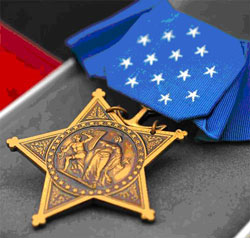
In January 1969, Lieutenant Vincent R. Capodanno, MM, became the second chaplain in United States history to receive our nation’s highest military honor. “For conspicuous gallantry and intrepidity at the risk of his life above and beyond the call of duty …”, he was posthumously awarded the Congressional Medal of Honor.

Medal of Honor Citation:

Medal-of-honorFor conspicuous gallantry and intrepidity at the risk of his life above and beyond the call of duty as Chaplain of the 3d Battalion, in connection with operations against enemy forces.

In response to reports that the 2d Platoon of M Company was in danger of being overrun by a massed enemy assaulting force, Lt. Capodanno left the relative safety of the company command post and ran through an open area raked with fire, directly to the beleaguered platoon.

Disregarding the intense enemy small-arms, automatic-weapons, and mortar fire, he moved about the battlefield administering last rites to the dying and giving medical aid to the wounded.

When an exploding mortar round inflicted painful multiple wounds to his arms and legs, and severed a portion of his right hand, he steadfastly refused all medical aid. Instead, he directed the corpsmen to help their wounded comrades and, with calm vigor, continued to move about the battlefield as he provided encouragement by voice and example to the valiant Marines.

Upon encountering a wounded corpsman in the direct line of fire of an enemy machine gunner positioned approximately 15 yards away, Lt. Capodanno rushed a daring attempt to aid and assist the mortally wounded corpsman. At that instant, only inches from his goal, he was struck down by a burst of machine gun fire.

By his heroic conduct on the battlefield, and his inspiring example, Lt. Capodanno upheld the finest traditions of the U.S. Naval Service. He gallantly gave his life in the cause of freedom.

In addition, he was also awarded the National Defense Service Medal and the Vietnam Service Medal. The government of Vietnam awarded him the Vietnamese Gallantry Cross with Silver Star and the Republic of Vietnam Campaign Medal with device.

Fr. Capodanno’s cause has been opened:

Prayer to Obtain a Favor Through the Intercession of the Servant of God Father Vincent R. Capodanno, M.M. by Archbishop Timothy P. Broglio

Almighty and merciful God, look with Love on those who plead for Your help. Through the intercession of your servant, Father Vincent Capodanno, missionary and Catholic Navy Chaplain, grant the favor I earnestly seek (mention the request). May Vincent, who died bringing consolation to the Marines he was privileged to serve on the field of battle, intercede in my need as I pray in the name of the Father, and of the Son, and of the Holy Spirit.

I want to add a word of thanks to a priest friend of mine, Fr. Tim Vakoc, with whom I was in seminary.  He suffered serious wounds in Iraq, which, after causing years of suffering, eventually lead to his passing away. May he rest in peace.

These men served in hell armed with love of God and love of country.  We should remember chaplains.

CLICK TO MAKE A DONATION

Posted in "How To..." - Practical Notes, ACTION ITEM!, Hard-Identity Catholicism | Tagged , ,
11 Comments

28 May – St Augustine of Canterbury: chance meetings make a difference

Chance meetings are important.

In the traditional Roman calendar, today is the Feast of St. Augustine of Canterbury (+604).   He had been the prior of the monastery in Rome on the Caelian Hill during the pontificate of the Great Gregory I.  In the Novus Ordo he is celebrated on 27 May, though he probably died on 26 May.

As the story goes, one day Pope Gregory spotted some English boys in the Roman slave market and was struck by their appearance, saying “Non sunt Angli sed angeli.”  Moved to compassion, he tasked Augustine to go to England with missionaries in an effort of “new evangelization”.  England had once been Christian but the Faith had flagged.   Gregory paved the way with letters and missives, but the task was daunting.

Augustine and his companions landed in Kent and began to work.  They met with King Ethelbert and Queen Bertha and the rest is history.

My congratulations to my good friends Fr. Timothy Finigan, His Hermeneuticalness, who is a parish priest close to the place when Augustine set foot in England, Margate, and to Fr. Marcus Holden, who is rector of the Shrine of St Augustine, Ramsgate.

Chance meetings can be occasions of grace not just for one or two, but for nations.

Today we need to pray and make reparation for entire nations, lest they be – as Our Lady said – “annihilated”.

Posted in Saints: Stories & Symbols | Tagged
2 Comments
























