Under the post Msgr. Bux’s Open Letter v. Card Cupich a commentator brought up the issue of “liturgical sobriety”. Card. Cupich referred to “sobriety” twice in his offering.
The renewal of our worship was pursued in keeping with the Council Fathers’ desire to present to the world a church defined not by the trappings of world power but marked by sobriety and simplicity, enabling it to speak the people of this age in a way that more closely resembles the Lord and allowing it to take up in a fresh way the mission of proclaiming good news to the poor.
[…]
With the recovery of the ancient sobriety of the Roman Rite the Eucharist is once again the locus of genuine peace and solidarity with the poor in a fractured world.
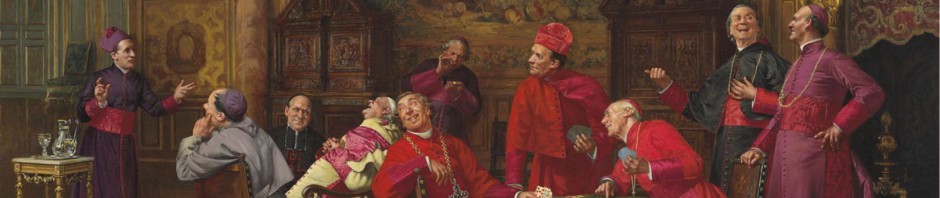
It is highly unlikely that “the poor” (whoever they are) would be more attracted to what the Church has to give through drab vestments, banal architecture and dreadful music than they might be by a beautiful church, splendid vestments and the great works of the Church’s treasury of sacred music. And would the not-poor (whoever they are) be more motivated in their service to “the poor” through the drab, banal and dreadful?
But let’s dig into the idea of “sobriety” as it has been used over the centuries. It is conceivable that that word does not mean what he thinks it means in a liturgical context viewed through the centuries.
There is an ancient paradox – sobria ebrietas, the sober intoxication of sacred liturgical worship.
This sheds light on Msgr. Bux’s reply to Cardinal Cupich.
Authentic reform never flattens the sacred, which is what Cupich promotes. The liturgy elevates and clarifies. It does not dilute. God’s proffered chalice – which we receive and return in fulfillment of the virtue of Religion – intoxicates with beauty which reflects truth.
The little Latin oxymoron sobria ebrietas sounds like something out of Chesterton, yet it is far older. It names a biblical and patristic intuition that grace makes a man “drunk” without destroying his reason, caught up in God yet more lucid than before. This is a result in full, conscious and actual participation (aka active receptivity) in sacred worship.
Scripture gives the core imagery. In the Vulgate Psalm 35(36):9 we pray,
inebriabuntur ab ubertate domus tuae,
et torrente voluptatis tuae potabis eos
RSV: Ps 36:8 – They feast on the abundance of thy house, and thou givest them drink from the river of thy delights.
The wording is strong. God does not merely “refresh” his friends, he makes them inebriated in his presence. This does not bring fuzziness or confusion, but rather: “apud te fons vitae, et in lumine tuo videbimus lumen” (v. 10), “with you is the fountain of life, and in your light we shall see light.” It expands the mind with clarity.
The New Testament gives the negative and positive poles in a single sentence. Saint Paul exhorts the Ephesians (5:8),
Et nolite inebriari vino, in quo est luxuria, sed implemini Spiritu Sancto
“Do not be drunk with wine, in which is debauchery, but be filled with the Holy Spirit.”
The contrast is not between “feeling something” and being flat and sober. It is between one kind of inebriation, that dissolves man in sensuality, and another, where he is filled with the Spirit, speaking “in psalmis et hymnis et canticis spiritualibus” (Eph 5:19). That, of course, is liturgical.
At Pentecost, the crowd misunderstands the apostles’ joy. ““ἕτεροι δὲ χλευάζοντες ἔλεγον ὅτι γλεύκους μεμεστωμένοι εἰσίν”” (Acts 2:13), “others mocking said, they are filled with new wine.” Peter answers:
οὐ γὰρ ὡς ὑμεῖς ὑπολαμβάνετε οὗτοι μεθύουσιν, ἔστιν γὰρ ὥρα τρίτη τῆς ἡμέρας
“These are not drunk as you suppose, for it is the third hour of the day.” They are “full,” but of the Spirit who has just been “poured out” on all flesh (Acts 2:17).
Out of this biblical matrix the Fathers coined sobria ebrietas. Patristic scholars trace the theme back at least to Philo and Origen, who already speak of an “ecstasy” in which the soul goes out of itself to God without losing its reason.
Ambrose of Milan, however, is the great transmitter of the phrase into the Latin West. Modern studies of his Eucharistic preaching note that he explicitly uses sobria ebrietas in his exposition of the Psalms and that he loves to speak of bona or spiritalis ebrietas in connection with the chalice.
One key text is Ambrose’s Eucharistic reading of our psalm verse. He returns again and again to inebriabuntur ab ubertate domus tuae as an image of the chalice that gladdens without making the feet totter. In a sermon on the Psalms he explains, in a passage preserved in translation,
Bona ergo ebrietas, quae non dissolvit animum sed erigit; quae non solvit, sed colligit sensus. Inebriari enim te volo deliciis domus Dei.” (Exp in Ps. 35, 46–47)
“Inebriation of this sort is good and fills the heart with joy without causing the feet to totter. Yes, it is good inebriation. It steadies the footsteps and makes sober the mind.”
Here is the heart of sobria ebrietas: a divine “drunkenness” that makes the mind more sober, not less.
Ambrose explicitly identifies the Eucharistic chalice with the calix inebrians of Psalm 22(23):5 in De sacramentis, 5,3, 17:
“Accipe quod ait propheta: ‘Calix inebrians quam praeclarus est.’
Calix iste est qui inebriat non corporis ebrietate sed mentis.”
“Take what the prophet says: ‘How glorious is the cup that inebriates.’
This cup is one that inebriates not with a bodily drunkenness but of the mind.”
Ambrose uses the exact expression sobria ebrietas (sometimes sobria ebrietas Spiritus) when contrasting Spirit-given intoxication with wine. The clearest instance is in Exp Evangelii secundum Lucam, 7, 177:
“Sobria ebrietas est, quae mentem perducit ad modum, non ad vertiginem;
ebrietas Spiritus, non vini.”
“It is a sober drunkenness, which leads the mind to right measure, not to dizziness;
an inebriation of the Spirit, not of wine.”
The same Ambrose gives the Latin Church one of its classic hymns of light, Splendor paternæ gloriæ, sung at Lauds. It does not use the phrase sobria ebrietas itself, yet the motif is everywhere in it. The hymn opens:
Splendor paternae gloriae,
de luce lucem proferens,
lux lucis et fons luminis,
diem dies illuminans.
Christ is the “Splendor of the Father’s glory,” the “Light from light,” the “fountain of light,” who makes every day shine. The second stanza calls him verus sol, the “true sun,” and asks:
Verusque sol, illabere
micans nitore perpeti,
iubarque Sancti Spiritus
infunde nostris sensibus.
“True sun, come down, shining with unending brightness, and pour the radiance of the Holy Spirit into our senses.”
This is the same logic as Ephesians 5. Do not fill yourself with wine, which clouds the senses, beg the “true sun” to pour in the radiance of the Spirit, which enlightens the senses. Ambrose’s readers, already steeped in Psalm 35(36), hear the prayer for a filling that is an inebriation of light.
Medieval mystics, East and West, play with the same combination. Writers influenced by Gregory of Nyssa and the Dionysian corpus call this ecstatic state sobria ebrietas, linking it to the biblical ἔκστασις or excessus mentis, the “going out of the mind” that does not destroy, but fulfills, the mind.
Aquinas does not use the exact phrase, but in ST II-II, q. 168, he describes joy in the Holy Spirit as an affective “overflow” (redundantia) that perfects the mind while leaving it fully rational, a clear scholastic underpinning for the notion of sobria ebrietas.
Many authors commenting on the Song of Songs go down this same path.
In The Spirit of the Liturgy Pope Benedict XVI addresses sobriety in a discussion of liturgical music:
The Church’s Tradition has this in mind when it talks about the sober inebriation caused in us by the Holy Spirit. There is always an ultimate sobriety, a deeper rationality, resisting any decline into irrationality and immoderation. We can see what this means in practice if we look at the history of music.
He’s not talking about Joncas and Haas.
And:
It is above all in Church music that the “sober inebriation” of faith takes place—an inebriation surpassing all the possibilities of mere rationality. But this intoxication remains sober, because Christ and the Holy Spirit belong together, because this drunken speech stays totally within the discipline of the Logos, in a new rationality that, beyond all words, serves the primordial Word, the ground of all reason. This is a matter to which we must return.
In Catholic spirituality sobria ebrietas therefore marks a concrete set of experiences.
At the most basic level it belongs to sacramental life.
At the altar the priest takes up the chalice that is “calix salutaris,” the “cup of salvation,” and the faithful pray to be “inebriated” with the love that flows from Christ’s pierced side rather than with the spirit of the age.
Ambrose can say of the Eucharist, in De sacramentis 5, 4, 25: “Christus mihi cibus, Christus est potus, caro Dei cibus mihi et Dei sanguis est potus”, “Christ is my food, Christ is my drink, the flesh of God is my food and the blood of God is my drink,” and that “daily Christ is served to me.”
To receive that food with faith is to enter into the “good inebriation” of which he speaks.
At a deeper level the phrase names what happens when grace seizes the intellect and affections. The soul goes out of itself in love, it tastes something of divine sweetness, yet its faculties are not abolished.
On the contrary, the “drunken” man of the Spirit begins to see with new clarity that “omnis homo mendax” (Ps 115:11), “every man is a liar,” and that only God is faithful.
In short, the world offers an “inebriation” that dulls conscience and finally leaves a man empty. The liturgy, rightly loved, promises something loftier, sobria ebrietas, the sober intoxication of those who “inebriabuntur ab ubertate domus Dei,” and whose minds are made clear because they are “impleti Spiritu Sancto.”
Which sort of “inebriation” results from conforming liturgical rites to social programs? From immanentism and horizontalism?
Which sort of “inebriation” results from conforming liturgical rites to an encounter with mystery which is tremendum et fascinans? Transcendent and vertical?
Which of the two would provide the deeper and more lasting motive based on charity properly understood regards spiritual and corporal works of mercy toward the poor of body and of spirit?
With the lens of sobria ebrietas we return to the “walking together” of Bux and Cupich.
In his letter Msgr. Bux corrects Card. Cupich’s claim that the post-conciliar liturgical reform was primarily about creating “a new image … simpler and more sober, embracing the entire people of God … more closely resembling her Lord than worldly powers.”
Bux insists that this characterization distorts the intent of Sacrosanctum Concilium, which calls for “rites should be ‘distinguished’ by a noble simplicity” precisely because they reflect the majesty of God. He argues that reducing the liturgy to an aesthetic of poverty or solidarity with the poor neglects the transcendent and sacrificial dimension of worship, thereby weakening the “sober intoxication” of divine joy that true liturgy cultivates. In short, Bux defends the traditional Rite as a staged, majestic offering that leads the faithful into the mystery of God, not into a sociological program of “solidarity.”
Finally, regarding that quote from Sacrosanctum Concilium as provided by Cupich – “rites should be ‘distinguished’ by a noble simplicity” – another commentator points out that if we look at the Latin original we find ritus nobili simplicitate fulgeant as “The rites should shine by a noble simplicity”. Lewis and Short says fulgeo is “to flash, glitter, gleam, glare, glisten, shine (syn. splendeo)” and tropologically as “to shine, glitter; be conspicuous, illustrious (rare and mostly poet.)”.
This is not the same as “be distinguished by”.
The sociological arguments seeks to extinguish rather than to make distinguished.
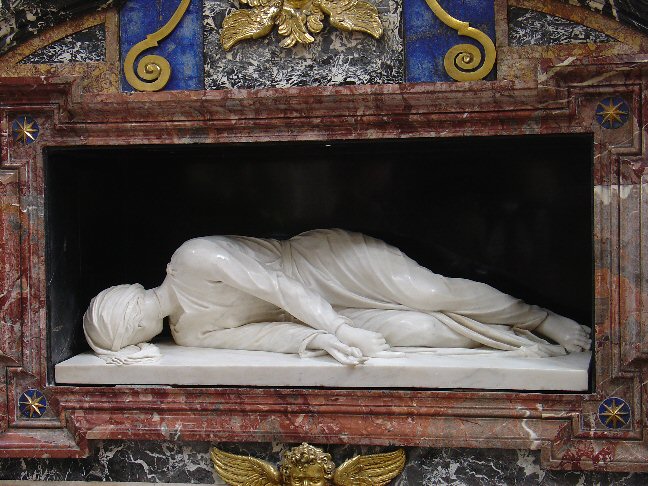
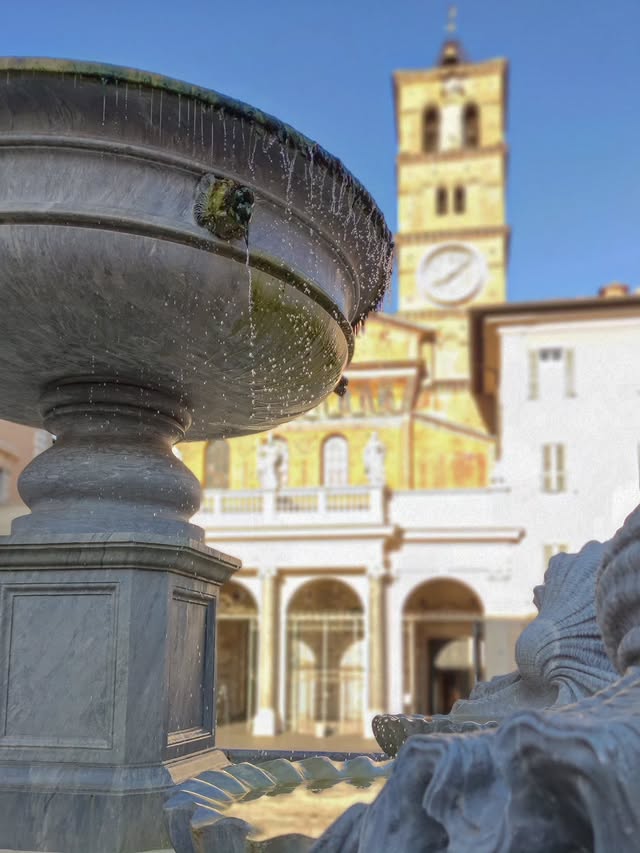
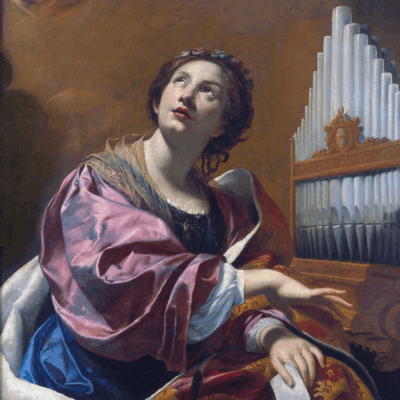 Today is the feast of St. Cecilia, a virgin martyr and saint of the Roman Canon.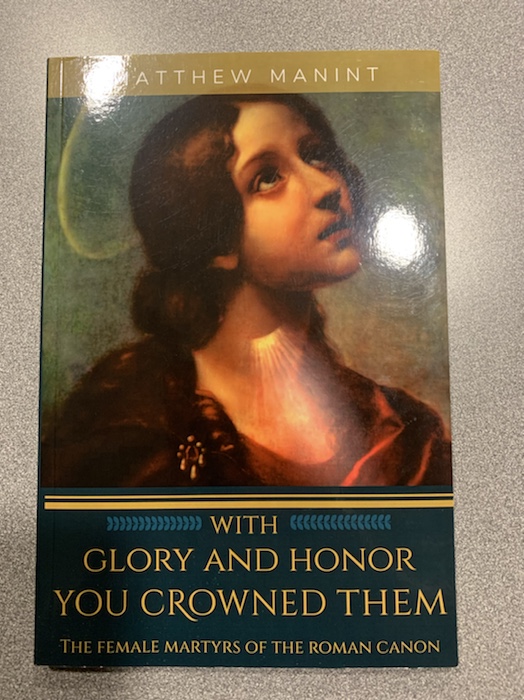






 November 13th, 2025


 November 12th 2025

 waalaw on ROME 26/10– Day 22: Colors and courses and Coco: “Thank you, pestolover. I made sure that my solution was correct before posting it; but, as is my fatal flaw,…”


























