My friend Fr. Gerald Murray held the lone guest chair with Raymond Arroyo on EWTN the other night, and the video is now available.
Fr. Murray is no-nonsense.
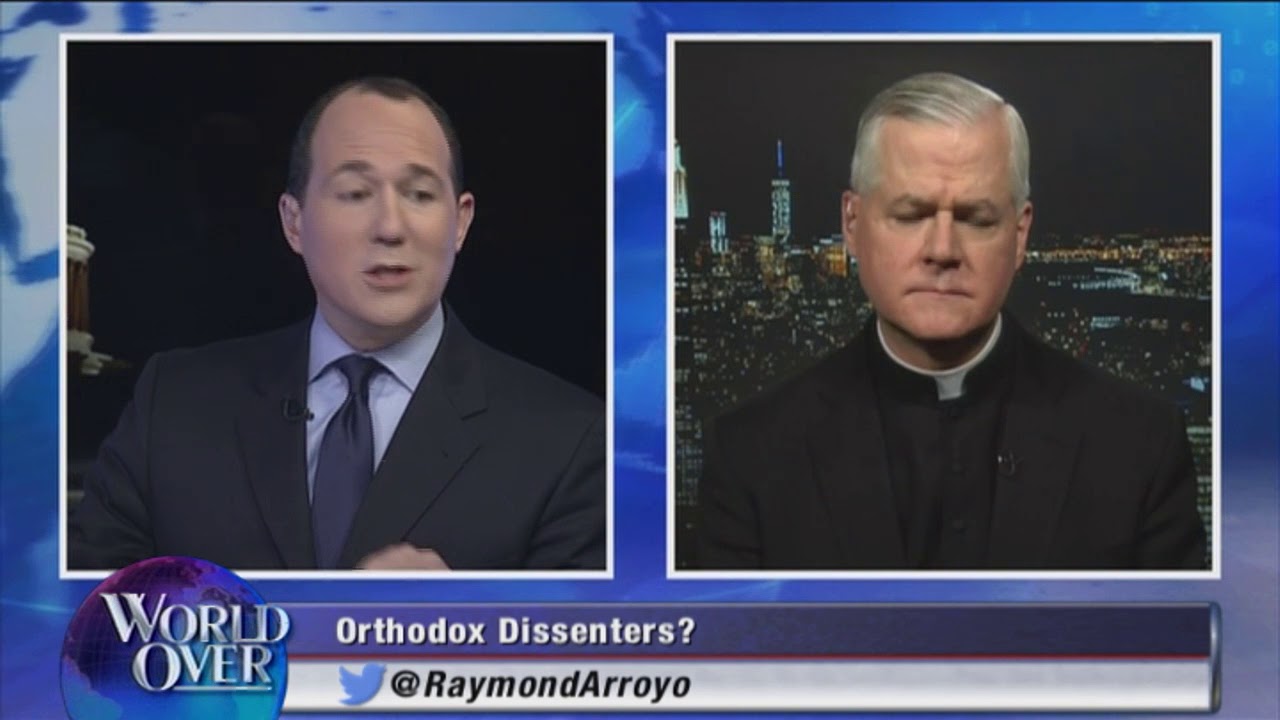

My friend Fr. Gerald Murray held the lone guest chair with Raymond Arroyo on EWTN the other night, and the video is now available.
Fr. Murray is no-nonsense.

Dunstan 1 – Devil 0
At Rorate there is a post especially for priests about the proper and improper use of the exorcism prayers in the older Rituale Romanum. It’s a good service.
After providing images of a 2009 letter from the Pontifical Commission “Ecclesia Dei” with responses to questions (back in the day we got answers to dubia), about deacons blessing with the older Rituale (sort of important, but … not really), they got down to the far more important issue: the danger to priests (or others) which can result from using the restricted exorcism prayers without the proper permission.
The Rorate post adds a anonymous (alas) note about how sins and playing with things like oujia boards can open the door to entrance by demons. The writer correctly states – and this is accurate and salutary – that demons are legalistic. Therefore, if a priest uses these restricted prayers without permission, he could be opening the door to the demons attacking him! I often warn lay people in these electronic pages to avoid getting at all into these matters, these texts. Avoid them! If even a priest – having the character imposed by orders – without a permission can get into trouble, how much more lay people?
Some explanation is in order:
The traditional rite of exorcism is found in the traditional Rituale Romanum.
Summorum Pontificum 9, §1 allows the use of the Ritual in force in 1962, that is, the 1952 edition, which was the last official edition prior to 1962. Universae Ecclesiae 35, a document explaining the implementation of SP, says that the Ritual can be used in its entirety. That means that the rites for Exorcism can be used. HOWEVER… these rites were restricted to bishops and those to priests to whom the ordinary gave permission. They still are. Always have been.
The rites of exorcism are found in Title XI of the 1952 Rituale. Title XI is in 3 chapters.
1. De exorcizandis obsessis a daemonio – An introductory chapter which explains exorcisms, etc. It doesn’t contain rites of exorcism.
2. Ritus exorcizandi obsessos a daemonio – This rite may be pronounced only by bishops and and by priests who have authorization from the Ordinary (keep in mind that that are different kinds of “ordinaries” – a Vicar General is an “Ordinary”). The rite includes the litany, long prayers with signs of the Cross, readings from Scripture, the Athanasian Creed, psalms, etc. If I wanted to drive the devil out of some Jesuit, I would use this prayer, with the permission of the local bishop or ordinary.
3. Exorcismus in satanam et angelos apostaticos – This prayer – for driving the infesting enemy from people and from places – can be used by bishops and by priests who have authorization from the Ordinary. It consists of a prayer to St. Michael, a couple of exorcism prayers, etc. For example, if I wanted to exorcise the offices of the Fishwrap I would use this prayer with permission from the local bishop or vicar general (unless the bishop restricted this to himself in KC).
In each case, a priest must have permission. Any bishop can use them pretty much anywhere.
It was very good that Rorate posted on this. Hopefully priests will read the post and take it seriously. Dealing with demons is not a game of bean bag. They are angelic beings, restrained in large part by God, but angelic nonetheless.
The Rorate post’s comment, however, may go astray on a point. The writer seems to imply that the 2009 PCED letter (the “protocol”) might have changed something. After commenting that some priest used the Ch. 3 of Title XI with good effects for some time apparently without specific permission, and that that was recommended in a book which had an imprimatur by Card. Pell, (emphases added):
“this protocol makes it clear that it is now unquestionably at least a material disobedience each and every time any priest in the world uses this prayer without the proper permissions. And certainly every devil in the world is well aware of this.”
This is a small matter, but Card. Pell’s book couldn’t have given any permission to use Ch. 3 and I don’t believe there was ever a question about whether or not a priest could use ch. 3 without permission. If Summorum Pontificum gave permission to use the entire Rituale, it did not thereby remove the restrictions on exorcisms.
Therefore, the 2009 PCED letter did not once again place restrictions on the use of those prayers. The restrictions were always there. Period. It was always wrong and even dangerous for the aforementioned priest to use either ch. 2 or 3 without the permission of the ordinary, before SP and after.
That said, it is true that demons know the law and that they are legalistic. That’s a good point in the Rorate post. This is one of the reasons why the Church’s traditional exorcism prayers are seemingly repetitive when breaking demonic bonds. Demons claim rights to be where they are, because they were invoked or invited by curses or “spells” or through objects and sins, etc. Once there, they attach like leeches and get legalistic. The prayers of the Church systematically break their claims and eradicate them and expel them.
And they really hate Latin.
Demons get so legalistic that they will mock priests whose Latin isn’t very good. That’s why I made this post HERE.
Folks, I’m not making this stuff up.
If after Vatican II the Church’s shepherds stopped talking about sin and its consequences, that doesn’t mean that sin stopped having consequences.
Demons can infest places and things and people like vermin or ringworm or parasites and they are decidedly unhelpful for everyone around.
Don’t kid yourselves. This is one reason why in our traditional practices as Catholics we use lots of sacramentals, we say prayers before meals asking God to bless our food, etc. We had – have – blessings for everyday things, tools, foods, common and important places (homes or perhaps sick rooms). We have blessings and rites for feasts and changes of seasons. All these practices wove us as individuals into the rich fabric of the Church’s life in the practice of the virtue of religious, and braided us all together in our rites and our identity together with our forebears and descendants.
We are our rites! Change them, drop them, denigrate them… there are consequences.
Holy Church is the greatest expert on humanity there has every been. Through centuries of experience she developed what is good for us and WHAT WORKED. These things can slowly change and shift over time, but they do so slowly. Human beings don’t really change over the millennia. Circumstances do, but even then not too much. So, when the Church figured it out, making sudden changes to… everything, I guess, was consequential.
In the creeds we recite, we say that we believe in things that are “invisible”. That means the angelic realm, with its good and holy angels who are our friends and guardians as we as the fallen angels, who are demons and who desire our spiritual isolation from God and ultimate torment. There are hierarchies of angels, good and bad. Some are vastly more powerful than others, each one being his own species, as different from each other as a giraffe from a spiny hedgehog. But all angels transcend our human nature. Thanks be to God we have our Church with sacramentals and even more mighty sacraments. We have angels and the restraining will of God over all the forces of Hell.
This is why I never fool around with rites for blessings and sacramentals. I use the older Rituale, with its permitted exorcisms in Latin and clear intentions.
Finally, listen up!
The rite of exorcism is just a sacramental. Confession and the Eucharist are sacraments and are immensely powerful. If you are having problems of some kind and suspect demonic involvement, make plans to make a good Holy Communion, examine your conscience and…
GO TO CONFESSION!
UPDATE:
Some priests have written to ask for the aforementioned recordings. One of them wrote,
I am a Priest of ___ I have just been appointed Exorcist for ___. I offer the TLM regularly but but Latin doesn’t come easily for me. I would appreciate you sending me your recordings. I intend using the old ritual in this ministry. As one priestly wag commented: “The only reason the demon would leave when the new prayers are used is out of boredom.”
LOL! Thanks, Father, for the chuckle.
Massimo “Beans” Faggioli … what a puzzle.
He seems to be bright, but he constantly tweets dopey things.
The diocese in Albano, Italy is setting up a shelter for separated or divorced fathers who, having to pay monthly livelihood to wife and children, do not have a house to sleep in. This is Francis’ Church of mercy that Catholic rigorists don’t like.
— Massimo Faggioli (@MassimoFaggioli) January 12, 2018
For Beans, a Catholic “rigorist” is anyone who does not simply roll over and accept unquestioningly that, for example, chapter 8 of Amoris laetitia needs no additional clarifications.
So, he writes…
This is Francis’ Church of mercy that Catholic rigorists don’t like.
Beans would have you think that his fictitious straw-men rigorists want separated fathers who can’t afford housing, to sleep rough or in their cars.
I am reminded of the malice of the dems who return like dogs to the vomit of the lie that republicans want to push grandma in her wheelchair over a cliff. Never mind that it’s the dems who push euthanasia and abortion.
BTW… that’s a problem in Italy… jobs, incomes, a place to live, people with good degrees and skills and even decent jobs sleeping in their cars. It’s a big problem.
I looked up the details of the program that the Diocese of Albano set up. There is a story in L’Osservatore Romano (not that L’O is that reliable). Some additional notes about who owns the property and how it being paid for HERE. The Bishop of Albano is also the secretary of the Pope’s gang of cardinals which meets regularly.
Essentially, there is now a house where, as it is reported, they can take in eight men who wind up without a dwelling after a separation or a divorce. As the diocese says, this is “a new and increasingly pressing form of poverty that the diocese of Albano is addressing in its territory.”
For my part, I think that this is a great initiative.
The area in question, the Castelli Romani, stringing to the southeast of Rome, is deeply troubled, with lots of illegal immigrants and massive drug problems… not to mention Satanic activity. Helping these guys is a great idea.
The Bishop of Albano, in the bit published by L’O, says that:
The words written by Francis in Amoris laetitia, especially in chapter 8, and the invitation to welcome, accompany and integrate were for us like a true corroboration.
Interesting. The Pope’s words were a corroboration of what they were doing. They started on this before Amoris. However, the Bishop wants to associate the work with Amoris. Fine. Who can see a problem with that? Admitting men to this house isn’t the same as admitting the divorced and then publicly, civilly remarried and living more uxorio to Holy Communion without further qualifications.
Care of these poor men is an entirely separate issue.
Hence, Beans comment is pretty nasty by anyone’s reckoning.
Why would he say such a thing?
His tweets are simply meant to provoke, to pull in a little more traffic, to make a name for himself among those whom he wishes to impress… rather like a kid who wants to join a gang or like a new cadre in the New catholic Red Guards wants to show that he’s got the chops.
Oh… by the way… Beans “blocked” me on Twitter, as if that makes a difference.
When I see the word “brede” I can’t help but think of the novel In This House Of Brede by Rumor Godden (US HERE – UK HERE).
From a reader…
QUAERITUR:
Our little EF congregation would like to invite our Bishop to attend a Mass. we do not have the items or people sufficient for a Ponitifcal Mass. we are thinking of Mass in the Presence of a Prelate. however, we are having trouble finding a pax-brede. any suggestions.
First, good for you for getting what you are able to do, done. Quantum potes, tantum aude…. brick by brick… and all that good stuff.
Some of you are probably scratching your heads wonder what a “pax-brede” is.
Explanations are in order.
There is a moment in the Roman Rite designated for the “Sign” or “Kiss of Peace”. You all know. Most of you dread it.
In ancient times that kiss was done in the Roman manner, formally. It wasn’t an undignified free for all of idiot waving and roaming about, no longer mindful of the sacred. Giving the “pax… peace” flowed out from the altar, as the bishop/priest would bestow it on the sacred ministers, who in turn would go to the other clergy nearby, and so forth and so on.
 At one point there developed an object to facilitate this kiss of peace. It came to be called a instrumentum pacis or osculatorium (Latin osculum = kiss). In English was was called the “pax brede” or simply “the pax”.
Brede is an archaic spelling of “board”, for that is what this object is: a flatish board, often highly decorated or with a decorated frame, usually having a some kind of handle, presented for people to kiss. It is often decorated with the Lamb of God or another eucharistic symbol.
It is possible that this liturgical critter evolved to speed the process of giving the sign of peace among quite a few participants, or to avoid any embarrassments, etc. In any event, the presenter presents the “pax brede” with a “Pax tecum”, whereupon the presentee kisses it and responds “Et cum spiritu tuo.”
The use of the pax brede, or pax, pretty much died out except in fancier Masses, as those of higher prelates such as bishops or involving them. Even in those Masses, use of the pax didn’t widely survive.
However, it remains an option today, under Summorum Pontificum.
Now, to your specific situation: Mass in the presence a prelate.
If you have a Solemn Mass in the presence of the prelate, the deacon could take the Pax to the bishop, who is at that moment parked, kneeling at his bench and faldstool set in the sanctuary directly before the altar.
However, in the Low Mass or Missa Cantata there is no deacon to bring the Pax to His Nibs. The priest is not supposed to leave the altar! Quod Deus avveruncet!
So. What to do? How to get the kiss of peace to His Nibs the Bishop?
DING! The pax brede. But wait! You don’t have a pax brede. Thus, the question.
Well, sonny, I say…
IMPROVISE, ADAPT and OVERCOME!
If you don’t have a motivated, dedicated, yah ha, oorah pax brede, then overcome its lack by adapting something else to serve the purpose.
What could substitute for a pax brede? Let’s see…
You don’t want to use just anything, for this is sacred worship.
It should be flatish, as the pax brede is flatish.
It should probably have a handle, as the pax brede usually does.
DING!
Why not improvise your pax brede by using the Communion paten?
It is a sacred vessel, blessed because the Host and particles may contact it. It isn’t decorated, but… hey! You don’t have a pax brede and you need a solution.


The priest’s paten is, at this moment during Mass, busy with other duties. The Communion paten, however, is waiting for its queue. Give it a TDA (Temporary Duty Assignment).
The MC can carry the TDA brede to His Nibs, and then keep it at hand for the distribution of Communion, to follow soon thereafter.
IMPORTANT: Explain to His Nibs beforehand what you are going to do at the sign of peace. Explain that, because you don’t have a pax brede, you will substitute a paten. Don’t take His Nibs by surprise. In my experience, bishops don’t like surprises. Also, it is the common sense, correct thing to do.
You might send His Nibs to this blog post! On the other hand, it is possible that he will already have read it.
How bad is the situation of vocations to the priesthood tragic Germany?
“In 2017, only 76 priests were ordained in Germany; in 2000 there were still about twice as many, namely 154. When the German Bishops’ Conference tallied this number nationwide for the first time in 1962, there were even 557 ordinations to the priesthood.”
A friend sent a link to an article in katholisch.de and included an ironic observation about the photo used with the article.
Germany would appear to have so few priests, they can’t even get photos of their own!
The photo shows a seminarian reading his breviary… at Dunwoody seminary in New York.

The German bishops are killing the Church in Germany and poisoning the rest of the Body of Christ as well.
UPDATE:
On a related note, a story from 2013 about the German Church selling off churches. Think about it. If the German Church takes in billions of euro, why sell a church… unless there is some other agenda than money or the parishes are well and truly dead? HERE
 When I would explain the Decalogue to children, I’d say something like: God didn’t give us rules because he wanted to ruin our fun. These rules are God’s way of saying, “Don’t hurt yourself. You are made in my image. I love you. I want you to be happy. Do these things and avoid these other things, and you’ll truly be happier.”
That’s a segue in to the terrific essay by Anthony Esolen today at Crisis. He drills into virtue in general and chastity in particular using The Tempest as his spring board.
Esolen gets Shakespeare, as he gets Dante. I’m a sucker for Shakespeare and for Dante.
Here is a taste of Esolen’s piece:
[…]
Now the power the Miranda possesses, both as subject and object, is ineradicable from her innocence and purity, which in her assume a distinctly womanly form. I imagine that everyone has seen a man who appears unpleasantly handsome, because the vicious life he leads has begun to show in his countenance—the leering eye, the cold smile, debauchery in the lip and jowl; or a woman unpleasantly beautiful, because of a vicious life of her own—the look of a whore, perhaps, without the poverty and suffering. Miranda is what she is because of her virtue, the very thing that the feminist critic found appalling. It is as if the critic were railing against Prospero for having fed his daughter good food and given her plenty of fresh air and sunshine for the health of her body.
For virtue is like health. That is something Shakespeare understood quite well, and the feminist critic did not. The typical charge against Prospero is that he has used his magic art to cause Ferdinand [not the bull in the book] to fall in love with Miranda, [not the planet in the Firefly movie] stealing her freedom from her—“freedom” understood as self-will, autonomy, the spoiled teenager’s “I want it!”—but Miranda needs no art to make her wondrous, and when the young people meet, Prospero suggests that the magic is in them: “They are both in either’s powers.”
Virtue is a power, a liberating power. Let us repeat it every day. Virtue is not the possession of the “right” political opinion, no more than it was, among the upper classes in Victorian England and in the growing American state, the possession of the right books and objets d’art, attendance at the right religious services, knowing the right people, speaking with the right accent, wearing the right clothes in public, and extending the right pinky while you were drinking the right tea from the right china arranged in the right way.
[…]
Read the rest there. It’s great.
 Just as a reminder…. Esolen translated Dante’s Divine Comedy into English and did a great job of it.
If you have never read the Divine Comedy, you should. You could start with Esolen (Part 1, Inferno US HERE – UK HERE) or perhaps with Dorothy Sayer’s fine version (Part 1, Inferno, US HERE – UK HERE). There are many renderings to choose from. I would very much like to teach on Dante someday. Maybe it’ll happen.
When you make the excellent choice to read the Divine Comedy, here are a couple tips. First and foremost, make the decision that you will read the whole thing. Don’t read just the Inferno. The really great stuff comes in Purgatorio and Paradiso. Also, read straight through a canto to get the line of thought and story and then go back over it, also looking at the notes in your edition. Dante was, perhaps, the last guy who knew everything (with the possible exception of Erasmus). Each Canto is dense with references. You will need notes to help with the history, philosophy, cosmology, poetic theory, politics, theology, etc. Really. You will need help.
 This is disgusting, but it is necessary for you to know.
A forward, which I have offered before:
I’ve argued here – often – that the homosexualist agenda has been patiently engaged for a long time and is still reaching for that brass ring.
The brass ring is the lowering of the age of consent.
The homosexualists have slowly been shifting the language about deviant same-sex acts and those who regularly commit them.
Through the MSM and entertainment industry the image of homosexuality as something hidden and unclean was broken by replacing it with victim status during the flaming up of the AIDS epidemic in certain populations.
Then the victim image had to be broken and replaced, which was accomplished through cool and “with it” characters in TV shows and other culture movers. Think of the absurdly high percentage of homosexuals in TV shows, increasing every year. You can’t turn on a TV series now and not find it filled with deviants, now doing deviant things in prime time.
BUT! They are cool and emotionally sensitive, who have answers for the dysfunctional and often less attractive “hetero” characters.
Fuse this culture shift with the rise of no-fault divorce and nearly universal contraception and we have the perfect deadly storm that can rip the sexual act conceptually away from marriage (what’s that?) and procreation (what’s that?).
Shall we mention the near total silence of the Catholic Church?
Now that subcultures are multiplying like viruses, we are just about ready, I think, for the next stage of the assault on the human person and God’s plan. Not content for legalization of same-sex “marriage”, the next phase of the homosexualist agenda will soon be implemented: lowering of the age of consent (aka the aforementioned the brass ring).
And now they have helpers within the Church who are highly visible and often in positions of authority. Certain Jesuits are blatant homosexualists, their superiors do nothing to stop them and bishops allow them to speak anywhere. Bishops themselves in Germany are talking about blessing same-sex relationships.
Within the Catholic Church very highly placed authorities are working incrementally to detach procreation from human procreative powers and potentials and acts.
If you can successfully detach procreation from the use of procreative acts, etc., then it’s game over for Catholic moral teaching and, subsequently, for all Catholic doctrine. Once you say that what is true (in nature and revelation) isn’t true, it’s over.
And, to be clear, the brass ring they are all reaching for is the lowering of the age of consent of those whom you can rape … have sex with.
And to hell with those who are trying to live chaste lives and who fight various inclinations. Now, highly placed teachers in the Church are offering justification for mortal sins because, after all, people can live according to “ideals”. And, well, in our “lived experience”, we see that living chastely can be difficult, and that many fall. The ideal remains the ideal but we all know that it is is simply too hard. Therefore, let’s stop calling acts that violate the ideal an obstacle to receiving the sacraments (which are also “ideals”, I guess).
If some at the very pinnacle of those behind the scenes fueling these movements – not their Jesuit tools, German bishops, etc. – have the ultimate transformation of the Church in mind, those who are at lower levels of the movements really want to have sex with anyone or anything, and to start recruiting while their young.
Now look at LifeSite‘s story about
LGBT fetish underwear designer defends making 9-year-old drag queen its ‘covergirl’
January 11, 2018 (LifeSiteNews) – The designer behind an “LGBT luxury brand” is defending using a 9-year-old drag queen to advertise a sequined onesie alongside a “BDSM Bondage Leather Star and Chain Dress,” bondage-themed nipple pasties, and glittery anatomy-highlighting men’s underwear.
House of Mann, run by Brandon Hilton, is a Charlotte, North Carolina-based online shop that sells clothing and lingerie for drag queens and gay men. It uses “vegan leather,” sequins, and various bondage and sex motifs to make its products. [It’s safe for the environment?]
Nine-year-old Nemis Quinn Mélançon Golden, also known by his drag name “Lactatia,” became a sensation after appearing onstage at the Montreal stop of the “Werq the World Tour.” His mother, Jessica Mélançon, encourages Nemis to be a “drag queen.”
Breitbart and the Daily Caller originally sounded the alarm at Nemis named House of Mann’s “covergirl,” and being featured alongside “vegan leather harness jackets” and “fetish stripper boxer briefs.”
[…]
Mark you… this is what the homosexualists within the Catholic Church also want.
 Occasionally a friend of mine in England makes weekend adventures to visit sites where there are preserved “priest holes”, and he sends photos. They really give you pause. As you know, in the 16th and 17th centuries, Catholics who refused to give up their now-illegal faith would at times hide priests, who would have been arrested, tortured and murdered. Moreover, there has been a recent series about the “Gunpowder Plot” in which some brutal scenes show how Catholics were treated.
Today, by the way, they’d find us priests. There would be no place to hide, I’m afraid.
Another friend just sent a link to a fascinating piece about “Mass paths” in Ireland.
When Catholics were persecuted in Ireland during the Penal Times and could not have churches, they had to go out to some remote place and have clandestine Masses. Over time, their feet beat paths that, apparently, remain to this day.
Let’s see a bit from Atlas Obscura:
On Ireland’s southwest coast, in County Kerry, there is a small village called Caherdaniel. Nearby, there is a national park, a fort that offers glimpses of the Skellig Islands, and the sloping shores of Derrynane Bay. And, etched into this countryside, is the Caherdaniel Mass Path. Like other such paths around Ireland, this narrow track was used by Catholics to attend mass 300 years ago, during a time of religious persecution.
The locations of these passages were closely held secrets, which is why it took Irish photographer Caitriona Dunnett years to research her project Mass Paths. It was the one at Caherdaniel that first sparked her interest. “I photographed it and remembered learning about the penal times at school,” she says. “It inspired me to research and find other penal paths to photograph.”
Beginning in the 1690s, the Protestant-controlled Irish Parliament, in conjunction with the English Parliament, passed a series of increasingly stringent, brutally wide-ranging penal laws that imposed serious restrictions on the already oppressed Catholic majority. No Catholic person could vote, or become a lawyer or a judge. They could not own a firearm or serve in the army or navy. They could not set up a school, or teach or be educated abroad. They could not own a horse worth more than £5. They could not speak or read their native Gaelic. [Sort of like …early Dems.]
In an attempt to decrease Catholic land holdings, in the early 1700s, a new law prohibited primogeniture, and instead, when an Irish Catholic died, his land was divided among his sons and daughters. But any son who became Protestant could inherit everything. According to one report, Catholics made up 90 percent of the country’s population. A the end of 1703, they owned less than 10 percent of the land.
Catholic bishops were forced to leave the country. One priest per parish could remain, if he registered with the authorities. [An important development for our liturgical worship today, I think. More below.] The rest were banished, and any who returned would be executed. In 1709, another law was enacted that forced priests to take an oath of abjuration to Protestant Queen Anne. Only 33 priests are recorded to have taken this oath, and the rest had effectively been outlawed. The law also forced people to declare where and when they had attended mass during the prior month, and report any hidden clergy.
These hidden priests held mass in secret, away from watchful eyes. It might be in a shed, or outdoors, with a rock as an altar. Priests sometimes obscured their faces, so if anyone in attendance was later questioned, they could honestly assert they did not know who had led the mass. Priest hunters, who received a bounty for any bishop, priest, or monk they captured, created further peril.
Mass attendees were at similar risk. Some walked to mass along streams, to mask their footsteps, while many took these secret mass paths to worship. Penal law reforms began late in the 18th century and continued throughout the 19th century, but it was only in 1920 that the last laws were finally repealed. [1920!]
Dunnett’s project Mass Paths will be exhibited at the Custom House Studios and Gallery in Westport, County Mayo, Ireland, from March 22 to April 15, 2018. She is also running a crowdfunding campaign. Atlas Obscura spoke to the photographer about memory and landscape, researching oral histories, and how she produced her evocative images.
[…]
Read the rest there.
Lessons for religious liberty!
Not many things could entice me for a visit to Ireland – where I haven’t been since the early 80s – but I would like to see this.
On the note of liturgical worship…
First, many of the Irish clergy had to go to France for formation and survival. Hence, many of them fell into the clutches of Sulpicians, whose formation was rigid and Jansenistic (in the less technical use of the word). Eventually they and the Sulpicians would go to the New World, bringing their problems with them.
Also, because of the repression, the Irish did not develop any tradition of church architecture or – and this is important – grand liturgical worship or – and this is even more important – sacred music.
All of this formed part of the Irish experience and ethos when they came to the New World, where they – as speakers of English had advantage over the immigrating Germans, Italians, etc. The Irish came to dominate the hierarchy but effects of repression continued to work its influence in Church through a certain kind of inflexibility and low church worship. As an exercise sometimes, compare old American Irish churches and German churches built around the same time. The German churches will, in general, have large choir lofts and probably large pipe organs (or they did). Irish churches, small organs and lofts: they had no tradition of music that required lots of musicians and singers. Hence, some of the “hymns” that developed in English wound up sounding like the sentimental slop one might sing about the old sod or about a barefoot cathleen after a pint or two at the pub.
In any event, things that happened a long time ago, still influence us today. It’s good to drill in and remember.
Remembering might not prevent persecution of Catholics from happening again, but it might fend it off for a while. Perhaps we’ll know more about that after the 2018 midterm elections and 2020.
Meanwhile, that project is interesting. I noticed that there is some “crowd funding” involved, which those of you of Irish background might look into more deeply.
Finally, off the top of my head, I might recommend a trilogy of early books by Michael O’Brien. They spoke back into his foundation work Father Elijah (US HERE – UK HERE). The trilogy – the Children of the Last Days – covers a 100 year span up to the “millennium” (now past, of course, but that doesn’t make a difference): Strangers and Sojourners (US HERE – UK HERE) and Plague Journal (US HERE – UK HERE) and Eclipse of the Sun (US HERE – UK HERE). In the last of these, there is a time of persecution.
Most of Michael D. O’Brien
 From a reader…
QUAERITUR:
Lately I’ve been attending the EF mass but my only two options all week are a diocese EF mass at noon on Sunday or go to the local SSPX chapel for 8:30 am Sunday Mass. I want to give preference to the diocese but I prefer going earlier in the day.
Am I required to make the effort to go in the middle of the day to avoid the SSPX or can I attend the SSPX mass so long as I’m not intentionally avoiding the diocese or taking on a “siege mentality” ( I just want to go to a reverent Mass…)?
In earlier blog posts you spoke of “undue burden” for the faithful to reception of valid sacraments and participation at Masses, would this situation apply?
Lemme see.
Two choices for Sunday Mass, the unapproved one at 8:30 at the SSPX, and the approved one at 12:00 at the diocesan parish.
It is an “undue burden” to have to wait 3.5 hours for Mass?
Channeling my inner Jerry Seinfeld… really!?
A whole 3.5 hours?
You haven’t mentioned that you have a bunch of kids and a wife in tow and that you have to drive 2 hours each direction.
Oh… wait… you don’t, or you would have mentioned that.
I suspect that some people here might envy you the choice between two TLMs, which seem not to be all that far away. They, too, might be thinking, “Really!?”
Look. If you want to go to the SSPX chapel, don’t fiddle with excuses. God cannot be fooled.
Sigh… I really look forward to formal and complete reunification and reintegration.
UPDATE 11 Jan:
Fathers and seminarians,
Be sure to read the response by a good theological to the bad theologian – the canary in the mine shaft – who at a Jesuit school launched an attack on the integrity of Humanae vitae.
Professor Josef Seifert, co-founder of the International Academy of Philosophy (IAP) and a former member of the Pontifical Academy for Life, has said the positions of Fr. Maurizio Chiodi, delivered on Dec. 14, 2017 during a public lecture at the Pontifical Gregorian University in Rome, contain “disastrous general philosophical errors that have been magisterially and forcefully rejected by Pope John Paul II in Veritatis Splendor.”
[…]
Prof. Seifert added that Chiodi’s theory, which draws on the Pope’s apostolic exhortation Amoris Laetitia to “place subjective responsibility over objective moral situations,” is “profoundly erroneous and totally destructive not only of the moral teaching of the Catholic Church, but also of the essence of morality, and in fact, of any truth and any Church Teaching.”
[…]
The full statement is important for all priests and seminarians to read.
___ Originally Published on: Jan 9, 2018
Two points which are interrelated. They intersect at Chapter 8 of Amoris laetitia.
First, at LifeSite there is a piece about a new priest member of the Pontifical Academy for Life who may be the canary in the mineshaft:
ROME, January 8, 2017 (LifeSiteNews) — Responsible parenthood can obligate a married couple to use artificial birth control, a recently appointed member of the Pontifical Academy for Life has argued, basing his theory on Pope Francis’ apostolic exhortation on the family, Amoris Laetitia. [Yes, you read that right.]
Italian moral [?] theologian Father Maurizio Chiodi said at a December 14 public lecture at the Pontifical Gregorian University in Rome [Jesuits… again] that there are “circumstances — I refer to Amoris Laetitia, Chapter 8 — that precisely for the sake of responsibility, require contraception.”
Chapter 8 of the Pope’s 2016 document on the family has drawn controversy because of its differing interpretations on the issue of admitting some divorced and civilly “remarried” couples to Holy Communion.
When “natural methods are impossible or unfeasible, [“impossible or unfeasible”?!?] other forms of responsibility need to be found,” argued Fr. Chiodi in his lecture entitled: Re-reading Humanae Vitae (1968) in light of Amoris Laetitia (2016). [Reading 2+2 can give you 5, also.]
In such circumstances, he said, “an artificial method for the regulation of births could be recognized as an act of responsibility that is carried out, not in order to radically reject the gift of a child, but because in those situations responsibility calls the couple and the family to other forms of welcome and hospitality.” [What a heap of steaming dung.]
[…]
B as in B. S as in S.
However… you can see what’s going on. The trajectory is becoming clearer.
This is an example of creeping incrementalism.
Libs don’t usually go straight at their goal in one move. They use lots of small steps to get there. The bump the needle in the direction they want it to point a degree at a time. They turn up the temperature slowly in order to boil the frog. They… you get the idea.
In another story at LifeSite, a Cardinal steps up. NB: There is a VIDEO. Some bits and pieces from the longish and packed piece:
January 9, 2018 (LifeSiteNews.com) – Cardinal Juan Sandoval Íñiguez, Archbishop Emeritus of Guadalajara, Mexico, rejected the possibility of giving Holy Communion to people who commit the sins of homosexuality, contraception, and adultery, in an exclusive interview with LifeSiteNews.
He also called homosexuality a “psychological illness” that leads to the self-destruction of its practitioners. He accused the elite financial class of the Anglo-Saxon countries of seeking to impose gender ideology on developing countries.
Asked about proposals to give practicing homosexuals Holy Communion if they are in “good conscience” about their behavior, Sandoval responded, “They can’t be in good conscience. Chastity is a universal precept. All of us must maintain chastity.”
The cardinal added that chastity is not something required exclusively of those who suffer from homosexual impulses, but of everyone according to his particular situation.
“So just as those who have normal tendencies, and aren’t married, have to abstain, so those who have abnormal tendencies must also abstain,” said Sandoval, adding, “Even more so, knowing that homosexuality is a psychological illness which can be cured. Let them seek a cure, because homosexuality is never permitted.” [Libs are sure to pounce in this and then ignore the rest about chastity. Just watch.]
“That’s what Genesis is about. Gomorrah . . . what happened with Sodom and Gomorrah? What happened? They gave vent to their desires and were destroyed in that way,” said the Cardinal.
“There are many people who have the misfortune of being homosexual but who live chastely,” said Sandoval. “Those, yes, are going to enter into the kingdom of God. But those who practice it will not enter the kingdom of God. St. Paul says that. And homosexuality is condemned, totally condemned, in the Old Testament, in Genesis, and by St. Paul in the New Testament.”
Sandoval also rejected proposals to give Holy Communion to Catholics who use artificial birth control, noting that “contraception is decisively condemned, totally condemned, in Blessed Paul VI’s Humanae vitae. It’s totally condemned because it runs counter to human nature and against the plan of God. All forms of contraception.”
The Cardinal said that Pope Francis had been misunderstood regarding giving Holy Communion to those who are divorced and remarried, and pointed to Pope John Paul II’s apostolic exhortation Familiaris consortio, which gave “a series of very wise and very concrete conditions that were established by the Holy Father, John Paul II.”
“It’s necessary to return to them,” he said. “They give a response to the confusion over chapter eight of Amoris Laetitia.” He observed that Familiaris consortio requires that those who have divorced and invalidly remarried cannot receive Holy Communion unless they abstain from the sexual act.
Cardinal Sandoval told LifeSiteNews (LSN) that the progress of the culture of death in Mexico is continuing, despite a “great exorcism” that was performed on the country in 2015. He put part of the blame on bishops whom he said often don’t have the courage to speak the truth.
Asked LifeSiteNews: “In 2015 you did a rite of ‘great exorcism’ . . . for all of Mexico in response to attacks against the value of human life in the country. How has the situation changed in the country since then? Is it better, worse, or the same in your opinion?”
[…]
Be sure to read to the end of that piece.

Coat of Arms by D Burkart









A Daily Prayer for Priests


They find you a pro-life agent in your area who commits to giving a portion of the fee to a pro-life group!

PLEASE subscribe via PayPal if it is useful. Zelle and Wise are better, but PayPal is convenient.
A monthly subscription donation means I have steady income I can plan on. I put you my list of benefactors for whom I pray and for whom I often say Holy Mass.
In view of the rapidly changing challenges I now face, I would like to add more $10/month subscribers. Will you please help?
For a one time donation...



Help Monks in Wyoming (coffee – UPDATED LINK) and Norcia (beer) and the wonderful "Soap Sisters" of Summit, NJ!


Please follow me on Twitter!










Visits tracked by Statcounter
since Sat., 25 Nov. 2006:

