Spiritual Super Powers: Monks of Norcia and Card. Sarah

I am reading Card. Sarah’s new book “The Power of Silence: against the dictatorship of noise”.  It is profound.  What a tonic for the confused pabulum we are getting from… elsewhere.

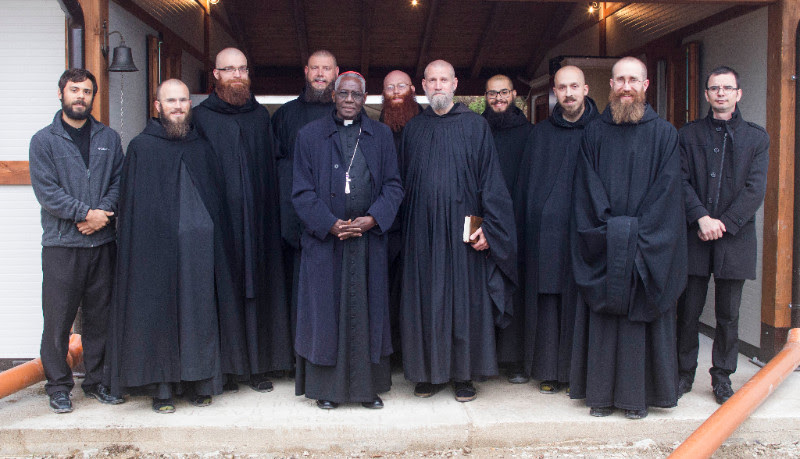
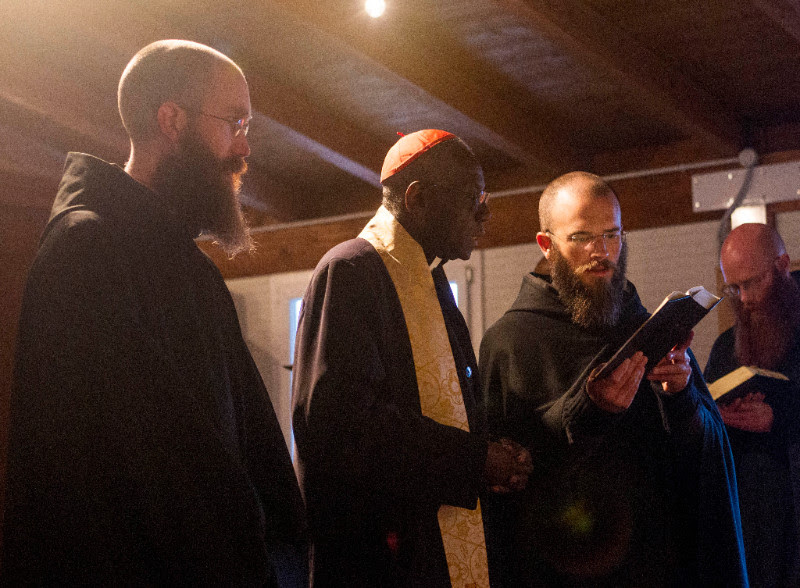
I got a note from the Benedictine monks of Norcia – who make great beer – about the visit of Card. Sarah to their earthquake stricken digs.

“It reminds me of Bethlehem.”

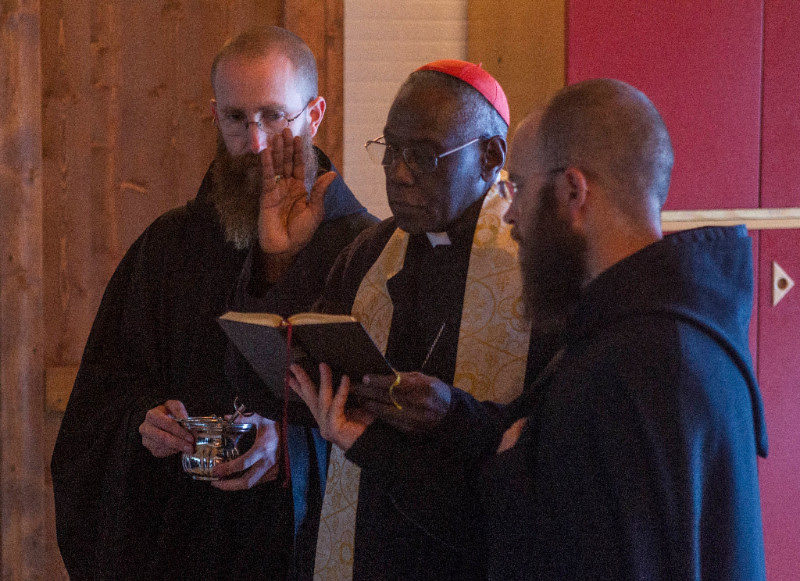
With these words, Robert Cardinal Sarah, Prefect of the Congregation for Divine Worship at the Vatican, brought consolation and inspiration to the ears of his listeners — the 10 monks of San Benedetto in Monte. In the early hours of October 22, we gathered together for the Cardinal’s blessing of our temporary living quarters.

After sprinkling the kitchen, scriptorium, beds and chapel, he declared gently but powerfully: “I am certain that the future of the Church is in the monasteries… because where prayer is, there is the future.”

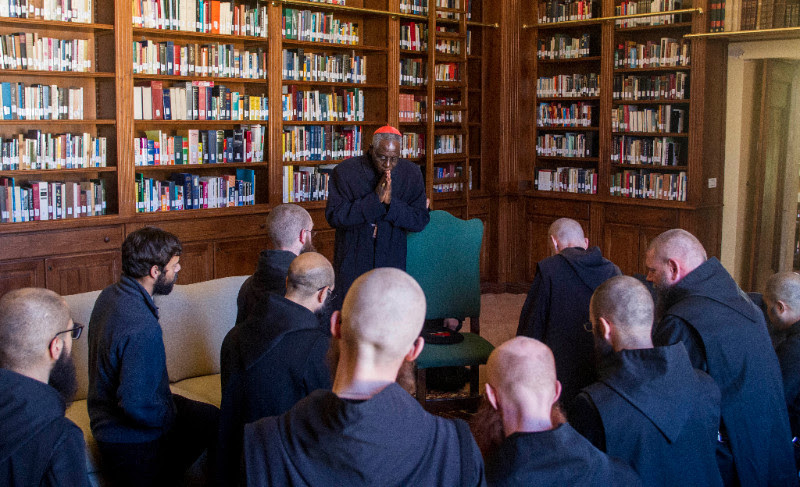
Planned long before the earthquake, His Eminence’s visit for a speech to the local lay chapter of the Association of St. Benedict, Patron of Europe, became the occasion for a visit to the damaged buildings and personal time with the monks. After assisting at Conventual Mass in choir, the Cardinal brought his gentle tone and gracious words to an informal gathering of the entire monastic community and answered our questions with candor and depth, reminding us that, just as Pope Benedict XVI has given us an example of the importance of prayers, we are called to be men of prayer for the entire Church, to help bring up to heaven all who encounter us in one broad sursum corda.

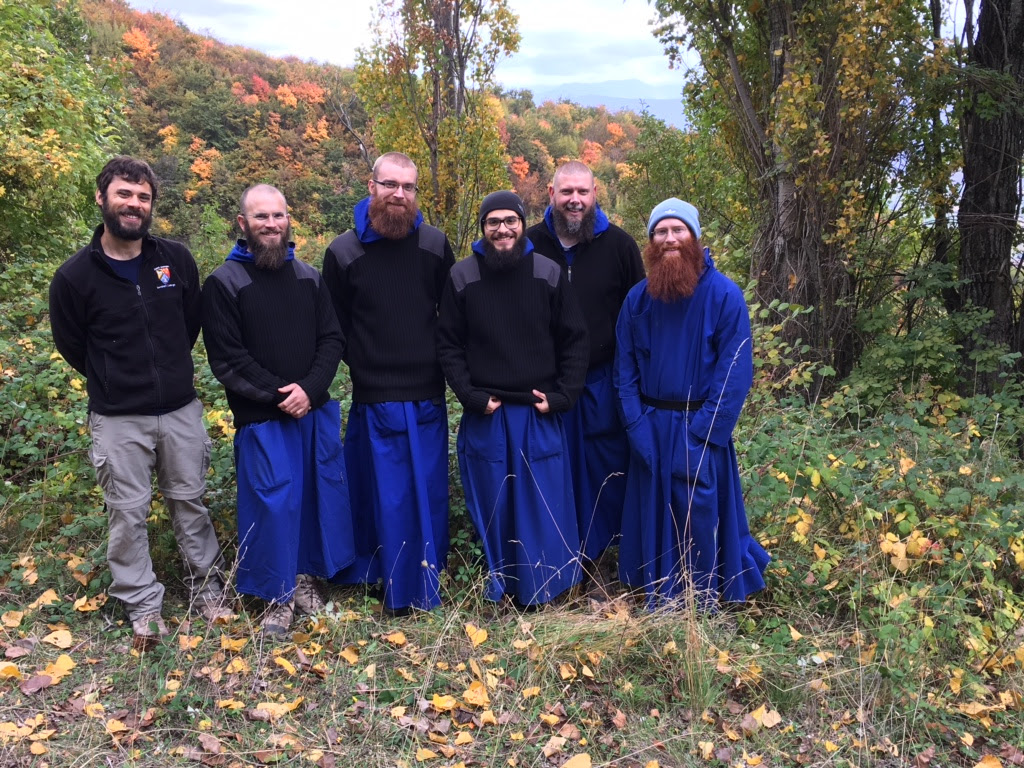
This delightful visit was no doubt the highlight of the week, but as we prepared for it we also cleaned the property and enjoyed an intense mountain hike to explore the 17th century stone walls surrounding the property. We were searching for the best places to pray — and for a spot to picnic!
Other discoveries this week have included the surprise donation of a gas stove top from a local restaurant. Monks in town made a fraternal visit to the Benedictine monastery of S. Pietro in Perugia which has often hosted our monks while they study Italian. The leaves are now changing color and the mountainside of Norcia reminds of autumn in New England. We know many there and throughout the world are praying for us and as winter comes closer, know that your prayers are appreciated as we now have roofs over our heads and a warm fire. Deo Volente, we might just have our church of San Benedetto in Monte open by Christmas. A new Bethlehem indeed.

We produce below a transcript of the Cardinal’s words to the monks at San Benedetto in Monte following the blessing:

Thank you for this welcome, for the prayer this morning, and for asking me to bless this house, which reminds me of Bethlehem, where it all began. Salvation began in Bethlehem, in absolute poverty, and I think that we should follow Christ in this, in His poverty, which is also the humility of God. God is humble, God is poor, but He is rich in love. To live here means that your heart is full of the love of God, for you cannot live with God without loving him. Love is at the center of all of our work. This is why the revelation that Jesus gives us says that the Lord, our Father, is love, and that everything we do comes from love, above all.

I ask that this be a place of love for the Lord. I am certain that the future of the Church is in the monasteries, because where prayer is, there is the future. Where there is no prayer, there is disaster, division, war. Perhaps I am not an optimist, but I see that a church that doesn’t pray is a disastrous church. Since you are a church that prays, the whole of the Church is here.

So I thank you for your commitment, for this manifestation of your love, for the expression of your love in continuous prayer. Pray for the Church, pray for the Holy Father, for his collaborators and for me. I promise you now that I am familiar with your home, that I will always pray for you and ask the Lord to continue to send you more young men to join your life that serves the Lord in prayer, in silence and, above all, in solitude.

Thank you, pray for me. I promise to pray for you. And if the Lord gives me life, perhaps I will return to see your new home. But never forget poverty, never forget humility, and if your house is beautiful, remain always humble and poor. Thank you.

– Robert Cardinal Sarah –
October 22, 2016

Posted in SESSIUNCULA | Tagged ,
9 Comments

WDTPRS – 23rd Sunday after Pentecost: SNIP!

In the pre-Conciliar Missale Romanum this Sunday’s Collect prayer in the Extraordinary Form of the Roman Rite was in the ancient Veronese Sacramentary in the month of September, a fast time. It was a bit different: Absolue, domine, quaesumus, tuorum delicta populorum, et quod mortalitatis contrahit fragilitate purifica; ut cuncta pericula mentis et corporis te propellente declinans, tua consolatione subsistat, tua graita promissae redemptionis perficiatur hereditas.  It also was used on a weekday of Lent.  It also survived to live on in the Novus Ordo book, as well.

Absolve, quaesumus, Domine, tuorum delicta populorum, ut a peccatorum nexibus, quae pro nostra fragilitate contraximus, tua benignitate liberemur.

A nexus, from necto (“to bind, tie, fasten; to join, bind, or fasten together, connect”), is “a tying or binding together, a fastening, joining, an interlacing, entwining, clasping” and thence, “a personal obligation, an addiction or voluntary assignment of the person for debt, slavery for debt”.  Nexus is used to indicate also “a legal obligation of any kind”.  It is not uncommon to find somehwere near nexus the word absolvo, which is “to loosen from, to make loose, set free, detach, untie”.  In juridical language it means “to absolve from a charge, to acquit, declare innocent”.

Here is a truly fascinating piece from the mighty Lewis & Short Dictionary: “to bring a work to a close, to complete, finish (without denoting intrinsic excellence, like perficere; the fig. is prob. derived from detaching a finished web from the loom”.

Contraho in this context is “to bring about, carry into effect, accomplish, execute, get, contract, occasion, cause, produce, make”.  Blaise/Dumas indicates that contraho means “to commit sin”.

LITERAL TRANSLATION

Unloose, O Lord, we implore, the transgressions of Your peoples, so that in Your kindness we may be freed from the bonds of the sins which we committed on account of our weakness.

ICEL version:

Lord,
grant us your forgiveness
and set us free from our enslavement to sin.

When you see an English version that is shorter than the Latin original, your alarms bells should ring.  18 words in Latin, 14 English words in the obsolete ICELese.

Think of sin as a web which we both weave and then get caught in.  As Hamlet says the engineer is “hoist with his own petard”.

When our First Parents comitted the Original Sin, they contracted (contraho) the guilt and effects for the whole human race.  At that point our race was bound by justice.   To be “justified” again, and to be unbound from our guilt and set to right with God, reparation had to be made.  Thus, the New Adam allowed Himself to be bound by His tormentors, and be bound to the Cross, and then unbind His soul from His Body and die.

The Sacrifice of the Lord was aimed not just at a few chosen or privileged people.  It was for all peoples.  The Sacrifice was “for all”, though “all” will not accept its effects.  Some will refuse what Christ did to free us from our sins and the punishments of eternal hell they deserve.  “Many” will be saved as a result of Christ’s Passion and Death.  Which side of the reckoning will you be on.

Returning to the image of the loom, which is woven into today’s vocabulary, I have in mind the incredible phrase from the Book of Job:

“My days are swifter than a weaver’s shuttle, and come to their end without hope.  Remember that my life is a breath; my eye will never again see good.”

Our days are indeed like a shuttle.

Zip Zap Zip Zap Zip Zap…

Some years ago I met a women who wove cloth with a large loom.  She showed me how it worked.  In her practiced hands, the shuttle lashed swiftly back and forth, back and forth, back and forth, while the loom packed the threads together.  The cloth “grew” as it was woven, slowly, but surely.  The shuttle snapped back and forth with increasing speed as she found her rhythm and settled into it.  At the end… SNIP… the thread was cut.  Absolutely.

Absolved?  Unabsolved?

GO TO CONFESSION.

Posted in GO TO CONFESSION, Liturgy Science Theatre 3000, WDTPRS | Tagged , , ,
Comments Off on WDTPRS – 23rd Sunday after Pentecost: SNIP!

ASK FATHER: Is a priest allowed to do the readings, or must a lay person do them?

From a reader…

QUAERITUR:

On occassion the Lector or Reader is a no-show for Mass and Father will say “We’ll just wait for someone to come do the readings.” At the Sat. evening vigil Mass many of us are older and I, for one, am petrified of getting up in front of people. Sometimes we’ve waited a good long time before someone, in anger by that point, stomps up there to read. Is it absolutely necessary to stop Mass for this or can the accolyte or priest just do the readings on these occassions?

Ridiculous.   The priest should do the readings.  That is, after all, his job.

Have we gotten to the point of such sclerotic clericalism? Priests won’t budge out of their chairs because they want someone to feel like she is participating by being allowed to do the priest’s work in the sanctuary?  Lay people are not dignified enough on their own?  No no.  They have to be actualized by the priest, who condescends to let them do something he can do.

Sound harsh?  That’s what happens when we turn the sock inside out on this craze to have all sorts of people doing stuff in the name of “active participation” of the laity.  It’s a subtle form of clericalism.  And sometimes it’s not so subtle.

I suppose most priests nowadays are deeply conditioned to give up their roles in the priestly precinct of the sanctuary, the presbyterium.

We have even gotten to the point where someone wonder if the priest is allowed to read the readings himself!

I’ll be there are priests out there who barely remember that they could do the readings themselves. It is as if they are under a foul spell, some fell enchantment.

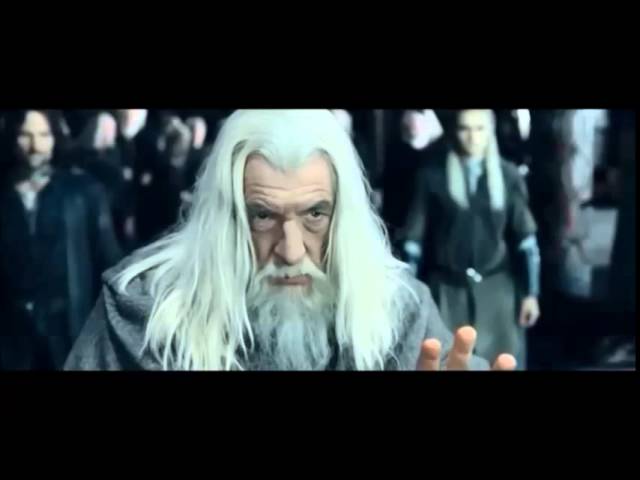
There popped into my mind’s eye the image of King Theoden being freed from the clutches of the modernist liturgist Saruman. In this scenario I am Gandalf   Priests across the land are Theoden, oppressed by modernist liturgists who, through their whispered poisons, twist the clerics into a false confirmation of lay people.

There is even a cameo appearance by Tim Kaine as Wormtongue.

“You would remember your priestly strength better, if you grasped your priestly role!”

YouTube thumbnailYouTube icon

Posted in "How To..." - Practical Notes, ASK FATHER Question Box | Tagged , , , ,
16 Comments

Wimple by Wimple in New Jersey

A few days ago I was in Florence and I saw things and places associated with Savonarola.  This, of course, reminded me of the smoke-scented glycerin soap made by the wonderful Summit Dominicans, the great “soap sisters”, called “Savonarola”… get it?  Lemme help… any French speakers out there who know something of the history of Florence?

They’re not on a bus.  They’re not in pants suits.  They’re in habits.

Not only. These marvelous Dominicans have now returned to the use of the wimple.

Here is a recent photo…

Summit WIMPLE

Help them build their new monastic building.  They are in desperate need of more space.

PS to women religious out there reading this:
They have vocations.  

Posted in Women Religious | Tagged , , ,
7 Comments

Christmas isn’t too far away

I just received an email from my baker who made stunning homemade panettone for me, for the bishops, and for my Supper For The Promotion of Clericalism.  This got me to thinking about Christmas shopping preparations.  It is good to get some of these things out of the way now, so that Advent can be more about what it is supposed to be about.  Why wait?   Right?

So, I’ll remind you that when you Christmas shop online, pretty please use my Amazon search box?  I’ll get a small percentage, the price remains the same for you, and you get stuff delivered to your doorstep.  Easy peasy.

Also, remember to frequent the wonderful Wyoming Carmelites and their coffee, tea and religious products.  HERE

The Summit Dominicans make soaps and the foofy things.  HERE  Women seem to like this stuff, and I believe they appreciate it when men use soap.

There is Z-Swag.  HERE  Irritate libs.

Another great option would be to get beautiful art work from Daniel Mitsui and have it framed.   That’s what I have done.  It is edifying and much appreciated.  The latest I did was a housewarming gift to a priest friend when he moved. Mitsui has a great variety of works.  Also, I am pretty sure that, right now especially, you’ll do him a great service by frequenting his site in a timely manner and getting his art.  HERE

I just noticed his coloring pages for children.  Very spiffy.  Please go look.

Posted in "How To..." - Practical Notes, The Campus Telephone Pole |
Comments Off on Christmas isn’t too far away

Contentions between liturgists and musicians: What to do?

guido mariniIt is too bad that, thanks to our fallen nature and the prodding of the Enemy of the soul, we have conflicts in the Church.  You will, however, note right back at me that we have had arguments since before Day One.  Consider, for example, the argument between the Apostles over who might be higher or the avaricious whine of Judas over the use of money.

Sometimes we have to have fights, however.  When the stakes are high, we mustn’t shy from conflicts just because they upset us.

I saw a story at CNS about a talk given by Msgr. Guido Marini (aka Good Marini), who is the Holy Father’s Master of Ceremonies.  He was brought in by Benedict XVI from Genoa and the umbral influence of the late, great Card. Siri, and remains in place even now.   He answered a question about conflicts over liturgy and music.

One of the things that I learned of early on in my time in the Church, first in theory and then in practice, was about the perennial tension that exists between liturgists and musicians. Msgr. Schuler, the long-time pastor of St. Agnes Church in St. Paul, who had been involved in the Consociatio Internationalis Musicae Sacrae before and after the Council, who had edited Sacred Music for decades, who had served in the infamous advisory board to the US Bishops… he tried to fend off the predations of the likes of Weakling… described many instances of his battles over music and liturgy.   Then in seminary and after, I found out on my own how difficult it can be to work as a musician with a “liturgist”, or on the liturgical side with a musician.   This is something repeated in parishes across the world, I’m sure.

Let’s look at what Msgr. Marini said, with my emphases and comments.

Fighting over liturgy distorts purpose of Mass, papal liturgist says

By Carol Glatz
Catholic News Service

VATICAN CITY (CNS) — When a choir director and parish priest differ over liturgical music, the choir should follow in good faith the wishes of the priest for the sake of unity, said the papal liturgist. [There really isn’t another way, is there?  Even when the priest is an ignorant boob, as so many of them are, he’s da man.]

When it comes to celebrating the liturgy, “we should never fight,” Msgr. Guido Marini told choir members, directors and priests. “Otherwise, we distort the very nature” of what the people of God should be doing during the Mass, which is seeking to be “one body before the Lord.” [There’s fighting and there’s fighting, respond I.  Some things are just plain wrong, and they should be resisted.]

The papal master of liturgical ceremonies spoke Oct. 21 at a conference opening a three-day jubilee for choirs. Hundreds of people involved in providing music for the liturgical celebrations in Italian dioceses and parishes — such as singers, organists and musicians — attended, as did directors of diocesan liturgy offices and schools of sacred music.

During a brief question-and-answer period after his talk [often the part of the talk that people enjoy the most] on the role of the choir, a participant asked Msgr. Marini what she termed “an uncomfortable, practical question.”

“Many times, in our parishes, the priest wants the choir to perform songs that are inappropriate, both because of the text” and because of the moment the song is to be performed during the service, she said.

“In these situations, must the choir master follow the wishes of the priest even with the knowledge that by doing so, the choir is no longer serving the liturgy, but the priest?” she said to applause.

Asked for his advice, Msgr. Marini smiled, cast his eyes upward and rubbed his chin signaling his awareness that it was a hot-button topic. He said he felt “sandwiched” “between two fires, between priests and choirs.” [Yep.  Been there.  Bought that shirt.]

Acknowledging the difficulty of such a situation, he said he sided with the priest. [Short of quitting, that’s it, isn’t it.]

There are situations where priests may not be giving completely correct guidance, he said, and there are directors that could be doing better. But in either case, conflict and division should be avoided and “humility and communion be truly safeguarded,” he said.

This, like with all disagreements, he said, requires that all sides be very patient with each other, sit down and talk, and explain the reasons behind their positions.  [Something else is needed, too.  More on that below.]

But if no conclusion or final point is reached, then “perhaps it is better also to come out of it momentarily defeated and wait for a better time rather than generate divisions and conflict that do no good,” he said to applause.

Live the path of communion and unity in the parish “with lots of goodness, cordiality and sometimes the ability to sacrifice something of oneself, too,” Msgr. Marini advised.

Just like the grain of wheat, he said, “sometimes all of us must die in something” knowing that it will bear future fruit.

Msgr. Marini responded to the question after delivering a 50-minute speech, in which he received a standing ovation.

Titled, “The Role of the Choir in Liturgical Celebrations,” the monsignor outlined five fundamental elements of the liturgy and how choirs should help serve each of those aspects.

The liturgy is the work of Christ and it should express the Savior’s living presence, he said. Choir members, therefore, must be people who have Christ present in their hearts.

While much care must be given to the artistic and technical aspects of liturgical music’s performance, the hearts of those who perform must be cared for as well so that they are men and women of faith who feel “a burning love for Christ” and find their life’s meaning in him, he said.

The liturgy also must evoke the church’s universality, where there is a harmonious union of diversity and continuity between tradition and newness, he said. This means that the choir must never be “front and center” or seem separate from the faithful because they are part of the assembly.

Pope Francis has insisted that liturgical music for papal liturgies “never go beyond the rite” and force celebrants and the assembly to wait for the singing to finish before proceeding on to the next moment of the Mass, he said. “Song integrates itself into the rite,” serving the ceremony and not itself. [Hmmmm… I’m going to disagree slightly at this point.  Msgr. Marini is surely looking at the question from the point of view of the liturgist.  Truly good, artistic sacred music which is appropriate for the rite at hand is not an add on.  It is prayer.  You can’t be distracted from prayer, by prayer.  Of course we also acknowledge the old adage, “Quidquid recipitur…“, etc.  Much depends on the capacity of the congregation, which ought to be, over time, brought to a greater and greater degree of “actual participation”, which involves as a sine qua non, the ability to listen, with active receptivity.]

He also asked that choirs help the liturgy in its purpose of gathering everyone together to conform themselves more closely to God and his will.

The Mass is about overcoming individual distinctions so that “it is no longer I who live but Christ who lives in me,” he said. That means the choir should help everyone in the assembly be an active participant during the moments of song including by stirring people’s emotional or spiritual feelings. [Not to mention thoughts.]

Choirs must help the liturgy by inviting all of creation to lift its gaze toward God on high, he said. People should feel elevated and pulled out of the mundanity of the ordinary and everyday — not to escape from it, but so as to return renewed to one’s everyday life after Mass.

If song is not “a bridge over eternity” then it is not doing its job, he said. Song must not be worldly and unworthy, but must in some way be the “song of angels.” [And if it is that, then there shouldn’t be a problem with lingering in it, even waiting for it during the rite.  Of course there are moments when waiting is just what we are doing. I have a great memory of celebrating a solemn Mass with the music of Franz Josef Haydn.  We were halted, waiting for the Benedictus to conclude.  As it went on and on, “Qui venit… qui venit… qui venit venit veeeeeeenit…. qui venit venit veeeeeeeeeenit….”, my deacon, a distinguish Englishman, quiet said, “I wish he’d hurry up and get here.”]

Lastly, he said, choirs must be missionary like the church and the liturgy by way of attraction, which it does by revealing God’s beauty, wonder and infinite mercy. [That sounds, GASP, like proselytizing through music!  Of course that’s what first snagged my attention as a Lutheran/pagan and lead me into the Church.]

So many men come to the priesthood without the slightest idea about sacred music, or art or history or … lots of other things too.  We need to provide them with some basic tools.  They should have classes and workshops on sacred music, to learn about the development of chant and about different styles of sacred music through the centuries.  They need classes on art, etc.   There is, indeed, bad music and bad art.  I don’t accept without caveats that beauty is only in the eye of the beholder.  There are standards for beauty.

Posted in Liturgy Science Theatre 3000 | Tagged , ,
18 Comments

Fr. Murray on Hillary’s anti-Catholic distortions at Al Smith Dinner

Clarity and common sense from my friend Fr. Murray on the Al Smith Dinner…

Posted in SESSIUNCULA | Tagged ,
33 Comments

More Wikileaks emails about lib machinations tied to the Clinton campaign

This is a fascinating look into liberal catholic machinations.

As you know the head of Hillary Clinton’s campaign, John Podesta, has been involved in creating institutions within the Church to create instability and revolution.  Wikileaks has the goods from his emails.

Here’s more from Wikileaks.  A friend in Washington DC has kept his eye on them.  He sent me a link to an email which names lots of names.  The web of names shows who is networked to whom.  NB: National catholic Reporter, Card. Rodriquez Maradiaga, Black Lives Matter, SIEU, Card. Turkson….

It’s an interesting read between the lines.

Just because you are mentioned in an email doesn’t mean that you have anything to do with anything.  Right?

HERE

Posted in SESSIUNCULA | Tagged
13 Comments

UPDATE on Reginald Foster’s ‘Ossa Latinitatis Sola’ – Request for old Ludi Domestici

Ossa Latinitatis Sola

CLICK ME!

UPDATE 21 Oct:

A priest friend sent me a photo of his very own copy of Ossa, duly delivered.  Yes, folks, the books are shipping.

16_10_21_foster_ossa

UPDATE:

Some people are asking me for updates on the publication of the 1st volume of the Ossa Latinitatis Sola.

First, there is a website which has news about the volumes. HERE

Fr. Foster was quite ill for a while and the project stalled a bit. However, I believe is is going forward even though it is much delayed.  Not too long ago, I visited Fr. Foster and I actually saw galley sheets of the book.

Second, I’ve sent an email asking for an update.

Finally, there will eventually be volumes of Foster’s famous (infamous?) homework sheets or Ludi Domestici.  I still have lots of them squirreled away somewhere.  Having them bound in volumes will be invaluable.  As a matter of fact, on that web cited (above) there is a request to any and all for sheets from certain years and levels.  

Nota bene, all you former Reggie students.

For my original post about this go HERE.

Now available for pre-order in the UK HERE.  It has become more expensive over the last few months.

UPDATE:

I heard back from the co-editor, Dom Daniel McCarthy, OSB.  He wrote:

The OSSA book may be available perhaps by August, but the publisher is not giving another publication date until he is sure.

Reggie and I saw the full text of the draft book completely formatted only last December, and we spent a month revising it together at his place. I was not able to stay longer, so I had to complete the job myself after returning to Rome in February to begin teaching. Thus, before holy week I submitted the draft with 6,100 + notations. They are currently working on our comments. There were so many notations that I requested they send the draft back to me for a second review, which I’ll do myself in Rome. Thereafter they will make the final changes and print the book. It may be available by August, but again the publisher is not giving any firm date.

Please let your readers know, so they can plan their curriculum.

So, the release is not imminent, but there is forward movement.

Consider yourselves updated.

And… if any of you alumni if The Experiences have your old ludi, you might check to see if you can fill in some blanks.  HERE

Screen Shot 2016-04-04 at 11.40.06

Posted in The Campus Telephone Pole | Tagged ,
12 Comments

Pius XI is back on the job after a nice vacation

12_11_13_PopePiusXIA few days ago I got a note from a reader that, on the Vatican website, it was no longer possible to access the documents of Pope Ratti, Pius XI (1922-39).   Immediately, I thought, “AH HAH!”  “Ah hah! …”, what? … wasn’t exactly clear, but I thought, “AH HAH!”

Pius XI wrote hard hitting stuff that didn’t mince words.  I’ve done a couple of podcasts about his documents, including about Mortalium animos, which concerns ecumenism.  Was that why he was removed?  Hmmmmm…. conspiracy.

Since discovering this mysterious lacuna, I occasionally checked the Vatican website to see if Pius XI’s would be reinstated, if perchance their disappearance was just another tech mess up.  It’s, by the way, ironic that he wasn’t any longer in the archive, considering that this is Pope Ratti we are talking about.  He was a librarian and was often found hanging out in the archive.  Get it?  And then he was not to be found in the archive.  Get it?  It was even more ironic that, during Ratti’s hiatus you defaulted to John XXIII!

Well, he’s back!

My view as I write…

Screen Shot 2016-10-21 at 18.02.33

Here’s an explanation of what happened to Pius XI over the last few days.

As future Pope Pius XIII, We assure you that, whether you are a dead Pope, an alive Pope, or even now a retired Pope, being a Pope is not easy. Sometimes you just need a vacation. In view of my future difficult pontificate, while I… while We have the chance We are now hanging out at Lago di Garda. We hope Our future predecessor was able to get a little rest in a nice spot like this. Now that the present guy has decided that Popes won’t stay at Castel Gandolfo – that’s a mistake, by the way, and We teach that with future infallibly with retro force – Popes will need to be creative about where they hang out for R&R.

Heck, if there are enough retired Popes at once, perhaps We could get a time share somewhere!

Anyway, welcome back Pius XI!  It’s great to have you back “on the job” again.

Everyone should listen to your wonderful Mortalium animos, especially as we close in on 2017.

Posted in Lighter fare | Tagged , ,
13 Comments