
"Would that we had died by the hand of the LORD in the land of Egypt, when we sat by the fleshpots and ate bread to the full; for you have brought us out into this wilderness to kill this whole assembly with hunger." (Exodus 16:3 RSV)
Fleshpots? Pots??! What??? Not "precious chalices"?!
"Then the LORD said to Moses, "Behold, I will rain bread from heaven for you; and the people shall go out and gather a day’s portion every day, that I may prove them, whether they will walk in my law or not. (Exodus 16:4 RSV)
"And when the dew had gone up, there was on the face of the wilderness a fine, flake-like thing, fine as hoarfrost on the ground. When the people of Israel saw it, they said to one another, "What is it?" For they did not know what it was. And Moses said to them, "It is the bread which the LORD has given you to eat. (Exodus 16:14-15 RSV)
"When the dew fell upon the camp in the night, the manna fell with it." (Numbers 11:9 RSV)
Christ explains its significance as foreshadowing Himself.
"Our fathers ate the manna in the wilderness; as it is written, ‘He gave them bread from heaven to eat.’" Jesus then said to them, "Truly, truly, I say to you, it was not Moses who gave you the bread from heaven; My Father gives you the true bread from heaven. For the bread of God is that which comes down from heaven, and gives life to the world." (John 6:31-33 RSV)
And also
"I am the bread of life. Your fathers ate the manna in the wilderness, and they died. This is the bread which comes down from heaven, that a man may eat of it and not die. I am the living bread which came down from heaven; if any one eats of this bread, he will live for ever; and the bread which I shall give for the life of the world is My flesh." (John 6:48-51 RSV)
 Ambrosiaster wrote: "Manna autem typus est escae spiritalis, quae resurrectione domini ueritas facta est in eucharistiae mysterio." (q. 85,3 CSEL 50 p. 169). "Manna is the type (foreshadow) of spiritual food, which by the resurrection of the Lord became the Truth in the mystery of the Eucharist."
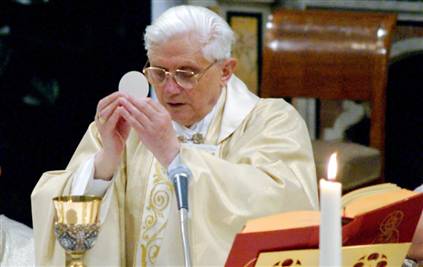
On 16 June 2006 the Holy Father Pope Benedict XVI taught about the Eucharist as "bread from heaven".
"The Host is the manna with which the Lord nourishes us, it is truly the bread from heaven, with which he really gives himself".
From the last book of the Bible:
"Repent then. If not, I will come to you soon and war against them with the sword of my mouth. He who has an ear, let him hear what the Spirit says to the churches. To him who conquers I will give some of the hidden manna, and I will give him a white stone, with a new name written on the stone which no one knows except him who receives it.’" (Apoc 2:16-17 RSV)































I would like to thank Fr. Z for pointing out the scriptural bases for the use of the word “dew” in the Third Eucharistic Prayer.
I think that that has pretty much put paid to the attempts of His Grace, Bishop Trautman, to excise the language of Tradition and the Magisterium from vernacular translations of the Divine Liturgy in favor of a language which is supposedly more “scriptural”.
Of course, anyone who has actually read the Second Vatican Council’s Constitution on Divine Revelation would know that our Church has always held that the three means by which the Holy Spirit has spoken to us are and have been Scripture, Tradition, and Church Authority. I think it only fair to state that with the best of intentions, His Grace may be attempting to silence the voices of Tradition and Church Authority in favor of the voice of Scripture, and thus, to attempt to frustrate the workings of the Holy Spirit in the Divine Liturgy.
Interesting how Latin uses the concept of dew in various forms.
In addition to “Ros, Roris” (dew) and “Rorare” (“to dew” as in “Rorate Caeli”) we also have “Roratio” (dewing?)
After the conclusion of Vatican II, Pope Paul VI issued his Apostolic Constitution “Mirificus Eventus” where he declared a year of jubilee and encouraged the faithful to gather with their bishops in their cathedral churches. Here is a sentence from that document:
Deinde templum cathedrale expressa imago est ducenda aspectabilis Christi Ecclesiae, quae in terrarum orbe et precatur, et canit, et adorat; est nimirum imago putanda Mystici eius Corporis, cuius membra in una conglutinantur caritatis compage, supernorum donorum RORATIONE nutrita;
[Further, the cathedral temple is an expression of the image of the Church of Christ, praying, singing, adoring all over the world: surely it is to be viewed as an image of His Mystical Body, whose members are bound together through a structure of love, nourished by the “dewing” of celestial gifts …]
Isn’t that a nice expression? “Christi Ecclesia supernorum donorum roratione nutrita.” (The Church of Christ nourished by the “dewing” of celestial gifts).
Bernard, I think that “rore” is from EP II.
Thanks Fr. Z for working to preserve/restore the fresh morning air.
Giuseppe, di nulla!
o{]:¬)
Andrew, that is so good I am going to tease it out for a separate entry!