
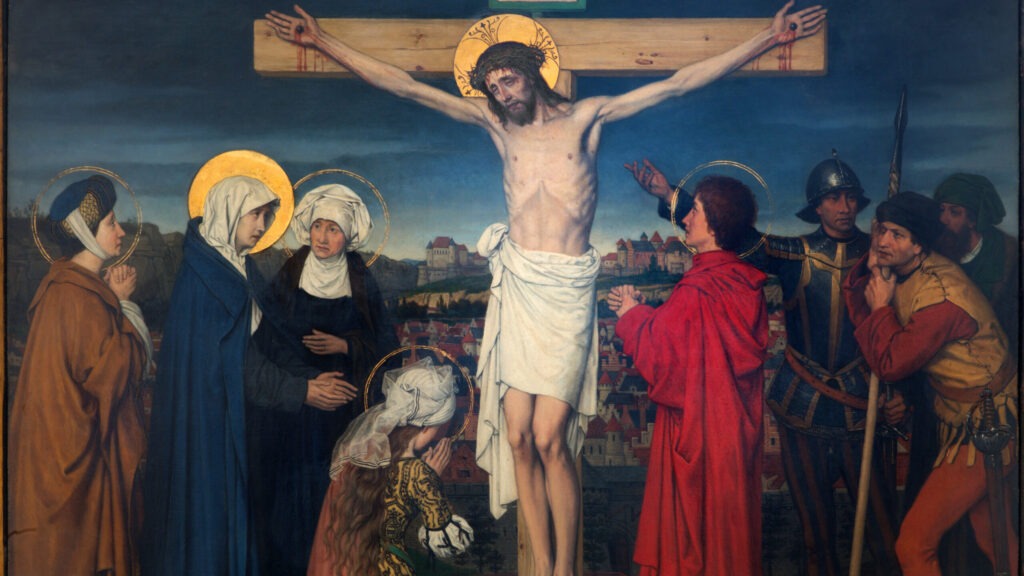
ANTWERP, BELGIUM – SEPTEMBER 5: Crucifixion as part of Seven Sorrows of Virgin cycle by Josef Janssens from years 1903 – 1910 in the cathedral of Our Lady on September 5, 2013 in Antwerp, Belgium
From a reader…
QUAERITUR:
Hello Father, I was making a typo correction to this Mass when I noticed that the Introit (John 19, 25) has Salome at the foot of the Cross. Seemed unlikely to me, so I looked at the Gospel (John 19: 25-27) – no Salome. So I looked at the Vulgate, no Salome. Confused, I looked at divinumofficium.com which has the same inconsistency, ditto my Angelus Press 1962 Missal. So I have resorted to pestering you for some words of wisdom. Help!
So, how do we explain the inclusion of “Salome” in the Introit for the Feast of the Sorrows of the Virgin? The Introit is stated to be from John 19:25:
Stabant iuxta Crucem Iesu Mater eius, et soror Matris eius, María Cléophæ, et Salóme et María Magdaléne.
How does John 19:25 read?
The Vulgate of John 19:25 has:
Stabant autem iuxta crucem Iesu mater eius et soror matris eius, Maria Cleopæ, et Maria Magdalene.
The RSV says:
But standing by the cross of Jesus were his mother, and his mother’s sister, Mary the wife of Clopas, and Mary Mag?dalene.
Thus “et Salomé” is a liturgical addition. The Gospel of the Mass later gives John 19:25 in its biblical form, without Salome. The Missal therefore clearly distinguishes between the scriptural lesson and the somewhat expanded, harmonized text of the Introit.
Salome comes from St. Mark’s Passion. Mark 15:40 names among the women watching the Crucifixion:
Mary Magdalene, Mary the mother of James the Less and Joseph, and Salome.
Matthew 27:56 gives the parallel list, but calls the third woman “the mother of the sons of Zebedee.”
Hence, the harmonization identifies Salome as the wife of Zebedee and mother of James and John.
The Introit therefore wove Mark’s Salome into John’s scene at the Cross. This sort of evangelical harmonization is not unusual in liturgical composition. The citation “John 19:25” identifies the principal source rather than claiming that every word is a literal quotation.
There is an additional wrinkle. John 19:25 is grammatically capable of being read as mentioning either three or four women. One interpretation takes soror matris eius, Maria Cleopae as one person: “His Mother’s sister, Mary of Clopas.” Another takes “His Mother’s sister” as an unnamed fourth woman, whom many commentators have proposed was Salome, the mother of St. John. The latter interpretation would make John the Blessed Virgin’s nephew or close relative. That reading has an attractive connection with Christ’s words immediately afterward, Ecce mater tua. But it remains an interpretation rather than a certainty.
So here Salome is a fourth woman added from the Synoptic Passion tradition, rather than being identified with Mary’s unnamed sister.
There is also a beautiful liturgical reason for expanding the company. On the feast of the Seven Sorrows, the Church deliberately gathers around the Cross the faithful women remembered across the Gospel accounts. They form, as it were, the little remnant of fidelity surrounding the Mater Dolorosa.
Mary stands at the center, but she does not stand utterly alone. Salome belongs to that circle of women who had followed Christ from Galilee and remained when so many others had fled.
St. Augustine himself explicitly wrestled with the apparent difference between John’s women iuxta crucem and Matthew and Mark’s women watching a longe, and harmonized the accounts rather than treating them as contradictory.
In sum, Salome is present because the Introit is a liturgical harmonization of the Passion narratives, principally John 19:25 but with more information from Mark 15:40. Salome’s presence in the Introit emphasizes the company of faithful women gathered about Mary and the Cross.































For what it’s worth, the Wikipedia article on Salome states that there were two Salomes, the one who danced for Herod and the one who stood at the foot of the cross.
Oh neat. This brings to mind for me the propers of the Slavic Churches, which are essentially liturgical poetry. They do all kinds of fun theological speculation, including speculating on a dialogue between Adam, Eve, and the Theotokos (See Romanos the Melodist).