3 Feb: St. Blaise and the blessing of candles and of throats

blaiseEvery time I get my throat blessed on St. Blaise Day, I get a sore throat or bronchitis.  Although… this year I have already had it, so I hope I’ve dodged for February.

Ever the optimist, I keep going back each year for a blessing of the throat.

Tomorrow is the Feast of St. Blaise, about whom we know very little.   We have only this very brief entry in the Martyrologium Romanum:

Sancti Blasii, episcopi et martyris, qui pro christiano nomine Sabaste in Armenia passus est sub Licino imperatore. … [Feast of] St. Blaise, bishop and martyr, who suffered for the name of Christ in Sabaste in Armenia under the Emperor Licinus.

That “pro Christiano nomine” probably needs to be rendered as “for the name of Christ” along the lines of rendering dies dominica or oratio dominica as, respectively, “the Lord’s Day = Sunday” or “the Lord’s Prayer”.  It is entirely possible, of course, just to keep it literal and say, “for the Christian name”, which would be pretty much the same thing in the balance.

Either way, he was killed because, as a Christian, Blaise professed belief in Christ.

COLLECT:
Exaudi, Domine, populum tuum,
cvm beati Blasii martyris patrocinio supplicantem,
ut et temporalis vitae nos tribuas pace gaudere,
et aeternae reperire subsidium.

LITERAL TRANSLATION:
O Lord, graciously hear Your people
begging by means of the patronage of blessed martyr Blaise,
that you grant us to delight in the peace of temporal life
and obtain the protection of eternal life.

St. BlaiseI take away from this prayer the serious message that life is dangerous.

The word subsidium means “support, assistance, aid, help, protection” and often in liturgical Latin “help”.  Either way, subsidium sets up a stark contrast between the life we have now and the life to come.  Even the phrase about enjoying the peace of this life, indicates subtly how precarious everything is in this earthly existence which Catholics are accustomed to call a “vale of tears”.

This is firmed up by another wonderful prayer associated with St. Blaise.  You all know about the blessing of throats on the feast of St. Blaise.  In the older form of the Rituale Romanum there is a marvelous blessing for the candles used to confer the blessing of throats.  Here it is:

BLESSING OF CANDLES ON THE FEAST OF ST. BLAISE:

O God most powerful and most kind, Who didst create all the different things in the world by the Word alone, and Whose will it was that this Word by Which all things were made should become incarnate for the remaking of mankind; Thou Who art great and limitless, worthy of reverence and praise, the worker of wonders; for Whose sake the glorious Martyr and Bishop, St. Blaise, joyfully gained the palm of martyrdom, never shrinking from any kind of torture in confessing his faith in Thee; Thou Who didst give to him, amongst other gifts, the prerogative of curing by Thy power every ailment of men’s throats; humbly we beg Thee in Thy majesty not to look upon our guilt, but, pleased by his merits and prayers, in Thine awe-inspiring kindness, to bless+this wax created by Thee and to sanc+tify it, pouring into it Thy grace; so that all who in good faith shall have their throats touched by this wax may be freed from every ailment of their throats through the merit of his suffering, and, in good health and spirits, may give thanks to Thee in Thy holy Church and praise Thy glorious name, which is blessed for ever and ever.  Through our Lord, Jesus Christ, Thy Son, Who with Thee lives and reigns, in the unity of the Holy Spirit, God, world without end.  R. Amen.

Ah!  What a pleasure that prayer is!  Or course, the candles are to be sprinkled with holy water after the blessing.  Maybe you should print this out and take it to your parish priest “with Fr. Z’s compliments”.  It might be that he doesn’t have this text and perhaps would like to (or you would like to) have your throat blessed in Latin!

Here is the Blessing for throats:

Per intercessionem Sancti Blasii, episcopi et martyris, liberet te Deus a malo gutturis, et a quolibet alio malo. In nomine Patris, et Filii +, et Spiritus Sancti.  Amen.

Through the intercession of St. Blaise, bishop and martyr,
may God free you from illness of the throat and from any other sort of ill. In the name of the Father, and of the Son + and of the Holy Ghost.  Amen.

St. BlaiseI will never forget this formula.

Long ago, as a deacon, I lived at the Church of San Carlo ai Catinari, which is also dedicated to St. Blaise, San Biagio, as co-patron.  The Barnabites there have in their possession relics of St. Blaise.  There is one in a large reliquary and one in a crystal placed on a large ring held in the fist of one hand (click the photo to see a larger image and inside the crystal).   This is what they used to bless throats on this feast.

I was asked by the clergy there to help with blessing the throats of the people who thronged to the church that day.  As soon as I donned my surplice every other cleric actually attached to the place vanished.  I was left there for several hours.  I can’t say how many times I said that formula that day.

The configuration of the candles used for the blessing can vary.  Here are a few examples.

This is probably the most common.

blaise candles 01

And there is the twisty version:

blaise candles 02

And then we have a high tech approach:  [Last year the nice people at F.C. Ziegler saw this – they make this gizmo – and asked me to post a link to it.  Okay! HERE]

blaise candles 04

Finally, there is this contraption, which looks like it is from Star Trek:

blaise candles 03


Hmmm….

Posted in Liturgy Science Theatre 3000, Our Catholic Identity | Tagged , ,
12 Comments

Tabernacle by Tabernacle

A while back there was a flurry of discussion in Madison, WI about the long-standing, patiently-implemented, diocesan-wide policy of returning the tabernacles for the Blessed Sacrament to the center of churches.

News reached me that in Brooklyn, a church is being restored to its focus on the Blessed Sacrament with the restoration of its altar that was (heinously) removed some 30 years ago.

From the Brooklyn Daily:

Second coming! Church’s rescued relic restored [See what they did there?  Cutesy.]

An important piece of a Bath Beach church’s century-old altar has returned from the grave thanks to a pious parishioner whose de-shrine intervention saved it 30 years ago, his pastor said.

“The high altar is right in the center of the church, and the piece Bill saved is an important piece of it,” said the Rev. Michael Louis Gelfant.

Bill Coppa rescued the face of St. Finbar Church’s tabernacle — where Catholics store what they believe is the body of Jesus Christ — from a garbage pile during a 1984 renovation. A previous pastor didn’t give a frock about the gilded marble masterpiece, but Coppa thought trashing it was a sin, so he put it in his den, he said.

“I ran back in and I said ‘Father! There’s this beautiful piece there, and it’s thrown in the trash,’ and I asked if I could take it,” Coppa said. “He didn’t mind, so I grabbed it, and I’ve had it in my home office for 32 years.”

The congregation is in the midst of a larger renovation, and Coppa jumped at the chance to return the relic, he said.

Gelfant discovered two other pieces of the altar in a forgotten storeroom shortly after inheriting the flock in 2010, and the revelation inspired him to return the church to its former glory, he said.

“Those two great finds sparked the possibility we could restore it to the way it was,” Gelfant said.

Parishioners raised nearly a million dollars for the renovations, which started in October 2015. The church is tearing up 30-year-old tile to reveal the main sanctuary’s original terrazzo floor, sprucing up pews, and rehabbing the building’s exterior.

Gelfant expects they’ll resurrect the sanctuary, including the altar, in time for Easter, and anticipates the rest done in the following months.

The project has many long-time parishioners excited, and some handy churchgoers even volunteered their talent, Gelfant said.

“The people are so proud they’re getting their church back, and some have donated their labor — it’s been a real community effort,” he said. “People were never really happy with the 1984 renovations, a lot of them called it a ‘wreck-o-vation.’

No, they weren’t.  And they still aren’t.

Church architecture and decoration reflect what the Church believes about herself.  When we wreck beautiful church, stripping them of any trace of the transcendent, and turn them into confused and tacky meeting spaces, when we build church that look more like municipal airports than they do sacred spaces, we have a clue that something is deeply twisted in our prevailing Catholic identity.


Posted in Brick by Brick, Our Catholic Identity | Tagged , , ,
9 Comments

Candle by Candle in NY

In Wisconsin we had rather dreadful weather and so cancelled the Candle-mass.  I am consoled, however, with this.

From a reader…

First mass celebrating the proper feast today in the EF in this church (St. Mary’s, Roslyn, NY – Long Island) for the Purification of the Blessed Virgin Mary in more than 50 years! Magnificent example of what happens when you’re patient, plan, and execute carefully with a supportive pastor. Beautiful scola – check. Trained servers – check. Supportive congregation who organize and buy candles and necessary items – check. And, best of all, the mass attracts families and men and women of all ages – everyone well behaved and reverent – tonight perhaps more than 100 souls in attendance. The monthly EF mass sees the most young people and children of all masses in the (aging) parish combined! The celebrant spoke about how this may be the longest continually celebrated feast from ancient times, that is documented back to at least the 380s AD.

I found it gave me a big boost.

Hope you’re well, thought you’d want to hear some good news and see some pics.  HERE

Here are a few samples…

https://www.flickr.com/photos/eddecasey/24158146163/in/album-72157664263327035/


https://www.flickr.com/photos/eddecasey/24785009465/in/album-72157664263327035/

https://www.flickr.com/photos/eddecasey/24691500831/in/album-72157664263327035/

https://www.flickr.com/photos/eddecasey/24785014915/in/album-72157664263327035/

https://www.flickr.com/photos/eddecasey/24417369649/in/album-72157664263327035/


Posted in Brick by Brick, Liturgy Science Theatre 3000 | Tagged
5 Comments

Fr. Rutler on Card. Kasper and the Germans: “Modernists are people who do not believe what they believe.”

Run, don’t walk, to Crisis to see Fr. George Rutler’s latest.  HERE.

The German bishops, theologians and Card. Kasper are front and center.

Here are some of my favorite moments…

[…]

The social consequences of German idealism were hymned in the refrain “Am deutschen Wesen soll die Welt genesen” (“The German spirit shall heal the world”) and it stained the twentieth century with its bitter irony. By 1912, eugenic theory banned interracial marriage in German colonies. When French occupation forces included African troops after World War I, mulatto progeny were called “Rhineland bastards” and in Mein Kampf, Hitler disdained them as a contamination of the white race plotted by Jews and “negrified” Frenchmen. In 1937, Hitler approved “the discrete sterilization of the Rhineland bastards” by a special Gestapo commission.

While one would not impute such crassness to contemporary intellectuals, mauled as they have been by history yet oblivious to their wounds, [Quod Deus averruncet!] a remnant bias seems irrepressible. During last year’s Synod on the Family, Cardinal Walter Kasper expressed frustration with African bishops for opposing more conciliatory attitudes toward homosexuality that he called their “taboo” and said that Africans “should not tell us too much what we have to do.” Cardinal Kasper denied having said this, and managed an awkward apology when a recording of what he said was presented as evidence. The cardinal’s remarks echoed the poorly tutored John Shelby Spong of the Episcopal Church who said of Africans in 1998: “They’ve moved out of animism into a very superstitious kind of Christianity. They’ve yet to face the intellectual revolution of Copernicus and Einstein that we’ve had to face in the developing world: that is just not on their radar screen.”

[…]

It’s the reference to Spong that makes that a gem.

[…]

After the close of the Synod, the official website of the German bishop’s conference said that the exponential growth of the “romantic, poor Church” in Africa is due to the lamentable fact that “the educational situation there is on average at a rather low level and the people accept simple answers to difficult questions.” And lest anyone think that the “Dark Continent” is a phrase remaindered to the dustbin of history, the website added that in Africa “the growing number of priests is a result not only of missionary power but also a result of the fact that the priesthood is one of the few possibilities for social security on the dark continent.” If this reeks of “the white man’s burden,” let it be noted that Rudyard Kipling actually coined that phrase, not in reference to Africa but to the Philippines during the Spanish American War, and would have been appalled by the German “Uberlegenheitskomplex”—superiority complex.

That complex is redolent of the disdain shown toward the early Christians by Pliny the Younger, Lucian of Samosata, and Celsus who, like the writer for the German bishops, Bjorn Odendahl, [ROFL!] regretted with imperious loftiness the rusticity, superstition, and poverty of the followers of the Christus. One does not know what Herr Odendahl is paid for writing such prodigious infelicity, but given the wealth of the German Church, he is not on an African pay scale. The German Church is the wealthiest per capita in the world, and the second biggest employer in their country. The German Catholic leaders, for all their claims to social progressivism, are in the pay of the government through tax subsidies, by which arrangement German priests are paid much more than their counterparts in the United States while their bishops are paid upwards of $189,000 a year plus benefits.

[…]

First, Spong and now Pliny.

And the coup de grâce from the tag-team of Stark and Péguy …

[…]

German professor Thomas Heinrich Stark has quoted the aforementioned Péguy with reference to Cardinal Kasper: “Modernists are people who do not believe what they believe.” Surely in charity one would hope that reality might temper the German idealists, perhaps aided by light from the Dark Continent.

[…]

By the way, Stark’s piece in Catholic World Report, though hard, should be your constant reference point when considering the antics of the Germans.

German Idealism and Cardinal Kasper’s Theological Project

Finally… don’t forget The Ten Africans Book™.

Christ’s New Homeland – Africa: A contribution to the Synod on the Family

Christs New Homeland Africa

USA HERE UK HERE

Ten African cardinals and bishops wrote essays about the attitudes of Africans about marriage and the family.   The indomitable Francis Card. Arinze wrote the preface.

Among the cardinals and bishops are

Card. Sarah
Card. Arinze
Card. Tumi
Card. Sarr
Arcbp. Kleda

Get a Kindle now, if you don’t have one already.  USA HERE – UK HERE


Posted in Fr. Z KUDOS, Si vis pacem para bellum!, The Drill | Tagged , , ,
9 Comments

Jill Stanek’s house vandalized by pro-aborts. She’s not about to quit.

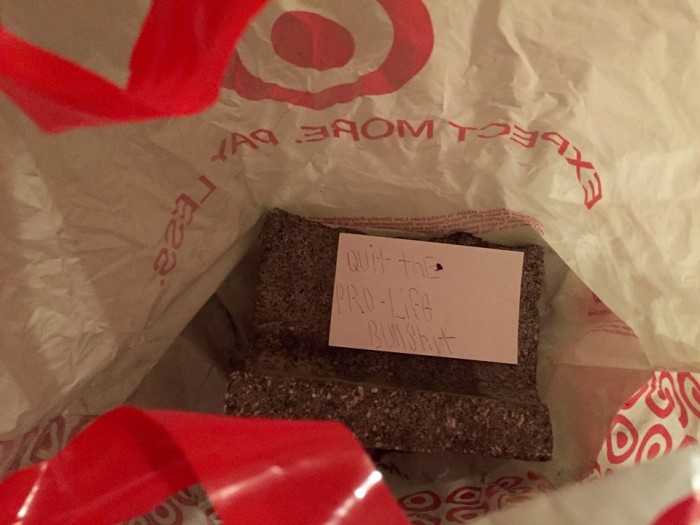
Pro-life activist Jill Stanek’s house was vandalized by pro-abortion cowards.  The story is HERE. One of them threw a brick through her window with the note: “Quit the pro-life bulls**t.”

It’s in a Target sack.   I’ll take Irony for $1000, Alex.

Stanek’s reaction?  She is more convinced than ever.  Also, she asked for the brick.

Police are filing a report, calling this “biased” vandalism. [Doesn’t hate crime apply?] Just before they took the brick away for evidence, Jill asked if she could have it back. One policeman was rather surprised, asking, “For what, a trophy?” Ever the dedicated go-getter, Jill replied, “Yes, actually.

Fr. Z kudos to Jill.

I say, si vis pacem para bellum.

Posted in Emanations from Penumbras, Fr. Z KUDOS, Si vis pacem para bellum!, The Coming Storm, The future and our choices | Tagged ,
15 Comments

WDTPRS: Presentation – “the substance of our flesh”

Forty days (there’s that number again) out from the Feast of the Nativity we come to the Feast of the Presentation of the Lord, called also the Purification of Mary as well as the Feast of Meeting by some of our Eastern brethren.

Today is also called “Candlemas”, for we bless candles and light them against the darkness.  And today is and even called YPOPANTI AD SANCTAM MARIAM!

As I wrote quite a while ago, we discern in the Gospels an interesting pattern.

The Second Person empties Himself of glory and becomes incarnate of the Virgin Mary. The eternal Word becomes a speechless child. He is lain upon the wood of the crib. He is pierced with metal and He sheds His Blood for our sake. The Incarnate Word Jesus Christ empties Himself of glory and enters His Passion. He stands mute before Pilate and the soldiers. He is lain upon the wood of the Cross. He is pieced with metal and sheds His Blood for our sake. In each case He is bound to the Temple, first in His Presentation, finally when the lambs (which foreshadow Him) are being slaughtered in the Temple. All of this is for our sake.

Today’s Collect was in the 1962 Missal and is based on one in the ancient Gelasian Sacramentary amidst the prayers “in purificatione sanctae Mariae” on the date iiii Nonas Februarias (read 2 February).

In the Gelasian it goes like this:

Deus, qui in hodierna die unigenitus tuus in nostra carne quam adsumpsit pro nobis in templo est praesentatus, praesta, ut quem redemptorem nostrum laeti suscipimus, uenientem quoque iudicem securi videamus: …

When you go to your church for Candlemas, you might be privileged to hear this:

COLLECT:

Omnipotens sempiterne Deus,
maiestatem tuam supplices exoramus,
ut, sicut unigenitus Filius tuus
hodierna die cum nostrae carnis substantia
in templo est praesentatus,
ita nos facias purificatis tibi mentibus praesentari.

SLAVISHLY LITERAL TRANSLATION:

Almighty and everlasting God,
we humbly beseech Your majesty,
that, just as Your only-begotten Son
was on this day in the substance of our flesh,
presented in the temple,
so too You may cause us, once our minds have been purified,
to be presented unto You.

Here is a great version from the …

1559 Book of Common Prayer 
(the first version ever brought to North American by the settlers at Jamestown):

Almyghtye and everlastyng God,
we humbly beseche thy Majestie,
that as thy onelye begotten sonne
was this day presented in the Temple
in the substaunce of our fleshe;
so graunte that we maie bee presented unto thee with pure and cleare myndes;

How does the version in Latin compare with what you usually hear in churches these days?

OBSOLETE ICEL:

All-powerful Father,
Christ your Son became man for us
and was presented in the temple.
May he free our hearts from sin
and bring us into your presence
.

Really?

CURRENT ICEL (2011):

Almighty ever-living God,
we humbly implore your majesty
that, just as your Only Begotten Son
was presented on this day in the Temple
in the substance of our flesh,
so, by your grace,
we may be presented to you with minds made pure
.

You decide.

Posted in Liturgy Science Theatre 3000, WDTPRS | Tagged , ,
2 Comments

“Ministry is not about…”

A friend sent this.

From the composer David Haas… from HERE

821-David-Haas-Bizarre-Creed

What do you, dear readers, think ministry is not about?

Ministry is not about [FILL IN BLANK] – 
it is about [FILL IN BLANK].

Posted in Liberals | Tagged
78 Comments

Prefect of Cong. for Bishops says more priests now decline becoming bishop

I have a priest friend who has 30+ reasons on his list for why he doesn’t want to be a bishop.

[UPDATE: I was informed that the list is presently at 42 reasons for why he doesn’t want to be a bishop.  It’s inclusive and brutally honest.]

My list isn’t quite as long as his, but it is pretty long and pretty similar.

From CNS via CathNews:

Although the number is not high, it is no longer “exceptional” to have priests turn down an appointment as bishop, according to Canadian Cardinal Marc Ouellet, prefect of the Congregation for Bishops.

Speaking yesterday about the annual course his office sponsors for new bishops, the Cardinal was asked about rumours that more and more priests are saying they do not want to be a bishop and declining an appointment even when the Pope, on the recommendation of Cardinal Ouellet’s office, has chosen them.

Yes, that’s true. Nowadays you have people who do not accept the appointment,” he said, adding that he would not provide statistics on how often it happens, although he insisted the number was not huge. [So… it is “big”?  “substantial”? “hefty”?]

Priests decline for a variety of reasons, Cardinal Ouellet said, pointing to the example of a priest who was chosen, but then informed the congregation that he had cancer and had not told others of his illness. “It was a sign of responsibility not to accept the appointment,” he said.

Others decline because of something in their past or because they think they cannot handle the responsibility, he said. In the latter case, he said, “normally we insist” because often people are not the best judges of their own abilities. But when a person makes “a decision in conscience,” the Vatican respects that.

As for the type of priests Pope Francis and the congregation are looking for as candidates, Cardinal Ouellet said the Pope “has insisted on the pastoral quality of the bishops. That’s very clear. It does not mean that they do not have to be masters of the faith because a bishop is, first and foremost, the first teacher of the faith in his diocese.”


[…]

Read the whole thing there.

Happily, I will never be a bishop.

But about that Monsignor thing….

Posted in Mail from priests, Priests and Priesthood | Tagged ,
23 Comments

Pope Francis to play himself in a movie… uh huh. POLL

UPDATE 2 Feb:

See below…

____ ORIGINAL  Published on: Feb 1, 2016

From Variety (not The Onion… not Eye of the Tiber):

Pope Francis will play himself in the new religious movie “Beyond the Sun,” marking his acting debut and the first time that a pope has appeared in a feature film.

“Beyond the Sun” — from Ambi Pictures — is a family adventure based on the Gospels. Pope Francis asked the filmmakers to make a movie that communicated Jesus’ message to children.

AMBI co-founders Andrea Iervolino and Lady Monika Bacardi will finance and produce the film. Graciela Rodriguez wrote the screenplay and will co-produce with Gabriel Leybu. Monsignor Eduardo Garcia will be Pope Francis’ advisor.

All profits from the film will be donated to Argentinean charities El Alemendro and Los Hogares de Cristo, which aid at-risk children and young adults.

Iervolino made his first film in his hometown of Cassino, Italy, at age 15.

“Our excitement and gratitude toward His Holiness, Pope Francis participating in this film is beyond words,” he said. “This is not just a movie for us, it’s a message, and who better to have on your side to deliver an important societal and spiritual message than the Pope.”

Bacardi said, “It is a great honor for Andrea and I to have the opportunity to work with His Holiness, Pope Francis, to spread the awareness of his message, through this film. We will make a movie everyone involved with can be proud of. Not only will families from around globe enjoy this film and be entertained, but they will be moved.”

Principal photography is slated to begin early this year in Italy. Ambi will oversee worldwide distribution for “Beyond the Sun” through its Los Angeles-based international sales division.

[…]

Okay… let’s poll this one.

Choose your best answer and, if you are registered to comment, give an pith and well-considered explanation in the combox.

Should Popes be actors in movies even to play themselves?

View Results

Moderation queue is ON.

UPDATE 2 Feb:

From AP via ABC:

Vatican Disputes Pope Film Claim, Says Pontiff Not an Actor

The Vatican is disputing a U.S. film studio’s claim that the pope is making his movie debut, saying no scenes were shot for the venture and that the pope isn’t an actor.

Los Angeles-based AMBI Pictures headlined its press release: “Film Will Mark First Ever Big Screen Participation Role for the Leader of the Worldwide Catholic Church.”

Monsignor Dario Vigano, the head of the Vatican’s communications operation, acknowledged that he couldn’t exclude that the filmmakers got hold of some clips of the pope. But in comments broadcast on Vatican Radio on Tuesday, Vigano disputed the press release claiming that Francis would “play himself” in the film “Beyond the Sun.”

He said: “The pope is not an actor.”

AMBI described the film as “a family adventure story where children from different cultures emulate the apostles while searching for Jesus in the world around them.”

[…]

The company said “Beyond the Sun” initiated with Francis asking the filmmakers to make a movie for children that communicates Jesus’s message. The press release was accompanied by photos of the pope with the filmmakers.

The Vatican works hard to control the pope’s image, enforcing tough copyright restrictions on all visual media, and Vigano’s reaction to the announcement was a clear sign that the Vatican didn’t appreciate the hype. But Francis has been known to go his own way on several occasions, allowing friends to shoot video of him to convey messages to private gatherings: He delivered such a message to the Argentine Jewish community and to a gathering of American Pentecostals.

Vigano’s comment that he couldn’t exclude that the filmmakers had some footage of the pope suggested that they might have secured some video of him in the privacy of his hotel reception rooms.

The organizers said all profits from the film will go to two Argentina-based charities that help at-risk children and young adults.

A spokesman for AMBI declined to comment Tuesday.

Posted in Francis, POLLS | Tagged , ,
53 Comments

@BishopCoyne to start a digital Catholic High School

Bishop Christopher Coyne of Diocese of Burlington is setting up a “digital Catholic High School”.  Intriguing, no?

Here is a part of an interview he did at Aleteia.

Your diocese — Burlington, Vermont — announced plans to open the first Catholic online high school. Why did you decide to do this?  

I came from the Archdiocese of Indianapolis, which has a huge Catholic school system, which produces such benefits for the diocese. When I got here to Vermont, I encountered a school system a quarter of the size in a state that is half the population … so I started think about how I could foster and  support Catholic schools here.

We only have two Catholic high schools … we’re such a rural state — everything is spread out. How do we engage our Catholic families and Catholic students, especially at the high school level? And the idea of a digital Catholic high school came to fruition, not just as an online program, or as a curriculum for homeschooling families, or classes, but we asked: What makes Catholic school unique? It’s the formation. So we decided to have one day a week called a “hub day,” where students would sign up for our school, but then one day a week they’d have to make a trek to one of the hubs in the state where they’d have Mass, formation, peer ministry, counseling, tutoring if need be, but without the hassle of doing that every day.

And when do you plan to launch this?

We hope this fall to have our first freshman class up and running. We’ve got a lot of content from the Jesuit online program and the Archdiocese of Miami, which has its own online high school program, but they don’t have the hub days, or focus engagement with the families on the formation level.

Do you envision this being for people who might otherwise home-school, as well as those who may currently send their kids to a public or Catholic school?

We’re getting a lot of inquiries from home-schoolers — but what they’re more interested in is content. They’re excited about tying into what we’re doing and using a lot of our online classes, but they’re not necessarily inclined to enroll fully into the Academy yet; they want to see how it plays out.

But we’re also getting inquires from across state borders — from Massachusetts and New York, and from Canada. So we hope to set up our hubs in the corners of the state, close to borders so a lot of these families can enroll and be able to have their students attend our Academy. Many schools are failing in Vermont, due to dwindling numbers and resources, and current private schools, whether Christian or secular, are very expensive, so we’re trying to keep our costs very low but offer a quality education and Catholic charism. Currently, we have an online survey and we’re trying to figure out where the people are who would be interested in our Academy, and then we’ll choose our hubs accordingly.

In addition to nearby border states, do you see this as something families in far away states could eventually participate in? 

We just got an inquiry from Hawaii. If you think about it, a digital Catholic academy spread across the islands could work well out there.

Another story at the National Catholic Register:

Named after St. Thérèse, it will join other online offerings for students and teachers.

BURLINGTON, Vt. — The Diocese of Burlington, this fall, hopes to become one of the first in the country to open a digital high school, where lectures, class discussions and homework largely take place in an online environment instead of a traditional bricks-and-mortar classroom.
Although online courses have long been available to Catholic home-school students, including some that go back to the 1990s, the idea of an accredited and diocesan-supported online Catholic school is quite new. The National Catholic Education Association (NCEA) said it is aware of the existence of just one other: the Archdiocese of Miami Virtual Catholic School.
The Archdiocese of Miami Virtual Catholic School opened in 2013. It claims to be the only diocesan-supported school of its kind. At least one other archdiocese, Chicago, also launched a digital academy in the same year. But it is intended to offer supplementary courses taken by students already enrolled in a physical school.
A third institution, Jesuit Virtual Learning Academy, also offers supplementary courses to any Jesuit or other Catholic school. It opened in 2008.

[…]

Inspired by St. Thérèse
In Vermont, newly appointed Bishop Christopher Coyne said the digital option is a way to offer a Catholic education in sparsely populated areas. It is also expected to be more affordable. Tuition is tentatively pegged at about $5,000, noticeably less than what is charged at the two high schools in the state’s main population centers. Rice Memorial High School near Burlington charges $9,395; at Mount St. Joseph Academy in Rutland, it is $6,400.
The school will be named the St. Thérèse Digital Academy. Bishop Coyne, who is an active user of social media, said he came up with the name after reflecting on how St. Thérèse of Lisieux’s teaching applies to digital culture.
“I started thinking she could be the patron saint of the digital culture because she showed us how to love God in each and every moment of our life; and being present in the digital culture is really being present in a lot of small moments in a lot of small events,” Bishop Coyne said.

[…]

Posted in SESSIUNCULA | Tagged , ,
8 Comments