ASK FATHER: Viaticum and how many we can receive Communion in a day

last rites extreme unction anointing viaticum 02From a reader…

QUAERITUR:

I understand that we can receive Holy Communion twice a day, but the second reception must be made at Mass. Can. 917 says this “without prejudice to Can. 921, §2.” I’ve read that this is understood as allowing for the day’s 2nd reception of Communion outside the Mass through Viaticum. However, should this provision also be understood as allowing for a 3rd reception if one had already received twice (the 2nd at Mass) during the day? For example, if I received at a Communion service, then at Mass, could I also receive Viaticum should I have the grace of a provided death? Many thanks.

Since I haven’t had this question for a while, we can review.

First, a provided death means that you – at least – died in the state of grace.  In most instances this can mean that as you were dying a priest gave you absolution.  In more ideal situations, it means that the priest absolved you, anointed you, gave you Viaticum, and, the Apostolic Pardon.  May God, please, give us the grace for this sort of death.

Viaticum, an adjective, is Latin for “of or belonging to a journey, resources, provision for a journey (via)”.. “one for the road” as it were..  In early Latin it was used by Plautus as “a parting farewell meal”.  In military imagery – and we are soldiers on the march in this Church Militant – it was the prize money a soldier made in war.  Communion is also called a pignus, a “pledge” of future glory.  So, in one sense, Viaticum is the moment of being paid out at your soldierly discharge as you step into the patria.

Catholics in the state of grace can receive twice in one day.

The 1983 Code of Canon Law says:

Can. 917 – Qui sanctissimam Eucharistiam iam recepit, potest eam iterum eadem die suscipere solummodo intra eucharisticam celebrationem cui participat, salvo praescripto Can. 921, § 2.

Someone who has already received the Most Holy Eucharist can receive it again (iterum) on the same day only within the Eucharistic celebration [i.e. Mass, not a Communion service] in which the person participates, with due regard for the prescription of can. 921 § 2.

Can. 921 § 2 says that if a person is in danger of death, he may receive Communion even it is not in the context of Mass.  That is Viaticum.

That iterum does not mean “again and again”, but merely “again, one more time”.

Also, that “Eucharistic celebration” in the canon does not mean just any service involving Communion.  It means Mass. That was cleared up by the Holy See in an official response to a dubium.

So, say in the morning you attend a Novus Ordo Communion service wherein you receive Communion, or you went to a Mass in either Form.  Later in the day you stumble into a church where Mass about to be celebrated and decided to stay for it.  At that Mass you can receive Communion again (iterum).  This would be even if you were, say, visiting a Maronite Catholic Church, or a Ukrainian Catholic Church and their Divine Liturgy was about to get under way.

However, if you were at Holy Mass in the morning and then stumbled into a Communion service at a priest-less parish in the afternoon, you could NOT receive again because a Communion Service isn’t Mass.  If you were at Mass in the morning and then in the afternoon when you were visiting your auntie in the hospital when the chaplain came, you could not receive even if the priest invited you to do so (which in my opinion he should not).  However, if you stayed for another Mass immediately following, you would be able to receive.

Canon 917 tries to walk the line between promoting frequent reception of the Eucharist and a superstitious or excessive frequency, which – I can assure you – some people fall into.

The key here is that the second time must be during a Mass, and you may not enter the Mass at some late point merely in order to receive.

Viaticum, which is Communion in the context of Last Rites for someone in danger of death, is a separate issue.

Even if a person has received twice in a day, if the person is in danger of death, he can – of course – be given Viaticum.

At this most important moment of life, a person needs everything that can be given to help him on the way to a happy judgment and the promise of heaven.

At that point, the Church, whose highest law is the salvation of souls, gets “tunnel vision”, as it were, and focuses on the dying person in that moment.

Another way we can see this great concern, is that when someone is dying, any and every priest who was ever validly ordained has – in that moment – the faculty to hear the dying person’s confession and/or give absolution validly.  As most of you know, it is not enough that a priest be validly ordained.  He must also have the Church’s permission granted through legitimate authority to receive sacramental confessions and given absolution validly.  Thus, in the case of a person dying on the street from, say, a car accidents or a freak bow and arrow incident, even an ex-priest who had been convicted of horrible crimes and “laicized”, stripped of his ability to function as a priest for the rest of his life, could, were he present, validly absolve the dying person.

So, under normal circumstances a person can receive Communion twice in a day, so long as the second time is in the context of Mass.  If he tries to die during the same day, he can receive Communion again, as Viaticum.

This doesn’t apply to priests, who must consume both species no matter how many times they say Mass in a day.  Ideally a priest celebrates Mass once.  In some circumstances he celebrates twice (bination).  Under pressing circumstances, he celebrates thrice (trination).  He really isn’t suppose to celebrate more than that but, sometimes, it happens that he has to.  In that case the good of the faithful kicks in and Father takes care of business!  But bination and trination are matters for a different post.

Posted in "How To..." - Practical Notes, ASK FATHER Question Box, Four Last Things, Hard-Identity Catholicism, Liturgy Science Theatre 3000 | Tagged , , ,
7 Comments

Your Sunday Sermon Notes

Was there a good point in the sermon you heard for your Sunday Mass of obligation?

Let us know!

Posted in SESSIUNCULA |
10 Comments

Sunday Supper: Fun With Rosemary Edition

rosemary_01It has been a while since I offered a “Sunday Supper” post. I am committed to urging you all to think about good, slow, and sometimes important meals, with people, on Sundays. Alas, though I cast out a few lines and hooks today I was not with people for Sunday Supper, but – undaunted – I have a post anyway!

Tonight I did a couple things with rosemary.  Bought rosemary… how I miss my garden.

In this corner, weighing in at 3.5 lbs, an ex-chicken.  Like any fighter it was rubbed down… with butter and pepper.  I stuffed it with lemon pieces and extra zest, and rosemary sprigs.

Into the Steam Pipe Trunk Distribution Venue’s toaster oven at 450F for 15, and then back to 375 for another hour.

Meanwhile, fun with rosemary continues.  As I watched a couple episodes of season 4 of The West Wing (Pres. Bartlett seems like Ronald Reagan compared to the present guy… but I digress), a pre-prandial is in order.

Years ago a priest friend of mine (we were in seminary together), Fr. Alain Boussand, introduced me to the aperitif Suze.  I remember exactly where we were: Chartres at an outdoor cafe/bar. We were heading south to Rome after the summer, looking at Romanesque churches, Paray Le Monial, Ars, Le Barroux …. When I was in Paris with some friends not too long ago, I reintroduced myself, and them, to Suze.  It was a hit.  It wasn’t available in these USA until recently.

Here is a cocktail I found suggested online.

In an old fashioned glass and over ice…

  • 1/3 Suze
  • 2/3 Tonic
  • A splash of peach syrup
  • A sprig of rosemary
  • A 1/4 lime

Refreshing! It prepared the palate well for the chicken.

Yes, that’s hiragana in the background.  I have it pinned up on the wall. I’m repacked it.

Meanwhile, here’s the chicken.


Tonight’s chicken was accompanied by a romaine lettuce salad with tomatoes and balsamic vinaigrette.   I cut up tomatoes and macerated them with nearly transparent slivers of garlic, ground pepper, salt, balsamic vinegar and first press olive oil.

Savory and satisfying.

As I munched I remembered a wonderful roast chicken my friend Fr. Tim Finigan and I devoured in his rectory at Blackfen … in happier days for Blackfen.  We had golden roasted potatoes and a squishy cake with a warm sweet sauce.  A great memory.

Sunday Supper… plan for it.  Make it special.

Posted in Fr. Z's Kitchen | Tagged , , , ,
11 Comments

Bp. Stika (D. Knoxville) on true human ecology, Planned Parenthood, trauma

Reading the news around the Catholic world you would think that prelates and priests and lay faithful alike are going absolutely loony about climate change.  Since Laudato si’ it seems as if those who read selectively have been rushing lemming-like to the ever warming sea.  Running screaming waving their front legs… which lemmings can’t really do and still run.  But I digress.

And so it is refreshing to read what the Bishop of Knoxville said about ecology… about human ecology.

From knoxnews.com:

Bishop Richard Stika: Human ecology recognizes value of life from conception to death

Decades ago, people on another continent shocked the world, saying, “We did not know,” regarding the atrocities they chose to ignore.

And before that, our own country enshrined as the law of its land the slavery of those we deemed less than human.

Yet today, we encounter a similar troubling indifference, and worse: the suppression of the truth regarding the most vulnerable among us.

Evil without its makeup [especially the eye-liner… don’t forget the eye-liner] — that is the reality exposed in the unfolding series of videos revealing how the unborn life of a baby, deemed worthless by Planned Parenthood while in the womb, has value only in the sale of its dissected human parts. [human parts… baby human parts… human parts of human babies, because babies are humans]

What has become of our humanity when our conscience is not sickened by the callous talk of less “crunchy” methods to fetch a greater dollar value for the baby limbs and organs that will be separated in a petri dish for sale like a laboratory rat?

But if one is to believe Planned Parenthood, the real aggressor is the Center for Medical Progress, which shined a light into the arena of darkness and the Frankenstein-like business of trafficking in human parts, which is prohibited by federal law. [Blaming the messenger is a time honored tradition.]

If Planned Parenthood’s definition of an extremist is one who believes in the sanctity of the unborn and the protection that these vulnerable lives should be afforded, then I, too, am an extremist. I challenge everyone to view these videos.

If someone watched the major news outlets during these past few weeks, one story dominated the headlines in most reports: the poaching of Cecil the lion in Africa. [I didn’t pay much attention to that story, but I read somewhere that Cecil had developed a taste for man flesh .. rather like Planned Parenthood.  How ironic that the name of Planned Parenthood is also Cecil.  Cecile.] Care for the environment and of all God’s good creation is important, but have we forgotten a far greater ecology that calls for our attention?

Pope Francis recently highlighted the “throwaway” mentality behind not only our failure to care for our earthly environment but also, and more importantly, our failure to respect a human ecology.

A true human ecology is one that recognizes the inestimable value of life from conception to natural death, be it the life of the unborn in the womb, the poor, the sick and elderly, and even those on death row who themselves may have brutally taken another life. This human ecology calls us to especially reach out with love, mercy and healing toward those who may be contemplating, or have chosen to have, an abortion.

There is so much senseless violence in our country today, emblematic of this “throwaway” mentality that cheapens the value of human life. Should we be surprised by the growing violence in our society when the brain or liver of an 11-week-old fetus has a value of $75?

So I ask the question Pope Francis asked: “How can we genuinely teach the importance of concern for other vulnerable beings … if we fail to protect a human embryo, even when its presence is uncomfortable and creates difficulties?”

If only the half-billion dollars of taxpayer money given to Planned Parenthood each year could be redirected to the thousands of pregnancy help centers, which offer loving and compassionate options that instead affirm the sanctity and dignity of both mother and child.

[This is good… ] If the ongoing coverage of Planned Parenthood causes anyone to experience revived trauma from a past abortion, [because that’s what it causes] be assured that any and all people will be welcomed with compassionate, nonjudgmental, confidential assistance through the Catholic Church’s post-abortion healing ministry, Project Rachel, www.projectrachel.com. And anyone who is scared and needs help with a pregnancy can contact our Catholic Charities of manast Tennessee Pregnancy Help Center at 1-877-990-4673.

The Most Rev. Richard F. Stika is bishop of the Diocese of Knoxville.

Posted in Emanations from Penumbras | Tagged , , ,
15 Comments

CQ CQ CQ – #HamRadio Update – A Scenario

ham radio maximilian kolbe sp3rn1Later today I’ll start up my Echolink program.  And remember that WB0YLE has a node for us.

Last weekend I heard CW of a North American QSO (“contact”) Party that was going on.  I deciphered some of the calls, looked them up, and sent a few emails.  Most everyone replied and with encouraging notes.  I’ll keep working on the Morse Code, with or without a key.  [UPDATE: see below] Dash by dash.

Here is a sample of what it sounded like while the QSO Party was going on. You can hear how everyone jumps in when a call sign is sent out.

One of the interesting moments in listening last week was hearing/deciphering signals from someone who seemed to be blind.  He was talking about other blind hams.  It was an actual conversation, rather than just the exchange of call signs.

I haven’t made any additional progress on my contact card yet.  I need a template for the blank side for the filling in of information.

Finally, I repeat what I posted last week.

During the month of August, there will be a Ham “Event” in honor of St. Maximilian Kolbe, who was slain on 14 August 1944 in Auschwitz.  I heard this via PSK31.

St. Maximilian was SP3RN.

At QRZ.com I saw

July, 20, 2015

Hello  …

I have been in contact with Ted Figlock W1HGY, and wanted to communicate my intentions for the St. Maximilian Maria Lokbe SP3RN special event activation. Call sign will be K8M and the dates will be between 01 August 2015 0400 (UTC) to 16 August 2015 0359 (UTC),

A standard sized QSL card will be available, for US stations, please send SASE, for all DX, please send $1 (US, CDN or Euro all ok) and self addressed envelope. My address is good on www.qrz.com. Please no buro.

Operating modes will be SSB, PSK31, and possibly RTTY

VY 73 de Joe Miller KJ8O Troy Michigan

So, you Hams out there, say a prayer to St. Maximilian and get to work!

You never know what use we may need to make of radio, especially low power, in the future.  For a while now I’ve been thinking about how to network with Catholic hams, even dioceses.  Ham radio is useful in emergencies.  What if we were faced with The Big Emergency?

Scenario:

nce upon a time…

…in his Tiny House at the Sheltered Glade, Father stays in touch by CW with the faithful priests and the few Catholic bishops left on the continent through the Catholic net they had prudently formed when everything was hunky-dory.

Before the Collapse.

He carefully transcribes bishops’ brief pastoral letters and sermons along with messages to other priests and faithful in the area, and then relays them to other hams at times and frequencies scheduled by consulting the fifth letter and third number on certain pages of the 1962 Roman Missal.  It’s a little maddening to work out the coded schedule, but it has to be done this way.

Father finds it a little harrowing to have the headphones on and to be buried in the static and the flow of the code.  You can hear what’s going outside in the world, but you can’t hear what’s going on outside the house.  Ironic.  Scary, but ironic.

The transmissions are over. Tidying his work space his mind drifts to the day back before the SHTF when he had the bishop out to the Tiny House.  He used the Roman Ritual to bless the radio equipment.  He could have done it himself, but it’s better to have the bishop see what had been organized and do it himself. It was a beautiful prayer…

God, who ordered all things in creation in a marvelous way, determining even their measure, number, and weight; and who gave man a share in your knowledge, thus enabling him to detect and control the latent forces with which you endowed the things of the universe; be pleased, we pray, to bless + these instruments made for transmitting wavelengths of sound through the air, spreading out in all directions as instantaneously as lightning. Let them carry messages of aid in times of crises, of solace in times of distress, of advice in times of doubt, of light in times of darkness, and thus make known the glory of your name more widely throughout the world that all its peoples may be gathered into the fellowship of your love; through Christ our Lord.

Father shuts down the radio and power source. With practiced speed he secures the door to the lower level punching the code, closes the vault-like door of the ground level storage area and slips on the pre-sorted chest rig and camelbak pack. He double checks his mags and the batteries for the handheld, slings the 5.56 AR-15, and then scans through the ballistic glass windows for a few minutes before closing the steel shutters.

Saftety off.  Exit.  Scan.

He stands perfectly still, listening.  Looking.

Minutes pass.

Nothing out of place comes to his senses.

As he locks the door he recalls with regret – and a rise of the hair on his arms – the smell of the men who were around the corner of the house.  And what followed.

The first step away from the Tiny House always gives him the creeps now.

Shrugging his gear into place he sets out with a glance up at the nearly invisible wires of the various dipole antennas strung amidst the branches of the trees.

He points himself toward the Appointed Place for Holy Mass on the Rock By The Stream.  It usually takes a full day to get there, Deo volente.

He blesses the stone-piled graves as he moves down the path in the forest. “Eternal rest grant unto them, O Lord…”.

As he gets in range of the Appointed Place, he should be able to contact one of the hams in the area who will relay his arrival via the GMRS and FRS radios people have. That’s a security hole, but they have to do something to let people know when to gather.

Besides, things have been calm lately but you can’t have people just waiting around.

In the early days there were packs of dogs who weren’t afraid of people.  There were gangs of marauders and desperate families and individuals who had survived the chaos, starvation and disease. Then came the true wolf packs.

The individuals and families were thinned out by now, but he had heard there were still some gangs and, as the chaos settled, who ever was “in charge” these days had starting hunting priests again.

“Not this priest!”, he muttered.

There are probably going to be a few baptisms and maybe a marriage or two this time.  At least he hopes so.  It’s about time they tie the knot and have the graces of the sacraments.  Since the Collapse, things have been … intense… for young people and pretty much without the benefit of clergy. Often without any relatives at all, poor things.  But a lot of them, the ones who didn’t succumb to despair, found Religion.  They have the Faith now.  Total disaster helps people sort their values.

People in the Catholic net are pretty serious.

This week at the Appointed Place he should also rendezvous with a contact conveying wine through the underground.  He is to keep some for his own use and collect messages and news for the net to be broadcast.  The messages are one thing, but it always surprises him that the wine gets through.  But it does.  He had made some from regional grapes but it was better suited for hand to hand combat than Mass.  Brutal but valid.

The building project at the Rock by the Stream is going well.  Pretty soon they’ll have to think about what to call the chapel.  “Should I try to get the bishop to come?”, he mused.  “It’s a hike and he isn’t young.”

Mostly, Father didn’t like the idea of the bishop saying that it was time for him to be consecrated.  He shivered.

Eyes moving.  Not too fast.   Stop.  Listen.  Nothing.

Keep moving.

“O God, Who did cause the children of Israel to traverse the Red Sea dryshod; Thou Who did point out by a star to the Magi the road that led them to Thee; grant to me I beseech Thee, a prosperous journey and propitious weather; so that, under the guidance of Thy holy angels I may safely reach my journey’s end, and later the haven of eternal salvation.  Hear, O Lord, the prayers of Thy servants. Bless their journeyings. Thou Who art everywhere present, shower everywhere upon them the effects of Thy mercy; so that, insured by Thy protection against all dangers, they may return to offer Thee their thanksgiving. Through Christ our Lord. Amen.”

Next week it’ll be time again to hike up the Big Rocky Hill with a portable rig and antenna for a scheduled DX contact from “Rome”, wherever “Rome” may be now.

He had an inkling that some big decisions had been made.

Okay, that’s enough of that.

I am still securing some useful items.  I have an antenna to order.  I may drive to Milwaukee this coming week where there is a radio store.  That’s what I’ve got.

I am building a list of hams who frequent this blog:

Z-Blog HAMS

  • acardnal KE4WKV
  • Joan W4JMJ
  • BMKoenig K3BMK
  • chris1 KJ4MPE
  • crule N4TII
  • Bryan Boyle WB0YLE
  • Andy Lucy KG4ZMF
  • Navy Jeff KC9TCZ
  • EXCHIEF N7WR
  • pledbet424 WB0MZT
  • Kenneth Jones KB3JA/BY
  • asperges G4NJH
  • Dan Soderlund KBØEO
  • Hesiodos AD7QQ
  • MWindsor – KT5WX
  • dahveed – KD8ZIB
  • FloridaJoan – W4JMJ
  • Jilly – WA4CZD
  • jpaluh – KB3LUE
  • Humilitas – KC4RAC
  • Jeffc – AC5XL
  • pledbet424 – WB0MZT
  • JBBIII – AD7QQ
  • Patrick L – AG4JQ
  • Dr Guinness – VK3SJB
  • MacBride – KC2MEO
  • Evan C – N5EDC
  • boxerpaws1952 – N3XFQ
  • chris_R – N3GBJ
  • Jack – W1JEM
  • Julia12 – KC9ALW
  • moon123 – KB9VSE
  • Pearl – KC8JSL
  • OK_doc – KF5THY
  • Baritone – KD5AYJ
  • IPSB – SA2BXP
  • ByzCath08 – W8GMN
  • Mojoron – K0CCP
  • Deacon Bob – W8CRO
  • Incensum – N9WIV
  • SimonsDad – KB1WOL
  • O. Possum – KC1BGU
  • Curt – AF7KQ
  • Arthur – KD9BRV
  • jeff_logullo – N0MII
  • ckamas – AD6CL
  • revueltos67 – KE5AKL
  • marty5519 – N7CYY

PRIESTLY HAMS

  • Fr. David McGuire AE4LH
  • frdanbecker WA1ZHQ
  • Rev. Canon Glenn Gardner K9ALT
  • plaf26 – KC0GA
  • Fr. Bryan – KD8ZFF
  • starprst- AB4TS
  • Fr. J. Stefanski – SQ3SWS / N2FCH
  • Fr. Paul A. – Cannariato KB2TJY

There must be more of you!

KC9ZJN
73

UPDATE:

I received a key today from W2LJ.  Thanks!

UPDATE:

This is kinda cool. In the combox one of you – N5EDC – said he was going to be on PSK31 on 14.070. I saw it in time, fired up the rig, and saw this.

Posted in Ham Radio, Semper Paratus, TEOTWAWKI, The Coming Storm | Tagged , , ,
40 Comments

Clergy defending Big Business Abortion

Planned Parenthood, which makes money from selling dead baby parts, has a Clergy Advocacy Board, which released a statement defending the abattoir.

I tried to find the names of the board members, but came up with this when I clinked their link.  HERE

15_08_08_PP_Clergy

I want to know who the Catholics are.

A commentator (below) found it. I dates to April 2015, but we can assume it is still accurate for the most part.

Here is a screen shot.

15_08_08_PP_Clergy_02

Posted in Emanations from Penumbras | Tagged ,
20 Comments

Illness, Sick Call Sets, Anointing and You

I recently went to a family home to anoint a fellow who is seriously ailing. They participate regularly in the Extraordinary Form at the parish where I help out and so I took my old Roman Ritual (the rite is sublime).

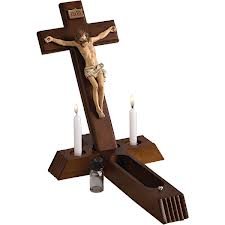
Before my visit I asked if they had a sick call set and, sure enough, they did. It was a Crucifix form set, a wedding gift, which was on their wall for the last 50+ years, unused until yesterday.

But … they had one!

I made some comments about how to set things up for my visit and, arriving, found everything just right for the administration of the sacrament.

Note the pieces of bread and lemon which is used to clean the Oleum Infirmorum from Father’s thumb.

The cotton balls and bread and lemon should all be burned and the ashes put down the sacrarium or, alternatively buried.  The priest will take care of that.

The other day during my day trip with a priest friend to SW Wisconsin to see sites associated with Ven. Samuel Mazzuchelli.  In one display there was an old set.

Sick call sets can take many forms.  It is important that you have one, whichever it may be.

A sick call set will include, at minimum,

  • a white tablecloth
  • 2 blessed candles (matches)
  • a Crucifix
  • Holy Water
  • regular water
  • linen cloth and/or cotton balls

Set up a table with the cloth near the bed or place where the sick person is, especially so he can see it
Set up the crucifix and light the blessed candle on either side

  • You could have a piece of a blessed palm from Palm Sunday which the priest could use to sprinkle the Holy Water if the water is in a dish.
  • Have some regular water for when he cleans his fingers.
  • I recommend also a piece of bread and/or lemon and cotton balls.
  • Some include a small bell that the priest can ring after the sick person makes a confession to let people know they can reenter the room.

People get sick and die.

This is probably your fate if you are not killed suddenly.

Whatever may be the method God has in mind for you, death is not optional.

This important sequence of the human experience is provided for by Our Lord.  He gave His Church the ordinary means of our salvation.  We need the spiritual and, sometimes, physical strengthening that is conferred through the Sacrament of Anointing.  When given in the last moments of life, it is called “Extreme Unction”.  Unctio, in Latin, is anointing.  “Extreme” refers to “in extremis“, that is, the last moments of life or “at the limits of one’s powers”.

What are the effects of Anointing?

The effects of the Sacrament of Anointing or Anointing of the Sick or, sometimes, Extreme Unction, are:

  • To increase sanctifying grace in a moment of great need (danger of death)
  • To console the person
  • To strengthen against temptation
  • To heal the body
  • To forgive mortal sins when a person is incapable of confessing them or is unaware of his state of soul

Anointing was placed in the category of “sacraments of the living”, a handy way of saying that for them to be as effective as they can be, we must receive them while “alive”, that is, not “dead in sin”, that is, in the state of grace.  The key to understanding anointing and forgiveness of mortal sins is that the person must be incapable for one reason or another of confessing mortal sins.  However, upon recovery or a change of condition such that he is capable, he is bound to confess mortal sins in the normal way as soon as possible.  Danger of death always changes the playing field.

It is an abuse of the sacrament of anointing and unhelpful for people when the sacrament is given en masse without regard for the person’s condition of soul or, in many cases, body.

The law about who receives the sacrament is clear:

Can.  1004 §1. The anointing of the sick can be administered to a member of the faithful who, having reached the use of reason, begins to be in danger due to sickness or old age.

And there is the Catechism of the Catholic Church:

1514 “The anointing of the sick is not a sacrament for those only who are at the point of death. Hence, as soon as anyone of the faithful begins to be in danger of deathfrom sickness or old age, the fitting time for him to receive this sacrament has certainly already arrived.”

Common points?  Danger of death… sick and old age.

Reflect on the prayer of the Church in the Litany, that we be saved from an unprovided death.

One can be in danger of death for many reasons.  For example, someone who is about to undergo surgery requiring a general anesthesia could be in danger of death.  People about to be executed or go into battle are in danger of death. Those are not occasions for the sacrament because they are external to the person.  Once damage is inflicted through a wound and danger of death is obvious, that’s another matter.

Soldiers and those to be executed ought to be given the opportunity to make their confession, receive Viaticum, hear the commendation of the soul, and so forth.

Some of you might be saying “But Father! But Father!  Vatican II did away with rules.  Pope Francis said so!  All sacraments should be given to everyone all the time.  You make me cry.  I need to be anointed now.  You hate Vatican II!”

Some argue that when a person reaches a certain age, he or she should be anointed because, at that age, you live in a perpetual state of danger of death.  That argument is weak.  If a person is baptized, he draws on the graces of that sacrament.  The sacrament of confirmation is intended also to strength us against temptation and live our Christian character well in moments of challenge.  The sacrament of penance also strengthens us against sinning and it also consoles us when we are not in danger of imminent death.  The Eucharist forgives venial sins and is our greatest consolation and strength in good times and bad, and at every stage of life.  Furthermore, as far as these en masse anointing services are concerned, there is often no provision for people to make a sacramental confession before they are anointed.  It is wrong, simply wrong, to anoint a person in the state of sin if there is no real danger of death looming on the horizon.  The sacrament cannot be effective for forgiveness of mortal sins if he or she is perfectly capable to make a confession.

The sacrament of anointing should truly evoke reverential awe because it associates us with the suffering Lord, the Crucified Savior, whose Passion gives meaning to all human suffering.

That’s not nothing.

Another point.

The fact that the sacrament of anointing, in some circumstances, forgives mortal sins, then the only valid and licit minister of the sacrament is a sacerdos, a priest or bishop.

DEACONS CANNOT ANOINT.  DEACONS CANNOT ANOINT.  DEACONS CANNOT GIVE THE SACRAMENT OF ANOINTING OF THE SICK.

Neither can nuns in pantsuits with or without a lapel pin.

Neither can a parish volunteer.

Only a priest or bishop validly administers the sacrament of anointing.

This is a surprise to many.

Therefore, anything that resembles or simulates the actions of the sacrament of anointing should be stopped, so that people are not confused a) about what they are getting .. not getting, and b) what different roles in the Church are.

That said: The sacrament of anointing is not simply for extreme nearness of death.  It is for the sick or infirm.  But I think we must be wary of making it into something that it isn’t.  Having a cold doesn’t qualify, unless you have other ailments which mean that a cold could kill you.

Sacraments, all sacraments, should be simultaneously familiar and awesome.

They should be thoroughly incorporated into our lives and approached and received as often as appropriate, with something I can only describe as fearful familiarity, timid  boldness, reverential ease.

They should be both commonplace and also as if the rarest of events.  “Rare” means not only “infrequent” but also “precious, excellent, fine”.

We should be at the same time filled with longing for them when we need them and also filled with pious dread at the mystery of God’s ineffable favor poured out on us for no merit of our own, all because He has deigned to make us His adopted sons and daughters.

So… in short, the Sacrament of Anointing of the Sick can forgive mortal sins in certain circumstances.  It is, however, a sacrament to be received, unless impeded, in the state of grace, and only a priest can give it.

Use it.  Don’t abuse it.

Have a sick call set in your homes and know how to set it up.  God permit that you never need it, but…


Posted in "How To..." - Practical Notes, Liturgy Science Theatre 3000, Our Catholic Identity | Tagged , , , , ,
43 Comments

Of Dominicans and cat-demons and soap

The wonderful Dominicans in Summit, NJ  – who do not belong to the LCWR – have been posting stories about St. Dominic on their blog.  According to the traditional, Roman calendar St. Dominic’s feast was 4 August, but it was moved in the post-Conciliar reform to 8 August.

One of the stories.  HERE:

Dominic Seignadou

Click for larger

A Monastery for Sisters is Founded at Prouille

In order to give assistance to certain women of the nobility whose parents were led by poverty to give them over to the heretics for training and support, he established a monastery between Fanjeaux and Montreal in a place called Prouille. There, to this day, handmaids of Christ give a pleasing service to their Creator. By the vigor of their holiness and the noble purity of their innocence, they lead a life which is of spiritual benefit to themselves, a source of edification to men, a joy to the angels, and a pleasure to God.

“One evening in 1206, outside the north gates of the village of Fanjeaux, St. Dominic sat reading about St. Mary Magdalen whose feast day it was. As he reflected on the life of the saint he was moved to ask God for guidance in what he should do. He also asked for a sign from the Blessed Virgin to help him. Just then a globe of fire came out of the heavens, hovered a bit and then in a blaze of glory settled over the forlorn and desolate church of Prouille which was nearby. The saint could not believe his eyes. He came back to the same spot the next evening and the sign was repeated. He returned again on the third evening and sure enough the vision appeared again. He took this as the sign he had prayed for and determined that the church at Prouille was the place God wanted him to begin his work. This vision is known as the Seignadou, “the sign of God” in the language of the place and time.”

Berengaria declared under oath that she was an eye-witness when Blessed Dominic told the nine women converted from error to behold the thing which possessed them: a demon in the form of a cat with fiery eyes as large as a cow’s and with a long tongue that breathed a firelike substance and with a tail as thick as a dog’s and more than a foot long. At his command this creature escaped through the opening for the bell-rope in the tower and disappeared from their sight. But before doing all this, he had told them to have no more fears, as he would show them the master they had been serving.

I hope you noted that word: Seignadou.

The Summit Dominicans are the legendary “Soap Sisters”.  Their enterprise is called “Seignadou Soaps“, and now you know whence the name came!

Actually, they are a great deal more than that, but it’s catchy and descriptive.

The sisters make wonderful soaps, and other things, by which they keep themselves going (along with prayers and the kindness of others).

I have bought their soap for my mother.

I see that they have beeswax candles.

Check out the “Don’t Bug Me” spray.   If only it worked on more than mosquitoes.

I use their shaving mug.

Remember that Dominicans are mendicants.  They have a building project. HERE

The other day I visited the motherhouse of one of the great foundations of Dominican women in these USA, the Sinsinawa Dominicans.  They conformed to the world and became weird.  They are dying out.  It was really sad.

These sisters, the faithful Summit Dominicans have to turn people away because they don’t have the space for them.  They are true to their purpose.   This is a cloistered community of contemplative sisters whose apostolate is the Perpetual Rosary. They are, bless them, “Mary’s Guard of Honor”.  They are a joy.

Posted in Our Catholic Identity, Women Religious | Tagged , ,
5 Comments

A Bishop cautions the Faithful about the SSPX

bp morlino

UPDATE 14 SEPT: Since this was posted there was a development.  Bp. Morlino appeared on EWTN and made a clarification about one statement  in the letter, below.  HERE

____

ORIGINAL  Published on: Aug 7, 2015 @ 08:59:

His Excellency Most Reverend Robert C. Morlino, Bishop of Madison (aka The Extraordinary Ordinary) published a column in the diocesan newspaper and website about the Society of St. Pius X.  HERE

Here it is with my emphases:

A word of caution about the Society of Saint Pius X

Bishop’s Column
Written by Robert C. Molrino, Bishop of Madison

The 50 years since the close of the Second Vatican Council have been tumultuous for the Church. Forces both inside and outside of the Church tried to distort and exploit the council and the post-conciliar liturgical reforms to create a new Church after their own image.

Too many of us endured years of sloppy or irreverent liturgy and mushy or even unorthodox preaching and catechesis. Too often when we voiced our concerns we were ignored.

Most of the faithful Catholics who saw this happening fought hard for a “reform of the reform.” Sadly, others decided that the only way forward was to work outside of — and sometimes against — the hierarchical Church and its structures.

This was the choice made by the Society of Saint Pius X (SSPX), a worldwide society of priests best known for its strong opposition to the post-conciliar reform of the Mass. The Masses that they celebrate in their own chapels according to the 1962 Missal have attracted sizeable communities of the lay faithful, even here in the Diocese of Madison.

I want to be cautious and fair about the SSPX. Many of their concerns are legitimate. Many of their values and aspirations are admirable, and their zeal is impressive. Their priests wish to serve the Lord and His people. The people who attend their chapels are fervent.

We should always be cordial, respectful, and welcoming to them as brothers and sisters in Christ. Yet, their relationship with the Church is complex and developing. Moreover, the situation of SSPX bishops, of SSPX priests, of the faithful who formally align themselves with the SSPX, and of the faithful who occasionally or informally attend Mass with the SSPX, are all different in important ways. It would be inaccurate to call it a schismatic group in a strict sense, and we should all pray that it may someday be fully reconciled with the Church.

Having said that, all is not well with the SSPX, and my advice, my plea to the traditionally-minded faithful of the diocese is to have nothing to do with them. As Pope Benedict XVI made clear, the SSPX “does not possess a canonical status in the Church” and its ministers “do not legitimately exercise any ministry in the Church” (March 10, 2009, Letter to the Bishops of the Catholic Church).

The priests of the SSPX are validly ordained priests, but because for the most part they were ordained illicitly (i.e., by a bishop who had no jurisdiction over them and no permission to ordain), they are suspended ipso facto from the moment of their ordination (c. 1383); that is to say, even though they are ordained, they have no permission from the Church, which is necessary, to exercise priestly ministry.

Their Masses are valid but are illegitimately celebrated. The same is true, in most cases, with their baptisms, their conferral of the anointing of the sick, and provided it is administered by a bishop, their confirmations. Thus, Catholics should not frequent SSPX chapels or seek sacraments from the priests of the SSPX.


But there are two other, serious, sacramental problems that must be understood by everyone who may wish to attend SSPX chapels. If you take nothing else away from this letter, at least hear this — the SSPX’s marriages and absolutions are invalid because their priests lack the necessary faculties.

The SSPX argues for the validity of their marriages and absolutions based on the canonical principle that the Church supplies the faculty in cases of doubt or common error. In certain rare and exceptional cases that might apply to their situation, especially with regard to confession, but for the most part their arguments are not persuasive.

Part of their argument hinges on the faithful erroneously believing that the SSPX priests have the requisite faculty; well, if you were in error about that up until now, you are not in error anymore.

The SSPX also makes the argument that they have permission because the Church is in a state of “emergency.” However, 1) the Legislator (the Pope) and the bishops with him don’t think there is a state of emergency, and 2) the sacraments offered by the SSPX are already widely available at legitimate parishes and chapels, i.e., no one is being denied the sacraments.

This is not the place for a discourse on the technical points of canon law, but the point is: do you want to take that kind of a risk with your marriage or even with your soul? Apart from legal and sacramental concerns, there is also the danger that affiliating with the SSPX can gradually cause one to absorb a schismatic mentality.

You might attend your first Mass at an SSPX chapel for good and noble reasons, e.g., such a strong initial desire for a reverently celebrated liturgy that you are willing to tolerate the SSPX’s irregular status. But as you attend more and more, it ceases to become something you tolerate and starts to become a mark of identity, even a badge of pride. You adopt a fixed posture of separation from the Church. That is a perilous position for any soul to be in.

The larger question is why put yourself in that position in the first place? The Traditional Latin Mass (also called the Tridentine Mass, the Usus Antiquior, or the Extraordinary Form of the Mass) is celebrated regularly in parishes throughout the Diocese of Madison, both on Sundays and on weekdays. These Masses are beautifully and reverently celebrated by vibrant, faithful priests. I myself celebrate it frequently.

As interest in the Traditional Latin Mass grows, these opportunities will increase. Already, there are very few people in the Diocese of Madison who could get to an SSPX chapel on Sunday without passing by a legitimate parish in which the Traditional Latin Mass is celebrated. If you’re knowingly doing that, it’s time to take a good hard look at your motives.

In closing, I want to stress that the need for a reform of the reform is real, and it is underway in our diocese. If you see that the Church needs fixing, work with your bishop, your pastors, and your fellow lay faithful to fix it. Share your needs and your concerns. Leaving is the last thing to do; leaving just doesn’t make sense! Communion with the Church is something to be cherished, safeguarded, and nourished.

Always looking at our Blessed Mother’s fidelity to Her Son, let us turn in prayer to Mary, Mother of the Church and Mother of our faith.

Click here for a list of Traditional Latin Masses celebrated in the Diocese of Madison.

Keeping in mind that one cannot say everything that must be said in a short column, this is comprehensive and it strikes the right tone.

The comment moderation queue is ON.  I’ll let comments pile up before releasing them so that people can express things without being jumped on by other participants. Please think before posting.

UPDATE: 

Some good comments stacking up so far.

Posted in Hard-Identity Catholicism, Our Catholic Identity, SSPX | Tagged , ,
52 Comments

Prelude to the Tears of St. Lawrence

From Spaceweather:

PERSEID FIREBALLS: Earth is entering a stream of debris from Comet Swift-Tuttle, source of the annual Perseid meteor shower. Peak rates of 100+ meteors per hour are expected next week when Earth approaches the heart of the debris stream. The display, however, is already underway. “Our network of meteor cameras has picked up more than 78 Perseid fireballs since July 27th,” reports Bill Cooke of NASA’s Meteoroid Environment Office. He prepared this solar system diagram showing the orbits of all the fireballs so far:

The green ellipses trace the orbits of Perseid meteoroids. They are a good match to the orbit of the parent comet, shown in purple.

“Comet debris particles a few cm wide are hitting the atmosphere with an average speed of 59.6 km/s (133,350 mph),” continues Cooke. “The average magnitude of the resulting fireballs is -3.7, about as bright as Venus.”

Cooke and colleagues have been monitoring fireball activity for years, and they have found that the Perseids produce more fireballs than any other annual shower.Check out their data.

“Comet Swift-Tuttle has a huge nucleus–about 26 km in diameter,” notes Cooke. “Most other comets are much smaller, with nuclei only a few kilometers across. As a result, Comet Swift-Tuttle produces a large number of meteoroids, many of which are hefty enough to produce fireballs.”

More fireballs are in the offing as Earth moves deeper into the debris stream of Comet Swift-Tuttle. Stay tuned!

Posted in Look! Up in the sky! | Tagged ,
1 Comment