Speak badly of Pope Francis and incur automatic excommunication… NOT.

During the Year of Mercy – which I guess already began, at least in Africa, but which is going to begin sometime tomorrow in Rome and then some days later elsewhere – certain confessors are to be granted faculties to absolve from censures reserved to the Holy See.  Archbishop Rino Fisichella, President of the Pontifical Council for Promoting the New Evangelization, recently expanded on one of the sins that incurs such a censure: physical violence against the person of the Roman Pontiff (e.g., belting the Pope, assassinating the Pope, throwing something at the Pope, etc.).  Fisichella’s comments have made not a few people scratch their heads.

Archbp. Fisichella said:

I would say that we need to understand well ‘physical violence,’ because sometimes words, too, are rocks and stones, and therefore I believe some of these sins, too, are far more widespread than we might think.

Ummmm…. words?  No.

What is he suggesting?  Speak badly of the Pope and you… what?  You incur a latae sententiae excommunication?  By the very fact of speaking negatively about or to the Pope (HEY! Libs! … any Pope!  Right?) you can incur excommunication?

I don’t think so.  It might be that Pope Francis appreciates his zeal, but, no.

Canonist extraordinaire Ed Peters leaps in at his blog.  HERE  My emphases and comments:

Most words are not crimes

I am not sure what Archbishop Rino Fisichella meant when he said that “we need to understand well ‘physical violence’ [against the pope] because sometimes words, too, are rocks and stones, [ehem… they might be hurtful, but they are not “physical violence”] and therefore I believe some of these sins, too, are far more widespread than we might think.” Yes, we do need to understand the terms of law well but, as the prelate was speaking in the context of faculties to absolve from automatic excommunications, and as there is an automatic excommunication against those who employ physical force against the pope (1983 CIC 1370 § 1), I am guessing that Fisichella might be thinking that ‘harsh language’ against the pope is a canonical crime that makes one liable to excommunication. If so, he is mistaken.

Besides Canon 17 that requires canons to be understood in accord with the proper meaning of their words, and Canon 18 that requires penal canons to be read strictly (i.e., as narrowly as reasonably possible), and Canon 221 § 3 that protects the faithful against canonical penalties not authorized by law, the whole of Book Six of the 1983 Code is redolent with an emphasis (some might say, to an exaggerated degree) on benignity in the application of penalties in the Church.

Now, Canon 1370 criminalizes “vim physicam” against the pope, not “verba aspera” or variants thereon, and I know of no canonical commentary that includes “words” as a species of “physical force” in this context. Indeed, the CLSA New Commentary, the Exegetical Commentary, the Ancora Commentary, and the Urbaniana Commentary—at which point I stopped looking—expressly exclude ‘verbal violence’ from the range of actions penalized under Canon 1370.

To be sure, hateful speech directed against any one is objectively sinful, and if directed against a man of God, let alone a pope, it is especially wrong. [It can be the sin of sacrilege, which is mistreatment of a sacred place, thing, or person.] Occasionally, speech might rise to level of crime (see e.g., Canon 1369 on expressing insults against the Church or Canon 1373 on inciting animosity against the Apostolic See) but the penalties in such cases are not automatic and do not extend to excommunication. Usually, verbal hate is just a sin (if I may put it that way) not a crime.

Priests may be assured, then, that if penitents confess uttering hateful words against the Holy Father, [Surely THAT doesn’t happen!] they may reconcile such sinners in the normal course of the sacrament and need invoke no special faculties or powers to absolve of sin or (non-existent) crime.

Et poenae latae sententiae delendae sunt. [This is Dr. Peters’ cause for jihad.]

Dear readers…

GO TO CONFESSION!

Posted in "How To..." - Practical Notes, Canon Law, GO TO CONFESSION, HONORED GUESTS, The Drill, What are they REALLY saying?, Year of Mercy | Tagged , ,
13 Comments

ASK FATHER: Godparent by proxy?

From a reader…

QUAERITUR:

I am an American living in Europe, and I was baptized and confirmed by a priest (not the bishop) in the Roman Catholic Church at Easter in 2009 (at the age of 35) in the Czech Republic. In the months leading up to the baptism, I went through the various rites of preparation as a catechumen. I asked a man in our parish to be my godfather, and he agreed. But during the time of preparation he moved away to another continent on business, about four months before the baptism. He was not able to return in the meantime, so his wife stood in for him during the various rites and at the baptism itself. My cousin is my godmother (and was present for the baptism), and therefore the man’s wife cannot be my godmother. I think that the wife may have written the man’s name into the church’s baptism registry and signed for him.

I have read conflicting information about whether a sponsor must be physically present for the baptism, and therefore I am not certain if I really have a godfather. What do you think?

The current Code of Canon Law is silent on the topic of godparents serving by proxy, though it does provide norms for marriage by proxy (can. 1105).

The prevailing opinion is that, since proxies for godparents have a longstanding tradition, and the current law, while not speaking of proxies does not forbid them, the practice remains a licit practice. The only requirement for a proxy is that said proxy clearly represent the intention of the person for whom he or she is representing.

Therefore yes, you have a godfather, the man from your parish who agreed to serve in that capacity.

There may be some who disagree, and who point to the silence of the Code on the matter as somehow invalidating that practice. To them should be pointed out the complete and absolute silence of the Code on the subject of the necessity of gin in a true martini.

Posted in "How To..." - Practical Notes, ASK FATHER Question Box | Tagged , ,
3 Comments

Turning St. Peter’s Basilica into a projection screen for climate change panic propaganda

UPDATE 8 Dec 2015 GMT:

I pulled up the live stream of the webcam over St. Peter’s Square.

The facade of San Pietro…

15_12_08_lightshow_08

I am trying to imagine what St. Peter would think about this.

Based on his anger toward priests who misused sacred vessels and did not provide for the dignity of the sacred mysteries, I am trying to what St. Francis of Assisi would express at the use of the basilica housing the tomb of Peter this way.

As I watch, there are different images of animals, bugs, lizards, birds with the corresponding critter noises, punctuated by sound effects, new age zings and zoongs.  It’s like the LSD psycho tunnel at the Detroit airport.   But… it’s St. Peter’s.

And, of course.. the baby seal…

15_12_08_lightshow_11

I haven’t seen any human beings yet.  Remember… we aren’t part of nature.

Okay… as I wrote that… they showed human hands planting a tree.

15_12_08_lightshow_13

That’s a good human, I guess and not a Mother Earth destroying virus.

15_12_08_lightshow_07

When they came to this, with the obligatory roar, I didn’t think of the inscription on the base of the obelisk at the center of the piazza, but rather:

Sobrii estote vigilate quia adversarius vester diabolus tamquam leo rugiens circuit quaerens quem devoret cui resistite fortes fide scientes eadem passionum ei quae in mundo est vestrae fraternitati fieri… Be sober and watch: because your adversary the devil, as a roaring lion, goeth about seeking whom he may devour. Whom resist ye, strong in faith: knowing that the same affliction befalls, your brethren who are in the world.

The “show” finally cycled around to a few people (not city dwellers mind you).

____ ORIGINAL Dec 8, 2015 @ 01:30

I thought I could just let it pass… but I can’t.

On 8 December (Feast of the Immaculate Conception) at 7 pm climate-change zealots will be allowed to project a light show entitled “Illuminating Our Common Home” onto the facade of St. Peter’s Basilica in order to “educate and inspire change around the climate crisis across generations, cultures, languages, religions and class,” a press release states.

On the opening of the Year of Mercy?

Why not rent out the Sistine chapel too, while they’re at it? HERE

The Vatican basilica is a consecrated building.  This is a non-sacred use – in fact it is an irreverent use – of a consecrated building.

St. Peter’s is, without question, a sacred place and object (a very large one, too!).  It is, without question, dedicated by the Church to sacred purposes.  The use of this sacred building and place (where St. Peter was martyred and buried, a pilgrimage place, etc. etc. etc.) as a projection screen for mere secular purposes is irreverent treatment.

From The Catholic Dictonary:

Sacrilege: “The irreverent treatment of sacred things, persons or places, i.e., those dedicated by God or the Church to sacred purposes.  It is a sin against the virtue of religion, of its nature grave, but admitting smallness of matter. Sacrilege may be either personal, as when violence is done to a cleric or religious; local, as when certain crimes are committed or actions done in a church; real, as by the abuse of sacraments, the theft of sacred objects or their irreverent misuse and the sin of simony. These varieties of the sin differ specifically from one another.”

And… on the Feast of the Immaculate Conception?  Really?

What’s next?  A change to the Litany of Loreto?  St. John Paul II inserted two titles of Mary into the Litany by which we invoke her intercession… Holy Mary… “Mother of the Church” and “Queen of the Family”.  What looms on our horizon now?

Holy Mary, innocent of carbon footprint… pray for us.
Holy Mary, conceived without climate change… pray for us.

This has gone beyond ridiculous.  The next thing you know, we’ll be told that we have to give obsequium religiosum to observations about air-conditioning or off the cuff remarks about changes in the weather.

We fly to thy patronage, O holy Mother of God; despise not our petitions in our necessities, but deliver us always from all dangers, O glorious and blessed Virgin. Amen.

Play video

The moderation queue is, of course, ON.

Posted in Pò sì jiù, Year of Mercy, You must be joking! | Tagged ,
66 Comments

Sister bags a buck

Here is a great story…

This is from the Diocese of Erie, via Global News:

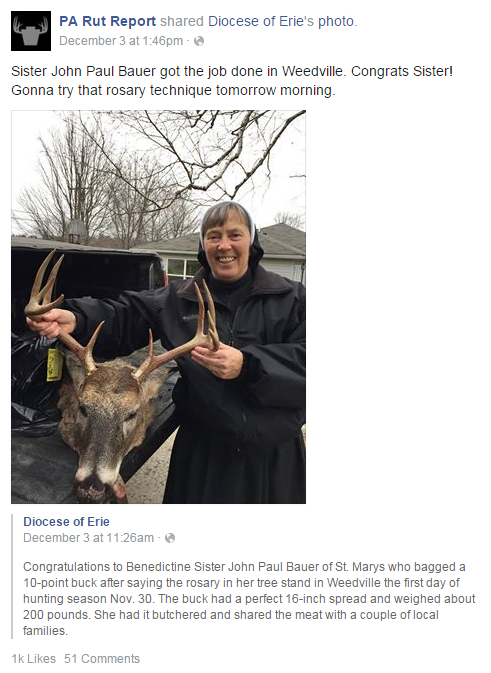
Benedictine Sister John Paul Bauer prayed the rosary in her tree stand the first morning of hunting season. Then she shot and killed a 100-kilogram, 10-point buck.

A photo showcasing the Roman Catholic nun holding the enormous deer’s remains has made her an online sensation.

Sister bags a buck

The local diocese claims the photo was seen more than two million times on Facebook before they felt forced to remove it after harsh criticism. [Why?  Because they’re cuuute? When I see deer (aka rats with hooves) I see supper and jacket.]

But Bauer, a teacher at Elk County Catholic High School in St. Mary’s, PA, believes her hunt promotes conservationism.

[…]

Read the rest there.

Good for Sister!

I want to know what rifle she uses.  Please let it be black.   And please, O St. Hubert, let her carry a handgun in case of a necessary coup de grâce… etc.

Posted in Just Too Cool | Tagged , ,
17 Comments

Advent Rorate Masses

Some of you have written asking about “Rorate Masses” during Advent.

This is a beautiful custom whereby Mass is celebrated illuminated only by candlelight. They are usually before dawn.

The Mass is a Votive Mass of the Blessed Virgin, and so it is celebrated in white, rather than Advent purple.  “Rorate” is the first word of the Introit chant for a Votive Mass of the Blessed Virgin in Advent.  There is also a beautiful Advent Gregorian chant hymn that uses this text, which comes from Isaiah 14.

One way that I have heard this done is that, while the hymn Rorate caeli begins, the priest and people, who have gathered outside, process into the church. At the end of the hymn, prayers at the foot of the altar begin as the chant Rorate is sung if it is a Missa Cantata. When the Gloria is sung (for the Blessed Virgin’s votive Mass) the lights of the church are turned on.  That’s one way.  Otherwise, the lights remain off, as they would have, obvious, in time before electrification.

It could be good to time to end of Mass as the sun is rising.

Are you having Rorate Masses where you are?

A friend sent me photos of the Rorate Mass recently celebrated at the vibrant parish of Holy Innocents in Manhattan.  Here are a few snaps.

15_12_07_HI_Rorate_01

15_12_07_HI_Rorate_02

15_12_07_HI_Rorate_03

Posted in SESSIUNCULA | Tagged
15 Comments

Strike your breasts in sorrow and hope

12_07_28_augustineImagine for a moment the sound made in church of hundreds of people simultaneously and with force striking their breasts with closed fists.

St. Augustine, in his Enarrationes in psalmos 117, speaks of the thunder-like sound, strepitus, made in church by the beating of breasts at the mention of the word confessio:

Audivimus, fratres, admonentem nos atque hortantem Spiritum sanctum, ut sacrificium confessionis offeramus Deo. Confessio autem, vel laudis eius est, vel peccatorum nostrorum. Et illa quidem confessio, qua peccata nostra Deo confitemur, omnibus nota est; ita ut hanc solam dici confessionem in Scripturis sanctis minus erudita existimet multitudo: nam ubi hoc verbum [i.e., “confessio”] lectoris ore sonuerit, continuo strepitus pius pectora tundentium consequitur. Sed debent advertere quomodo dictum sit in alio psalmo: Quoniam ingrediar in locum tabernaculi admirabilis usque ad domum Dei, in voce exsultationis et confessionis, soni festivitatem celebrantis. Hic enim certe manifestum est vocem confessionis et sonum, non ad moerorem poenitentiae, sed ad laetitiam festivitatis celeberrimae pertinere.

My brothers and sisters, we have heard of the Holy Spirit admonishing us, exhorting us, to offer a sacrifice of confession to God. Now confession can be either an offering of praise or an acknowledgment of our sins. Confession of sins is something familiar to everyone; indeed we are so used to it that when the holy scriptures mention confession, the majority of less educated people think it always means that. As a result, no sooner has the word been uttered by the reader than a devout din follows: the sound of people striking their breasts. But they should remember what is said in another Psalm: I will walk into the wonderful attempt, even to the house of God, amid the shouts of joy and confession and the sound of people celebrating a festival (Ps 41:5 (42:4)). It is quite obvious from that Psalm that the songs and sounds of confession are signs not of penitential grief but of a joyful and very crowded festival. (trans. Maria Boulding, OSB)

I would not choose “din”, which has a tinny quality to it.  Better would “rumble” or “thunder”.

Now that I have, I hope, whetted your appetite, check out a good post at NLM about breast beating and then …

GO TO CONFESSION!


In the NLM piece, the writer, Peter Kwasniewski quotes Dom Cassian Folsom of Norcia who, in turn, quotes Roman Guardini about the beating of breasts.  Folsom and Guardini reinforces Augustine’s point: the moving sound of the beaten breast and its… ehem… personal impact. Here’s a sample (emphases mine):

Fr. Cassian continues, quoting one of my favorite books, [Romano] Guardini’s Sacred Signs:

Guardini has something to say about this gesture too. He asks the question: “What is the significance of this striking the breast? All its meaning lies in its being rightly done. To brush one’s clothes with the tip of one’s fingers is not to strike the breast. We should beat upon our breasts with our closed fists. In the old picture of Saint Jerome in the desert he is kneeling on the ground and striking his breast with a stone. It is an honest blow, not an elegant gesture. To strike the breast is to beat against the gates of our inner world in order to shatter them. This is its significance.” … The gesture of striking the breast, made carefully and with full awareness, can communicate to ourselves and to others more than mere words can say, that we recognize our sinfulness and publicly declare our sorrow for our sins. … Try it yourself. The rib cage is like an echo chamber. If you strike your breast properly, you’ll hear the sound of it: like the sound of thunder.

Tracking back to Augustine, the act of striking one’s breast in acknowledgement of sin is not just a signal of sorow.  For the Christian, it is also a gesture of freedom, a sign of hope.

Posted in Hard-Identity Catholicism, Patristiblogging | Tagged , ,
4 Comments

7 December: St. Ambrose of Milan

Today is the feast of St. Ambrose, who seemed to bring out both the worst and the best in people.  For example, St. Jerome couldn’t stand him. HERE

7 December: St. Ambrose of Milan

Click

If you are interested in learning more about this titanic figure of the 4th century, who helped God to convert St. Augustine and faced down heretics and Emperors, one the better books about him is Ambrose by Boniface Ramsey. [UK HERE]

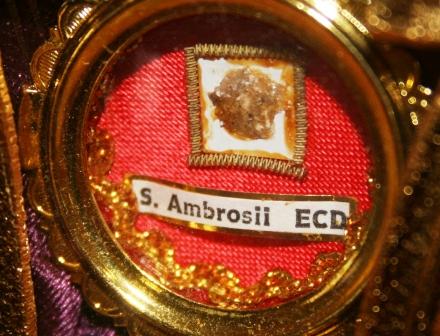
I am happy to have the company of Ambrose in a special way: a first class relic of the great saint and doctor.

7 December: St. Ambrose of Milan

Ask St. Ambrose today to intercede before God’s throne am implore graces for the recovery of pro-abortion catholic politicians and for strength, especially, for bishops who must deal with them.

Fill in the names in your prayers!

How do you think St. Ambrose would have dealt with, say, Nancy Pelosi?

7 December: St. Ambrose of Milan

Click!

Posted in Saints: Stories & Symbols | Tagged ,
4 Comments

Your Sunday Sermon Notes

Was there a good point in the sermon you heard for your Mass of Sunday obligation?

Let us know.

NB: If it isn’t a good point, don’t even think of posting it.   Keep it positive and constructive, please. Thanks in advance.

Among other things, during Mass in the Extraordinary Form this foggy morning, I pointed out that what the Lord said of John, who was in Christ’s words the greatest man born of woman, can be reminders for our own lives.  Christ asks His audience what they came out into the desert to see?  Someone shaky?  No, John is strong and unshakable.  Someone pampered?  No, John is austere.  We too need to be firm in our own calling, as John was, and not swayed from the truth by pressure or fear.  We, too, need to take stock of our use of material goods and, especially in this time of penitential preparation, mortify ourselves.

Furthermore, the examples which Christ sends back to John in prison as signs of who He is so that John my make his act of Faith (the blind see, the lame walk, etc.), should be the signs that others see in us (through works of mercy) so that, by our dicta et facta, people might be themselves drawn to the Faith and to Christ through them.

Posted in SESSIUNCULA |
21 Comments

CQ CQ CQ #HamRadio Saturday: taverns, windmills and dumplings

CQ CQ CQ #HamRadio Saturday: taverns, windmills and dumplingsNow for another edition of Ham Radio Saturday.

I created a page for the List of YOUR callsigns.  HERE  Chime in or drop me a note if your call doesn’t appear in the list.

I’ve been really busy lately, so I haven’t been able to do much radio stuff. There is good news about the radio shack, however. We have a date for clearing out the room where the station will be. That’s a step in the right direction.

Today, however, I went to a local tavern (my kind of place… reminded me a little of my first cooking job) where there is a regular Saturday meeting of hams. It was a nice group of people, which has been my overall experience of hams.

During the meeting, a couple of the people had brought things for show and tell. One of the things was 19th century book, about engineering windmills. In the book there was an amusing bit which was pointed out to me about a Catholic angle on who owns the wind!

“At the end of the fourteenth century, the monks of the celebrated but long since destroyed monastery of Augustines at Windsheim, in the province of Oversyssel, were delirious of erecting a windmill not far from Zwoll; but a neighboring lord endeavored to prevent them, declaring that the wind in the district belonged to him.

The monks, unwilling to give up their point, had recourse to the Bishop of Utrecht, under whose jurisdiction the province had continued since the tenth century.  The bishop, highly incensed against the pretender who wished to usurp his authority, affirmed that the wind of the whole province belonged to him only, and in 1391 gave the convent express permission to build a windmill wherever they thought proper.”  (From The Windmill As A Prime Mover by Alfred R. Wolfe, 1980, p. 50)

Another thing that was brought for show and tell was a cool little Chinese box for SDR, software defined radio.  More about that at another time.

There was a good deal of radio talk.  I understood about 10% of it, understood something of about 30% of it, and pretty much nothing about the rest.  They were into the arcana of radio things like tubes… referring to numbers and models that seemed like entirely normal language to them.  Anyway, it was interesting to clam up and listen to these people with decades and decades of experience.

I then went for lunch with two of the participants (who are parishioners and future members of the parish’s Statio Radiophonica) to a new Chinese place that has opened up near where I live, along side a Chinese grocery.  I have been pretty disappointed  in the Chinese food here in town, so I was eager to try this place.  Going there will a couple more people provided an opportunity to try more dishes.

Here are a few shots, which I consider germane to a post on Ham Radio activities.

Eggplant in garlic.

CQ CQ CQ #HamRadio Saturday: taverns, windmills and dumplings

San bei ji.

CQ CQ CQ #HamRadio Saturday: taverns, windmills and dumplings

The shredded pork in garlic sauce was outstanding.  There were a couple flavors in it that we couldn’t make out, but were enticing.

CQ CQ CQ #HamRadio Saturday: taverns, windmills and dumplings

Great dumplings.

CQ CQ CQ #HamRadio Saturday: taverns, windmills and dumplings

Really great spring rolls.

CQ CQ CQ #HamRadio Saturday: taverns, windmills and dumplings

The light was filtering through Venetian blinds, but you get the idea.

I am delighted about this development.


Posted in Ham Radio, SESSIUNCULA | Tagged , , , ,
8 Comments

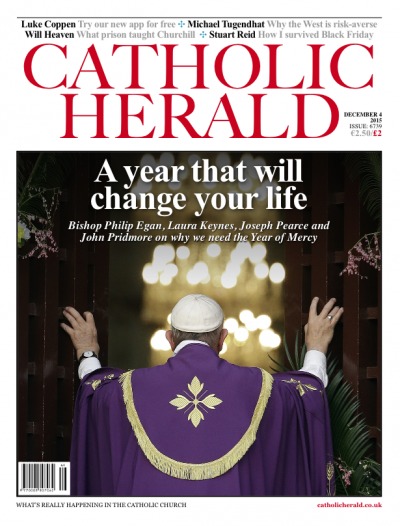
Catholic Herald app!

Catholic Herald app!For a few years I have been writing a weekly column for the UK’s best Catholic weekly, the Catholic Herald.  At first I had a column about the prayers of the Mass, which carried us through the transition to the new English translation of the Roman Missal.  Now I have an eclectic column called Omnium Gatherum.  They don’t underscore my column online very often, but it is in the print edition each week.

My editor informed me about…

The new Catholic Herald app is now up and working at iTunes, Google Play and Amazon.

Would you consider retweeting this? [Done!]

We’re offering the first four issues of the magazine absolutely free to anyone who downloads the app anywhere in the world. So this is a chance for us to expand our readership dramatically.

My article HERE.

And our FAQs.

Alas, they don’t have a Fr Z promo code!

Check out the app. Also, you can read subscribe to read the entire print edition online and search their archive.  Very handy for people who would otherwise receive the print edition after the date.

Posted in The Campus Telephone Pole | Tagged
4 Comments