“There are not a series of rules made up by the Church; they constitute divine law, and the Church cannot change them.”

"There are not a series of rules made up by the Church; they constitute divine law, and the Church cannot change them."

Click to PRE-ORDER

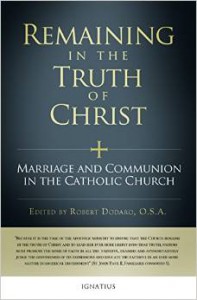
Today in the liberal Italian daily Corriere della sera there is an article about the forthcoming book Remaining in the Truth of Christ: Marriage and Communion in the Catholic Church (in English by Ignatius Press HERE – UK link HERE).  The books is being rolled out in Italian soon and so the daily jumped on it.

As a matter of fact, this is why – I think -the news of Card. Burke reassignment was leaked.  I digress.

I didn’t expect a good presentation by Corriere, but it was remarkably fair.   The best part about it is that, unexpectedly, it stuck to the issues and quoted exactly the right bits from the introductory chapter by the editor, Fr. Robert Dodaro.  I’ve read nearly the whole book, by the way.

Corriere‘s headline faltered badly in a couple respects:

«No alla comunione ai divorziati» … “No to Communion for the divorced”
Cinque cardinali contro le aperture … “Five Cardinals against openings” (like saying opening up to the “divorced”)

The problem isn that the Church says that the “divorced” can’t receive Communion. They can. If, however, they are not in the state of grace, they can’t, just like everyone else. If the divorced subsequently get a civil marriage, that’s a problem. And it isn’t as if the Cardinals are “closed” to “openings”. They, however, are defending Catholic doctrine. That is what this fight is really going to be about.

That said, without translating the whole of the Corriere piece, here are the bits from Dodaro’s chapter which they quoted:

Remember: The clearly stated purpose of the book is to respond to the ideas brought up by Walter Card. Kasper. The Pope stated that he wanted people to study the problems that were raised. He got exactly what he asked for.

An extended quote from Dodaro’s introduction:

The authors of this volume jointly contend that the New Testament presents Christ as unambiguously prohibited divorce and remarriage on the basis of God’s original plan for marriage set out in Genesis 1:27 and 2:24. The “merciful” solution to divorce advocated by Cardinal Kasper is not unknown “in the ancient Church, but virtually none of the writers who survive and whom we take to be authoritative defend it; indeed when they mention it, it is rather to condemn it as unscriptural. There is nothing surprising in that situation; abuses may exist occasionally, but their mere existence is no guarantee of their not being abuses, let alone being models to be followed” (p. 80). The current Eastern Orthodox practice of oikonomia in cases of divorce and remarriage stems largely from the second millennium and arises in response to political pressure on the Church from Byzantine emperors. During the Middle Ages and beyond, the Catholic Church in the West resisted such efforts more successfully and did so at the cost of martyrdom. The Eastern Orthodox practice of oikonomia is not an alternative tradition to which the Catholic Church can appeal. Oikonomia, in this context, rests on a view of the indissolubility of marriage that is not compatible with Roman Catholic theology, which understands the marital bond as being rooted ontologically in Christ. Hence, civil marriage following divorce involves a form of adultery, and it makes the reception of the Eucharist morally impossible (1 Cor 11:28), unless the couple practice sexual continence. There are not a series of rules made up by the Church; they constitute divine law, and the Church cannot change them. To the woman caught in adultery, Christ said, “[G]o and do not sin again” (Jn 8:11). God’s mercy does not dispense us from following him commandments.

Let me underscore some things.

First, watch coverage of this issue and watch for words like “rules” and “policies” when the Church’s perennial, divinely founded teachings are described.  The Church could change mere “rules”.

Second, just because something happened in the past, that doesn’t mean that what happened was either good or accepted.  This is key to understanding the flaws even about the claimed ordination of female deacons.  On p. 17 of Remaining, in the introduction chapter, Dodaro cites a former professor of mine in Rome, Fr. Giles Pelland, SJ.  This concerns Card. Kasper’s flawed methodology in presenting his (flawed) support from ancient sources for his proposals.  I’ll quote Peland:

In order to speak of a “tradition” or “practice” of the Church, it is not enough to point out a certain number of cases spread over a period of four or five centuries. One would have to show, insofar as one can, that these cases correspond to a practice accepted by the Church at the time. Otherwise, we would only have the opinion of a theologian (however prestigious), or information about a local tradition at a certain moment in its history—which obviously does not have the same weight.

In a nutshell, it is possible to find any number of isolated incidents of this or that aberrant practice in the ancient Church.  We see this in our own day.  Just because some group does or says X today doesn’t mean that it is accepted Catholic practice or teaching.  A serious problem arises when you try to found your arguments on those isolated aberrant practices as if they were accepted.

Next, note the comments about Eastern oikonomia and the influence of political pressure.  We cannot, as Catholics, simply cave into secular ways and expectations.  Anglicans, for example, have hitched their ecclesial community to the State.  We don’t do that.  We cannot simply give away divinely founded perennial teaching under the pressure or the expectations of “the world”.

I’ll be writing more in the days to come, but here are a few points to ponder as you watch the press.

This new book is a HUGE DEAL.  It isn’t easy reading, but it pays dividends.

 

Posted in Hard-Identity Catholicism, One Man & One Woman, Our Catholic Identity, The Drill | Tagged , , , , ,
7 Comments

Emergency Contact, Medical Information and YOU!

Emergency Contact, Medical Information and YOU!Sometimes I post about preparing for emergencies or disasters.  For example, I’ll mention things as practical as having an Uninterreptable Power Source (UPS) for your important electronic equipment. I like APC products the best, reliable and great customer service. I’ll mention some emergency food and water, especially for times of natural disaster or a quick get away from where you live. I’ll mention some identity security, such as LifeLock.

I’ll tell you to GO TO CONFESSION!  Because a sudden and unprovided death (without the sacraments) is a dreadful prospect.

Things always happen to someone else… until it’s your turn.

Thus, I saw something at ITS Tactical that some of you might find useful. The GO ID Emergency Medical ID Kit

Say you are out and about and, quod Deus averruncet, something happens to you and you are unable to tell first responders about your medical history or allegeries, medicines you take, etc.  Time and information are critical in emergencies.  Giving a EMTs or firefighters or LEOs a fast overview could make a big difference.

Some people with certain conditions wear or carry medical ID.   Some like the bracelet or dog tag option.  This is another option.

For lots of photos and a thorough review, check out the page at ITS Tactical HERE  They have photos of how this handy medical ID can fit beneath your watch with an exposed tag, or be placed in the weaving of your shoe laces, or clipped onto other laces or straps or cords or zipper pulls.  It also has the recognizable “Star of Life” medical logo on it.

Check it out and then…

GO TO CONFESSION!

Because it’s always someone else, until it’s you.

Posted in "How To..." - Practical Notes, Semper Paratus | Tagged , , ,
1 Comment

St. Robert Bellarmine

St. Robert BellarmineToday I greet readers and friends who are blessed with the name “Robert”.  Happy Novus Ordo Name Day.  You get two Name Days, since the traditional day is 13 May.

In particular I congratulate His Excellency Most Reverend Robert C. Morlino, the Extraordinary Ordinary, Bishop of Madison.

Let’s have a look at St. Robert’s entry in the post-Conciliar Martyrologium Romanum of 2005.

Sancti Roberti Bellarmino, episcopi et Ecclesiae doctoris, e Societate Iesu, qui praeclare de theologicis temporis sui controversiis peculiari ac subtili habitu disputavit; cardinalis renuntiatus, ad ministerium pastorale in Ecclesiae Capuana magnopere sese impendit et tandem Romae ad Apostolicae Sedis et fidei doctrinae defensionem plurimos suscepit labores.

St. Robert’s body may be venerated in Rome at the Church of St. Ignatius, Sant’Ignazio, which is a must visit for many reasons.  He was deeply involved – and positively – in the “Galileo Affair”.

Would you all like to stretch your Latin muscles?  I’ll turn on the moderation queue so that you can’t copy from each other’s papers.  Other comments (without translations) about St. Robert I’ll let through as I find them.

Not long ago, I was privileged to see a letter with a signature of St. Robert Bellarmine.  HERE

St. Robert Bellarmine


Posted in Liturgy Science Theatre 3000, Saints: Stories & Symbols | Tagged , ,
9 Comments

The possible demotion of Card. Burke. Wherein Fr. Z rants.

The possible demotion of Card. Burke. Wherein Fr. Z rants.Now that the cat is out of the bag, I’ll post this. I do not like the fact that Sandro Magister posted in this way, however.  I’ve been biting the inside of my mouth for a while now.  The optimist in me was saying that the official announcement would not be made until after the Synod of Bishops, or at least the beginning of the Synod.  Or at all.

It’s not good news.  At the time of this writing, it is still – officially – a rumor.  I believe it, however. I have been trying to get myself into a mental and spiritual place to see it for what it is and, more importantly, for what it is not, and to plot my own reaction and subsequent course.

Vatican Insider has posted that His Eminence Raymond Card. Burke will soon be demoted by Pope Francis from being Prefect of the Apostolic Signatura to the Patron of the Knights of Malta.

The move is not lateral.  That position is usually entrusted to older Cardinals.  The present Cardinal Patron is Card. Sardi, who is now 80.  Before him was Pio Card. Laghi.  The reassignment would be a demotion, for the Patron of the Knights is not nearly the equivalent of Prefect of a Roman dicastery.

I didn’t think that Card. Burke would be moved to Chicago, though I had a little fun with that idea. I thought he might be moved laterally to the Congregation for Causes of Saints to replace Card. Amato, who is over 75.  More on Saints, below.

There are a few points to make here, before the trads blow arteries and quite simply die and before liberals and dissidents, who suffer from Burke Derangement Syndrome, start their Lord of the Flies Dance.

First, it is possible that the three Roman tribunals (Penitentiary, Signatura, Rota), might be collapsed into a single dicastery for justice. I don’t know how that would work. I think it would be a really bad idea, but they didn’t ask me. If that is the case, the Signatura and the Penitentiary will not both need a Cardinal.

Second, according to a couple sources I have heard from, there is talk of collapsing the Congregation for Causes of Saints back into Divine Worship where, historically, it once belonged. Once upon a time the powerful Sacred Congregation of Rites had the brief for beatification and canonization. That would eliminate another cardinalatial chair in the Curia.

Furthermore, there is talk of collapsing minor curial offices, Councils and the like, into a Congregation for Laity. That could eliminate several other Cardinals in the Curia.

If you eliminate a position that has required a Cardinal, and that Cardinal is not 75 or 80, that is, ready for retirement, the Pope has to do something with him.  Burke is only 66.  What can the Pope do if there are no longer enough cardinalatial slots in the curia because he plans on eliminating them?  Well, you can send His Eminence off to be the bishop of some important see in his own country, right?  What if the Pope can’t do that because the Cardinal’s own countrymen have been drenching the same Cardinal in contumely?  Not enough curial chairs, not a good option back home?  Don’t forget that the Archbishop Secretaries of eliminated offices have to go somewhere too!  They might need those dioceses back in their native places.

So, what? You put the Cardinal in the best possible cardinalatial role you can find.  Some Cardinals who hit 75 and are at the end of service in a Congregation, are still useful.  They reside in Rome.  They can be on other Congregations until they are 80.  They could head up some office such as, once upon a time, the Pontifical Commission “Ecclesia Dei”.  That’s been put under the CDF.  There are still, for example, Archpriests at the Major Basilicas.  But, there’s already an American at St. Paul’s outside-the-walls: Card. Harvey, 64, also from Wisconsin, just like Card. Burke. Two American sexagenarian Cardinals from Wisconsin as Archpriests of Papal Basilicas at the same time? Not likely. I suspect that if Francis eliminates a few offices, such as Cor Unum or Justice and Peace or the like which have men who are still of service age, one of them will go, say, to be Archpriest at St. Mary Major, where the present man, Card. Abril y Castelló, is about to turn 79. An Italian could wind up as the Delegate for the Basilica of St. Francis where Card. Nicora, 77, is now.

It is fair to imagine that Pope Francis – certainly at the instigation of a few close advisers – is purging the Curia of his predecessor’s influence.

It is also fair to imagine that Francis is pairing down the number of Cardinals and offices in the Curia.  It could be more about that than about Burke himself.  It could be a purge of Cardinals and not just of Burke.

It could be about both.  After all, Cardinals Piacenza and Cañizares were moved.

What I am wondering about is what might happen at the Congregation for the Doctrine of the Faith. Will Card. Müller be moved out of the Curia to Berlin?

We could know more when and if Francis appoints Burke’s successor at an existing, unreformed Signatura.

NB: with the removal of Burke from the Signatura, there will be zero US Cardinals in the Roman Curia.  Is it likely that that is what Pope Francis wants?  No American Cardinals in the Roman Curia?  That’s a pretty big and influential country to snub.

QUAERITUR: Is Francis opening up a slot into which he would move another American Cardinal from these USA?  An American (or other) Cardinal into a key position for any reform of the tribunals who may agree with Card. Kasper’s views or be on side if it comes to trimming down the annulment process?

And then there is this.

The possible demotion of Card. Burke. Wherein Fr. Z rants.

Click to PRE-ORDER

This news has been leaked a couple weeks before the Extraordinary Synod of Bishops which will tackle, inter alia, the question of Communion for the divorced and civilly remarried.  However, Card. Burke will surely be a participant in the Synod.  Moreover, days before the Synod begins, a book will be released in five languages – in English, Remaining in the Truth of Christ: Marriage and Communion in the Catholic Church, by Ignatius Press HERE – UK link HERE – in which Card. Burke has an essay (along with those of four other Cardinals) in defense of the Church’s traditional teaching and discipline.  Card. Burke has been a leading figure in the holding position against the really bad ideas of Walter Card. Kasper, the “tolerate but don’t accept” position that the liberals and dissidents are swooning over.  You will have noticed – or maybe not, for how many people read it, after all – that at Amerika Magazine, its 24/7 Kasperism.

“But Father! But Father!”, some of you are asking, “How could something like this take place?  Why would this take place?” Others are saying “Hah hah Fr. Z!  You hate Vatican II! Next we’re coming for you!”

In addition to the scenario of cutting back the curia I outlined, above, I  think that Card. Burke’s enemies, both in these USA and in Rome – at least occasionally, got the upper hand when advising Pope Francis.  It would be naïve in the extreme to think that there are lacking near Francis’s elbows those who have been sharpening their knives for Card. Burke and for anyone else associated closely with Pope Benedict.

This is millennial, clerical blood sport.

Sacerdos sacerdoti lupissimus.

No surprises here.  The sun rises at dawn.  Dog bites man.

Is there an upside to this?  Sure there is!

If this happens – and it is still not official yet – Card. Burke will not have so much on his plate. He is still young enough to have a good store of energy.  This move, if true, would mean that he would not be tethered to a desk full of nearly as much paperwork.  He will have more time to write.  He will have more opportunities to raise his voice and express his views.  He is already pretty forthright as a Prefect.  When he is off the leash, he will still act with the Romanitas and the gravitas of a Cardinal, but I’ll bet he’ll be even more vocal.

Another upside?  He will probably retain his membership in the Congregations to which he belongs.  Those appointments change from time to time.  We shall see.

Remember, this is not official until it is formally announced.  However, it seems likely.

I know Card. Burke a little.  I know him well enough to know that he is a man of deep spiritual resources.  He will be fine.  Do, however, say a prayer for him regularly.  Every Cardinal needs prayers!  Imagine how the Enemy targets Cardinals, especially real defenders of tradition.  It’s a terrifying prospect.

And then there’s this.  This is the part I direct at YOU, dear readers.

Many of you will be tempted to have a spittle-flecked nutty of sorrow and panic about this, directly proportioned to the spittle-flecked nutty of giddiness and schadenfreude that the catholic Left are about to throw.

Many of you will be tempted to run in circles squawking about Francis the Disaster, the cross between a Jesuit and South American Dictator.  At the same time the catholic Left will be running in the opposite direction squawking about Francis The Unjudgmental, the first Pope ever to smile or to kiss a baby, the most wonderfullest fluffiest Pope ehvurrr. He’s the only Pope ever to think about mercy!  In doing this, the Left will also manifest their trademark venom. Remember what foaming paroxysms they had when Burke was not reappointed as a member of the Congregation of Bishops?  When he was moved from St. Louis to Rome?  “Demotion!”, they cried. (Benedict moved him to Rome, by the way, not Francis, and it was a promotion.) So too with the Right!  Francis says something that is – admittedly – strange or impenetrable and trads freak out.

We have to breathe deeply and try to see this for what it is and what it isn’t.  And to continue the respiratory metaphor, some of us – I include myself – are going to have to hold our noses and swallow this bitter dose as if it had all the asafoetida that Dr. Maturin was accustomed to add to his draughts.  [That’s a Patrick O’Brian reference.]

Every pontificate has its good days and its bad days.  Which it ain’t always beer and skittles, is it, as Preserved Killick would put it?  [That’s another.]

There are many factors to consider in this move, consideration of which should take us beyond a simple and facile assumption that this is part of a Franciscan Night of the Long Knives.

Posted in "But Father! But Father!", Francis, O'Brian Tags, The Drill, Wherein Fr. Z Rants | Tagged , , , , , , ,
115 Comments

Fishwrap: Approve of “gay” sex or risk a shrinking, irrelevant Church.

Fishwrap: Approve of "gay" sex or risk a shrinking, irrelevant Church.I think we are going to see the National Schismatic Reporter (aka Fishwrap) lurch even farther to the left, even deeper into angry dissent now that they have to cope with and distinguish themselves with Crux.

I suspect Crux will wind up doing a better job of what Fishwrap has been doing.

Here is an example of angry edginess from Fishwrap.  This ought bring in those readers!

Brian Cahill has a peevish piece in which he makes the claim that …

The Catholic church is on track to become a shrinking cult

Oh no!  What will save us from this dire fate?  Fishwap has an answer!

Let’s have a look.

Taking a break from his crusade against civil gay marriage, San Francisco Archbishop Salvatore Cordileone is establishing an Oratory of St. Philip Neri at Star of the Sea Parish in the city.  [So, the theme has been introduced.]

[…]

But the Holy Spirit works in all sorts of strange and wonderful ways, and any effort to attract young adults — to keep them from leaving the church, should be praised, especially given the wholesale exodus of young Catholics over recent years. The Pew Research Center’s Religion and Public Life Project reports that four out of five Catholics who have left the church and haven’t joined another church did so before the age of 24.

One can point to an increasingly secular, materialistic culture as a factor in this exodus. But a closer look suggests that young Catholics are increasingly turned off by the attitudes and actions of some American bishops — the failure to address the child abuse scandal, the harsh opposition to civil gay marriage, the cluelessness of church teaching on contraception, and the refusal to consider women priests.

More recently, Catholic high school students, who can spot dishonesty and hypocrisy a mile away, are reacting with disillusion and disgust at how the church is treating some teachers in Catholic schools.

Bishop Michael Barber of Oakland, Calif., is attempting to coerce Catholic identity with a mandated morality pledge.

[…]

Cincinnati Archbishop Dennis Schnurr upheld the firing of an assistant principal who expressed support for civil gay marriage on his blog.

[…]

Cleveland Bishop Richard Lennon fired a teacher at a Catholic high school from her job when the diocese read the obituary of her mother’s death and discovered the teacher was a lesbian. How many thoughtful Catholic high school students will stick around in a church that is capable of that kind of behavior?

St. Paul-Minneapolis Archbishop John Nienstedt sent one of his priests to speak at a mandatory high school assembly just before Minnesota was to vote on an anti-gay-marriage constitutional amendment.

[…]

If our church is left in the hands of these bishops, [Those mean dumb meanies!] we are on track to become a shrinking, increasingly irrelevant cult [Fishwrap’s future] — not a source of appeal for thoughtful Catholic high school students.

Yep.  That’s a great idea!  Let’s adjust the Church’s Magisterium to the view of high school students!  We need a Magisterium of Sophomores!

Bottom line: The Pope should declare that every gender-distinction in the Bible and the Magisterium has been wrong all along and Bishops should stop teaching about sexual morality.  We really must start saying that sticking what you have into any place you want is fine, especially when it comes to same-sex sex.   Hey!  Even better…. why not just approve it!  That would make us even more relevant, and hip, right?  I can see the beginning of the Dogmatic Constitution from Vatican III: Quae olim dedecora esse dixit Ecclesia, nunc …. 

Posted in Liberals, One Man & One Woman, Sin That Cries To Heaven | Tagged , , ,
33 Comments

San Francisco: Pontifical Mass!

I was sent some photos from the Pontifical Mass at the Throne on Sunday celebrated by His Excellency Most Reverend Salvatore Cordileone.

First, it is nice to see the canopy.

San Francisco: Pontifical Mass!

As a matter of fact, we are getting a canopy together for such Masses here.  Brick by brick!

Also, it seems that we aren’t the only one’s to have a assemble a pontifical set from more than one set.  Still, quite spiffy.

San Francisco: Pontifical Mass!

We are doing some fundraising here for the sake of getting proper Pontifical sets.  Bp. Morlino has cordially made himself available for such Masses and we have a good crew of clerics and lay people who are getting to know the ceremonies well.

As a matter of fact, if you want to donate to our project go HERE (right after visiting my own donation button, of course).  We recently ordered a pontifical set in black.  We kept it simple for the black, since it will be used infrequently.  We’d like to get a really elegant white set, since we will use it more often.

So!  Let’s Pontifical Masses abound!  Invite your bishop to come to say a Pontifical Mass at the Throne (or Faldstool) and not just be in choir.

A last shot.

San Francisco: Pontifical Mass!

Posted in "How To..." - Practical Notes, Brick by Brick, Liturgy Science Theatre 3000, SUMMORUM PONTIFICUM |
6 Comments

ASK FATHER: What time of day should Father be saying his Office?

ASK FATHER: What time of day should Father be saying his Office?From a reader…

QUAERITUR:

I know some priests who pray all the Hours of the divine office at a particular time…for example:

There is this priest who went out for an important trip..he probably didn’t have any free time in the evening so he prayed Lauds, Office of Readings, Daytime, and Vespers all in the morning, is that allowed for just causes since Canon Law states that the Hours be prayed as much as possible in their respective time, thanks Father.

First, let it be said that it really isn’t any of your business when Father says his Office.  Be happy that he is, in fact, saying his Office for the whole Church (that is, also for you).

That said, restricting myself to priests of the Latin Church and Roman Rite, the law requires that the Officium  (“office” is from Latin officium, “duty, obligation, function, service”) be celebrated “as far as possible” at the appropriate time of day (cf. General Instruction of the Liturgy of the Hours 29).  Also, the 1983 Code of Canon Law says in can. 276, § 2, n. 3: “Priests, and deacons aspiring to the priesthood, are obliged to carry out the liturgy of the hours daily, in accordance with their own approved liturgical books; permanent deacons are to recite that part of it determined by the Episcopal Conference”. The 1983 CIC no longer says “under pain of mortal sin”.

This all gives the Latin cleric a good deal of latitude.

A good and faithful priest, taking stock of his schedule, will pray his Office when he can. If the evening is jammed with a meeting of the Knights of Columbus, a funeral vigil, training servers for the Extraordinary Form Mass, and a social event with the St. Gabriel Possenti Gun Club at the parish’s indoor shooting range, Father is to be commended for his foresight if he prays Vespers at 1:00 pm. If Father knows he has a free morning, but the afternoon and evening are going to be hectic, and he therefore he prayers through the whole Office in the morning, that could be better than rushing through Vespers and Compline with tired eyes and distracted mind at 11:53 PM.

BTW… there was a time when priests would, while driving, stop their cars and read their breviaries with the light of the car’s headlamps.   Not only!  They would know when solar midnight fell in the place where they lived, or how far they lived from the timezone line by longitude in case they needed those extra few minutes accorded them by the interpretive principle of law odiosa restringenda, that is, that laws which impose a duty are to be interpreted strictly.  This is handy for understanding “time” in the legal sense.  For example, if I need to finish my office by midnight, I can think in terms of 1200 midnight by civil time, 24h.  That’s both boring and too restrictive.  To give me more flexibility I can also go by an offset of how many degrees I am from the timezone line.  By that reckoning, I should have, given my location, till about 12:06 AM, I think, to complete my office.  However, I can also calculate Roman midnight, since I am Roman Catholic priest.  Roman midnight is halfway between sunset and sunrise the next day.  As a matter of fact, my Roman Curia calendar, with the tear off sheets provides me with the sunrise and sunset times, in addition to “Aurora” and “Ave Maria” times… in Rome.  But figuring this out each day is a bother.  To give myself greatest latitude, pardon the pun, I can also go by solar midnight, which would today give me until 12:52  AM tomorrow (and 54 seconds), given my precise coordinates on your planet!  That’s when your Earth’s yellow sun will be at the exact nadir for my location. But I digress.

So, if Father regularly prays the whole Office at once “to get it out of the way”, he might want to bring his practice up with his spiritual director. That notwithstanding, he fulfills his obligation to the Lord and to the Church, an obligation he willingly assumed at the time he was ordained a deacon.

As far as the time of recitation of the hours is concerned, looking at the Liturgy of the Hours, it is reasonable to assume that the Church wants us to pray Morning Prayer in the Morning, right?  The intermediate hours still have distinctions of Terce, Sext, Nones.  Does that mean that Father must say the intermediate prayer for Sext exactly at noon (civil, solar or Roman?).  I don’t think so.  Neither should Father worry during Mass about completing signs of the Cross exactly between the syllables where the ✠ appears on the page.

Priests should talk to their spiritual directors about their relationship to the Office.  They should be open with their brother priests if they struggle with it. Fraternal support can help tremendously, and fraternal correction can also be of great value. They publicly assume at ordination the duty to recite the Office daily, that is, to offer the Church’s official prayers on behalf of the whole Church so that God hears ceaselessly the supplications and praises raised by His Son’s Mystical Body.

And, before people raise it:

Yes, Latin, Roman Rite priests fulfill their obligation by reciting either the Roman Breviary as it was during the Second Vatican Council (that is to say with the Breviarium Romanum of Saint John XXIII, the actual Vatican II Office) or with the Liturgia Horarum of Paul VI revised by St. John Paul II in 1985 with the New Vulgate.  And were I to participate in the singing of any of the hours at, say, the wonderful Benedictine Monastery at Norcia or at Le Barroux, I would fulfill my obligation.

Furthermore, while recitation of the Office should be aloud, since it is official and vocal prayer – this is why of yore and even now priests move their lips when saying their Office, there is always a measure of subvocalization taking place when reading.  I am of the opinion that a priest fulfills his obligation even when not moving his lips, reading silently.

And, yes, priests and deacons can use mobile phone apps and websites.  They don’t have to be holding a book in their hands.  The Office is the text, not the book.

Finally, this is why I think it is wrong wrong wrong to call Holy Mass simply “the liturgy”.  The Church’s liturgy is much more expansive than Mass, even though Mass is the zenith of what we do in our sacred liturgical rites.

Posted in "How To..." - Practical Notes, ASK FATHER Question Box, Liturgy Science Theatre 3000, Priests and Priesthood, Seminarians and Seminaries | Tagged , , , , , , ,
35 Comments

Crux – Fr. Z’s initial observations

I have been watching the new initiative from the Boston Globe, with the involvement of former Fishwrap writer John Allen: Crux.

I have some initial observations.

Happily, it seems to me that Crux has the potential to make the National catholic Fishwrap irrelevant.  Sadly, it could be that Crux will make the National catholic Fishwrap irrelevant.  That is to say, Crux might be a slicker, smarter Fishwrap on steroids. [UPDATE: To be nicknamed, if it proves to be subversive, “Horcrux”? In the Harry Potter world: “A Horcrux is a powerful object in which a Dark wizard or witch has hidden a fragment of his or her soul for the purpose of attaining immortality.”]

Now for a few more concrete observations.

Crux‘s “spirituality editor” is former Boston Globe wrote Margery Eagan.

Back in January 2014 Eagan wrote in the Boston Herald that

“a birth control ban has never been central to Catholic doctrine. The church says family planning is fine, as long as it’s done by the natural rhythm method. A commission made up of bishops, cardinals, and theologians did vote to end the ban on artificial birth control in the mid-1960s, but then Pope Paul VI overruled them, mainly for political reasons. Pope Francis, whose politics are clearly different, could actually lift the ban.”

In her bio at Crux we read:

Maybe you’ve heard some variation on this line: “I’m an American. Just because I disagree with much of what America’s doing, I don’t run off and become a Canadian.”

I heard it years ago from a friend explaining why he remained a Catholic despite his massive disappointments with the Church.

I’ve used it myself when somebody asks: if you disagree with the church on gays, birth control, women, their handling of the sex abuse crisis, etc. – why not become an Episcopalian, a Methodist, a Quaker, a Jew? Why stay when you’re at odds with its teachings?

What I read in this is that she disagrees with the Church on “gays, birth control, women, their handling of the sex abuse crisis”.  However, she won’t “leave the Church”. Why?  She explains that she stays Catholic because of the Church’s “intellectualism”.  The problem is that you can’t have a personal relationship with intellectualism.  You can’t pray with and for and even to intellectualism.  You can’t love and be loved by intellectualism.  She has more reasons:

The sensual parts of Catholicism. The bread, wine, incense, candles, phenomenal stained-glass windows. Smudged forehead ashes at the start of Lent. Anointing with oils. Palm Sunday. White lilies crowding the Easter altar, the liturgical season in sync with our own.  [All great things.  But these are externals, literally skin deep.]

Daily Mass, 365 days a year. It is peaceful, short, intimate, a holy half-hour of quiet before or after a frantic day. Some people stay afterwards to say the Rosary, in unison. [You can go to a tanning parlor for that.]

Community. The older I get, the less I like “Bowling Alone,” as Harvard’s Robert Putnam wrote in his book of that name. I like being in a prayer group with people who don’t think I’m crazy. I like parish life, the chances to volunteer, meet and greet. I like seeing the same parishioners in the same pew week after week. [A gardening club or Red Hat group can do these things.] I like being with people very different from me but the same in this: we are seekers, some days frustrated doubters, some days drawn, as if magnetized, into the mystery. Many, like me, were born Catholic. Keenly and even painfully aware of Catholicism’s many and gargantuan flaws, we stay Catholic. And we will die Catholic, too.  [There’s a ringing endorsement.]

Not a word about Christ.  Nothing about God, or grace, or sin and redemption.

This is Crux‘s spirituality writer.

Let’s turn the page.

Whom did they choose to answer questions from readers? Lisa Miller. Miller has a BA in English. She wrote for Newsweek about how stupid and backward the Church is, how awful Pope Benedict was. When writing about a movie on Hildegard von Bingen for Newsweek she used the opportunity to bash the Church and leave the reader with the image of the Mother of God as a “potty-mouthed BFF”.  See how she writes about the Catholic hierarchy.  HERE

In any event, at Crux she answered a question:

What of those who cannot accept in good conscience various teachings of the magisterium [official Church policy]? Are we still to consider ourselves Catholic, or should we go elsewhere?

Did you detect a problem there?  Anyone who goes out of her way to describe “teachings of the magisterium” as “policy” is not going to be able to approach the question from the right perspective.  Only one sort of person frames the Magisterium’s teachings as “policy”.  Policy, after all, can be changed, especially after extensive polling.

Let’s glance at something from Miller’s answer:

Perhaps a more provocative question is this: To what extent must the hierarchy heed the consciences of the faithful? [There actually is an answer to this, in Lumen gentium 25.]

For decades, the bishops have appeared to be a my-way-or-the-highway kind of crew, and Pope Benedict gained a reputation for disdaining the cafeteria approach of American Catholics, wanting instead to build a smaller, purer church.  [This is a biased misrepresentation of Benedict.  There was no one more patient when dealing with dissent.  I don’t think he has ever “distained” anyone in his life.  But WAIT!  There’s more!   You can hear the next word coming….]

But [BUT!] Pope Francis has taken a different, and historically significant, tack, says the Rev. Drew Christiansen at Georgetown.  For him, the beliefs of faithful Catholics ought to define the faith – at least as much as the hierarchy does.  [Is that even true?]

Benedict bad.  Francis good.   At least Francis will be good until she, and other liberals, turn on him.  When he doesn’t conform to their expectations, they will turn on him.

And sample her penetrating analysis of Justice Scalia HERE.

So, Crux asked Lisa Miller to answer questions about the Catholic faith.

And then there is today’s, 16 Sept, Q&A from Lisa Miller,  HERE.  It includes this jewel:

For Jesus, of course, forgiveness is the ultimate Christian act, a way for humans to reflect God’s love and grace.  But I think Gandhi said it best: “The weak can never forgive. Forgiveness is an attribute of the strong.”

Yah, there’s Jesus. But enough about him. Let’s see what Gandhi says!

I was curious about Millar’s background so I checked on Wikipedia. Yes, I know that Wikipedia isn’t absolutely reliable, since any loon can do stuff to other people’s entries or even create them out of whole cloth without your knowledge or permission.  Still, this is what I found.

Born in Cleveland, Ohio, Miller was raised in a secular Jewish home. … Miller was married to her husband in an interfaith ceremony performed by an Episcopalian priest who worked with a rabbi on the ceremony.  After the birth of her daughter, Miller joined a Jewish Temple for reasons of “blood and history and culture”. She describes this religious community as a “progressive, inclusive congregation.”

Look.  People can have fascinating backgrounds and amazing journeys into the Holy Catholic Church.  But, unless I am missing something, Miller hasn’t become a Catholic.  And yet, here she is, writing Q&A for Crux.  Unless,… I am reading about the correct Lisa Miller?

Moving on, Crux also tapped on Michael O’Loughlin to be their “National Reporter”. In the past he was written for The Advocate (a homosexual advocate, if you hadn’t guessed), Religion News Service, Foreign Policy, America, National Catholic Reporter, Religion & Politics, Busted Halo, and Faith & Leadership.

On Saturday 13 September, John Allen wrote (among other things) about what he thinks Crux aims to do and to be.  Here are relevant excerpts.

The vision behind Crux:

[…] Toward the end [of the roll out event], I fielded a question about the vision forCrux and whether it can do something about the widespread polarization that many American Catholics perceive in the Church.

The truth is that if someone should be laying out a vision, it’s really not me. Brian McGrory, editor of The Boston Globe, and Teresa Hanafin, editor of Crux, are the decision-makers responsible for overall direction.  [Get that?  The Boston Globe is guiding this “Catholic” endeavor.  What could go wrong?]

That said, it’s a legitimate question, and obviously I have my own reasons for getting involved. For what it’s worth, I’ll recap my answer.

To begin, the basic ambition ofCrux is simple: To get the story right. Catholicism is a complicated and difficult beat; it’s hard enough to be accurate, comprehensive, and balanced in the way we cover the news without trying to accomplish another agenda.

That said, I also believe that ifCrux can get the story right on a regular basis, one natural consequence could be softening divisions in Catholic life.

[…]

IfCrux becomes a trusted forum for all voices [“all”?  I’m not seeing a lot of balance.  Just look at their staff.] in the conversation, it will create a virtual space in which members of different Catholic tribes can build friendships. Over time, that can’t help but have a positive effect.

So, yes, I suppose helping to mitigate polarization is part of the plan. Just don’t ask us to think too much about it, because most of the time we’ll be too busy trying to nail down today’s news.

Crux is slick. They have had a big, splashy roll out. My jury is still out. My sense is, however, that Crux is poised to out-Herod Herod, or out-Fishwrap Fishwrap.

And there must be bails of money behind it.

But, for now, we are on Crux Watch.

The moderation queue is ON.

Posted in Biased Media Coverage, CRUX WATCH, Liberals, Our Catholic Identity, The Drill | Tagged , , , , ,
49 Comments

Our Sorrowful Mother, Queen of Martyrs

Our Sorrowful Mother, Queen of MartyrsToday is the Seven Sorrows of the Blessed Virgin Mary.  Can you name them?
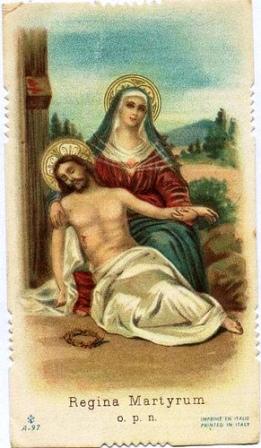
Here the entry from the Roman Martyrology:

Memoria beatae Mariae Virginis perdolentis, quae, iuxta crucem Iesu adstans, Filii salutiferae passioni intime fideliterque sociata est et nova exstitit Eva, ut, quemadmodum primae mulieris inoboedientia ad mortem contulit, ita mira eius oboedientia ad vitam conferret.

In the older, pre-Conciliar Missale Romanum we find this wonderful Collect for today’s Holy Mass.

COLLECT (1962MR):
Deus, in cuius passione,
secundum Simeonis prophetiam
dulcissimam animam gloriosae Virginis Matris Mariae
doloris gladius pertransivit:
concede propitius;
ut qui dolores eius venerando recolimus,
passionis tuae effectum felicem consequamur.

LITERAL VERSION:
O God, at whose Passion,
according to Simeon’s prophecy,
the most sweet soul of the glorious Virgin, Mary our Mother,
was pierced by a sword of sorrow:
mercifully grant
that we who observe her sorrows by veneration
may attain to the happy result of Your Passion
.

Our Sorrowful Mother, Queen of MartyrsAlso, in the old Communion Antiphon we have a connection between the great sorrow of Mary at the Cross and how she merits to be called Queen of Martyrs:

ANTIPHONA AD COMMUNIONEM:
Felices sensus beatae Mariae Virginis,
qui sine morte meruerunt martyrii palmam
sub Cruce Domini
.

Sensus is an incredibly complicated word. It means, among other things, the faculties of sensing and perceiving, but also of the sentiments of the heart and mind. In a collective “sense” sensus stands for “the common feelings of humanity, the moral sense”. Sensus is also our disposition of mind or humor and inclination. It signifies understanding of the thinking faculty, in the sphere of reason.

LITERAL VERSION:
Blissful the sentiments of the Blessed Virgin Mary,
which beneath the Cross of the Lord,
without death merited the martyr’s palm
.

This antiphon underscores how the totality of Mary’s being, “magnified” by God at every point of her life, was united with her Son as He endured the sufferings of the Cross.

This feast reminds us that there is a path to holiness through the sufferings and sorrows we endure.  We must learn to unite them to the sufferings of our Lord.  Mary teaches us to do this.  The martyrs teach us to do this.

Posted in Liturgy Science Theatre 3000, WDTPRS |
4 Comments

Intinction

The other day the Holy Father Pope Francis witnessed, during Holy Mass for the Feast of the Exaltation of the Cross, the marriages of a passel of couples, some in some irregular situations. Leaving that aside, there was one thing that caught my eye.

His Holiness, again, did not seem to distribute Communion. He doesn’t, you know. However, deacons distributed under both kinds and by intinction.

Thus, no Communion in the hand.  Nota bene: they are kneeling.

Intinction

For all the liturgical progressivists out there who think that Francis is the first Pope who has ever smiled or kissed a baby…. When will you implement kneeling in your parishes for Communion by intinction?

Posted in "How To..." - Practical Notes, Francis, Liturgy Science Theatre 3000 | Tagged ,
57 Comments