ASK FATHER: Valid absolution from Orthodox priest, but not from SSPX priest?

ASK FATHER: Valid absolution from Orthodox priest, but not from SSPX priest?From a reader…

Quaeritur:

Why is absolution from an Orthodox priest valid but absolution from an SSPX priest invalid? I was told by someone that this is one argument from the SSPX as to why their Confessions are valid.

This won’t satisfy some SSPXers – what will? – but the answer lies in the concept of jurisdiction.  I’ve explained this before on this blog, but let’s try again in yet another way.

Absolution of sins is both a sacramental and a juridical act.

The sacramental and juridical aspects cannot be separated. They are intertwined.

A priest’s sacramental authority, or power, to forgive sins comes from his ordination, the ontological change to his soul from Holy Orders.  A priest’s juridical authority to forgive sins comes from the bishop, the chief judge of the diocese (… or his religious superior).

The Church says that a priest must have both to be able to absolve validly.

The priests of the Society of St. Pius X have separated themselves from the legitimate authority of the diocesan bishop, in union with the Roman Pontiff.  Since they have no connection to the local bishop’s authority, they are not given faculty – permission – to hear to absolve.  They lack the jurisdiction to do so. The SSPX bishops are not diocesan bishops who are authorized to share their jurisdiction to absolve, to exercise the power of the keys, as it were.  The SSPX bishops are an anomaly unheard of in Christian tradition: bishops without no diocese, either actual/real or titular.  They are like husbands without wives.  They have orders but no jurisdiction.  They are like husbands without wives.

Therefore, they have no basis to claim any jurisdiction for themselves, let along provide jurisdiction to a priest. As my old pastor Msgr. Schuler used to say, Nemo dat quod non got.

By contrast, an Orthodox priest is in communion with a bishop who has a diocese. That bishop, while in schism, has jurisdiction over his flock. Since he has jurisdiction, he can share that jurisdiction with priests that are subject to him. They have both orders and jurisdiction.  Therefore, their absolution is valid.

A Catholic –unless he had no reasonable recourse to a Catholic priest (reasonable time to find one, distance to travel, other moral reasons) – would illicitly confess to an Orthodox priest, but the absolution would be valid.  Both the sacramental and jurisdictional required for validity would be met.

That is a bit about what lies behind some of the Canons in the Latin Church’s 1983 Code of Canon Law, such as:

Can. 966 §1. The valid absolution of sins requires that the minister have, in addition to the power of orders, the faculty of exercising it for the faithful to whom he imparts absolution.

§2. A priest can be given this faculty either by the law itself or by a grant made by the competent authority according to the norm of ? can. 969.  [Even a priest who has been laicized automatically has the faculty when a person is in danger of death.]

Can. 967 §1. In addition to the Roman Pontiff, cardinals have the faculty of hearing the confessions of the Christian faithful everywhere in the world by the law itself.  Bishops likewise have this faculty and use it licitly everywhere unless the diocesan bishop has denied it in a particular case. [Every Cardinal is at least a priest (sacerdos) as are bishops.]

§2. Those who possess the faculty of hearing confessions habitually whether by virtue of office or by virtue of the grant of an ordinary of the place of incardination or of the place in which they have a domicile can exercise that faculty everywhere unless the local ordinary has denied it in a particular case, without prejudice to the prescripts of ? can. 974, §§2 and 3.  [SSPX aren’t incardinated anywhere and no one has given them faculties.]

§3. Those who are provided with the faculty of hearing confessions by reason of office or grant of a competent superior according to the norm of cann. ? 968, §2 and ? 969, §2 possess the same faculty everywhere by the law itself as regards members and others living day and night in the house of the institute or society; they also use the faculty licitly unless some major superior has denied it in a particular case as regards his own subjects.  [The Holy See itself has clarified that they don’t have faculties.]

[…]

Can. 969 §1. The local ordinary alone is competent to confer upon any presbyters whatsoever the faculty to hear the confessions of any of the faithful. Presbyters who are members of religious institutes, however, are not to use the faculty without at least the presumed permission of their superior.  [The SSPX superior does not have the authority to grant faculties.]

[…]

Can. 970 The faculty to hear confessions is not to be granted except to presbyters who are found to be suitable through an examination or whose suitability is otherwise evident.  [It is not that the SSPX priests are “unsuitable” in regard to knowledge or good will or holiness.  They are good men for the most part. They are separated from proper authority, which makes them unsuitable.]

[…]

I could go on, but that is sufficient for now.

I long for the day that the SSPX priests will be fully re-integrated with proper authorities and will be able to set all these things aside.

Comment moderation is ON.

Posted in "How To..." - Practical Notes, ASK FATHER Question Box, GO TO CONFESSION, Hard-Identity Catholicism, Liturgy Science Theatre 3000, Our Catholic Identity, SSPX, The Drill | Tagged , , , ,
29 Comments

Stay frosty, my readers. Things are getting weird out there.

As my eyes scan around and watch the signs of the times, these two items seem to me eerily related.

First, from Breitbart:

SUPER BOWL 2014: RIOT POLICE RESTORE ORDER IN SEATTLE AFTER SEAHAWKS WIN

After the Seattle Seahawks won their first Super Bowl in franchise history on Sunday, fans in Seattle jumped on cars, took over intersections, torched couches, and riot police had to be brought in to restore order.

[…]

Panem et circenses.

Next, from Infowars:

Students Sign Petition To Have Gun Owners Executed In Concentration Camps

College kids To Activist Prankster: “No Problem!” “sounds about right.”

Political prankster Mark Dice has once again documented how many young Americans are completely disconnected from reality, capturing California college students signing a fake petition to imprison all legal gun owners in concentration camps and even to have them executed.
“We just want to make sure we disarm the citizens. We can trust the government to be the only ones with guns.” Dice said to students on campus in San Diego, while they unquestioningly signed the petition to “repeal the Second Amendment.”
“These peasants don’t need guns,” Dice stated, adding “We want to put all registered gun owners in prison,” prompting one student to replay “Yes, it’s too dangerous.” for people to own guns.
“It’s just a simple repeal of the Second Amendment and we’ll be terminating and executing all of the gun owners.” Dice told another signatory who replied “OK, thank you.” and walked off.

“We are going to ban all guns except for the military and police.” Dice told another student, who signed the petition. “We’ll do door to door confiscations, we have lists of all the registered weapons, so the military will just go and take those away from people.” Dice added. “Ok.” the student replied.

Another male student signed the petition even though Dice suggested confiscating gun owners’ weapons and shooting them with them. “If they like their guns so much, lets just feed the gun owners some of their own lead.” Dice ludicrously said.

“I didn’t think I could get any more ridiculous.” Dice stated after the student thanked him and went about his day.

But he did get more ridiculous. “We need to take these gun owners and put them into FEMA concentration camps to keep everybody safe.” Dice told a skateboarding jock who replied “well I agree with you there, keep them safe.” Although he refused to sign “something I don’t know anything about,” which is something the next student did not consider as he replied “sounds about right” to Dice’s FEMA camp suggestion.

Several other students then happily signed the petition, with responses such as “no problem!” as Dice suggested putting Americans in detention camps and killing them.

Dice has now successfully managed to persuade Americans in his area to agree to repeal the First, Second, Third, Fourth , Fifth, Sixth and Seventh Amendments, as well as the entire Bill Of Rights.

Stay frosty out there, my readers.

Things are getting weirder and weirder out there.


Posted in Pò sì jiù, The Coming Storm, The future and our choices | Tagged , , , , ,
34 Comments

Ghent Altarpiece in 100 Billion Pixels

Here is something for your Just Too Cool file.

They Getty Foundation collaborated to render the Ghent Altarpiece in 100 billion pixels. Yes, that’s billion with a b.

HERE

Ghent Altarpiece in 100 Billion Pixels

Posted in Just Too Cool | Tagged ,
5 Comments

Priest (D. Brentwood, UK) claims we can use obsolete English translation of Missal. FAIL.

UPDATE:  HERE

Readers of Protect the Pope have informed us that Bishop Thomas McMahon has acted decisively against Fr Butler’s letter advocating that they abandon the revised Roman Missal by writing to the priests of Brentwood diocese to refute his arguments and make clear that his maverick letter does not express the policy of the diocese.

Augustine writes:

‘In any case, the President of the Diocesan Liturgical Commission is Bishop Thomas McMahon – who has already written to all his priests very politely and very firmly putting the record straight. The letter he sent to all his priests this morning made it quite clear that Fr Butler acted without his knowledge or approval. With a few crisp words the Bishop has refuted Fr Butler’s verbose and incoherent arguments – as surely as if he had used a pin to burst the balloon of an over-inflated ego. Which is in fact what he has done.’

‘Apparently he acted even faster than you! My contacts tell me that he sent an email to all his priests this morning (30th January 2014).

I would very much like to see that!

Fr. Z Kudos to Bp. McMahon!

__________

ORIGINAL:

A priest friend alerted me to this at the site Protect The Pope:

Fr Butler sends his Tablet letter to every priest in Brentwood diocese telling them it’s OK to dump the new Roman Missal

Fr Michael J. Butler, the chairman of Brentwood’s diocesan commission for liturgy, has sent his letter in The Tablet [Wouldn’t you know that RU-486 (aka The Bitter Pill) would be involved…] to every priest in the diocese telling them it’s legitimate for priests to ditch the new translation, and use the previous missal. [Which is, of course, a lie.] Fr Butler has sent his brother priests the full version of his letter which the Tablet significantly edited for reasons that will be obvious as you read it.

I think everyone should see this.

Dear Sirs, [meaning, editors of The Tablet]

Re: Revised Translation of the Roman Missal

‘It doesn’t get better’ is a very apt heading for Martin Redfern’s letter (9 November 2013) on the Revised Translation of the Roman Missal. [Alas, I don’t have access to the full, online edition of The Pill. Anyone wanna share their access with me?]

I am Chairman of our Diocesan Commission for Liturgy and have had much discussion with clergy, both within the diocese and without. [He didn’t contact me. Did he talk to the bishop?] Most priests [Oh? Perhaps the priests with whom this guy associates with.  Which would be “few priests”.] have got on with it but grumbled about it. Not only grumbled but also changed or avoided some words and phrases that they found somewhat difficult to say with meaning. [Maybe the priests he hangs with aren’t very smart.  Hey!  It happens!] Some avoid words like ‘dewfall’, ‘oblation’, ‘consubstantial’, ‘many’ (and prefer ‘all’), some refuse point blank to use the Roman Canon ever again. Others reject the Sunday Collects and have returned to the previous translation’s Book of the Chair. Another has said that he has returned fully to the previous translation ‘in order to preserve his sanity’ – clearly ‘all is not well in the state of Denmark’! [That’s not the proper quote, but let that pass.]

What has gone wrong?

At the end of Vatican II in 1965, there was a final statement from the Pope’s Apostolic Letter, In Spiritu Sancto, read out to the assembled Bishops by Archbishop Felici, declaring the Council closed and enjoining that “everything the council decreed be religiously and devoutly observed by all the faithful.”

This prompted me to turn to Sacrosanctum Concilium to see what it was that referred particularly to matters of translation (Articles 34 and 36): [NB: He will avoid the texts that require that Latin be preserved, that pastors are obliged to make sure that people can respond in Latin, etc.]

*34: The rites should be distinguished by a noble simplicity, they should be short, clear and unencumbered by any useless repetitions; they should be within the people’s powers of comprehension, and normally should not require much explanation.

*36, #2: The use of the mother tongue is frequently of great advantage to the people in the Mass, the administration of the sacraments and other parts of the liturgy, the limits of its employment may be extended.

#3: … it is for competent ecclesiastical authority mentioned in art. 22,2 to decide whether and to what extent, the vernacular language is to be used.

#4: Translations from the Latin text intended for use in the liturgy must be approved by the competent local authority… [As if that somehow lessens the authority of the Holy See….(not).]

The above quotations from the same document contain the words ‘mother tongue’ and ‘vernacular’, both of which are rendered as ‘vernacula’ in the Latin document.

If we consult Oxford’s Lewis and Short (Latin Dictionary) we find that the word ‘vernaculus,a,um’ is translated as ‘of or belonging to home-born slaves’; in the Shorter Oxford English Dictionary we find ‘vernacular’ defined as ‘the native language or dialect of a particular country or district; the informal, colloquial, or distinctive speech of a people or community. Now also, homely speech.’

‘Vernacular’, therefore, does not mean choosing the variety of English that is of scholarship and academe. [HUH?] I think that it would be closer to the reality if we were to think of the English that we learned from our mothers’ knees rather than the high flown, scholarly, Latinate vocabulary with which the Revised Translation of the Roman Missal is now unhappily afflicted. [LOL! THAT’s an argument?  Moreover, what Father doesn’t understand is that the ancient liturgical Latin was decidedly not “homely”.  It was stylistically elegant and replete with specialized vocabulary, references to Neo-Platonic and Stoic philosophy, etc.  It was the vernacular, yes, but it was not the language of people in the street.]

Of course, it is not the fault of the translators that brought about this sorry mess. It is ‘Liturgiam Authenticam’ that is at fault: a document that is now a laughing stock among academics and scholarly linguists. [Gratis asseritur, gratis negatur.  Some scholars, perhaps.]

The document had the intention of creating a specific and recognizable language for the Liturgy – somehow a language set apart [as in sacred for the sacred liturgy] – but, of course, we already have a language that is suitable for Liturgical discourse, it is known as the Queen’s English with its enormous vocabulary, capable of describing all things to all men.  [Is he under the impression that the obsolete ICEL version was somehow a good example of “the Queen’s English”?]

‘Liturgiam Authenticam’, therefore, is a Latin document that should be quietly removed from the Vatican bibliography and never spoken of again. [Good luck with that.]

The notion of ‘competent local authority’ is a subject that is being given much attention these days by the Bishop of Rome, [An interesting title, among many, to choose.  It signals something about this fellow’s starting points.] so there is no need to discuss it further. [Doubtless, when we next have the excitement of translating Latin documents into English that is ‘understanded of the people’, it will be Anglophones who undertake the task. [I am not sure I ‘understooded’ that. But, hey… I’ll let typos slide. No wait, that’s a reference to Article XXIV of the Articles of Religion of the Church of England of 1549.  In real life, however, people whom Father thinks might want the obsolete ICEL will see “understanded” as a typo.  There are two in my column in the Catholic Herald this week.]

I do hope that we can make use of the 1998 Bishops’ Conference of England and Wales translation (at least for a trial period and perhaps in paper-back form). [Here we go….] In the meantime, I feel [good word choice… since the thought here is thin…] that it is legitimate to use our previous Missal, [No.] since what we currently have was conceived in error (neglecting to follow the rules from Vatican II’s Sacramentum Concilium and the type of English to be used), [No.] and it was not born of the competent local authority (and therefore lacks any authority). [No.]

I add a footnote, by way of a quotation from Father John O’Malley’s “What happened at Vatican II”: [Good grief. Him?] ‘On November 14 (1962) Cardinal Tisserant, the presiding president of the day, put Sacrosanctum Concilium to a vote on whether to accept the schema as the base text. … The outcome of the voting astounded everybody – a landside in favor, 2,162 votes, with only 46 opposed. .. The next year, on December 4, 1963, the council overwhelmingly gave its approval to the revised text of Sacrosanctum Concilium, and Paul VI then promulgated it. The final vote was even more of a landslide: 2,147 in favor, 4 against.’ [So?]

The current Revised Translation of the Roman Missal has already been labelled a failure; [By a few whingers.] it is also illegitimate. [No.]

I remain, Sirs, yours very sincerely,

(Rev. Michael J Butler)

Chairman,

Liturgy Commission, Diocese of Brentwood

Ridiculous.

First, the Congregation for Divine Worship has its competence and authority from the Roman Pontiff. The Congregation can develop its own translations and promulgate them.  However, in the case of the 2011 translation, the Congregation used the work of ICEL and the Vox Clara Committee.  The Council’s document did not diminish the authority of the Roman Pontiff to delegate tasks to dicasteries of the Roman Curia.

Second, the writer’s claim about what “vernacular” is is simply goofy.

Third, the fact that this priest took it upon himself to write this and actually distribute it in public is scandalous.  In my opinion he should be swiftly called to heel and should be obliged, under obedience, to issue an apology for what he did.

Posted in Liberals, WDTPRS | Tagged , , , , , , , , ,
28 Comments

ASK FATHER: “Did you desire to completely destroy your relationship with God?” A serious error some priests are into.

ASK FATHER: "Did you desire to completely destroy your relationship with God?" A serious error some priests are into.From a reader…

Quaeritur:

Recently went to confession at a parish near my new job.  I hadn’t been there ever before. I mentioned the phrase “mortal sin”. The priest said, “I don’t think there was any mortal sin. Mortal sin requires three things: serious matter, knowing that it’s serious matter and desire to completely destroy your relationship with God. [?!? – This sounds like a variation of the “fundamental option” error.] Did you desire to completely destroy your relationship with God when you [omitted]?”

Of course I answered honestly that I didn’t desire to completely destroy my relationship with God. I thought that arguing moral theology with the priest might raise questions about the sincerity of my repentance for my sins involving pride and anger, so I held my tongue. [In that moment, probably for the best.]

I would have expected any Catholic to have a better grasp on such a basic topic, let alone a priest who is a member of an order famous for its academic achievements. [I’ll get you a popsicle it was a Jesuit.] Makes me very glad that the efficacy of the sacrament is independent of the lunacy of the minister of the sacrament.  [Good call.]

I suspect that that priest is infected, willingly or not, with the deeply harmful errors of the likes of Richard McCormick SJ and Charles Curran.  Many priests of a certain age are.  Many of certain religious orders are.

First, let’s clarify what the Church teaches.

For a sin to be a mortal sin, it must meet three conditions.  It must be:

  • of grave matter
  • committed with full knowledge of the sinner
  • committed with deliberate consent of the sinner
Check out CCC 1857.

The third condition is NOT: “desire to completely destroy your relationship with God” – FAIL.  That could be a result, but the desire to do so is not a condition.

The third condition (deliberate consent) means that you must not only know that what you are going to do is a sin, you also will to do it.  If your will is not engaged, you are not guilty of a mortal sin.  If you are being forced, you are under duress, you are impaired in some way, etc., your will is not wholly involved.  Mortal sins are not accidents.  Mind you, objectively the act itself might be serious enough to be grave matter, but subjectively you are not guilty of a mortal sin if your will isn’t wholly involved.  Again, you have to know it is a mortal sin and then you commit that sin anyway, willingly. This means that mortal sins are intended by the sinner. They are a willing rejection of God’s law and love.  That does NOT mean that you want thereby “completely to destroy your relationship with God”.  Example: “I am going to do X.  I know X is wrong.  I am going to do it anyway.  I want to do X in order completely to destroy my relationship with God.”  NO.   That is not how 99.99999% of sinners wind up committing mortal sins.  As a matter of fact, that would be something so rare as to be unfathomable: that someone sets out to deliberately to do exactly that.  There is a difference between knowing that you are harming your relationship with God by sinning and “desiring to completely destroy your relationship with God”.

However, some moral theologians in decades past – thanks be to God this is fading as the Biological Solution takes them out – advanced erroneous ideas about mortal sin.  This bad theology infected myriad seminary and university professors, to the untold damage to countless people.  I tremble for their souls of those who spread it.

One of the bad ideas advanced by these aberrant moral theologians was that of the “fundamental option”.  See if this doesn’t sound a bit like what that confessor asked.

According to this false theory, a person makes a “fundamental” choice for or against God. If the acts you commit do not change your basic orientation for God, then you do not lose the state of grace. Only when your acts change your default position to be against God do you lose the state of grace.  Consequently, according to this false idea, you could commit particular sins (which otherwise fit the classic definition of mortal sins) without losing the state of grace.  Say you do X.  Say you choose to do X, knowing that it is a sin, and say X is grave matter, and you then do X anyway.  But … say that, well, you did X but you didn’t really shift your “fundamental option” in favor of God.  According to the “fundamental option” angle, yah, okay, you did something wrong, but… your sin wasn’t mortal after all.

See how dangerous this is?

Those who embrace this false understanding of mortal sin, claim that you could commit adultery, homosexual acts, masturbation, and all other manner of sins which the Church has always held are mortal, without changing your default position on God, your “fundamental option”.  (And it’s almost always about sex with these fundamental option types… it is the way they excuse all manner of behavior and then, once they are on the slippery slope and sliding, they rationalize all manner of moral turpitude and deviant acts.)

Moreover, these wrong-headed types say that no single sin can change your “fundamental option”.  Nice, huh?  Your default changes only you develop a lasting pattern of sinful behavior.   Do X once… pffft.   Do X twice… thrice… heck, a bunch of times, pffft. But, 365 times?  Maybe we will need to talk about that some day.

We got this rubbish in seminary back in the 80’s.  I got in serious trouble with our ultra-liberal overloads by asking how many times I could commit suicide in a calculated way before my “fundamental option” changed.

So, be wary of the sort of rubbish you heard from this priest confessor, may God have mercy on him.  John Paul II corrected the error of the “fundamental option” in his encyclical Veritatis splendor (cf. esp. 65-70).  He ought to know that.

In point of fact, man does not suffer perdition only by being unfaithful to that fundamental option whereby he has made “a free self-commitment to God”. With every freely committed mortal sin, he offends God as the giver of the law and as a result becomes guilty with regard to the entire law (cf. Jas 2:8-11); even if he perseveres in faith, he loses “sanctifying grace”, “charity” and “eternal happiness”. As the Council of Trent teaches, “the grace of justification once received is lost not only by apostasy, by which faith itself is lost, but also by any other mortal sin”.

[…]

The statement of the Council of Trent does not only consider the “grave matter” of mortal sin; it also recalls that its necessary condition is “full awareness and deliberate consent”. In any event, both in moral theology and in pastoral practice one is familiar with cases in which an act which is grave by reason of its matter does not constitute a mortal sin because of a lack of full awareness or deliberate consent on the part of the person performing it. Even so, “care will have to be taken not to reduce mortal sin to an act of ‘fundamental option’ — as is commonly said today — against God”, seen either as an explicit and formal rejection of God and neighbour or as an implicit and unconscious rejection of love. “For mortal sin exists also when a person knowingly and willingly, for whatever reason, chooses something gravely disordered. In fact, such a choice already includes contempt for the divine law, a rejection of God’s love for humanity and the whole of creation: the person turns away from God and loses charity. Consequently, the fundamental orientation can be radically changed by particular acts.Clearly, situations can occur which are very complex and obscure from a psychological viewpoint, and which influence the sinner’s subjective imputability. But from a consideration of the psychological sphere one cannot proceed to create a theological category, which is precisely what the ‘fundamental option’ is, understanding it in such a way that it objectively changes or casts doubt upon the traditional concept of mortal sin”.

Be clear and cut through the rubbish.  To coopt their terms: sins which do not change our true fundamental option are what we call venial sins, they do not kill the life of grace in the soul.  Sins which kill the life of grace in the soul are mortal sins. When we commit mortal sins, we lose the state of grace; we lose the friendship of God.  In that sense our fundamental option has indeed changed, for we have gone against what we know is God’s will and have deliberately set aside his love and gifts: we have lost the state of grace, which is pretty fundamental.  However, an individual mortal might not entirely change our “fundamental option” in the sense that we still hope for forgiveness and God’s love, we still have faith in God, even though we have lost supernatural charity.

Mortal sin is complicated because we are complicated.  But it isn’t as complicated as these dreamy egg-heads made it out to be.  Mind you, I suspect that most of the people who grasped onto this “fundamental option” thing thought they were doing the right thing, thought they were drilling down to the roots of sin, and forgiveness and God’s love, and reconciliation and conversion.  But … they got it wrong, and in spreading their error, have done serious damage to countless souls.

The fundamental option theory, erodes people’s awareness of what sin is.  It undermines the sense of danger sin creates for the soul.  And, apparently, it is still confusing some people in the confessional.

Bottom line:

GO TO CONFESSION!

Confess all your mortal sins in kind and in number, omitting nothing.

Comment moderation is ON.

Posted in ASK FATHER Question Box, GO TO CONFESSION, Hard-Identity Catholicism, Liturgy Science Theatre 3000, New Evangelization, Our Catholic Identity, The Drill | Tagged , , , ,
28 Comments

Registration and spammer attacks on the rise

A note to everyone:

There has been a sharp uptick of attacks on the registration form and on the combox.

I am getting lots of false registrations.  Also, I received a notification of a request from “someone” to be white-listed, to be allowed through my moat, boiling oil, alligators, arrows and attack dogs, flame-throwers, razor-wire and TVs with reruns of Green Acres.

So, if you try to register, use that “About Yourself” field in the registration form to convince me that you are not a spammer.  You don’t have to write a biography.  But, if you leave it blank or put nothing but generic pabulum in it, I will not approve the registration.

Also, I warmly advise that you do not use your own email address as your username.

I am also going to use the moderation option more often right now.

So… the Fishwrap closes its combox completely and spam attacks rise over here.

Posted in "How To..." - Practical Notes |
Comments Off on Registration and spammer attacks on the rise

D. Buffalo: Flash “Mass mobs” continue to help dying parishes

Do you remember the story I posted about flash “Mass mobs” being organized to inject some life into dying parishes in Buffalo, NY? ¡Vaya lío! Flash ‘Mass Mobs’ help struggling parishes.

There is an update story from AP.

Mass mobs fill pews, lift prayers at NY churches

Check it out.

Posted in ¡Hagan lío!, "How To..." - Practical Notes, Be The Maquis, Brick by Brick, The future and our choices | Tagged , ,
4 Comments

Francis: “Can you imagine a Church without nuns?” Fr. Z gives his view.

Francis: "Can you imagine a Church without nuns?" Fr. Z gives his view.Pope Francis has made it clear that he considers dimly women religious who are not fruitful. He has admonished nuns not to be “zitelle… spinsters, old maids, biddies”. To be called “una zitella” isn’t a compliment in Italian.

“But Father! But Father!”, you feminist-leaning Pope Fluffy fans are now nervously whimpering, “What does the Most Wonderfullest Pope Ehvur mean b… b… by … fruitful?”

From the site of Vatican Radio.

Pope Francis: a Church without nuns is “unimaginable”! [I think it is “imaginable”.  We don’t see many recognizable sisters around.  How long has it been since they have been present in significant numbers in our schools, hospitals, missions.  No wait!  They’re on buses!  Platforms of the DNC!]

(Vatican Radio) Pope Francis on Sunday highlighted the great value that nuns bring to the Church. “What would happen” – the Pope said – “if there were no nuns? [Here we go!] No nuns in hospitals, in missions, in charitable institutions, in schools… Can you even imagine a Church without nuns…? No it is unthinkable!”.  [What’s missing?  Hierarchy.  Holy Orders.  Nope.  Not there. Won’t be there… ehvurrrr.]

And speaking on the day in which we celebrate the World Day for Consecrated Life, the Pope said that nuns are great women. He said “they are a gift, the leaven that carries the message of Christ”. “These women – he said – are great!”

The Pope’s words came before the Sunday recitation of the Angelus in St Peter’s Square, after having presided over Mass in the Basilica on the Feast Day of the Presentation of Jesus at the Temple, a Feast which is traditionally dedicated to Consecrated Life.

To those gathered in the Square Pope Francis said that consecrated persons in different sectors are “the leaven of a more just and fraternal society”. [Nice phrase.  I wonder if he has been reading materials from Acton Institute?] He said that “Consecrated Life is a gift of God to the Church and to His people”.

The Pope said that the Church and the world needs the witness of religious and consecrated lay people to the love and the mercy of God, and he asked for prayers so that many young people may say “yes” to God who calls them “to consecrate their lives to Him and to be of service to their brothers and sisters”.

Pope Francis recalled that the year 2015 will be dedicated to Consecrated Life and asked for prayers for this initiative. After the recitation of the Angelus Prayer, Pope Francis reminded those present that in Italy “The Day for Life” is celebrated today with the theme “Generating the Future”. He sent his greetings and encouragement to those committed to the defence of life from its conception to its natural end.

At this point I can’t help but think of one of the darlings of the LCWR type nuns in these USA, Sr. Donna Quinn, who was featured in my post Nuns Gone Wild!

Francis: "Can you imagine a Church without nuns?" Fr. Z gives his view.Donna Quinn an advocate for legalized abortion. As late as 2009 she was engaged in escorting women to abortion clinics in the Chicago area so they could abort their babies safe from pro-life protesters. She is now a coordinator of the radically liberal National Coalition of American Nuns (NCAN), which stands in opposition against the Catholic Church’s position on abortion, homosexuality, contraception, and the exclusively male priesthood. In a 2002 address to the Women’s Studies in Religion Program at Harvard Divinity School, Quinn described how she came to view the teachings of her Church as “immoral”: “I used to say: ‘This is my Church, and I will work to change it, because I love it,’” she said.  “Then later I said, ‘This church is immoral, and if I am to identify with it I’d better work to change it.’  More recently, I am saying, ‘All organized religions are immoral in their gender discriminations.’” Quinn called gender discrimination “the root cause of evil in the Church, and thus in the world,” and said she remained in the Dominican community simply for “the sisterhood.”

The Pope doesn’t want nuns as escorts at abortion clinics.  He doesn’t want them in radical feminist causes.  He doesn’t want them in the hierarchy.

Meanwhile, the Congregation for the Doctrine of the Faith, with the help of Archbps. Sartain and Blair, is still watching the LCWR.

Lastly, please consider buying some fine soap from the great Dominican sisters in Summit, NJ.

Francis: "Can you imagine a Church without nuns?" Fr. Z gives his view.

Also, you can pre-order a music CD of music for Lent from the Benedictines of Mary, Queen of Apostles.   You know their CD for Advent.

Francis: "Can you imagine a Church without nuns?" Fr. Z gives his view.

Fr. Z endorsed!


Posted in Francis, Women Religious | Tagged , , , ,
37 Comments

“Novus Ordo Priest” learns the TLM. Holiness ensues.

I have been urging you not to let up.  Liberals think they have the big mo.  HA!

Do not give out. Do not give up.  Do not give in.  Press forward.  Be encouraging to your priests.  Be supportive.  Give and provide anything and everything they will need.  Make the pitch.  Make it again.  Make it again.  Be cheerful. Be persistent.  And pray pray pray.

At Regina Magazine, a new traditional online monthly which you should all check out… see  their ad on my sidebar here… there is a good piece about a priest who learned how to say the older, traditional form of Holy Mass, the Extraordinary Form of the Roman Rite.

What Happens When a Novus Ordo Priest Learns the Latin Mass

by Rosa Kasper

Although the Holy Sacrifice of the Mass had always been the center of Father Paul Sumler’s priestly life, the truth is that he hadn’t considered celebrating Mass in the Extraordinary Form. That is, until one Sunday when John Morrell and Mark Holly from the Latin Mass Society of Beaumont, Texas approached Father to ask if he would be willing to do so.  [Good for them!]

”At the time, I was still recovering from major surgery, so I asked them to call me in three or four months,” Fr. Sumler explained. “And then I promptly forgot about my brief encounter with them until they again approached me three and a half months later.”

He invited the men to lunch with him at the rectory, so he could hear their story. [Good for him!]

“At this point I was perplexed as to why they wanted a Latin Mass, but I was willing to listen to their reasons,” the priest added. “The luncheon meeting ran almost two hours as they spoke and I asked question after question. [Be prepared!] They told me they had approached a number of priests in the Beaumont Diocese and each priest gave various reasons for not wanting to offer the Traditional Latin Mass.” [pfffft]

“I was perplexed as to why they wanted a Latin Mass, but I was willing to listen to their reasons. After they left, I wondered what I had gotten myself into.”

Impressed with their articulate, authentic Catholic spirituality and love for the Church, Fr. Sumler told the two young men that although 50 years before he had been an altar boy for the Latin Mass, he would now be starting from scratch if he should offer this Mass.

As it turned out, [Watch this…] the Latin Mass Society covered the expenses of training workshops, including his travel expenses so in June 2011, he spent five days with the Priestly Fraternity of St. Peter (FSSP) at Our Lady of Guadalupe Seminary in Denton, Neb., under the tutelage of Father Joseph Lee.

Father Sumler describes the time as a “spiritual boot camp,” involving eight and a half hours days for five days straight. He offered his first Sunday Low Mass one month later. He then attended a Missa Cantata High Mass training workshop in 2012. Since then he has been offering a Sung High Mass every Sunday at 9:30 am.

A small number of his parishioners attend the Extraordinary Form Mass, Sumler explained, but most come from various other parts of the Beaumont Diocese, including many young people and home schooling families. [What a surprise.]

“Thanks to the Augustinian Fathers who pastored my parish for 60 years, I inherited a beautiful church,” Fr. Sumler observed. “During my time as pastor, we have renovated a number of lovely statues and placed them back in the church, much to the happiness of the people. [Get that you wreckovators?] The interior is quite beautiful and conducive to prayer. The Rosary is prayed before each Sunday Masses.”

Fr. Sumler characterized his Latin Mass congregants as deeply spiritual, committed Catholics, the integrity of whose faith had been damaged by liturgical abuses so common in many Novus Ordo parishes.

[And here is another thing I have been saying for years now…] “The spiritual impact of the Extraordinary Form has had a major impact on me as well,” Fr. Sumler noted. “I have learned to let Jesus say the Mass. I don’t have to worry anymore if I’m holding people’s attention. Jesus, through the Mass and liturgical actions, can speak for Himself, and the people do not have any need for my innovations. [The change in the priest’s self-perception, and the way he says even Mass in the Novus Ordo, must eventually produce a knock-on effect in the congregation.]

“I cannot imagine my life without this beautiful Mass. In addition to the Sunday Sung Mass, I offer a Low Mass Tuesday through Friday at 12:10 pm,” Fr. Sumler concluded. “I will always be indebted to encountering John Morrell and Mark Holly. To them I say ‘thank you.’” [And we say “Thank you!”, too!]

Pretty good, huh?

Fr. Z Kudos to everyone.

How grateful we should be to Benedict XVI for Summorum Pontificum.


Posted in "How To..." - Practical Notes | Tagged , ,
17 Comments

Your Sunday Sermon Notes

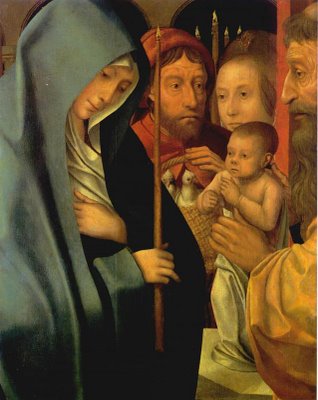
Your Sunday Sermon NotesThis Sunday is the Feast of the Presentation of the Lord, also called the Purification.

Did you hear a particularly good point in the sermon you heard at Mass to fulfill your Sunday obligation?

Meanwhile, here is something for your edification.  This is the third of the five prayers of blessings of candles during Mass, Candlemas.

Let us pray. O Lord Jesus Christ, the true Light who enlightenest every man that cometh into this world: pour forth Thy blessing + upon these candles, and sanctify + them with the light of Thy grace, and mercifully grant, that as these lights enkindled with visible fire dispel the darkness of night, so our hearts illumined by invisible fire, that is, by the splendor of the Holy Spirit, may be free from the blindness of all vice, that the eye of our mind being cleansed, we may be able to discern what is pleasing to Thee and profitable to our salvation; so that after the perilous darkness of this life we may deserve to attain to neverfailing light: through Thee, O Christ Jesus, Savior of the world, who in the perfect Trinity, livest and reignest, God, world without end.
R.: Amen.

Your Sunday Sermon Notes

A couple shots from Mass today, thanks to Elizabeth at Laetificat:

Your Sunday Sermon Notes

Your Sunday Sermon Notes


Posted in SESSIUNCULA |
47 Comments