QUAERITUR follow up and THANKS to readers!

I has placed a question on the blog about the priests who concelebrate not consuming both species.  Because I was probably traveling and didn’t have the chance to dig, I opened things up for answers.

Well…!

Today, while sitting on another airplane about to take off, I picked up an e-mail from a priest friend who faced the situation while recovering from surgery of being told not to consume even the least amount of alcohol because of the post-op medication he was on.  He asked about concelebrants being able to consume under one kind alone.

SKADOOSH! 

After a twitch of my pinky finger, I was able to call him back between flights… right now, that is… and give him an explanation and concrete reference which answered his question and situation perfectly.

It is a great part due to the contribution of readers that this was possible.

First, because there are so many of you, I keep this going.

Second, because so many of you are well-informed, I keep this going.

Third, because so many of you think before posting, I keep this going.

Fourth, because I too learn so much, I keep this going.

Thanks to you all.  You helped me help a friend in a particular and important circumstance.

Posted in ASK FATHER Question Box | Tagged
6 Comments

Part of a day in KC MO

I had the great pleasure of visiting the WWI Memorial and museum today.

Don’t miss this museum.

It is one of the best of it’s kind I have ever seen.

The some KC BBQ!

Then a quick stop at a cigar store.

And the Cathedral.

Posted in SUMMORUM PONTIFICUM |
32 Comments

QUAERITUR: Mass cancelled for bad weather

From a reader:

My pastor "canceled" Sunday Mass this morning due to an icy parking lot from a recent snow/ice storm. Needless to say, I live in a part of the country where we rarely have such weather. However, while protestant churches all over the city canceled their services, ours was the only Catholic Church in town that where Masses were "cancelled."

If you were in my neck of the woods, where I grew up in Minnesota, that would not fly.

But while we know there is an obligation for Mass in Sundays, when people face a significant burden … such as truly inclement weather… their obligation is mitigated.

People are not bound to the impossible, or the truly burdensome when it comes to this obligation. Many people are sincerely afraid to out when weather is like that.

In places where winter weather is not normal inexperience with driving conditions and, frankly, fear of incompetent drivers, seems to me a sufficient reason to attenuate the obligation.

The pastor, by canceling Mass, could have been trying to put people ease about their obligation. Of course I hope he said Mass anyway at the times scheduled for those who showed up all the same.

Posted in ASK FATHER Question Box |
28 Comments

A citation concerning the use of hymns at Mass

Gregorian chantThis citation from NLM is really useful.

Bugnini’s own Consilium in 1969 offered the following instruction, consistent with the Vatican II emphasis on chant over vernacular hymnody. As printed in 1 Notitiae, 5 (1969), p. 406

That rule [permitting vernacular hymns] has been superseded. What must be sung is the Mass, its ordinary and proper, not “something,” no matter how consistent, that is imposed on the Mass. Because the liturgical service is one, it has only one countenance, one motif, one voice, the voice of the church. To continue to replace the texts of the Mass being celebrated with motets that are reverent and devout, yet out of keeping with the Mass of the day amounts to continuing an unacceptable ambiguity: it is to cheat the people. Liturgical song involves not mere melody, but words, text, thought, and the sentiments that the poetry and music contain. Thus texts must be those of the Mass, not others, and singing means singing the Mass not just singing during Mass.

Sacred music is not an add on to the liturgy.  It is liturgySacred music is pars integrans in the sacred liturgy, that is, an integral part or, better integrating part of the whole of liturgical worship.

Thus, music for Mass must be sacred and it must be artistic.  The texts sung must be sacred and relevant to the liturgy of the day.  It must be composed and performed in the best manner possible, a truly artistic way. 

Pastors and church musicians should… must… rethink the "four hymn sandwich".

Posted in "How To..." - Practical Notes | Tagged , , , , ,
36 Comments

WDTPRS: 4th Sunday of Ordinary Time – COLLECT (2002MR)

Today’s Collect was not in the post-Tridentine editions of the Missale Romanum but it does have its origin in the "Leonine Sacramentary" or, as it is better titled by its editor, the scholarly L. Cunibert Mohlberg, the Veronese Sacramentary

The three most important ancient sacramentaries are the Leonine/Veronese, Gelasian and Gregorian.  The Sacramentarium Veronense (SV hereafter), so called because it exists in a single manuscript in Verona, is dated by famed paleographer E.A. Lowe to the first quarter of the 7th c.  The material of the SV is a collection of Roman Mass books perhaps made by Maximianus, archbishop of Ravenna from 546-557 and, according to Joseph Lucchesi, its calendar follows that of Ravenna of the time.  The prayers in the SV are attributable to Popes Leo I (+461), Gelasius (+496) and Vigilius (+557).  Were you to hear this prayer intoned in Latin, or at least in an accurate translation, you would be thereby transported back 1500 years to our most Roman of Catholic roots.  

COLLECT (2002MR):
Concede nobis, Domine Deus noster,
ut te tota mente veneremur,
et omnes homines rationabili diligamus affectu
.

LAME-DUCK ICEL (1973 translation of the 1970MR):
Lord our God,
help us to love you with all our hearts
and to love all men as you love them.

Is this what the Latin really says?  Lewis & Short, that Dictionary of inestimable value, says the deponent verb veneror means, “to reverence with religious awe, to worship, adore, revere, venerate… to do homage.”  We sing in the well-known hymn to the Blessed Sacrament Tantum Ergo by St. Thomas Aquinas, “veneremur cernui…we adore / venerate with religious awe, our heads bowed to the ground.”   The noun affectus, us signifies, “A state of body, and especially of mind produced in one by some influence (cf. affectio), a state or disposition of mind, affection, mood”.  In post-Augustan Latin it comes to mean “affection” in the sense of “love, desire, fondness, good-will, compassion, sympathy”.  Diligo, lexi, lectum is composed from from lego, legi, lectum. “to bring together, to gather, collect” (not from lego, legavi, legatum, “to send with a commission; choose”).  The punctilious etymological dictionary of Latin by Ernout & Meillet shows that diligo aims conceptually at distinguishing one thing by selecting it from others.  Thus diligo comes to mean, “to value or esteem highly, to love” although Cicero used diligo in a somewhat less strong sense than amo, amareDiligo can also suggest “thrifty, frugal” and “careful or attentive with regard to things”. English “diligence” and its antonym “negligence” correspond to this.  Rationabilis is a post-Augustan word for the more classical rationalis and means “reasonable, rational”.

SLAVISHLY LITERAL VERSION:
Grant us, O Lord our God,
that we may venerate you with our whole mind,
and may love all men with rational good-will
.

“Affection” just doesn’t cut it for affectus and something more pointed than “love” is needed too.  I came up with “rational good-will”.  We mustn’t reduce all these complicated Latin words to “love”.  Why not?  Note in the prayer the contrast of the themes “reason” and “mood”, the rational with the affective dimension (concerning emotions) of man; in short, the head and the heart.   The fact is, a properly functioning person conducts his life according to both head and heart, feelings under the control of reason and the will.  The terrible wound to our human nature from original sin causes the difficulty we have in governing feelings and appetites by reason and will.  

Today’s prayer aims at the totality of a human person: our wholeness is defined by our relationship with God.  We seek to know God so that we may the better love Him and His love drives us all the more to know Him.  Furthermore, possible theological and Scriptural underpinnings of this prayer are Deuteronomy 6 and Jesus’ two-fold command to love God and neighbor: “You shall love the Lord your God with all your heart, and with all your soul, and with all your mind. This is the great and first commandment.  And a second is like it, You shall love your neighbor as yourself. On these two commandments depend all the law and the prophets” (cf. Matthew 22:36-38; Mark 12:2-31; Luke 10:26-28).  In Deut 6:5-6 we have the great injunction called the Shema from the first Hebrew word, “Hear, O Israel: The LORD our God is one LORD; and you shall love the LORD your God with all your heart, and with all your soul, and with all your might….” Jesus teaches the meaning and expands the concrete application of this command in Deuteronomy 6.   There is no space here for the subtle relationships between the Latin words St. Jerome chose in his translations and the Greek or Hebrew originals of these verses.  Suffice it to say that in the Bible the language about mind, heart, and soul is terrifically complex. However, these words aim at the totality of the person precisely in that dimension which is characteristic of man as “image of God”.  Heart, mind and will distinguish us from brute animals.  We are made to act as God acts: to know, will and love.  Thus, “mind” and “heart” in man are closely related faculties and cannot be separated from each other.  Mind and heart are revealed in and expressed through our bodies and thus they point at the “real us”.  Love is at the heart of who we are and it the key to our prayer today.

We are commanded by God the Father and God Incarnate Jesus Christ to love both God and our fellow man and God the indwelling Holy Spirit makes this possible.  But the word and therefore concept of “love” is understood in many ways and today, especially, it is misunderstood.  “Love” frequently refers to people or stuff we like or enjoy using.  Bob can “love” his new SUV. Besty “loves” her new kitten.  We all certainly “love” baseball and spaghetti.  But “love” can refer to the emotional and affections people have when they are “in love” or, as I sometimes call it, “in luv”.  Luv is usually an ooey-gooey feeling, a romantic “love” sometimes growing out of lust.  This gooey romantic “love” now dominates Western culture, alas.   The result is that when “feelings” change or the object of “luv” is no longer enjoyable or useable, someone gets dumped, often for a newer, richer, or prettier model.

There some other flavors of “love” you can come up with, I’m sure.  But Christians, indeed every image of God in all times everywhere, are called to a higher love, the love in today’s prayer, which is charity: the grace-completed virtue enabling us to love God for His own sake and love all who are made in His image.  This is more than benevolence or tolerance or desire or enjoyment of use.  True love is not merely a response to an appetite, as when we might see a beautiful member of the opposite sex, a well-turned double-play, or a plate of spaghetti all’amatriciana.  True love, charity, isn’t the sloppy gazing of passion drunk sweethearts or the rubbish we see on TV and in movies (luv).  Charity is the grace filled adhesion of our will to an object (really a person) which has been grasped by our intellect to be good.  The love invoked in our prayer is an act of will based on reason. It is a choice – not a feeling.  Charity delights in and longs for the good of the other more than one’s own.  The theological virtue charity involves grace.  It enables sacrifices, any kind of sacrifice for the authentic good of another discerned with reason (not a false good and not “use” of the other).  We can choose even to love an enemy.  This love resembles the sacrificial love of Christ on His Cross who offered Himself up for the good of His spouse, the Church.  Rationabilis affectus reflects what it is to be truly human, made in God’s image and likeness, with faculties of willing and knowing and, therefore, loving.

Knowledge and love are interconnected.  The more you get to know a person, the more reason you have to love him (remember… love seeks the other person’s good in charity even if a person is unlikable).  Reciprocally, the more you love someone or (in the generic sense of love) something, the more you want to know about him and spend time getting to know him. For example, Billy is fascinated by bugs.  From this “love” for bugs Billy wants to know everything there is to know about them.  He works hard to learn and thus launches a brilliant career in entomology.  Given Our Creator’s priority in all things, how much more ought we seek to know and love God first and foremost of all and then, in proper order, know and love God’s images, our neighbors?  He is far more important that the bugs He created.  Even spouses must love God more than they love each other.  Only then can they love each other properly according to God’s plan.

We also have a relationship with the objects of both love and knowledge.  What sort of relationship?  With bugs or spaghetti it is one thing, but with God and neighbor it is entirely another.  In seeking to understand and love God more and more we come to understand things about God and ourselves as his images that, without love, we could never learn by simple study.  The relationship with God through love and knowledge changes us.  St. Bonaventure (+1274) the “Seraphic” doctor wrote about “ecstatic knowledge”. This kind of knowledge is not merely the product of abstract investigation or analytical study (like Billy with his bugs).  Rather, it comes first from learning and then contemplating. According to Bonaventure, by contemplation the knower becomes engaged with the object. Fascinated by it, he seeks to know it with a longing that draws him into the object.  Consider: we can study about God and our faith, but really the object of study is not just things to learn or formulas to memorize: the object of our study and faith is a divine Person in whose image and likeness we ourselves are made.  To be who we are by our nature we personally need the sort of knowledge of God that draws us into Him.  Knowledge of God (not just things learned about God) reaches into us, seizes us, transforms us.  To experience God’s love is to have certain knowledge of God, more certain than any knowledge which can be arrived at by means of mere rational examination.

Bring this all with you back to the last line of our prayer and the command to love our neighbor, all of them made in God’s image and all individually intriguing – fascinating, in a way that resembles the way we love God and ourselves.  This we are to do with our minds, hearts, and all our strength.  
Posted in WDTPRS | Tagged , ,
3 Comments

The UK’s Catholic Herald writes of priest bloggers, especially Fr. Finigan

I am glad to post that the UK’s best Catholic weekly, The Catholic Herald, has posted a brief piece about priest bloggers.

What makes this article so congenial is that it talks about my good friend Fr. Tim Finigan, whose blog The Hermeneutic of Continuity stands out among clerical contributions in the Catholic blogosphere.  His Hermeneuticalness is not only a great observer of life in general, but a good parish priest.

My emphases and comments:

Priestly bloggers are a great gift to the Church

29 January 2010

We did not know until this week that the word "blog" was in the Holy Father’s vocabulary, but there it is – tucked away in his message for World Communications Day.

The Pope writes: "Priests can rightly be expected to be present in the world of digital communications as faithful witnesses to the Gospel, exercising their proper role as leaders of communities which increasingly express themselves with the different ‘voices’ provided by the digital marketplace. Priests are thus challenged to proclaim the Gospel by employing the latest generation of audiovisual resources (images, videos, animated features, blogs, websites) which, alongside traditional means, can open up broad new vistas for dialogue, evangelisation and catechesis." [What is great about this, first and foremost, is the proof this gives that someone around the Holy Father is paying attention to the fact that there are real and useful tools of social communication.]

The secular media have interpreted this as a papal invitation to priests to "get blogging". We suspect they are right. Pope Benedict XVI is unlikely to spend much of his day online, but he is almost certainly aware that blogging has become a powerful phenomenon in Catholic circles. Many of the world’s most engaged Catholics visit blogs several times a week, to pick up information and rumours about the Church, and also to air their views. One might protest that some of the information is inaccurate, that some of the rumours are false and that some views aired are contrary to Church teaching – but the fact remains that blogs fill a vacuum created, in part, by ecclesiastical structures that have lost the knack of communicating with the laity. [YES!]

It is no accident that among the most successful blogs are those run by individual priests, rather than dioceses. Not only do the faithful like to know what their parish priest is up to, but a seasoned and witty evangelist can build a cyber-parish that extends for thousands of miles. [It is a "diakonia" to a "digital continent", to paraphrase the Holy Father.] An outstanding example is our columnist Fr Tim Finigan of Blackfen in Kent, [HUZZAH!] who spreads the Gospel alongside authoritative news of papal and other liturgical initiatives that are sometimes overlooked by the official channels.

His blog is called The Hermeneutic of Continuity, a phrase used by Pope Benedict XVI [ehem… before Fr. Finigan applied it to his blog…] to emphasise the lack of rupture between the Church’s teaching before and after the Second Vatican Council; so well-known is Fr Tim’s blog that it has helped popularise the Pope’s thinking on this subject throughout the English-speaking world.

Many priest-bloggers are conservative in their liturgical preferences; but there is room in cyberspace for clerical writers who embody many different authentic Catholic approaches. [And "market forces" will be at work.] The internet can empower priests who have felt their influence decline as vocations and congregations decline. Indeed, it has the ability to reverse these trends.

We should therefore welcome it for what it is: a gift to the Church. [Do I hear an "Amen!"?]


Huge WDTPRS kudos to The Catholic Herald and His Hermeneuticalness!

Posted in The Drill | Tagged ,
16 Comments

“Whatever it is, I’m against it!”

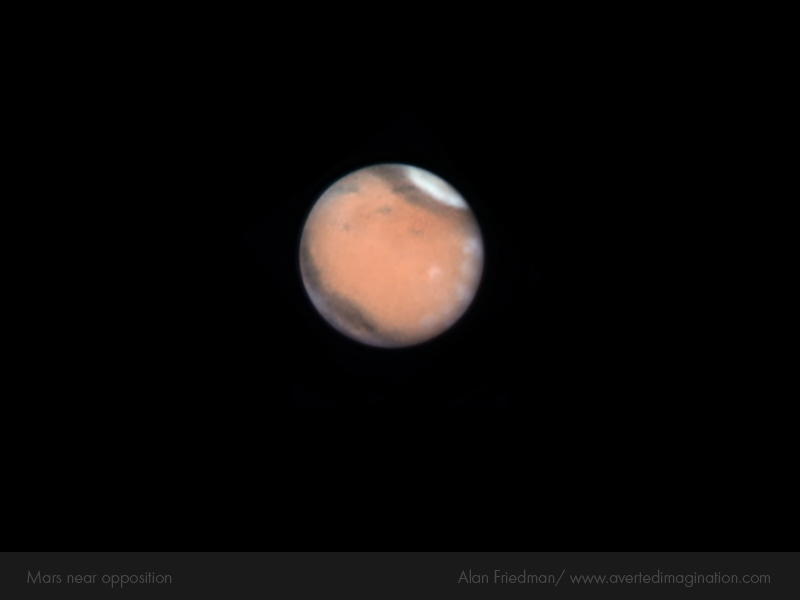
Meanwhile… over in Spirit’s neighborhood, this via Astronomy Pic of the Day, Mars is in opposition!

Yes, Mars is opposed today, even as the Moon is full.

Explanation: Mars is at opposition tonight, opposite the Sun in planet Earth’s sky. Of course, it will be easy to spot because Mars appears close to tonight’s Full Moon, also opposite the Sun in Earth’s night sky in the constellation Cancer. For this opposition, Mars remains just over 99 million kilometers away, not a particularly close approach for the Red Planet. Still, this sharp view of Mars recorded on January 22nd is an example of the telescopic images possible in the coming days. The planet’s whitish north polar cap is at the upper right. Mars’ tiny red disk is about 14 arcseconds in angular diameter, less than 1/100th the diameter of the Full Moon.

Posted in Just Too Cool | Tagged
2 Comments

Catholic identity must not be checked at the door of the polling booth

From CNA:

Catholic identity must not be checked at the door, advise Costa Rican bishops

San José, Costa Rica, Jan 27, 2010 / 11:02 pm (CNA).- In light of the upcoming presidential elections in Costa Rica set for February 7, the country’s bishops issued a statement reminding the faithful that their Catholic faith is not just another aspect of their lives, but rather has “unavoidable implications in the field of political morality and public life.”

In their letter the bishops urged Catholics to vote by discerning the best choice “with the help of the Lord” and to use sound reasoning in the search for what is best for the country.

After noting that “politics is a noble activity,” they added that it must be guided by “paths of justice, respect for human life, marriage, the family, religious freedom and the search for the common good.” The bishops then pointed to the various challenges the next president must address such as the country’s breakdown in security, violence, disrespect for life, ongoing poverty, unstable families, unemployment, corruption and drug trafficking.

The letter reminded Catholic voters they must not check their Catholic identity at the door of the polling booth, and stressed that the Christian faith “has unavoidable implications in the field of political morality and public life.”

The bishops also exhorted “all people of good will to analyze ahead of time and to attentively discern, guided by reason and ethics, the proposals set forth by candidates, in order to cast a vote that is responsible and reasoned.”

“At this time in our history,” they said, “we invite the entire People of God to invoke the help of the Lord and the maternal protection of Our Lady of the Angels, so that we may once again feel her intercessory presence and she may guide us to strengthen our democracy in peace, justice and freedom.”

Posted in Our Catholic Identity | Tagged
6 Comments

Start teaching Gregorian chant to parishes before the new translation starts

Latin is not, as some claim, tooo haaard for parishes.

From a priest reader:

I’ve been thinking about the new translation of the Novus Ordo.  Suddenly, all of the old music will be out, of no use.  I wondered what to do about it, when it struck me that this is the time to teach the parish Gregorian Chant.  We will begin with the Sanctus this Lent and continue slowly making additions until the new translation comes; we’ll be prepared.  They won’t be adjusting to everything all at once; and in some sense will be very well prepared to accept the new translation!
 
I shared this with the chair of the diocesan liturgical commission, and he thought it was a wonderful idea.

I would add… start forming a schola cantorum.

Posted in "How To..." - Practical Notes, Mail from priests | Tagged , ,
32 Comments

Why did we need Summorum Pontificum? Reason #7467

Here is a video from gloria.tv about a Mass in Germany for Fasching (the lead up to Lent called "Carnival" – historically a time of excess in various spheres).

I know that Fasching has deep cultural roots… but… in church?

Infra dignitatem.

[flv]10_01_27_Fasching.flv[/flv]

Folks… charitably resist as you can stupid things scheduled to be done in your parishes churches.

Biretta tip to Prodigal Daughter.    o{]:¬)

Posted in SUMMORUM PONTIFICUM | Tagged ,
53 Comments