QUAERITUR: odd elevation style

From a reader:

My family attended a Novus Ordo Christmas Vigil Mass with a visiting priest. During the major elevation (This Is My Body), he elevated the host with one hand (his right) while the other held on to the altar. He did the same at the next elevation of the cup. I have never seen this done in the fifty years I’ve attended Catholic Masses (both old and new rite). The elevation has always been two hands, thumb and forefinger. Is this valid or licit, both or neither.

Maybe the priest has bursitis. The would have been improper for sure in the traditional form of Mass in the Roman Rite. Both hands are designated and for good reason: to steady the chalice. You also create a symmetry that way. I do not believe there is ant indication if both hands for the Novus Ordo. Thus, while what you saw is a departure from the Roman way, a rupture of continuity as it were, I don’t think it was illicit.

NOTA BENE: If I am not mistaken, and I am dredging my memory here, does the Novus Ordo GIRM instruct the priest at the offertory to raise the paten with the host and the chalice with the wine with water using both hands?   If that is the case, then it seems fitting that the elevation would similarly be with both hands.

I have seen older priests do this one-handed, btw, because they have shoulder troubles.

Don’t assume a strange motive.

Posted in ASK FATHER Question Box |
47 Comments

QUAERITUR: patterns for lacemaking for church linens, etc.

From a reader in Poland:

We (me & my wife) are searching the network for good, noble and beautiful patterns of filet crochet church laces for bordering altar clothes, cottas and surplices for our church.

I am sure that You can ask Your P.T. readers in a special blog entry for any hints, where to find them and in Poland it’s very hard to find

Can you help?

Posted in ASK FATHER Question Box |
1 Comment

QUAERITUR: “Litanies of the Love of God” by St. Pius V

A friend here in NYC asked an interesting question yesterday.  I want to enlist the help of other readers to come up with the answer.

Here are the basics.  Apparently Pope Pius V wrote a "Litanies of the Love of God".   My friend has it in Spanish.  It must have been written in Latin, but he can’t find the text.

Can anyone help?

Here is what I received from my friend via email.

I’d like to ask you to see if you can find the Latin version of the Litanies of the Love of God prayer composed by St. Pius V. I only have it in Spanish.
 
These are the Litanies:
 
LETANIAS DEL AMORE DE DIOS
by the Holy Pontiff of the Rosary, the immortal Dominican St. Pius V
 
Vos que Sois el Amor Infinito ***
Vos que me habeis prevenido por Vuestro Amor.
Vos que me mandais amarOs.
Con todo mi corazón.
Con toda mi alma.
Con todo mi espíritu.
Con todas mis fuerzas.

[…]

ORACION:
 
 ¡Oh! Dios que poseéis en una abundancia incomprensible todo lo que puede para siempre ser perfecto y digno de amor, extinguid en mí todo amor culpable, sensual y desarreglado por las criaturas, y encended en mi corazón el fuego purísimo de Vuestro Amor, a fin de que no ame sino a Vos, o por Vos, hasta que siendo en fin consumido por Vuestro Santo Amor, vaya a amarOs eternamente con los elegidos en el Cielo. Así sea.

Any ideas?

UPDATE:

It may have been Pius VI.

Posted in ASK FATHER Question Box | Tagged
9 Comments

NYC – Manhattan – Christmas Midnight TLM with music

If you are in or near Manhattan….

There will be a Solemn TLM for Midnight Mass (yes, midnight, Christmas) at Holy Innocent’s in Manhattan.

The undersigned is celebrant for the Mass.  Here is the music line up:

Prelude Music (starting at 11:30 PM)

  • Gwendolyn Toth, organ: Pastorale from the Concerto Grosso #8 – Arcangelo Corelli (1653-1713)
  • Linnea Shin & Lauren Alfano, sopranos; Kelly-Ray Meritt, recorder: Amoena Quam Festivitas duet – Valentin
  •      Molitor (1637-1713)
  • Peter Becker, bass: Verbum Caro – Ottavio Durante (fl. 1608-1618)
  • Linnea Shin, soprano; Lauren Alfano, soprano; Kelly-Ray Meritt, tenor; Peter Becker, bass: Chorale,
  •     O Jesulein Süss by J.S. Bach (1685-1750)
  • Gwendolyn Toth, organ: Joseph est Bien Marie – Claude Balbastre (1724-1799)
  • Linnea Shin, soprano: Virgin Slumber Song – Max Reger (1873-1916)
  • Lauren Alfano, soprano and Peter Becker, bass: Gesu Bambino – Pietro Yon (1866-1943)
  • Linnea Shin, soprano; Lauren Alfano, soprano; Kelly-Ray Meritt, tenor & recorder; Peter Becker, bass:
  •     Lo How A Rose E’er Blooming – Michael Praetorius (1571-1621)

 
Mass Music

  • Processional: organ, Noel – Louis-Claude Daquin (1694-1772)
  • Chanted propers from Liber
  • Missa "O Magnum Mysterium" – Tomas Luis de Victoria (c.1548-1611)
  • (Creed is congregational except for Et Incarnatus est)
  • Offertory:Angelus ad Pastores – Orlande de Lassus (1532 – 1594)
  • Offertory: Christe Redemptor  – Victoria (alternating chant & polyphony – as many verses as needed)
  • Communion #1: O Magnum Mysterium – Victoria
  • Communion #2: O Magnum Mysterium – Poulenc
  • Recessional: Organ, Noel Suisse – Daquin

Posted in On the road |
19 Comments

Did Shakespeare study for the priesthood… in Rome?

Fr. Longenecker has an interesting post about Shakespeare:

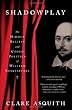
The literature on Shakespeare being a Catholic keeps mounting. Clare Asquith’s book Shadowplay along with the scholarship of Fr.Peter Milward started the ball rolling, then Joseph Pearce’s excellent, The Quest for Shakespeare gathered all the evidence together in a rollicking good read and the PBS documentary In Search of Shakespeare made it visual.

Now some mysterious evidence has emerged in the Venerable English College in Rome. You can read the article here. They have found some documents that might have Shakespeare’s name on them, indicating that during his ‘lost years’ from 1585 – 1592 he was in Rome, and if in Rome was he studying for the priesthood? [This is from The Daily Telegraph.]

A leather parchment kept by the college is signed by "Arthurus Stratfordus Wigomniensis" in 1585, "Shfordus Cestriensis" in 1587 and "Gulielmus Clerkue Stratfordiensis" in 1589. The college believes these signatures are: "(King) Arthur’s (compatriot) from Stratford (in the diocese) of Worcester," "Sh(akespeare from Strat)ford (in the diocese) of Chester" and "William the Clerk from Stratford".

What makes the quest so intriguing is that the evidence for Shakespeare’s life is so scant, and in this particular area it is very scant indeed, but the times were dangerous. To be a Catholic in England was considered an act of treason. Catholics had to disguise their identities. If the names in the register at the English college were cryptic maybe they had to be so that real identities would not be revealed. It’s all very juicy conspiracy theory stuff, and yet that was the situation the Catholics were in. They were members of an underground church. They had to destroy or disguise evidence and ‘keep it secret keep it safe.’

As it happens, I’ve produced the outline of a screenplay called The Shakespeare Plot. In it Shakespeare is a secret Catholic in Elizabethan England and is all tied up with spies, disguised priests, torture chambers priest’s holes, executions and other juicy stuff. Think Man for All Seasons meets Shakespeare in Love. Some people in California seem to be interested.  [Intriguing!]

Posted in Just Too Cool | Tagged
24 Comments

Michael O’Brien on “Twilight”: modern man’s futile flight from conscience

From a reader:

I think Michael O’Brien’s new piece (12/19/09) on "Twilight" and its popularity is a much better analysis than the one written by Sophie Caldecott.  I have both read and written a lot on Twilight and O’Brien’s piece is the most thought provoking, and, I fear, accurate analysis I have read yet. 

Here is an interesting segment from O’Brien’s article:

"E. Michael Jones has written that at the root of the phenomenal rise of horror culture [I would add dystopia especially in movies.] is suppressed conscience.

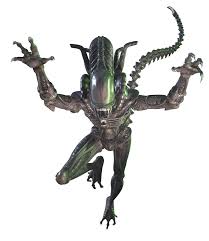
Tracing the pattern from Mary Shelley’s novel Frankenstein (first published in 1818) through to Ridley Scott’s film Alien (1979) [The only that made me crawl the back of my chair.] and its sequels, Jones argues that the denial of moral law produces metaphorical monsters that arise from the subconscious of creative people and spread into society through their cultural works. The monster in the Alien films, for example, is a ghastly abomination of the feminine, and salvation is possible only through expulsion of the offspring it implants and incubates in humans—a subconscious eruption of internal conflicts (and guilt) over abortion. [!]

As Jones points out:

By following our illicit desires to their logical endpoint in death, [cf. John  Paul II’s discussion of a "culture of death".] we have created a nightmare culture, a horror-movie culture, one in which we are led back again and again to the source of our mysterious fears by forces over which we have no control.

Even though modern man denies the authority of moral conscience, he cannot escape it. He is created in the image and likeness of God, and deep within the natural law of his being the truth continues to speak to him, even as he adamantly denies the existence of God (in the case of atheists) or minimizes divine authority (in the case of nominally religious people, the practical atheists). In order to live with the inner fragmentation, which is the inevitable effect of violated conscience, he is driven to relieve his pain through three diverse ways:

a)     He makes open war against conscience and all its moral restraints, and pursues with radical willfulness an aggressive consumption of sensual rewards—generally a plunge into various kinds of addictions and a life of sexual promiscuity;

b)    More passively, he simply ignores the inner voice of conscience and distracts himself from it by sensual and emotional rewards—generally the search for love without responsibility and a restless striving for worldly success;

c)     He tries to rationalize a self-made form of conscience for himself, based in values such as “tolerance” and “non-dogmatism.” Generally this produces a new kind of perverse moralism, a self-righteousness which is, paradoxically, quite intolerant of genuine righteousness. Its anti-dogmatism is its dogma. Here there is no absolute rejection of morality, but rather a rewriting of it according to subjective feelings.

None of the foregoing coping mechanisms need be conscious. Indeed they tend to be largely subconscious processes through which a person feels that he is finding his personal identity, is living out the principle of freedom, discovering his path in life, and getting from it a portion of happiness. Though he is afflicted from time to time by a sense of the inner void, he presumes that the remedy for these dark moments will be found by increasing the dose of the very drug that is killing him.

The Twilight series, it would appear, follows the third coping mechanism mentioned above in c), the one which appeals to the broadest possible audience."

Grist for the mill.

Posted in The Drill | Tagged , ,
26 Comments

Dust up in Japan over new translation

In the UK’s weekly liberal fishwrap The Tablet (aka The Pill aka RU486) there is a note about a tussle over the new translation in Japan.

JAPAN

JAPAN’S BISHOPS have clashed with the Vatican in an effort to keep their version of the Mass culturally sensitive, writes William Grimm. The bishops are working on a re-translation of the liturgy in accordance with the 2001 instruction Liturgiam Authenticam, which mandates a more literal translation of the Latin text of the Mass into the vernacular. They are awaiting a response to a request to the Vatican’s Congregation for Divine Worship (CDW) that a new translation of the Mass not use the word “spirit” in the response to the greeting, “The Lord be with you.” The bishops want to use a Japanese equivalent of “And also with you”, as is presently the case in English translations (although the version due for introduction in 2011 returns to “and with your spirit”). The Japanese language does not have an equivalent to the Latin spiritus. The English word “spirit” is usually translated into a Japanese word for “ghost” used by groups that dabble in the occult. Bishop Masahiro Umemura of Yokohama, chairman of the bishops’ liturgy commission, said that in 2006 he warned the then-prefect of the CDW, Cardinal Francis Arinze, that non-Christians attending church weddings and funerals could conclude that Catholicism is a sort of cult.

In other news, the same issue has a story entitled… and I apologize in advance for the use of this haaard word:

Born with ineffable love


Hmmm… the appearance of this word in that weekly perhaps undermines the contention of a certain crowd that the new translation is tooo haaard.

Posted in WDTPRS | Tagged ,
67 Comments

POLL ALERT: Le Figaro on Ven. Pius XII … AUX ARMES!

Aux armes, citoyens!

In another entry I asked you readers to keep your eyes peeled for online POLLS about the decision of Pope Benedict XVI to promulgate the decree regarding the heroic virtues of Ven. Pius XII.

A reader alerted us to a poll in the large national French daily Le Figaro.  Alas, the good guys are not doing so well. 

I voted "OUI". 

Go HERE to vote!

There are quite a few votes, 18K+, so I hope other bloggers will take up the gauntlet.

UPDATE 1638 GMT:

Is anyone else getting a message that the voting is closed?  "Le vote est clos."

If so, I was the ante-penultimate vote.

Posted in POLLS | Tagged ,
15 Comments

QUAERITUR: priest says not to lift the chasuble during TLM

From a reader:

Our TLM priest has asked the altar servers not to lift his chasuble during the elevations. Says it distracts him.
Anyway, I was wondering if the chasuble lifting is just a tradition or if it is such a tradition that it has become a ‘norm’ so to speak.

I don’t recall that this lifting of the chasuble is – for servers – an actual norm.  In the Ritus servandus in the 1962 Missale Romanum we are told that during a Solemn Mass the deacon is the lift the edge of the chasuble ("fimbrias planetae elevat").  Therefore, I assume that all others do this in imitation of the deacon at the solemn Mass.  That said, this is certainly a long-enduring custom, and a good one.

If this is really a problem for the priest, then it would be okay at a low Mass not to do it.   But… but… why should this be a big problem for the priest? 

Unless the server is yanking on the chasuble backward, I cannot fathom why this should be a problem.  If the server is being to intrusive in the way he handles the chasuble, then the server’s action should be corrected, not forbidden.

Thus, I would say in this case, it really should be done, from custom, and in imitation of the deacon, and from the expectations of the people, and from the desire of the servers (especially when young) to be able to do cool things.   I would say to the servers to be careful with the chasuble.  There is an old adage that "less is more".  Just raise the edge a little.  You don’t have to yank it backwards or raise it above your head.  A couple inches should suffice.

To the priest I would suggest "offer it up" if it bothers you.   This isn’t about you, after all.  Let the young men do what is expected and just deal with it.  In the meantime, be sure you train them to lift the chasuble in a way that is neither abrupt nor asphyxiating.

Posted in "How To..." - Practical Notes, ASK FATHER Question Box | Tagged
35 Comments

NY Daily News article on Pius XII (POLL ALERT)

You knew that as soon as the ball started rolling again in the cause of Pope Pius XII, as Pope Benedict XVI did today, the naysayers would resume their detraction.

What always astonishes me is how the earlier lies so quickly became the footnotes in subsequent "scholarly" attacks.  But I digress.

Here is a story in the New York Daily News… which as a POLL!   I voted "No" in their poll… not that you have to.  But again I digress.

Pope Benedict XVI declares Pius XII ‘venerable,’ angering Jewish groups

BY Samuel Goldsmith
DAILY NEWS STAFF WRITER

Saturday, December 19th 2009, 11:46 AM

Jewish leaders expressed disgust Saturday when Pope Benedict XVI pushed a controversial predecessor one step closer to sainthood.  [Actually, it must have been Pius XII’s own life that pushed him closer to this.  You should see the documentation presented in the cause for Pius.  I did.  I saw the stacks of volumes of the positio presented to demonstrate the "heroic virtue" of Pius XII.]

The pontiff declared Pius XII "venerable" even though he’s been criticized for not doing enough to help Jews during the Holocaust.  [Pius XII saved thousands of Jews.  Thousands of families exist today because of him, perhaps even those to which some of his detractors belong.]

Jewish groups had asked for the move – one step before beatification – to be postponed until they’re allowed to review Vatican archives on Pius’ World War II actions.  [And why should Jews be able to determine anything about a cause for a servant of God in the Catholic Church?  Are Catholic leaders consulted when someone is determined to be "Righteous Among The Nations"?]

Elan Steinberg, vice president of the American Gathering of Jewish Holocaust Survivors and their Descendants, called Benedict’s decision "profoundly insensitive and thoughtless."

"We are left bereft in our feelings," he said from his Manhattan office Saturday.

The Vatican maintains Pius worked quietly to help the Jews during World War II.

Jewish groups say no documents supporting that have been released and they need to know more about what he did and didn’t do.  [HUH?]

"Why the rush to open up the wound again before the opening of the archives?" asked Abe Foxman, U.S. national director of the Anti-Defamation League, from Jerusalem.  [The same old same old.]

Also elevated on the road to sainthood Saturday was Pope John Paul II, widely popular among both Christians and Jews during his time as pontiff from 1978 to 2005.

When Jews start consulting Catholic leaders about how Jews can pray or who is considered worthy of veneration, we might be able to see their concerns in a different light.

I dunno.  This stuff always sounds whiny to me.  I know… I know… emotions run high in these discussions.  Am I wrong about this?

The New York Daily News has a POLL about this. 


In the meantime:

I recommend these books about Pius XII and what he did to save Jews.  These could also be good gifts. It is important to get this information into circulation.

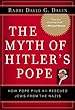
First, try The Myth of Hitler’s Pope: Pope Pius XII and His Secret War Against Nazi Germany  by David G. Dalin.  The author is a rabbi.

Also, there are the excellent books by Ron Rychlak Hilter, the War, and the Pope.  Rychlak is professor in the law school at Ole’ Miss and teaches how to handle evidence.  Amazon made this really hard to hunt up on their site.  A search won’t produce it.  I had to modify an old link I posted some time ago.  This is a testimony that this is one of the better books.


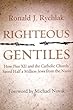
Also by Rychlak with Michael Novak is Righteous Gentiles: How Pius XII And the Catholic Church Saved Half a Million Jews from the Nazis

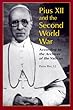
Speaking of evidence, there is also Pius XII and the Second World War: According to the Archives of the Vatican by Pierre Blet,


Others could be added (and maybe I will add them), but give these a shot.  They are fascinating reading.

UPDATE: 20 Dec 0536 GMT

Posted in POLLS, The Drill | Tagged , ,
39 Comments