WSJ picks up on Catholic Hospitals vs. the Bishops

The Wall Street Journal has a piece today entitled:

Catholic Hospitals vs. the Bishops

Administrators shop for theologians to support practices that conflict with church teachings.

It is by Anne Hendershott is professor of urban studies at the King’s College in New York City. She is the author of “Status Envy: The Politics of Catholic Higher Education” (Transaction Books, 2009).

Thanks for noticing, WSJ!

WDTPRS has been on this for a long time.

Note, inter alia

From the WSJ article:

Many theologians, like Prof. Nicholas Healy of St. John’s University in New York, write that theologians comprise “an alternative magisterium” to the teaching authority of the bishops. And in cases like the one at St. Joseph’s, the alternative magisterium often trumps the true Magisterium of the church. Catholic colleges and hospital administrators now “shop” for theologians who will support their decisions.

Sound about right?

Posted in Emanations from Penumbras, Linking Back | Tagged ,
Comments Off on WSJ picks up on Catholic Hospitals vs. the Bishops

WaPo – What’s in: Latin Mass

An alert priest reader sent me this:

In the Washington Post’s annual "What’s In and What’s Out"
list for the new year, the list for 2010 includes:

What’s out:  Latin fusion
What’s in:  Latin Mass

(scroll about 45% down the page, just past the pictures of Emily Blunt and Rosamund Pike)

WaPo say we got the BigMo.


Brick by brick.


Posted in Brick by Brick, Mail from priests |
16 Comments

Spaghetti al seminario

I mentioned on Plurk/Twitter that I was going to make what I call "spaghetti al seminario".  This is pretty simply stuff and you can put it together with brutal speed

The name comes from the fact that in my seminary in Rome we got this stuff all the time.  We got horse all the time too, but that is another story.

Get the water, with salt or chicken/beef broth in it started right away.  Begin browning some ground beef… or horse, as you please in a good sized pot.  Your carrots and onions will add a lot of volume. Season a bit with course salt and ground pepper.  I work with a pretty hot surface and like the darker flavor the browning gives.  This is 96%lean beef.  I have some elk in the freezer that would have been perfect.  Use a higher fat content if you want.

Meanwhile, chop up carrots, onion and garlic.  Don’t be fancy.  Just whack away.  This is rough and ready.

Add the veg with olive oil.  Season again, stirring to cover with oil and pick up some brown.

At this point I added some beef stock and sweated it down a bit.  You can use a little of the paste type of stock/flavor too.

When most of the liquid was gone I added my canned tomatoes. 

In this case the tomatoes were San Marzano and they were a gift from a reader here from my Amazon Wish List.  Many thanks to TG of MO who checked the wish list and sent the flat of San Marzano tomatoes!

Chop up the tomatoes right in the pan.  Don’t worry about breaking them up finely.  The cooking will take care of a lot of that.  At the end I like to have some identifiable pieces with a rough and ready preparation like this.

My oregano, which I brought in before the first freeze, has gone the way of all flesh.  I therefore used dried oregano from my summer plants.  Also, dried oregano has a very different flavor.  Work with caution.  I added finely ground hot red pepper, animi caussa.  Season it to your liking. Use a little lemon juice if you want to keep the salt down and still brighten it up.

I added a little more beef stock and then put the fire to low and let it reduce for a time the merciless way: I was hungry.  If you use the paste form of stock you can work faster, though I like some time for everything to integrate.

When I am making an express sauce like this, the fast and cruel way, I will often let it rest a minute or so just to see if it is going to separate a little, get watery.  In that case, I crank up the fire again for a bit.  This can be a little harder to gauge when working with whole or fresh tomatoes. 

Finish with grated Parmigiano and ground pepper and a drizzle of good peppery first press olive oil.  Garnish ad libitum.

If you want, you could cook your pasta (I recommend spaghetti for this, rather than penne or rigatoni) to just the underdone side of al dente and then finish cooking it right in the sauce.  That can produce some nice results and the starch from the pasta can take care of some of your texture if the sauce needs more reduction. I didn’t do that this time.  That technique permits the sauce to permeate the pasta a bit.  Think about it. 

Your pasta is going to taste like what you cook it in, right? 

Just a tip.  Try it.

Ecco.  "Spaghetti al (Fr. Z’s) seminario".  Un primo piatto sia veloce sia sostanzioso.

The carrots impart a sweetness that contrasts well with the salt and dark tones of the beef.  Furthermore, they greatly increase the volume of sauce!  Excellent for many guests and it keeps the cost down.

Serve with a modest but sturdy Italian red such as Santa Cristina.   This doesn’t need a fancy wine.  I would avoid anything light and fruity such as the incoming Italian novello or Beaujolais.  Stick to the drier and structured end of the spectrum.  A Chianti would work.  But you can always do as the Romans do and wash this fast plate down with a cold sharp white, in the style of the Castelli Romani, which was all we got in seminary.  Try a cold bottle of Frascati.

Having crusty bread to scrape the bowl will help.  This is called "fare la scarpetta" or mop the plate/bowl.  Literally something like "doing the little shoe thing".  The image has to do with the shape of the heal, like the piece of bread cut in a slice off an oblong loaf and then halved.  "Fare la scarpetta" is not done in a fancy place or formal meal.  I can assure you it is done in a Roman seminary.

If you want a variation when it is well reduced, add a little heavy cream or half and half as it is resting and blend it in. Yum.

Many "slow food" style Italian recipes will work with beef and at least some carrot as well as milk or cream.  This is the fast method when you need lots of food in a pinch. 

Reverend Fathers, you can whip this up in no time when hungry seminarians descend on your rectory.
Posted in Fr. Z's Kitchen | Tagged
43 Comments

Blue moon eclipse revisited

One of you readers caught the partial eclipse of the blue moon!

Very cool.

As view from Sutton Coldfield, West Midlands, GB at 1928 local time.

Another, a priest friend, sent this from Ascona, Switzerland at 2010 GMT!

Posted in Just Too Cool | Tagged ,
3 Comments

This is too cool: BLUE MOON ECLIPSE!

Space Weather News for Dec. 31, 2009

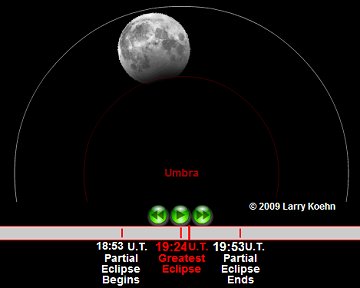
BLUE MOON ECLIPSE:  For the first time in almost 20 years, there’s going to be a "Blue Moon" on New Year’s Eve.  In Europe, sky watchers will witness an even rarer event–an eclipse of a Blue Moon on New Year’s Eve.  What are the odds? Probabilities and observing tips may be found at http://spaceweather.com.


A blue moon is the 2nd full moon in a calendar month.

From NASA we read this:


If you told a person in Shakespeare’s day that something happens "once in a Blue Moon" they would attach no astronomical meaning to the statement. Blue moon simply meant rare or absurd, like making a date for the Twelfth of Never. "But meaning is a slippery substance," says Hiscock. "The phrase ‘Blue Moon’ has been around for more than 400 years, and during that time its meaning has shifted."

The modern definition sprang up in the 1940s. In those days, the Farmer’s Almanac of Maine offered a definition of Blue Moon so convoluted that even professional astronomers struggled to understand it. It involved factors such as the ecclesiastical dates of Easter and Lent, and the timing of seasons according to the dynamical mean sun. Aiming to explain blue moons to the layman, Sky & Telescope published an article in 1946 entitled "Once in a Blue Moon." The author James Hugh Pruett cited the 1937 Maine almanac and opined that the "second [full moon] in a month, so I interpret it, is called Blue Moon."

That was not correct, but at least it could be understood. And thus the modern Blue Moon was born.

Blue moon has other connotations, too. In music, it’s often a symbol of melancholy. According to one Elvis tune, it means "without a love of my own." On the bright side, he croons in another song, a simple kiss can turn a Blue Moon pure gold.


But back to the eclipse:


On Dec. 31st, the Blue Moon will dip into Earth’s shadow for a partial lunar eclipse. The event is visible from Europe, Africa and Asia: map. At maximum eclipse, around 19:24 Universal Time, approximately 8% of the Moon will be darkly shadowed. Click on the image to launch an animated preview:

Blue Moons are rare (once every ~2.5 years). Blue Moons on New Year’s Eve are rarer still (once every ~19 years). How rare is a lunar eclipse of a Blue Moon on New Year’s Eve?

A search of NASA’s Five Millennium Catalogue of Lunar Eclipses provides an approximate answer. In the next 1000 years, Blue Moons on New Year’s Eve will be eclipsed only 11 times (once every ~91 years). So this is a rare event, indeed.


Very cool.


Posted in Just Too Cool | Tagged
6 Comments

From First Things and Forum Letter: “Temple prostitution: a modest proposal”

Want to have a chuckle while looking at a serious issue?

Serious for the Lutherans, that is.

You remember the ELCA decision last summer about homosexual clergy and same-sex unions?

I picked up on the site of First Things their replay of a piece in the Lutheran Forum Letter by the nephew of the late Fr. Neuhaus, Pastor Peter Speckhard, entitled … Temple prostitution: a modest proposal.

Pastor Speckhard may have learned from his uncle to be a master of the absurd to underscore a point.

First, he explains the Lutherans have some big problems, namely…

  • —Inability to retain or reach out to young, single people, especially men. …
  • —Failure to use the gifts of the laity. Sure, it is easy to use the gifts of creative, educated, energetic, talented people. …
  • —Declining revenue. …
  • —Legalism. …
  • —Biblicism. …
  • —Irrelevance. …
  • —Worship without impact. …

Big hurdles, nicht wahr?   Pastor Speckhard has a solution.

Temple Prostitution!

Sure, some will object.  Blah blah blah.  As he points out with deadly satire, there may be Scriptural grounds for objections but, hey…  

The Biblical writers never foresaw or contemplated sanctified, faithful, God-pleasing prostitution in the churches and thus never wrote about it.

We also have to consider "interpretive nuance" and "love", which conquers all.

Go read the piece and have a good time, for free!

In effect, this type of mordent commentary truly strips away the whatever clothing the emperor/ess may have retained.

I wonder if the whole wymyn priest movement thingie understands that this is the direction they are headed.

Just askin’

Posted in I'm just askin'..., Lighter fare, The Drill | Tagged
16 Comments

The Feeder Feed

Between various bouts with the keyboard today, I took a few photos of the every busy birds at the feeder.

Lots of black and white these days.


Though other muted colors come around.

I am glad to see some House Finches back.  They were gone for a while, perhaps on that same cruise the Chickadees were on.  Not with Celebrity, I hope.

poing!

Once in while I catch some bird just hanging out. 

This Nuthatch, during a lull, just sat there, looking around for the longest time.

Similarly, I caught this woodpecker actually dozing upside down, pretty much motionless for a few minutes.

Like I said… just hanging around.

I feed the birds from your donations.

Posted in The Feeder Feed |
7 Comments

Pro-abortion Speaker Pelosi gives more public scandal

A reader alerted me to an interview in the execrable Newsweek with House Speaker Nancy Pelosi (D-CA), pro-abortion but self-named "Catholic".   You might remember some of her scintillating theological explanations about how she justified promoting abortion.

Here is a bit from the interview with my emphases and comments.


The Target

Nancy Pelosi doesn’t care if you like her. All that matters is getting the job done.
By Eleanor Clift | NEWSWEEK

Published Dec 21, 2009
From the magazine issue dated Jan 4, 2010

[…]

Q It was reported that you were negotiating with the conference of bishops.

I talked to one of the cardinals. I said to him that I believe that what we are doing honors the principles we talked about: we want to pass a health-care bill, we want it to be abortion neutral, and we want it to [have] no federal funding [for abortion], which is the law. And we believe that our language does that. They said, "We believe that it does not." I said, let’s sit down at the table and our lawyers can compare language. That’s what the meeting was about—to make our case. Clearly, the people at that table were not willing to accept what we know to be a fact.  [Someone isn’t telling the truth.]

Q I think you have had some brushes with [church] hierarchy.

[Remember… this person calls herself "Catholic"…] I have some concerns about the church’s position respecting a woman’s right to choose. [What sort of addled comment is that?  Note the language she uses.  She lives entirely within her liberal political view and even imposes its language on the teaching of the Church.] I have some concerns about the church’s position on gay rights. I am a practicing Catholic, although they’re probably not too happy about that. But it is my faith. I practically mourn this difference of opinion [Is that what it is?  A difference of opinion?  As if her opinion could possible have some sort of equivalence with the teaching of the Church… which is just the Church’s "opinion"?] because I feel what I was raised to believe is consistent with what I profess, and that is that we are all endowed with a free will and a responsibility to answer for our actions. And that women should have that opportunity to exercise their free will. [But apparently she wasn’t raised to believe that people have a right to be born.]

Q Is it difficult for you to reconcile your faith with the role you have in public life?

You know, I had five children in six years. The day I brought my fifth baby home, that week my daughter turned 6. So I appreciate and value all that they want to talk about in terms of family and the rest. When I speak to my archbishop in San Francisco and his role is to try to change my mind on the subject, well then he is exercising his pastoral duty to me as one of his flock. When they call me on the phone here to talk about, or come to see me about an issue, that’s a different story. Then they are advocates, and I am a public official, and I have a different responsibility.  [So, she has adopted the Kennedy Dichotomy.]


I cannot fathom why she hasn’t been told she must not receive Holy Communion.

How much more public scandal does she have to give before the bishops of the places where she resides take concrete action?

Posted in Emanations from Penumbras, Our Catholic Identity | Tagged
60 Comments

The Feeder Feed

I’m back and the birds are busy!

This Red-bellied Woodpecker is having a hard time with the shape of this feeder.

This Hairy Woodpecker spent some time tapping on my window next to my desk.

Chickadee.

Nuthatch, scrounging.

Posted in The Feeder Feed |
6 Comments

REMINDER – 1 January – Holy Day of Obligation

1 January 2010 is a Holy Day of Obligation in the United States. 

It is among the Holy Days for the Latin Church.

If you are able to go to Mass on 1 January and do not go, you commit a sin you must confess.  You are not obliged to receive Holy Communion, but you have to go to Mass.

So, right now, make your plan about going to Mass on Friday, 1 January.

Do you remember your Precepts of the Church?

1. You shall attend Mass on Sundays and on holy days of obligation and rest from servile labor.
2. You shall confess your sins at least once a year.
3. You shall receive the sacrament of the Eucharist at least during the Easter season.
4. You shall observe the days of fasting and abstinence established by the Church.
5. You shall help to provide for the needs of the Church.

Cf. The Catechism of the Catholic Church 2041-3.

II. THE PRECEPTS OF THE CHURCH

2041 The precepts of the Church are set in the context of a moral life bound to and nourished by liturgical life. The obligatory character of these positive laws decreed by the pastoral authorities is meant to guarantee to the faithful the very necessary minimum in the spirit of prayer and moral effort, in the growth in love of God and neighbor:

2042 The first precept ("You shall attend Mass on Sundays and holy days of obligation and rest from servile labor") requires the faithful to sanctify the day commemorating the Resurrection of the Lord as well as the principal liturgical feasts honoring the mysteries of the Lord, the Blessed Virgin Mary, and the saints; in the first place, by participating in the Eucharistic celebration, in which the Christian community is gathered, and by resting from those works and activities which could impede such a sanctification of these days.82

The second precept ("You shall confess your sins at least once a year") ensures preparation for the Eucharist by the reception of the sacrament of reconciliation, which continues Baptism’s work of conversion and forgiveness.83

The third precept ("You shall receive the sacrament of the Eucharist at least during the Easter season") guarantees as a minimum the reception of the Lord’s Body and Blood in connection with the Paschal feasts, the origin and center of the Christian liturgy.84

2043 The fourth precept ("You shall observe the days of fasting and abstinence established by the Church") ensures the times of ascesis and penance which prepare us for the liturgical feasts and help us acquire mastery over our instincts and freedom of heart.85

The fifth precept ("You shall help to provide for the needs of the Church") means that the faithful are obliged to assist with the material needs of the Church, each according to his own ability.86

The faithful also have the duty of providing for the material needs of the Church, each according to his own abilities.87

82 Cf. CIC, cann. 1246-1248; CCEO, cann. 881 § 1, § 2, § 4.
83 Cf. CIC, can. 989; CCEO, can. 719.
84 Cf. CIC, can. 920; CCEO, cann. 708; 881 § 3.
85 Cf. CIC, cann. 1249-1251; CCEO, can. 882.
86 Cf. CIC, can. 222; CCEO can. 25; Furthermore, episcopal conferences can establish other ecclesiastical precepts for their own territories (Cf. CIC, can. 455).
87 Cf. CIC, can. 222.

Posted in "How To..." - Practical Notes | Tagged ,
62 Comments