A 1st TLM experience

From a reader:

I know you must be very busy, but I thought you may like to share my experience on your blog. I attended my first Tridentine Mass, which was a High Mass, celebrated at the Oratory of St. Francis de Sales in St. Louis, Missouri today. I had never been to one before, and I thought it was simply a magnificent experience. It just seemed to be so much more reverent the NO Masses which are celebrated at the extremely liberal parishes in my area. It was a stunning experience, and, even though my Latin is very poor, I was able to follow along with what was going on the entire time. It was a truly beautiful experience, and I look forward to being able to attend there again. The Oratory of St. Francis de Sales is run by the Institute for Christ the King, the Sovereign Priest. Words can not begin to describe how beautiful of an experience this was, and I would encourage anyone who has never been to a TLM before that they should attend, even if it’s only once, just to experience such a magnificent Mass.

Posted in Brick by Brick, SUMMORUM PONTIFICUM |
17 Comments

Phoenix, AZ: secularist pogrom focused on church bells

The late Msgr. Richard Schuler loved church bells.  The lofty bell tower of St. Agnes Church in St. Paul with its four bells, would ring the hours and half hours 24/7, as well as the Angelus at noon and 6 pm, summons bells before masses, a somber toll on 3 pm every Friday, as well as ringing for the Resurrection on Saturday evenings.   The great bell, "Richard", would toll at the consecration on Sunday Masses, for funerals and all the bells would peal at the end of funerals and for weddings.

These bells functioned to remind the people of the neighborhood what day it was, when to go to church for Mass, what was going on in church, when to to to pray during the day … the echo of an era when the once heavily Catholic immigrant neighbors could walk to church.  A reminder to us today that religion should be woven into all our daily activities.  Our Catholic identity is 24/7.

If perhaps someone would call the rectory to complain about the bells… usually someone with a snoot full or simply bilious by nature… Msgr. Schuler would make the observation that, after decades of studying the question, he had come to the conclusion that if someone didn’t like church bells, it was because they had a bad conscience about something. 

I was interested, therefore, by this story from CNA about the ringing of church bells in Arizona.

My emphases and comments.


Arizona Catholic church sues to ring its bells

Phoenix, Ariz., Sep 6, 2009 / 04:23 am (CNA).- Three churches have filed a lawsuit against the city of Phoenix, charging that its noise ordinance which prohibits the ringing of their church bells is unconstitutional and suppresses a long American tradition. [Get this…] One pastor was sentenced to jail [!?!]  for violating the ordinance, which allows an exception for ice cream trucks but not for churches.  [What’s wrong with this picture?]

St. Mark Roman Catholic Parish, First Christian Church, and Christ the King Liturgical Charismatic Church have challenged the ordinance in a lawsuit filed by attorneys from the Alliance Defense Fund (ADF).  [True ecumenism.]

Christ the King Church joined the lawsuit after its pastor, Bishop Rick Painter, was sentenced for ringing his church’s bells as a way of praising God. He was given a suspended sentence of ten days in jail and three years’ probation on June 3.  [probation… talk about the Clapper of Damocles!]

“The church bells chime a short, ancient melody of praise to God no louder than an average conversation,” Bishop Stanley explained. [Must be a carillon.] “It’s true that people can hear the bells at that low level. After all, bells are meant to be heard. But the city’s problematic ordinance is being used to inconsistently single out the peaceful sound of this time-honored expression of worship while allowing exceptions for others.”

A judge [One wonders about this judge.  Is this an elected judge?] has issued an order restricting chimes at the church to no more than 60 decibels for two minutes on Sundays and specific religious holidays.

An ADF statement reports that the bells at Bishop Painter’s church normally chime every hour from 8 a.m. to 8 p.m. Their volume has been registered as emitting 67 decibels at the nearest property line. By comparison, a whisper is 30 decibels and a normal conversation runs from 60 to 70 decibels.

Under an exception to the ordinance, ice cream trucks are allowed to emit sounds of up to 70 decibels at a distance of 50 feet.

In August, after a neighbor complained about the bells, [Wouldn’t it be interesting to interview that person?] city officials told St. Mark Roman Catholic Parish that ringing its bells could be considered in violation of the same noise ordinance. The officials included two representatives from the Phoenix city prosecutor’s office and two city police officers.

St. Mark has rung its bells for the last 20 years. Christians have used church bells since at least the early middle ages.

ADF senior legal counsel Erik Stanley explained the suit, saying that churches shouldn’t be published “for exercising their faith publicly.”

He charged that the law is “unconstitutionally vague” and has been abused to silence a form of worship that has “peacefully sounded through the streets of our nation since its founding.”

“No one should be sentenced to jail and probation for doing what churches have traditionally done throughout history, especially when the sound of the church’s bells does not exceed the noise level that the law allows for ice cream trucks,” Stanley said.

The suit seeks to ensure that the churches can ring their bells without fear of future prosecution and criminal penalties.


Once upon a time in a place such as Arizona, heavily Hispanic, you would never have heard this.  Now that Arizona has been invaded by lefties and progressivists from the East, suddenly religion in public is a problem.

Bad consciences? 

QUAERUNTUR:

Would this judge issue a similar edict about an adhan? A mosque’s call to prayer? 

Would the judge jail a muezzin?

UPDATE 7 Sept 1705 GMT

The Bourdon of Notre Dame in Paris

[flv]09_09_07_ND_Paris_Bourdon01.flv[/flv]
 

[flv]09_09_07_ND_Paris_Bourdon02.flv[/flv]

Posted in I'm just askin'..., Our Catholic Identity |
53 Comments

True active participation

The great Fr. Ray Blake of St. Mary Magdalen in Brighton has a highly amusing piece on his blog:

I had a telephone call from Fr Mark Elvins this evening, before becoming a Capuchin friar he was a curate here. He is the author of Catholic Trivia.

One piece of trivia he told me was that Gladstone’s sister was received into the Church here. She was somewhat eccentric and so caught up in the liturgy that she wore the colour of the day. Her enthusiasm for liturgical imitation apparently overcame her on Holy Thursday when at the stripping of the altar, she had to be restrained from removing more than her coat!

Now that is active participation!

Posted in Lighter fare |
11 Comments

PODCAzT 90: St. Leo on the beatitudes; the sacred, sacrilege and reparation

On this beautiful Saturday of the 22nd Week of Ordinary Time, Labor Day Weekend, I have spend inside laboring on another PODCAzT just for you listeners.

Today we hear from St. Pope Leo I, “the Great” (+461) in his Sermon 95, on the Beatitudes in the Sermon on the Mount (Matthew 5).  From across the centuries Leo’s voice rings out about the root of the “happiness” expressed in the beatitudes, humility, which cuts across all classes of society and each person’s lot in life.  There are some wonderful images, such as “consecrated tears”.

I was inspired to do this audio project by the second reading in the Office of Readings in today’s Liturgia horarum, or Liturgy of the Hours, the “office”, which priests are obliged to recite.  It is always a pleasure to work with Leo.

I then ramble for quite a while the sacred and the profane.  We need to recover a sense of the sacred, and how it is different from the temporal sphere, dominated by the “Prince of this world”.  There are many acts of “sacrilege” occurring now.  I talk about what sacrilege is and then speak of reparation.
https://zuhlsdorf.computer/podcazt/09_09_05.mp3

And check out the PODCAzT Page!

090 09-09-05 St. Leo on the beatitudes; the sacred, sacrilege and reparation
089 09-08-31 Imitation of Christ on temptation and consolation, Fr. Z rambles about the world, the flesh and the devil
088 09-06-11 Consecration of the Human Race to the Sacred Heart; Leo XIII’s Annum Sacrum

051 08-02-25 Communion in the hand


Posted in Patristiblogging, PODCAzT | Tagged ,
8 Comments

Rockford, IL: The Labor Day assault on Saint Mary’s Oratory

You have probably heard examples of encroachment on private property by state and city governments through aggressive use of "eminent domain".

A reader alerted me to this Very Alarming Development in the Diocese of Rockford, IL.

This is from the Rockford Catholic Examiner with my emphases and comments:

The Labor Day assault on Saint Mary’s Oratory
September 4, 11:56 AM
Rockford Catholic Examiner
Scott P. Richert

In 2010, the second-oldest Catholic church in Rockford will celebrate its 125th anniversary.  Yet just a few years ago, it seemed as if Saint Mary’s Oratory might not reach that milestone.

Founded in 1885, Saint Mary’s is an imposing red-brick Gothic structure. The stained-glass windows are some of the most intricate and beautiful of any church in Rockford. Having survived a fire in 1962 and low Mass attendance throughout the 1970’s and 1980’s, Saint Mary’s became the home of Rockford’s only traditional Latin Mass in 1997, when Bishop Thomas Doran put the church under the administration of the Institute of Christ the King.

Catholics from across northern Illinois and as far north as Madison, Wisconsin, began to flock to Saint Mary’s. But [The point…] when the voters of Winnebago County approved the construction of a new county jail, the church’s future was cast into jeopardy.

Over Labor Day [NB:] 2003, an email from a member of the Winnebago County Board inadvertently revealed county officials’ plans to force the Rockford diocese to sell Saint Mary’s to the county.  The church and its school would be razed, and the grounds would be used for parking for the new jail.

Fortunately, one county board member, the late Mary Ann Aiello, sounded the alarm, and the parishioners of Saint Mary’s, as well as Catholics from across the country, rode to the rescue.  Faced with national headlines, opposition from the Rockford diocese and from the Catholic League for Religious and Civil Rights, the county dropped its plans.

Today, 500 Catholics attend Mass at Saint Mary’s every Sunday, across the street from the new county jail.  And when they celebrate the church’s 125th anniversary next year, they will undoubtedly light many candles, and offer many prayers, for the soul of Mary Ann Aiello—a Catholic first, and a politician second.

There is something redolent of the ancient in this story.

Posted in Our Catholic Identity, The future and our choices | Tagged , , ,
9 Comments

Six years of Saturn… and I don’t mean the car!

JUST.TOO.COOL!

From APOD:

Posted in Just Too Cool |
3 Comments

QUAERITUR: age for starting to train altar boys

An e-mail came with a question.

It came without a subject in the subject line and I usually just delete them, but I opened this one.

What is the "rule of thumb" ,age wise, for boys to start to train for the Latin Mass?
Any help/suggestions would be greatly appreciated.

I think that the age of First Holy Communion might not be too early to start thinking about learning and speaking the Latin responses.

What about those of you involved with training altar boys?

Folks?  Want to chime in?

Posted in "How To..." - Practical Notes, ASK FATHER Question Box |
25 Comments

What is this?

I am getting interested in mushrooms. Anyone know what this one is?

I am pretty sure that this is Langermannia gigantea.

Posted in My View |
13 Comments

Catholic Herald front and center on “Reform of the Reform”

The Catholic Herald, the best Catholic weekly in the UK, has a front page piece on the Reform of the Reform of the Church’s liturgy.  It is penned by the wonderfully persistent Anna Arco.

My emphases and comments.

Vatican seeks ‘reform
of the reform’
By Anna Arco

28 August 2009

The Vatican has proposed sweeping reforms to the way Mass is celebrated, it has been claimed.

Communion on the tongue, Consecration celebrated ad orientem (facing east) and renewed use of Latin could all be re-introduced to ordinary Sunday Masses as part of proposals put forward by the Congregation for Divine Worship.

Andrea Tornielli, a senior Vatican watcher, reported last week that the congregation’s cardinals and bishops voted "almost unanimously in favour of greater sacrality of the Rite" at a plenary meeting in March.

Members of the congregation are said to have put forward 30 propositiones ("propositions") aimed at reforming the way in which the Novus Ordo has been celebrated since the Second Vatican Council.

These set out to recover a "sense of Eucharistic worship", the use of the "Latin language in the celebration" and include the "remaking of the introductory parts of the Missal in order to put a stop to liturgical abuses".  [I have said elsewhere that I am all for this.  However, we already have liturgical laws on the books now… in force now.  We might think about using them.  When laws are promulgated repeatedly, they are weakened.]

According to Mr Tornielli the propositions, which were voted on by the congregation on March 21, also include placing renewed emphasis on receiving Communion on the tongue "according to the norms".

Mr Tornielli said that Cardinal Antonio Cañizares Llovera, the prefect for the Congregation for Divine Worship, had also been studying ways to return to the ad orientem celebration of the Mass. This would see the priest and the congregation facing the cross and the altar during the Consecration.  [Long ago I made a series of PODCAzTs which dealt with Pope Benedict’s thought about ad orientem worship.  I concluded then – and I hold now – that his "Benedictine arrangement" of altars (i.e., Mass facing the people over the altar, but with the traditional six candles and the centrally placed Cruficix between the congregation and priest) was a temporary… provision… transitional arrangement on the way to an eventual return to ad orientem worship.]

He also said that the "propositiones foresee a return to the sense of sacredness and to adoration, but also a recovery of the celebrations in Latin in the dioceses, at least in the main solemnities, as well as the publication of bilingual Missals – a request made at his time by Paul VI – with the Latin text first". [Having a bilingual Roman Missal would be helpful.]

Mr Tornielli said these were the first concrete steps towards the "reform of the reform", a notion outlined in Pope Benedict’s 2000 book, The Spirit of the Liturgy. The book argues that some of the liturgical reforms following the Second Vatican Council got out of hand and needed reform as they no longer reflected the changes envisaged by the Council Fathers.

Cardinal Cañizares delivered the propositiones to Pope Benedict on April 4, receiving the Pope’s approval, Mr Tornielli said. But Mr Tornielli also said that the "reform of the reform" would take a long time before it would be fully implemented. He said it would require a long and patient labour "from below" with the aid of the bishops.

"The point of departure and ultimately also that of arrival is the Council’s Constitution on the liturgy Sacrosanctum Concilium," he said. "The Pope is convinced that it serves nothing to make hasty steps or to drop directives from on high, with the risk then that it could remain a dead letter. The style of Ratzinger is one of comparison and, above all, of example. This is evidenced in the fact that for a year now anyone who receives Communion from the Pope must kneel on a kneeler prepared for that purpose by the master of ceremonies."  [You have read it here a hundred times if you have read it once: The Holy Father has a vision for the Church.  He wants to revitalize Holy Church’s identity, both within the Church herself and to the watching world.  The tip of the spear in this effort ad intra and ad extra is LITURGY… sound WORSHIP.  It is part of Pope Benedict’s "Marshall Plan" for the Church to reform our worship.] 

Shawn Tribe, the editor and founder of the New Liturgical Movement, an online magazine which deals with liturgy, said: "Given what we know from the Pope’s writing and discourses over the years, one can at least say that what is being suggested would be consonant with the Pope’s own liturgical thought and approach.

"Evidently we can only speculate at this point and will have to wait and see what, if anything, might actually come to pass, though Tornielli has proven himself reliable in these regards in the past. If what has been reported does indeed come to pass, it would certainly be a matter of no little significance."

Fr Ciro Benedettini, the deputy spokesman for the Holy See, downplayed the report on Monday. He said: "At the moment, there are no institutional proposals in existence regarding a modification of the liturgical books currently in use."  [This was the "non-denial denial"]

But Mr Tornielli stood by his story, saying that he interpreted Fr Benedettini’s denial of "institutional proposals" as indicative of "unofficial (for now) projects".

The American Catholic News Service (CNS) quoted anonymous Vatican sources as denying that proposals had been voted on at the plenary meeting. Rather, the congregation had forwarded its suggestions on the subject of Eucharistic Adoration – which had been the theme of the plenary session – to the Pope. The subject of ad orientem had never been discussed, according to the CNS source

The Second Vatican Council’s Constitution on the Sacred Liturgy, Sacrosanctum Concilium, said that Latin should remain the language of the liturgy even as it promoted the wider use of the vernacular.

It said that "the use of the Latin language is to be preserved in the Latin rites" but also that "since the use of the mother tongue, whether in the Mass, the administration of the sacraments, or other parts of the liturgy, frequently may be of great advantage to the people, the limits of its employment may be extended".

Communion on the tongue continues to be the liturgical norm, while reception on the hand remains an indult granted on a local level. Archbishop Malcolm Ranjith, then secretary of the worship congregation, caused a stir last year when he said that Communion should be received on the tongue.

Archbishop Ranjith argued that the practice had been brought in hastily in some places and was only approved by the Vatican after it had been introduced. [In other words… it was introduced in disobedience to the Church’s law.]

The 2004 instruction Redemptionem Sacramentum also re-emphasised that the faithful had a right to receive Communion on the tongue but that receiving Communion on the hand was only granted to the faithful in areas where an indult had been given. Officials for the Congregation for Divine Worship were unavailable for comment.
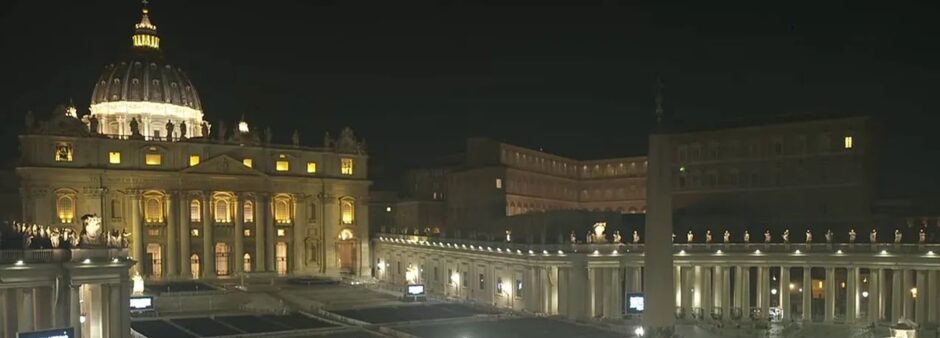
Posted in Brick by Brick | Tagged , , , ,
17 Comments

First THURSDAY of the month – plenary indulgence offered

Remember!

In this year dedicated to priests and prayer for priests, Holy Church has provided lay people with a special plenary indulgence on first Thursdays of each month.

For the faithful, a plenary indulgence can be obtained on the opening and closing days of the Year for Priests, on the 150th anniversary of the death of St. Jean-Marie Vianney, on the first Thursday of the month, or on any other day established by the ordinaries of particular places for the good of the faithful.

To obtain the indulgence the faithful must attend Mass in an oratory or Church and offer prayers to "Jesus Christ, supreme and eternal Priest, for the priests of the Church, or perform any good work to sanctify and mould them to his heart."

The conditions for the faithful for earning a plenary indulgence are to have gone to confession and prayed for the intentions of the Pope.

BENEDICT XVI’S PRAYER INTENTIONS FOR SEPTEMBER

VATICAN CITY, 1 SEP 2009 (VIS) – Pope Benedict XVI’s general prayer intention for September is: "That the word of God may be better known, welcomed and lived as the source of freedom and joy".

  His mission intention is: "That Christians in Laos, Cambodia and Myanmar, who often meet with great difficulties, may not be discouraged from announcing the Gospel to their brothers, trusting in the strength of the Holy Spirit".

Posted in "How To..." - Practical Notes, Year of Priests |
6 Comments