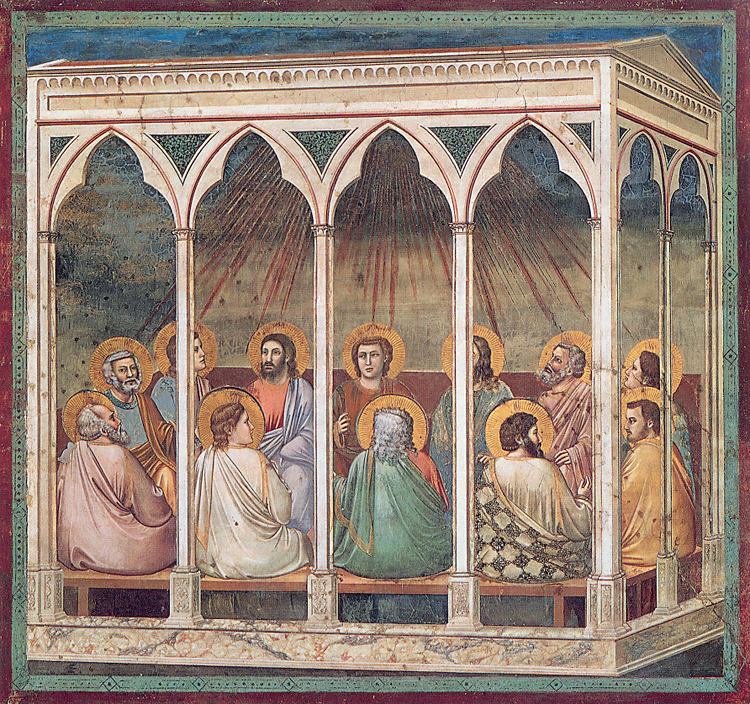
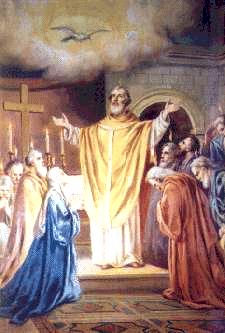
5th Glorious Mystery: The Coronation of Our Lady

queen-of-heavenWe conclude our Patristic Rosary Project today with the:

5th Glorious Mystery: The Coronation of Our Lady

Can we be certain of our final judgment? Those who say they are run the risk of the sin of presumption. We must proceed always with humbly confident perseverance.

Salvation is possible. Our Lord has taken our humanity to the heavenly throne, where it (and we in it) already are glorified. The saints the Church has discerned through our long earthly pilgrimage, demonstrate that virtue and perseverance is possible. They intercede before God’s throne for us. Our greatest example and intercessor is the Blessed Mother of God, our Mother and Mother of the Church, who was assumed body and soul into heaven and is now reigning as heavens Queen. In our recitation of the Rosary we gaze at Mary our motherly Queen who redirects our gaze to the source of her beauty, the Lord Himself. Their glory is our promise. But first, with tools such as the Rosary in hand, we must make our way through this world and persevere to the end and our judgment.

Cassiodorus (+c. 585) writes:

The holy man demands judgment because he is certain of the Lord’s mercy. As Paul has it: “As to the rest, there is laid up for me a crown of justice, which the Lord, the just Judge, will render to me in that day.” He walks in his innocence because… he puts his trust in the Lord. The presumption he shows is not in his own powers but in God’s generosity. [Explanation of the Psalms 25.1]

The idea of judgment can make us at times shivers. But we approach it knowing that Mary is our advocate. We can come to heaven with some measure of humble confidence. St. Augustine of Hippo (+430) wrote to Hesychius a bishop in Dalamatia:

I have received the letter of your Reverence in which you urge on us the great good of loving and longing for the coming of our Savior. In this you act like the good servant of the master of the household who is eager for his lord’s gain and who wishes to have many sharers in the love which burns so brightly and constantly in you. Examining, therefore, the passage you quoted from the apostle where he said that the Lord would render a crown of justice not only to him but to all who love His coming, we live as uprightly as he and we pass through this world as pilgrims while our heart constantly expands with this love, and whether He comes sooner or later than He is expected, His coming is loved with faithful charity and longed for with pious affection. [ep. 199.1.1]

In heaven Mary has been crowned with glory. This is the reward of her faithfulness, a faithfulness beyond all others which merits a crown more glorious than any other. The reward of the crown is often, mostly associated with the struggle ending in bloody martyrdom. Our Lady is also crowned as the Queen of martyrs. Not all of us will be graced with the final perseverance that ends in the perfect charity which is bloody martyrdom for the sake of God and neighbor. We must persevere in far more mundane details of ongoing life, in prayer, work, and contemplation. Cassiodorus mentions something in this regard, however, which is very useful for us:

As someone has said, you will scarcely ever find that when a person prays, some empty and external reflection does not impede him, causing the attention which the mind directs on God to be sidetracked and interrupted. So it is a great and most wholesome struggle to concentrate on prayer once begun, and with God’s help to show lively resistance to the temptations of the enemy, so that our minds may with unflagging attention strain to be ever fastened on God. Then we can deservedly recite Paul’s words: I have fought a good fight, I have finished my course, i have kept the faith. [Explanation of the Psalms 101.1]

Coronation-of-the-Virgin-AdiBartoloOur Blessed Mother exemplifies perfectly the struggle of perseverance. Given exceptional graces, Mary was open with perfect focus to all God offered her, including her sufferings in unity with her Son. Her willing participation in the Passion of the Lord makes her the greatest of the martyrs, and while she did not physically receive the Lord’s wounds, she suffered by them nonetheless.

St. John Chrysostom (+407) speaks of crowns:

We see no garments or cloaks, but we see crowns more valuable than any gold, than any contest prizes or rewards, and ten thousand blessings stored up for those who live upright and virtuous lives on earth. [On the incomprehensible nature of God 6.7]

The many beautiful things of this world can take our attention and affection so much that they begin to displace in us our hunger for the reward of heaven. We must keep always firmly in mind that everything in this world fades and passes. Our hope of lasting happiness is found only in heaven with God. Venerable Bede (+735) speaks to this:

The flower of the field is pretty and its smell is pleasant for a while, but it soon loses the attraction of its beauty and charm. The present happiness of the ungodly is exactly the same – it lasts for a day or two and then vanishes into nothing. The rising sun stands for the sentence of the strict Judge, which puts a quick end to the transient glory of the reprobate. Of course it is also true that the righteous person flourish, though not in the same way. The unrighteous flourish for a time, like glass, but the righteous flourish forever like great trees, as Scripture says: “The righteous flourish like the palm tree.” [Concerning the Epistle of James]

holy-theotokos-iconDidymus the Blind (+398), the teacher of St. Jerome and Rufinus expands this:

James does all he can to encourage people to bear their trials with joy, as a burden which is bearable, and says that perfect patience consists in bearing this for their own sake, not for the hope of some better reward elsewhere. He nevertheless tries to persuade his hearers to rely on the promise that their present state will be put right. The person who has fought the hard battles will be perfectly able to handle anything. Someone who comes through his troubles in this way will be duly prepared to receive his reward, which is the crown of life prepared by God for those who love him. [Commentary on James]

The Rosary teaches us to gaze, with Mary as our guide and companion, always upon the face of Christ, who reveals man more fully to himself. In crowning our Lady as Queen, the Lord does in an unsurpassed way what He does in each one of us: He crowns His own merits. But in doing so, Christ reveals more and more about who we are and what we were made for.

The Madonna of the Magnificat, Detail of the Virgins Face and Crown, 1482


Posted in Our Solitary Boast, Patristiblogging, Patristic Rosary Project | Tagged , ,
1 Comment

My view…

…no view.

Updated….

Updated again…

And again….


Posted in My View |
5 Comments

4th Glorious Mystery: The Assumption

We continue our Patristic Rosary Project today with the:

4th Glorious Mystery: The Assumption

Although Ven. Pius XII refers carefully to Mary having completed the course of her life, rather than explicitly to her death in the document whereby he declared infallibly the dogma of the Assumption, and St. John Paul II adverts to the end of Mary’s life in a General Audience in 1997 – as do other saintly writers – we do not have from the Church a definitive or infallible teaching beyond a shadow of a doubt whether Mary died and then was assumed body and soul into heaven at that moment or if she was assumed without dying.  That said, it was certainly fitting that, if her Divine Son tasted death, then she would as well.  On the other hand, it is possible that in some manner like to perhaps what unfallen man might have been able to do, Mary’s love for God could no longer be contained and went to God by loving choice rather than experiencing the punishment of the Original Sin she did not have.

Even in the Eastern tradition, which speaks of the Dormition, the Sleeping, of Mary we have a sub-current of death.  Sleep is certainly a euphemism for death and they are closely related. Greek κοίμησις gives us κοιμητήριον or Latin coemeterium, whence English “cemetery”, which is a “sleeping place”. Traditions are divided about her last earthly breaths. Some authors hold that she did not die before her Assumption. There is also a strong tradition that she was buried.  That said, no one really knows where, though the cult of the burial places of the holy has always been strong, even in the days before Christ.

Perhaps a good explanation is that Our Blessed Mother, desiring to be like her Son, who did die, chose herself to die though Satan had no hold on her.  It was fitting that she, the daughter of her Son and disciple of Her Lord, should be as He was.  So, after a brief interval during which no corruption touched her, her soul and body were reunited in heaven in the presence of God.

In any event, we know with our Catholic faith, and by infallible authority, that at the end of her earthly life, the Mother of God was assumed into heaven and no stain of the corruption of the grave touched her.

Our humanity is seated at the right hand of the Father in the divine Person of our Lord, but now also in the human person of our Lady.

Christ is consubstantial with the Father. Christ is consubstantial with His Mother.

Mary is Mother of a divine Person with two natures. She is not Mother of part of Christ, but Mother of all of Christ in His integrity. And so, we can call her Mother of God and Mother of the Church. Her heavenly Assumption was fitting.

There are not elaborate reflections in the writings of the Fathers on the Assumption, because it was not a main point of reflection. Still, we can find their thoughts on some passages of Scripture which help us to understand Mary’s role in the plan of our salvation.

As a perfect model for our own Christian discipleship, we can consider, among many texts, Proverbs 8:

And now, my sons, listen to me: happy are those who keep my ways. Hear instruction and be wise, and do not neglect it. Happy is the man who listens to me, watching daily at my gates, waiting beside my doors. For he who finds me finds life and obtains favor from the LORD; but he who misses me injures himself; all who hate me love death.

While this concerns Wisdom, in a sense it harks to Mary, Wisdom’s seat. Here is the reflection of Athenagoras on this section of Proverbs:

[The Son] is the first offspring of the Father, I do not mean that He was created, for, since God is eternal mind, He had His Word within Himself from the beginning, being eternally wise. Rather did the Son come forth from God to give form and actuality to all material things, which essentially have a sort of formless nature and inert quality, the heavier particles being mixed up with the lighter. The prophetic Spirit agrees with this opinion when He says, “The Lord created me as the first of His ways, for His works.” Indeed we say that the Holy Spirit Himself, who inspires those who utter prophecies, is an effluence from God, flowing from Him, and returning like ray of the sun. Who, then, would not be astonished to hear those called atheists who admit God the Father, God the Son, and the Holy Spirit, and who teach their unity of power and their distinction in rank? … We affirm, too, a crowd of angels and ministers, whom God, the maker and creator of the world, appointed to their several tasks through His Word, He gave them charge over the good order of the universe, over the elements, the heavens, the world, and all it contains. [A plea regarding Christians 10]

This fellow sounds a bit like a subordinationist, but he is fascinating. This passage is interesting also for its hints at the cosmology and physics of late antiquity. Also, it aims at the spiritual hierarchy in which our wondrous Lady has a privileged place.

Consider that the reward of assumption into the beatific vision stems as well from her perfect act of free will when she gave her “Fiat” to God’s will as expressed by the angel. Here is St. Augustine speaking of the impact of free will:

Man in paradise was capable of self-destruction by abandoning justice by an act of will; yet if the life of justice was to be maintained, his will alone would not have sufficed, unless He who made Him glad had given him aid. But, after the fall, God’s mercy was even more abundant, for then the will itself had to be freed from the bondage in which sin and death are the masters. There is no way at all by which it can be freed by itself, but only though God’s grace, which is made effectual in the faith of Christ. Thus, as it is written, even the will by which “the will itself is prepared by the Lord” so that we may receive the other gifts of God through which we come to the Gift eternal – this too comes from God. [Enchiridion 28.106]

God’s grace and Mary’s “Fiat” which was by grace. Mary was drawn with love into God’s plan and, later, into God’s presence. The Fathers made frequent use of the Song of Songs. St. Gregory the Great writes about the exchanges of heaven and earth which marked the plan of salvation:

The Church speaks through Solomon: “See how he comes leaping on the mountains, bounding over the hill!” … By coming for our redemption the Lord leaped! My friends, do you want to become acquainted with these leaps of His? From heaven He came to the womb, from the womb to the manger, from the manger to the Cross, from the Cross to the sepulcher, and from the sepulcher He returned to heaven. You see how Truth, having made Himself known in the flesh, leaped for us to make us run after Him. [Forty Gospel Homilies 29]

Our Lady, who would feel Christ leap beneath her heart, herself leapt after Christ in her heart by her “Fiat”. She leapt to begin His public ministry when she said at Cana “Do whatever He tell you.” She leapt up Calvary with Him when the Blood and water flowed down. Her motherly and Christian heart leapt in joy in seeing Him gloriously risen. She leapt to Him in heaven when her earthly life was concluded.

In heaven Mary shines with the glory God shares with her. In the book of Revelation we have a description chapter 12 of the woman clothed with the sun. The Fathers speak about this image. They will mostly consider the woman as an image of the Church. We cannot reduce the Church to Mary. Nor in talking of the Church as Christ’s Body reduce Christ to the Church. But the three, Christ, Mary and Church are intimately associated. Hippolytus (+245) writes:

By the “woman clothed with the sun”, he meant most manifestly the Church, endued with the Father’s Word, whose brightness is above the sun. And by “the moon under her feet,” he referred to [the Church] being adorned, like the moon, with heavenly glory. And the words “upon her head a crowd of twelve stars” refer to the twelve apostles by whom the Church was founded.

Of course Christ founded the Church on the Apostles, and chiefly upon the Rock who is Peter. The description of the woman, however, fits Mary the Mother of the Church as well as the Church herself. Here is an extended piece by someone not too many in the West may read, Oecumenius (6th c.) called the “Rhetor” who wrote the earliest Greek commentary on Revelation:

The vision intends to describe more completely to us the circumstances concerning the antichrist…. However, since the incarnation of the Lord, which made the world his possession and subjected it, provided a pretext for Satan to raise this one up and to choose him [as his instrument] – for the antichrist will be raised to cause the world again to fall from Christ and to persuade it to desert to Satan – and since moreover His fleshly conception and birth was the beginning of the incarnation of the Lord, the vision gives a certain order and sequence to the material that it is going to discuss and begins the discussion from the fleshly conception of the Lord by portraying for us the mother of God. What does he say? “And a sign appeared in heaven, a woman clothed with the sum and the moon was under her feet.” As we said, it is peaking about the mother of our Savior. The vision appropriately depicts her as in heaven and not on the earth, for she is pure in soul and body, equal to an angel and a citizen of heaven. She possesses God who rests in heaven – “for heaven is my throne” – it says yet she is flesh, although she has nothing in common with the earth nor is there any evil in her. Rather, she is exalted, wholly worthy of heaven, even though she possesses our human nature and substance. For the Virgin is consubstantial with us. Let the impious teaching of Eutyches, which make the fanciful claim that the Virgin is of another substance than we, be excluded from the belief of the holy courts together with his other opinions. And what does it mean that she was clothed with the sun and the moon was under her feet? The holy prophet Habakkuk, prophesied concerning the Lord, saying, “The sun was lifted up, and the moon stood still in its place for light.” calling Christ our Savior, or at least the proclamation of the gospel, the “sun of righteousness”. When He was exalted and increased, the moon – that is, the law of Moses – “stood still” and no longer received any addition. For after the appearance of Christ, it no longer received proselytes from the nations as before but endured diminution and cessation. You will, therefore, observe this with me, that also the holy Virgin is covered by the spiritual sun. For this is what the prophet calls the Lord when concerning Israel he says, “Fire fell upon them, and they did not see the sun.” But the moon, that is, the worship and citizenship according to the law, being subdued and become much less than itself, is under her feet, for it has been conquered by the brightness of the gospel. And rightly does he call the things of the law by the word “moon”, for they have been given light by the sun, that is, Christ just as the physical moon is given its light by the physical sun. The point would have been better made had it said not that the woman was clothed with the sun but that the woman enclothed the sun, which was enclosed in her womb. However, that the vision might show that the Lord, who was being carried in the womb, was the shelter of His own mother and the whole creation, it says that He was enclothing the woman. Indeed, the holy angel said something similar to the holy Virgin: “The Spirit of the Lord will come upon you, and the power of the Most High will overshadow you.” For to overshadow is to protect, and to enclothe is the same according to power. [Commentary on the Apocalypse 12.1-2]

Take careful note of the image drawn on by the interesting Oecumenius, which also speaks to the cosmology of late antiquity. First, Oecumenius either knew that the sun gave light to the moon, as it does, or he extrapolates this from the glory that Christ gives to Mary.

All our Marian feasts, all our reflection, to keep the sunlight and moon theme going, always must draw us back to the Person of the Lord. We reflect on the face of the Lord who is reflected in the face of His Mother.

Our recitation of the Rosary brings us to know the Lord more and more and, in turn, know ourselves better.

We reflect His image and likeness and He came into the word to reveal us more fully to ourselves.

Posted in Patristiblogging, Patristic Rosary Project | Tagged ,
Comments Off on 4th Glorious Mystery: The Assumption

3rd Glorious Mystery: Descent of the Holy Spirit

We continue our Patristic Rosary Project today with the:

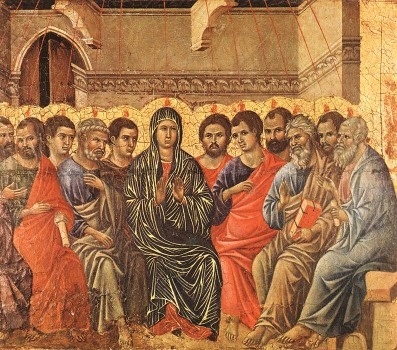
3rd Glorious Mystery: Descent of the Holy Spirit

Pentecost is the birthday of the Church, when the Holy Spirit breathes His own life into the Body and all the members. The descent of the Holy Spirit marks one of the ways in which Christ is faithful to His promise that He would be “with us always” (Matthew 28). The Scriptures describe the coming of the Holy Spirit, ru’ach, as a mighty wind rushing and as fire fifty days after the Lord’s Resurrection on a Jewish festival called the “feast of weeks” (Cf. Exodus 34:22; Deut 16:10). Here is St. Cyril of Jerusalem (+386):

‘And there appeared unto them cloven tongues like as of fire, and it sat upon each of them; and they were all filled with the Holy Spirit’ (Acts 2:3-4). They partook of fire, not of burning but of saving fire; of fire which consumes the thorns of sins, but gives luster to the soul. This is now coming upon you also, and that to strip away and consume your sins which are like thorns, and to brighten yet more that precious possession of your souls, and to give you grace; for He gave it then to the Apostles. And He sat upon them in the form of fiery tongues, that they might crown themselves with new and spiritual diadems by fiery tongues upon their heads. A fiery sword barred of old the gates of Paradise; a fiery tongue which brought salvation restored the gift. [Catechetical Lectures 17.15]

Do you remember that image of the fiery sword in the hands of the angel who closed the gates behind Adam and Eve? We have seen the Father’s refer to this before. Notice also how Cyril makes the event of Pentecost so personal. This leads to the question: Upon whom did the Holy Spirit descend? On the Twelve alone? Here is St. John Chrysostom (+407):

Was it upon the twelve that it [the Holy Spirit] came? Not so; but upon the hundred and twenty. For Peter would not have quoted to no purpose the testimony of the prophet, saying, ‘And it shall come to pass in the last days, saith the Lord God, I will pour out of My Spirit upon all flesh: and your sons and your daughters shall prophesy, and your young men shall see visions, and your old men shall dream dreams’ (Joel 2:28). ‘And they were all filled with the Holy Spirit.’ For, that the effect may not be to frighten only, therefore it is both ‘with the Holy Spirit, and with fire. And began to speak with other tongues, as the Spirit gave them utterance’ (Mt. 3:11). [Homilies on the Acts of the Apostles]

One of the signs of the working of the Spirit in the new Church is the anti-Babel, or anti-babble He produced. You remember that as punishment for his pride, in the book of Genesis God inflicted man with different languages. From that point men could no longer understand each other with facility. At Pentecost, they hear each other as if they were all using everyone else’s mother tongue. Here is St. Gregory Nazianen (+389):

But as the old Confusion of tongues was laudable, when men who were of one language in wickedness and impiety, even as some now venture to be, were building the Tower; for by the confusion of their language the unity of their intention was broken up, and their undertaking destroyed; so much more worthy of praise is the present miraculous one. For being poured from One Spirit upon many men, it brings them again into harmony. And there is a diversity of Gifts, which stands in need of yet another Gift to discern which is the best, where all are praiseworthy. [Oration on Pentecost]

The spellbinding Romanos the Melodist (+6th c.) has this about our praise of the Spirit. Amazing imagery:

Brothers, we shall hymn with praise the tongues of the disciples, because, not with elegant speech, But in divine power they have revived all men. Because they took up His Cross as a reed, So that they might again use words as fishing lines and fish for the world Since they had speech as a sharp fishhook, Since the flesh of the Master of all Has become for them a bait, it has not sought to kill But it attracts to life those who worship and praise The All-Holy Spirit. [On Pentecost]

One of my favorite lines in all of Scripture is John 21:3: Simon Peter said to them, “I’m going fishing.”

Many don’t realize the great importance the feast has always had in the Church. In the pre-Conciliar Roman rite, Pentecost actually had more liturgical bells and whistles attached to it that Easter Sunday. St. Pope Leo I, “the Great” (+461) preaches about the granduer of Pentecost with his characteristic elegance:

Pentecost holds great mysteries in itself, mysteries new and old. By them it is clear that grace was foretold through the old law, and the old law was fulfilled through grace. When the Hebrew people were freed from the Egyptians, the law was given on Mount Sinai on the fiftieth day after the sacrifice of the lambs. So, after the suffering of Christ — the true Lamb of God, who was slain — and on the fiftieth day from His resurrection, the Holy Spirit came down upon the Apostles and the crowd of believers. The true Christian can easily see how the beginnings of the Old Testament prepared for the beginnings of the gospel, and that the second covenant was founded by the same Spirit who had set up the first …

Oh, how swift are the words of wisdom! How quickly the lesson is learned when God is the Teacher! No interpretation is needed for understanding, no practice for using, no time for studying. The Spirit of Truth blows where He wills (see Jn 3:8), and the languages of each nation become common property in the mouth of the Church. So, from that day, the Gospel preaching has resounded like a trumpet. From that day, the showers of gracious gifts, the rivers of blessings, have watered every desert and all the dry land. To “renew the face of the earth” (Ps 103:30), the Spirit of God “was moving over the face of the waters” (Gen 1:2); and to drive away the old darkness, flashes of new light shone forth. By the blaze of those busy tongues, the Lord’s bright Word kindled speech into fire — fire to arouse the understanding and to consume sin. Fire has the power to enlighten and the power to burn.

God’s word has authority, and it is ablaze with these and countless other proofs. Let us, all together, wake up to celebrate Pentecost. Let’s rejoice in honor of the Holy Spirit, through whom the whole Catholic Church is made holy, and every rational soul comes alive. He is the Inspirer of Faith, the Teacher of Knowledge, the Fountain of Love, the Seal of Chastity, and the Source of all Power.

Let the spirits of the faithful rejoice. Let one God, Father, Son, and Holy Spirit, be praised throughout the world, by the confession of all languages. And may that sign of His presence, the likeness of fire, burn perpetually in His work and gift.

The Spirit of Truth makes the house of His glory shine with the brightness of His light, and He wants nothing in His temple to be dark or lukewarm.

Note the images of water, the baptismal medium, and the fire. Let’s stick with that for a moment longer. Here is St. Ambrose of Milan (+397):

So, then, the Holy Spirit is the River, and the abundant River, which according to the Hebrews flowed from Jesus in the lands, as we have received it prophesied by the mouth of Isaiah. This is the great River which flows always and never fails. And not only a river, but also one of copious stream and overflowing greatness, as also David said: “The stream of the river makes glad the city of God.”

For neither is that city, the heavenly Jerusalem, watered by the channel of any earthly river, but that Holy Spirit, proceeding from the Fount of Life, by a short draught of Whom we are satiated, seems to flow more abundantly among those celestial Thrones, Dominions and Powers, Angels and Archangels, rushing in the full course of the seven virtues of the Spirit. For if a river rising above its banks overflows, how much more does the Spirit, rising above every creature, when He touches the as it were low-lying fields of our minds, make glad that heavenly nature of the creatures with the larger fertility of His sanctification.

And let it not trouble you that either here it is said “rivers,” or elsewhere “seven Spirits,” for by the sanctification of these seven gifts of the Spirit, as Isaiah said, is signified the fulness of all virtue; the Spirit of wisdom and understanding, the Spirit of counsel and strength, the Spirit of knowledge and godliness, and the Spirit of the fear of God. One, then, is the River, but many the channels of the gifts of the Spirit. This River, then, goes forth from the Fount of Life.

And here, again, you must not turn aside your thoughts to lower things, because there seems to be some difference between a Fount and a River, and yet the divine Scripture has provided that the weakness of human understanding should not be injured by the lowliness of the language. Set before yourself any river, it springs from its fount, but is of one nature, of one brightness and beauty. And do you assert rightly that the Holy Spirit is of one substance, brightness, and glory with the Son of God and with God the Father. I will sum up all in the oneness of the qualities, and shall not be afraid of any question as to difference of greatness. For in this point also Scripture has provided for us; for the Son of God says: “He that shall drink of the water which I will give him, it shall become in him a well of water springing up unto everlasting life.” This well is clearly the grace of the Spirit, a stream proceeding from the living Fount. The Holy Spirit, then, is also the Fount of eternal life. . . .

Good, then, is this water, even the grace of the Spirit. Who will give this Fount to my breast? Let it spring up in me, let that which gives eternal life flow upon me. Let that Fount overflow upon us, and not flow away. For Wisdom says: “Drink water out of thine own vessels, and from the founts of thine own wells, and let thy waters flow abroad in thy streets.” How shall I keep this water that it flow not forth, that it glide not away? How shall I preserve my vessel, lest any crack of sin penetrating it, should let the water of eternal life exude? Teach us, Lord Jesus, teach us as Thou didst teach Thine apostles, saying: “Lay not up for yourselves treasures upon the earth, where rust and moth destroy, and where thieves break through and steal.” [On the Holy Spirit, 1.177-82]

pentecost5Ambrose is good in print, even in translation. But when you read him in Latin, out loud and will some energy, you get a sense of why even someone like Augustine, who was a professional orator in the Imperial court, was completely captivated and much in awe of this mighty figure. In his piece above, Ambrose is very much bringing our baptism to mind. Our baptism is like our own personal Pentecost. Another captivating Latin Father, St. Hilary of Poitiers (+367) wrote about the commission laid by Christ on the Church to baptize:

Our Lord commanded us to baptize in the name of the Father and of the Son and of the Holy Spirit. In baptism, then, we profess faith in the Creator, in the only-begotten Son and in the gift which is the Spirit. There is one Creator of all things, for in God there is one Father from whom all things have their being. And there is one only-begotten Son, our Lord Jesus Christ, through whom all things exist. And there is one Spirit, the gift who is in all. So all follow their due order, according to the proper operation of each: one power, which brings all things into being, one Son, through whom all things come to be, and one gift of perfect hope. Nothing is wanting to this flawless union: in Father, Son and Holy Spirit, there is infinity of endless being, perfect reflection of the divine image, and mutual enjoyment of the gift.

Our Lord has described the purpose of the Spirit’s presence in us. Let us listen to his words: I have yet many things to say to you, but you cannot bear them now. It is to your advantage that I go away; if I go, I will send you the Advocate. And also: I will ask the Father and he will give you another Counsellor to be with you for ever, the Spirit of truth. He will guide you into all the truth; for he will not speak on his own authority, but whatever he hears he will speak, and he will declare to you the things that are to come. He will glorify me, for he will take what is mine.

From among many of our Lord’s sayings, these have been chosen to guide our understanding, for they reveal to us the intention of the giver, the nature of the gift and the condition for its reception. Since our weak minds cannot comprehend the Father or the Son, we have been given the Holy Spirit as our intermediary and advocate, to shed light on that hard doctrine of our faith, the incarnation of God.

We receive the Spirit of truth so that we can know the things of God. In order to grasp this, consider how useless the faculties of the human body would become if they were denied their exercise. Our eyes cannot fulfil their task without light, either natural or artificial; our ears cannot react without sound vibrations, and in the absence of any odor our nostrils are ignorant of their function. Not that these senses would lose their own nature if they were not used; rather, they demand objects of experience in order to function. It is the same with the human soul. Unless it absorbs the gift of the Spirit through faith, the mind has the ability to know God but lacks the light necessary for that knowledge.

This unique gift which is in Christ is offered in its fullness to everyone. It is everywhere available, but it is given to each man in proportion to his readiness to receive it. Its presence is the fuller, the greater a man’s desire to be worthy of it. This gift will remain with us until the end of the world, and will be our comfort in the time of waiting. By the favors it bestows, it is the pledge of our hope for the future, the light of our minds, and the splendor that irradiates our understanding. [On the Trinity, 2.1.33,35]

We can spend some more time with St. Augustine as he describes the Spirit as the love. Take a moment to hear Augustine. Read all the Fathers aloud, but especially Augustine:

There is no gift of God more excellent than this. It alone distinguishes the sons of the eternal kingdom and the sons of eternal perdition. Other gifts, too, are given by the Holy Spirit; but without love they profit nothing. Unless, therefore, the Holy Spirit is so far imparted to each, as to make him one who loves God and his neighbor, he is not removed from the left hand to the right. Nor is the Spirit specially called the Gift, unless on account of love. And he who has not this love, “though he speak with the tongues of men and angels, is sounding brass and a tinkling cymbal; and though he have the gift of prophecy, and know all mysteries and all knowledge, and though he have all faith, so that he can remove mountains, he is nothing; and though he bestow all his goods to feed the poor, and though he give his body to be burned, it profiteth him nothing.”

How great a good, then, is that without which goods so great bring no one to eternal life! But love or charity itself,–for they are two names for one thing,–if he have it that does not speak with tongues, nor has the gift of prophecy, nor knows all mysteries and all knowledge, nor gives all his goods to the poor, either because he has none to give or because some necessity hinders, nor delivers his body to be burned, if no trial of such a suffering overtakes him, brings that man to the kingdom, so that faith itself is only rendered profitable by love, since faith without love can indeed exist, but cannot profit. And therefore also the Apostle Paul says, “In Christ Jesus neither circumcision availeth anything, nor uncircumcision, but faith that worketh by love:” so distinguishing it from that faith by which even “the devils believe and tremble.” Love, therefore, which is of God and is God, is specially the Holy Spirit, by whom the love of God is shed abroad in our hearts, by which love the whole Trinity dwells in us. And therefore most rightly is the Holy Spirit, although He is God, called also the gift of God. And by that gift what else can properly be understood except love, which brings to God, and without which any other gift of God whatsoever does not bring to God? . . .

Wherefore, if Holy Scripture proclaims that God is love, and that love is of God, and works this in us that we abide in God and He in us, and that hereby we know this, because He has given us of His Spirit, then the Spirit Himself is God, who is love. Next, if there be among the gifts of God none greater than love, and there is no greater gift of God than the Holy Spirit, what follows more naturally than that He is Himself love, who is called both God and of God? And if the love by which the Father loves the Son, and the Son loves the Father, ineffably demonstrates the communion of both, what is more suitable than that He should be specially called love, who is the Spirit common to both? For this is the sounder thing both to believe and to understand, that the Holy Spirit is not alone love in that Trinity, yet is not specially called love to no purpose. [On the Trinity 15.18.32; 19.37]

Several of the Fathers, East and West, wrote on the Holy Spirit. Here is St. Basil the Great (+379) talking about the effect of the indwelling of the Spirit:

Now the Spirit is not brought into intimate association with the soul by local approximation. How indeed could there be a corporeal approach to the incorporeal? This association results from the withdrawal of the passions which, coming afterwards gradually on the soul from its friendship to the flesh, have alienated it from its close relationship with God. Only then after a man is purified from the shame whose stain he took through his wickedness, and has come back again to his natural beauty, and as it were cleaning the Royal Image and restoring its ancient form, only thus is it possible for him to draw near to the Paraclete.

And He, like the sun, will by the aid of thy purified eye show thee in Himself the image of the invisible, and in the blessed spectacle of the image thou shalt behold the unspeakable beauty of the archetype. Through His aid hearts are lifted up, the weak are held by the hand, and they who are advancing are brought to perfection. Shining upon those that are cleansed from every spot, He makes them spiritual by fellowship with Himself. Just as when a sunbeam falls on bright and transparent bodies, they themselves become brilliant too, and shed forth a fresh brightness from themselves, so souls wherein the Spirit dwells, illuminated by the Spirit, themselves become spiritual, and send forth their grace to others.

Hence comes foreknowledge of the future, understanding of mysteries, apprehension of what is hidden, distribution of good gifts, the heavenly citizenship, a place in the chorus of angels, joy without end, abiding in God, the being made like to God, and, highest of all, the being made God [that is, sharers in the divine nature]. Such, then, to instance a few out of many, are the conceptions concerning the Holy Spirit, which we have been taught to hold concerning His greatness, His dignity, and His operations, by the oracles of the Spirit themselves. [On the Holy Spirit, 9]

pentecost miniatureBasil is referring to the “divinization” of our souls, an ongoing process in the life come when God shares His own glory with us. I love the image of the light in a trasparent body. We have all seen light defract through the flowing water of a stream or falls, or though a prism. The light makes luminous what it illuminates and seems almost to be increased. The thing illuminated is made more than it was. So, Basil says that we who are weak are “taken by the hand” and lead on the proper path. Stunning.

Turning now to an Easterner relocated in the West, we hear St. Irenaeus of Lyon (+202) on the effect of the Spirit not on just the individual, but on the collective:

When the Lord gave to the disciples power to confer rebirth into the life of God, he said: “Go, make disciples of all nations, baptizing them in the name of the Father and of the Son and of the Holy Spirit”.

He promised through his prophets that he would pour out this spirit in the last times on his servants and handmaidens so that they would prophesy. And so the Spirit came down on the Son of God, who became the Son of man, and with him became accustomed to dwell in the human race and to abide in God’s creation, within men, working the Father’s will among them and making their old natures new with the newness of Christ.

Luke says that at Pentecost, after the ascension of the Lord, the Spirit came down on the disciples with power to grant all nations entry into life, and to open the new testament. And so in every language they sang a hymn to God in unison; for the Spirit brought the scattered races together into a unity, and offered to the Father the first-fruits of all the nations.

Therefore the Lord promised to send us the Holy Spirit to make us fit for God’s purposes. Just as dry flour cannot coalesce into a lump of dough, still less a loaf, without moisture, so we, who to begin with are dry wood, can never bear the fruit of life unless the rain from heaven falls upon our wills.

For our bodies through the water of baptism have received the unity which leads to freedom from corruption; but our souls have received it through the Spirit.

The Spirit of God came down on the Lord, “the Spirit of wisdom and understanding, the Spirit of counsel and might, the Spirit of knowledge and devotion, the Spirit of fear of the Lord”. He gave the same Spirit again to the Church, sending the Counselor to every nation from heaven, from which the Lord said “the devil was cast down like lightning”. Accordingly we need God ‘s dew, so as not to be burnt up and made unfruitful but rather to have a Counselor when we have an accuser. For the Lord entrusts to the Holy Spirit his man who had fallen among thieves. Taking pity on him he has bound up his wounds, and given two imperial coins, stamped with the image of the Spirit and the inscription of the Father and the Son. We are to accept them, and make the coin entrusted to us bear fruit and multiply for the Lord. [Against Heresies]

Hmmm…. dew of the Spirit… where have I seen that before? If you are registered on this blog, I think you get the use of a search function and can look up the many entries I posted on the Fathers and dew imagery. But let’s shift images back to one of the most dramatic of the Holy Spirit: tongues of fire. Since this blog is interested in translation issues and various tongues, we can linger over something of the Great Basil:

That day all the believers were gathered together in one place. Suddenly there came a sound from heaven like a strong wind blowing, and it filled the whole house where they were sitting. Then they saw what looked like tongues of fire coming down to rest on each one of them. They were all filled with the Holy Spirit and began to speak in other tongues as the Spirit gave them the power of utterance (Acts 2:1-4).

No sooner had the Spirit come upon them than they began to speak in tongues. They needed no time to study the languages they were given, nor practice to gain facility. Nor did their hearers need an interpreter. God was the master of speakers and hearers alike; it was his Spirit that inspired the apostles to give testimony and enabled the crowds to understand them. That day the wonderful works of God were proclaimed in every language of the world. The Spirit of Truth breathes where he will, and since the day of Pentecost each country’s native tongue has become common property in the mouth of Christ’s Church, as the gospel is preached throughout the world. The Spirit of God has swept over the chaos once more to renew the face of the earth, watering every barren place with a rain of charismatic gifts and blessings. The tongues of men declare God’s mighty deeds and proclaim his word in the power of the Spirit, while the Lord works with them and confirms their message by accompanying signs (cf. Mark 16.20).

The perrenial message of the gospel is that the Lord has saved his people. he has conquered sin and death, and given us new life as God’s adopted sons. And because we are sons, God has sent the Spirit of his Son intou our hearts, crying “Abba, Father!” (Gal. 4:6). Now where the Spirit of the Lord is, there is freedom (2 Cor. 3:17). We are no longer slaves, but free men. It belongs to the dignity of free men to play some part in their own salvation; our task is to elude the enemy’s clutches by constantly turning in repentance to our Redeemer and proclaiming that Jesus is Lord of our whole lives. [On the Holy Spirit]

We pray that those who are working now in the matter of translating the Church’s liturgy into many languages of the world will be open to the promptings of the Holy Spirit.

There is too much to read from the Fathers on Pentecost and the Holy Spirit. We can close with a magnificent piece again from the eloquent Leo speaks about the effect of the Holy Spirit in the Church today. Among the many things I note in this is the appeal to reason much as Leo’s successor Benedict XVI is doing. You will note that this is for the Vigil of Pentecost. Through the centuries Catholics dedicated themselves to serious fasts so that they could participate more fully and consciously and actively in the liturgy.

By these and other numberless proofs, dearly-beloved, with which the authority of the Divine utterances is ablaze, let us with one mind be incited to pay reverence to Whitsuntide [Pentecost], exulting in honour of the Holy Ghost, through Whom the whole Catholic Church is sanctified, and every rational soul quickened; Who is the Inspirer of the Faith, the Teacher of Knowledge, the Fount of Love, the Seal of Chastity, and the Cause of all Power. Let the minds of the faithful rejoice, that throughout the world One God, Father, Son, and Holy Ghost, is praised by the confession of all tongues, and that that sign of His Presence, which appeared in the likeness of fire, is still perpetuated in His work and gift. For the Spirit of Truth Himself makes the house of His glory shine with the brightness of His light, and will have nothing dark nor lukewarm in His temple. And it is through His aid and teaching also that the purification of fasts and alms has been established among us. For this venerable day is followed by a most wholesome practice, which all the saints have ever found most profitable to them, and to the diligent observance of which we exhort you with a shepherd’s care, to the end that if any blemish has been contracted in the days just passed through heedless negligence, it may be atoned for by the discipline of fasting and corrected by pious devotion. On Wednesday and Friday, therefore, let us fast, and on Saturday for this very purpose keep vigil with accustomed devotion, through Jesus Christ our Lord, Who with the Father and the Holy Ghost lives and reigns for ever and ever. Amen. [s. 75.5]

“Pious devotions”. The recitation of the Holy Rosary, with a meditation on the mystery of Pentecost, will help us focus our gaze on the Person of Christ who sent His Spirit upon and and who is with us until the ending of the world.
Posted in Patristic Rosary Project |
Comments Off on 3rd Glorious Mystery: Descent of the Holy Spirit

2nd Glorious Mystery: The Ascension

We continue our Patristic Rosary Project today with the:

2nd Glorious Mystery: The Ascension

Everything about the life of the Lord is a blessing for us.  After His resurrection the Lord blessed the Apostles with His presence, gloriously risen.  When His earthly work with them was completed, He very explicitly blessed them.  “Then he led them out as far as Bethany, and lifting up his hands he blessed them. While he blessed them, he parted from them, and was carried up into heaven.” (Luke 24:50-51).  Even the Lord’s departure from us was a blessing and it occurred in the midst of Christ’s explicit blessing of His apostles.  Venerable Bede (+735) speaks of the Lord’s blessing:

Our Redeemer appeared in the flesh to take away sins, remove what humans deserved because of the first curse, and grant believers an inheritance of everlasting blessing.  He rightly concluded all that He did in the world with words of blessing.  He showed that He was the very one of whom it was said, “For indeed He who gave the law will give a blessing.”  (Ps 83:8 Vulgate)  It is appropriate that He led those who He blessed out to Bethany, which is interpreted “house of obedience”.  Contempt and pride deserved a curse, but obedience deserved a blessing.  The Lord Himself was made obedient to His Father even unto death, so that He might restore the lost grace of blessing to the world.  He gives the blessing of heavenly life only to those who strive in the holy Church to comply with the divine commands. [Homilies on the Gospels 11.15]

Remember that for Bede, like most of the Fathers, the details have spiritual meanings.  Even the place to which the Lord led the Apostles meant something:

We must not pass over the fact that Bethany is on the slope of the Mount of Olives.  Just as Bethany represents a Church obedient to the commands of the Lord, so the Mount of Olives quite fittingly represents the very Person of our Lord.  Appearing in the flesh, he excels all the saints, who are simply human beings, by the loftiness of His dignity and the grace of His spiritual power.

St. Cyril of Alexandria (+444) speaks of the blessing the Lord confers:

Having blessed them and gone ahead a little, he was carried up into heaven so that He might share the Father’s throne even with the flesh that was united to Him.  The Word made this new pathway for us when He appeared in human form.  After this, and in due time, He will come again in the glory of His Father with the angels and will take us up to be with Him.  Let is glorify Him.

We may not at all times remember that even at this very instant our human nature is, in the divine Person of Our Lord, seated at the right hand of the Father.  We are therefore in a state of “already but not yet”: humanity is enthroned in heaven sharing something of God’s glory, and yet we are still here, awaiting the final realization of all Christ accomplished.  St. Leo the Great (+461) pries this open:

Dearly beloved, through all this time between the resurrection of the Lord and His ascension, the providence of God thought of this, taught this and penetrated their eyes and hearts.  He wanted them to recognize the Lord Jesus Christ as truly risen, who was truly born, truly suffered  and truly died.  The manifest truth strengthened the blessed apostles and all the disciples who were frightened by His death on the Cross and were doubtful of His resurrection.  The result was the were not only afflicted with sadness but also filled with “great joy” when the Lord went into the heights of heaven.  It was certainly a great and indescribable source of joy when, in the sight of the heavenly multitudes, the nature of our human race ascended over the dignity of all heavenly creatures.  It passed the angelic orders and was raised beyond the heights of archangels.  In its ascension, our human race did not stop at any other height until this same nature was received at the seat of the eternal Father.  Our human nature, united with the divinity of the Son, was on the throne of His glory.  The ascension of Christ is not elevation.  Hope for the body is also invited where the glory of the Head preceded us.  Let us exalt, dearly beloved, with worthy joy and be glad with a holy thanksgiving.  Today we not only are established as possessors of paradise, but we have even penetrated the heights of the heavens in Christ.  The indescribable grace of Christ, which we lost through the ill will of the devil, prepared us more fully for that glory.  Incorporated within Himself, the Son of God placed those whom the violent enemy threw down from the happiness of our first dwelling at the right hand of the Father.  The Son of God lives and reigns with God the Father almighty and with the Holy Spirit forever and ever.  Amen.  [s. 73.3-4]

Before His ascension, the Lord laid a great commission on the apostles.  Here is St. Jerome (+420):

“Jesus approached them and said, ‘All authority in heaven and earth has been given to me.'”  This authority was given to one who had just been crucified, buried in a tomb, laid dead, and afterwards had arisen.  Authority was given to Him in both heaven and earth so that He who once reigned in heaven might also reign on earth through the faith of His believers.  “Go therefore and teach all nations, baptizing them in the name of the Father and of the Son and of the Holy Spirit.'”  First they teach all nations; then they baptize those they have taught with water for the body is not able to receive the sacrament of baptism before the soul has received the truth of the faith.  They were baptized in the name of the Father and of the Son and of the Holy Spirit so that the three who are one in divinity might also be one in giving themselves.  The name of the Trinity is the name of the one God.  “‘Teach them to observe all that I have commanded you.'” What a marvelous sequence this is.  He commanded the apostles first to teach all nations and then to baptize them in the sacrament of faith and then, after faith and baptism, to teach them to observe all that He had commanded.  Lest we think these commandments of little consequence or few in number, he added, “all that I have commanded you,” so that those who were to believe and be baptized in the Trinity would observe everything they had been taught. [Commentary on Matthew 4.28.18-19]

This is a heavy charge, but the Lord consoles them as well.  St. John Chrysostom (+407) makes this point:

After that, because he had enjoined on them great things, to raise their courage He reassures them that He will be with then always, “even to the end of the world.”  Now do you see the relation of His glory to His previous condescension?  His own proper power is again restored.  What He had said previously was spoken during the time of His humiliation.  He promised to be not only with these disciples but also with all who would subsequently believe after them.  Jesus speaks to all believers as if to one body.  Do not speak to me, He says, of the difficulties you will face, for “I am with you,” as the one who makes all things easy.  Remember that this is also said repeatedly to the prophets in the Old Testament.  Recall Jeremiah objecting that He is too young and Moses and Ezekiel shrinking from the prophet’s office.  “I am with you” is spoken to all these people.  [The Gospel of Matthew, Homily 90.2]

Posted in Patristiblogging, Patristic Rosary Project | Tagged , , , , ,
Comments Off on 2nd Glorious Mystery: The Ascension

Articles on “pro multis”

In 2004 I wrote several articles in The Wanderer about the "pro multis" controversy.  I have posted them for your convenience.

  1. The Roman Canon / 1st Eucharistic Prayer – 8: “Simili modo”
  2. The Roman Canon / 1st Eucharistic Prayer – 10: “Simili modo” part 2
  3. The Roman Canon / 1st Eucharistic Prayer – 10: “Simili modo” part 3
  4. The Roman Canon / 1st Eucharistic Prayer – 12: “Simili modo” part 4


Posted in PRO MULTIS, WDTPRS |
28 Comments

The Roman Canon / 1st Eucharistic Prayer – 8: “Simili modo”

What Does the Prayer Really Say? The Roman Canon / 1st Eucharistic Prayer – 8: "Simili modo"

ORIGINALLY PRINTED IN The Wanderer in 2004

PART 1 of a 4 part article on the words of consecration of the Precious Blood, focusing on the pro multis issue.

We arrive at the second stage of the two-fold consecration. The priest consecrates the chalice containing wine with the drops of water. Massive controversies of momentous spiritual and theological import revolve around translation of this prayer. WDTPRS cannot possibly deal with all of issues. But explore and make conclusions and choices we must. Ad ramos!

"Simili modo"
LATIN TEXT (2002MR):
Simili modo, postquam cenatum est, accipiens et hunc praeclarum calicem in sanctas ac venerabiles manus suas, item tibi gratias agens benedixit, deditque discipulis suis, dicens: Accipite et bibite ex eo omnes: hic est enim calix Sanguinis mei novi et aeterni testamenti, [mysterium fidei] qui pro vobis et pro multis effundetur in remissionem peccatorum. Hoc facite in meam commemorationem.

We will not spend too much time with a comprehensive overview of vocabulary. However, as we attempt to look through the Apostle’s "dark glass" (1 Cor 13:12) at the mystery that follows our lantern to dispel the darkness of ignorance, the Lewis & Short Dictionary informs us that testamentum (from testor) is "the publication of a last will or testament; a will, testament". It is therefore an instrument that bears witness to the intent of one regarding the other concerning inheritance, participation by others in his goods after his death. It is used here for the concept of "covenant". A covenant in Biblical terms was a sort of contract and establishing of a special relationship between parties. The covenants between God and His chosen People were not by any means between equal parties. God initiated them, on His terms, to which He was and is absolutely faithful. This is the new covenant (testamentum ‚ Gr. diatheke), replacing and by far outstripping the old by which God draws heaven and earth into a new and deeper binding relationship forever. It is eternal (aeternum) and it is signed, sealed, and guaranteed before witnesses with the Blood of the God made man in an indestructible bond with our humanity. It is a matter of pure undeserved gift from Him to us to make a covenant with us. Effundo (ex fundo) signifies "pour out, pour forth" in a lavish or extensive way.

The ancient Roman form of the prayer had merely the terse Hic est sanguis meus to which was added the word calix from the Lucan and Pauline accounts. The idea of covenant from Matthew and Mark was blended in together with other elements.

The words mysterium fidei were pronounced in the midst of the formula since at least the 7th c., but were removed for the Novus Ordo. They refer to the chalice specifically and seem merely to point out very explicitly what has been said before. Some suggest that once the deacon would exclaim these words so that the people could know what was going on behind the curtains which were drawn before the altar. History shrouds exactly how they got inserted. However, to be sure, the word mysterium is of profound importance. We cannot linger over this, however, for we are constrained by space and must stick to the Novus Ordo.

ICEL (1973 translation of the 1970MR):
When supper was ended, he took the cup. Again he gave you thanks and praise, gave the cup to his disciples, and said: Take this all of you and drink from it: this is the cup of my blood, the blood of the new and everlasting covenant. It will be shed for you and for all so that sins may be forgiven. Do this in memory of me.

We are trying to be precise and accurate, true to what the Latin says and also, God helping, to the Church’s understanding of what this text of Holy Mass is intended to accomplish. This means that we must now justify the choice‚ – how odd that sounds! – to translate pro multis as "for many" rather than what ICEL and other modern language version have, "for all". First, let it be said that pro multis in Latin means "for many". All the Latin rites, historical or modern, have pro multis and not pro omnibus or pro universis. Those who choose "for all" have theological reasons for their choice. We must examine this issue and the arguments on both sides with great care and respect. We cannot simply reject "for all" out of hand. We must understand the reasons for that choice. Before moving on we will have to deal with the pro multis question at length, which will involve some nitpicking and patience.

What has the liturgy of the Mass actually had in the past?  We get “pro vobis et pro multis … for you and for many” in the formula of consecration from a blending of the accounts in Mark 14:24 (translated from Greek: “this is my blood of the covenant (diatheke) shed for many (tò peri pollôn)”) and Matthew 26:28 also says “for many” together with Luke 22:20 (translated from Greek: “Likewise also the cup, after the supper, saying ‘This cup is the new covenant (diatheke) in my Blood which will be poured out for you.’”   The choice to do this had theological significance.  Our patristic sources, such as the writings of the 4th c Doctor of the Church St. Ambrose of Milan when describing the words of consecration in the Eucharistic liturgy, have pro multis and not pro omnibus, etc.  The liturgical formulas were from Scripture.  The 4th c. Doctor of the Church St. Jerome, who translated from Greek and Hebrew texts into Latin giving us a Bible translation called the Vulgata, chose to use pro multis when translating the Greek tò peri pollôn (genitive plural of polus) in describing Jesus’ words at the Last Supper.   In Greek polus means “many” or “much” or even “most” as in the majority: it does not mean “all”.  In the ancient Church, no one said “for all” instead of “for many”.  In the Greek Gospel accounts of the Last Supper, Jesus uses a form polus “many”.   The liturgical rites of the East retained a form of polus.  The rites of the Latin West have ever used pro multis

Theological challenge, especially heresy, forces us to reevaluate our doctrines and their formulations. Theological revolt and heresy constrains Catholics to go deeper, and the disputes bear great fruits in the long run. During the 16th c. the Church was compelled to battle the Protestant heresies concerning the Eucharist, grace, and justification, the nature of man, etc. The long process of the Council of Trent (1545-1563) deepened our understanding of the faith and gave clear expression to what we believe. We find the Church’s teaching enunciated succinctly by the Roman Catechism or Catechism of the Council of Trent (1566), the practical guide for pastors of souls. This Catechism says about the pro multis topic:

But the words which are added for you and for many (pro vobis et pro multis), were taken some of them from Matthew (26: 28) and some from Luke (22: 20) which however Holy Church, instructed by the Spirit of God, joined together. They serve to make clear the fruit and the benefit of the Passion. For if we examine its value (virtutem), it will have to be admitted that Blood was poured out by the Savior for the salvation of all (pro omnium salute sanguinem a Salvatore effusum esse); but if we ponder the fruit which men (homines) will obtain from it, we easily understand that its benefit comes not to all, but only to many (non ad omnes, sed ad multos tantum eam utilitatem pervenisse). Therefore when He said pro vobis, He meant either those who were present, or those chosen (delectos) from the people of the Jews such as the disciples were, Judas excepted, with whom He was then speaking. But when He added pro multis He wanted that there be understood the rest of those chosen (electos) from the Jews or from the gentiles. Rightly therefore did it happen that for all (pro universis) were not said, since at this point the discourse was only about the fruits of the Passion which bears the fruit of salvation only for the elect (delectis). And this is what the words of the Apostle aim at: Christ was offered up once in order to remove the sins of many (ad multorum exhaurienda peccata – Heb 9:28); and what according to John the Lord says: I pray for them; I do not pray for the world, but for those whom you gave to Me, for they are Yours (John 17:9). Many other mysteries (plurima mysteria) lie hidden in the words of this consecration, which pastors, God helping, will easily come to comprehend for themselves by constant meditation upon divine things and by diligent study. (My translation and emphasis. Part II, ch. 4 (264.7-265.14) from the Catechismus Romanus seu Catechsimus ex decreto Concilii Tridentini ad parochos ….  Editio critica.  Libreria Editrice Vaticana, 1989, p. 250. Cf. The Catechism of the Council of Trent.  Trans. John A. McHugh & Charles J. Callan. Joseph F. Wagner, Inc.: New York, 1934, pp. 227-28.)

Naturally those working towards a new English translation must cope with all of this. And God help them! I hear that at this point they are leaning (again) toward "for all". Rumor aside, what is the status quaestionis … the "state of the question"? What current evidence can we find for what is happening around this thorny problem?

It seems years ago, but in WDTPRS for the Post communionem for the 4th Sunday of Easter (8 May 2003), I already addressed at length the problematic translation, and indeed Latin text, of the Holy Father’s latest Encyclical Ecclesia de Eucharistia (EdE).  When the Pope referred to the words of institution, he used “for all” rather than “for many.”   I went through all the Scripture and showed also that, probably in their haste, the people in charge of the release of the letter made mistakes in the Biblical citations (“Mt 14:24” should have been either Matthew 26:28 or Mark 14:24). Even the Latin version of the Encyclical, at the time of its first release said: “qui pro vobis funditur et pro omnibus in remissionem peccatorum” which changed the words of Scripture and thus the Mass formula.  Mind you, the citation was clearly a paraphrase of the account and not a direct quote: it was cited with a confer (“cf.” or “cfr”) reference, so they have an out.  However, that was in fact, in black on white, the text at the time of the public release of Ecclesia de Eucharistia.

But wait, there’s more. 

The certified text of any papal document is always promulgated in the official monthly publication of the Holy See called Acta Apostolicae Sedis (AAS).  Very often, after big documents come out with a great bang and splash, some months later the real text is issued, and it is different – and no one knows it because no one reads the Latin anymore.  When you look now at the official AAS text of the EdE 2 wherein the Pope supposedly changed pro multis to pro omnibus we find that a correction has been made (cf. AAS 95 – 7 July 2003  – p. 434). Someone, God bless him, put the smack down on pro omnibus in EdE 2.   A Polish colleague of mine verifies that on the Vatican’s website, the Polish version says “za wielu…for many” in the controverted spot.  Draw your conclusions as you will, someone, if not the Pope himself, had the clout to get this changed.   That is the status quaestionis.

The Church’s teaching is clear.  This is our Catholic faith: Christ died for all but not all will be saved.   Many will be saved.  Many can be a huge number, a multitude so vast it defies human imagining but not God’s ability to number.  Lacking even one, not all are saved.   What does this mean?  Why did ICEL chose “for all” in the translation we have been using?     How is WDTPRS going to translate pro multis?  Come back next week to find out!

Posted in PRO MULTIS, WDTPRS |
13 Comments

The Roman Canon / 1st Eucharistic Prayer – 10: “Simili modo” part 2

What Does the Prayer Really Say? The Roman Canon / 1st Eucharistic Prayer – 10: “Simili modo” part 2

ORIGINALLY PRINTED IN The Wanderer in 2004

PART 2 of a 4 part article on the words of consecration of the Precious Blood, focusing on the pro multis issue.

“Many other mysteries (plurima mysteria) lie hidden in the words of this consecration, which pastors, God helping, will easily come to comprehend for themselves by constant meditation upon divine things and by diligent study.” (Catechism of the Council of Trent, Part II, 4)

WDTPRS left things hanging last week. We looked at the tradition behind the words pro multis and then asked: “Why did ICEL chose “for all” if the Greek of Scripture and the Latin of the Mass clearly say “for many” and if the Council of Trent insisted on the distinction between the two concepts? Oh! for the help of God in what follows! For if this is “easy” then it is so only in light of Paul’s observation that in this earthly life we see “as if through a mirrored glass, in puzzling obscurity” (per speculum in aenigmate… Vulgate 1 Cor 3:12). But ICEL gave us “for all” and bishops approved it and the Holy See ratified it. Seasoned Catholics will remember what happened then.

The change from “for many” to “for all” in the English translation after the Council did not go unnoticed. It stirred some to outrage and accusations of heresy. They said that the change makes the English formula of consecration heretical and invalid. Their point is this: Christ died for the salvation of all, but not all will be saved – some will be saved, even if it is many or most, but not all (cf. Council of Trent). The doctrine that all will be saved is a heresy condemned in the early centuries of the Church (cf. the Greek phrase apokastasis pantôn and the anti-Origenist controversy). So, to say “for all” means that, in the Mass, the Church says that Jesus at this moment in the institution of the Eucharist was saying that all would be saved. That would mean, impossibly, that Jesus said something false. Thus, “for all”, since it is heresy, invalidates the consecration. Furthermore, they maintain that the mistranslation was adopted in order to introduce into the Mass a heresy of Lutherans that the Sacrifice of Christ on the Cross saves all who have faith (regardless of their moral lives, actual doctrines and beliefs, their formal membership in the Catholic Church, etc.).

How did it come to this? We go back to the time when the Novus Ordo was released in 1969. The official publication of the then Sacred Congregation for Divine Worship’s Notitiae (6 (1970) 39-40, 138-40) already had a two-pronged explanation of the translation choice “for all” which must have been decided ahead of time. First there was a response from the SCDW (pp. 39-40) and then a couple months later a “study” by Fr. Max Zerwick, SJ, a heavy-hitting Bible scholar at the Rome’s Biblicum, the Biblical Institute (pp. 138-40). First, a fast response is given in Latin to a question of whether in the vernacular versions corresponding to “for all men” we are to understand that the doctrine about this issue found in the Roman Catechism of the Council of Trent had been “undone” (doctrina… superata – I quoted that Catechism last week). The answer was that: “In no way is it to be understood that the doctrine of the Roman Catechism is undone: the distinction about the death of Christ being sufficient for all and efficacious only for many retains its force.” Also in Latin: “In the approval given to this vernacular variation in the liturgical text, nothing which is less than correct has slithered in (nihil minus rectum irrepsit), which urgently requires correction or emendation.” (My translation – NB: “minus rectum… less than correct” isn’t “less than clear” – it might be ambiguous, open to different interpretations.)

Then comes the “study” in Latin by Zerwick explaining that according to exegetes (biblical scholars) pro multis means pro omnibus because of the Hebrew and Aramaic behind the biblical texts which were in Greek. Zerwick says first that despite the response given by the SCDW a few months before, there was still a lot of unrest! He then gives examples in Latin from Old Testament, Qumran papyri and New Testament texts where “many” can be taken to mean “all” (omitting a few important ones that don’t, by the way). Zerwick then says that because Jesus was using Isaiah 53 we must conclude that what Jesus said meant “pro omnibus” (remember this argument and Isaiah 53). So, Zerwick asks: If the phrase “pro multis” in Latin is correct and can mean “for all” or “for many”- “Why therefore in our liturgical translation must this venerable original “pro multis” give way to the phrase “pro omnibus”?” He responds:

On account of its accidental but still real incongruity: the phrase “pro multis” – as was said – shuts out from our mind (when not advised beforehand) the redeeming work’s universality which could have been connoted in that phrase for the Semitic mind and which it certainly did mean on account of the theological context…. But if on the other hand the phrase “pro omnibus” is said also to have its own incongruity, namely that it can suggest to some that all are going to be saved in actuality (in actu), the danger of such an erroneous understanding seems scarcely to be thought to exist among Catholics.

Here is what Zerwick is saying. First, scholars of Aramaic say that Jesus really meant “for all”. Second, our formula pro multis doesn’t exclude the concept “all” but it causes us to think that “all” are not included in Jesus’ saving work. Third, even if the formula “for all” admittedly sounds like all will in fact be saved, certainly no Catholic thinks that way. Therefore, we can and should use the phrase “for all” because it sounds better.

I must make an observation. Zerwick says that because Catholics know what the Church teaches and do not believe that all are saved even through Jesus died for all, we can safely use the “for all”: Catholics will hear it in the right way, not the wrong way. Go to a funeral in a Catholic church today. Listen to how priests preach and people talk. You hear virtually, only, the concept that all are in fact saved. When people die, they go to heaven automatically. This is a perfect example of the rule lex orandi lex credendi … how we pray has a reciprocal relationship with what we believe. If you believe something, you will pray in a certain way even while by praying in a certain way you will come to believe what you pray. Catholics have been made to pray a certain way for decades and, over time, we have come to believe what we hear: all are saved because that is what the phrase “for all” in the consecration sounds like. Zerwick was right in one respect: if Catholics were well instructed and their knowledge of doctrine secure, “for all” could work. Zerwick was fatally wrong in another respect: he couldn’t imagine in 1970 what things would look like in thirty years … or could he? Either way, catechism is the key.

NB: In his weekly The Word From Rome (13 Feb. 2004) item on the internet the ubiquitous fair-minded Rome correspondent for the left-ish National Catholic Reporter, Mr. John L. Allen, Jr., reports on the progress of the new English text in preparation. Allen cites these same Notitiae paragraphs, both the responses and Zerwick, as being footnoted in a draft of the new translation! Mr. Allen provided a somewhat faulty translation, though not critically so (thus, I redid it). Again, see the importance of being able to read the Latin texts and know what is really being said!

Going on, as Notitiae indicated in 1970, ICEL founds its choice of “for all” on the work of Biblical scholars. I apologize to the WDTPRS readers for all this and what follows. You may be all at sea with this, but it is critical to know the level of scholarship this battle over the next translation is now being fought. WDTPRS must linger over this. I do not recall having read anything online or in a book or article that goes into this issue to this extent. Also, we are dealing with icons, nay rather, the idols of the biblical and liturgical elite. They are the sibyls whose oracular pronouncements were taken by ICEL and all others thereafter upon bended knee. Who were the scholars Notitiae and ICEL are talking about when they made their defense of “for all”?

For an answer we turn the clock back before the Second Vatican Council to some extremely important scholarship done by the eminent Lutheran theologian and philologist Joachim Jeremias (b. Dresden 1900 d. Tübingen 1982). Theology owes an enormous debt to Jeremias for his work on the “historical Jesus”, what Jesus actually did and said. Jeremias is one of the exegetes, biblical scholars, before whose résumé liturgical and biblical gurus kneel and swing incense, and with good reason. Virtually everything said about the parables of Jesus today is based on his work. Challenges to the claims of such as Jeremias by those as puny as the undersigned are received by said gurus with patient chuckles followed later in the day with a sneer over the tinkle of ice in highball glasses as the anecdote is recounted. That said, Jeremias’ approach has some flaws. Often, Jeremias simply isolates texts out of their context and dissects them without regard for how they fit (or don’t fit) with others. Also, as Heinrich Schlier observed, Jeremias tries seemingly to separate what came from Jesus’ Himself, out and away from the interpretation of the same. Jeremias thus makes the “historical Jesus” into a kind of “fifth gospel” and the criterion of the four Gospels. Jeremias’ work was the keystone for ICEL’s reason-defying translation, upheld by mandarins of the SCDW (heavily influenced then by German historical-critics, the liturgical views of Annibale Bugnini et al., and the ecumenical efforts of those like Karl Rahner, SJ), of pro multis as “for all”. Remember: people simply assume that Jeremias, the “archetypal historical critic”, was right in all things. When Zerwick and the SCDW addressed this issue in the official publication Notitiae, and spoke about exegetes and scholars of Aramaic, they meant specifically Joachim Jeremias and his work on the Greek word  polloí­ – “many”.

Prof. Jeremias prepared the article for the Greek word “polloí” (“many”) for the Theologisches Wörterbuch zum Neuen Testament in 1959 (vol. VI, 540.36-545.25 also in English translation as Theological Dictionary of the New Testament, 1968, pp. 536 ff). He says in this article, “our main concern will be with the significance of the saying that Jesus dies for many” (English version p. 536 emphasis mine). He asks the right question about the verses in which polloí­ is used in reference to Jesus’ saving work:

“The question raised by these verses is whether polloí­ is understood exclusively in Greek fashion (many, but not all) or inclusively in the sense that “many” can have in Semitic (the totality which embraces many individuals). In other words, does the vicarious work of Jesus avail only for the redeemed community or does He die for all without limitation?” (p. 543).

The Notitiae paragraph I quote above, written in 1970 and filtered with Italian and Latin, still uses Jeremias’ same vocabulary (“without limitation”).

Looking at the same verses mentioned in the Catechism of the Council of Trent Jeremias, clearly having an axe to grind against someone, says of the “exclusive” use of polloí­:

“This is the question whether the broad interpretation of polloí­ corresponds to the original sense of Mk. 10:45; 14:24 or whether we have here a secondary and more comprehensive understanding designed to avoid the offence of a restriction of the scope of the atoning work of Jesus to ‘many’” (pp. 543-44).

The foundation for our present translation was Jeremias’ rereading of Scripture so as to avoid the offense in Catholic doctrine. Also, since Catholics know what the Church teaches, it will be okay adopt “for all”. We will have to continue with Jeremias’ argument next week. And yes, readers, the WDTPRS version of the consecration of the chalice will be coming soon.

Posted in PRO MULTIS, WDTPRS |
4 Comments

The Roman Canon / 1st Eucharistic Prayer – 10: “Simili modo” part 3

What Does the Prayer Really Say? The Roman Canon / 1st Eucharistic Prayer – 10: “Simili modo” part 3

ORIGINALLY PRINTED IN The Wanderer in 2004

PART 3 of a 4 part article on the words of consecration of the Precious Blood, focusing on the pro multis issue.

We have in this Odyssey seen the vocabulary, the Church’s teaching from the Catechism of the Council of Trent on the universality of value of Christ’s Sacrifice while the fruits will be applied “to many”. We saw the defense of the reason-defying translation “for all” from the Sacred Congregation for Divine Worship (SCDW) and from ICEL in 1970. We must now continue with our close look at the keystone for the reasoning behind this decision to make pro multis mean “for all” rather than “for many”: the scholarship of the great Lutheran Scripture exegete Joachim Jeremias.

Prof. Jeremias provided the key article in an important dictionary of the Bible in the 1950’s which was translated into English in the 1960’s (Theologisches Wörterbuch zum Neuen Testament in 1959, vol. VI, 540.36-545.25 also in English translation as Theological Dictionary of the New Testament, 1968, pp. 536 ff). He examined the Greek word polloí (“many”) which Scripture says Jesus said at the Last Supper. Not distinguishing between the value and the application of Its fruits, Jeremias states in the article openly that the idea of any “exclusive” concept attached to Jesus’ saving work is an “offense”. He then designs an understanding of polloí without this “offense” by means of a convoluted rereading of the relevant verses. Jeremias basically makes a conjecture about what Jesus really said in Aramaic and argues that Scripture’s polloí (“many”) is wrong. We continue now in with what we started last week.

Jeremias begins to design his inclusive understanding in this important research dictionary (which the SCDW and ICEL simply adopted) saying there is no correspondence between Hebrew/Aramaic and Greek vocabulary for “all”: “This inclusive use is due to the fact that Heb. and Aram. have no word for “all”” (p. 536). He admits there is the Hebrew/Aramaic kol, kola, which means “all”, but, according to Jeremias, they don’t mean “all”, they mean rather “the totality”: “The totality is in view from the very first, whereas “all” expresses the sum as well as the totality” (p. 536, n. 4). I am not sure what that means. Apparently “all” of something is more than the “totality” of something. Contrasting polloí with pántes (“all”) Jeremias writes, “In Greek, polloí is differentiated from pántes ((h)óloi) by the fact that it is the antonym of a minority” (p. 536 – emphasis added). So far so good: “many” can be a “majority” but not “all”. Jeremias states that the Hebrew/Aramaic words mean “the many who cannot be counted … the great multitude”. The word Jeremias thinks Jesus might have said in Aramaic means a group so inclusive as to mean “all”.

Jeremias then rereads the relevant Bible verses through the lens of Isaiah 52:13-53:12. Remember Zerwick in his article for Notitiae we saw last week? This is where Zerwick got his material. According to Jeremias the Hebrew word corresponding to Greek polloí, “is taken to refer to the whole community, comprised of many members, which has fallen under the judgment of God.” Jeremias then offers the amazing proclamation: “There is no support for the idea that Jesus interpreted Is. 53 any differently” (p. 545 – emphasis added). You will observe, of course, that there isn’t any evidence to the contrary either. Conclusion: in Greek Jesus says “many” but He really meant to say “all”. Using impressive philological gymnastics Jeremias effectively argues that Scripture’s polloí is wrong: therefore the Scripture we have is wrong in the account of the Last Supper. But, if that is true then the Church’s dogma has also been wrong. Mass is wrong because of its pro multis. Jeremias figured out what the Catholic Church (purposely?) missed all these centuries. You will reasonably ask why the authors of the Gospels and the letters of Paul didn’t know any of this when they, under the inspiration of the Holy Spirit, made the “mistake” of writing polloí in Greek instead of pántes. How did St. Jerome miss this when he wrote pro multis? Did the Fathers lie for centuries or simply blow it when considering the words of Jesus at the Last Supper?

Let us sum up a little. Probably motivated in large part by ecumenical zeal, under the pressure of the deeply problematic radically historical-critical Scripture scholarship which gripped the Church like a vice in those years, ICEL (like the SCDW before them) eagerly embraced the Lutheran scholar Joachim Jeremias’ work regarding polloí. ICEL and the SCDW then made a Latin word mean something it has never meant in the history of that language because a Greek word had been made by Jeremias to mean something it had never meant before. All this was based on Jeremias’ guess about a word Jesus might have said in yet another language read through a lens designed correct the “offense” to Protestants implicit in the Church’s consecration formula and expressed teaching about the same. ICEL set aside the probability that Evangelists and Paul knew what they were doing and meant what they wrote, with the Holy Spirit’s help, because it expressed the truth as they saw it. Ditto the Fathers of the Church.

It is possible to argue that the English translation, reflecting an ecumenical vision prevalent at the time, was created to cover over the “offense” some Protestants might hear in the Catholic Church’s “inclusive” teaching about the value and intention of Jesus’ Sacrifice which had been coupled by the ancient Church to the “exclusive” teaching about its fruits which are all not equally accepted by fallen humans. Some non-Catholics claim that the Church believes that Jesus died only for “many” and not for all. The Church does not teach that. Let us be clear about the other side too. Some extremists (yes, extremists) say that “for all” introduces to the Mass a heresy that makes the English formula of consecration in the Mass invalid. They are wrong, but their instincts are good. Their concern must be taken seriously if not their conclusion.

So, there are those who oppose “for all” saying that it is heresy, those who defend it as only a change of emphasis and not of doctrine. They must both be taken seriously in their claims. But I cannot agree with them either.

I think that ICEL’s translation obscured, not denied, the clarity of the Church’s perennial doctrine, which was not exclusive in any unjust, uncharitable, unreasonable, or offensive way. The change in emphasis that is/was needed is in catechism, instruction, and preaching, not in the consecration formula itself, which should reflect more clearly the Church’s teaching on the value and the fruits of Christ’s Sacrifice.

Since all sorts of folks of the rather “traditionalist” stripe have been yelping “SEE! We told you so all along!”, I will state this clearly just in case they missed my point: “For all” in English doesn’t invalidate the consecration and it is not “heresy”.

I think “for all” changes the Church’s clarity.I think “for all” is nebulous

There are two camps formed to do war over this issue, but in between there are the vast majority who never really think about any of this but simply go to Church and have heard this translation for decades. They have slowly been formed by the fuzziness of the phrase “for all” into thinking that all are in fact saved, that everyone automatically goes to heaven. Never mind that they don’t think about those in purgatory, they don’t believe that hell exists (except maybe for bad men like Hitler, but hardly anyone else). In the great dark vacuum of catechesis and preaching of the basics, people were formed just as you might expect them to be according to the absolutely correct principle of lex orandi lex credendi: how you pray has a reciprocal relationship with what you believe.

Was this obscuring compromise worth it for ecumenical reasons? I have no idea and I will leave that to my betters. However, to my mind this is an age when we need greater clarity not more nuances, a stronger sense of our Catholic faith and not something fuzzy. I do not think that ecumenical dialogue, as desirable as it can be when it is authentic, benefits from Catholics blurring their own teaching about how the fruits of the Lord Jesus’ Sacrifice will only be accepted by many even though He gave Himself up for all. By saying “for many” the Church does not teach that God cannot and does not save non-Catholics through the merits of the Lord’s Sacrifice! But, even if the number of the many who accept the fruits is beyond the reckoning of man, it is not going to be the “totality”, all of mankind, everyone who ever lived. If counting the elect is impossible for us, that mysterious number will not be beyond God who knew it before Creation. The Church taught clearly what this meant in a time of great upheaval and theological revolution. This teaching has been formally upheld in recent years. It is not in our best interests as a “Church in the modern world” to leave “for all” as the translation for pro multis. We must return to “for many” and then teach, teach, teach…and embrace in charitable dialog all who will wonder what we mean or will seek to say we are wrong.

On 20 February the Holy Father offered to bishops from France (where the Church and faithful are drowning in nuance and unbridled secularization) the following remarks about

“…the catechetical and evangelizing nature of liturgy, which must be understood as a path to holiness, the inner strength of the apostolic dynamism and missionary nature of the Church. … Pastors must take ever greater care, with the collaboration of the laity, in the preparation of Sunday liturgy, paying special attention to the rite and beauty of the celebration. … In their homilies, priests must take care to teach the faithful about the doctrinal and scriptural foundations of the faith. I again strongly ask all the faithful to base their spiritual experience and their mission in the Eucharist, around the bishop, minister and guarantor of communion in the diocesan Church, for ‘where the bishop is, there is the Church’.”

I submit the following for you readers and for all others who are involved in this vital mandate of preparing translations for the sake of “the catechetical and evangelizing nature of liturgy”:

LITERAL TRANSLATION:
After the supper was concluded, in a similar way taking into His holy and venerable hands also this noble chalice, in like manner giving thanks to You He blessed and He gave it to His disciples, saying: All of you receive and drink from this: for this is the chalice of my Blood of the new and eternal covenant, which will be poured out abundantly on your behalf and on the behalf of multitudes for the remission of sins. Do this for my remembrance.

Please note that while in Polish you hear “za wielu” or “for many”, in Italian we have “per tutti”, in German “für alle”, in Spanish “por todos” (meaning “for all”), and in Mandarin Chinese we say “zhòng rén” which is “for the multitudes i.e., everybody”. French remarkably has “pour la multitude”.

Latin says “for many” and this is the language that counts for the Latin Rite. I think that “on behalf of/for (the) multitudes” strikes the proper balance of Christ’s Sacrifice which was unquestionably “for all” with the Church’s authentic teaching that “many” (without further specification) will accept the fruits of Christ’s Sacrifice. “Multitudes” lends an aspect to pro multis which is certainly true: the number of the saved will be vast, no matter how many or how few are sadly lost.

Next week, I will return to this thorny problem bringing in some recent comments about the pro multis issue by His Eminence Joseph Card. Ratzinger.

Posted in PRO MULTIS, WDTPRS |
2 Comments

The Roman Canon / 1st Eucharistic Prayer – 12: “Simili modo” part 4

What Does the Prayer Really Say? The Roman Canon / 1st Eucharistic Prayer – 12: “Simili modo” part 4

ORIGINALLY PRINTED IN The Wanderer in 2004

PART 4 of a 4 part article on the words of consecration of the Precious Blood, focusing on the pro multis issue.

Last week, WDTPRS said we must move away from “for all” as a translation of pro multis. It is not heresy (as some claim), but it makes the Church’s teaching fuzzy for those who hear it if they are not fully catechized. The translation “for all” might fly if the faithful were well-instructed, but they sadly are not. Therefore, the nebulous sound of “for all” gives people an impression very different from what the Church teaches about the application of the fruits of the Sacrifice Christ made for all. We need a phrase which gives the impression of vast numbers of the saved while leaving it clear that not all are certainly going to be saved. I chose “for/on behalf of multitudes”.

I return now to a point I made before. Translations of the Mass of the Latin Rite are to be made from the Missale Romanum which is in Latin. The Missale Romanum is in Latin – not Greek – not Aramaic. Scripture has immense importance in preparing translations of Mass texts, but we are not Protestants: Scripture is not the only source of revelation Catholics refer to. The Church made the decision to join different Biblical accounts of the Last Supper together and use specific carefully considered language for the consecration. A Council explained the theology clearly and explicitly on this very point. Those facts have weight.

His Eminence Joseph Card. Ratzinger confronts this in God Is Near Us: The Eucharist, The Heart of Life (Ignatius Press, 2003). His Eminence makes three points (pp. 37-8, n. 10): 1) Jesus died to save all and to deny that is not in any way a Christian attitude, 2) God lovingly leaves people free to reject salvation and some do, and 3):

“The fact that in Hebrew the expression “many” would mean the same thing as “all” is not relevant to the question under consideration inasmuch as it is a question of translating, not a Hebrew text here, but a Latin text (from the Roman Liturgy), which is directly related to a Greek text (the New Testament). The institution narratives in the New Testament are by no means simply a translation (still less, a mistaken translation) of Isaiah; rather, they constitute an independent source”.

What Card. Ratzinger did here is cut loose the raft of emotion and conjecture lashed to the pier built by Lutheran scholar Joachim Jeremias, upon which ICEL justified rendering “for many” as “for all”. Remember that Jeremias and then Fr. Max Zerwick, SJ (in Notitiae in 1970) used Aramaic and Isaiah 53 arguments for their change to “for all.” Whether Jeremias was right or wrong (and I think his argument was at best tenuous) is entirely beside the point now. First, we are not Protestants who approach doctrine from a standpoint of sola Scriptura … Scripture alone. Second, we are not historical-critics when we approach the consecration of the Mass, we are believing Catholics. Third, the Missale Romanum and the Tradition and teachings of the Church have their own value, a value not to be abandoned in the face of conjecture and the vagaries of historical-critical Scripture scholarship or the concerns of non-Catholics. Fourth, the Missale Romanum is in Latin. This is a key point which every reader of WDTPRS must understand.

The Church today, as in every age, will have new insights into the meaning of the Lord Jesus’ Sacrifice. New insights must be in harmony with and deepen the previously defined and clear teachings in our Tradition and Magisterium, not confuse them. Look at it this way: if the Pope or a new Council chose to explain a new emphasis using a document of sufficient weight and authority, and if the Holy See then changed the Latin of the Missale Romanum to say “pro vobis et pro universis”, then there would be a linguistic justification for saying “for all” as an accurate translation of the Missale Romanum. But the Church cannot change the Latin from pro multis to pro universis. That would explicitly contradict the Church’s teaching as expressed in Latin by the Council of Trent (cf. Catechism of the Council of Trent, Part II, 4). Such a change would contradict doctrine and not simply change emphasis about an aspect of that doctrine. Clear English must reflect the clarity of the Latin. What to do?

Dear readers, the last few weeks have been ponderous. But this is a matter of great concern for every one who has ever or will ever warm a pew in the coming decades. What will ICEL and the Holy See choose this time? “For many… for all”? The Congregation for Divine Worship’s document Liturgiam authenticam (LA) established norms for translations. From LA the working guidelines, the ratio translationis was developed. The ratio translationis says:

“Given the long history of the Roman Rite which developed in part around certain divisions in the practice of the faith, seen most acutely in liturgical and credal language, translators must show great care in expressing the mysteries of the faith as understood in the Catholic tradition. As a result, traditional Catholic expression is not ordinarily rendered through language which belongs to other faith communities.”

“For many” reflects defined Catholic doctrine. “For all” reflects the concerns of “other faith communities”. However, in working draft of the English language translation now in preparation in a footnote we find:

“The translation of pro multis as ‘for all’ has been retained in the proposed text as a rendering of the original biblical text, even though it does not appear to be a literal translation.”

Now you have the background for the controversy. When it comes up in the press, and it will, you will know what is going on. In WDTPRS for the Simili modo section of the Roman Canon we examined with four week’s worth of columns the problems in the English translation of the consecration of the chalice involved with the word “take” and also at length the words “for all”. It is time to get this information into more people’s hands. Also, since these articles are designed to promote greater love through greater knowledge of our prayers of the Mass, I have aspired to change forever the way you hear the consecration formula. Fuzzy as it may be the phrase “for all” does not invalidate the Mass. Moreover, even if that less than clear translation is maintained in the future, you will now always be capable of hearing it in the right way.

LITERAL TRANSLATION:
After the supper was concluded, in a similar way taking into His holy and venerable hands also this noble chalice, in like manner giving thanks to You He blessed and He gave it to His disciples, saying: All of you receive and drink from this: for this is the chalice of my Blood of the new and eternal covenant, which will be poured out abundantly on your behalf and on the behalf of multitudes for the remission of sins. Do this for my remembrance.

Posted in PRO MULTIS, WDTPRS |
8 Comments