The Roman Canon / 1st Eucharistic Prayer – 12: “Simili modo” part 4

What Does the Prayer Really Say? The Roman Canon / 1st Eucharistic Prayer – 12: “Simili modo” part 4

ORIGINALLY PRINTED IN The Wanderer in 2004

PART 4 of a 4 part article on the words of consecration of the Precious Blood, focusing on the pro multis issue.

Last week, WDTPRS said we must move away from “for all” as a translation of pro multis. It is not heresy (as some claim), but it makes the Church’s teaching fuzzy for those who hear it if they are not fully catechized. The translation “for all” might fly if the faithful were well-instructed, but they sadly are not. Therefore, the nebulous sound of “for all” gives people an impression very different from what the Church teaches about the application of the fruits of the Sacrifice Christ made for all. We need a phrase which gives the impression of vast numbers of the saved while leaving it clear that not all are certainly going to be saved. I chose “for/on behalf of multitudes”.

I return now to a point I made before. Translations of the Mass of the Latin Rite are to be made from the Missale Romanum which is in Latin. The Missale Romanum is in Latin – not Greek – not Aramaic. Scripture has immense importance in preparing translations of Mass texts, but we are not Protestants: Scripture is not the only source of revelation Catholics refer to. The Church made the decision to join different Biblical accounts of the Last Supper together and use specific carefully considered language for the consecration. A Council explained the theology clearly and explicitly on this very point. Those facts have weight.

His Eminence Joseph Card. Ratzinger confronts this in God Is Near Us: The Eucharist, The Heart of Life (Ignatius Press, 2003). His Eminence makes three points (pp. 37-8, n. 10): 1) Jesus died to save all and to deny that is not in any way a Christian attitude, 2) God lovingly leaves people free to reject salvation and some do, and 3):

“The fact that in Hebrew the expression “many” would mean the same thing as “all” is not relevant to the question under consideration inasmuch as it is a question of translating, not a Hebrew text here, but a Latin text (from the Roman Liturgy), which is directly related to a Greek text (the New Testament). The institution narratives in the New Testament are by no means simply a translation (still less, a mistaken translation) of Isaiah; rather, they constitute an independent source”.

What Card. Ratzinger did here is cut loose the raft of emotion and conjecture lashed to the pier built by Lutheran scholar Joachim Jeremias, upon which ICEL justified rendering “for many” as “for all”. Remember that Jeremias and then Fr. Max Zerwick, SJ (in Notitiae in 1970) used Aramaic and Isaiah 53 arguments for their change to “for all.” Whether Jeremias was right or wrong (and I think his argument was at best tenuous) is entirely beside the point now. First, we are not Protestants who approach doctrine from a standpoint of sola Scriptura … Scripture alone. Second, we are not historical-critics when we approach the consecration of the Mass, we are believing Catholics. Third, the Missale Romanum and the Tradition and teachings of the Church have their own value, a value not to be abandoned in the face of conjecture and the vagaries of historical-critical Scripture scholarship or the concerns of non-Catholics. Fourth, the Missale Romanum is in Latin. This is a key point which every reader of WDTPRS must understand.

The Church today, as in every age, will have new insights into the meaning of the Lord Jesus’ Sacrifice. New insights must be in harmony with and deepen the previously defined and clear teachings in our Tradition and Magisterium, not confuse them. Look at it this way: if the Pope or a new Council chose to explain a new emphasis using a document of sufficient weight and authority, and if the Holy See then changed the Latin of the Missale Romanum to say “pro vobis et pro universis”, then there would be a linguistic justification for saying “for all” as an accurate translation of the Missale Romanum. But the Church cannot change the Latin from pro multis to pro universis. That would explicitly contradict the Church’s teaching as expressed in Latin by the Council of Trent (cf. Catechism of the Council of Trent, Part II, 4). Such a change would contradict doctrine and not simply change emphasis about an aspect of that doctrine. Clear English must reflect the clarity of the Latin. What to do?

Dear readers, the last few weeks have been ponderous. But this is a matter of great concern for every one who has ever or will ever warm a pew in the coming decades. What will ICEL and the Holy See choose this time? “For many… for all”? The Congregation for Divine Worship’s document Liturgiam authenticam (LA) established norms for translations. From LA the working guidelines, the ratio translationis was developed. The ratio translationis says:

“Given the long history of the Roman Rite which developed in part around certain divisions in the practice of the faith, seen most acutely in liturgical and credal language, translators must show great care in expressing the mysteries of the faith as understood in the Catholic tradition. As a result, traditional Catholic expression is not ordinarily rendered through language which belongs to other faith communities.”

“For many” reflects defined Catholic doctrine. “For all” reflects the concerns of “other faith communities”. However, in working draft of the English language translation now in preparation in a footnote we find:

“The translation of pro multis as ‘for all’ has been retained in the proposed text as a rendering of the original biblical text, even though it does not appear to be a literal translation.”

Now you have the background for the controversy. When it comes up in the press, and it will, you will know what is going on. In WDTPRS for the Simili modo section of the Roman Canon we examined with four week’s worth of columns the problems in the English translation of the consecration of the chalice involved with the word “take” and also at length the words “for all”. It is time to get this information into more people’s hands. Also, since these articles are designed to promote greater love through greater knowledge of our prayers of the Mass, I have aspired to change forever the way you hear the consecration formula. Fuzzy as it may be the phrase “for all” does not invalidate the Mass. Moreover, even if that less than clear translation is maintained in the future, you will now always be capable of hearing it in the right way.

LITERAL TRANSLATION:
After the supper was concluded, in a similar way taking into His holy and venerable hands also this noble chalice, in like manner giving thanks to You He blessed and He gave it to His disciples, saying: All of you receive and drink from this: for this is the chalice of my Blood of the new and eternal covenant, which will be poured out abundantly on your behalf and on the behalf of multitudes for the remission of sins. Do this for my remembrance.
Posted in PRO MULTIS, WDTPRS |
8 Comments

1st Glorious Mystery: The Resurrection

We continue our Patristic Rosary Project today with the:

1st Glorious Mystery: The Resurrection

The Lord of life laid down His life. St. John Chrysostom (+407) explained:

"When Jesus had cried out with a loud voice, he yielded up the spirit." This refers to what he had earlier said: "I have power to lay down my life, and I have power to take it up again," and "I lay it down of myself." So for this cause He cried with the voice, that it might shown that the act is down by His own power. [The Gospel of Matthew, Homily 88.1]


Already in the death of Christ the work of the resurrection began. The wonderful St. Hilary of Poitiers (+367) looks at moment the Lord died:

The earth shook. For the earth could not hold this dead man. Rocks were split, for the Word of God and the power of His eternal goodness rushed in, penetrating every stronghold and principality. Graves were opened, for the gates of death had been unlocked. And a number of the bodies of the saints who had fallen asleep arose. Dispelling the shadows of death and illuminating the darkness of hell, Christ destroyed the spoils of death itself at the resurrection of the saints, who saw Him immediately. The centurion and the guards who witnessed this disturbance of the entire natural order confessed Him to be the Son of God. [On Matthew 23.7]


The Lord is laid in His heavily guarded borrowed tomb. The women come on Sunday and find the angel. The tomb is empty and they do not see the one they were seeking. St. Peter Chrysologus (+450) speaks of the Lord’s bodily resurrection:

The Lord rises in the same flesh. He brings back the wounds, takes on again the holes from the nails and bears witness by His resurrection, which were the ravages of His suffering. If so, how could anyone imagine that He might return in some other body? How could anyone fail to believe that He will return in His own flesh? IT is fanciful to think that the servant would be chance disdain His own flesh. Rest assured, my friend, when you arise form the dead it will be you in your own body. Otherwise it would not be you if your should rise in the flesh of another. [s. 76.1]


St. Cyril of Alexandria 9+444) has an interesting comment about the role of the angel at the tomb:

So the angel became an evangelist and herald of the resurrection to the women. "Do not seek," he says, "the one who" always "lives," who in His own nature is life,."among the dead. He is not here," that is, dead and in the tomb, "but He has been raised." He has become a way of ascent to immortality not only for Himself but also for us. For this reason He made Himself nothing and put on our likeness, that "by the grace of God," just as the blessed Paul says, "he might taste death on behalf of all." And so He has become the death of death. [Frag. 317]


The Lord of Life is the slayer of the death that is perpetual. In doing so, He was like the new Adam putting to right what the old Adam had failed to do. Consider how Adam, who was given guardianship of the garden and all that was in it, had also been given guardianship of Eve. Christ overturned the old defeat of our human nature and undid what Adam and Eve had done: St. Jerome has more to say about the new Adam and the curse of Eve:

Two different feelings occupied the minds of the women: fear and joy. Fear came from the magnitude of the miracle they had witnessed and joy from their desire for the resurrection. Nevertheless both feelings impelled their steps. They continued on to the apostles so that through them the seed of faith would be scattered. "And behold, Jesus met them, saying, ‘Hail!’" They who sought Him out and ran to Him deserved to be the first to meet the risen Lord and to hear Him say "Hail!". Thus it happened that Eve’s curse was undone by these women. [Commentary on Matthew 4.28.8-9]


And they worship Him. St. John Chrysostom:
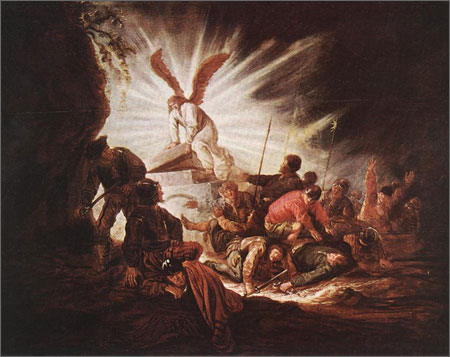
After they had departed with fear and joy, Jesus met them saying, "Hail!" They ran to Him with great joy and gladness. They "took hold of His feet". Thus they received by His touch an irrefutable proof of His resurrection, with full personal assurance of it. And they "worshipped Him." What does He then say? "Do not be afraid." Again, Jesus Himself casts out their fear, making room for their faith: "Go and tell my brothers to go to Galiliee, and their they will see me." Note well how He Himself sends good tidings to his disciples by these women. He thereby brings honor to that sex which is most prone to be dishonored. Through these women He brings good hope and the healing of that which was diseased.


Some among you may desire to be liKe these faithful women. You too may wish to take hold of the feet of Jesus. You can, even now. You can embrace not only His feet, but also His hands and even His sacred head. You too can today receive the awesome mysteries with a pure conscience. You can embrace Him not only in this life but also even more fully on that day when you shall see Him coming with unspeakable glory, with a multitude of the angels. If you are so disposed, along with Him, to be compassionate, you shall hear not only these words, "All hail!" but also those others: "Come, you blessed of my Father, inherit the kingdom prepared for you before the foundation of the world." [The Gospel of Matthew, Homily 89.3]

Before the creation of the world, God knew each and every one of us and desired us for Himself. The death and resurrection of the Lord was for our sake, not His. He gives Himself to us in Communion ("You too can today receive the awesome mysteries…") for our sake, not His. And in the life to come, He opens the way to heaven for those who have accepted Him and His gifts for our sake and that love and glory be multiplied, not because He can change in love or glory.

Imagine how the one who is entirely transcendent and unchanging forever banished the hideous parody of God’s unchanging nature which would have befallen if not for the resurrection. We learn in our study of physic about the principle of entropy and the slow but sure distribution of energy throughout the universe. Eventually, if not for the resurrection, after who knows how long, after how many billions of eons, all energy would be evenly distributed and there would remain only the perfectly lightless, motionless, cold silence of absolute death in the physical realm. With Christ, the Victor King, though the world will eventually be unmade in fire, as we read in the letter of Peter, all will be taken by Him and submitted to the Father so that God might be all in all, as Paul told the Corinthians. All things shall be made new.

When we face our own death or consider the death of loved ones, Christians look to the resurrection. Since we are approaching the month in which we pray in a special way for the dead, let us listen to St. Augustine, who speaks to the hope we find in the Lord and His resurrection:

1. When we celebrate days in remembrance of our dead brothers and sisters, we ought to bear in mind both what we should be hoping for and what we should be afraid of. We have reason to hope, you see, because "Precious in the sight of the Lord is the death of his holy ones (Ps 116:15); but reason to be afraid, because "The death of the sinner is very evil" (Ps 34:21). That’s why, as regards hope, "The just will be kept in mind for ever"; while as regards fear, "he will not fear an evil hearing (Ps 112:6-7). There will be something heard, you see, than which nothing could be worse, when those on the left hand are told, "Go into everlasting fire" (Mt 25:41). That is the evil hearing which the just will not fear, because he will be among those on the right hand who will be told, "Come, blessed of my Father, receive the kingdom" (Mt 25:34).


In this life, though, which is spent halfway between and before ultimate good and ultimate evil things, in the midst of middling goods and evils, in neither case the ultimate – because whatever good things come one’s way here are just nothing in comparison with the good things of eternity; and whatever evils one may experience in this life are not to be counted at all in comparison with eternal fire – so in this halfway kind of life we must hold onto what we heard just now in the gospel: "Whoever believes in me", he said, "even though He dies, is alive." He both proclaims life and does not deny death. What does it mean, "even though he dies, is alive?" Even though he dies in the body, he is alive in the spirit. Then He adds, "and whosoever is alive and believes in me, will not die for ever (John 11:25-26). Well, now, "even though he dies"; but how, if "he will not die?" Yes, but even though he dies for a time, "he will not die for ever." That’s how we solve that problem, and see how the words of Truth do not contradict each other, and how they can support our loving devotion. So then, although we are going to die in the body, we are alive if we believe. ….

So let us comfort one another, even with these words of ours. It is possible for the human heart not to grieve for a dear one who has died; it is better, though, that the human heart should feel grief and be cured of it, than by not feeling any grief to become inhuman. [s. 173.1-2]

The recitation of the Rosary directs us to contemplate the face of the Lord in His infancy, His ministry, His suffering and in His glory. In each glimpse of the Lord’s face, Christ reveals man more fully to himself (Cf. GS 22). The Rosary, the patient prayer, can also help us see our neighbor, even the most annoying or disappointing, in a new light. The beads of the Rosary help us to build what we might call "resurrection glasses", which when directing our gaze at our neighbor, helps us to see him in light of the resurrection for which he was destined from before the foundation of the world. Christ died for our neighbors and the resurrection is what defines them too, despite their and our shortcomings.

Posted in Patristic Rosary Project |
9 Comments

Full day

I am back in full swing here, I think. I had interviews with a couple papers back home and set up a "hit" with FNC for tomorrow. Lunch brought us a sort of elicoidali with ragù followed by a little slice of beef with a green salad. Supper gave us some minestrone and, for me, more salad, but followed by gorgonzola and a pear. I am taking considerable heat and ribbing at meals by the fact that I am American. Apparently Pres. Bush is the devil and Americans are obsessed with bombs. Today I had conversations in Italian, English, French, Chinese and German and began to make some new friends, new residents, in The House. (I do not live in the American ghetto here… which means that I actually speak Italian and other tongues and understand them when spoken… inter alia… even though some people elsewhere think I don’t know anything!    o{]:¬)    ) The coffee at the nearby bar is as good as ever. Today I read Augustine, Ephrem and other Fathers. Mass, breviary, a long walk to the P.za del Popolo and a big circle back. Some writing on the blog. Here at the end, a little scotch and Braveheart.

As I turn me head, here is the view. I miss The Sabine Farm.

Posted in My View |
11 Comments

5th Sorrowful Mystery: The Crucifixion

We continue our Patristic Rosary Project today with the:

5th Sorrowful Mystery: The Crucifixion

We come to the place of the Skull, Golgotha, where some traditions held Adam was buried. The New Adam is about to put to right the damage of the old Adam. This time, in defending His Bride from the serpent, the Bridegroom will be entirely faithful, even to the shedding of His Blood.

St. Ambrose of Milan (+397) connect’s Christ crucifixion and Adam’s burial:

The very place of the Cross is in the middle, as conspicuous to all. It is above the grace of Adam, as the Hebrews truly argue. (Mat 27:33; Mk 15:22; John 19:17) It was fitting that the beginning of death occured where the first fruits of our life were placed. [Exposition of the Gospel of Luke 10.114]

Since death entered by a man’s sin, in justice a man had to put it right. However, no man could possible be adequate or proportioned to bridge that gap between the human race and God. Thus, one who is both man and God had to do it.

St. Cyril of Alexandria also comments on the connection between death from Adam and life from Christ:
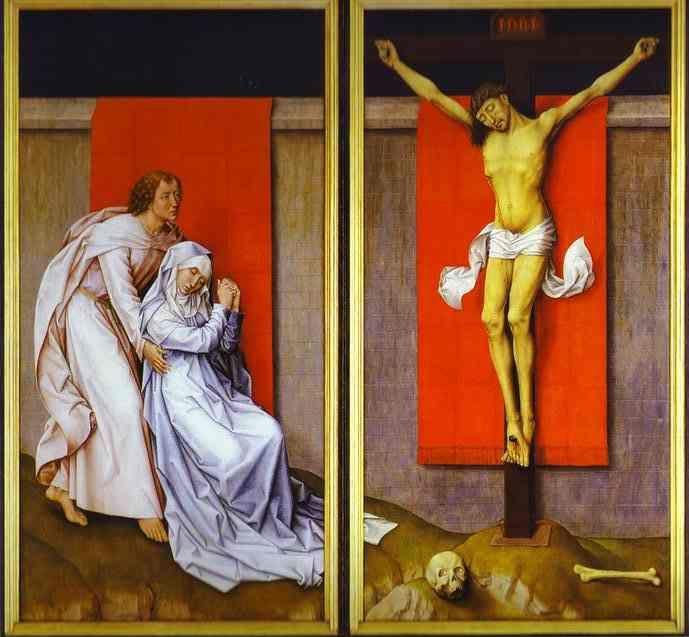
By becoming like us and bearing our sufferings for our sakes, Christ restores human nature to how it was in the beginning. The first man was certainly in the Paradise of delight in the beginning. The absence of suffering and of corruption exalted him. He despised the commandment given to hm and fell under a curse, condemnation and the snare of death by eating the fruit of the forbidden tree. By the very same thing, Christ restores him to his original condition. He became the fruit of the tree by enduring the precious Cross for our sakes, that He might destroy death, which by means of the tree [of Adam] had invaded the bodies of mankind. [Commentary on Luke, Homily 153]

Death is described almost like a parasite, slithering into our innards. Indeed, death is connected to the worm and the skull. We are freed from the eternity of nothingness in the grave by the humble submission of the God Man to the Cross and the tomb. Consider His condescension. The Rosary helps us redirect and fix our gaze on the face of the Crucified Christ.

St. Augustine (+430) considered the intention of the Lord in His Sacrifice:

Look at the Lord who did precisely what He commanded. After so many things the godless Jews committed against Him, repaying Him evil for good, did He not say as He hung on the Cross, "Father, forgive them, because they do not know what they are doing?" He prayed as man, and as God with the Father, He heard the prayer. Even now He prays in us, for us and is prayed to by us. He prays in us as our High Priest. He prays for us as our Head. He is prayed to by us as our God. When He was praying as He hung on the Cross, He could see and foresee. He could see all His enemies. He could foresee that many of them would become His friends. That is why He was interceding for them all. They were raging, but He was praying. They were saying to Pilate "CRUCIFY!", but He was crying out "Father, FORGIVE!" He was hanging from the cruel nails, but He did not lose His gentleness. He was asking for pardon for those from whom He was receiving such hideous treatment. [s. 382.2]

So much is available in this short excerpt for our reflection. Think of it this way. When we are at Holy Mass, we are at the renewal of the event of this mystery: the Crucifixion, the Bloody Sacrifice raised to the Father for our salvation. We participate in this Sacrifice as the Head of the Body (the priest) and the Body of Christ (the congregation), together Christ entire and whole (as Augustine says, Christus totus). We have our roles to fulfill. Our reflection on the crucifixion through the recitation of the Rosary can help us participate more fully at Mass.

Secondly, consider how Augustine makes the distinction that Christ died for all, but that He foresaw that He would have many as His friends. Augustine is sometimes thought to be a pessimist about human nature and, indeed, he is truly pessimistic, but in a realistic way. Still, while Augustine does not say here that "all" would be His friends, neither does Christ say "few" will be His friends.

The word Augustine chose was "many", which is what we find in Scripture. This is what we find in the consecration of the Precious Blood at Mass. At the second of the two-fold consecration, the Sacrifice is enacted, by the separation of the Body and the Blood. In this moment, Holy Church expresses correctly in Scripture and in the liturgical form of the sacrament her proper understanding: Christ died for all but many, not all, will be saved. The Latin says that clearly. And we rejoice to pray that in all the vernacular translations to be issued in the future, we will say "for many" as a fuller and better explanation of the meaning of the moment.

Another thing this wonderful passage from Augustine tells us is that when we pray the Rosary and participate at Mass, nay rather, before Mass, we ought to take stock of how we may have committed wrongs against others and find forgiveness for wrong committed against us. Let’s hear more Augustine, in a sermon on St. Stephen, holds a mirror up to our souls:

But people who are reluctant to carry out the precept [of forgiveness], eager to get the reward, who don’t love their enemies but do their best to avenge themselves on them, don’t pay attention to the Lord, who would have had nobody left to praise Him if He had wanted to avenge Himself on His enemies. So when they hear this place in the Gospel, where the Lord says on the Cross, "Father, forgive them, because they do not know what they are doing," they say to themselves, He could do that as the Son of God, as the only Son of the Father. Yes, it was flesh hanging there, but God was hidden within. As for us, though, are we to do that sort of thing? So didn’t He really mean it when He gave this order [to forgive]? Perish the thought. He certainly mean it. If you think it is asking too much of you to imitate Your Lord, look at Stephen your fellow servant…. [s. 317.2-3,6]

Again, the Rosary redirects and focuses our gaze on the face of Christ, the Priest and Victim. We can use the Rosary to prepare for Mass. Here is another mighty preacher, St. Pope Leo I (+461) on the Cross and the altar we kneel before to receive Holy Communion:

This Cross of Christ holds the mystery of its true and prophesied altar. There, through the saving Victim, a sacrifice of human nature is celebrated. There the Blood of a spotless lamb dissolved the pact of that ancient transgression. There the whole perversity of the devil’s mastery was abolished, while humanity triumphed as conqueror over boasting pride. The effect of faith was so swift that one of the two thieves crucified with Christ who believed in the Son of God entered paradise justified.

Who could explain the mystery of such a great gift? Who could describe the power of such a marvelous transformation? In a brief moment of time the guilt of a longstanding wickedness was abolished. In the middle of the harsh torments of a struggling soul, fastened to the gallows, that thief passes over to Christ, and the grace of Christ gives a crown to Him, someone who incurred punishment for his own wickedness. [s. 55.3]

How much time does it actually take to go to confession?

St. Jerome (410) in his direct and forceful way describes the Cross thusly:

That flaming flashing sword is keeping Paradise safe. No one could open the gates that Christ closed. The thief was the first to enter with Christ. His great faith received the greatest of rewards. His faith in the kingdom did not depend on seeing Christ. He did not see Him in His radiant glory or behold Him looking down from heaven. He did not see angels serving Him. To put it bluntly, he certainly did not see Christ walking about in freedom, but on a gibbet, drinking vinegar and crowned with thorns. He saw Him fastened to the Cross and heard Him begging for help, "My God, my God, why have you foresaken me?"… The Cross of Christ is the key into paradise. The Cross of Christ opened it. He has not said to you, "The kingdom of heaen has been enduring violent assault, and the violent have been seizing it by force"? (Mat 11:12) Does not the One on the Cross cause the violence? There is nothing between the Cross and paradise. The greatest of pains produces the greatest of rewards. [On Lazarus and Dives]

How we have seen some many things happen in the Church which we would rather not have seen. But Christ has permitted them. It is His Church. He permits challenges for the Church and for us. There is no glory without the Cross. Even in the Cross there is, for the Christian, hope. Here is Ephrem the Syrian:

There came to my ear
from the Scripture which had been read
a word that caused me joy
on the subject of the thief;
it gave comfort to my soul
amidst the multitude of its vices,
telling how He had compassion on the thief.
O may He bring me too
into that garden at the sound of whose name
I am overwhelmed with joy;
my mind bursts its reins
as it goes forth to contemplate Him.

[Hymn on Paradise 8.1]

Posted in Patristic Rosary Project |
Comments Off on 5th Sorrowful Mystery: The Crucifixion

4th Sorrowful Mystery: Carrying the Cross

We continue our Patristic Rosary Project today with the:

4th Sorrowful Mystery: Carrying the Cross

In the Gospel we read: "And he called to him the multitude with his disciples, and said to them, ‘If any man would come after me, let him deny himself and take up his cross and follow me.’" (Mark 8:34) Christ has been interrogated, humiliated, excoriated, beaten, exposed to ridicule and condemned. The Jews called down His Blood upon their heads and choose to call for mercy for a criminal rather than their Messiah. Now the Lord will begin the last foot journey, though part of it will be made on His bloody hands and knees. He gives concrete witness to what he taught His followers: "Take my yoke upon you, and learn from me; for I am gentle and lowly in heart" (Matthew 11:29).

During the carrying of the Cross, there were some who followed the Lord. The "daughters of Jerusalem" followed the Lord and He told them to week for themselves and their children. (Luke 23:28) Cyril of Alexandria (+444) writes:

He was going to the place of crucifixion. Weeping women, as well as many others, followed Him. The female sex tends to weep often. They have a disposition that is ready to sink at the approach of anything that is sorrowful. "Daughters of Jerusalem, do not weep for me, but week for yourselves and for your children. For behold, the days are coming when they will say, ‘Blessed are the barren, and the wombs that never bore, and the breasts that never gave suck!’" How did this happen? When the way came on the country of the Jews, they all totally perished, small and great. Infants with their mothers and sons with their fathers were destroyed without distinction. He then says, "Then they will begin to say to the mountains, ‘Fall on us’; and to the hills "Cover us.’" In extreme miseries, those less sever misfortunes become, so to speak, desirable. [Commentary on Luke, Homily 152]


The Rosary can help us put things into perspective. The day’s business will often distract us from very important things, such as the contemplation of our judgment. What seems terrifically difficult here and now might, in the long run, not be so very difficult after all. With each Hail Mary, we remind ourselves of the Four Last Things. With this repetition, we can gain some perspective. On that note, the Lord continues with enigmatic phrase, hard to understand. The Fathers tried to break it open. Jesus said: "For if they do this when the wood is green, what will happen when it is dry?" (Luke 23:31). The lyrical Ephrem the Syrian (+373) comments:

The Lord said, "If they do that to the green wood." He compared His divinity with the green wood and those who received His gifts to the dry wood. What is green bears fruit, as these words that He spoke testify: ‘For which of my works are you stoning me?" (John 8:46) If I suffer to this extent, although you have found no sin in me, which of you will convict me of sin? (John 8:46) Since you have invented a pretext to dispose of me, how much more will you suffer?" Perhaps He was referring the green wood to Himself, because of the miracles He had done. He called the righteous who were without virtue the dry wood. They are the fruit of this green wood, and they rejoiced beneath its foliage. Then they took it in hatred and destroyed it. What more will they do to the dry wood, which does not even have a sprout? What more will they do to the ordinary righteous people who do not work miracles? [Commentary on Tatian’s Diatessaron 20.21]


Trust too much in the world lately?

Another now famous figure accompanied Jesus with His Cross. Simon of Cyrene was constrained to help the Lord carry His burden. The same Ephrem comments:
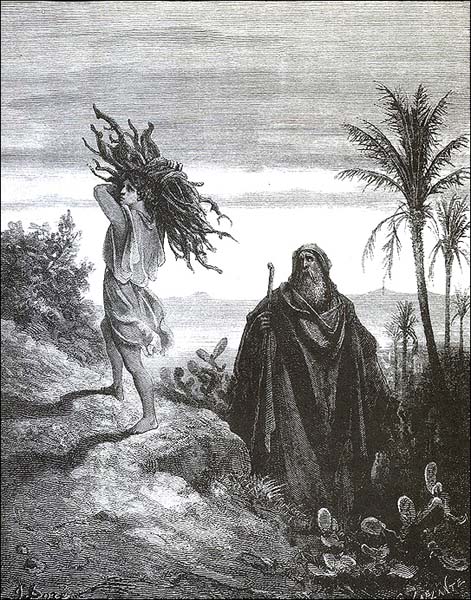
After He took up the wood of His Cross and set out, they found and stopped a man of Cyrene, that is, from among the Gentiles, and placed the wood of the Cross on him. It was only right that they should have given the wood of the Cross voluntarily to the Gentiles, since in their rebellion, the Jews rejected the coming of Him who was bringing all blessings. In rejecting it themselves, in their jealousy, they threw it away to the Gentiles. They rejected it in the jealousy and the Gentiles received it, to their even greater jealousy. The Lord approved the welcoming Gentiles and this provoked jealousy among their contemporaries through the Gentile’s acceptance. By carrying the wood of His Cross Himself, Christ revealed the sign of His victory. Christ said that another person would not pressure Him into death, "I have power over my life, to lay it down or to take it up again." (John 10:18) Why should another person have carried the Cross? This showed that He, in whom no sin could be found, went up on the Cross for those who rejected Him. [Commentary on Tatian’s Diatesseron 20.20]


Again we see how the theme of the shift from the Jews to the Gentiles is taken up.

The carrying of the wood up Golgotha, was seen as symbolic by the Fathers, foreshadowed in a well-known event in the Old Testament. Here is Cyril of Alexandria:

When Blessed Abraham went up the mountain that God showed him so that he might sacrifice Isaac according to God’s command, he laid the wood on the boy. Isaac was a type of Christ carrying His own Cross on His shoulders and going up to the glory of His Passion. Christ taught us that His Passion was His glory. He said, "Now is the Son of Man glorified, and in Him God is glorified; if God is glorified in Him, God will also glorigy Him in Himself, and glorify Him at once." (John 13:31) [Commentary on Luke Homily 152]


Fathers such as Origen of Alexandria tended to find in events and people of the Old Testament foreshadowings or "types" of what would occur in the mysteries of Christ’s life, which we meditate on in the Rosary. Here the figures of Abraham and Isaac are together "types", foreshadows, of Christ as simultaneously Priest and Victim, Abraham with the knife, Isaac with the wood, both ascending the hill.
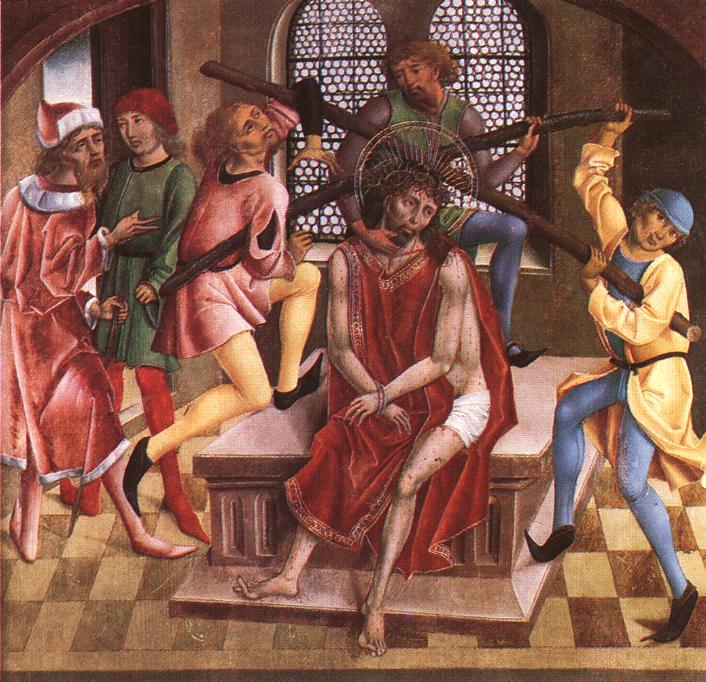
The Rosary can help us to steel ourslves for the reality of the Lord’s invitation to take up our own Cross and follow Him. Epiphanius the Latin (5th c.) comments on the yoke and our reluctance:

Therefore let everyone who whan life and desires to see good days put down the yoke of iniquity and malice. The prophet says, "Let us burst their bonds and thrust their yoke from us." (Ps 2:3) For unless one throws behind the yoke of iniquity, that is, the spark of all vices, one cannot take up the agreeable and light yoke of Christ. But if the yoke of Christ is so agreeable and light, how is it that divine religion seems so harsh and bitter to some people? It is bitter to some because the heart that has been tainted by earthly desires cannot love heavenly things. It [the heart] has not yet come to Christ, so that it can take up His yoke and learn that He is gentle and humble of heart. Hence we observe, my dearest friends, from the teaching of our Lord, that unless a person is gentle and humble of heart, he cannot bear the yoke of Christ. [Interpretation of the Gospels 26 PG 56:780]


Posted in Patristic Rosary Project |
Comments Off on 4th Sorrowful Mystery: Carrying the Cross

3rd Sorrowful Mystery: The Crowning with thorns

We continue our Patristic Rosary Project today with the:

3rd Sorrowful Mystery: The Crowning with thorns

One of the wonderful things which exploring the Fathers can teach us is how to savor each and every detail of the Scriptures. After many decades of Scriptural deconstruction and over-application of the historical critical method, with its "hermeneutic of suspicion" we can benefit from a refresher on how to approach Scriptures through the example of the Fathers.
For the Fathers, the details in the accounts of the Scriptures were laden with significance. Let us listen for a moment to St. Hilary of Poitiers (+367) on the torment Christ suffered in this Third Sorrowful Mystery:

The beaten Lord is dressed in a scarlet robe, a purple cloak and a crown of thorns, and a reed is placed in His right hand. Bending their knees before Him, they mock Him. Having taken upon Himself all the infirmities of our bodies, He is covered with the scarlet blood of all the martyrs destined to reign with Him, and He is cloaked with the high honor of the prophets and patriarchs in purple cloth. He is also crowned with thorns, that is, with the former sins of the remorseful Gentiles, so that the glory might derive from the destructive and useless things, plaited on His divine head, which they contrive. The sharp points of the thorns aptly pertain to the sins from which a crown of victory is woven for Christ. The reed symbolizes the emptiness and weakness of all those Gentiles, which is held firm in His grasp. His head, moreover, is struck. As I believe, not much harm was done to His head being struck with a reed; however, the typical explanation for this is that the bodily weakness of the Gentiles that was previously held in Christ’s hand finds comfort now in God the Father, for He is the head (cf 1 Cor 11:3). But amid all this, while Christ is mocked, He is being adored. [On Matthew 33.3]

The details are meaningful. A robe is put on the Lord. The robe is stripped off. The writer Appolinaris says:

The cloak itself represents the blood shed by the world and the people in it. The Savior was put to death for the salvation of all. But they who are choked by "worries, wealth, and pleasure" have received the word of God but have not borne fruit. (Luke 8:14) They weave thorns togethe and crown Jesus with them, dishonoring Him…. Those who deemed His Kingdom to be of little value placed a reed in His right hand. [Fragment 139]

Remember: Christ died for all but only many will actually be saved! We can choke off the fruits of our salvation with the strangling thorny weeds of sin.

The creative Origen (+254) has more on the robe and the crown:

So now, in taking up the "scarlet robe", He took upon Himself the Blood of the world, and in that thorny "crown" plaited on His head, He took upon Himself the thorns of our sins. As to the robe, it is written that "they stripped Him of the scarlet robe". But as to the crown of thorns, the Evangelists mention nothing further. Apparently they wanted us to determine what happened to that crown of thorns placed on His head and never removed. My belief is that the crown of thorns disappeared from the head of Jesus, so that our former thorns no longer exist now that Jesus has removed them from us once and for all on His own distinguished head. [Commentary on Matthew 125]

Consider the famous line of Isaiah 1:18: "Come now, let us reason together, says the LORD: though your sins are like scarlet, they shall be as white as snow; though they are red like crimson, they shall become like wool." "Reason together"…. Pope Benedict XVI would love that.

There is no sin so terrible we finite little mortals can commit that the infinite power of our merciful God cannot forgive. Not only forgive, but wash clean, washed pure and away from our souls as if it had never been there. At our judgment, they will not be held against us, provided we receive their cleansing in the way He desired us to receive it: especially in the sacrament of penance. That sacraments takes your sins away so they are not there. Cloaked with the scarlet of our sins, the Lord is then stripped of the cloak. But, alas, the thorns of their memories remain, do they not?

The interesting and ecclectic Chromatius of Aquileia (+407)gives us a reflection on the mysterious kingship of the Lord. Remember that Jesus had already had a surprising exchange with the cowardly Pilate about His kingdom:

These things were done to mock Jesus. But now we know these things happened through a heavenly mystery. Wickedness was at work among the former; among the latter, the mystery of faith and the light of truth. In the purple tunic Christ is dressed as a king; and in the scarlet robe, as prince of martyrs, He is resplendent as precious scarlet in His sacred Blood. He receives the crown as conqueror, for crowns are usually bestowed upon conquerors. He is adored as God by people on bended knees. Therefore He is vested in purple as king, in scarlet as prince of martyrs; He is crowned as conqueror, is hailed as Lord and is adored as God. We can recognize in the purple cloak also the Church, married to Christ the King and resplendent with regal glory. Hence it is called by John in the Revelation a "royal nation". (Rev 1:6; cf. 1 Pet 2:9) As to this purple cloth, we read in the Song of Solomen: "His whole bed is purple." (Cant 3:10) For Christ rests on that bed where He is able to find purple cloth, that is, royal faith and a beautiful spirit…. The crown of thorns which the Lord received on His head stands for our community, which came to faith from the Gentiles. At one time we were thorns, that is to say sinners. Believing now in Christ, we have become a crown of righteousness, for we no longer cause pain or harm to the Savior. Rather, we surround His head with our profession of faith while we praise the Father in the Son, because the head of Christ is God, as the apostle says. (1 Cor 11:3) This is the crown foretold by David in a psalm: "You placed a crown of precious stones on His head." (Ps. 21:3 (20:4 LXX) We were thorns at one time, but after we were included in the crown of Christ, we became precious stones. For he, who raised up children of Abraham from stones, made precious stones out of thorns. (Matthew 3:9) This scriptural passage did not consider of trivial importance the fact that a reed was placed in the Lord’s right hand. Note what David says about Christ in the psalm: "My tongue is the pen of a ready writer" (Ps 45:1 (44:2 LXX). As He was about to suffer, therefore, He took up the reed in His right hand so that with a heavenly notation He might pardon our misdeeds or inscribe His law in our hearts with divine letters. As He says through the prophet: "I will put my law within them." (Jer 31:33) We may also infer other things about the reed, for it has many spiritual meanings. A reed that is hollow and without pith connotes the Gentile people, who were once without the pith of God’s law, empty of faith and devoid of grace. Therefore this type of reed, that is, the Gentile people, is put in the Lord’s right hand, for His left had already contained the Jewish people who were persecuting Him. [Tractate on Matthew 19:1-4]

Fascinating connections here, no? Take note that the Fathers I cite bring the Gentiles into the symbolism of the details, in slightly different ways. But what I find interesting about the imagery of Chromatius is how he suggests that the praying assembly of the Church is like the crown of thorns. Some wag might wrying respond, "Yah, and the thorns are still pretty painful when I look around at people at Mass, too, especially the ‘priest’ and ‘song leaders’!" Still, this is a wonderful thing to think about. By the sacraments, we are made more and more like a temple made of living stones. Stones seem woven together when they are laid and cemented into walls and floors. When they form a church building they surround the Body and Head of Christ, the priest and the congregation. The thorns are like stones, for Chromatius. It might be interesting to think of this when you are having problems or difficulties with people, even at Mass. Think about them as thorns, like yourself, causing suffering but… but… destined for glorious transformation. Christ died for each thorn and by each thorn. The goal was not the tomb, but the resurrection.
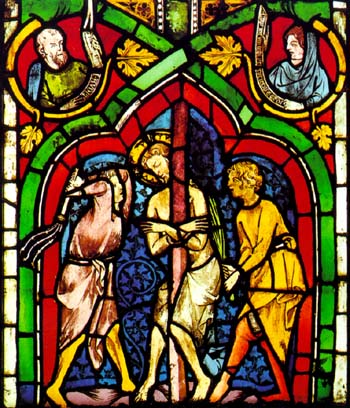
Notice also how Chromatius makes a connection between the hollow reed in Christ’s hand and the hollow pen with which He can write. He can write our name in the Book of Life. He can strike through our name as well. It depends on us. When we receive the sacrament of baptism and, later, penance, our souls are wiped clean. They are like a perfect white parchment waiting to receive its words, to be over written. Shall he offer it to the King of Glory or to the Prince of this world, the Enemy of the soul? Before the Lord received His thorns from us and the reed and the blows that went with them, He told Pilate in no uncertain terms: "I will no longer talk much with you, for the ruler of this world is coming. He has no power over me; but I do as the Father has commanded me, so that the world may know that I love the Father. Rise, let us go hence." (John 14:30-31) "Non habet in me quidquam" Does the Prince of this world have anything on you?

Recitation of the Rosary can give us some clarity about the state of our own souls, as we pray again and again about the hour of our own death. With death comes judgment. God’s justice we will receive whether we want to or not, but His mercy is always there for the asking.

Posted in Patristic Rosary Project |
Comments Off on 3rd Sorrowful Mystery: The Crowning with thorns

2nd Sorrowful Mystery: The Scourging

We continue our Patristic Rosary Project today with the:

2nd Sorrowful Mystery: The Scourging

The Roman flail was a terrible thing, designed to do maximum damage. The Lord endured outrageous humiliation of His Divine Person as well as physical suffering beyond our understanding.

Pilate, who made decisions based on polls, queried the Lord about His Kingship. Christ responded: "My kingship is not of this world" (John 18:36). The Bishop of Hippo, St. Augustine (+430) wrote what is probably the best commentary on John ever assembled. Here is an obervation on Christ’s dialogue with Pilate:

2. Hear then, ye Jews and Gentiles; hear, O circumcision; hear, O uncircumcision; hear, all ye kingdoms of the earth: I interfere not with your government in this world, "My kingdom is not of this world." Cherish ye not the utterly vain terror that threw Herod the elder into consternation when the birth of Christ was announced, and led him to the murder of so many infants in the hope of including Christ in the fatal number, made more cruel by his fear than by his anger: "My kingdom," He said, "is not of this world." What would you more? Come to the kingdom that is not of this world; come, believing, and fall not into the madness of anger through fear. He says, indeed, prophetically of God the Father, "Yet have I been appointed king by Him upon His holy hill of Zion;" but that hill of Zion is not of this world. For what is His kingdom, save those who believe in Him, to whom He says, "Ye are not of the world, even as I am not of the world"? And yet He wished them to be in the world: on that very account saying of them to the Father, "I pray not that Thou shouldest take them out of the world, but that Thou shouldest keep them from the evil." Hence also He says not here, "My kingdom is not" in this world; but, "is not of this world." And when He proved this by saying, "If my kingdom were of this world, then would my servants fight, that I should not be delivered to the Jews," He saith not, "But now is my kingdom not" here, but, "is not from hence." For His kingdom is here until the end of the world, having tares intermingled therewith until the harvest; for the harvest is the end of the world, when the reapers, that is to say, the angels, shall come and gather out of His kingdom everything that offendeth; which certainly would not be done, were it not that His kingdom is here. But still it is not from hence; for it only sojourns as a stranger in the world: because He says to His kingdom, "Ye are not of the world, but I have chosen you out of the world." They were therefore of the world, so long as they were not His kingdom, but belonged to the prince of this world. Of the world therefore are all mankind, created indeed by the true God, but generated from Adam as a vitiated and condemned stock; and there are made into a kingdom no longer of the world, all from thence that have been regenerated in Christ. For so did God rescue us from the power of darkness, and translate us into the kingdom of the Son of His love: and of this kingdom it is that He saith, "My kingdom is not of this world;" or, "My kingdom is not from hence." [tr. Io. eu. 115]


The cowardly Pilate declares Christ innocent several times. Yet He condemns Him to savagery anyway. St. Ambrose (+397) has something to say about this:
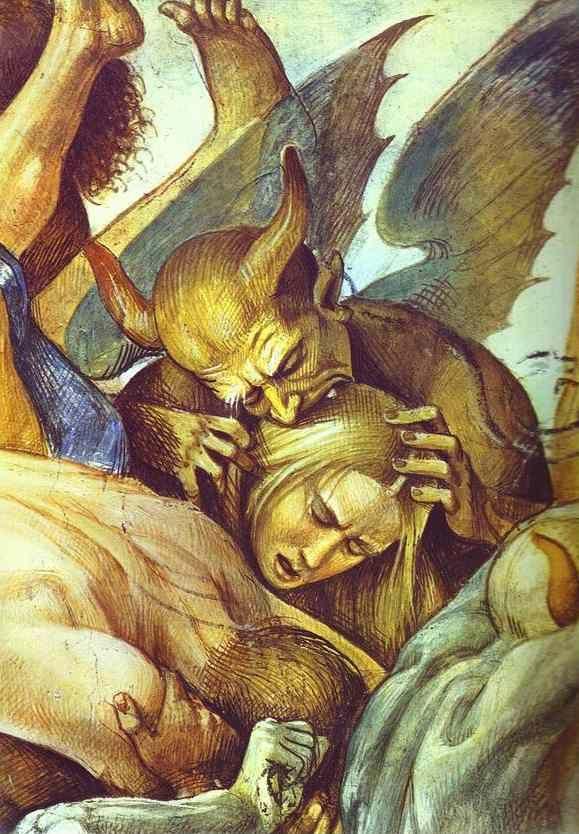
They send Christ to Herod and then to Pilate. Although neither pronounces Him guitly, both gratify the desires of strange cruelty. Pilate washes his hands but does not wash away his actions. A judge should not yield to either envy or fear and then sacrifice the Blood of the innocent (cf. Matthew 27:24). Pilate’s wife warned him (Matthew 27:19). Grace shone in the the flight. The Godhead was revlead, yet he still did not abstain from a sacrilegious verdict. [Exposition of the Gospel of Luke 10.100]

Cyril, (+386) the bishop of Jerusalem where it all took place, writes about Christ’s innocence and the subsequent impact of His condemnation.

Many have been crucifed throughout the world, but the demons are not afraid of any of these. These people died because of their own sins, but Christ died for the sin of others. He "did not sin, neither was deceit found in His mouth". It was not Peter, who could be suspected of partiality, who said this, but Isaiah, who, although not present in the flesh, in spirit foresaw the Lord’s coming in the flesh. Why do I bring only the prophet as a witness? Take the witness of Pilate himself. He passed judgment on Him, by saying, "I find no guilt in this man." When he delivered Him over and washed his hands, he said, "I am innocent of the Blood of this just man." (Matthew 27:24) [Catechetical Lectures 13.3]


Indeed, demons fear Christ. His Presence, even in the Blessed Sacrament is unfathomable agony for them. And yet their malice for us is so great that they over come their agony in the presence of the Eucharist so for the opportunity to weaken us, tempt us to receive Communion when we ought not. Then the demons do not fear us. They fear and hate us when our souls shine with the indwelling of the Holy Spirit, made more splendid yet by Communion received in the state of grace. The Rosary can be a great tool of discernment in our approach to Communion.

St. Augustine puts Christ’s betrayal, scourging, humiliation and condemnation into perspective:

1. On the Jews crying out that they did not wish Jesus to be released unto them all the passover, but Barabbas the robber; not the Saviour, but the murderer; not the Giver of life, but the destroyer,–"then Pilate took Jesus and scourged Him." We must believe that Pilate acted thus for no other reason than that the Jews, glutted with the injuries done to Him, might consider themselves satisfied, and desist from madly pursuing Him eve, unto death. With a similar intention was it that, as governor, he also permitted his cohort to do what follows, or even perhaps ordered them, although the evangelist is silent on the subject. For he tells us what the soldiers did thereafter, but not that Pilate ordered it. "And the soldiers," he says, "platted a crown of thorns, and put it on His head, and they clothed Him with a purple robe. And they came to Him and said, Hail, King of the Jews! And they smote Him with their hands." Thus were fulfilled the very things which Christ had foretold of Himself; thus were the martyrs moulded for the endurance of all that their persecutors should be pleased to inflict; thus, by concealing for a time the terror of His power, He commended to us the prior imitation of His patience; thus the kingdom which was not of this world overcame that proud world, not by the ferocity of fighting, but by the humility of suffering; and thus the grain of corn that was yet to be multiplied was sown amid the horrors of shame, that it might come to fruition amid the wonders of glory.


2. "Pilate went forth again, and saith unto them, Behold, I bring him forth, that ye may know that I find no fault in him. Then came Jesus forth, wearing the crown of thorns and the purple robe. And he saith unto them, Behold the man!" Hence it is apparent that these things were done by the soldiers not without Pilate’s knowledge, whether it was that he ordered them or only permitted them, namely, for the reason we have stated above, that His enemies might all the more willingly drink in the sight of such derisive treatment, and cease to thirst further for His blood. Jesus goes forth to them wearing the crown of thorns and the purple robe, not resplendent in kingly power, but laden with reproach; and the words are addressed to them, Behold the man! If you hate your king, spare him now when you see him sunk so low; he has been scourged, crowned with thorns, clothed with the garments of derision, jeered at with the bitterest insults, struck with the open hand; his ignominy is at the boiling point, let your ill-will sink to zero. But there is no such cooling on the part of the latter, but rather a further increase of heat and vehemence. [tr. Io. eu. 116]

How often do we warm to the theme of our own sins, sparing not even our Crucified Lord, sunk so low for our salvation? As Pope John Paul emphasized, the Rosary teaches us to gaze with Mary on the face of Christ. He must be seen not only in His risen glory, but also in His battered state when He had been beaten "beyond recognition of a man".

Who has believed what we have heard? And to whom has the arm of the LORD been revealed? For he grew up before him like a young plant, and like a root out of dry ground; he had no form or comeliness that we should look at him, and no beauty that we should desire him. He was despised and rejected by men; a man of sorrows, and acquainted with grief; and as one from whom men hide their faces he was despised, and we esteemed him not. Surely he has borne our griefs and carried our sorrows; yet we esteemed him stricken, smitten by God, and afflicted. But he was wounded for our transgressions, he was bruised for our iniquities; upon him was the chastisement that made us whole, and with his stripes we are healed. All we like sheep have gone astray; we have turned every one to his own way; and the LORD has laid on him the iniquity of us all. He was oppressed, and he was afflicted, yet he opened not his mouth; like a lamb that is led to the slaughter, and like a sheep that before its shearers is dumb, so he opened not his mouth. By oppression and judgment he was taken away; and as for his generation, who considered that he was cut off out of the land of the living, stricken for the transgression of my people? And they made his grave with the wicked and with a rich man in his death, although he had done no violence, and there was no deceit in his mouth. Yet it was the will of the LORD to bruise him; he has put him to grief; when he makes himself an offering for sin, he shall see his offspring, he shall prolong his days; the will of the LORD shall prosper in his hand; he shall see the fruit of the travail of his soul and be satisfied; by his knowledge shall the righteous one, my servant, make many to be accounted righteous; and he shall bear their iniquities. Therefore I will divide him a portion with the great, and he shall divide the spoil with the strong; because he poured out his soul to death, and was numbered with the transgressors; yet he bore the sin of many, and made intercession for the transgressors. [Isaiah 53]


Posted in Patristic Rosary Project |
Comments Off on 2nd Sorrowful Mystery: The Scourging

5th Luminous Mystery: Institution of the Eucharist

We continue our Patristic Rosary Project today with the:

5th Luminous Mystery: Institution of the Eucharist

The Eucharist, its celebration and the Sacred Species, is the greatest of the sacraments. It is the only of the seven which actually is that which it confers. It is like the great jewel of a heavenly centerpiece set about with other gems, each making the others more beautiful by their relationship.

Holy Mass has been celebrated in one form or another in the Church since the Last Supper. The early Church bears witness to its celebration. Here is a famous passage from St. Justin Martyr (165):

There is then brought to the president of the brethren bread and a cup of wine mixed with water; and he taking them, gives praise and glory to the Father of the universe, through the name of the Son and of the Holy Ghost, and offers thanks at considerable length for our being counted worthy to receive these things at His hands. And when he has concluded the prayers and thanksgivings, all the people present express their assent by saying Amen. This word Amen answers in the Hebrew language to genoito [so be it]. And when the president has given thanks, and all the people have expressed their assent, those who are called by us deacons give to each of those present to partake of the bread and wine mixed with water over which the thanksgiving was pronounced, and to those who are absent they carry away a portion. And this food is called among us Euxaristia, of which no one is allowed to partake but the man who believes that the things which we teach are true, and who has been washed with the washing that is for the remission of sins, and unto regeneration, and who is so living as Christ has enjoined. For not as common bread and common drink do we receive these; but in like manner as Jesus Christ our Saviour, having been made flesh by the Word of God, had both flesh and blood for our salvation, so likewise have we been taught that the food which is blessed by the prayer of His word, and from which our blood and flesh by transmutation are nourished, is the flesh and blood of that Jesus who was made flesh. For the apostles, in the memoirs composed by them, which are called Gospels, have thus delivered unto us what was enjoined upon them; that Jesus took bread, and when He had given thanks, said, “This do ye in remembrance of Me, this is My body; “and that, after the same manner, having taken the cup and given thanks, He said, “This is My blood; “and gave it to them alone. [First Apology 65-66]

The Supper occured on that fateful evening when Christ was betrayed. The Fathers teach us that even the details are significant. St. John Chrysostom (+407) talks about “evening”:

But the evening is a sure sign of the fullness of times and that the things were now come to the very end. [He took bread] and gave thanks to teach us how we ought to celebrate this sacrament and to show that He does not unwillingly come to the Passion. He is teaching us so that whatever we may suffer, we may bear it thanksfully. So it is a sign of good hope. If the [Mosaic] type pointed to deliverance from bondage, how much more will the truth He embodies set free the whole world. He is being delivered up for the benefit of our whole human race. This is why He did not ordain the sacrament before this time. But from then on, when the rites of the law were no longer in effect, Jesus ordained it. [The Gospel of Matthew, Homily 82.1]

The mighty Bishop of Milan, St. Ambrose (+397) talks about the consecration of the bread:

Do you wish to know how it is consecrated with heavenly words? Accept was the words are. The priest speaks. He says: “Perform for us this oblation written, reasonable, acceptable, which is a figure of the Body and Blood of our Lord Jesus Christ. On the day before He suffered He took bread in His holy hands, looked toward heaven, toward You, holy Father omnipotent, eternal God, giving thanks, blessed broke, and having broken it gave it to the apostles and His disciples,” saying: “Take and eat of this, all of you; for this is my Body, which shall be borken for many” (1 Cor 11:24). Take note. Before it is consecrated, it is bread; but when Christ’s words have been added, it is the Body of Christ. [On the sacraments 4.5]

Sound familiar? It ought to. It is the Roman Canon. There is a two-fold consecration at the Last Supper renewed in Holy Mass. Again, Ambrose:

Before the words of Christ, the chalice is full of wine and water; when the words of Christ have been added, the the Blood in effect redeems the people. So behold in what great respects the expression of Christ is able to change all things. Then the Lord Jesus Himself testified to us that we receive His Body and Blood. Should we doubt at all about His faith and testimony? [On the sacraments 4.23]

Christ’s words can change all things. When was the last time you heard the alter Christus, the other Christ, the priest say, “I absolve you of your sins”? Have you received Communion without hearing those words? His words, through the priest, can change all things. He made this possible… all for you. Christ’s Blood was poured out “for the many”, since although He died for all, not all will accept the gifts He offers. This is clear from the Greek text of the New Testament accounts of the Last Supper. The Fathers knew this, of course. St. Jerome certainly did when he gave us “pro multis” in the Vulgate.

Perhaps more is needed about this all important issue. In the Latin Church (as in all the ancient Churches) we have ever said “for many”. But in the terrible English translation (which, though horrible does not invalidate the consecration), we hear “for all”. We should get at this a little more.
What has the liturgy of the Mass actually had in the past? We get “pro vobis et pro multis … for you and for many” in the formula of consecration from a blending of the accounts in Mark 14:24 (translated from Greek: “this is my blood of the covenant (diatheke) shed for many (tò peri pollôn)”) and Matthew 26:28 also says “for many” together with Luke 22:20 (translated from Greek: “Likewise also the cup, after the supper, saying ‘This cup is the new covenant (diatheke) in my Blood which will be poured out for you.’” The choice to do this had theological significance. Our Patristic sources, such as the writings of Ambrose when describing the words of consecration in the Eucharistic liturgy, have pro multis and not pro omnibus, etc. The liturgical formulas were from Scripture. Jerome, who translated from Greek and Hebrew texts into Latin giving us a Bible translation called the Vulgata, chose to use pro multis when translating the Greek tò peri pollôn (genitive plural of polus) in describing Jesus’ words at the Last Supper. In Greek polus means “many” or “much” or even “most” as in the majority: it does not mean “all”. In the ancient Church, no one said “for all” instead of “for many”. In the Greek Gospel accounts of the Last Supper, Jesus uses a form polus “many”. The liturgical rites of the East retained a form of polus. The rites of the Latin West have ever used pro multis.

Theological challenge, especially heresy, forces us to reevaluate our doctrines and their formulations. Theological revolt and heresy constrains Catholics to go deeper, and the disputes bear great fruits in the long run. During the 16th c. the Church was compelled to battle the Protestant heresies concerning the Eucharist, grace, and justification, the nature of man, etc. The long process of the Council of Trent (1545-1563) deepened our understanding of the faith and gave clear expression to what we believe. We find the Church’s teaching enunciated succinctly by the Roman Catechism or Catechism of the Council of Trent (1566), the practical guide for pastors of souls. This Catechism says about the pro multis topic:

But the words which are added for you and for many (pro vobis et pro multis), were taken some of them from Matthew (26: 28) and some from Luke (22: 20) which however Holy Church, instructed by the Spirit of God, joined together. They serve to make clear the fruit and the benefit of the Passion. For if we examine its value (virtutem), it will have to be admitted that Blood was poured out by the Savior for the salvation of all (pro omnium salute sanguinem a Salvatore effusum esse); but if we ponder the fruit which men (homines) will obtain from it, we easily understand that its benefit comes not to all, but only to many (non ad omnes, sed ad multos tantum eam utilitatem pervenisse). Therefore when He said pro vobis, He meant either those who were present, or those chosen (delectos) from the people of the Jews such as the disciples were, Judas excepted, with whom He was then speaking. But when He added pro multis He wanted that there be understood the rest of those chosen (electos) from the Jews or from the gentiles. Rightly therefore did it happen that for all (pro universis) were not said, since at this point the discourse was only about the fruits of the Passion which bears the fruit of salvation only for the elect (delectis). And this is what the words of the Apostle aim at: Christ was offered up once in order to remove the sins of many (ad multorum exhaurienda peccata – Heb 9:28); and what according to John the Lord says: I pray for them; I do not pray for the world, but for those whom you gave to Me, for they are Yours (John 17:9). Many other mysteries (plurima mysteria) lie hidden in the words of this consecration, which pastors, God helping, will easily come to comprehend for themselves by constant meditation upon divine things and by diligent study. (My translation and emphasis. Part II, ch. 4 (264.7-265.14) from the Catechismus Romanus seu Catechsimus ex decreto Concilii Tridentini ad parochos …. Editio critica. Libreria Editrice Vaticana, 1989, p. 250. Cf. The Catechism of the Council of Trent. Trans. John A. McHugh & Charles J. Callan. Joseph F. Wagner, Inc.: New York, 1934, pp. 227-28.)

Think about it and decide. Back to the Fathers. The amazing Origen (+254) has this for our reflection:

If therefore we wish to receive the bread of blessing from Jesus, who is eager to give it, we should enter the city and go into the house, prepared beforehand, where Jesus kept the Passover with His disciples. We ascent to the “large, furnished upper room”(Luke 22:12) where He “took the cup”from the Father and, “when had given thanks, He gave it to them” who had gone up there with Him and said, “Drink this, for this is my Blood of the new covenant.” The cup was both consumed and poured out. It was consumed by the disciples. It was “poured out for the remission of sin” committed by those who drink it. If you want to know in what sense it was poured out, compare this saying with what was written [by Paul]: “God’s love has been poured into our hearts.” (Rom 5:5) If the Blood of the covenant was poured into our hearts for the remission of our sins, then by the pouring of that potable Blood into our hearts all the sins we have committed in the past will be remitted and wiped clean. He who took the cup and said “drink this all of you” will not depart from us who drink it but will drink it with us (since He Himself is in each of us), for we are unable alone or without Him either to eat of the bread or to drink of the fruit of the true vine. You should not marvel that He who is Himself the bread also eats the bread with us or that He who is Himself the cup of the fruit of the vine also drinks it with us. This is possible because the Word of God is omnipotent and is at once the bearer of many different names, for the multitude of His virtues are innumerable, since His is Himself every virtue. [Commentary on Matthew 86]

This takes nothing away from the necessity of baptism and and sacrament of penance, the obligation to be baptized and confess our sins to the alter Christus. However, it directs our gaze to the connect of the sacraments, especially how the forgiveness we receive flows from the Eucharistic Lord, offered and consumed, and culminates in His celebration and reception.

Recitation of the Most Holy Rosary, can be an excellent help for our preparation for confession and for Communion. The Rosary always guides us back to Christ through His Mother’s gaze, she who first bore the Eucharistic Lord within and beneath her heart so that we could receive Him.

Posted in Patristic Rosary Project | Tagged ,
1 Comment

4th Luminous Mystery: The Transfiguration

Transfiguration_by_fra_Angelico_(San_Marco_Cell_6)We continue our Patristic Rosary Project today with the:

4th Luminous Mystery: The Transfiguration

The Mystery of the Transfiguration was a matter of intense reflection on the part of the Fathers.

Remember that this takes place some eight days after the Lord confers the keys on Peter by the Jordan at Caesarea Philippi.  The Fathers thought everything in Scripture was significant and they attached great meaning to numbers.  Let us see what the mighty Ambrose of Milan (+397) has to say about the timing of the Transfiguration in relation to the events at Caesarea Philippi:

You may know that Peter, James and John did not taste death and were worthy to see the glory of the resurrection.  It says, “about eight days after these words, He took those three alone and led them onto the mountain.” Why is it that he says, “eight days after these words”?  He that hears the words of Christ and believes will see the glory of Christ at the time of the resurrection.  The resurrection happened on the eight day, and most of the psalms were written “For the eighth”.  (cf. e.g., Ps 6:1; 12:1 LXX and Vulgate)  It shows us that He said that he who because of the Word of God shall lose his own soul will save it, (Luke 9:24) since he renews his promises at the resurrection.  (Matthew 16:25-27)  But Matthew and Mark say that they were taken after six days.  (Cf. Matthew 17:1; Mark 9:2)  We may say that they were taken after six thousand years, because a thousand years in God’s sight are as one day.  (Ps 89:4 LXX)  We counted more than six thousand years.  We prefer to understand six days as a symbol, because God created the works of the world in six days (Gen 2:1), so that we understand works through the time and the world through the works.  [Exposition of the Gospel of Luke 7.6-7]

Transfiguration 12th_cSt. Augustine (+430) also gets into this issue of six days, as recounted in Matthew and Mark, and eight days (as in Luke) in a discussion of the resurrection three days after the Passion and death of the Lord.  He is trying to make sense of the numbers.  In other places I have explained how the ancients numbered their periods of days, that is, inclusively.

St. Cyril of Alexandria (+444) wrote of the Transfiguration in terms of the connection between suffering and glory, between the Law and the Prophets, between the foreshadowings of the past and their fulfillment.

“I say to you, there are some of those standing here who shall not taste of death until they have seen the kingdom of God.” … By the “kingdom of God” He means the sight of the glory in which He will appear at His revelation to the inhabitants of earth.  He will come in the glory of God the Father and not in a humble condition like ours.  How did He make those who received the promise spectators of a thing so wonderful?  He goes up into the mountain taking three chosen disciples with Him.  He is transformed to such a surpassing and godlike brightness that His garments even glittered with rays of fire and seemed to flash like lightning.  Besides, Moses and Elijah stood at Jesus’ side and spoke with one another about His departure that He was about, it says, to accomplish at Jerusalem.  This meant the mystery of the dispensation in the flesh and of His precious suffering upon the Cross.  It is also true that the law of Moses and the word of the holy prophets foreshadowed the mystery of Christ.  the law of Moses foreshadowed it by types and shadows, painting it as in a picture.  The holy prophets in different ways declared before hand that in due time He would appear in our likeness and for the salvation and life of us all, agree to suffer death on the tree.  Moses and Elijah standing before Him and talking with one another was a sort of representation.  It excellently displayed our Lord Jesus Christ as having the law and the prophets for His bodyguard.  It displayed Christ as being the Lord of the Law and the Prophets, as foretold in them by those things that they proclaimed in mutual agreement beforehand.  The words of the prophets are not different from the teachings of the law.  I imagine this was what the most priestly Moses and the most distinguished of the prophets Elijah were talking about with one another.  [Commentary on Luke, Homily 51]

The last line here is interesting.  It makes me call to mind what one finds in studying ancient historiography, such as Herodotus and Thucydides.  When reporting the speeches great figures made, about which they might at the very best have some distant report from someone who heard about the content of the speech, such as Pericles’s great oration, from a generation or more removed, Thucydides would record what the great man ought to have said in that momentous occasion.  This sounds much like what Cyril is doing.

Have you ever wondered why some get some graces and others do not?  St. Maximus Confessor (+682) gives an interesting insight while he comments on the Transfiguration:

The Lord does not always appear in glory to all who stand before Him. To beginners He appears in the form of a servant (Phil 2:7); to those able to follow Him as He climbs the high mountain of His Transfiguration He appears in the form of God, the form in which He existed before the world came to be (John 17:5). It is therefore possible for the same Lord not to appear in the same way to all who stand before Him, but to appear to some in one way and to others in another way, according to the measure of each person’s faith. When the Logos of God becomes manifest and radiant in us, and His face shines like the sun, then His clothes will also look white. That is to say, the words of the Gospel will then be clear and distinct, with nothing concealed. And Moses and Elijah – the more spiritual principles of the Law and the Prophets – will also be present with Him.

St. John Chrysostom (+407) takes on this same issue:

“Now after six days Jesus took Peter, James and John his brother, led them up on a high mountain by themselves;” (Matt. 17:1) …Note, I pray you, the severe goodness of Matthew, not concealing those who were preferred to himself. Also, John often does this (in his Gospel), recording the peculiar praises of Peter with great sincerity. For the choir of these holy men (disciples) was everywhere pure from envy and vainglory. Having taken, therefore, the leaders, “He was transfigured before them. His face shone like the sun, and His clothes became as white as the light. And behold, Moses and Elijah appeared to them, talking with Him.” (Matt. 17:2,3) Why does Jesus take with Him these three only? Because these were superior to the rest. And, Peter indeed showed his superiority by exceedingly loving Him; John; by being exceedingly loved by Him; and James again by his answer which he gave with his brother, saying “We are able (to drink this cup);” (Matt. 20:22) but not by this answer only, but also by his works …For so earnest was he (James), and so grievous to the Jews, that Herod himself supposed that he found favor with the Jews by slaying him (James).”  [St. John Chrysostom, Homily 56]

I suppose we ought to be careful what we ask for.  Our earthly fate notwithstanding, we are always able to have a moment of Transfiguration in the proper reception of Holy Communion, which is far more than a mere vision of something of Christ’s divine shining through our humanity.  The Eucharist is not only the Body, Blood, Soul and Divinity of Christ, it is for us a “pledge of future glory, containing in Itself all delight”, as St. Thomas Aquinas (+1274) wrote for the feast of Corpus Christi, and which we all sing whenever there is Benediction of the Blessed Sacrament.  A good reception of Communion is an even greater encounter with the Lord, than a Transfiguration.  It opens up the way to a bright future for us.  On that note, Gregory of Nazianzus (+389) ties us all into the mystery of the Transfiguration, saying:

He was bright as the lightning on the mountain and became more luminous than the sun, initiating us into the mystery of the future.  [Oration 3.19, On the Son]


Posted in Patristic Rosary Project |
Comments Off on 4th Luminous Mystery: The Transfiguration

3rd Luminous Mystery: Proclamation of the Kingdom

We continue our Patristic Rosary Project today with the:

3rd Luminous Mystery: Proclamation of the Kingdom

There are many moments in the Gospels we could use to illustrate this Mystery so we must make a choice.

Consider what the Lord says in Mark 1:15, after John has been arrested when Christ is in Galilee: "The time is fulfilled, and the kingdom of God is at hand; repent, and believe in the gospel."  In a sense, many of the things Christ says after this extend and exemplify the "good news", the "proclamation of the Kingdom".  

Since I am dealing these days with many apples, their eating and general enjoyment, my mind is drawn to something that St. Jerome (+420) wrote:

The sweetness of the apple makes up for the bitterness of the root.  The hope of gain makes pleasant the perils of the sea.  The expectation of health mitigates the nauseousness of medicine.  One who desires the kernel breaks the nut.  So one who desires the joy of a holy conscience swallows down the bitterness of penance.  [Commentary on the Gospels]

These are not the Glorious Mysteries.  Christ is preaching Good News which, at this point, is the Kingdom is at hand.  He will say to skeptics and onlookers in different times and ways that if the blind see and lame walk and miracles are being worked by Him, then the Kingdom of God is upon them.  In a way, His own sacred Person is the Kingdom of God in small.  Entrance into the Kingdom of God and into Christ requires the bitter before the sweet, suffering before joy, penance before peace.  The Cross precedes the glory.  But is it not true that even in the anticipation, the preparation, the purification and perseverance the glory is already present?  Didn’t Christ wear a crown already while on the Cross?  This Mystery reminds us that the Kingdom, although already (but not yet) at hand, requires us to repent as contituent element of the enjoyment of the Good News.  What a gift we have in the sacrament of penance.

To that end, one of the most amazing and conforting dimensions of Christ’s proclamation of the Kingdom, the announcement that we are slaves to sin no more and, instead, we are to be adopted children of the Father, is the gift of the sacraments and, in particular, the sacrament of penance, wherein repentence and the Good News of forgiveness converge.

When Christ healed the paralytic in Mark 2, He forgave his sins.  St. Ambrose, the great bishop of Milan (+397) offers this:

In their ministry of the forgiveness of sin, pastors do not exercise the right of some independent power.  For not in their own name of the Father and the Son and the Holy Spirit do they they forgive sins.  They ask, the Godhead forgives.  The service is enabled by men, but the gift comes from the Power on high.  [The Holy Spirit 3.18.137]

And were there ever greater words about the Kingdom spoken than those Christ uttered before His Ascension?  He breathed on the Apostles and gave them His own power to forgive His in His stead.  So, the priest, acting in the person of Christ, forgives sins.   St. Augustine (+430) explains something important:

He exhibits Himself as occupying a middle position when He says, He me, and I you.  "And when He had said this, He breathed on them, and said unto them, Receive ye the Holy Ghost." By breathing on them He signified that the Holy Spirit was the Spirit, not of the Father alone, but likewise His own.  "Who soever sins," He continues, "ye remit, they are remitted unto them; and whose soever ye retain, they are retained." The Church’s love, which is shed abroad in our hearts by the Holy Spirit, discharges the sins of all who are partakers with itself, but retains the sins of those who have no participation therein.  Therefore it is, that after saying, "Receive ye the Holy Ghost," He straightway added this regarding the remission and retention of sins."  [tr. Io. eu.]

Christ is truly the "middle position", the one Mediator between God and man.  The priest, so closely associated with Christ by the power the Holy Orders, is another middle man with Christ’s own power to forgive sins.  The sinner must be with the Church to be forigven.  So must also the priest.  So important is this sacrament that the priest himself must have more than just the sacrament, the "power" to forgive, he must also have the mandate from the Church.  This is all according to the will of God, who desired that the gates of heaven be opened, the bonds of sins broken and the Good News be proclaimed by a Mediator.  And the words "I absolve you from your sins" are Good News.

The key to forgiveness, on the part of God and the priest and the penitent, is love.  Love must be part of the mix, not just fear (though fear really helps!).  About the woman "who loved much" and obtained from Christ forgiveness of her sins in Luke 7, we hear from Ambrose:

A kiss is a mark of love…. He truly kisses Christ’s feet who, in reading the Gospel, recognizes the acts of the Lord Jesus and admires them with holy affection.  With a reverent kiss, he caresses the footprints of the Lord as He walks.  We kiss Christ, therefore, in the kiss of Communion: "Let him who reads understand." (Mt 24:15)  The Church does not cease to kiss Christ’s feet and demands not one but many kisses in the Song of Songs. (1.2)  Since like blessed Mary she listens to His every saying, she receives His every Word when the Gospel or the Prophets are read, and she keeps all these words in her heart.  (Luke 2:51).  The Church alone has kisses, like a bride.  A kiss is a pledge of nuptials and the privilege of wedlock.  [ep. 62]

Christ walked all over as He proclaimed the Good News.  His feet could be a matter of reflection for us.  St. Alphonsus de Liguori says in his Stations of the Cross, "Nail my heart to Thy feet."  A baroque flourish, perhaps, but it is another way of kissing, like the penitent Mary Magdalene, the feet of the Lord as she weeps over them on account of her sins and her confidence in His mercy.  Christ dirtied His own feet in proclaiming and washed the feet of the Apostles who walked with Him.  His feet are beautiful: "How beautiful upon the mountains are the feet of him who brings good tidings, who publishes peace, who brings good tidings of good, who publishes salvation, who says to Zion, ‘Your God reigns.’" (Isaiah 52:7)

Each bead of the Rosary can be like a footstep along the path leading to our salvation and the blessed relief of the souls in Purgatory.

Posted in Patristic Rosary Project |
4 Comments