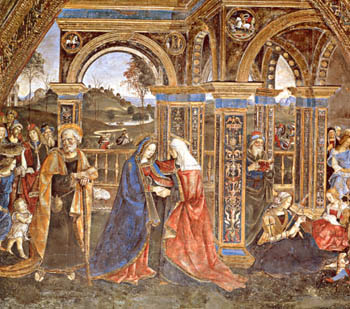
2nd Luminous Mystery: The Wedding at Cana

We continue our Patristic Rosary Project today with the:

2nd Luminous Mystery: The Wedding at Cana

The late great John Paul II wrote in his letter Rosarium Virginis Mariae wrote:

24. The Rosary is at the service of this ideal; it offers the “secret” which leads easily to a profound and inward knowledge of Christ. We might call it Mary’s way. It is the way of the example of the Virgin of Nazareth, a woman of faith, of silence, of attentive listening. It is also the way of a Marian devotion inspired by knowledge of the inseparable bond between Christ and his Blessed Mother: the mysteries of Christ are also in some sense the mysteries of his Mother, even when they do not involve her directly, for she lives from him and through him.

First, Mary stays mostly in the background. But in the case of the Wedding at Cana, she steps for a moment into the light. In the Gospel we read: “On the third day there was a marriage at Cana in Galilee, and the mother of Jesus was there; Jesus also was invited to the marriage.” Take careful note that Mary seems to have had the main invitation and The Lord was “also invited”. Mary, however, redirects everyone back to the Lord. Second, in all the moments in the Gospel in which Mary appears, she is seen to take in what happens in regard to her Son and herself and then contemplate them in silence before doing anything. After the Angel departed from her, she journeyed to see Elizabeth contemplating what happened before she burst out in her great Canticle. At the Presentation she contemplated the things Simeon told her. You will find this pattern again and again. At Cana Mary sees how the time, the right moment, had finally arrived for Jesus to make Himself known in public. Mary contemplated everything and, when all was prepared, she spoke and then stepped back into the shadows. She always redirects our gaze to her Son.

As Catholics we know with certain and divinely guided Faith that Christ instituted sacraments which would be the ordinary means for us to obtain the graces opening the way to salvation. God the Father created marriage in the creation of Adam and Eve and the mandate and different roles He gave them. We know that Christ’s presence at the Wedding at Cana did sanctify that marriage and, in so doing, sanctifies Christian marriage contracted in Christ in and under His Church, raising marriage to the dignity of a sacrament. As Venerable Bede said (+735):

To show that all states in life are good… Jesus designed to be born in the pure womb of the Virgin Mary; soon after He was born He received praise from the prophetic lips of Anna, a widow, and, invited in His youth by the betrothed couple, he honored the wedding with the power of His presence. [Homily 13]

It might strike some as odd to connect the mystery of Cana with the creation of Adam and Eve, but the connection is there. St. Augustine of Hippo (+430) wrote a commentary on the Gospel of John which has never been surpassed in all the ages since. In Tractate IX, he explores the symbolism of the six water-jars and the measures of wine within them.

In the very beginning, Adam and Eve were the parents of all nations, not of the Jews only; and whatever was represented in Adam concerning Christ, undoubtedly concerned all nations, whose salvation is in Christ. What better can I say of the water of the first water-jar than what the apostle says of Adam and Eve? For no man will say that I misunderstand the meaning when I produce not my own, but the apostle’s. How great a mystery, then, concerning Christ does that of which the apostle makes no mention contain, when he says, “And the two shall be in one flesh: this is a great mystery!” (Eph 3.31) And lest any man should understand that greatness of mystery to exist in the case of the individual men that have wives, he says, “But I speak concerning Christ and the Church.” What great mystery is this, “the two shall be one flesh?” While Scripture, in the Book of Genesis, was speaking of Adam and Eve, it came to these words, “Therefore shall a man leave his father and mother, and shall cleave to his wife; and they two shall be one flesh.” (Gen 2:24) Now, if Christ cleave to the Church, so that the two should be one flesh, in what manner did He leave His Father and His mother? He left His Father in this sense, that when He was in the form of God, He thought it not robbery to be equal with God, but emptied Himself, taking to Him the form of a servant. (Phil 2:6) In this sense He left His Father, not that He forsook or departed from His Father, but that He did not appear unto men in that form in which He was equal with the Father. But how did He leave His mother? By leaving the synagogue of the Jews, of which, after the flesh, He was born, and by cleaving to the Church which He has gathered out of all nations. Thus, the first water-jar held a prophecy of Christ; but so long as these things of which I speak were not preached among the peoples, the prophecy was water, it was not yet changed into wine. And since the Lord has enlightened us through the apostle, to show us what we were in search of, by this one sentence, “The two shall be one flesh; a great mystery concerning Christ and the Church;” we are now permitted to see Christ everywhere, and to drink wine from all the water-jars. Adam sleeps, that Eve may be formed; Christ dies, that the Church may be formed. When Adams sleeps, Eve is formed from his side; when Christ is dead, the spear pierces His side, that the mysteries may flow forth whereby the Church is formed. [tr. io. eu. 9.10]

Posted in Patristic Rosary Project |
Comments Off on 2nd Luminous Mystery: The Wedding at Cana

1st Luminous Mystery: Baptism of Jesus by John

Baptism-of-Jesus-by-Juan-Fernandez-de-NavarreteWe continue our Patristic Rosary Project today with the:

1st Luminous Mystery: Baptism of Jesus by John

The one God had sent to prepare the way and whom Christ Himself described as the greatest man born of woman, was a focus of much contemplation by the Fathers and we can only touch the surface of their comments.  Chromatius (+c.406), Bishop of Aquileia, wrote of the Baptist and his significance for us:

Hence John prepared these ways of mercy and truth, faith and justice.  Concerning them, Jeremiah also declared, “Stand by the roads, and look, and ask for the ancient paths, where the good way is, and walk in it.  (Jer 6:16)  Because the heavenly kingdom is found along these ways, not without good reason John adds, “The kingdom of heaven is near.” (Mt 3:2)  So do you want the kingdom of heaven to also be near for you?  Prepare these ways in your heart, in your senses and in your soul.  Pave within you the way of chastity, the way of faith and the way of holiness.  Build roads of justice.  Remove every scandal of offense from your heart.  For it is written: “Remove the stones from the road.”  (Is 40:4)  And then, indeed, through the thoughts of your heart and the very movement of your soul, Christ the King will enter along certain paths.  [Tractate on Matthew 8.1]

Why Christ submitted to baptism was a puzzle to the Fathers.  Christ, who had no need of baptism, received baptism by water.  Hilary of Poitiers (+367) spoke about Christ’s effect on the water, rather than its effect on Him:

In Jesus Christ we behold a complete man.  Thus in obedience to the Holy Spirit the body he assumed fulfilled in him every sacrament of our salvation.  He came therefore to John, born of a woman (Cf. Gal 4:4), bound to the law and made flesh through the Word.  (Cf. Jn 1:14)  Therefore there was no need for him to be baptized, because it was said of him: “He committed no sin.” (1 Pet 2:22)  and where there is no sin, the remission of it is superfluous.  It was not because Christ had a need that he took a body and a name from our creation.  He had no need for baptism.  Rather, through Him the cleansing act was sanctified to become the waters of our immersion.  [On Matthew 2.5]

Jerome (+420) also comments on this mystery:

For three reasons the Savior accepted baptism from John.  First, because He was born a man, that He might fulfill all justice and humility of the Law.  Second, that by His baptism He might confirm John’s baptism.  And third, that by sanctifying the waters of the Jordan through the descent of the dove, he might show the Holy Spirit’s advent in the baptism of believers.  [Commentary on Matthew 1.3.13]
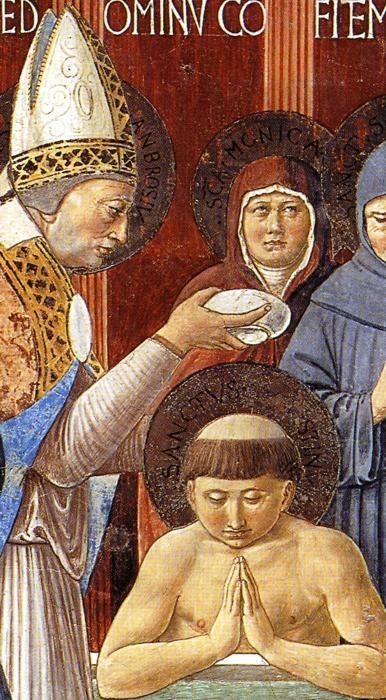
One of the remarkable things occurring at the baptism of Jesus is the sound of the Voice.  Here is Hilary again:

A voice from heaven thus spoke: “This is my beloved Son, in whom I am well pleased.”  (Mt 3:17)  God’s Son is manifested both by hearing and by sight.  Both the witnesses of contemplation and the spoken word are sent from the Lord to an unfaithful people who disregard the prophets.  At the same time, we know from those who were immersed in Christ that after baptism with water the Holy Spirit would descend to us from the heavenly gates.  Then we would be filled with the anointing of heavenly glory and become God’s children through the adoption the Father’s voice announced.  Truth prefigures the image of the sacrament through these very happenings.  [On Matthew 2.6]

The great bishop of Hippo, the Doctor of Grace, St. Augustine (+430) spoke about the Trinitarian dimension of this mystery:

Here then we have the Trinity presented in a clear way: the Father in the voice, the Son in the man, the Holy Spirit in the dove.  This only needs to be barely mentioned, for it is so obvious for anyone to see.  Here the recognition of the trinity is conveyed to us so plainly that it hardly leaves any room for doubt or hesitation.  The Lord Christ Himself, who comes in the form of a servant to John, is undoubtedly the Son, for here no one can mistake Him for either the Father or the Holy Spirit.  It is the Son who comes.  And who could have any doubt about the identity of the dove?  The Gospel itself most plainly testifies: “The Holy Spirit descended upon Him in the form or a dove.”  So also there can be no doubt whose voice it is who speaks so personally: “You are my beloved Son.” So we have the Trinity distinguished…. Here are the three Persons of the Trinity distinguished: When Jesus came to the river, He came from one place to another.  The dove descended form heaven to earth, from one place to another.  The very voice of the Father sounded neither from the earth nor from the water but from heaven.  These three are as it were distinguished in places, in offices and in works.  But one may say to me, “Show me instead the inseparability of the triune God.  Remember you who are speaking are a Catholic, and to Catholics you are speaking.”   For thus does our faith teach, that is, the true the right Catholic faith, gathered no by the opinion of private judgment but by the witness of the Scriptures, not subject to the fluctuations of heretical rashness but grounded in apostolic truth.  This we know, this we believe.  This, though we do not see it with our eyes nor as yet with the hear, so long as we are being purified by faith, yet by this faith we most firmly and rightly maintain the Father, Son and Holy Spirit are a Trinity – inseparably one God, not three gods.  But yet one God in such a way that the Son is not the Father, and the Father is not the Son, and the Holy Spirit is neither the Father nor the Son but the Spirit of the Father and of the Son.  This ineffable Divinity, abiding ever in Itself, making all things new, creating, creating anew, sending, recalling, judging, delivering, this Trinity, I say, we know to be at once indescribable and inseparable.  [Sermon 1.1.2 – c. 410-12]


Posted in Patristic Rosary Project |
Comments Off on 1st Luminous Mystery: Baptism of Jesus by John

5th Joyful Mystery: The Finding in the Temple

We continue our Patristic Rosary Project today with the:

5th Joyful Mystery: The Finding in the Temple

Pious Jews would go to Jerusalem for the Passover so that they could bring a lamb to the Temple to be sacrificed at the right moment on the right day. Jesus Himself would be nailed to a Cross and die during the slaughter of the lambs in the Temple while the priests lined the stairs to the altar and sang Psalms. In the quiet of the ancient world, when Jerusalem was still on that holy day, Jesus could probably hear the crying of the lambs and the psalms being sung. Did Jesus picture the scene as He was dying? He knew the Temple well, after all. The Holy Family traveled to the Temple at least one during the childhood of the Lord and Jesus wound up spending three days there.

Mary and Joseph lost Jesus for three days and found Him again in the Temple. Few hints of His childhood remain to us in Scripture. Thus, the Fathers thought they were filled with meaning. St Ambrose of Milan (+397) wrote:

The beginning of the Lord’s disputation is taken from His twelfth year. This number of the evangelists was intended for the preaching of the Faith. (cf. Mt 10:1-2,7) Nor is it idly that, forgetful of His parents according to the flesh, he who according to the flesh assuredly was filled with the wisdom and grace of God is found after three days in the Temple. It is a sign that He who was believed dead for our Faith would rise again after three days from His triumphal Passion and appear on His heavenly throne with divine honor. [Exposition of the Gospel of Luke 2.63]

The Father’s reflected about the divinity even in the context of this very human situation. Venerable Bede (+735) offers this:

The Lord’s coming every year to Jerusalem for the Passover with His parents is an indication of His human humility. It is characteristic of human beings to gather to offer God the votive offerings of spiritual sacrifices, and by plentiful prayers and tears to dispose their Maker toward them. Therefore the Lord, born a man among men, did what God, by divine inspiration through His angels, prescribed for man to do. He Himself kept the Law which He gave in order to show us, who are human beings pure and simple, that whatever God orders is to be observed in everything. Let us follow the path of His human way of life. If we take delight in looking upon the glory of His divinity, if we want to dwell in His eternal home in heaven all the days of our lives (Ps 27:4 (26:4 LXX)), it delights us to see the Lord’s will and to be shielded by His holy Temple. And lest we be forever buffeted by the wind of wickedness, let us remember to frequent the house, the Church of the present time, with the requisite offerings of pure petitions. [Homilies on the Gospels 1.19]

We can always find Jesus in Person in the Blessed Sacrament in the tabernacle of a Catholic church. When buffeted, find Him.

Sometimes we think we know more than we do and we press it on others. The young Christ, God, gives a good example to pushy know-it-alls. The always engaging Origen (+254) wrote:

Because He was a small child, He is found “in the midst of teachers”, sanctifying them and instructing them. Because He was a small child, He is found “in their midst”, not teaching them but “asking questions”. He did this because it is appropriate to His age, to teach us what befits boys, even if they are wise and learned. They should rather hear their teachers than want to teach them and not show off with a display of knowledge. He interrogated the teachers not to learn anything be to teach them by His questions. From one fountain of doctrine, there flow both wise questions and answers. It is part of the same wisdom to know what you should ask and what you should answer. It was right for the Savior first to become a master of the learned interrogation. Later He would answer questions according to God’s reason and Word. [Homilies on the Gospel of Luke 19.6]

“The Church should ordained women!”
“The Church should back off about homosexuality!”
“The Church must conform to modern times!”

Perhaps some of those who are so keen constantly to tell the Church what ought to be believed and what shouldn’t be might meditate on this mystery.

People lose Jesus all the time. They lose Him in the details of life. They lose them in their own naval gazing. They lose Him sometimes for years or decades and they never search Him out.

He never stops searching for us, however.

William Holman Hunt finding saviour temple

Posted in Patristic Rosary Project | Tagged , ,
3 Comments

4th Joyful Mystery: The Presentation

We continue our Patristic Rosary Project today with the:

4th Joyful Mystery: The Presentation

We are made in God’s image and likeness and Christ came into the world to reveal man for fully to him (GS 22).  Though the Lord’s Circumcision took place eight days after Our Lord’s Birth, and the Presentation of the Lord in the Temple, forty days after, we are nevertheless bound within the infancy narrative and bound to the Temple and the law.  We are, moreover, radically in unity with Christ and, through Him, with each other. In this light, let’s think about the Circumcision for a moment (there isn’t a Mystery for that in the Rosary, which could be a bit of a mystery) even before we go on to reflection the 4th Mystery, the Presentation of the Lord in the Temple and Our Blessed Mother’s Purification according to the Law.

Here are words of 3rd century Alexandria writer Origen (+254):

So, when He died, we died with Him, and when He rose, we rose with Him. Likewise, we were also circumcised along with Him. After His circumcision, we were cleansed by a solemn purification. Hence we have no need at all for a circumcision of the flesh. you should know that He was circumcised for our sake. Listen to Paul’s clear proclamation. He says, “For in Him the whole fullness of deity dwells bodily, and you have come to fullness of life in Him, who is the head of all rule and authority. In Him also you were circumcised with a circumcision made without hands, by putting off the body of the flesh in the circumcison of Christ. And you were buried with Him through faith in the working of God, who raised Him from the dead.” (Col 2:9-12) Therefore His death, His resurrection and His circumsion took place for our sake. [Homilies on the Gospel of Luke 14.1]

We discern in the Gospels an interesting pattern. The Second Person empties Himself of glory and becomes incarnate of the Virgin Mary. The eternal Word becomes a speechless child. He is lain upon the wood of the crib. He is pierced with metal and He sheds His Blood for our sake. The Incarnate Word Jesus Christ empties Himself of glory and enters His Passion. He stands mute before Pilate and the soliders. He is lain upon the wood of the Cross. He is pieced with metal and sheds His Blood for our sake. In each case He is bound to the Temple, first in His Presentation, finally when the lambs (which foreshadow Him) are being slaughtered in the Temple. All of this is for our sake.

In the Presentation Mary and Jesus are seen to be obedient to the Law. Here is Venerable Bede (+735):

Mary, God’s blessed mother and a perpetual virgin, was, along with the Son she bore, most free from all subjection to the law. The law says that a woman who “had received seed” (Lev 12:2 LXX) and given birth was to be judged unclean and that after a long period she, along with the offspring she had borne, were to be cleansed by victims offered to God. So it is evident that the law does not describe as unclean that woman who, without receiving man’s seed, gave birth as a virgin. Nor does it teach that she had to be cleansed by saving sacrificial offerings. But as our Lord and Savior, who in His divinity was the one who gave the law, when He appeared as a human being, willed to be under the law…. So too His blessed mother, who by a singular privilege was above the law, nevertheless did not shun being made subject to the principles of the law for the sake of showing us an example of humility. [Homilies on the Gospels 1.18]

Some of the Fathers, explicitly St. Augustine (+430), argued that heretics reject the Incarnation.  The Circumcision certainly underscores that this is a Savior who truly has a human nature.  He is not merely spiritual.  St. Jerome (+420) does as well and he makes his point in the context of talking about the Presentation:

All heretics have gone astray by not undestanding the mystery of His nativity. The statement “he who opens the womb shall be called holy to the Lord” is more applicable to the special nativity of the Savior than to that of all men, for Christ alone opened the closed doors doors of the womb of virginity, which nevertheless remained permanently closed. This is the closed east door, through which only the high priest enters and leaves, and nevertheless it is always closed. [Against the Pelagians 2.4]

There is a good point there also for our liturgical worship, the orientation of Holy Mass!

There is a lot going on there. Jerome connects the birth of the Lord with the High Priest going into the Temple on the day the lambs are to be slain. He speaks of the East. This makes me think about the exit of the priest from the sacristy and his entrance into the sanctuary to go unto the altar for Mass. He goes from the sacristy, like Christ from the womb, into the area partitioned away from the nave of the church. He goes into the place reserved for alter Christ, who acts in the liturgy in the place of the Head of the Body, the Mystical Person of Christ. The nave is the place designated for those who speak and act as the Body of Christ’s Mystical Person. Together, sanctuary and nave form the body of the whole church. Together, priest and people form the Church, just as Christ the Head and Christ the Body are, as Augustine says, Christus totus, Christ whole entire.

In the Temple, Christ is presented as the Law prescribes. Standing by is the figure who embodies prophecy and priesthood, old Simeon. Ephrem the Syrian (+373):

Simeon presented our Lord, and in Him he present two gifts he had, so that what had been given to Moses in the desert was passed on by Simeon in the temple. Because our Lord is the vessel in which all fullness dwells (Col 2:9), when Simeon presented him to God, he poured our both of these upon him: the priesthood from his hands and prophecy from his lips. The priesthood had always been on Simeon’s hands, because of ritual purifications. Prophecy, in fact, dwelt on his lips because of revelations. When both of these saw the Lord of both of these, they were combined and were poured into the vessel that could accommodate them both, in order to contain priesthood, kingship, and prophecy. [Homily on Our Lord 53.1-54.1]

Priesthood and prophecy are the cause of joy, but, just as the Cross precedes resurrection, they also are the source of pain. Simeon reveals to the Blessed Virgin in the moment of joy that she will experience great pain. Pain of spirit by which she experience the Passion of her Son. Here is the bishop of Milan, St. Ambrose (+397):

“And a sword will pierce through your own soul.” Neither Scripture nor history tells us that Mary departed this life by a violent death. For it is not the soul but the body that can be pierced by a material sword. This, therefore, proves that Mary was not unaware of the heavenly mystery: “For the word of God is living and active, sharper than any two-edged sword, piercing to the division of soul and spirit, of joints and marrow, and discerning the thoughts and intentions of the heart.” (Heb 4:12) God’s Word exposes the thoughts and intents of the heart, because all things are open and naked to the eyes of Mary’s Son, to whom the secrets of our conscience are visible. [Exposition of the Gospel of Luke 2.61]

And let us not forget the person of Anna.

Origen has an interesting note about her presence at this mysterious event:

Because it was necessary that women too should be saved, after Simeon there came a woman who was a prophet. Scripture says of her, “And Anna was a prophetess, a daughter of Phanuel, from the tribe of Asher.” How beautiful the order is! The woman did not come before the man. First, came Simeon, who took the child and held Him in his arms. Then came the woman. Her exact words are not recorded. But the account says in general terms that “she gave priase to the Lord and spoke about him to everyone who was awaiting the redemption of Jerusalem.” [Homilies on the Gospel of Luke 17.9]

The woman did not become the man.  We can turn this inside out and also say the man did not become the woman.  Each had their role with a mysterious content not to be subverted or confused.  This is also a point of reflection about the dignity of true marriage in the way GOD intended marriage.

The Presentation, with its dynamics of purification and, I will also bring in, of circumcision, of Law and of ritual purity and of blood, are perhaps hard for us to grasp in this day of egalitarianism. However, God’s ways are strange to us always, perhaps more so today in a desacralized society. Men and women are different, and have different roles in life and in the history of salvation. The Presentation underscores that this is as true now as it ever was. The point is this: who knows what it all means, but it is so; who knows why it is that way, but men and women, equally God’s image and equal in diginity, are given different and complimentary tasks.

Another thing to notice in the Presentation is that age plays a role. We have the very youngest in the Person of Jesus, those who are in the prime of life, Mary and Joseph, and the elderly Simeon and Anna. Ambrose writes:

Anna, who, by reason of her years of widowhood and her virtues, is set before us as wholly worthy of belief, announces that the Redeemer of all people has come…. Not without purpose, however, does he make mention of the eighty-four years of her widowhood, because both the seven twelves and the two forties seemed to imply a number that is sacred. [Exposition of the Gospel of Luke 2.62]

The mystery of the Presentation speaks to us all and its impact in the midst of joy embraces us all within the bloody Sacrifice of the Cross.

Posted in Patristic Rosary Project |
Comments Off on 4th Joyful Mystery: The Presentation

3rd Joyful Mystery: The Nativity

Nativity DuccioWe continue our Patristic Rosary Project today with the:

3rd Joyful Mystery: The Nativity

Christ came into the world in “the fullness of time” (Gal 4:4). His First Coming was foreseen from all eternity and His Nativity was prepared from the beginning of the history of our salvation. The manner of His birth is significant. St. Leo I, “the Great” (+461; whose Christmas sermons deserve entries apart!) wrote in a letter:

His God in that “all things were made through Him and nothing was made without Him.” (John 1:3) He is human in that He was “made from woman, made under the law”. The nativity of His flesh shows His human nature. The virgin birth is an indicator of His divine nature. [ep. to Flavian 4]

Commenting on Luke 2:5, Gaius Marius Victorinus (+IV c.), a teacher of St. Jerome, wrote:

As there is a fullness in things, so there is in time. For each thing has its fullness in a full and copious perfection that abounds in everything. Christ is the fullness of things. The fullness of times is the consummation of freedom. So that His fullness may be whole and perfect Christ collects His members who are scattered, and in this way His fullness is achieved. So in the same way the fullness of times was achieved when all had become ripe for faith and sins had increased to the utmost, so that a remedy was necessarily sought in the judgment of all things. Hence Christ came when the fullness of time was completed. [Epistle to the Galatians 2.4.3-4]


Using the same concept of Christ coming even in the fullness of man’s sins, St. Cyril of Alexandria (+444; ever the good Neoplatonist) states, in a Eucharistic fashion:

He found humanity reduced to the level of the beasts. Therefore He is placed like feed in a manger, that we, having left behind our carnal desires, might rise up to that degree of intelligence which befits human nature. Whereas we were brutish in soul, by now approaching the manger, yes, his table, we find no longer feed, but the bread from heaven, which is the body of life. [Commentary on Luke, s. 1]


St. Jerome, who spent so much of his time at Bethlehem, wrote:

He found no room in the Holy of Holies that shone with gold, precious stones, pure silk and silver. He is not born in the midst of gold and riches, but in the midst of dung, in a stable where our sins were filthier than the dung. He is born on a dunghill in order to lift up those who come from it: “From the dunghill he lifts up the poor.” (Ps 113:7 (112:7 LXX). [On the Nativity of the Lord]


One wonders if Jerome, perhaps still stinging from his being passed over in the splendors of Rome, didn’t spend a great deal of time reflecting on poverty and riches.

St. Ambrose of Milan (+397), the nobly-born and sophisticated bishop of enormously powerful Milan, whom Jerome disliked intensely, makes an observation about Christ’s humility and in a bright paen speaks of the forgiveness of those same black sins Jerome and Cyril went on about. This is simply gorgeous:

He was a baby and a child, so that you may be a perfect man. He was wrapped in saddling cloths so that you be freed from the snares of death. He was in a manger so that you may be in the altar. He was on earth that you may be in the stars. He had no other place in the inn so that you may have many mansions in the heavens. “He, being rich, became poor for your sakes that through His poverty you might be rich”. (2 Cor 8:9) Therefore His poverty is our inheritance, and the Lord’s weakness is our virture. He chose to lack for Himself that He may abound for all. The sobs of that appalling infancy cleanse me, those tears wash away my sins. Therefore, Lord Jesus, I owe more to your sufferings because I was redeemed than I do to works for which I was created…. You see that He is in swaddling clothes. You do not see that He is in heaven. You hear the cries of an infant, but you do not hear the lowing of an ox recognizing its Master, for the ox knows his Owner and the donkey his Master’s crib. [Exposition of the Gospel of Luke 2.41-42]


ox and ass 01The eloquent Ambrose, not always original in his sources, is picking up imagery of the ox and ass, so commonly recognized by us as part of all our nativity scenes. It probably developed from a reference to Balaam’s ass in Scripture to which prophetic angel came (cf. Numbers 22). In the apocryphal and heterodox Proto-Gospel of James we also find the ox and ass.

St. Francis of Assisi (+1226), whose feast we celebrate on 4 October, Francis was truly devoted to the Blessed Virgin. In a year we can’t determine he composed a salutation to Mary which he recited every day:

Hail Lady, Holy Queen, Holy Mary Theotokos, who are the Virgin made church · and the one chosen by the Most Holy Father of Heaven, whom He consecrated with His Most Holy Beloved Son and with the Holy Spirit, the Paraclete; · in whom there was and is all fullness of grace and every good. · Hail His Palace; Hail His Tabernacle; Hail His Home. · Hail His Vestment; Hail His Handmaid; Hail His Mother · and hail all you holy virtues, which through the grace and illumination of the Holy Spirit are infused into the hearts of the faithful, so that from those unfaithful you make them faithful to God.

Francis-Assisi_Creche-NativityAll that Mary was and came to be, she is in light of her Son, the Word made flesh, flesh from Mary. Francis was a great lover of the mystery of the Incarnation and Nativity. In 1223 in a cave near the tiny Italian hill town of Greccio, Francis “reenacted” the Nativity scene, bringing in a manger and straw and an ox and ass. There was a procession in the night of the Christmas Vigil with and Mass was celebrated. Francis had a vision of the infant Jesus and he held Him in his arms. At. my home parish of St. Agnes in St. Paul (MN) at midnight Mass there is a procession to the crib and one of the altar boys, dressed in a Franciscan habit, places the Christ Child in the manger. I am sure you have your own wonderful customs. I guess it doesn’t surprise me that secularists hate Christmas and Nativity scenes so much. Christmas calls for humility and simplicity, yielding and generosity.

What an amazing thing it is to consider how the eternal Word, through whom all things were made, was made so very small. Interestingly, it was also in 1223 that Francis had put together the ninth chapter of Rule in which he concerns himself with the verbum abbreviatum. His brothers were to speak with brief words because the Lord Himself became a verbum abbreviatum. How consistent this is with the adage attributed (wrongly) to Francis that we should always be preaching the Gospel, and sometimes even use words.

nativity 01So much of our Christian life should be rooted in simplicity. Jerome again, Doctor Cantankerus as patristiblogger Mike dubbed him, makes a wonderful point aimed at us who spend our time in lofty books:

The Lord is born on earth, and He does not even have a cell in which to be born, for there was no room for Him in the inn. The entire human race had a place, and the Lord about to born on earth had none. He found no room among men. He found no room in Plato, none in Aristotle, but in a manger, among beasts of burden and brute animals, and among the simple too, and the innocent. For that reason the Lord says in the Gospel, “The foxes have dens, and the birds of the air have nests, but the Son of Man has nowhere to lay His head.” (Luke 9:58). [Homilies on the Gospels 1.6]


All of us, especially clergy who might glance at this page, can also take away this, from the quill of Origen (+c. 254) a thought about the meaning of the angel (incredible) being going to the shepherds to announce the Good News:

Listen, shepherds of the churches! Listen, God’s shepherds! His angle always comes down from heaven and proclaims to you, “Today a Savior is born for you, who is Christ the Lord.” For unless that Shepherd comes, the shepherds of the churches will be unable to guard the flock well. Their custody is weak, unless Christ pastures and guards along with them. We read in the apostle: “We are coworkers with God”. (1 Cor 3:9) A good shepherd, who imitates the good Shepherd, is a coworker with God and Christ. He is a good shepherd precisely because he has the best Shepherd with him, pasturing His sheep along with him. [Homilies on the Gospel of Luke 12.2]

A last thought from Ambrose as we think about this 3rd Joyful Mystery:

He is brought forth from the womb but flashes from heaven. He lies in an earthly inn but is alive with heavenly light. [Exposition of the Gospel of Luke 2.42-43]

Barocci Nativity

Posted in Patristiblogging, Patristic Rosary Project |
Comments Off on 3rd Joyful Mystery: The Nativity

2nd Joyful Mystery: The Visitation

We continue our Patristic Rosary Project today with:

2nd Joyful Mystery: The Visitation

Commenting on Luke 1:39-45, the when Mary journeys to visit her cousin Elizabeth, St. Augustine of Hippo (+430) speaks of the infant John, to be known as the Baptist, leaping in the womb at the sound of Mary’s voice:

We see instances of leaping not only in children but even in animals, although certainly not for any faith or religion of rational recognition of someone coming.  But this case stands out as utterly uncommon and new, because it tool place in the womb, and at the coming of her who was to bring forth the Savior of mankind.  Therefore this leaping, this greeting, so to speak, offered to the mother of the Lord is miraculous.  It is to be reckoned among the great signs.  It was not effected by human means by the infant, but by divine means in the infant, as miracles are usually wrought. [ep 187.23]

God wrought something in John at that moment.  What happened?  We can look to the Greek writer Origen (+ c.254) for his view:

Elizabeth, who was filled with the Holy Spirit at that moment, received the Spirit on account of her son.  The mother did not inherit the Holy Spirit first.  First John, still enclosed in her womb, received the Holy Spirit.  Then she too, after her son was sanctified, was filled with the Holy Spirit.  You will be able to believe this if you also learn something similar about the Savior.  (In a certain number of manuscripts, we have discovered that blessed Mary is said to prophesy.  We are not aware of the fact that, according to other copies of the Gospel, Elizabeth speaks these words of prophecy.)  Mary also was filled with the Holy Spirit hen she began to carry the Savior in her womb.  As soon as she received the Holy Spirit, who was the creator of the Lord’s Body, and the Son of God began to exist in her womb, she too was filled with the Holy Spirit.  [Homilies on the Gospel of Luke 7.3]

The concept of being “filled with the Holy Spirit” is rather interestings.  Perhaps some of you have heard of the glosses on this phrase which compare the Blessed Virgin, John the Baptist, and St. Stephen.  All were said to be filled with the Holy Spirit.  Mary was prevented from ever having any stain of original sin.  John was said to have been forgiven the guilt of original sin before his birth, which is the moment he leapt in the womb at the coming of the Lord.  Stephen, the Protodeacon, was also “filled with the Holy Spirit”, but after his birth.  In any event, the always creative and interesting Origen speaks of John’s sanctification in the womb at the coming of Mary who was bearing the Son of God.

Each of us must prepare to bear Christ and be filled with the Holy Spirit.  St. Ambrose, the bishop of Milan (+397) said:


You see that Mary did not doubt, but believed and therefore obtained the fruit of faith.  “Blessed … are you who have believed.”  But you also are blessed who have heard and believed.  For a soul that has believed has both conceived and bears the Word of God and declares His works.  Let the soul of Mary be in each of you, so that it magnifies the Lord.  Let the spirit of Mary be in each of you, so that it rejoices in God.  She is the one mother of Christ according to the flesh, yet Christ is the Fruit of all according to faith.  Every soul receives the Word of God, provided that, undefiled and unstained by vices, it guards its purity with inviolate modesty.  [Exposition of the Gospel of Luke 2.26]

Our baptism should remind us every day that we are deeply woven into the fabric of the Church, a Church which in many ways can said to stretch back into the depths of our great “Family History”  as God’s People.  In a comment on the Magnificat, which Mary pronounced during her mysterious Visitation, Venerable Bede (+735) says:

When blessed Mary was making mention of the memory of the fathers, she properly represented them by naming Abraham in particular.  Although many of the fathers and holy ones mystically brought forward testimony of the Lord’s incarnation, it was to Abraham that the hidden mysteries of this same Lord’s incarnation and of our redemption were first clearly predicted.  Also, to him it was specifically said, “And in you all the tribes of the earth witll be blessed.” (Gen 12:3)  None of the faithful doubts that this pertains to the Lord and Savior, who in order to give us an everlasting blessing deigned to come to us from the stock of Abraham.  However, “the seed of Abraham” does not refer only to those chosen ones who were brought forth physically from Abraham’s lineage, but also to us…. Having been gathered together to Christ from the nations, we are connected by the fellowship of faith to the fathers, from whom we are far separated by the origin of our fleshly bloodline.  We too are the seed and children of Abraham since we are reborn by the sacraments of our Redeemer, who assumed his flesh from the race of Abraham.  [Homilies on the Gospels 1.4]

Did you catch that great phrase?  “Mary was making mention of the memory of the fathers…”  Perhaps we can see how the Blessed Virgin is a good model for all patristicists and, of course, patristibloggers!

Posted in Patristic Rosary Project |
1 Comment

1st Joyful Mystery: The Annunciation

Because October is dedicated in a special way to the Most Holy Rosary of the Blessed Virgin Mary, during the month I, as a dedicated patristiblogger, will work my way through the Mysteries of the Rosary offering some comments from the Fathers of the Church.  Let’s jump right in!

1st Joyful Mystery: The Annuniciation

Commenting on Luke 1:26-38, the announcement of Jesus’ birth, St. Ambrose of Milan (+397) makes a connection between Mary and the Church.  :

And, therefore, the Evangelist, who had undertaken to prove the incorrupt mystery of the incarnation, thought it fruitless to pursue evidence of Mary’s virginity, lest he be seen as a defender of the Virgin rather than an advocate of the mystery.  Surely, when he taught that Joseph was righteous, he adequately declared that he could not violate the temple of the Holy Spirit, the mother of the Lord, the womb of the mystery.  We have learned the lineage of the Truth.  We have learned its counsel.  Let us learn its mystery.  Fittingly is she espoused, but virgin, because she prefigures the Church which is undefiled (cf. Eph 5:27) yet wed.  A virgin conceived us of the Spirit, a Virgin brings us forth without travail.  And thus perhaps Mary, wed to one, was filled by Another, because also the separate Churches are indeed filled by the Spirit and by grace and yet are joined to the appearance of a temporal Priest.  [Exposition of the Gospel of Luke 2.6-7]

The Marian thought of Ambrose has an ecclesiological dimension.  The Second Vatican Council cited this important passage in Lumen gentium, the dogmatic constitution on the Church:

63. By reason of the gift and role of divine maternity, by which she is united with her Son, the Redeemer, and with His singular graces and functions, the Blessed Virgin is also intimately united with the Church. As St. Ambrose taught, the Mother of God is a type of the Church in the order of faith, charity and perfect union with Christ.  For in the mystery of the Church, which is itself rightly called mother and virgin, the Blessed Virgin stands out in eminent and singular fashion as exemplar both of virgin and mother.  By her belief and obedience, not knowing man but overshadowed by the Holy Spirit, as the new Eve she brought forth on earth the very Son of the Father, showing an undefiled faith, not in the word of the ancient serpent, but in that of God’s messenger. The Son whom she brought forth is He whom God placed as the first-born among many brethren, namely the faithful, in whose birth and education she cooperates with a maternal love.

Because of Mary’s “Fiat mihi“, we can be members of the Church with Mary as our Mother.  Our baptism integrates us into this wondrous bond.  St. Leo the Great (+461) in one of his glorious sermons says:

Each one is a partaker of this spiritual origin in regeneration.  To every one, when he is reborn, the water of baptism is like the Virgin’s womb, for the same Holy Spirit fills the font, who filled the Virgin, that the sin, which that sacred conception overthrew, may be taken away by this mystical washing.  [s. 24.3]

Theopanes BrandedThis is not merely a Western insight.  While it is a little late for our Patristic interests, here is a snip from fascinating Kontakion of the Annunciation by the 9th century Theophanes Graphtos, the Branded:

The Theotokos said: Thou bringest me good tidings of divine joy: that Immaterial Light, in His abundant compassion, will be united to a material body.and now thou criest out to me: all-pure one, blessed is the fruit of thy womb!
The Archangel said: Rejoice, lady; rejoice, most pure virgin! Rejoice, God-containing vessel! Rejoice, candlestick of the light, the restoration of Adam, and the deliverance of Eve! Rejoice, holy mountain, shining sanctuary! Rejoice, bridal chamber of immortality!

The Theotokos said: The descent of the Holy Spirit has purified my soul; it has sanctified my body: it has made me a temple containing God, a divinely adorned tabernacle, a living sanctuary, and the pure Mother of Life.

The Archangel said: I see thee as a lamp with many lights; a bridal chamber made by God! Spotless maiden, as an ark of gold, receive now the Giver of the Law, who through thee has been pleased to deliver mankind’s corrupted nature!

Here the Blessed Virgin represents the Temple, the Tabernacle and the Ark of the Covenant, images of the Church.

Posted in Patristiblogging, Patristic Rosary Project | Tagged ,
7 Comments

Laws of The House of God

On the blog Wormtalk and Slugspeak I was astonished to see a word not so many people use or even know: Gomer. “Well!” quoth I, “It is time to talk about Fat Man’s Laws of the House of God!”

“But Father!” you are sure to be saying, “What does this have to do with St. Augustine? Or what prayers really say??”

The answer to that should be obvious once you get the Laws.

Samuel Shem’s book The House of God about doctors and interns at a Boston hospital in the 1970’s is my constant inspiration. Especially useful for understanding all things ecclesiastical are the Fat Man’s Laws of the House of God which I have constantly before my eyes.

Especially these days, for reasons that ought to be apparent.

Here are a few things you need to know before you get the list.

GOMER: An acronym of “Get Out of My Emergency Room”. These are patients admitted frequently with complicated but uninspiring and incurable conditions. They are sometimes called “too old to die.” GOMER applies also to patients described as “LOL in NAD” or “Little Old Lady in No Apparent Distress”, who would do better with some help at home than coming to the ER where really bad things could happen to her.

GO TO GROUND: The equivalent of “Go to turf”, which means basically being shifted off to someone else’s department.

BUN: “Blood Urea Nitrogen is test that measures the the amount of nitrogen in the blood that comes from urea (which is secreted by the liver and removed from the blood by the kidneys).

LASIX: A brand name of Furosemide which is a loop diuretic used for congestive heart failure and edema. It has also been used to prevent race horses from bleeding through the nose. http://en.wikipedia.org/wiki/Image:Furosemide.png

BMS: The best medical student from the Best Medical School.

And now you are ready for Fat Man’s Laws of the House of God.

Please keep in mind possible ecclesiastical connections. The (helpful interlinear commentary) is mine.

I. GOMERS DON’T DIE.
(Some people simply live and live and live against all odds and indicators.)

II. GOMERS GO TO GROUND.
(The best way to handle GOMERS is to shove them off onto someone else.)

III. AT A CARDIAC ARREST, THE FIRST PROCEDURE IS TO TAKE YOUR OWN PULSE.
(See to yourself first, after all, it’s all about you.)

IV. THE PATIENT IS THE ONE WITH THE DISEASE.
(It’s not your problem, right?)

V. PLACEMENT COMES FIRST.
(Put the problem somewhere, and figure out what the problem is later.)

VI. THERE IS NO BODY CAVITY THAT CANNOT BE REACHED WITH A #14 NEEDLE AND A GOOD STRONG ARM.
(If it’s stuck force it, if it breaks, okay, it had to be replaced anyway.)

VII. AGE + BUN = LASIX DOSE.
(Really simple solutions to really complicated problems might not work, but what the heck!)

VIII. THEY CAN ALWAYS HURT YOU MORE.
(Tell me about it.)

IX. THE ONLY GOOD ADMISSION IS A DEAD ADMISSION.
(Both the paperwork and the time required are greatly reduced.)

X. IF YOU DON’T TAKE A TEMPERATURE, YOU CAN’T FIND A FEVER.
(Like putting your hands over your own eyes in order to hide from a problem.)

XI. SHOW ME A BMS WHO ONLY TRIPLES MY WORK AND I WILL KISS HIS FEET.
XI-A. Al’s Corollary: Show me a resident who only triples my work, and I will kiss his/her feet.
(If they only screw up my life a little, I’ll be happy. Good one for Italy. Cf. Latin: Primum non nocere.)

XII. IF THE RADIOLOGY RESIDENT AND THE BMS BOTH SEE A LESION ON THE CHEST X-RAY, THERE CAN BE NO LESION THERE.
(Given what we know about their real level of competence, if they came up with something, it must be wrong.)

XIII. THE DELIVERY OF MEDICAL CARE IS TO DO AS MUCH NOTHING AS POSSIBLE.
(This both cuts down on your work load and satisfies XI at the same time.)

I am thinking that you readers could perhaps make your own connections with what we see going on in the ecclesiastical world around us.

For example, are there any parallels between, say, (cf. XIII) a BMS with a Radiology Resident looking at a problem and a Liturgy Expert with a… ex-sister in charge of the parish choir?

Is there a parallel between, say, LAW III and being faced with making a decision about Catholic politicians who support abortion?

Have at!

Posted in Classic Posts, Lighter fare | Tagged
5 Comments

USCCB: Patristics in the formation of seminarians

The USCCB issued a program for formation for US seminaries. Inter alia the conference has codified that Patristics (study of the theology of the Fathers of the Church) is to be included. Here are the relevant paragraphs:

201. Patristic studies constitute an essential part of theological studies. Theology should draw from the works of the Fathers of the Church that have lasting value within the living tradition of the Church. The core should include Patrology (an overview of the life and writings of the Fathers of the Church) and Patristics (an overview of the theological thought of the Fathers of the Church).[130]

[130] See Congregation for Catholic Education, Instruction on the Study of the Fathers of the Church in the Formation of Priests (1989).

210. In historical studies, the core should include courses on the history universal and the history of the Catholic Church in the United States that way which reflects her multicultural origins and ecumenical context. Among the study of patristics and the lives of the saints are of special importance.

Posted in "How To..." - Practical Notes, Patristiblogging, Priests and Priesthood | Tagged , , , ,
9 Comments

Newman, hard words, and dew

NewmanI have been reading a wide circle and a narrow about the issue of "dew" and "precious chalice" and all these words which some people think are too hard for us dopes to grasp. 
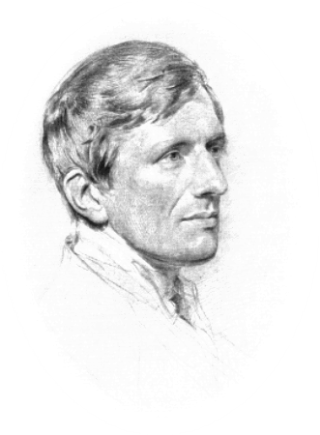
My peregrinations brought me today to Venerable John Henry Card. Newman. 

While I haven’t found anything explicitly dewy in Newman so far, I find something which made me sit straight up a pay attention.  Newman usually does that to me, not only for the beauty of his prose but also for the clarity of his thought.  As my friend Fr. Ian Ker puts it, Newman is about the only modern writer worthy of being grouped in association with the Fathers.  This Patristiblogger agrees.

Here is a some excerpts from the great one’s essay On the Introduction of Rationalistic Principles into Revealed Religion

Think about the following points in light of the Translation Wars and in light of the reasons we have been given for avoiding hard words or challenging sentences.  See if you don’t find that these are fine insights into our present situation. 

In this piece we are about to look at Newman is rightly concerned about the reduction of the content of Revealed Truth to something that we evaluate according to our own subjective desires.  We make ourselves the arbiter of what is true by seeking to make human perceptions the starting point.  In short,

1. … To rationalize in matters of Revelation is to make our reason the standard and measure of the doctrines revealed; to stipulate that those doctrines should be such as to carry with them their own justification; to reject them, if they come in collision with our existing opinions or habits of thought, or are with difficulty harmonized with our existing stock of knowledge.  And thus a rationalistic spirit is the antagonist of Faith, for Faith is, in its very nature, the acceptance of what our reason cannot reach, simply and absolutely upon testimony.

Okay, some people change the content of what has been given by divine revelation because of they insist on making sense of It while at the same time limiting It to their own limited tools.  I am not saying that anyone is specifically denying, outright, any doctrines of the faith.  However, when you start denying (in the sense of withholding) traditional and techinal and accurate words and expressions of Faith because you think is doesn’t fit anyone’s world view or, rather, it doesn’t fit your own, well… what can one say about that? 

Let’s go on with Newman.

2. … The Rationalist makes himself his own centre, not his Maker; he does not go to God, but he implies that God must come to him. And this, it is to be feared, is the spirit in which multitudes of us act at the present day. Instead of looking out of ourselves, and trying to catch glimpses of God’s workings, from any quarter,—throwing ourselves forward upon Him and waiting on Him, we sit at home bringing everything to ourselves, enthroning ourselves in our own views, and refusing to believe anything that does not force itself upon us as true. Our private judgment is made everything to us,—is contemplated, recognized, and consulted as the arbiter of all questions, and as independent of everything external to us. Nothing is considered to have an existence except so far forth as our minds discern it. The notion of half views and partial knowledge, of guesses, surmises, hopes and fears, of truths faintly apprehended and not understood, of isolated facts in the great scheme of Providence, in a word, the idea of Mystery, is discarded.

In other words, if it doesn’t fit my world view, it must not be so.  Think about liturgical language and read that again before moving on to this next bombshell: 

Hence a distinction is drawn between what is called Objective and Subjective Truth, and Religion is said to consist in a reception of the latter. By Objective Truth is meant the Religious System considered as existing in itself, external to this or that particular mind: by Subjective, is meant that which each mind receives in particular, and considers to be such. To believe in Objective Truth is to throw ourselves forward upon that which we have but partially mastered or made subjective; to embrace, maintain, and use general propositions which are larger than our own capacity, of which we cannot see the bottom, which we cannot follow out into their multiform details; to come before and bow before the import of such propositions, as if we were contemplating what is real and independent of human judgment. Such a belief, implicit, and symbolized as it is in the use of creeds, seems to the Rationalist superstitious and unmeaning, and he consequently confines Faith to the province of Subjective Truth, or to the reception of doctrine, as, and so far as, it is met and apprehended by the mind, which will be differently, as he considers, in different persons, in the shape of orthodoxy in one, heterodoxy in another. That is, he professes to believe in that which he opines; and he avoids the obvious extravagance of such an avowal by maintaining that the moral trial involved in Faith does not lie in the submission of the reason to external realities partially disclosed, but in what he calls that candid pursuit of truth which ensures the eventual adoption of that opinion on the subject, which is best for us individually, which is most natural according to the constitution of our own minds, and, therefore, divinely intended for us. I repeat, he owns that Faith, viewed with reference to its objects, is never more than an opinion, and is pleasing to God, not as an active principle apprehending definite doctrines, but as a result and fruit, and therefore an evidence of past diligence, independent inquiry, dispassionateness, and the like. Rationalism takes the words of Scripture as signs of Ideas; Faith, of Things or Realities.

"… in the use of CREEDS…"

In a vital dimension of our faith life there are those things before which we must bow.

Let’s get into another piece and see where Newman takes us:

4. … This is a fit place to make some remarks on the Scripture sense of the word Mystery. It may seem a contradiction in terms to call Revelation a Mystery; but is not the book of the Revelation of St. John as great a mystery from beginning to end as the most abstruse doctrine the mind ever imagined? yet it is even called a Revelation. How is this? The answer is simple. No revelation can be complete and systematic, from the weakness of the human intellect; so far as it is not such, it is mysterious. When nothing is revealed, nothing is known, and there is nothing to contemplate or marvel at; but when something is revealed, and only something, for all cannot be, there are forthwith difficulties and perplexities. A Revelation is religious doctrine viewed on its illuminated side; a Mystery is the selfsame doctrine viewed on the side unilluminated. Thus Religious Truth is neither light nor darkness, but both together; it is like the dim view of a country seen in the twilight, with forms half extricated from the darkness, with broken lines, and isolated masses. …

Okay, there is an objective dimension and a subjective dimension at work at the same time.  Something will always remain mysterious and hard to grasp.  That is the very nature of mystery and revelation.  This is the very nature of our prayers at Holy Mass too, right?  As well as the sacred actions?  They are the "sacred mysteries"… sacramenta… mysteria. 

Back to Newman:

5. … The practical inference to be drawn from this view is, first, that we should be very reverent in dealing with Revealed Truth; next, that we should avoid all rash theorizing and systematizing as relates to it, which is pretty much what looking into the Ark was under the Law: further, that we should be solicitous to hold it safely and entirely; moreover, that we should be zealous and pertinacious in guarding it; and lastly, which is implied in all these, that we should religiously adhere to the form of words and the ordinances under which it comes to us, through which it is revealed to us, and apart from which the Revelation does not exist, there being nothing else given us by which to ascertain or enter into it.

Okay, we know that the prayers of Mass are texts composed by the Church, according to this time’s needs and that time’s needs.  they can be changed and altered, erased and recomposed.  However, once they are established and given authority by the Church’s visible reference point in whom Christ vested his own authority to teach and govern and sanctify, then we must treat those texts with something of the reverence we might hold for Scripture, upon which those prayers are more often than not based. 

Striking indeed is the contrast presented to this view of the Gospel by the popular theology of the day! That theology is as follows: that the Atonement is the chief doctrine of the Gospel; again, that it is chiefly to be regarded, not as a wonder in heaven, and in its relation to the attributes of God and to the unseen world, but in its experienced effects on our minds, in the change it effects when it is believed. To this, as if to the point of sight in a picture, all the portions of the Gospel system are directed and made to converge; as if this doctrine were so fully understood, that it might fearlessly be used to regulate, adjust, correct, complete, everything else. Thus, the doctrine of the Incarnation is viewed as necessary and important to the Gospel, because it gives virtue to the Atonement; of the Trinity, because it includes the revelation, not only of the Redeemer, but also of the Sanctifier, by whose aid and influence the Gospel message is to be blessed to us.

Here Newman revels the attitude of people who think that everything must be "understood", and indeed understood in a way that reduces complicated and mysterious things to something else that they imagine they grasp. The fundamental point for this entry is the focus on the need to have everything "understandable". 

Posted in Patristiblogging, WDTPRS |
1 Comment