One thing NOT to do with the obsolete “Sacramentary”. Wherein Fr. Z rants.

At CNA there is an article picking up on earlier commentary on the USCCB about what to do with the now happily obsolete – that feels so good to write –  copies of the book called the Sacramentary, which has to old, now obsolete ICEL translation.   The bottom line is that, while some could be archived, they may be buried with or without being burned (I opt for the burning).

However, the piece includes this snippet:

“Some have even suggested following a custom used in various Eastern churches,” they noted, “whereby liturgical books or Bibles are placed in the coffin of the deceased as a sign of devotion and love for the liturgy.”

Let this word of warning go forth…

If anyone…anyone… puts a copy of the obsolete ICEL Sacramentary in my coffin, I will haunt that person until the end of his subsequently miserable days.

Posted in "How To..." - Practical Notes, Lighter fare, Wherein Fr. Z Rants | Tagged ,
39 Comments

“The Belt of the Mother of God”

Here is a fascinating post from the Director of SPUC, Mr. John Smeaton.  Check out the very first part:

Vladamir Putin turns to Mary to halt Russia’s population decline

Under the headline “Mother of God’s Belt comes to Russia to help reverse population decline” The Freethinker The Voice of Atheism since 1881 has featured  the news that Vladamir Putin, prime minister of Russia, received the Belt of the Mother of God “a revered Orthodox piece of antiquity” at St. Petersburg Airport.

[…]

Interested?

First, you should know about SPUC anyway.

Next, I finished reading Michael O’Brien’s The Father’s Tale.  I was impressed by the stress O’Brien placed on the future, potential future role of Russia.

One wonders… about that consecration thing….

READ ME

Posted in SESSIUNCULA | Tagged , , , ,
26 Comments

Refusing to “learn the damn prayers”.

Ultra-liberal Huffington Post has an article on the implementation of the new, corrected translation.

Here is one of the dumbest things I have read to date about this new, translation, even from some the professional whiners.

[…]

Maribeth Lynch, 51, a publisher from the Milwaukee suburb of Elm Grove, said she was “distraught” over the changes and would refuse to “learn the damn prayers.

“It’s ridiculous. I’ve been a Catholic for 50 years, and why would they make such stupid changes? They’re word changes. They’re semantics,” she said.

“It’s confusion. All it’s doing is causing confusion,” she said. “You want to go to church and be confused?”
[…]

I think someone brought her confusion with her to church this morning.

What a nice way to talk about something so sacred as the prayers of our central form of worship of Almighty God.

I am reminded of the person who is tearing along in the car, shouting at other motorists, “Get the HELL out of my way! I’m late for Mass!”

Posted in Liturgy Science Theatre 3000, Throwing a Nutty |
36 Comments

Your Good News and Sunday Sermon Notes

Do you have any good news for us?

Was there some particularly good point in the Sunday sermon you heard?

Posted in SESSIUNCULA |
45 Comments

O Magnum Mysterium

For your Advent, pre-Christmas reflection… the text from Matins of Christmas.

Think about this for the next month, in the version by Lauridsen, sung about as well as you might hear it sung.

O magnum mysterium,
et admirabile sacramentum,
ut animalia viderent Dominum natum,
jacentem in praesepio!
Beata Virgo, cujus viscera
meruerunt portare
Dominum Christum.
Alleluia.

[wp_youtube]nn5ken3RJBo[/wp_youtube]

Posted in Just Too Cool | Tagged , ,
Comments Off on O Magnum Mysterium

“Imagine our Lord himself as holding back, keeping you waiting for a little.”

Pat Archbold uses the opportunity of the implementation of the new translation to reflect on the three-fold “Domine non sum dignus” before Communion.

[…]

I have for years attended the Traditional Latin Mass when my schedule would permit and will admit that I am fond of it. I won’t get into the whys, but suffice it to say that certain elements appeal to me. One of the things that so grabbed my attention those years ago (back when we needed an indult? What’s that?) was the non sum dignus. What really got my attention was the fact that faithful said that prayer not once, not twice, but three times. When you say something three times in a row, you get the message, this is important.

Saying that prayer three times really focused me on the great gift I was about to receive and my complete unworthiness of it.

“Lord, I am not worthy…”

“Lord, I am not worthy…”

“Lord, I am not worthy…”

That recognition of my own unworthiness back then and the great gift bestowed upon me nevertheless stuck with me. Ever since then I have focused myself on saying it properly (in Latin) in the new mass as a way of keeping that focus. I am grateful that I can now say it properly in English.

But one thing I would really love to see restored in the mass is the triple repetition of this prayer as I am sure that it might then have the same effect on others as it had on me. Saying it just once seems like pauper’s gruel when there is really a great feast to be had.
[…]

Some time ago I posted about the three-fold Domine non sum dignus, saying:

From a sermon of Ronald Knox:

[W]hen the priest, just before communion, says the threefold Domine non sum dignus in your name, you should imagine our Lord himself as holding back, keeping you waiting for a little, so as to test your dispositions. He often did that, didn’t he, before consenting to perform a miracle; ….

But, when I speak of testing our dispositions, do I mean that he looks into our hearts and expects to find his own likeness already there? Must we already be humble with a humility like his, already be unwearied in his service, already be perfectly resigned to all the suffering which may befall us, or be told that we are not fit to receive him? If I meant that, if I meant that holy communion is a privilege reserved, at least commonly, for an élite of almost perfect souls, then I should be falling back into the error of the Jansenists, and I should be wronging the memory of that great Pope who has just been raised to the altars of the Church. For whatever else St Pius the Tenth is remembered, he will be remembered for having thrown open the gates of the sanctuary to hesitating and struggling soul; to the unworthy who know themselves to be unworthy.

No, the dispositions I am speaking of are not those which quality us to receive holy communion; we go to holy communion in order that those dispositions may be formed in us. Only, we must want them to be formed in us. The trouble, you know, about you and me is not that we aren’t saints, but that we don’t want to be saints. Lord, I am not worthy, because I am not humble; but I do want to be humble. Lord, I am not worthy because I am backward and slothful in your service; but I hate my backwardness, I hate my sloth. Lord, I am not worthy, because I am a bad sufferer; but how I wish it were otherwise! Let it be otherwise, Lord; speak the word only, and they servant shall be healed.

Posted in The Drill, WDTPRS | Tagged , ,
4 Comments

ACTION ITEM! POLL ALERT at Huffington Post on new, corrected translation… imagine

At the ultra-liberal Huffington Post there is a poll about preferences concerning the new, corrected translation or the obsolete, bad translation.

I ask readers to vote and I ask bloggers to pick this up as well.

Remember: This is about the translation not the Ordinary and Extraordinary Form.  Whoever did this poll used bad terms.  “New Mass” = “New Translation”, not Novus Ordo.

As of this writing, the results …

CLICK HERE to to go the poll.

UPDATE 28 Nov 1402 GMT:

We seem to be moving the poll a bit.

UPDATE 28 Nov 1824 GMT:

Progress.

UPDATE 28 Nov 2128 GMT:

I’m proud of you. And thanks to other bloggers, if any of you picked it up.

0

How about a nice coffee break?

You might try some

Jingle Bell Java or Christmas Blend 2011.

Prefer tea?  Let It Snow!

And as we continue to grind out those good votes, get yourself a grinder, too.

It’s swell!

UPDATE 29 Nov 0220 GMT:

Press on!

UPDATE 29 Nov 1429 GMT:

It’s going very well!

UPDATE 29 Nov 2042 GMT:

Excellent.

Posted in POLLS | Tagged
56 Comments

Typo on the first day in the Catholic Book Publishing Company edition

From a priest reader:

The Roman Missal for the Catholic Book Publishing Company (large edition) has a typo on the First Sunday of Advent. The Introit adds a word that should not be there: “Nor let “not” my enemies exult over me;….”

That’s pretty embarrassing, isn’t it?

The very first prayer for the very first day.

Let’s have a look:

And the priest hasn’t even reached the altar yet!

Any other editions have this glitch?

The Catholic Truth Society got it right.

Posted in Liturgy Science Theatre 3000, Look! Up in the sky!, SESSIUNCULA | Tagged , ,
25 Comments

WDTPRS – 1st Sunday of Advent – SUPER OBLATA (2002MR): thresholds

Today’s Ordinary Form Super Oblata prayer, the prayer over the offerings during the Offertory, is found in the ancient Veronese Sacramentary amidst prayers for the month of July.

SUPER OBLATA – (2002MR):
Suscipe, quaesumus, Domine, munera
quae de tuis offerimus collata beneficiis,
et, quod nostrae devotioni concedis effici temporali,
tuae nobis fiat praemium redemptionis aeternae
.

Note the scrambling of word order for rhetorical effect.  Words that go together are separated and concepts are embedded between them.  This elegant rhetorical interlocking delights both ear and mind.  It also reflects how the concepts are interconnected.  Latin challenges us to hold different ideas in our minds as we wait for the final word and the sentence’s resolution, almost as a juggler foils the fall of many objects of differing shapes.  This sometimes makes rendering Latin into smooth English rather hard.

In ancient Roman terms, a devotio, a form of a consecratio, was the ritual dedication of an enemy, or self-dedication, to the gods of the underworld, the dii manes.  For example, when the Romans were struggling for their existence against a coalition of Gauls and Samnites in 295 BC, the consul Publius Decius Mus performed a devotio and then rode to the enemy with his toga drawn over his head, and the enemy killed him.  Romans didn’t want to die with their head or feet uncovered.  You might remember that when Julius Caesar was killed, before he died he struggled to cover his feet and head.  The Roman pontifex maximus prayed and sacrifice with the toga drawn over the head.  For a military devotio, a the “devoted” general, in a toga, leaned on a spear and repeated it a pray spoken by the pontifiex. With the toga over his head, like a priest (“Gabine fashion”) he rode over to the enemy.  If the “devoted” one survived, he was never again to perform a religious act.  If “devoted” survived, a large statue had to be buried in his stead.  Another kind of devotio is in the example during the sack of Rome by the Gauls in 390 BC, when some senators remained in their homes, in togas, waiting to be killed by the invaders.  A famous instance of the devotio was that of a senator who pledged to commit suicide if the emperor Caligula recovered from an illness.  Caligula recovered and demanded payment.  The episode is in I, Claudius if I recall.

In any event, the devotio was an act of self-sacrifice, ritually performed, to take upon oneself the salvation of others.  There was a spiritual dedication for a temporal effect.  Devotio is a word super-charged by centuries of Roman habits of prayer and the concept of sacrifice.

LITERAL TRANSLATION:
Take up, O Lord, we beg You, the gifts we are offering
which were gathered together from Your favors,
and let that which You grant to be accomplished by our temporal dedication
become for us the reward of Your eternal redemption
.

Remember that the first part of Roman prayers will invoke God according to some characteristic and the, in light of that characteristic, will present a petition.

In this case we recognize God as the source of benefits and that what we have on the altar is from Him. In light of that, the prayer sets up a contrast between the eternal and the temporal, that which is bound to time now. In the temporal sphere, God responds to our devotio, and what is granted then becomes, eventually, an eternal reward.  Note the way the clauses end in “temporal” and “eternal”

OBSOLETE ICEL (1973):
Father, from all you give us
we present this bread and wine.
As we serve you now,
accept our offering
and sustain us with your promise of eternal life
.

The now obsolete – HURRAY! – ICEL version emphasized the “meal” aspect of Mass rather than the transforming “sacrificial” dimension. The Latin says munera, “gifts”, but ICEL says “bread and wine”; panem et vinum are not in the Latin original. Of course at this point in Mass munera indicates the bread and wine on the altar. Tthe obsolete ICEL restricts us to the obvious elements of bread and wine. The Latin is less restrictive. Munera embraces all that we bring to the Lord at Mass, material and spiritual sacrifices.

The Latin word collata brings to my mind an image of laborers in fields and vineyards, quarries, orchards and forests, reaping, gathering, mining, collecting what their own labor and God’s blessings produce. Obsolete ICEL did not deal with collata. Collata (means “gathered together” – like English “collate” cf. confero in the useful Lewis & Short Dictionary: “to collect, gather together” and thence “to bring together for comparison” which is where we get the abbreviation “cf.” meaning “compare with”).

The Latin juxtaposes what we do and what God does. In the obsolete ICEL version we want God to “sustain” us with a “promise”. In the Latin we beg God to receive back from us what He already gave and subsequently cause those things to be entirely transformed (fiat) into the “reward of eternal salvation” – Himself. The structure of the prayer, by the complex way it weaves concepts between words that go together grammatically, hints at what the prayer really says: by our work and dedication we must give back to Him good things which were already His in anticipation of His transforming them as only He can.

Christ makes Himself the reward of our efforts.

NEW CORRECTED ICEL VERSION (2011):
Accept, we pray, O Lord, these offerings we make,
gathered from among your gifts to us,
and may what you grant us to celebrate devoutly here below
gain for us the prize of eternal redemption
.

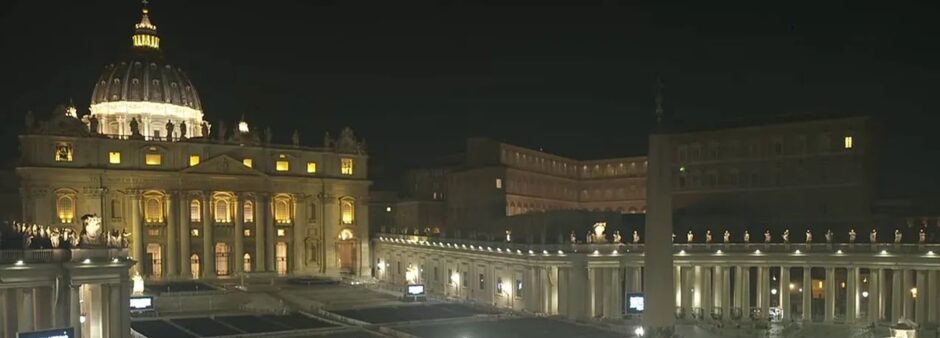
Keep our context in mind: this is the beginning of Advent, the season of preparation for the Coming of the Lord.

Advent is back to back with the observance of the Lord’s final coming at the end of the world. Advent is a time of penance before the First Coming of the Infant King.

Advent is liminal season, like a threshold, blending the end of the world with its rebirth in the new Adam. Advent is also about the how the Lord comes in actual graces, in the words of the priest…Hoc est enim corpus meum….This is my Body, in Holy Communion and in the person neighbor, especially the needy.

St. John the Baptist admonishes us during Advent to make straight Christ’s path, for He truly is coming. Christ Himself will straighten our paths His own way if have not taken care to straighten them beforehand.

It is a new liturgical year. Pray that this upcoming season of preparation for the coming of the Lord at Christmas will bring us and our loved one many material and spiritual blessings.
Posted in ADVENT, SESSIUNCULA, WDTPRS | Tagged , , ,
4 Comments

Praise for the new, corrected translation coming in.

I am getting some good feedback on the new translation.  Here’s one item:

It was such an improvement that I might (just might) go to Novus Ordo Mass in English there once in a while!

High praise indeed!

UPDATE:

From a long-time reader and frequent donor:

I am surprised at the reaction I am feeling in myself after praying the mass in the new corrected translation. I was totally ready. Having been reading your blog for years and supplementing with other resources, I knew what to expect from the peoples responses. Although I had read some of the words in the preface and canon, it was there that the greatest impact was seen. And it surprised me and took me off guard.

Our priest was very careful and diligent and took his time and said all the black and you could see him taking note of the red. The Eucharistic Prayer taken as a whole built up a crescendo of prayer, much more meaningful and rich than any mass I had heard or prayed before. Where I was totally unprepared was the emotional impact. After the Lamb of God when the people’s response was said, the one from scripture about allowing Christ to come under my roof, into my bodily temple, I was moved to tears.

I think the context to this is important to understand. Our church in under renovation. Our masses are being held in a cafeteria, with folding chairs, no kneelers. It’s crowded and somewhat uncomfortable. However, despite this, it was clear to me that the Lord was speaking to me, and I assume everyone, In a new way, in a better more elevated language that elevated my thoughts In precisely the right direction- upward toward God and In Christ. It worked.

My wife commented last night something fairly astute; we were some of the first to pray the mass last night at the vigil mass, the way the fathers of the council likely intended it to be prayed, and after 40 odd years. It’s hard to argue that she was on to something there. Clearly we have some notion about what went wrong in those years, but what I can report from the ground is that something now has gone right, and it’s a great source of hope.

Posted in Brick by Brick, Liturgy Science Theatre 3000 | Tagged
97 Comments