
I read with interest a piece on the “On The Square” blog of First Things. It is by Richard Upsher Smith, Jr., Professor of Classics and Chairman of the Department of Classics at Franciscan University of Steubenville. The Excellence of the Latin Novus Ordo.
Prof. Smith has taken a page from WDTPRS and done a great job looking at a Preface in the 2002MR.
You should read the whole article over there, but here is a taste with my emphases and comments:
The Excellence of the Latin Novus Ordo
Jul 15, 2011Richard Upsher Smith, Jr.As a convert to Roman Catholicism [I, too, am a convert.] from old Prayer Book and High Church Anglicanism, [Not I.] I resolved to tolerate the current translation of the Novus Ordo [We have our crosses.] (the Latin Mass as revised after Vatican II) because it was the Church’s, not because it was edifying or beautiful. After recently translating the Ordo Missae for use at Christ the King Chapel at Franciscan University of Steubenville, I have become convinced that the Novus Ordo contains much that is beautiful and edifying.
The language of the Novus Ordo is robust, the rhetoric persuasive, [In Latin… In Latin…] and the theology a complement to the “revitalization” of Catholic thought aimed at by the theologians of ressourcement before Vatican II. [NB…] All this despite the fact that Archbishop Annibale Bugnini’s “euchological pluralism and rubrical flexibility” (his prodigality with forms of prayer and his leniency with liturgical rules), advocated over a supposedly rigid “fixism,” displaced the traditional collects from the Mass, promoted a radically simplified ceremonial that tires the eye and deadens the imagination, and introduced a three-year lectionary that contains too much spread out over too long a period to shape a pious memory effectively. [Bull’s Eye!]
A paragraph from the Third Preface of the Nativity of the Lord illustrates these points.
Per quem hodie commercium nostrae reparationis effulsit, quia, dum nostra fragilitas a tuo Verbo suscipitur, humana mortalitas non solum in perpetuum transit honorem, sed nos quoque, mirando consortio, reddit aeternos.
Translated:
Through whom flashed forth today the transaction of the healing of our nature, because, when our frailty is received by thy Word, not only does human mortality pass across to everlasting honor, but it also, by a wonderful fellowship, renders us eternal.
The first clause in this passage is particularly striking, as commercium, a commercial term, is a jarring word to apply to our salvation. Effulsit, too, is vigorous, and in combination with commercium—“the transaction flashed forth”—creates an impressive concept for the mind. At the end of the passage, too, the phrase mirando consortio—“by a wonderful fellowship,”—implying as it does a community of goods, reinforces the notion of exchange that gives this passage its vitality.
[…]
The rest is good! Look at it.
Apparently Prof. Smith has a book coming out soon, entitled: “Vade Mecum,” A Handbook of Terms in Grammar, Rhetoric and Prosody for Readers of Greek and Latin. I shall be sure to put it on my wish-list if only I can learn when it will be published.
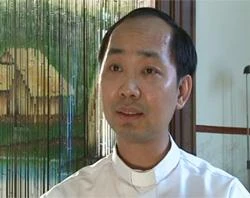 Rome, Italy, Jul 15, 2011 / 05:53 am (CNA).- “If I return now, they will throw me in jail and kill me.” These are the frank words that mark an encounter with Father Peter Nguyen Khai, a 41-year-old Vietnamese priest living in Rome.

 My friend Jeffrey Tucker at
 From a reader:


 ProfessorCover on Daily Rome Shot 1116: “This reminds me of something Thomas Pink said in a response to a question fromAndrew Cusak: Many European Bishops are…”




























