The Feeder Feed: freeeeezing cold edition

TwitterIt is cooooold here and all the visitors are doing their puff-ball imitation.  They fluff up their feathers to hold in their body heat.

They need a lot to eat in this sort of weather, and they are eating!

Some shots.

As I type it is -18°F (-28°C) and there is a fairly strong breeze.

Vote for Fr. Z!Think about it.

Here is a candid shot of Cardinal “Ray”.

Mr. Red-Breasted Woodpecker is fluffed-up and looking for the nuts, which have a higher fat content.

Chickadees galore.  They are my favorites.

The food bin is starting to get low.  I will have to get more soon.

Feed the birds!

Here is a Chickadee gnawing on something or other, probably a peanut.

Downy Woodpecker hanging hacking away at some very hard suet.

A note of thanks to those in the past who have contributed.   I feed them solely from donations.

Posted in The Feeder Feed | Tagged
17 Comments

New… Newer… Newest Evangelization

We have yet to see action from the Vatican’s new office for “New Evangelization”, which was created… to.. ehem…. to… well… Archbp. Fisichella is the President of the new office to help promote a restoration of the Faith in places where once it was strong and now is diminishing.

I call it the Council Pro Re-Propaganda Fide.

Here is a piece from Ironic Catholic which is sprinkled here and there with some salt grains:

Vatican City: The Vatican Office of Evangelization, inspired by the worldwide phenomenon that is WikiLeaks, has created a website intended to penetrate the deep secrets of Catholic Christianity. Angled to the “wandering spiritual seeker,” it is called WikiSeeks.

“Young Fr. Eamon over there was telling me about the WikiLeaks popularity, spilling out all this secret material all over the web, and I thought–hey, the faith is public and always has been, but no one seems to know that. You know, The DaVinci Code and all that crap. So why don’t we set up a website ‘revealing’ all our secrets? A few defenses of the faith? Mysteries explained?” enthused Cardinal Giovanni Bianci. “We’re releasing one doctrinal defense a day through twitter. If Francis de Sales spread the good word through trifolds, well, we can try newfangled media as well!” [That’s actually a pretty good idea.]

Fr. Eamon Donahue blushed, and added, “We’re calling it the Newer Evangelization around the office.”

Cardinal Bianci argued there was a hearty debate about whether to publish the site in Latin or a variety of common languages, but it was decided in the interest of transparency and retweets they would begin with English, with mirror sites in Mandarin and Spanish. [Parents… force your children to study Mandarin.]

An added benefit, noted Fr. Eamon, is that the office can detect interest in and response to the doctrinal defenses through the retweets. “We’re especially pleased that the resurrection of our Lord received 2,459 retweets. But we’re commissioned to the ends of the earth, so we think that number is just the beginning. We daily beg the Holy Spirit to move the sinsick souls of Twitter to retweet WikiSeeks.”

One typical follower on Twitter, Born2Search, posted this response to a recent tweet on predestination on his Twitter wall: “I’M SOO GREATFUL 2 U COO PRIESTS 4 CLEARING ^ TH PATH-MY SOUL REJOYCES-AMEN & ROCK ON #WIKISEEKS! [yahhhhh… that’s sounds about right.]

Fr. Eamon admits there has been an unexpected downside. “Apparently the Sikhs wanted to create a site by that name, and while they can–the words are differently spelled–they think the two sites will create too much confusion. The Office for Interreligious Dialogue is kind of in a holy huff at us.”

Julian Assauge could not be reached for comment.

–I.C.

Posted in Lighter fare |
16 Comments

QUAERITUR: Nitwit priest changes the words of absolution. Wherein Fr. Z really rants.

From a reader:

I am deeply distressed over this. I went to Confession today and for
the absolution, the priest said “…and I forgive you of all your
sins…” instead of “..I absolve you of your sins..”

Is my Confession
valid and am I still in a state of mortal sin and thus unable to
receive the Eucharist? Please help me with this issue Father. Thank
you very much.

Friend, I am so sorry you had this experience.  Please don’t let it put you off going to confession.

I am not the Congregation for the Doctrine of the Faith, which is the dicastery that makes determinations about the validity of sacraments.

That said, I suspect that the absolution was valid.  I suspect your sins were forgiven.  NB: In 2021 I have revised my view.  HERE  If you are not sure, go to confession again, explain what happened, and confession your sins, preferably to a different priest.

If opportunity presents itself, I would calmly and respectfully ask the priest why he uses words for absolution that are not in the book.  If you are distressed and worried and this is going on everytime you go, despite your inquiries,  ask your local bishop if that absolution was valid.

You have the right to ask.  You have the right properly celebrated sacraments.

During confession you can, by the way, tell the priest that you would prefer that he use the actual words of absolution as they are printed in the approved book.  Perhaps take a copy with you, just in case.

At this point, however, I will repeat what I have said a zillion times here.

PenancePriests should stick to the words in the book.

For the love of God… WHY IS THIS HARD TO DO?

When priests make changes on their own authority they run the risk of leaving the faithful in doubt about what just happened.

We are not talking here about changing a word in a collect, or riffing in some part of the Eucharistic Prayer.  We are talking about the actual form of a sacrament… the Sacrament of Penance.

The Sacrament of Penance is the point of contact for a Catholic and mystery in which a Catholic is at his most vulnerable.  Why introduce an illicit change, in some cases invalidating change, which could cause a person to a have doubts about having been forgiven their mortal sins?

If a priest can’t follow the book for the forms of sacraments, at the moment of the consecration during Mass, during the pouring of water at baptism, when absolving a penitent… then perhaps the bishop should remove that priest’s faculties until he is made to understand both what to say and do and why he says it and does it.

Just say the black and do the red and you avoid all of this.  It is so easy.

Here’s my little love letter to clerics:

Dear Reverend Fathers and Most Reverend Bishops,

These are my suggestions to you when it comes to the forms of sacraments, especially the Sacrament of Penance.

Review the form of the sacrament, the words of absolution.

If you are surprised by what you find, I suggest memorizing them and then using them as they are written.

If you aren’t surprised but think you are going to improve on them: think it through again.

Just say the words as they are.

Otherwise, an increasingly well-informed member of the lay faithful may just challenge you and, unsatisfied and thoroughly irritated with your arrogant and probably wide back-side, may also write a letter to the Congregation for the Doctrine of the Faith… from whom you do not want to hear.   I know some of the people who work there. They are very interested in stories like this.

If you are, reverend gentlemen, changing the words of absolution, pull your heads out of that dark place and knock it off.

With fraternal respect,

Fr. Z

This sort of thing makes me see the red and think the black.

Posted in "How To..." - Practical Notes, ASK FATHER Question Box, Biased Media Coverage, Wherein Fr. Z Rants | Tagged , ,
55 Comments

Virtual Prayer for Pope Benedict Project. How you can help.

Oremus pro PontificeI want to try an experiment.  Virtual Prayer for Pope Benedict.  “Oremus pro Pontifice nostro Benedicto!

I have a recording of the Prayer for the Pope on the Z-Cam’s live stream.  It rotates through the playlist.  But I make the responses myself.

I would like to a virtual congregation of you, readers of the blog and listeners of the stream.

If you want to participate, you have to record yourself and send it to me by email.  It would be best to send an mp3In your email subject line put: VIRTUAL CONGREGATION.

I don’t have to covert mp3 files.  They are best.  I like mp3s.  I don’t like non-mp3s.  Mp3s find favor and others don’t.  Being the easiest to work with, Fr. Z prefers mp3s.

EMAIL ADDRESS HERE.  (I don’t think you can attach files when sending me mail through the “Contact” button, above.)

We will use Latin.

I will use software to edit them together to create a virtual congregation responding.

Here are the responses you should record… in order… with about 5 seconds between each one.

It might take a while to put this together, but it could be a good project.

IMPORTANT UPDATE:

I have received a few files.  I should have anticipated that everyone would read at a different pace.

Here is the base file I am working from.  HERE.

If you put on head phones and listen to this as you record, we will be much much closer together and it will be much much easier to edit together.

Here’s how it goes:

Fr. Z. Oremus pro Pontifice nostro Benedicto.

YOU: Dominus conservet eum, et vivificet eum, et beatum faciat eum in terra, et non tradat eum in animam inimicorum eius.

Fr. Z: Pater noster qui es in coelis,
sanctificetur nomen tuum;
adveniat regnum tuum,
fiat voluntas tua,
sicut  in coelo et in terra.

YOU: Panem nostrum quotidianum da nobis hodie,
et dimitte nobis debita nostra,
sicut et nos dimittimus debitoribus nostris.
et ne nos inducas in tentationem
sed libera nos a malo.  Amen.

Fr. Z: Ave Maria, gratia plena; Dominus tecum: benedicta tu in mulieribus, et benedictus fructus ventris tui Iesus.

YOU:
Sancta Maria, Mater Dei ora pro nobis peccatoribus, nunc et in hora mortis nostrae. Amen.

FR. Z: Deus, omnium fidelium pastor et rector, famulum tuum Benedicto., quem pastorem Ecclesiae tuae praeesse voluisti, propitius respice: da ei, quaesumus, verbo et exemplo, quibus praeest, proficere: ut ad vitam, una cum grege sibi credito, perveniat sempiternam. Per Christum, Dominum nostrum.

YOU: Amen.

Posted in "How To..." - Practical Notes | Tagged
22 Comments

PZ Myers, low life

I picked this up from CMR. He didn’t provide a link, for reasons which will be obvious.   Posting like this is rather like picking up after some large dog during walkies.

You will unfortunately remember PZ Myers, pond scum, who wanted someone to send him a consecrated Host so that he could desecrate It.   Now he shares his thoughts about abortion.

First, never quote Mother Teresa at me — she was an evil hag who worshipped poverty, who did not help people except to encourage them to suffer more for her faith, while she lived in comfort and traveled far and wide to receive the accolades of the gullible. I would never find the words of that wicked woman persuasive. [I had the unfortunate experience of a priest who used to talk about the Little Sisters of the Poor and the Hawthorne Dominicans like this.  I still have holes in my back from that … fellow.  But he is not nearly as disgusting as this guy.]

Secondly, the standard bullying tactics of waving bloody fetuses might cow the squeamish, but I’m a biologist. I’ve guillotined rats. I’ve held eyeballs in my hand and peeled them apart with a pair of scissors. I’ve used a wet-vac to clean up a lake of half-clotted blood from an exsanguinated dog. I’ve opened bodies and watched the intestines do their slow writhing dance, I’ve been elbow deep in blood, I’ve split open cats and stabbed them in the heart with a perfusion needle. I’ve extracted the brains of mice…with a pair of pliers. I’ve scooped brains out of buckets, I’ve counted dendrites in slices cut from the brains of dead babies.

You want to make me back down by trying to inspire revulsion with dead baby pictures? I look at them unflinchingly and see meat. And meat does not frighten me.

I will keep the combox closed on this.

Stop and pray for this man.

I fear he will go to hell.

Posted in SESSIUNCULA |
Comments Off on PZ Myers, low life

Do we need a “Syllabus” on the Council?

The UK’s best Catholic weekly (which still has its digital subscription special going, a year for a “tenner”!) the Catholic Herald has an article by William Oddie about the proposal made by Bp. Athanasius Schneider about a Syllabus both of errors and of guidelines concerning the interpretation of Vatican II.

My emphases and comments.

The call for a new Syllabus of Errors, this time on Vatican II, should be heeded

Pio Nono’s Syllabus Errorum has had an undeservedly bad press: it is still relevant today
By William Oddie

The recent declaration of the beatification of Pope John Paul II reminded me of one attack on him sparked off by another beatification, that of Pius IX. One of the articles of indictment in John Cornwell’s [a peddler of codswallop] very hostile book about the late pope was that this was “an early item of poor judgment”, since Pio Nono “was chiefly famous for calling the First Vatican Council, which declared the dogma of papal infallibility and papal primacy, although he was known for his infamous syllabus of errors which denounced democracy, pluralism, workers’ unions and newspapers. A fine exemplar for the 21st century to be sure!”

Cornwell, of course, got it wrong about papal primacy, [and pretty much everything else he says] which had from the earliest centuries been taken for granted: it was no purpose of the Council to “declare” it. As for papal infallibility, that, too, was widely believed; Vatican I simply defined it formally. But he also got the Syllabus of Errors wrong: not one article of it mentions democracy, workers’ unions or newspapers, and if it rejects “pluralism” (not a concept anyone at the time was familiar with) it is mostly in the sense that any religion which claims to be true rather than a matter of opinion rejects it.

The Syllabus of Errors has had a bad press over the years: but this should not deter the present Pope from responding positively to a recent request for another Syllabus, this time one spelling out the errors that have circulated within the Church about the Second Vatican Council. This request was made by the patristics scholar Bishop Athanasius [excellent name for a theologian bishop] Schneider [You can listen to it in its entirety HERE.] at an important conference held last December in Rome, “for a correct hermeneutics of the Council in the light of Church Tradition”. I quote simply the passage in which Bishop Schneider calls for a document clearly spelling out the errors of the post-conciliar years:

“In recent decades there existed, and still exist today, groupings within the Church that are perpetrating an enormous abuse of the pastoral character of the Council and its texts… Keeping in mind the now decades-long experience of interpretations that are doctrinally and pastorally mistaken and contrary to the bimillennial continuity of the doctrine and prayer of the faith, there thus arises the necessity and urgency of …  a sort of “Syllabus” of the errors in the interpretation of Vatican Council II.

“There is the need for a new Syllabus, this time directed not so much against the errors coming from outside of the Church, but against the errors circulated within the Church by supporters of the thesis of discontinuity and rupture, with its doctrinal, liturgical, and pastoral application.

“Such a Syllabus should consist of two parts: the part that points out the errors, and the positive part with proposals for clarification, completion, and doctrinal clarification.”

This seems to me so obviously a good idea that no more needs to be said by me here. I would like to add just one thing, however. A century of modernist propaganda against Pio Nono has left the impression that the original Syllabus Errorum was so laughably reactionary a document that any attempt to repeat such an exercise should be rigorously avoided. The fact is that almost nobody today has read it, so how do they know? When I was preparing my Spectator review of Cornwell’s book (quoted above), I thought, in view of his contemptuous remarks about it, that I ought to look at this notorious text. [Imagine!  Actually reading the text!] What I found was a document of mostly impeccable [wait for it…] Catholic common sense, designed to defend Christian theology in a time of heavy rationalist attacks. Here, for instance, are extracts from the opening section. I haven’t space to quote it all: read it for yourself, [a good idea… so I will cut out his quote, below] here; all the following items, remember, are what Pio Nono is declaring to be errors:

[…]

Pio Nono was fighting for the Church’s life. Under the circumstances, the famous article 80 of the Syllabus – which condemns as an error the proposition (with which, presumably, most Tablet liberals would enthusiastically agree) [Tabula delenda] that “The Roman Pontiff may and ought to reconcile himself to, and to agree with, progress, liberalism and modern civilisation” – seems not only reasonable enough but beyond any question; it might be added that it is also entirely relevant to our own times: as Pope John Paul often said, Christians today are called on to be “signs of contradiction” in the face of secular culture. Article 80, in fact, sums up succinctly the real point at issue, even today, between the Church and the modern world.

It is particularly relevant to the erroneous interpretations of the Second Vatican Council which Bishop Schneider has called on Pope Benedict to correct in a new Syllabus. I very much hope the Pope responds to this call; and that the new Syllabus will be as relevant to the Church in this new post-conciliar situation as the original Syllabus of Errors was in its own day and remains even now. I also hope that one day quite soon he will announce the forthcoming canonisation of that great and holy man, Blessed Pius IX.

Such a Syllabus would be useful.

No?  Yes?

Posted in The Drill | Tagged , ,
52 Comments

Benedict XVI’s 2nd volume of ‘Jesus of Nazareth’ coming soon!

The second volume of the Holy Father’s work Jesus of Nazareth will be released for Lent 2011, with a date of 15 March.

This volume will focus on the period the Lord’s life from the entrance into Jerusalem to His resurrection.

The book may be “pre-ordered” through amazon.com.   Click HERE.

The first volume is HERE.

I found, in the first volume, the Holy Father’s exposition of the problems with an unbalanced “historical-critical” approach to Scriptures masterful and invaluable.  Also, he has a succinct explanation of how we are to understand “inspiration” and Scripture.  His reflections on the temptations of the Lord was rich.

I suggest that these would be good gifts to priests, useful for their preaching.   Both volumes would be useful for your Lenten reflections.

Lent is coming, you know.  So is the Pope’s new book.

Posted in REVIEWS, The Campus Telephone Pole | Tagged ,
13 Comments

PODCAzT 116: Bp. Athanasius Schneider’s proposal for a “Syllabus” on the correct interpretation of Vatican II

His Excellency Most Rev. Athanasius Schneider, auxiliary bishop in Karaganda, Kazakhstan, has made quite a splash over the last few years.

He first caught people’s eyes at the Synod on the Eucharist in 205 in Rome where he gave an intervention, as a priest, while secretary of the liturgy committee of the bishops’ conference in Kazakhstan.  He suggested to the Fathers of the Synod, if you can believe this, that faith in and devotion to the Eucharist wasn’t all that it should be in some places.  He suggested that to foster faith and devotion we should perhaps kneel and receive Communion – I am not making this up – on the tongue rather than in the hand.

Athanasius SchneiderHis ideas found favor in some high quarter, for soon thereafter he was consecrated bishop.  A book with his radical views was published by the Vatican’s own publishing house with a preface by the then-secretary for the Congregation for Divine Worship, Malcolm, now Cardinal, Ranjith.   His book Dominus Est is in now in English.

On 17 December 2010, again in Rome, Bp. Schneider gave an address at a conference which attracted more attention.

In the face of chaos which has been caused by a misinterpretation of the Second Vatican Council, by liberals who want to use the Council as a tool to force the Church into conformity with the world, or traditionalists who desire to reject the Council, Bp. Schneider proposed that there should be a document with magisterial effect which corrects false interpretations and offers positive guidelines.  This would be a sort of “Syllabus”, both of errors and proper principles.

The whole text in English is HERE, thanks to the good folks at EWTN.

To set up his proposal, Schneider offers an over view of the “pastoral” objective of the Council in 7 Vote for Fr. Z!points, derived from Sacrosanctum Concilium 9.

He states that the only authentic interpreters of the Council are Councils themselves and the Roman Pontiffs.  Therefore, in his exposition, Bp. Schneider makes extensive references to addresses of Bl. John XXIII and Paul VI during the sessions of the Council itself wherein they talk about the purpose and goals and context of the Second Vatican Council.

Bp. Schneider has strong and good observations about liturgical practice and, and this will raise the hackles on liberal necks, the need for brave faithful pastors who will not shrink from doing their duty in protecting and teaching the Catholic Faith without distortions or diminution.  He has mordant observations in this regard, though delivered in a gentle way.

I have read the entire text of the address from beginning to end.  It is long, so you may want to listen in stages.  You will find the part about rupture and the proposal for a “Syllabus” in the second half.

I read all the references and citations.  I don’t use the convention of saying “quote… unquote” or the like.  Hopefully you will hear the citations in the way I read them.

I hope this will be useful to those of you who haven’t the time or patience to read the address, but can listen to it with attention.

At the end of my PODCAzT I include a tune that was on the pop charts in October 1962 as the Second Vatican Council was opened and underway.  It says something about those times and, in a way, Bp. Schneider and perhaps even the undersigned.

Name that tune.

https://zuhlsdorf.computer/podcazt/11_01_21.mp3

Some pertinent PODCAzTs:

095 09-11-24 40 years ago… Paul VI on the eve of the Novus Ordo (Part III)
094 09-11-20 40 years ago… Paul VI on the eve of the Novus Ordo (Part II)
093 09-11-16 40 years ago… Paul VI on the eve of the Novus Ordo

Some recent PODCAzTs:
115 11-01-16 Singing the Eucharistic Prayer; Fr. Z sings and rants
114 11-01-07 Sing those Litanies!
113 10-12-12 More winter poems
112 10-12-08 Winter poems
111 10-12-23 4th Eucharistic Prayer; don Camillo (Part IX); digressions included
110 10-08-19 Learning the Roman Canon in Latin for Seminarians
Posted in HONORED GUESTS, New Evangelization, Our Catholic Identity, PODCAzT, The Drill, The future and our choices | Tagged , , ,
37 Comments

Notise anything odd about the hedline?

Someone in Green Bey nodded:

Green Bay Chicago

I’m not sure I would want to visit Chicaco.

Posted in Lighter fare | Tagged , ,
35 Comments

21 January: St. Agnes of Rome, virgin and martyr

Here is something I have posted in the past… about St. Agnes of Rome.  Newcomers to WDTPRS may not have seen it.

Behold the skull of Agnes.

The dies natalis (“birthday into heaven”) of Agnes was recorded in the register of the depositio martyrum as 21 January.

St. Agnes was slain probably during the reign of the Emperor Diocletian in 304. Some say she died during the time of the Emperor Valerian (+260).

The little girl was buried by her parents in praediolo suo, on their property along the Via Nomentana where there was already a cemetery.

This cemetery expanded rapidly after that, because many wanted to be buried near the grave of the famous martyr. The ancient cemetery grew in stages between the Basilica which Constantina, daughter of Constantine and Fausta began over her tomb from 337-350 and the small round Basilica of Constantia (Constantine’s daughter).

There was an acrostic inscription from that time in verses about the dedication of the temple to Agnes:

Constantina deum venerans Christoque dicata
Omnibus impensis devota mente paratis
Numine divino multum Christoque iuvante
Sacravit templum victricis virginis Agnes…

You get the idea.

The Basilica of St. Agnes was reconstructed towards the end of the 5th c. by Pope Symmachus (+514). Honorius I (+638) rebuilt it as a basilica with three naves, adding a wonderful fresco of Agnes. It was worked on again in the 16th c. by St. Pius V and in the 19th by Bl. Pope Pius IX.

Excavations in 1901 uncovered the silver sarcophagus made by Pius V for St. Agnes together with St. Emerentiana.

It contained the headless body of a young girl.

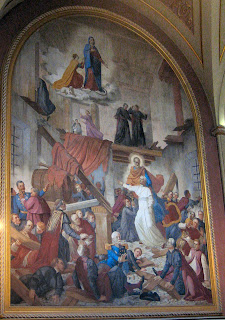
Zadock gave us a photo of the miraclous protection of Bl. Pius IX when once at the Basilica there was a near disastrous cave-in/collapse and no one was injured.

While Agnes’s body is in her tomb on the Via Nomentana, her skull is now at the place of her supposed martyrdom at the Piazza Navona in Rome’s heart. It is a fitting place to venerate a saint so much in the heart of the Roman people even today. It is not unusual for people to name their children Agnes in honor of this great virgin martyr, whose name is pronounced in the Roman Canon.

The skull was bequeathed to that church at the Piazza by Pope Leo XIII who took it from the treasury of the Sancta Sanctorum.

The Piazza itself was in ancient times the Stadium of Domitian (+96) a place of terror and blood for early Christians, far more than the Colloseum ever was. The Piazza is thus called also the “Circo Agonale” and the name of the saint’s church Sant’Agnese in Agone. “Navona” is a corruption of “Agonale”, from Greek agon referring to the athletic contests of the ancient world. St. Paul used the athlete’s struggle as an image of the Christian life of suffering, perseverance, and final victory even through the shedding of blood. Early Christian tombs often have wavy lines carved im the front, representing an iron instrument called a strigil, used by athletes to scrape dirt and oil from the bodies after contests. Victory palm branches are still used in the iconography of saints, as well as wreathes of laurels.

We know about St. Agnes from St. Jerome, and especially St. Augustine’s Sermons 273, 286 and 354. St. Ambrose wrote about Agnes in de virginibus 1,2,5-9 written in 377 as did Prudentius in Hymn 14 of the Peristephanon written in 405.

Ambrose has a wonderful hymn about Agnes (no. 8), used now in the Roman Church for Lauds and Vespers of her feast. The Ambrosian account differs somewhat from others. For Ambrose, Agnes died from beheading. Prudentius has her first exposed to shame in a brothel and then beheaded.

Here is the text of the hymn from the Liturgia horarum for the “Office of Readings” with a brutally literal translation.

Igne divini radians amoris
corporis sexum superavit Agnes,
et super carnem potuere carnis
claustra pudicae.

Shining with the fire of divine love
Agnes overcame the gender of her body,
and the undefiled enclosures of the flesh
prevailed over flesh.

Spiritum celsae capiunt cohortes
candidum, caeli super astra tollunt;
iungitur Sponsi thalamis pudica
sponsa beatis.

The heavenly host took up her brilliant white spirit,
and the heavens lifted it above the stars;
the chaste bride is united to the
blessed bride chambers of the Spouse.

Virgo, nunc nostrae miserere sortis
et, tuum quisquis celebrat tropaeum,
impetret sibi veniam reatus
atque salutem.

O virgin, now have pity on our lot,
and, whoever celebrates your victory day,
let him earnestly pray for forgiveness of guilt
and salvation for himself.

Redde pacatum populo precanti
principem caeli dominumque terrae
donet ut pacem pius et quietae
tempora vitae.

Give back to this praying people
the Prince of heaven and Lord of the earth,
that he, merciful, may grant us peace
and times of tranquil living.

Laudibus mitem celebremus Agnum,
casta quem sponsum sibi legit Agnes,
astra qui caeli moderatur atque
cuncta gubernat. Amen.

Let us celebrate with praises the gentle Lamb,
whom chaste Agnes binds to herself as Spouse,
he who governs the stars of heaven
and guides all things. Amen.

We can note a couple things from this prayer. First, the reference to fire probably a description of Agnes’s death related in a metrical panegyric of Pope Damasus about how Agnes endured martyrdom by fire. On the other hand, St. Ambrose, when speaking of her death, speaks of martyrdom by the sword.

Pope St. Damasus composed a panegyric, an elogia, inscribed in gorgeous letters on marble (designed and executed by Dionysius Philocalus) in honor of Roman saints, including Agnes.  This was the period when the Roman shifted from Greek to Latin.  Damasus was also trying to make a social statement with these great inscriptions, set up at various places about the City.   The panegyic of St. Agnes was placed in the cemetery near the saint’s tomb, but through the ages it was lost. Amazingly, it was at last rediscovered in 1728 inside the basilica, whole and complete: it had been used upside down, fortunately as a paving stone!

Now it is affixed to the wall in the corridor descending to the narthex. Its discovery was a find of vast importance (thanks to Zadok for the photo of the inscription).

FAMA REFERT SANCTOS DUDUM RETULISSE PARENTES
AGNEN CUM LUGUBRES CANTUS TUBA CONCREPUISSET
NUTRICIS GREMIUM SUBITO LIQUISSE PUELLAM
SPONTE TRUCIS CALCASSE MINAS RABIEMQUE TYRANNI
URERE CUM FLAMMIS VOLUISSET NOBILE CORPUS
VIRIBUS INMENSUM PARVIS SUPERASSE TIMOREM
NUDAQUE PROFUSUM CRINEM PER MEMBRA DEDISSE
NE DOMINI TEMPLUM FACIES PERITURA VIDERET
O VENERANDA MIHI SANCTUM DECUS ALMA PUDORIS
UT DAMASI PRECIBUS FAVEAS PRECOR INCLYTA MARTYR

It is told that one day the holy parents recounted that Agnes, when the trumpet had sounded its sad tunes, suddenly left the lap of her nurse while still a little girl and willingly trod upon the rage and the threats of the cruel tyrant. Though he desired to burn the noble body in the flames, with her little forces she overcame immense fear and, gave her loosened hair to cover her naked limbs, lest mortal eye might see the temple of the Lord. O one worthy of my veneration, holy glory of modesty, I pray you, O illustrious martyr, deign to give ear to the prayers of Damasus.

Damasus used the sources available. There were the stories told by her parents, the 4th edict of Diocletian against Christians in 304 (lugubres cantus tuba concrepuisset). Agnes did what she did of her own free will (sponte). Note the reference to the body as temple of God (1 Cor 3:16 and 2 Cor 6:16).

St. Agnes of Rome, has two grand churches in Rome.  She has two feast days in the traditional Roman calendar.  Since the reform of the calendar, Agnes now has only one day, alas.

Posted in Saints: Stories & Symbols | Tagged
22 Comments