WDTPRS – 9th Sunday of Ordinary Time

Christus MedicusBefore we head into the weekend, we should have a glance at the Collect, or “Opening Prayer” for the 9th Sunday of Ordinary Time.  In the traditional calendar it will be Quinquagesima Sunday which I will get to tomorrow.

Easter falls at a late date this year. We don’t see the 9th Sunday that often.  We have, however, dealt with this prayer before.  In the 1962MR it is the Collect for the 7th Sunday after Pentecost.  It came into the Novus Ordo untouched by the snippers and pasters of the Consilium.   The oration is in the ancient Gelasian Sacramentary as well as other old manuscripts.

COLLECT (2002MR):
Deus, cuius providentia in sui dispositione non fallitur,
te supplices exoramus,
ut noxia cuncta submoveas,
et omnia nobis profutura concedas
.

If you are looking in the thick L&S for submoveo you must look under summoveo: “to send or drive off or away, to remove”.  This was used of enemies.  Summoveo is also what the ancient Roman civil-servant bodyguards called lictors did.  Lictors, from ligare (“to bind, tie”), carrying bundles of white birch rods called fasces tied up around axes (when outside the City limits) with red leather straps, went before elected magistrates and sometimes Vestal Virgins.  The number of lictors you got depended on how important you were. They would sub-move people out of the way to “make room for” for the VIPs to pass.  So, summoveo can also be “to put or keep away” or “banish”.  The fasces was a symbol of the Republic.  Even though the word fasces also gave rise to the term “fascism”, these symbols are ubiquitous in Washington DC and other places of government in the USA, which is a federal constitutional republic.  You see the fasces also on the emblem of the Knights of Columbus.

Blaise/Chirat (a dictionary of liturgical Latin in French) indicates that dispositio is “disposition providentielle”.  It has to do God’s plan for salvation.  Fallo is an interesting word.  It means basically, “to deceive, trick, dupe, cheat, disappoint”.  Fallo is used to indicate things like simply being mistaken or being deceived.  It can apply to making a mistake because something eluded your notice or it was simply unknown. Fallo also has to do with circumventing, thwarting, frustrating someone or something. In our Latin conversation it is not uncommon to say nisi fallor, “unless I am deceived/mistaken…”.

Find profutura under prosum, which is “to be useful, to do good, benefit, profit”. There can be a medicinal/medical overtone. The adjective noxia (noxius) is “hurtful, harmful, injurious”.  It also means “an injurious act, a fault, offence, trespass”.  St. Ambrose of Milan (+397) juxtaposed noxia and profutura more than once (cf. Hexameron Day 3, 9, 40; Day 6, 4, 21; Exp. Lucam 2).

SLAVISHLY AWKWARD LITERAL RENDERING:
God, whose providence in its plan is not thwarted,
humbly we implore You,
that You clear away every fault
and grant us all benefits.

We have to make a choice about which way to go with noxia.  Does it mean “harmful things” that are outside us or that are within us, that is, our own sins, our faults?  Both?

LAME-DUCK ICEL (1973 translation of the 1970MR):
Father,
your love never fails.
Hear our call.
Keep us from danger
and provide for all our needs
.

Quite simply dreadful.  This may be one of the worst I have ever seen.

CORRECTED ICEL TRANSLATION:
O God, whose providence never fails in its design,
keep from us, we humbly beseech you,
all that might harm us
and grant all that works for our good
.

Posted in WDTPRS |
5 Comments

Exhibits for the blind at the Vatican Museum

Melozzo da ForlìFrom CNA:

Vatican City, Mar 3, 2011 / 11:46 am (CNA/EWTN News).- Specially-trained guides are now available to offer one-of-a-kind tours of the Vatican Museums to the deaf and blind.

The museums’ staff announced the new service at a March 1 press conference. Initially, they will be offered for Italian speakers and signers.

In the tour for the blind and visually impaired, visitors are able to touch copies of two of “the 30 most important works” in the Pinacoteca – the Vatican museum that houses an extensive collection of paintings.

They are guided in groups of eight to examine a replica of Caravaggio’s “Deposition from the Cross.” The work depicts Christ being taken down from the cross to be laid in the tomb.

The experience of discovering the painting’s content and texture through the hands-on examination of a special three-dimensional bas relief replica is accompanied by Scripture and poetry readings that explain the moment, as well as sacred music inspired by the depicted event.

Tourists are also guided through second work in fresco from an artist named Melozzo da Forlì. It depicts an angel playing a stringed instrument. Both this piece and the copy of the “Deposition,” created in the same way as the original, are available to be touched.

The raised design works of art are also available to the visitor in a pamphlet that is available in both Braille and dark print.

In addition, for Caravaggio’s work, the guide enhances the tour by offering visitors the chance to smell aloe and myrrh, which were used 2,000 years ago to prepare bodies for burial.

According to a statement from the Vatican Museums, the experience will evoke the images represented in the paintings, “promoting the passage from simple knowledge to the more profound perception of the work in an integral appreciation.”

The director of the new program, Maria Serlupi Crescenzi, told Vatican Radio that the tour “is a sum of stimuli that permits entering in contact with the work, deepening both the cognitive and, of course, the emotional sphere.”

For the deaf, seven specialists in Italian sign language offer tours two days a week. L’Osservatore Romano called the new offering “without precedent or equal, at least in Italy.”

The new tours, offered only in Italian for now, are free for those visitors who reserve a place in the limited-sized groups.

WDTPRS Kudos to the Vatican Museum.

Posted in Just Too Cool | Tagged ,
13 Comments

Shooting the Moon

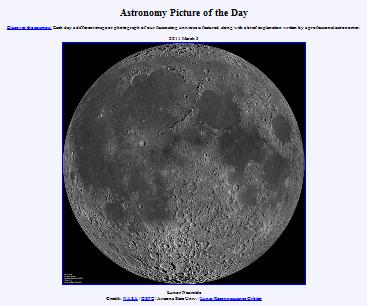
MoonThis is simply too cool not to share.

After voting for WDTPRS (which will take about 5 seconds) take a look at this.

This from Astronomy Pic of the Day.

About 1,300 images from the Lunar Reconnaissance Orbiter spacecraft’s wide angle camera were used to compose this spectacular view of a familiar face – the lunar nearside. But why is there a lunar nearside? The Moon rotates on its axis and orbits the Earth at the same rate, about once every 28 days. Tidally locked in this configuration, the synchronous rotation always keeps one side, the nearside, facing Earth. As a result, featured in remarkable detail in the full resolution mosaic, the smooth, dark, lunar maria (actually lava-flooded impact basins), and rugged highlands, are well-known to earthbound skygazers. To find your favorite mare or large crater, just slide your cursor over the picture. The LRO images used to construct the mosaic were recorded over a two week period last December.

That, folks, is very cool.

Posted in Just Too Cool | Tagged ,
17 Comments

Set a new trend in naming that baby!

I don’t do “help me name my baby” questions around here, except to suggest that you pick a saint’s name, spell it normally, and go for it.

That said, I would like to see a new trend back to some solid, serious meat and potatoes names and away from the frothy nothings so common now.

To that end, here are two entries from today’s page of the 2005 Martyrologium Romanum for your edification and Latin skills.

1. Caesareae in Palestina, sanctorum Marini, militis, et Asterii, senatoris, martyrum sub Gallieno imperatore; quorum prior, ab invido commilitone quod christianus delatus, coram iudice fidem suam voce clarissima professus est et coronam martyrii capitis abscissione suscepit; cum Asterius corpus martyris, qua induebatur veste substrata, exciperet honorem, quem martyri detulit, continuo ipse martyr accepisse narratur.

And…

8. Confugiae in Hassia, sanctae Cunegundis, quae plurima Ecclesiae contulit beneficia una cum coniuge sancto Henrico imperatore, post cuius mortem in claustro monialis, quo secesserat, Christum sibi heredem faciens, ipsa obiit. Corpus eius honorifice iuxta sancti Henrici ossa Bambergae depositum est.

We need more kids named Asterius and Cunegonda!

I would also suggest Nunilio and Alodia for twin girls.

Posted in "How To..." - Practical Notes, Lighter fare, Saints: Stories & Symbols | Tagged ,
90 Comments

Card. Burke and Card. Cañizares: liturgical abuse weakens the faith

Save The Liturgy Save The WorldHere is a story you won’t find over at the National Catholic Fishwrap… which is getting absolutely creamed in the Reader’s Choice Awards voting for Best Catholic Newspaper.  NCFishwrap is polling dead last, and I mean dead fish at 4%.

BTW…my favorites, the Catholic Herald and The Wanderer, for whom I write, could use your help.  And take an extra five seconds and vote for WDTPRS too.  Many thousands of readers come here each day read and many of you post comments.  A little help please?

Now for the story, by CNS’s Cindy Wooden, but which I picked up from the Catholic Herald.  This reminds me of our earnest discussion over changes to the liturgy leading to dissent on moral teaching.

My emphases and comments.

Cardinals: liturgical abuse weakens the faith

By Cindy Wooden

A weakening of faith in God, a rise in selfishness and a drop in the number of people going to Mass can be traced to liturgical abuse or Masses that are not reverent, two Vatican cardinals and a consultant have said. [Do I hear an “Amen!”?  Even “Amen! Amen!” Save the Liturgy – Save the World, friends.]

US Cardinal Raymond Burke, head of the Vatican’s supreme court, said: “If we err by thinking we are the centre of the liturgy, the Mass will lead to a loss of faith.” [There is a reciprocal relationship between how we pray and what we believe.]

Cardinal Burke and Spanish Cardinal Antonio Cañizares Llovera, prefect of the Congregation for Divine Worship and the Sacraments, spoke yesterday at a book launch in Rome.

The book, published only in Italian, was written by Fr Nicola Bux, [Of “The Bux Protocol“!] who serves as a consultant to the congregations for the doctrine of the faith and for saints’ causes and to the office in charge of papal liturgies.

The English translation of Fr Bux’s book title would be, How to Go to Mass and Not Lose Your Faith. [OOH-RAH!]

Cardinal Burke told those gathered for the book presentation that he agreed with Fr Bux that “liturgical abuses lead to serious damage to the faith of Catholics”.

Unfortunately, he said, too many priests and bishops treat violations of liturgical norms as something that is unimportant when, in fact, they are “serious abuses”.

Cardinal Cañizares said that while the book’s title is provocative, it demonstrates a belief he shares. “Participating in the Eucharist can make us weaken or lose our faith if we do not enter into it properly,” and if the liturgy is not celebrated according to the Church’s norms, he said.

“This is true whether one is speaking of the Ordinary or Extraordinary form of the one Roman rite,” the cardinal said. [It is interesting that the Cardinal Prefect brings in the older, Extraordinary Form in the context of liturgical abuse and the loss of faith.  In general – today – the Extraordinary Form is celebrated with great care and fidelity to the rubrics.  It is almost a contradiction in terms to talk about liturgical abuses in the Extraordinary Form, except perhaps with the exception of making mistakes or getting things wrong here and there.  None of the mistakes or variations would be irreverent.  At the same time, priests who celebrate the older form of Mass must also keep firmly in mind what Benedict XVI laid down in Sacramentum caritatis concerning our priestly ars celebrandi.]

Cardinal Cañizares said that at a time when so many people are living as if God did not exist, they need a true Eucharistic celebration to remind them that only God is to be adored and that true meaning in human life comes only from the fact that Jesus gave his life to save the world.

Fr Bux said that too many modern Catholics think the Mass is something that the priest and the congregation do together when, in fact, it is something that Jesus does.  [Christ is the true Actor.]

“If you go to a Mass in one place and then go to Mass in another, you will not find the same Mass. [What was commonly said about the older form of Mass in yesterday?  No matter what you would go in the world, Mass was the same as it was back in the parish church in Tall Tree Circle.  Indeed the older Form and the newer Form celebrated according to the books and in a Roman style with continuity are less different from each other than how you see Mass at parish X and parish Y.] This means that it is not the Mass of the Catholic Church, which people have a right to, but it is just the Mass of this parish or that priest,” he said.

Think about this.  Two cardinals show up for a book presentation.  Not one, two.  And they are Roman heavyweights of the first order.

Pay attention to Nicola Bux, friends.

Posted in Liturgy Science Theatre 3000, Our Catholic Identity, The Drill, The future and our choices | Tagged , , ,
60 Comments

Sacramental reality is no less real than sensible reality

Sacramental reality is no less real than sensible realityI hammered out and sent in a column for The Wanderer today.  Here is something I included this week (modified for the blog):

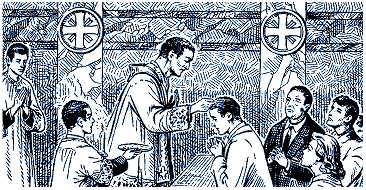
Latin Fathers such as St. Leo the Great saw the season of Lent  in sacramental terms.

The whole season of Lent is a transforming mystery, a “sacrament”, during which our practices have consequential effects: they bring us into the mystery of the dying and rising Jesus.  This transforming bond with Christ is brought about through denial of self and good works for others, penitential mortification and works of mercy, both spiritual and corporal.  In Lent the words of the Baptist must ring in our ears daily, even hourly: “He must increase, I must decrease” (John 3:30).   When He increases in us, we are more who we are supposed to be.  Thus, we have to make “room” for Him by our self-denial.

Remember!  Sacramental reality is no less real than the sensible reality we normally pay attention to.

When we participate actively in Lenten practices, God the Father conforms us to His Son who died and rose.  During Lent each year the Church conforms herself to the dying and rising Jesus.  This is why traditionally the Church stripped the liturgy of its ornaments: music and all decorations such as flowers.  On Passion Sunday (the Sunday before Palm Sunday) statues and images would be draped and hidden.  Bells would disappear on Good Friday and there was no Mass at all. The Mass experiences a liturgical death so that at Easter, when everything returns ten-fold, our joy can be that much sweeter, the flowers that much more florid, the music that much more splendid, the church that much brighter.  In our Collect today we ask God to make these annual disciplines and exercises effective in our lives so that we can have the joy which the deprivations promise.

Have a plan for your Lent.  Open up to the graces the Lord offers you through sacramental confession, Holy Communion, prayer, fasting and almsgiving.  Out Lenten discipline must includes penitential practices and works of mercy. During Lent let your life mirror the Lord’s Passion in preparation for the Resurrection.

Posted in "How To..." - Practical Notes, LENT, Our Catholic Identity |
3 Comments

What is the Pope of Christian Unity up to now?

The first time I used the phrase “Benedict XVI is the Pope of Christian Unity“, which is starting to get around, liberals were in grand-twit: they are losing control of what “ecumenism” means and how it is pursued.  Benedict is redirecting ecumenism.

Ecumenism is a necessary part of our Catholic thing.  We must pursue it.  And yet it is so hard a project, so fraught with obstacles that in the final analysis I believe only God can make it happen.  We are caught between giving up not even one essential inch, iota or item of what we believe as Catholics we as we must be engaged with people who hold strikingly different or only slightly different views.  We cannot sacrifice anything essential to “get along” in ecumenical efforts.  But the Lord prayed ut unum sint, and we have to do something about that.

Brick by brickPope Benedict is doing something about that. After decades of work which at best paved the way by changing how we talk with other groups, making it possible to have a conversation, the Holy Father is finding creative ways to engage in a true ecumenism.  This is the ecumenism in continuity with both Mortalium animos as well as Unitatis redintegratio whereby, eventually, all are one in the Catholic Church.

I read this on ZENIT:

Vatican Aide: Ordinariate Very Important to Pope

Says Unity Is Built on Love and Truth

VATICAN CITY, MARCH 2, 2011 (Zenit.org).- A priest at the Congregation for the Doctrine of the Faith is affirming that the newly established Ordinariate of Our Lady of Walsingham is “very important” to Benedict XVI. [That Ordinariate is, of course, for Anglicans who want unity with Peter.]

Members of the ordinariate, established for former Anglicans wishing to enter full communion with the Catholic Church, recently visited Rome and met with staff at the Congregation for the Doctrine of the Faith, including the prefect, Cardinal William Levada.

Father Hermann Geissler, head of the dicastery’s doctrinal office, gave an interview to The Portal, an independent review of the ordinariate.

He affirmed that “the ordinariate is very important to the Holy Father.”  [You can also bet that Summorum Pontificum and the talks with the SSPX are also very important to the Holy Father.  Think about it.  Summorum Pontificum has more enemies, however.]

“In the area of ecumenism it strengthens the Catholic Church’s approach in two ways,” the priest noted. “It promotes sincere dialogue with a Christian defense of life and the promotion of peace.”

[READ THIS SLOWLY AND SAVOR IT:] He stated: “The goal of the ecumenical movement is complete visible union with one Christ and with Peter in one Church. We must cooperate and grow together.” [What else can it be?]

Father Geissler affirmed that the Pope is called to promote unity in the Church and world. “He is the chief shepherd, he cannot do otherwise.”

“Unity is built on two pillars, love and truth,” the priest added.

Precious souls

He reported that 50-60 clergy and some 1,000 laity are already planning to join the ordinariate, and “every soul is precious.”

The priest added that there are also groups interested in following a similar model in the United States, Canada and Australia. He noted his dicastery is “watching events carefully” in Africa as well.

“We are not to give in to difficulties,” Father Geissler said. “We are to be generous and welcoming.”

He continued: “The issue is the whole question of unity and of mission. When God plants a beautiful tree, he cares for it.”

The priest concluded: “We pray for you that the ordinariate goes well. Priests are already ordained.

“We must be faithful to unity.

“We will do all we can to help you together with the bishops of England and Wales. Be encouraged by the words of Jesus Christ, ‘Seek ye first the Kingdom of God and everything else will be given you.’ There will be suffering, but God will guide us.”

Let us review: “The goal of the ecumenical movement is complete visible union with one Christ and with Peter in one Church. We must cooperate and grow together.”

With that in mind.

Also from Geissler’s interview with The Portal:

The Portal also reported that the Congregation for the Doctrine of the Faith has begun to receive requests from Lutherans to establish a similar canonical structure that would allow them to enter the Catholic Church while retaining aspects of the Lutheran heritage. “The Holy Father will do all he can to bring other Christians into unity,” Father Geissler commented.

SSPX?  Hello?  SSPX?  Anyone there?

Posted in Brick by Brick, New Evangelization, Our Catholic Identity, Pope of Christian Unity, The future and our choices, Wherein Fr. Z Rants | Tagged , ,
41 Comments

Did liturgical optionitis and degraded liturgy lead to dissent about morality?

I was alerted to a column by Louis Verrecchio over at the excellent CNA.

It weighs in at about 1700 words. I will edit and add some emphases and comments and then shoo you over there to read the rest.

Mr. Verrecchio makes an interesting connection.

Liturgy’s effect on gay ‘marriage’ debate
By Louie Verrecchio *

Perhaps you’ve visited the popular weblog of the inimitable Fr. Z (AKA Fr. John Zuhlsdorf at WDTPRS.com) [Why, yes! I have!] where one of his trademark battle cries is, “Save the liturgy, save the world!” If you haven’t, I highly recommend it. [Buy some stuff with that phrase.]

“If you throw a stone, even a pebble, into a pool it produces ripples which expand to its edge. The way we celebrate Mass must create spiritual ripples in the Church and the world,” Fr. Zuhlsdorf writes, making the point that our liturgical practices have a truly universal impact; whether positive or negative.

With this in mind it occurs to me that if one examines the history and the fruit of the post-conciliar reform of the Roman Rite, the liturgy’s impact on the way Catholics view the gay “marriage” issue can be brought into focus.

Post hoc ergo propter hoc? No, it certainly isn’t a matter of simple “cause and effect,” but follow me here and then draw your own conclusions.

Polling data published by the Pew Research Center in October 2010 claims that 42% of Americans support gay “marriage,” while an even greater percentage of self-identified Catholics (46%) responded likewise. More noteworthy still is that the percentage of those who so reject Church teaching on the sanctity of marriage remains remarkably high (34%) even among weekly Mass-goers!

Though the gay [I loath the distortion of the word “gay”.] “marriage” movement is a relatively recent one, it’s difficult to imagine more than one-in-three Catholic Mass-goers rejecting any such foundational doctrine of the Faith back in 1963; [Do I hear an “Amen!”?] the year the process of liturgical reform was formally set in motion with the promulgation of the Vatican II document Sacrosanctum Concilium.  [See where he’s going with this yet?]

So, how did we get here? Let’s begin by looking back to the year 1969 and the inception of the “gay rights movement” at the inaugural event often cited by its proponents; the “Stonewall Riots” during which homosexuals clashed with police in Greenwich Village over a period of three days beginning on June 28. It was an unprecedented uprising against secular authority for the gay community; setting the tone for decades to come. [Liberals and evil forces are brilliant at the use of creeping incrementalism.  Conservatives tend not to be so patient.]

Less than 90 days earlier, on April 3, Pope Paul VI had issued the Apostolic Constitution, Missale Romanum, with high hopes that the promulgation of the Novus Ordo Missae (now known as the “Ordinary Form of the Roman Rite”) would put an end to the challenges being leveled against the Church’s liturgical authority and all of the experimentation that came with it throughout much of the decade.

Fast forward to today.

It’s important for us to realize that the Council Fathers never envisioned, much less encouraged, a scenario in which the Church would in essence create a brand new “form” of the Roman Rite while leaving the Mass according to the 1962 Missal (now called the “Extraordinary Form”) unchanged. How and why this happened is a subject unto itself, but the salient point here is that the near “overnight” emergence of a “bi-formal” Roman Rite is as unusual as the unique set of circumstances it created!  [There is a bit of a misstep here, perhaps.  It is true that the older form of Mass remained in use, but it was for all intents and purposes crushed out of existence in most places.  The “bi-formal” has really come from Summorum Pontificum, in a juridical sense, at least.  But let’s not go down this rabbit hole.  The writer’s point is good: the Council Fathers asked for one thing and different thing happend.]

[…]

The peculiar set of circumstances in which we find ourselves today have created an environment in which Roman Rite Catholics are faced, either in practice or in theory, with two entirely valid liturgical “choices;” i.e. what form of the Roman Rite works best for me? [Of course Catholics have always had choices of Latin and Eastern Rites to attend.]
The majority of Catholics, who as the name suggests worship in the Ordinary Form, are further faced with yet another unprecedented set of potential liturgical choices as the Novus Ordo is given to multiple variations.

Do I prefer the Folk Mass or the “regular” Mass? Do I like Fr. Joe’s Mass or Fr. John’s Mass? Do I want to drive a few extra miles to go to the charismatic Mass, or should I take the kids to that parish across town with the video screens and the PowerPoint homilies?

Saving any commentary on the merits of these choices for another day, the very idea of shopping for a liturgy that suites one’s fancy is inherently flawed in that it approaches a divinely instituted gift that is given by Christ to His Church (not to the local community, much less to the individual) and it treats it as though it is a product of the people that can be repeatedly reinvented according to popular fashion as seems useful to the meet the demands of personal preference. It is, in other words, a liturgical approach that is inordinately “me-centered.” [In a sense, he is right.  In theory.  But in fact, when faced with a Mass filled with wacko stuff by Fr. Just-Call-Me-Bob at St. Abusiva in Mahonyville, or a reverently celebrated by Fr. Just-Say-The-Black at St. Fidelia over in Benedictburg, it isn’t any longer a matter of “fancy”.]

[…]
[And here we are at the point we knew he was aimed.] With this being the case, is it any wonder there are Catholics in our day who operate as though their personal preferences legitimately reign supreme in such fundamental matters of faith as how one defines the sanctity of marriage?  Consider, if you will, the convoluted yet not entirely unpredictable logic that the current liturgical climate has invited.  [If you incessantly show people that they can make it up as they go and then you chose to do things that are undignified, you are telling people that nothing they believed is fixed and those things we have been told are not that important anyway.  There is a reciprocal relationship between what we believe and how we pray.  Change one and, over time, the other will change too.]

[…]

Perhaps this is why so many on the Catholic Left who embrace personal choice when it comes to things like abortion and sexual morality are often moved to outright hostility at the mere suggestion that there is value in the traditional form of Holy Mass for anyone. [Truer words were never written.  And, ironically, I have found over the years that those who bash the older form of Mass the most are themselves burdened with problems of sexual identity.  It is usually only homosexuals who point their fingers at the traditional things and then suggest that those who use them are homosexuals.] Could it be that they realize there is much more at stake in the liturgy than what goes on within the walls of the church building? (Ironic, is it not, given the mantra of the Left, “Stay out of my bedroom?”)  [The proximity of the dismissal to the end of distribution of Communion, in both forms of the Roman Rite, is no accident.]
The fundamental difficulty here is that when liturgy, in practice, becomes a venue in which believers are empowered to exercise choice as a function of personal preference the stage is set for a certain “idolatry of self” to play itself out.

Evidence of this danger is made manifest in any number of ways in the Ordinary Form; the orientation of the priest and the physical layout of our church buildings wherein the community of believers is turned inward upon itself, the narcissistic music that we often bring into the Mass, the ever increasing roles that we assign to the laity while granting them the title “minister,” etc. [bingo!]

[…]
So now what?

“Save the liturgy, save the world,” of course.  [Do I hear an “Amen!”?]

I think he is on to something.

Also, for your amusement, Mr. Verrecchio also came up with a way to describe the concerted efforts to undermine, derail, otherwise whine about the new, corrected translation:

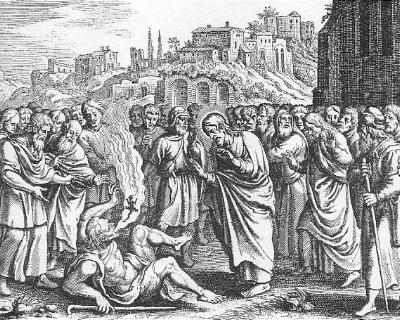
“Global Missal Dissent System”

Posted in Global Killer Asteroid Questions, Linking Back, Our Catholic Identity | Tagged , , ,
77 Comments

That smudge.

That smudge.Ash Wednesday is around the corner.  In the UK’s best Catholic weekly, the Catholic Herald, the lovely and persistent feature-writer Anna Arco has an article with comments about that ash-smudge.

Don’t rub off your ashes, urges bishop

By Anna Arco

Catholics should try not to rub their ashes off after Ash Wednesday Mass, an English bishop has said.

Bishop Kieran Conry of Arundel and Brighton, who heads the department of evangelisation and catechesis, urged Catholics across Britain to wear “the outward sign of our inward sorrow for our sins and for our commitment to Jesus as Our Lord and Saviour”.

He said: “The wearing of the ashes provides us with a wonderful opportunity to share with people how important our faith is to us and to point them to the cross of Christ. I invite you where possible to attend a morning or lunchtime Mass. [“Invite” is the right word, since Ash Wednesday is not a Holy Day of Obligation.  Still, I think Catholics do well to make the effort.  It is an important enough day in the Church’s liturgical calendar that it is the only other day with Good Friday when we must both fast and abstain.]

“Please try not to rub off your ashes as soon as you leave church, but take the sign of the cross to all those that you meet – in your school, office, factory, wherever you may be. This might just make people curious and wonder why you would do this. If you explain about Lent and Easter it might just make them think and may even awaken in them the questions that might lead to faith. Many people have a dim awareness of Lent and even ashes. It would be good to make this clear rather than dim. [Next question.  Can you explain Lent and Easter?]

“Don’t underestimate the power of this simple action and wear your ashes as not only a sign of the beginning of your Lenten journey, but also to witness to your greatest treasure in life. This small step could awaken faith in the hearts of many that you meet in a way that words could never do.”

Catholics receive ashes at Mass on Ash Wednesday where they are reminded of their own mortality when the priest says “From ashes to ashes”. [?] The ashes are made from the fronds of palm used on palm Sunday of the previous year.

Posted in "How To..." - Practical Notes, Clerical Sexual Abuse, New Evangelization, Our Catholic Identity | Tagged ,
19 Comments

QUAERITUR: About Lenten reading

From a reader:

The Little Black Book
This booklet surfaces around Lent in some local parishes and is based on the writings of Bishop Ken Untener (1937-2004).
PLEASE advise.Thank you.

I don’t know this book.  I understand that it isn’t really by Bp. Untener but dedicated to his memory.

However, I – personally – would not willingly read anything by the late Bishop Untener, may he rest in peace.  I would (pace Mary McCarthy) sit there and suspect everything he wrote, even “and” and “the”.  Not a spiritually beneficial experience, I think.

That said, from time to time a writer whom you would you suspect to be pretty dreadful in print can turn out some surprisingly good things at different points in his life.

That said, friend, there is only so much time in life.

Read the stuff you won’t have to be suspicious about.  If you are worried about a book dedicated to the memory of the very liberal late bishop, then ask around and get the skinny on it from people you trust.  In the meantime, there are books available which you don’t have to wonder about for a moment.

UPDATE 3 March 1816:

From a reader:

Now let me offer a positive example of a bishop going beyond ideology to address concrete pastoral concerns.

The late Bishop Kenneth Untener of Saginaw had long heard the many complaints about the poor quality of preaching in the Catholic Church. So he decided to address this pastoral problem directly.

He directed all of his priests to have their Sunday homilies videotaped. He had his own homilies taped as well. Then he arranged a meeting in which he and the priests would watch and critique together the recorded homilies, again, including his own. He even arranged to have some lay people from a neighboring diocese watch the videos and send him their critique. He encouraged his priests to continue the practice of working to improve their preaching. This was not a liberal initiative. This was not a conservative initiative. This was a pastoral initiative and the improved preaching that likely resulted from his initiative doubtless did more to keep Catholics in the pews than any formal church pronouncement!

Little Black Book

This booklet surfaces around Lent in some local parishes and is based on the writings of Bishop Ken Untener (1937-2004).

PLEASE advise.Thank you.

Posted in ASK FATHER Question Box | Tagged
Comments Off on QUAERITUR: About Lenten reading