Wonderful investiture of Benedictine postulants in Kansas City

We talk a great deal, and rightly so, about praying for vocations among men.   We must also pray both that women will answer a call and also have a place to go to realize that vocation.

Traditional communities of women are growing and happy.

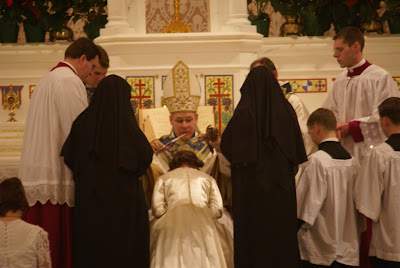
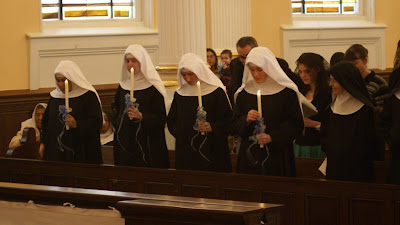
One of my favorite groups of Benedictines, the Benedictines of Mary, Queen of Apostles near Kansas City, MO, had an investiture of postulants.

They are a wonderful and growing community.

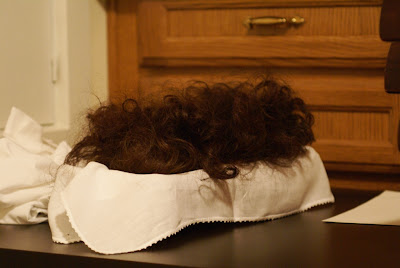
Here are a few photos of the investiture.  You can find more at the site Kansas Catholic.

Wonderful investiture of Benedictine postulants in Kansas City

Wonderful investiture of Benedictine postulants in Kansas City

Here is Bishop Robert Finn of Kansas City doing the honors.

Cutting hair.

Wonderful investiture of Benedictine postulants in Kansas City

Wonderful investiture of Benedictine postulants in Kansas City

Wonderful investiture of Benedictine postulants in Kansas City

There are some great photos on that site.  I encourage you to take a look.

Just one more…

Wonderful investiture of Benedictine postulants in Kansas City

Posted in Brick by Brick | Tagged , , ,
31 Comments

The Pope, the “sedia” and security – a security consultant’s view

Here on WDTPRS we had a POLL about whether or not the sedia gestatoria should be revived for the sake of the security of the person of the Roman Pontiff, at least in the Basilica of St. Peter.

The results:

    *  Yes
      1190 69% of all votes
    * No
      539 31% of all votes

Total Votes: 1729

People posted interesting comments with arguments for and against the revival of the sedia.

I find today on the site of the UK’s best Catholic weekly, The Catholic Herald, that there is an article arguing in favor of the revival of the sedia gestatoria for the sake of security.  The writer is a security consultant.

My emphases and comments and with my edits:

The sedia gestatoria would protect the Pope
Security expert Dominic Scarborough urges the Vatican to draw on tradition to prevent a repeat of the Midnight Mass attack on Benedict XVI

8 January 2010

[…]

One only has to look at old black and white footage of pontiffs prior to Paul VI to see how popes always used to enter the basilica being carried shoulder high in the sedia gestatoria. Not only that, but there was always a throng of people around the chair, not only the actual bearers but numerous chamberlains and nobility and a large number of guards: Swiss Guards, uniformed Gendarmes, the Palatine Guard and Noble Guard. These comprised the old papal court which Pope Paul VI abolished and which formed a kind of buffer zone between the Pope and the crowds, no doubt as much a practical defence measure as a piece of ceremony. [That was one of my own arguments in favor.]

The use of the sedia continued until very recently and many are unaware that the last pope to use the sedia was actually Pope John Paul I. While the abolition of this ancient form of transport may have since been considered appropriate in the context of the late 20th century and the need to democratise the appearance of papal ceremonies, [This was part of an argument used by those against the revival.] the reality has left the Pope an isolated and vulnerable figure separated from the deacons ahead and the MCs behind, one who appears all too often like the figure in the Third Secret of Fatima: a victim walking alone simply waiting to be attacked.

While there are bound to be some who would see the return of the sedia as yet another example of this Pope "turning the clock back", [specious] in fact not only would it save an elderly man’s tired legs but it would allow more of the crowd to see him. [A classic argument in favor.] Most importantly, it would actually insulate him from the kind of physical assault we saw at Christmas by virtue of the mob of people surrounding it (who could these days be swelled by Swiss Guards and the gendarme officers in suitably formal garb) to work alongside the suited officers at the perimeter.

Naturally, the risk of attack from a gunman or explosive device would still be present and indeed potentially magnified by the sedia [Some against raised this.] but the use of X-ray machines at the entrance to the basilica and physical searches of congregants should by now be mandatory at such events to confront these risks which are no more heightened by the Pope presiding at Mass from an elevated platform, as he does, than from being carried in a chair. [Exactly.]

It was being reported earlier in the year on several Catholic blogs that the Vatican was actively considering a return for the sedia gestatoria for ceremonies in St Peter’s, more because of the Pope’s age than as a protection against attack. Perhaps the latest incident will persuade them that what tradition hands down frequently has a practical origin beyond merely the visually impressive spectacle that to sceptical modern eyes it had appeared to have become.

Dominic Scarborough is a regular commentator in the press and internet on Catholic affairs. His company, Proteus Risk, advises companies on security issues


For the record, I am in favor of the use of the sedia gestatoria, not for any sort of triumphalism, but rather because a) it is really hard to see the Pope when he enters in the Basilica and b) it would create a buffer zone of strong and well-prepared men around him.

Posted in The Drill | Tagged
30 Comments

Doubt and shame

I was surfing around looking for some information and found this (the internet is so fascinating) on the blog After Existentialism, Light.

“[Doubt] is altogether a pernicious companion which has its origin not in the good creation of God but in the Nihil — the power of destruction — where not only the foxes and rabbits but also the most varied kinds of demons bid one another “Good night.” There is certainly a justification for the doubter. But there is no justification for doubt itself (and I wish someone would whisper that in Paul Tillich’s ear). No one, therefore, should account himself particularly truthful, deep, fine, and elegant because of his doubt. No one should flirt with his unbelief or with his doubt. The theologian should only be sincerely ashamed of it.”

Karl Barth, Evangelical Theology: An Introduction (Eerdmans 1992), p. 131.

Posted in SESSIUNCULA | Tagged ,
9 Comments

QUAERITUR: we want the TLM, but no priest, no parish

From a reader:

I must drive 1.5 hours minimum (in good driving conditions) to attend an EF mass.  There is only the […] offering it before noon.  I have 7, soon to be 8 children.  There are easily 12 parishes within 1/2 hour drive.  My own pastor refuses to offer latin mass in either form.  He isn’t at all prepared and he would likely get lynched.  I and others in the area have written to Archbishop […] requesting easier access.  The clergy in the area have no interest and some have contempt for anything latin.  Do I have reason to write to Ecclesia Dei or am I being unreasonable?   How would I go about it? 


You always have the right to write directly to the the competent office of the Holy See at any time.

That said, it is best to get involved locally before writing to the Holy See.

What you describe is not an easily solved situation.  If there is no priest who is capable of using the 1962MR, what can be done?  You can’t have that Mass without a priest who know how to do it.

I suggest that you keep working on your local Archbishop, saving copies of all your correspondence.

In the meantime, if there is a priest within a reasonable distance, perhaps you and others could arrange to bring the priest to you for a private Mass from time to time at a local parish where the pastor is disposed at least to help you that way. Be ready to give a donation to both the parish and the priest.

Keep a chronicle of everything that happens and urge others with your interest to do so as well.  Things written on paper remain, and they can be useful in future correspondence in case you need to write to the Holy See.

But the key here is a) find a priest willing to say that Mass and b) find a local priest willing to host it, it not do it himself.

You may need to apply some real diplomacy. 

In the meantime, keep going to Mass on days of obligation, even if you must go to the Novus Ordo.

Posted in "How To..." - Practical Notes, ASK FATHER Question Box |
17 Comments

QUAERITUR: EMCs, “leftover” Hosts after Communion calls

From a reader:

But I can’t post to your forum.  I am an extraordinary minister of the Eucharist for my parish, serving the homebound.  I receive communion at mass, then take the Eucharist to those who are sick.  Sometimes they cannot receive, so I am left with the Host, and the church is often locked preventing my returning the Host to the tabernacle.  Is it licit to consume the Host?  This being a second reception in a day, outside of the Eucharistic Celebration.  If not, what do I do with the Host?


Actually, you are not an "extraordinary minister of the Eucharist".  You are an "extraordinary minister of Communion" (EMC). 

What you are describing is, in effect, self-communication.

This is a good question, since I imagine this happens to EMCs with some frequency.

Your diocese may have specific directions for EMC’s in these situations.  Ask your parish priest.

In the absence of clear direction from the diocese, my strong suggestion is that you return immediately with the Host to the parish and leave the pyx for the parish priest or give it to him directly.  If you can’t reach your priest (you should have contact information!), perhaps there is another parish where, after some contact in advance, you can get some help.

Don’t simply go home with the pyx and Host or run errands.  First things first.  I would say if you are truly in a bind (no priest anywhere, no access to a proper place to leave the Host, no options), then consume It.

It may be that the diocese will have a policy that, in these situations, you are simply to consume the Host. 
Follow their policy if you cannot do this in the better way, that is, return to the parish with the Host and give It to the priest to care of. 

It is true that pastors, parish priests, are pretty busy, especially if they are alone.  Yet the Code of Canon Law describes as one of the main duties of the parish priest to care for the Blessed Sacrament.  I think this falls under that canon.   He ought to make it sufficiently easy for you to deal with something that is beyond your ordinary role.

Posted in "How To..." - Practical Notes, ASK FATHER Question Box |
15 Comments

A note to parish priests

I had a note from someone this morning saying that the writer’s parish priest in his parish bulletin had urged people to fight against the new English translation of the Roman Missal and sign the a dissenting online petition.

Perhaps parish priests reading this might choose to urge people to sign a better petition, one in favor of the new translation.

I’m just sayin’.

Posted in I'm just askin'... |
15 Comments

Recent posts of interest

Check these out…

Posted in SESSIUNCULA |
Comments Off on Recent posts of interest

Houston: protest planned for abortion super-store

From CNSNews:

Pro-Life Advocates Plan to Protest Opening of Largest Abortion Clinic in U.S.
Wednesday, January 06, 2010
By Penny Starr, Senior Staff Writer

(CNSNews.com) – A coalition of pro-life advocates and religious leaders plan to gather in Houston on Jan. 18 to oppose what is expected to be the largest abortion clinic in the country.

Planned Parenthood is renovating a former bank, [THAT’s not irony…] turning it into a 78,000 square foot facility that will include a surgical wing equipped to provide late-term abortions.
 
“It’s an abortion super center,” Lou Engle, founder of the pro-life group The Call to Conscience, which is organizing the rally, told CNSNews.com.  [One stop shopping.  LAST stop for some!]
 
Joining Engle at the “prayer march” will be Tony Perkins, president of the Family Research Council, and Samuel Rodriguez, president of the National Hispanic Christian Leadership Conference. Religious leaders expected to attend include Bishop Harry Jackson, senior pastor of Hope Christian Church; Richard Land, president of the Ethics and Religious Liberty Commission of the Southern Baptist Convention; Star Parker, president of the Coalition for Urban Renewal and Education; and Abby Johnson, the former director of a Planned Parenthood clinic.  [Ummmm … isn’t there a Cardinal in Galveston-Houston who has something to do with the USCCB’s pro-life committee?  I understand Card. DiNardo is a regular participant in sidewalk vigils, etc.]
 
Engle compared the fight for the rights of the unborn to another critical movement in America. “As Martin Luther King, Jr. said, ‘It is time to subpoena the conscience of America,’” he said.  [RIGHT!  Remember… the pro-life cause is THE social justice cause.]
 
Engle said he believes the clinic was strategically located in a part of Houston that is surrounded by black and Hispanic neighborhoods.  [Wasn’t the original purpose of Planned Parenthood to kill off those unwanted people?]

“We want to say that it’s not right to have an abortion super center that targets the minority community,” Engle said. He says Planned Parenthood actively markets its services, including abortion, to low-income, minority women.  [Low-income… minority… tax-payer funded abortions… Planned Parenthood is just getting ready to get your money.]
 
Last month, Houston elected the first lesbian, Annise Parker, to hold the mayoral office in a major U.S. city. Until her inauguration this week, the director of Health and Environmental Policy for the mayor’s office was Elena Marks, chairwoman of the Planned Parenthood Federation of America.
 
Attempts to reach Marks for comment on the clinic and the planned rally were unsuccessful.


Perhaps people in the Houston area should pay attention to this event.

Posted in SESSIUNCULA |
17 Comments

Msgr. Guido Marini on liturgical issues: active participation

I am pleased to link you to the site of NLM which has posted the full text of a presentation by the papal MC Msgr. Guido Marini delivered to the wonderful clergy conference for the Year of the Priest taking place in Rome.

The text is pretty long and I won’t give it all here.  You can find it at NLM.  

But I will over the next couple days pull out a few sections in different entries and comment on them. 

For example, here is Msgr. Marini on an issue we have dealt with many times on WDTPRS, namely, "active participation".

My emphases and comments.

4. Active Participation.

It was really the saints who have celebrated and lived the liturgical act by participating actively. [And those who desire to be.] Holiness, as the result of their lives, [As a result of grace….] is the most beautiful testimony of a participation truthfully active in the liturgy of the Church.

Rightly, then, and by divine providence did the second Vatican Council insist so much on the necessity of promoting an authentic participation on the part of the faithful during the celebration of the holy mysteries, at the same time when it reminded the Church of the universal call to holiness. This authoritative direction from the council has been confirmed and proposed again and again by so many successive documents of the magisterium down to the present day.

Nevertheless, there has not always been a correct understanding of the concept of “active participation”, [Say it isn’t so!  Okay.. he is using litotes here.] according to how the Church teaches it and exhorts the faithful to live it. To be sure, there is active participation when, [NB] during the course of the liturgical celebration, one fulfills his proper service; [He is probably referring to the priest, sacred ministers, those in the sanctuary at this point.] there is active participation too when one has a better comprehension of God’s word when it is heard or of the prayers when they are said; [That pertains to listening, being actively receptive, which isn’t always easy.] there is also active participation when one unites his own voice to that of the others in song [Outward physical expression.] ….All this, however, would not signify a participation truthfully active if it did not lead to adoration of the mystery of salvation in Christ Jesus, who for our sake died and is risen. This is because only he who adores the mystery, welcoming it into his life, demonstrates that he has comprehended what is being celebrated, and so is truly participating in the grace of the liturgical act. [How many times have I bashed away on this blog about mystery?]

As confirmation and support for what has just been asserted, let us listen once again to the words of a passage by the then Cardinal Ratzinger, from his fundamental study “The Spirit of the Liturgy”: “What does this active participation come down to? What does it mean that we have to do? Unfortunately the word was very quickly misunderstood to mean something external, entailing a need for general activity, as if as many people as possible, as often as possible, should be visibly engaged in action. However, the word ‘part-icipation’ refers to a principal action in which everyone has a ‘part’… [Not everyone’s actions as individuals, even if they are doing things in a coordinated way.  Remember: there is one true Actor in the sacred action.] By the actio of the liturgy the sources mean the Eucharistic prayer. The real liturgical action, the true liturgical act, is the oratio….This oratio—the Eucharistic Prayer, the “Canon”—is really more than speech; it is actio in the highest sense of the word.” (pp. 171-2) [And that is not a moment in which the congregation, for example, traditionally has an outwardly active role expect to kneel at the proper place and rise at the end.  I will leave aside the problematic issue of the "acclamation" after the consecration.] Christ is made present in all of his salvific work, and for this reason the human actio becomes secondary and makes room for the divine actio, to God’s work.  [Right.  The true Actor in the sacred action is Christ the High Priest.]

Thus the true action which is carried out in the liturgy is the action of God Himself, his saving work in Christ, in which we participate. This is, among other things, the true novelty of the Christian liturgy with respect to every other act of worship: God Himself acts and accomplishes that which is essential, whilst man is called to open himself to the activity of God, in order to be left transformed. [Again, we must be actively receptive to what God wants to give us and be transformed in our encounter with mystery.] Consequently, the essential aspect of active participation is to overcome the difference between God’s act and our own, that we might become one with Christ. [We can control our own disposition, by fasting and confession, and engaging our minds and wills, but God is the true Actor.] This is why, that I might stress what has been said up to now, it is not possible to participate without adoration. [I tend to stress the issue of having that encounter with mystery.  I think that the way the liturgy is carried out bears a great burden in this.] Let us listen to another passage from Sacrosanctum Concilium: “The Church, therefore, earnestly desires that Christ’s faithful, when present at this mystery of faith, should not be there as strangers or silent spectators; on the contrary, through a good understanding of the rites and prayers they should take part in the sacred action conscious of what they are doing, with devotion and full collaboration. They should be instructed by God’s word and be nourished at the table of the Lord’s body; they should give thanks to God; by offering the Immaculate Victim, not only through the hands of the priest, but also with him, they should learn also to offer themselves; through Christ the Mediator, they should be drawn day by day into ever more perfect union with God and with each other, so that finally God may be all in all.” (n. 48)

Compared to this, everything else is secondary.  [It is hard to deny after "God.. all in all", that everything else is secondary.] I am referring in particular to external actions, granted they be important and necessary, and foreseen above all during the Liturgy of the Word. I mention the external actions because, should they become the essential preoccupation and the liturgy is reduced to a generic act, in that case the authentic spirit of the liturgy has been misunderstood. [not to mention "active participation" has been misunderstood.] It follows that an authentic education in the liturgy cannot consist simply in learning and practicing exterior actions, but in an introduction to the essential action, which is God’s own, the paschal mystery of Christ, whom we must allow to meet us, to involve us, to transform us. Let not the mere execution of external gestures be confused with the correct involvement of our bodies in the liturgical act. Without taking anything away from the meaning and importance of the external action which accompanies the interior act, the Liturgy demands a lot more from the human body. It requires, in fact, its total and renewed effort in the daily actions of this life. This is what the Holy Father, Benedict XVI calls “Eucharistic coherence”. Properly speaking, it is the timely and faithful exercise of such a coherence or consistency [one might even say "continuity"] which is the most authentic expression of participation, even bodily, in the liturgical act, the salvific action of Christ.  [I wonder if "verification" might not be better to introduce.  Hmmm.]

I wish to discuss this point further. [NB…] Are we truly certain that the promotion of an active participation consists in rendering everything to the greatest extent possible immediately comprehensible? [WHAT?  You mean that it could be okay to have hard words?  Hard music?  Complex ritual?] May it not be the case that entering into God’s mystery [There is that encounter with mystery, that which is tremendum et fascinans again…] might be facilitated [Yes!  The liturgy bears much of the burden.] and, sometimes, even better accompanied by that which touches principally the reasons of the heart? Is it not often the case that a disproportionate amount of space is given over to empty and trite speech, [Such as banal translations?] forgetting that both dialogue and silence belong in the liturgy, congregational singing and choral music, images, symbols, gestures? Do not, perhaps, also the Latin language, Gregorian chant, and sacred polyphony belong to this manifold language which conducts us to the center of the mystery? [Which is another way of speaking of "encounter with mystery".]
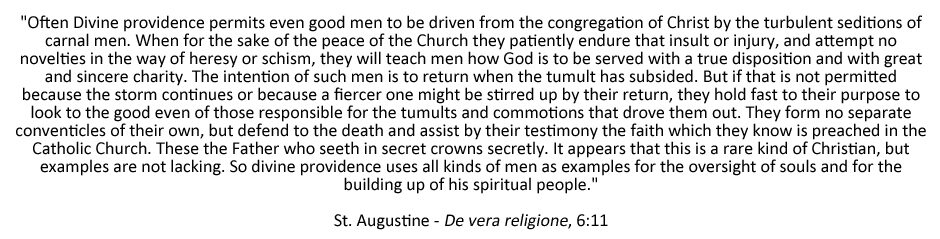
Very well done. 

Posted in SESSIUNCULA |
12 Comments

Bp. Vasa: excommunication can be appropriate

More from the ever interesting Bishop of Baker, H.E. Most Rev. Robert Vasa.

My emphases and comments:

Excommunication is a declaration of acts that severs ties

By Bishop Robert Vasa Bp. Vasa: excommunication can be appropriate

BEND — During the course of this past year there have been a number of occasions when bishops have hinted to laity that being Catholic involves a bit more than claiming the title. [In some cases more than hint.  Would that we could say in many cases.] This has been done, in particular, with regard to politicians who may, in their own way, love Jesus, who may attend Sunday Mass and who do identify themselves as “faithful” Catholics. The press usually hints at the big “E” word, excommunication. The question of when a Catholic should be excommunicated has even been asked quite frequently and very seriously. [And for very good reason.] While bishops are extremely reluctant to take the seemingly dramatic step of excommunication, I think there is very good reason for us to explore more thoroughly what excommunication really means and why it might be considered in certain circumstances.  [Can I believe me eyes?  Is this a bishop who is suggesting that excommunication could be appropriate?]

The press would undoubtedly accuse Bishops who talk or even think about excommunication as being tyrannical power mongers [D’ya think?] but this is unfair. Excommunication is a declaration, based on solid evidence, that the actions or public teachings of a particular Catholic are categorically incompatible with the teachings of the Church. It is intended primarily as a means of getting the person who is in grave error to recognize the depth of his error and repent. [It is a remedy more than a punishment.] A second reason, while somewhat secondary but no less important, is to assure the faithful who truly are faithful that what they believe to be the teaching of the Church is true and correct. [In other words to work against the scandal caused by the errant sheep, lest other sheep be lead astray.]  Allowing their faith to be shaken or allowing them to be confused when Catholics publicly affirm something contrary to faith or morals, seemingly without consequences, scandalizes and confuses the faithful. This is no small matter. The Church, and particularly bishops, have an obligation to defend the faith but they also have an obligation to protect the faithful. We do not generally see the dissidence of public figures as something that harms the faithful but it has a deleterious effect upon them.  [They do not see that the dissidence of public figures harms… but it does weaken?  How is that not harming?]

I find, very frequently, when I speak a bit more boldly on matters of morality or discipline, there are a significant number of the faithful who send messages of gratitude and support. [WDTPRS will join them when you do, Your Excellency.] It is their gratitude which stirs my heart for it makes me realize how much there is a need to support and affirm the clear and consistent teachings of our Catholic faith for the sake of the faithful. While the press may caricature such bishops in rather uncharitable fashion, I trust that they are men devoted to true compassion and to the truth itself. Their compassion extends to those who are misled and to those who, while not misled, are discouraged when their faith is attacked without rebuttal. This discouragement of the faithful is not insignificant. [Do I hear an "Amen!"?]  When we look at the word itself we see that its root is “courage” and allowing someone’s courage to be dissipated, or “dissed” as the young might say, is harmful to the person. En-couragement, by contrast, builds up the courage of the faithful and increases their strength for doing good. It is life giving and revitalizing. Allowing error, publicly expressed, to stand without comment or contradiction is discouraging.  [How is that not something that harms the faithful?]

When that moral error is espoused publicly by a Catholic who, by the likewise public and external act of receiving Holy Communion, appears to be in “good standing” then the faithful are doubly confused and doubly discouraged. In that case, the error is certainly not refuted. Furthermore, the impression is given that the error is positively condoned by the bishop and the Church. This is very dis-couraging to the faithful. In such a case, private “dialogue” is certainly appropriate but a public statement is also needed. In extreme cases, excommunication may be deemed necessary.

It seems to me that even if a decree of excommunication would be issued, the bishop would really not excommunicate anyone. He only declares that the person is excommunicated by virtue of the person’s own actions. [Bishops cannot do these things from a personal whim.] The actions and words, contrary to faith and morals, are what excommunicate (i.e. break communion with the Church). When matters are serious and public, the Bishop may deem it necessary to declare that lack of communion explicitly.  [It is clear enough in most cases when something is "public".  Some will want to debate "serious".]  This declaration no more causes the excommunication than a doctor who diagnoses diabetes causes the diabetes he finds in his patient. The doctor recognizes the symptoms and writes the necessary prescription.  [Excommunication is a remedy.] Accusing the doctor of being a tyrannical power monger would never cross anyone’s mind. Even when the doctor tells the patient that they are “excommunicated” from sugar it is clear that his desire is solely the health of his patient. In fact, a doctor who told his diabetic patient that he could keep ingesting all the sugar he wanted without fear would be found grossly negligent and guilty of malpractice. [And as St. Augustine described when describing Christ as the physician of the soul, using the medicine practice of his century, the doctor does not stop cutting just because the patient is screaming for him to stop.]

In the same way, bishops who recognize a serious spiritual malady and seek a prescription to remedy the error, after discussion and warning, may be required to simply state, “What you do and say is gravely wrong and puts you out of communion with the faith you claim to hold.” In serious cases, and the cases of misled Catholic public officials are often very serious, [Ah!  Now we have the admission that what Catholic public officials can do can be "very serious".] a declaration of the fact that the person is de facto out of communion may be the only responsible and charitable thing to do.

[Here we go…] Failing to name error because of some kind of fear of offending the person in error is neither compassion nor charity. Confronting or challenging the error or evil of another is never easy yet it must be done. [Do I hear an "Amen!"?] 

The adage usually attributed to Edmund Burke was correct: All that is necessary for evil to triumph is for good men to do nothing.

The Lord has called bishops to be shepherds. That shepherding entails both leading and protecting. [And extracting errant sheep from bushes and pits and keeping them from getting in trouble even by the use of a fast nipping dog or a whack with a staff.] In an era when error runs rampant and false teachings abound, the voice of the Holy Father rings clear and true. The teachings of the Church are well documented and consistent. [And we have laws.] Bishops and the pastors who serve in their Dioceses have an obligation both to lead their people to the truth and protect them from error.

Big WDTPRS kudos to Bp. Vasa.

Do I hear an "Amen!"?

Posted in Our Catholic Identity, SESSIUNCULA, The Drill | Tagged
45 Comments