Grand Central

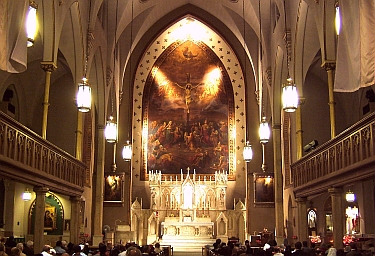
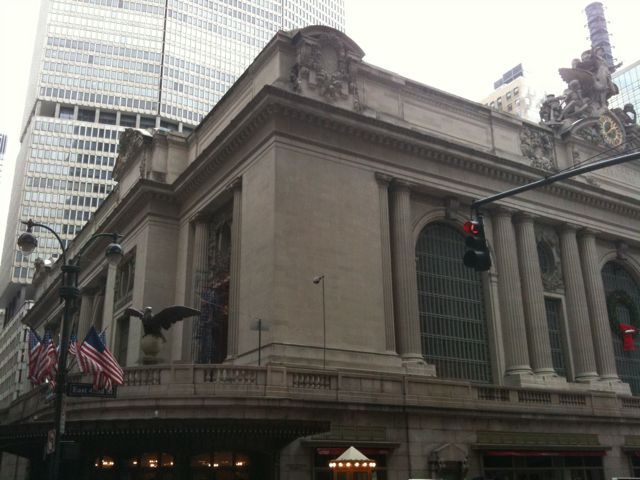
On Christmas Day Grand Central Terminal is not as frenetic as on a work day but people are still bustling through. Terminals are odd places. People only come in order to leave. I will leave when I have met my friends at the clock. Then it’s off to lunch somewhere.

Grand Central

Grand Central

Grand Central

Posted in SESSIUNCULA |
5 Comments

Pope Benedict’s Urbi et Orbi Message for Christmas 2009

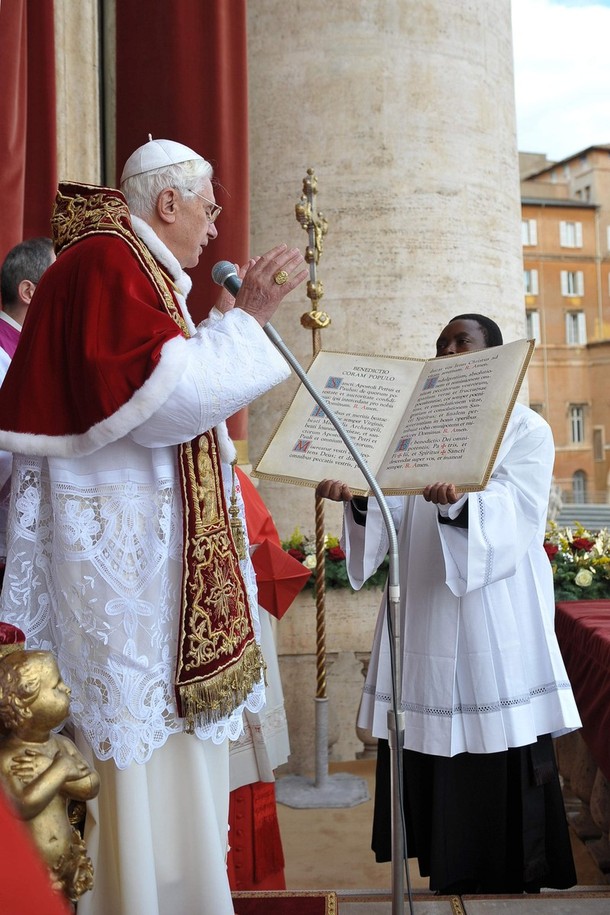
Pope Benedict's Urbi et Orbi Message for Christmas 2009Urbi et Orbi Message for Christmas 2009:

Dear Brothers and Sisters in Rome and throughout the world,

and all men and women, whom the Lord loves!

"Lux fulgebit hodie super nos,

quia natus est nobis Dominus.

A light will shine on us this day,

the Lord is born for us"

(Roman Missal, Christmas, Entrance Antiphon for the Mass at Dawn)

The liturgy of the Mass at Dawn [People are generally less familiar with this Mass formulary.  The texts are wonderful.] reminded us that the night is now past, the day has begun; the light radiating from the cave of Bethlehem shines upon us.

The Bible and the Liturgy do not, however, speak to us about a natural light, but a different, special light, which is somehow directed to and focused upon "us", the same "us" for whom the Child of Bethlehem "is born". This "us" is the Church, the great universal family of those who believe in Christ, who have awaited in hope the new birth of the Saviour, and who today celebrate in mystery the perennial significance of this event.

At first, beside the manger in Bethlehem, that "us" was almost imperceptible to human eyes. As the Gospel of Saint Luke recounts, it included, in addition to Mary and Joseph, a few lowly shepherds who came to the cave after hearing the message of the Angels. The light of that first Christmas was like a fire kindled in the night. All about there was darkness, while in the cave there shone the true light "that enlightens every man" (Jn 1:9). And yet all this took place in simplicity and hiddenness, in the way that God works in all of salvation history. God loves to light little lights, so as then to illuminate vast spaces. Truth, and Love, which are its content, are kindled wherever the light is welcomed; they then radiate in concentric circles, as if by contact, in the hearts and minds of all those who, by opening themselves freely to its splendour, themselves become sources of light. Such is the history of the Church: she began her journey in the lowly cave of Bethlehem, and down the centuries she has become a People and a source of light for humanity. Today too, in those who encounter that Child, God still kindles fires in the night of the world, calling men and women everywhere to acknowledge in Jesus the "sign" of his saving and liberating presence and to extend the "us" of those who believe in Christ to the whole of mankind.

Wherever there is an "us" which welcomes God’s love, there the light of Christ shines forth, even in the most difficult situations. The Church, like the Virgin Mary, offers the world Jesus, the Son, whom she herself has received as a gift, the One who came to set mankind free from the slavery of sin. Like Mary, the Church does not fear, for that Child is her strength. But she does not keep him for herself: she offers him to all those who seek him with a sincere heart, to the earth’s lowly and afflicted, to the victims of violence, and to all who yearn for peace. Today too, on behalf of a human family profoundly affected by a grave financial crisis, yet even more by a moral crisis, and by the painful wounds of wars and conflicts, the Church, in faithful solidarity with mankind, repeats with the shepherds: "Let us go to Bethlehem" (Lk 2:15), for there we shall find our hope.

The "us" of the Church is alive in the place where Jesus was born, in the Holy Land, inviting its people to abandon every logic of violence and vengeance, and to engage with renewed vigour and generosity in the process which leads to peaceful coexistence. The "us" of the Church is present in the other countries of the Middle East. How can we forget the troubled situation in Iraq and the "little flock" of Christians which lives in the region? At times it is subject to violence and injustice, but it remains determined to make its own contribution to the building of a society opposed to the logic of conflict and the rejection of one’s neighbour. The "us" of the Church is active in Sri Lanka, in the Korean peninsula and in the Philippines, as well as in the other countries of Asia, as a leaven of reconciliation and peace. On the continent of Africa she does not cease to lift her voice to God, imploring an end to every injustice in the Democratic Republic of Congo; she invites the citizens of Guinea and Niger to respect for the rights of every person and to dialogue; she begs those of Madagascar to overcome their internal divisions and to be mutually accepting; and she reminds all men and women that they are called to hope, despite the tragedies, trials and difficulties which still afflict them. In Europe and North America, the "us" of the Church urges people to leave behind the selfish and technicist mentality, to advance the common good and to show respect for the persons who are most defenceless, starting with the unborn. [!] In Honduras she is assisting in process of rebuilding institutions; throughout Latin America, the "us" of the Church is a source of identity, a fullness of truth and of charity which no ideology can replace, a summons to respect for the inalienable rights of each person and his or her integral development, a proclamation of justice and fraternity, a source of unity.

In fidelity to the mandate of her Founder, the Church shows solidarity with the victims of natural disasters and poverty, even within opulent societies. In the face of the exodus of all those who migrate from their homelands and are driven away by hunger, intolerance or environmental degradation, the Church is a presence calling others to an attitude of acceptance and welcome. In a word, the Church everywhere proclaims the Gospel of Christ, despite persecutions, discriminations, attacks and at times hostile indifference. These, in fact, enable her to share the lot of her Master and Lord.

Dear Brothers and Sisters, how great a gift it is to be part of a communion which is open to everyone! It is the communion of the Most Holy Trinity, from whose heart Emmanuel, Jesus, "God with us", came into the world. Like the shepherds of Bethlehem, let us contemplate, filled with wonder and gratitude, this mystery of love and light! Happy Christmas to all!

Posted in Brick by Brick, SESSIUNCULA |
2 Comments

Woman Who Lunged at Pope Tried Same Thing Last Year

About that attack on the Pope last night… this comes from Hell’s Bible (aka New York Times):

Woman Who Lunged at Pope Tried Same Thing Last Year

By RACHEL DONADIO
Published: December 25, 2009

ROME — The woman who leapt at Pope Benedict XVI during Christmas Eve Mass, causing him to trip and fall, had tried the same thing last year, only to be stopped by security, the Vatican said Friday.

The Vatican identified the woman as Susanna Maiolo, 25, a Swiss and Italian citizen with a history of mental problems, and said she was not armed.

The attempt last year came after Midnight Mass last year, said Vatican spokesman, the Rev. Federico Lombardi, but guards stopped her before she did any harm.

Television cameras show a woman in a red jacket leaping over the barriers as the papal procession entered the main aisle of Saint Peter’s, and security guards leaping toward her. The pope, 82, and an 87-year-old French cardinal, Roger Etchegaray, fell.

The cardinal broke his femur, Father Lombardi said, but is recovering well at a Rome hospital.

The incident alarmed the crowds and Saint Peter’s on one of the most momentous events in the Roman Catholic calendar and raised questions about the level of security surrounding the pope, who traditionally receives his flock during the Christmas season. Father Lombardi said that the Vatican had to balance the pope’s pastoral role with security concerns. “If the pope wants to be among people, it is impossible to have total security,” he said.

Father Lombardi said that Ms. Maiolo was being monitored in a medical facility and that she had not been arrested. He said he did not know whether the Vatican would pursue any legal consequences. The Vatican, an independent state, would have to formally petition Italian authorities on any judicial action.

Benedict is said to be in fine health, but he had moved Christmas Eve Mass to 10 p.m. from midnight to save his strength for his demanding public schedule during the holidays.

On Friday, Benedict looked well as he gave his traditional “Urbi et Orbi” message “to the city and the world” and offered Christmas greetings in a host of different languages from the loggia of Saint Peter’s Basilica.

In his message, Benedict said that the Catholic Church was in solidarity with “a human family profoundly affected by a grave financial crisis, yet even more by a moral crisis, and by the painful wounds of wars and conflicts.”

He spoke of the conflict in Iraq and the “little flock of Christians” in the Middle East. “At times it is subject to violence and injustice, but it remains determined to make its own contribution to the building of a society opposed to the logic of conflict and the rejection of one’s neighbor,” Benedict said.

The pope also singled out the situation of Christians in Sri Lanka, the Korean Peninsula and the Philippines, and in Africa called for more human rights in Guinea and Niger, and “begged” for an end to conflict in Madagascar.

Posted in SESSIUNCULA |
20 Comments

A little audio from midnight Mass in Manhattan

I haven’t had time to clean up the audio, but here is the Preface and Sanctus from the Mass tonight.

I am told that this is the first Solemn Mass for Christmas Midnight in some 40 years.

Posted in SESSIUNCULA |
9 Comments

NYC – Manhattan – Christmas Midnight TLM with music

If you are in or near Manhattan….

NYC - Manhattan - Christmas Midnight TLM with musicThere will be a Solemn TLM for Midnight Mass (yes, midnight, Christmas) at Holy Innocent’s in Manhattan.

The undersigned is celebrant for the Mass.  Here is the music line up:

Prelude Music (starting at 11:30 PM)

  • Gwendolyn Toth, organ: Pastorale from the Concerto Grosso #8 – Arcangelo Corelli (1653-1713)
  • Linnea Shin & Lauren Alfano, sopranos; Kelly-Ray Meritt, recorder: Amoena Quam Festivitas duet – Valentin
  •      Molitor (1637-1713)
  • Peter Becker, bass: Verbum Caro – Ottavio Durante (fl. 1608-1618)
  • Linnea Shin, soprano; Lauren Alfano, soprano; Kelly-Ray Meritt, tenor; Peter Becker, bass: Chorale,
  •     O Jesulein Süss by J.S. Bach (1685-1750)
  • Gwendolyn Toth, organ: Joseph est Bien Marie – Claude Balbastre (1724-1799)
  • Linnea Shin, soprano: Virgin Slumber Song – Max Reger (1873-1916)
  • Lauren Alfano, soprano and Peter Becker, bass: Gesu Bambino – Pietro Yon (1866-1943)
  • Linnea Shin, soprano; Lauren Alfano, soprano; Kelly-Ray Meritt, tenor & recorder; Peter Becker, bass:
  •     Lo How A Rose E’er Blooming – Michael Praetorius (1571-1621)

 
Mass Music

  • Processional: organ, Noel – Louis-Claude Daquin (1694-1772)
  • Chanted propers from Liber
  • Missa "O Magnum Mysterium" – Tomas Luis de Victoria (c.1548-1611)
  • (Creed is congregational except for Et Incarnatus est)
  • Offertory:Angelus ad Pastores – Orlande de Lassus (1532 – 1594)
  • Offertory: Christe Redemptor  – Victoria (alternating chant & polyphony – as many verses as needed)
  • Communion #1: O Magnum Mysterium – Victoria
  • Communion #2: O Magnum Mysterium – Poulenc
  • Recessional: Organ, Noel Suisse – Daquin

Posted in On the road |
19 Comments

Pope Benedict knocked down by woman before Mass in St. Peter’s Basilica

This isn’t the first time someone tried to get at the Pope, but this one actually got to him.

Here is a story from AP:

Pope Knocked Down by Woman at Christmas Mass

Thursday, December 24, 2009

VATICAN CITY —  A woman jumped the barriers in St. Peter’s Basilica and knocked down Pope Benedict XVI as he walked down the main aisle to begin Christmas Eve Mass on Thursday, a Vatican spokesman said.

The Rev. Ciro Benedettini said the 82-year-old pope quickly got up and was unhurt. As the pope’s procession was making its way toward the main altar gasps rang out through the public and a commotion could be seen among the clergymen surrounding Benedict. The procession came to a halt and bodyguards rushed to the trouble spot.

Benedettini said the woman who pushed the pope appeared to be mentally unstable and had been arrested by Vatican police. He said she also knocked down Cardinal Roger Etchegaray, who was taken to hospital for a check up.

"During the procession an unstable person jumped a barrier and knocked down the Holy Father," Benedettini told The Associated Press by telephone. "(The pope) quickly got up and continued the procession."

After the incident, Benedict calmly resumed his walk to the basilica’s main altar to start the Mass.

Benedict made no reference to the incident as the service started. As a choir sang, he sprinkled incense on the main altar [I bet that was messy!   Who writes this stuff?] before opening the service with the traditional wish for peace in Latin: "Pax vobis" ("Peace be with you"). The faithful responded: "Et cum spiritu tuo" ("And also with you").  [Not for much longer!]

It was the second year in a row there was a security breach at the service. At the end of last year’s Mass a woman who had jumped the barriers got close to the pope but was quickly blocked on the ground by security.  [And there was a man in the square who tried to get at the Pope on the popemobile.]

Benedettini said it was not immediately known if the same woman was behind Thursday’s incident.

Posted in SESSIUNCULA |
46 Comments

Merry Christmas!

Merry Christmas everyone!

Posted in SESSIUNCULA |
57 Comments

Benedict XVI’s Christmas Sermon: liturgy is the first priority

The shepherds teach us a priority: hasten to worship.  Everything else comes later.

In his sermon for Christmas Pope Benedict shows his mystical side.  He is a liturgical mystic.  That is to say, for Benedict, worship is an occasion for the deepest form of prayer, which is communion with God.  This is what liturgical worship is supposed to do for us.  It is probably what it does for him.

Pope Benedict quotes the 3rd c. Alexandrian theologian Origen and the 6th c. monastic St. Benedict.

The Holy Father first and foremost stresses the individuals relationship with God, as you yourself, your individual encounter with him in worship.  This encounter has consequences.  One of the consequences is attention to others.   But there is a priority.

My emphases and comments.

Benedict XVI's Christmas Sermon: liturgy is the first priorityDear Brothers and Sisters!

"A child is born for us, a son is given to us" (Is 9:5). What Isaiah prophesied as he gazed into the future from afar, consoling Israel amid its trials and its darkness, is now proclaimed to the shepherds as a present reality by the Angel, from whom a cloud of light streams forth: "To you is born this day in the city of David a Saviour, who is Christ the Lord" (Lk 2:11). The Lord is here. From this moment, God is truly "God with us". No longer is he the distant God who can in some way be perceived from afar, in creation and in our own consciousness. He has entered the world. He is close to us. The words of the risen Christ to his followers are addressed also to us: "Lo, I am with you always, to the close of the age" (Mt 28:20). For you the Saviour is born: through the Gospel and those who proclaim it, God now reminds us of the message that the Angel announced to the shepherds. It is a message that cannot leave us indifferent. If it is true, it changes everything. If it is true, it also affects me. Like the shepherds, then, I too must say: Come on, I want to go to Bethlehem to see the Word that has occurred there. The story of the shepherds is included in the Gospel for a reason. They show us the right way to respond to the message that we too have received. What is it that these first witnesses of God’s incarnation have to tell us?

The first thing we are told about the shepherds is that they were on the watch – they could hear the message precisely because they were awake. We must be awake, so that we can hear the message. We must become truly vigilant people. What does this mean? The principal difference between someone dreaming and someone awake is that the dreamer is in a world of his own. His "self" is locked into this dreamworld that is his alone and does not connect him with others. To wake up means to leave that private world of one’s own and to enter the common reality, the truth that alone can unite all people. Conflict and lack of reconciliation in the world stem from the fact that we are locked into our own interests and opinions, into our own little private world. Selfishness, both individual and collective, makes us prisoners of our interests and our desires that stand against the truth and separate us from one another. Awake, the Gospel tells us. Step outside, so as to enter the great communal truth, the communion of the one God. To awake, then, means to develop a receptivity for God: for the silent promptings with which he chooses to guide us; for the many indications of his presence. There are people who describe themselves as "religiously tone deaf". The gift of a capacity to perceive God seems as if it is withheld from some. And indeed – our way of thinking and acting, the mentality of today’s world, the whole range of our experience is inclined to deaden our receptivity for God, to make us "tone deaf" towards him. And yet in every soul, the desire for God, the capacity to encounter him, is present, whether in a hidden way or overtly. In order to arrive at this vigilance, this awakening to what is essential, we should pray for ourselves and for others, for those who appear "tone deaf" and yet in whom there is a keen desire for God to manifest himself. The great theologian Origen said this: if I had the grace to see as Paul saw, I could even now (during the Liturgy) contemplate a great host of angels (cf. in Lk 23:9). And indeed, in the sacred liturgy, we are surrounded by the angels of God and the saints. The Lord himself is present in our midst. Lord, open the eyes of our hearts, so that we may become vigilant and clear-sighted, in this way bringing you close to others as well!  [Concern for others follows from our contemplation of God and His heavenly host.  This is an important point which we really have to get right when we think about our liturgical practice.  Mass really isn’t the occasion for paying attention to each other, as if it were an occasion for social justice, or out reach, or relationship building.  That is not to say that we should simply ignore each other.  But our liturgical worship must be first and foremost about our contemplation of God, our encounter with mystery.  This encounter then has many other consequences down the line including charity for neighbor, proper relations with spouse, children, etc.  For Benedict, proper worship of God, where that privileged encounter takes place is the starting point.]

[Benedict continues in his liturgical mystic mode….] Let us return to the Christmas Gospel. It tells us that after listening to the Angel’s message, the shepherds said one to another: "‘Let us go over to Bethlehem’ … they went at once" (Lk 2:15f.). "They made haste" is literally what the Greek text says. What had been announced to them was so important that they had to go immediately. In fact, what had been said to them was utterly out of the ordinary. It changed the world. The Saviour is born. The long-awaited Son of David has come into the world in his own city. What could be more important? No doubt they were partly driven by curiosity, but first and foremost it was their excitement at the wonderful news that had been conveyed to them, of all people, to the little ones, to the seemingly unimportant. They made haste – they went at once. In our daily life, it is not like that. For most people, the things of God are not given priority, they do not impose themselves on us directly And so the great majority of us tend to postpone them. First we do what seems urgent here and now. In the list of priorities God is often more or less at the end. [This is indeed often the case in liturgical "worship" as well.]  We can always deal with that later, we tend to think. The Gospel tells us: God is the highest priority. [ATTENTION…] If anything in our life deserves haste without delay, then, it is God’s work alone. [What does he mean here by "God’s work"? … ] The Rule of Saint Benedict contains this teaching: "Place nothing at all before the work of God (i.e. the divine office)". For monks, the Liturgy is the first priority. Everything else comes later. In its essence, though, this saying applies to everyone. God is important, by far the most important thing in our lives. [Why did I lead this entry with that quote about the shepherds as the key to what followed? …. ] The shepherds teach us this priority. From them we should learn not to be crushed by all the pressing matters in our daily lives. From them we should learn the inner freedom to put other tasks in second place – however important they may be – so as to make our way towards God, to allow him into our lives and into our time. Time given to God and, in his name, to our neighbour is never time lost. It is the time when we are most truly alive, when we live our humanity to the full.  [Note the order of priorities.  First, seeking that encounter with God.  Then, all other things.]

Some commentators point out that the shepherds, the simple souls, were the first to come to Jesus in the manger and to encounter the Redeemer of the world. The wise men from the East, representing those with social standing and fame, arrived much later. The commentators go on to say: this is quite natural. The shepherds lived nearby. They only needed to "come over" (cf. Lk 2:15), as we do when we go to visit our neighbours. The wise men, however, lived far away. They had to undertake a long and arduous journey in order to arrive in Bethlehem. And they needed guidance and direction. Today too there are simple and lowly souls who live very close to the Lord. They are, so to speak, his neighbours and they can easily go to see him. But most of us in the world today live far from Jesus Christ, the incarnate God who came to dwell amongst us. We live our lives by philosophies, amid worldly affairs and occupations that totally absorb us and are a great distance from the manger.  [This is a good reminder not to think of ourselves as so sophisticated that we don’t need to be humble before God.  Again, there are liturgical angles to this.  Very often liberal types will make statements along the lines of, "We are modern people.  We no longer kneel as if we are serfs before the a feudal lord.  We are grown up now, and take Communion in the hand, rather than like children receive in the mouth."  Etc.  I think that attitude is a trap, and Pope Benedict exposes it well.] In all kinds of ways, God has to prod us and reach out to us again and again, so that we can manage to escape from the muddle of our thoughts and activities and discover the way that leads to him. But a path exists for all of us. The Lord provides everyone with tailor-made signals. He calls each one of us, so that we too can say: "Come on, ‘let us go over’ to Bethlehem – to the God who has come to meet us. Yes indeed, God has set out towards us. Left to ourselves we could not reach him. The path is too much for our strength. But God has come down. He comes towards us. He has travelled the longer part of the journey. Now he invites us: come and see how much I love you. Come and see that I am here. Transeamus usque Bethlehem, the Latin Bible says. Let us go there! [Here it is…] Let us surpass ourselves! Let us journey towards God in all sorts of ways: along our interior path towards him, but also along very concrete paths – the Liturgy of the Church, the service of our neighbour, in whom Christ awaits us.

Let us once again listen directly to the Gospel. The shepherds tell one another the reason why they are setting off: "Let us see this thing that has happened." Literally the Greek text says: "Let us see this Word that has occurred there." Yes indeed, such is the radical newness of this night: the Word can be seen. For it has become flesh. The God of whom no image may be made – because any image would only diminish, or rather distort him – this God has himself become visible in the One who is his true image, as Saint Paul puts it (cf. 2 Cor 4:4; Col 1:15). In the figure of Jesus Christ, in the whole of his life and ministry, in his dying and rising, we can see the Word of God and hence the mystery of the living God himself. This is what God is like. The Angel had said to the shepherds: "This will be a sign for you: you will find a babe wrapped in swaddling clothes and lying in a manger" (Lk 2:12; cf. 2:16). God’s sign, the sign given to the shepherds and to us, is not an astonishing miracle. God’s sign is his humility. God’s sign is that he makes himself small; he becomes a child; he lets us touch him and he asks for our love. How we would prefer a different sign, an imposing, irresistible sign of God’s power and greatness! But his sign summons us to faith and love, and thus it gives us hope: this is what God is like. He has power, he is Goodness itself. He invites us to become like him. Yes indeed, we become like God if we allow ourselves to be shaped by this sign; if we ourselves learn humility and hence true greatness; if we renounce violence and use only the weapons of truth and love. Origen, taking up one of John the Baptist’s sayings, saw the essence of paganism expressed in the symbol of stones: paganism is a lack of feeling, it means a heart of stone that is incapable of loving and perceiving God’s love. Origen says of the pagans: "Lacking feeling and reason, they are transformed into stones and wood" (in Lk 22:9). Christ, though, wishes to give us a heart of flesh. When we see him, the God who became a child, our hearts are opened. In the Liturgy of the holy night, God comes to us as man, so that we might become truly human. [Here is an echo of Augustine.  The Word became the son of man, that we might become the sons of God.  Also, this may echo the key for reading Gaudium et spes, a section which even for the theologian J. Ratzinger saved, in a sense, that Apostolic Constitution, namely, GS 22 in which we read that Christ reveals man more fully to himself.  We learn who we are by coming to know Him.] Let us listen once again to Origen: "Indeed, what use would it be to you that Christ once came in the flesh if he did not enter your soul? Let us pray that he may come to us each day, that we may be able to say: I live, yet it is no longer I that live, but Christ lives in me (Gal 2:20)" (in Lk 22:3).

Yes indeed, that is what we should pray for on this Holy Night. Lord Jesus Christ, born in Bethlehem, come to us! Enter within me, within my soul. Transform me. Renew me. Change me, change us all from stone and wood into living people, in whom your love is made present and the world is transformed. Amen.
Posted in Christmas and Epiphany, SESSIUNCULA, The Drill | Tagged , , ,
15 Comments

Live stream of the Holy Father’s Mass

I am tuned in to the broadcast of the Holy Father’s Mass from St. Peter’s.

The Sistine Choir is still pretty bad.

During the Holy Father’s entrance I caught a glimpse, I am sure, of my friend and blogger John Sonnen of Orbis Catholicus… taking photos!

The Holy Father looks good and looks focused.

I went over his sermon for "midnight" Mass this morning and will post it, in English, with some comments as soon as he has finished.  Hopefully I will have unsullied audio of the Italian original as he delivered it.

UPDATE 26 Dec 1829 GMT:

Yes…. I did see John Sonnen.

Live stream of the Holy Father's Mass

Posted in SESSIUNCULA |
24 Comments

Vigil of Christmas – (2005) Roman Martyrology

In the 2005 Roman Martyrology for Vigil of Christmas has a fascinating entry.  Here is the first entry of Christmas Eve day:

1. Commemoratio omnium sanctorum avorum Iesu Christi, filii David, filii Abraham, filii Adam, patrum scilicet, qui Deo placuerunt et iusti inventi sunt et iuxta fidem defuncti, nullis acceptis promissionibus, sed longe eas aspicientes et salutantes, ex quibus natus est Christus secundum carnem, qui est super omnia Deus benedictus in saecula.

The commemoration of all the holy forefathers of Jesus Christ, the son of David, the son of Abraham, the son of Adam, namely of the fathers, who pleased God and were found to be just also according to the faith of the dead, having received none of the promises fulfilled, but regarding them and greeting them from afar, from which the Christ was born according to the flesh, who is blessed God above all things forever.

Keep in mind that the Gospel reading for the Vigil Mass is the geneology of the Lord from the Gospel of Matthew.

In that Gospel geneology, Christ is shown to by the Lord of the history of our salvation. 

And Matthew takes pains to teach us subtle things. 

Take note of the four women he mentions.  He does not mention the great women we usually think of in the Old Testament, such as Sarah, Rebecca, Leah and Rachel.  Instead we get Tamar, Rahab, Ruth and the women who had been "the wife of Uriah." 

So, we see pagans in the geneology who are women of less than perfect background in the eyes of the ancient Jews.  

God choses those whom it pleases Him to choose.

Posted in SESSIUNCULA |
2 Comments