Taking possession of titular church

CARDINAL BERTONE TO TAKE POSSESSION OF HIS TITULAR CHURCH

VATICAN CITY, 1 OCT 2009 (VIS) – A communique published today by the Office of Liturgical Celebrations of the Supreme Pontiff announces that at 5 p.m. on Saturday 3 October, Cardinal Secretary of State Tarcisio Bertone S.D.B. will take possession of the suburbicarian Church of Frascati.

Posted in SESSIUNCULA | Tagged ,
3 Comments

WDTPRS: Unspeakable Angelic Collect

A reader sent a note about the upcoming Collect for the Feast of the Holy Guardian Angels, 2 Oct.

COLLECT
:
Deus, qui ineffabili providentia
sanctos angelos tuos
ad nostram custodiam mittere dignaris:
largire supplicibus tuis:
et eorum semper protectione defendi,
et aeterna societate gaudere
.

Even oblique or indirect exposure to such a dangerous word might cause irreparable harm to the people of God, as Bp. Trautman has explained.   Even if the people will be hearing the lame-duck ICEL version… get ready.  There could be casualties.

First, I think pastors of souls should prepare their people for the use of the word ineffabilis.

I am reminded of the Monty Python segment about the cryptographers who saw just two words of the joke so funny that it kills you…

On a more serious note, the sender also asked about the form of the word dignaris.

The word dignaris – dignor, dignare – can only be here, it seems to me, present indicative passive 2nd person singular (deponent). The only other reading is as a perfect subjunctive active second person singular, and I don’t see how that can fit the context, yet four of the six translations render the verb tense as perfect (all indicative):
 
1) Two of the St. Andrew translations left out dignaris entirely, but translated "hast sent" or "sent" (perfect).
 
2) Two use this as "who … hast deigned to send" (perfect).
 
3) Only two render this in the present indicative: "who … dost vouchsafe" or "who … art pleased" (present).
 
Am I missing something about dignaris which would make "hast deigned"/"deigned" the correct or acceptable rendering? (Unless Google missed it, you haven’t analyzed a prayer with dignaris yet.) The phrase aeterna societate presents another translation issue.

Let’s take care of the easy one first.

That societate aeterna is there with gaudeo.  Gaudeo, "rejoice", is often with the ablative of the thing in which one rejoices.  I think ablative was chosen here to keep the nice parallel with the previous clause where we have another infinive, defendi, and the ablative.

In the case of dignaris, this is a present tense.  If you are going to go with the perfect subjunctive, shortened form (dignaveris) then I think you would need a good explanation for the use of the subjunctive… and there really isn’t one.  It is present.

LITERAL VERSION:
O God, who by unspeakable/unutterable/indescribable/ineffable providence
find it worthy/deign/condescend to send Your Holy Angels for our defense:
bestow upon your supplicants:
both to be defended always by their protection,
and to rejoice in their eternal company
.

Posted in SESSIUNCULA, WDTPRS |
26 Comments

nimrods against crucifixes

My friend Patrick Madrid posted a story about a fellow in St. Louis, MO, a Catholic, who has a crucifix on display in his grocery store.

Freedom hating and generally obtuse "atheists" are complaining.

You know… the more I hear arguments of so-called "atheists", the less I think they are really "atheists".

Anyway…

My friend Richard Lane brought this irksome story to my attention, and so I now bring it to yours:


“It startled me. It seemed so out of place” was the comment of a patron of the new downtown Schnucks Grocery Store in St. Louis, Missouri. While driving to work this morning, my wife and I were listening to commentary KMOX Radio on this issue and then I went online to get the story from St. Louis Today Website.

Basically the person who felt the Crucifix was ‘out of place’, (also was Jewish – I am in no means insinuating that all Jewish brothers and sisters feel this way) went out of their way to write a letter to their local Jewish Newspaper on this issue complaining about what many say is the ‘obvious symbol of not just Christianity, but Roman Catholicism, since the dying Corpus of Christ was placed on a Cross. Obviously people are disapproving of this display of someone’s faith, Culinaria (Store) Manager Tom Collora, Jr., who is a parishioner at the Old Cathedral, located in downtown St. Louis, Missouri.

"It’s bad taste and bad business. Who wants to (shop) where someone else’s faith is being pushed down your throat?" were the comments from an Atheist who lives next to the store. Personally, if this Atheist was so loyal to his cause, then he should not be using United States Currency, which displays this Country’s Faith… but this is not the point in my opinion.  [Has this nimrod noticed that he lies in a city names "SAINT Louis"?]

What Mr. Collora has done, is answer the call of the New Evangelization, specifically the Mandate of Christ to ‘Go an make disciples’ by sharing our Faith; by sharing the Salvific Message of the Corpus of the Messiah on the Cross, which is not a sign of exclusion, but the opposite; this is the Glorious Sign of Inclusion into the Body (all pun intended) of Christ, who was ‘lifted up’, suffered, died and rose three days later in Triumph over death.

According to Pope Paul VI; the Roman Catholic Church exists so that She may Evangelize, taking the Eternal Message of Salvation to every end of the earth, every Home, Hamlet and Hovel; every Town, City, State, Country and Territory; Our (Roman Catholics) mission is to share the GOOD NEWS of Salvation through Jesus Christ to all mankind… and as Christ told us; “Do not be afraid!”

As one who has given up a secular life to continue to proclaim the Gospel, I applaud Mr. Collora and wish the other 1 Billion Catholics around the World would imitate his example. . . . (continue reading)

Posted in SESSIUNCULA |
27 Comments

Mpls Star-Tribune article on parish closures: the wierdos weigh in

In the Minneapolis daily Star-Tribune there is an article on some plans underway in the Archdiocese of St. Paul and Minneapolis which may result in parish closings.

You should see the comments appended to the article.

There are some deeply anti-Catholic bigots out there.

Posted in SESSIUNCULA |
22 Comments

30 Sept: St. Jerome – where is he buried?

I posted this last year, but a) there are new readers now and b) I put so much work into it that it deserves recycling on this feast of St. Jerome.

Some time ago, there was a discussion on one of our splendid Catholic blogs making mention of the burial place of St. Jerome perhaps in the Major Basilica of St. Mary Major in Rome. This is an interesting story and I dug into it a little. This is what I found.
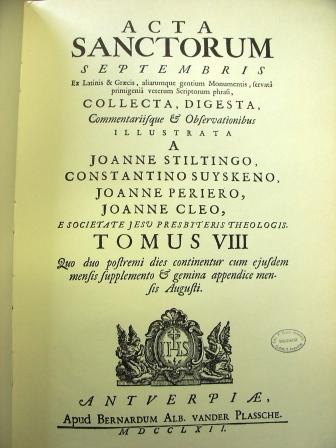
30 Sept: St. Jerome - where is he buried?We read in J.N.D. Kelly’s work Jerome: His Life, Writings, and Controversies (Duckworth, 1975, p. 333 – emphasis mine) :

Apocryphal lives extolling [Jerome’s] sanctity, even his miracles, were quick to appear, and in the eighth century he was to be acclaimed, along with Ambrose, Augustine, and Gregory the Great, as one of the four Doctors of the Church.[2] In the middle ages his works were eagerly copied, read, and pillaged; while towards the end of the thirteenth century the clergy of Santa Maria Maggiore, at Rome, were to persuade the public, perhaps themselves too, that his remains had been transported from Bethlehem to Italy, and could be venerated close to certain presumed fragments of the Saviour’s crib.[3]

Note 2: This was formally ratified by Pope Boniface VIII on 20 Sept. 1295: see Corpus iuris canonici II, 1059 (ed. E. Freidburg, Leipzig, 1879-81). The original number four (the list was later to be greatly expanded) was chosen so that the Doctors could match the Evangelists.

Note 3: The story of their alleged translation, in response to a visionary appearance of Jerome himself, is set out by J. Stilting in Acta Sanctorum XLVI, Sept. VIII, 636 (Antwerp, 1762); it is reprinted in PL 22, 237-40. Stilting also provides a discussion of its date, veracity, etc. on pp. 635-49.

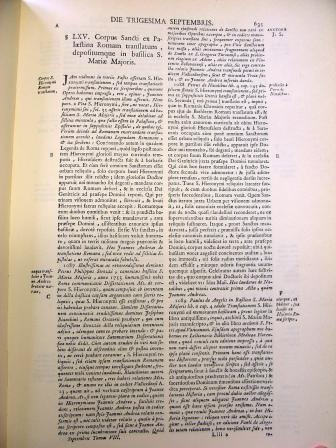
In the Acta Sanctorum for 30 September, under the entry for St. Jerome, we find the following section with its articles:

LXV. Corpus Sancti ex Palestina Romam translatum, depositumque in basilica s. Mariae Majoris. The body of the saint was brought to Rome from Palestine, and put in the Basilica of St. Mary Major.
LXVI. Inquiritur tempus quo Sancti corpus Romam delatum. An investigation is made into the time when the body of the saint was brought back to Rome.
LXVII. Corpus Sancti depositum prope aediculam Praesepis, conditum deinde ibidem altare, sub quo positum, ubi mansit usque ad pontificatum Sixti V, quando dicitur clanculum ablatum & absconditum. The body of the saint was placed near to the small chamber of the Crib, established then right at the same altar, under which it was placed, where it remained until the pontificate of Sixtus V, when it is said to have been secretly taken away and hidden.
LXVIII. Corpus Sancti clanculum ablatum & absconditum dicitur, ne transferretur alio a Sixto V: deinde frequenter frustra quaesitum. The body of the saint is said to have been secretly taken away and hidden lest it were to be transferred to another place by Sixtus V: aftward it is frequently sought in vain.
LXIX. An reliquae, sub altari principe S. Mariae Majoris inventae, videantur illae ipsae, quae ut corpus S. Hieronymi ad illam basilicam fuerunt translatae. When the relics found under the main altar of St. Mary Major which had been transferred to that Basilica seem to be the very same as the body of St. Jerome.
LXX. Admodum verisimile & probabile inventas esse S. Hieronymi. Clearly the [relics] found are most like and probably of Saint Jerome.
LXXI. Respondetur ad objectionem ex reliquiis Nepesinis: reliquiae, quae verisimiliter sunt S. Hieronymi sub mensa principis altaris depositae. An objection is answered about the relics at Nepi: relics placed under the main altar which more than likely are those of St. Jerome.
LXXII. Reliquiae Sancti in pluribus civitatibus Italiae, Galliae, Germaniae, Belgii, & aliis provinciis. The relics of the saint in more cities in Italy, France, Germany, Belgium and other provinces.
LXXIII. Cultus S. Hieronymi: festivitates eius & Officia. The veneration of St. Jerome: his feasts and offices.

Here is the page where these articles begin. If you want to have a fuller experience of the joys (the chore) of reading the Acta Sanctorum for any length of time click here for a larger image.

30 Sept: St. Jerome - where is he buried?

Posted in Patristiblogging | Tagged
Comments Off on 30 Sept: St. Jerome – where is he buried?

Pope Urges Priests to Use Communications Media

From ZENIT:

Pope Urges Priests to Use Communications Media

VATICAN CITY, SEPT. 29, 2009 (Zenit.org).- Benedict XVI has chosen to dedicate World Communications Day 2010 to the theme "The priest and pastoral ministry in a digital world: new media at the service of the Word."

The message for the 44th world day is addressed especially to priests, as the Church continues to celebrate the Year for Priests. The message also comes in the wake of last October’s synod of bishops on the Word of God.

A communiqué from the Pontifical Council for Social Communications announced the theme today, feast of the archangels.
The Holy Father urges priests to "consider the new media as a powerful resource for their ministry in the service of the Word and wishes to express a word of encouragement in order to address the challenges stemming from the new digital culture," the communiqué explained. "If the new media is adequately known and appreciated, it can offer priests and all pastoral agents a wealth of data and content that previously was difficult to access, and it facilitates ways of collaboration and growth of communion that were unthinkable in the past."  [Do tell!]

Reaching out

The communiqué highlights the fact that "thanks to the new media, those who preach and make known the Word of life can reach, with words, sounds and images […] individuals and whole communities on every continent."

This enables the creation of "new areas of knowledge and dialogue, enabling one to propose and carry out programs for communion," the council affirmed. "If used wisely, with the help of experts in technology and the culture of communion, the new media can thus become for priests and all pastoral agents a valid and effective instrument of true and profound evangelization and communion."

The Pontiff’s statement suggests the hope that the communications media will be a new way to bring Christ to the streets.

"The priest’s principal responsibility is to proclaim the Word of God made flesh, man, history, thus becoming a sign of that communion that God effects with man," the communiqué noted.

The World Day of Communications is the only worldwide celebration established by the Second Vatican Council. It is observed in most countries the Sunday before Pentecost.

Posted in SESSIUNCULA |
3 Comments

Sen. Hatch’s amendment shot down

I understand that Sen. Orrin Hatch’s (R-UT) amendment to Sen. Backus’ bill was voted down in the Senate Finance Committee.

The amendment would have prohibited federal funding of abortion in a way that is more lasting than the "Hyde Amendment" (which has to be renewed each year).  Hatch’s amendment would have permitted individual’s to purchase "riders" for abortion but would have forbidden public funds.

This amendment also provided conscience clause protection.

Sen. Debbie Stabenow (D-MI) helped shoot down the amendment (10-13) saying, “As a woman, I find it offensive. This is an unprecedented restriction on people who pay for their own health insurance.”

The seemingly desperate Sen. Max Backus (D-MT), chairman of the committee was against the amendment (to his bill) saying that his bill already prohibits federal funding of abortion.

I wonder how the vote broke down.

BTW.. Sen. Debbie Stabenow enjoys a 100% rating from NARAL and is in favor of partial birth abortion.  She is okay with transporting minors across state lines for abortions, and against defining unborn child as eligible for SCHIP.

Three Catholic pro-abortion Democrats were the swing votes.

Posted in SESSIUNCULA |
8 Comments

QUAERITUR: antique chalices

From a reader:

A classmate of mine is about to be ordained to the priesthood.  I’m trying to find an antique chalice for him.  Do you know any merchants who sell antique chalices?

Anyone?

Posted in "How To..." - Practical Notes, ASK FATHER Question Box |
8 Comments

BENEDICT XVI’S PRAYER INTENTIONS FOR OCTOBER

BENEDICT XVI’S PRAYER INTENTIONS FOR OCTOBER

VATICAN CITY, 30 SEP 2009 (VIS) – Pope Benedict’s general prayer intention for October is: "That Sunday may be lived as the day on which Christians gather to celebrate the risen Lord, participating in the Eucharist".

His mission intention is: "That the entire People of God, to whom Christ entrusted the mandate to go and preach the Gospel to every creature, may eagerly assume their own missionary responsibility and consider it the highest service they can offer humanity".

Posted in SESSIUNCULA |
1 Comment

QUAERITUR: cleaning up an old thurible and giving it to parish as incentive

QUAERITUR: cleaning up an old thurible and giving it to parish as incentiveFrom a reader:

First let me say I am a long time reader of your blog. Thank you for all that you do.

A few years ago I found a brass censer on eBay which I bought. The exterior is quite tarnished, and the interior is a bit corroded with the copper plating missing in some places. There’s a small ding at the base.

Nonetheless, I floated the idea of attempting to restore it and let my children present it to out priest as a gift to celebrate the Year of the Priest. I started polishing it up, and dang it if it doesn’t look pretty sharp. He does not currently use a censer; but if he has an inkling in his heart to do so, perhaps this would be a little encouragement.

Do you know of any reason why this would not be an appropriate gift? Would it be acceptable even if it is clear that the item is not new (I won’t even attempt to remove the small ding, fearing I’d only damage it further)?

Do you have any thoughts on this sort of gift? Are you aware of any considerations I should keep in mind when continuing?

First, it is good that some of this old stuff is being rescued and cleaned up and … hopefully… used.

A lot of that ecclesiastical hardware is is pretty expensive new.

Also, I can’t see why it would not be a good gift to some parish where the priest is trying to get things going again.

Something like this might be a source of encouragement.

I would also present it along with some incense and some charcoal, so that it is easy to start using it right away.

 QUAERITUR: cleaning up an old thurible and giving it to parish as incentive

I suspect most people would like to have more solemn liturgy on occasion, and the use of incense can go a long way in making it so.


Posted in "How To..." - Practical Notes, ASK FATHER Question Box |
5 Comments