During the morning the topic of episcopal mottos came up.
Some of the suggestions my priest friends came up with have been a little facetious… if you can imagine that.
How about your suggestions?
During the morning the topic of episcopal mottos came up.
Some of the suggestions my priest friends came up with have been a little facetious… if you can imagine that.
How about your suggestions?
CASTLE DANGER!

If you were writing a novel about
CASTLE DANGER [/echo effect]
how might it begin?
What would you write about…
CASTLE DANGER [/echo effect]
With a biretta tip o{]:¬) to the great Fr. Blake I note with pleasure that Fr. John Boyle is back online with a blog!
Welcome back to the blogosphere!
Will the Obama Administration have a comment on this?
From CNA:
Muslims burn 6 Christians to death after false allegations
Lahore, Pakistan, Aug 2, 2009 / 11:31 am (CNA).- Religious extremists struck again in Pakistan on Saturday when a violent mob of Muslims looted and burned a Christian neighborhood, killing six Christians by burning them to death. The attacks took place in reaction to a rumor that the Koran was desecrated in a nearby village.
The violence, which took place in the central Punjab town of Gorja City, occurred early on Saturday when a throng of Muslims surged into the Christian quarter, setting all 40 of the Christian houses and two churches aflame.
As the crowd of Muslims approached Gojra City, Christians fired shots at them in self-defense.
Six Christians—four women, a man and a 7 year-old child—were burned to death in the attacks.
The rioters were enraged by the alleged desecration of the Koran in the village of Koriyan, about two miles away.
However, Rana Sanaullah, provincial minister for law, who is also responsible for security matters of Punjab, said that an initial investigation found there was no desecration of the Koran. "It was just a rumor which was exploited by anti-state elements to create chaos," he said.
According to locals, the police observed the looting and burning, but took no action. “Though police was present at the time of attack, miscreants were not stopped by them,” local Christians complained. After some time, the police tried to stop the protesters, but the mob turned on the police, resulting in some injuries.
According to Minorities Concern of Pakistan, “this is the third incident in the last two months of this kind in Punjab province in which Christian localities were attacked due to alleged blasphemy.”
Christians make up just 1.5 percent of the total population of Islamic Republic of Pakistan.
From a reader:
Fr. Z:
Much of the time, I use one of the Rosary applications on my iPod touch in order to pray the Rosary. Would it be appropriate to ask a Dominican or other priest to use the Rosary blessing on my iPod touch, or is this just too weird? I suppose the same would be true of any other non-beads way of praying the Rosary.
In all seriousness, does one need to use bead-Rosaries in order to get your Rosary mechanism blessed? This might be an increasing issue going forward.
I quickly reviewed the Enchiridion Indulgentiarum to see what is required for gaining the indulgences attached to recitation of the Most Holy Rosary of the Blessed Virgin Mary.
I did not discover, as I suspected I would not, that rosaries must be blessed for you to gain the indulgence.
It was indeed the custom that if you used a rosary blessed by a Domincan or a priest with a special faculty to do so, you could gain additional indulgences than those which were laid out in, for example, the Raccolta. I don’t believe that is any longer in force.
Nevertheless, I think it is a very good thing to have your rosary blessed by a priest or bishop…. or Pope for that matter.
A rosary is a thing most terrifying to our deadly spiritual enemies, Ol’ Scratch and his demonic minions. They really hate this thing. However, when it is also a sacramental, that is, ripped from the realm of the profane and given over entirely to the realm of the sacred, a rosary is an even greater tool and defense against evil – especially when used.
I recommend that you have your rosaries blessed by a priest using the older, traditional Rituale Romanum. The simple prayer for blessing in the older Rituale actually constitutes the rosary as a blessed thing. I believe that one of the options in the newer (and nearly useless) "Book of Blessings" or in Latin De Benedictionibus, retains the older form of blessing as it is in the older Rituale Romanum.
The Rituale has two forms for blessing a rosary, a longer used by Dominicans (and other priests) and a shorter, which is the usual.
That said, we might consider that whole blessing the iPhone business.
There are blessings for Telegraph machines in the older Rituale. And iPhones are used for e-mails and SMSs. There is a blessing for a radio station, and the iPhone does broadcast and receive.
This is why we do need an updated book with blessings for some modern things not even in the imagination of those who originally worked with the Rituale Romanum. But it has to be a good book, with a sound theology of blessings rather than the insipid tasteless-salt book I mentioned above.
I guess you could use the blessing "For all things", but I rather like the idea of a little adaptation to those I mentioned above.
I once blessed the hardware going into someone’s knee-replacement. I used the blessing for mountain climbing equipment.
I am ever the optimist.
Stuart Reid, weekly columnist for the Catholic Herald, England’s best Catholic weekly, has a few things to say about "traditionalists".
Friday 31 July 2009
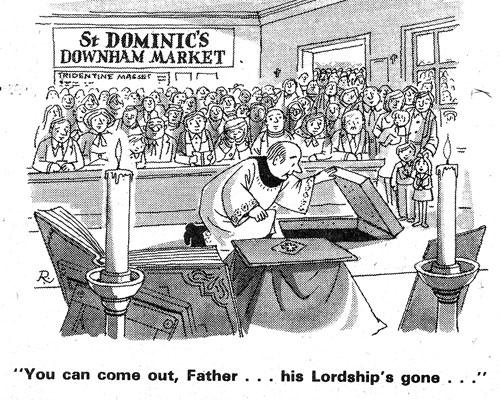
John Ryan’s 1975 cartoonLet me throw caution to the wind and suggest that the Archbishop of Westminster was right last week when, in his interview with The Catholic Herald, he said that traditionalists who reject the ordinary form of the Mass are "inexorably distancing themselves from the Church".
One caveat, however. No one should supinely accept the ordinary form of Mass when it is used as a vehicle for liturgical abuse. But what is abuse? Now you are asking. One man’s abuse is another man’s caring outreach.
I myself am easily offended. I find it hard, for example, not to wave my stick when lay people (ie, women) distribute Communion, especially when I know there are enough priests at the back of the house to do the job without suffering from heat exhaustion, post-traumatic stress disorder or repetitive strain injury.
If the Oratory does not need to use lay ministers, why does the Cathedral?
But I digress. The interesting thing about what the Archbishop said last week is that it chimes with what some traditionalists have been thinking, and saying, for a little while now.
One such is Thaddeus Kozinski, a doctor in philosophy from the Catholic University of America. He believes that the old rite is vastly superior to the Novus Ordo, indeed that the NO represents a radical breach in liturgical tradition, but at the same time is convinced that many so-called traditionalists are as much children of Vatican II, and of the Enlightenment, as the liberals are. There is something about them, he contends, that is schismatic, even Protestant; perhaps even modernist. They are rebels.
Kozinski is not thinking here principally of Lefebvrists or sedevacantists, but of what we might call the far liturgical right in the mainstream Church, the people you sometimes find in the LMS and the FSSP and in parishes where the old rite is said regularly. Thaddeus calls these people "Gnostic traditionalists", and by Gnosticism he means "the attitude that leads one to believe he possesses an irrefutable insight into the truth of matters of great importance, whether natural or supernatural".
For some years, according to his account in the New Oxford Review, Kozinski attended nothing but indult Masses in the old rite. Then, two or three years ago, he moved with his young family to an area where such Masses were not available, and he was therefore obliged to attend the Novus Ordo again.
As he became familiar with his new surroundings – and found rich spiritual fruit in the new rite as celebrated by the Oblates of St Joseph – he saw that in his former unyielding traditionalism he had developed what he calls "an ideological and neurotic consciousness of being a ‘traditionalist’ ".
Kozinski believes that "traditionalism" can become an ideology that makes one spiritually sick, "as one becomes more attached to the traditionalist movement, its narratives, personages, publications, polemics, criticisms, etc than to the Church as a whole – and to Christ Himself". This ideology, he says, can manifest itself in paranoia, judgment, harshness, Jansenism, and lack of meekness.
That’s me all right, but Kozinski clearly does not want to condemn all traditionalists, and I feel I should speak up here for the thousands of hardcore trads who are not at all Jansenist or harsh but are decent, well-balanced human beings. Among them I would include the Lefebvrist godfather of my youngest son.
Perhaps, meanwhile, I should add that Kosinski’s article appeared two years ago, but under my management this column has never been at the cutting edge of news, and anyway I did not come across the article until May.
To make sure that Kozinski had not changed his mind, however, I got in touch with him last week. He has not changed his mind, but now believes that the Gnosticism of which he speaks is not confined to the traditionalist right but can be found among ultra-orthodox adherents of the Novus Ordo.
The Gnostics, in Kozinski’s assessment, see orthodoxy (whether trad or NO) as the best protection against "the world". They do not fearlessly place their trust in Christ, but live in a "constrained, fearful, and spiritually suffocating world" of their own creation. There is among these people, he believes, "fanatical, unhealthy zeal" for religious purity.
So: calm down, dears. Let’s be healthy zealots and follow the Pope. What he wants, obviously, is reform of the reforms. There’s no getting rid of all the changes – that would cause even more confusion than the calamitous Pauline revolution of 1970 – but we must put the clock back.
Traditionalism is a new ism. What we want back is proper Catholicism. [Can I hear an "Amen!"?]
If we get that back – and curb our tongues [While we are not being "supine"?] – the traditional Latin Mass will surely thrive alongside the upcoming revision of the liturgy: the new New Mass.
One of the many things I regret is that I did not know John Ryan better. He was so obviously a good man that it was foolish of me not to have stayed in touch with him when our professional association ended 34 years ago.
I got to know John, who died last week, when I edited this newspaper for three months in 1975, and I liked him a lot. Maybe that had something to do with the fact that he seemed to sympathise with my not entirely sober stand on behalf of Archbishop Lefebvre; but the most important thing about him was not that he agreed with me but that he was kind, funny, modest, tolerant and open-minded.
His jokes were intended to make people happy rather than miserable, but his stuff could have a sharp edge. He once did a daring cartoon in defence of the agreeable but perhaps rather extreme Fr Oswald Baker, the traditionalist priest who stuck his toes in at Downham Market in Norfolk, and was eventually sacked.
At this distance I can’t quite remember the details, but I seem to recall that shortly before the turbulent priest was booted out of his parish the bishop visited Downham Market, perhaps to mount an inquiry. Fr Baker did not have the pleasure of meeting him, as John’s cartoon, above, shows.
It caught the mood of those of us who felt we were being ill-used by agents of a new reformation. It should be said, however, that John was never part of the paranoid tendency. He was far too kind and funny for that sort of caper. RIP.
Under another entry, a reader posted a comment about the whole SSPX "emergency powers" argument, by which the same SSPX justifies its lack of obedience to the Bishop of Rome and continues to act without any kind of permission or jurisdiction.
Here it is, edited slightly, and with my emphases and comments.
Father, it so hard for me not to be sympathetic to the SSPX’s "state of necessity" position.
The situation in my home diocese is absolutely wretched. A third of the parishes have been closed in the last 10 years, and those that remain are mostly in a deplorable state.
The Cathedral has been wrecked, with the "altar" now in the middle of the nave and other renovations to promote a heterodox understanding of the Mass.
Even worse, prominently displayed in the Cathedral bookshop (located at the entrance of the nave) are books by Joan Chittister (in good standing), Charles Curran (in good standing), Richard McBrien (in good standing), and John Shelby Spong.
Father Z, my bishop is selling books by JOHN SHELBY SPONG in our Cathedral!
My family’s old parish has LGBT rainbow flags in the vestibule. You can imagine how the rest of it is. Yet this scandalous priest and others operate with the support of my bishop.
I say it is my family’s OLD parish because almost my entire family has fallen out of the Catholic Church.
Gone. My father and I are the only practicing Christians in my immediate family—he’s a Baptist. He left after his world (the Church) imploded with chaos and novelty. He decided that the Church was obviously just a man-made institution, and a sick one at that.
Most of the rest of my family has simply fallen away.
I did not grow up a Catholic and was (by the miraculous grace of God) a convert in college. My family, before the 1970s, was Catholic for probably a millennium and a half going back to Italy.
The only other Catholics left in my family are several second cousins—and they (and their children) go to the SSPX chapel in my diocese (which is booming with young families).
Father, I never go to SSPX chapels (out of obedience). But I can’t begrudge my second cousins—I fear for their children’s prospects if they were elsewhere.
Indeed.
While it is necessary to interject at this point that "two wrongs don’t… er um… well… a whole bunch of wrongs don’t make a right", it is indeed hard to begrudge people their search for something which seems simply "normal" instead of the Salvador Dali landscape they find themselves in when they go to church.
I know how hard it is to learn another language and to translate from one language to another with anything like both accuracy and correct idioms.
That is why I enjoy the site Engrish.
For a chuckle:

From a reader comes an interesting question.
Given that – as I believe – we will be having more and more to do with followers of SSPX chapels, especially as Summorum Pontificum gets better traction, this person’s question deserves some attention:
We attend an SSPX parish every other week and our local OF every other week – we are very attached to the traditional rites of the church but are not comfortable missing mass when there is no EF available.
Our oldest child (7) received her 1st communion and confession with the SSPX this spring and has received both sacraments since then in our local OF parish and at other OF and EF masses since her 1st.
This weekend our local priest confronted me, asked where my daughter had received the sacraments, and responded that she had received the sacraments invalidly, he shouldn’t be giving her communion and would have to stop unless we remedied the problem.
The problems he stated were: 1) the eucharist is invalid with the SSPX [He is wrong about that. It is valid but illicit.] (he said they were "protestant") and 2) she was unable to receive (1st time???) out of his jurisdiction without his permission. [Wellll….] He had spoken to the bishop about the situation specifically and Bishop had agreed. [?] His only suggestion was that we go through the parish training materials.
As far as I can tell the parents are the primary teachers of the faith (so the training materials cannot be an impediment the the eucharist) – we homeschool and have used the St Joseph’s and Baltimore Catechisms. She also has received at least several valid communions and confessions by now by anyone’s account. Obviously I could add a lot more detail and history, but my questions are:
1) can my daughter be denied communion?
2) can you recall or point me to something written from the Vatican that clarifies that SSPX masses/communions (if not confessions) are at least valid (although not preferred), and
3) is it true that without permission 1st communion and confession cannot be received outside of one’s hometown parish – if not true can you please point out why not.Considering what I have learned the SSPX masses and holy eucharist are valid and the priest is asking us to 1) deny that validity or 2) stop receiving the sacraments at the OF because he would refuse our daughter. I don’t really like either option.
I am glad you take your responsibility as a parent seriously.
I consulted a canonist whom I trust on this. Here is the answer sent back, which I have only slightly edited.
Once a Catholic has been admitted to the Eucharist, he (or in this case, she) cannot be refused (c. 912) without the application of a canonical penalty, (and according to c. 1323, a child under the age of 16 cannot be subject to a canonical penalty), unless there is a determination that the person is "obstinately persevering in manifest grave sin. (c. 915). I don’t think the pastor would want to go there.
Reception of First Communion is not a juridic act – there is no obligation to receive the Eucharist the first time, or any time, from the pastor, nor does he have any specific authority to forbid his parishioners from receiving their First Communion outside of his parish. The pastor does have the right, under canon 914, to "exercise vigilance so that children who have not attained the use of reason or whom he judges are not sufficiently disposed do not approach holy communion." Yet the correspondent is correct that the obligation of preparing children for the Eucharist falls primarily on the shoulders of the parents.
While it is true that priests of the SSPX do not have the faculty to validly hear confessions, there is no obligation for anyone to make their First Confession – or any confession – to their pastor, or in their own parish. The young lady’s first attempted confession was invalid, but it seems that she has subsequently confessed to a priest with faculties, so I would not have scruples about the status of her soul.
The pastor does seem to be taking his job seriously – and is warning and cautioning his subjects (perhaps a bit too zealously) about the danger of approaching priests in a state of impaired communion for the Mass and the sacraments. It was imprudent of the parents to encourage their child to receive the sacraments (invalidly insofar as the confession is concerns, and illicitly insofar as the Eucharist is concerned) at the SSPX chapel. The pastor has the obligation of protecting the faithful from error and correcting them when they stray (c. 529). The faithful have the obligation of maintaining communion with the Church (c. 209), and while the desire to worship according to the traditional form of the liturgy is commendable, attending biweekly would seem to be imprudent – and receiving the Eucharist there even more so.
The pastor’s suggestion that the child go through the parish sacramental preparation program is not an undue burden for him to place on the parents – provided that the child not be denied the Eucharist to which she has already been admitted during the time it takes for her to go through the program.
I think this is a measured and correct response.


Coat of Arms by D Burkart
 fac on Daily Rome Shot 1118 – Paddywhack!: “Speaking of the disputatio back on October 31st between Archbishop Vesco and Bishop Barron (Vesco saying the Catholic Church was…”
 on Continue the Rome shot posts? I dunno.: “Please call continue the Rome photo posts if it not too much of a burden. Thank you, Father!”
 on Daily Rome Shot 1117 – A *POLL* about 2026-27: “Sorry… my bad. It is indeed SIX. 1. Rh8+! Kxh8 2. Qh2+ Kg8 3. Qh7+ Kf8 4. Qh8+ Ke7 5.…” on Encrypted Yeast? The Fathers on “What does the “leaven” really say?” (6th Sunday after Epiphany Resumed): “I especially like St. John Chrysostom’s insight, that when we are “hidden” in the normal places we live and work,…”
 on Daily Rome Shot 1117 – A *POLL* about 2026-27: “pestolover: For what it’s worth, your solution was the best I could do also.”
 on Daily Rome Shot 1117 – A *POLL* about 2026-27: “Fr Z thanks so much for 2 reminders. 1. Using your Amazon link! For heaven’s sake it costs us nothing…”
 on 10 November – St Andrew Avellino (Vetus Ordo). Wherein Fr. Z rants.: “So interesting that you bring this up, a couple weeks ago a priest at a neighboring parish died unexpectedly. They…”

A Daily Prayer for Priests








They find you a pro-life agent in your area who commits to giving a portion of the fee to a pro-life group!

PLEASE subscribe via PayPal if it is useful. Zelle and Wise are better, but PayPal is convenient.
A monthly subscription donation means I have steady income I can plan on. I put you my list of benefactors for whom I pray and for whom I often say Holy Mass.
In view of the rapidly changing challenges I now face, I would like to add more $10/month subscribers. Will you please help?
For a one time donation...



Help Monks in Wyoming (coffee – UPDATED LINK) and Norcia (beer) and the wonderful "Soap Sisters" of Summit, NJ!


Please follow me on Twitter!










Visits tracked by Statcounter
since Sat., 25 Nov. 2006: