Making some plans for London…blognic?

Making some plans for London...blognic?I don’t have a lot of time to put together my itinerary for London et alibi, but… you WDTPRSers have made it possible, and I am very grateful.

Thanks to all of you who made donations to the trip fund I will be able to participate at Blackfen for the 25th Jubilee of Fr. Tim Finigan’s ordination.

On Thursday morning I will celebrate Holy Mass for the intention of the benefactors who contributed to this project.  It is my honor and duty to do so.

I will be staying mostly with my friend Fr. Chris Baden at St. Bede’s in Clapham Park.

It is time to think about a London blognic.

Can you Londoners and those in the area make suggestions?

For the last London blognic we met at the Buckingham Arms on a Tuesday late afternoon. It was well attended… and a great time!

Making some plans for London...blognic?As an initial proposal, since I arrive on Friday, I won’t absolutely rule out Friday night, 17 July though I will be pretty tired. 

Saturday 18 July is not out of the question.  It wouldn’t necessarily have to be in the evening, since that is bad for priests.
Making some plans for London...blognic?
Anyway, I put this on the table.  I am putting my plans together for the days before The Event on the 28th.

Again, your donations were the only way I was able to do this in the first place.

Also, I am open to smaller, on the fly, meetings. For example, the last time I was there, on a couple afternoons, I stopped at a pub at Seven Dials where my iPhone could connect to the internet.  I had a pint and uploaded some photos and entries.  Things like that can be done with some creativity!  I could post my UK cellphone number when I get there and get it is once again "charged up" with pounds.

UPDATE 2302 GMT:

His Hermeneuticalness, Fr. Finigan, chimed in:

Can I suggest Friday evening 24th July at about 6pm somewhere in central London so that people who are working in London can make it fairly easily.

And… I add… we may have a surprise event at the blognic!


Posted in Lighter fare, SESSIUNCULA |
30 Comments

To think!

And to think… this beautiful church… yes… church… almost burned down!

To think!

Posted in SESSIUNCULA |
57 Comments

In the Pittsburgh area

In the Pittsburgh areaOur friend and fellow patristiblogger Mike Aquilina sent the following:

Barbara Bell, author of the children’s book Minimus (Cambridge University Press) is visiting Pittsburgh and offering a FREE Latin lesson to kids and adults on Thursday, July 23, from 7 to 8:30 p.m. at St. Louise de Marillac Parish Center, 312 McMurray Road Pittsburgh, PA 15241. Bell is director of the Primary Latin Project and a member of the Order of the British Empire. Since Minimus the Mouse is ten years old this year, there will be cake and cookies to celebrate. The event is free, but registration is required. To register, please call 412-833-1010.

Minimus mus…. hmmmmm

Do I sense a hint of Horace?


Posted in SESSIUNCULA |
2 Comments

D. Fort Wayne-South Bend, Bp. D’Arcy’s norms for TABERNACLES

From a reader comes new from the Diocese of Fort Wayne-South Bend, where His Excellency the exemplary John M. D’Arcy is bishop. 

His Excellency has made a statement about the placement of the tabernacle in churches of the diocese. Document.

Here is the cover letter with his statement with my emphases and comments:

PROMULGATION OF DIOCESAN NORMS

June 14, 2009 Feast of Corpus Christi

To Priests, Deacons, Religious, and to All the Faithful,

The presence of Jesus Christ in the Blessed Sacrament is at the center of our faith and of the devotional life of our Catholic people.

In recent years, the place of the tabernacle in our churches has become a source of controversy. This should not be. The Eucharist, whether we are referring to its celebration or to the place of reservation, should always be a means of unity and communion, and never of division.

The place of the tabernacle in our church should reflect our faith in the real presence of Christ, and should always be guided by Church documents.

My experience is that our people, with their instinct of faith, have always desired that the tabernacle be central and visible. They find it confusing when the tabernacle in their churches is not visible, and if possible, central.  [Amen. Alleluia.]

Because of my responsibility to foster the devotional life of our people, and to keep it sound, I have asked our Office of Worship to prepare norms for the placement and design of the tabernacle in this diocese. These norms were brought before the Presbyteral Council, the Liturgical Commission, and the Environment and Arts Committee. Suitable refinements and improvements were prepared.

These norms are promulgated to the Diocese of Fort Wayne–South Bend on June 14, 2009, the Feast of Corpus Christi, the Body and Blood of the Lord. They will be effective on August 4, 2009, the Feast of Saint John Mary Vianney, the patron saint of priests, in whose honor the present Year for Priests has been dedicated by the Holy Father Benedict XVI.

I urge all priests to follow these norms carefully and completely, and most importantly – to foster devotion to the Blessed Sacrament.

With every best wish and prayer, I remain

Sincerely yours in our Lord,

Most Reverend John M. D’Arcy
Bishop of Fort Wayne – South Bend


"But Father! But Father!", surely you are by now eagerly shouting.  "Don’t leave us in suspense!  What does the bishop really say?"

Here are a couple highlights from the norms which you can read on your own.

4. In the Diocese of Fort Wayne-South Bend, the Bishop has judged that the tabernacle is normally to be prominently located in the sanctuary of the church, along the central axis behind the main altar. Under this arrangement, the tabernacle should be at an elevated, open location in the apse area, or in another central place in the sanctuary that is equally conspicuous. Where a high altar with a tabernacle remains in place, it is appropriate to continue using this noble structure for the reservation of the Blessed Sacrament.

5. This prescription is to be observed in all future construction or restoration projects involving places of sacred worship (including all churches, oratories, and private chapels) in the Diocese. Any exception to this norm must be approved by the Diocesan Bishop, and must clearly demonstrate itself as a worthy alternative that would accentuate the sacramental nature of the church building and contribute to the spiritual life of the worshiping community.

6. In those existing places of sacred worship where the tabernacle is currently located elsewhere in the sanctuary or the main body of the church, a liturgical consultation with the faithful and with the Diocese should begin, regarding the possibility of moving the tabernacle to a central position in the sanctuary. Especially if the tabernacle in a particular church was central at one time and then was moved, it should be returned to its original location.

…

24. Aside from tending to the tabernacle itself, we must ensure that the faithful receive proper guidance and formation with respect to reverence before the Blessed Sacrament. [Amen. Alleluia.  I would add RECEPTION as well… but that is not the topic of these norms.] Today there are many of all ages who inadvertently do not genuflect or bow in the correct situations.

Care should be taken to instruct the faithful that genuflection is the appropriate sign of adoration in the presence of the Blessed Sacrament, “whether reserved in the tabernacle or exposed for public adoration.” Before or after Mass, when the tabernacle is visible somewhere in the church, genuflection should be directed towards it. Although those who genuflect when a tabernacle is not present or when the Blessed Sacrament is clearly removed from the tabernacle (for example, during much of the Sacred Triduum) typically do so out of a commendable pious habit, they should instead bow out of reverence towards the altar.

25. Every church should strive to make the tabernacle accessible for prayer during the day, and to preserve a peaceful setting favorable to prayerful visits. Meetings and other activities without a strictly spiritual purpose should therefore be held elsewhere on the church premises whenever possible. Under extraordinary circumstances, such as if it became necessary for a church to host an event of a purely secular nature, the Blessed Sacrament may be removed from the tabernacle and transferred to the sacristy or another suitable place. The location should be secure, with the ciboria veiled and the Lord’s presence clearly marked.

WDTPRS sends huge kudos to Bp. D’Arcy for another good day’s work in the Lord’s vineyard.

Posted in Brick by Brick | Tagged , , , , ,
62 Comments

QUAERITUR ALIBI: Why isn’t Mary considered a priest?

Mark Shea in his blog, Catholic and Enjoying It, has a good Q&A:

A reader asks:

Why isn’t Mary [the Mother of God] considered the first priest since she actually brought Christ into this world?

Well, in a certain sense she is since she participates in the common priesthood of all the baptized [If she was baptized… hmmm…]. However, the short answer is: Because Christ did not ordain her to the sacerdotal priesthood.

In many respects Mary willingly participated in Christ’s perfect sacrificial self-offering in the greatest degree that any human could, and certainly greater than anyone else ever has.

But she was not chosen by Christ to be a priest in the way he chose the Apostles and their successors in the ministerial priesthood.

I do not recall any speculation in the Father about Mary having been baptized.

Her lot in the economy of salvation is privileged.  I don’t think we can easily speak of her as needing precisely what all of us need, for example, the baptism which forgives the guilt of original sin, the baptism which would make the Mother of the Church a member of the Church, the baptism which would make her who gave Christ his Body a member of the Body of Christ.

Posted in ASK FATHER Question Box, Linking Back |
43 Comments

Gotta love a saint named Swithun

Gotta love a saint named SwithunOver at the well-written The Sensible Bond we find this on an interesting English Saint:

Today is traditionally the feast of St Swithun, bishop of Winchester. If people know anything about him, it tends to be the legend that associates his feast day with summer weather. Should it rain today, the legend states, it will rain for forty days. If it stays fine today, then it will supposedly stay fine for forty days. When Saint Swithun died in 862, his mortal remains were buried at his own request outside the old minster of Winchester. There his grave could be walked upon and there it lay open to the gentle elements; a bishop must be humble, even in death. In 971, however, after the construction of the new minster in Winchester they moved his body from the original grave and into the new church where a shrine was established until the Reformation (now re-established). Yet, that very night, a terrible rain storm began and it reportedly rained for forty days. This was said to be a sign of the saint’s wrath at his being moved.


Check out the post "Greatness in a handful of dust" for the rest!

Posted in Saints: Stories & Symbols |
19 Comments

The return of “Iota Unum” by Romano Amerio

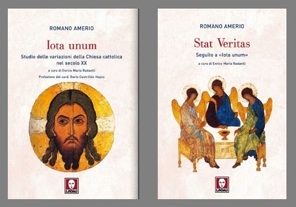
The return of "Iota Unum" by Romano AmerioThe find gentleman Sandro Magister has a very good piece today on his site about the return to view of two volumes by Italian-Swiss author Romano Amerio, namely Iota Unum and Stat Veritas.

These are very good books.  It is very interesting that these volumes seem to be coming back into view.

Iota Unum is available in English and it is an important read, especially now that we have been as a Church refocused through a hermeneutic of reform and continuity, rather than of rupture.

Here is the first part of Magister’s piece.  Go to his place for the rest.

You can purchase Iota Unum with this link.  I don’t have it in English, but I have read it in Italian.  You will get involved.

My emphases and comments.

The return of "Iota Unum" by Romano AmerioGrand Returns. "Iota unum" and "Stat veritas" by Romano Amerio

Two outstanding works of Catholic culture are returning to the bookstores. And the taboo on one of the greatest Christian intellectuals of the twentieth century is crumbling definitively. The question he highlights is also at the center of Benedict XVI’s pontificate: how much can the Church change, and in what way?

by Sandro Magister

ROME, July 15, 2009 – As of tomorrow, two volumes that have taken their place among the classics of Catholic culture will return to Italian bookstores, published by Lindau. Their content is in striking harmony with the title and foundation of Benedict XVI’s third encyclical: "Caritas in Veritate." [I must go back and reread, I think.]

The author of the two volumes is Romano Amerio, the Swiss scholar, philosopher, and theologian who passed away in 1997 at the age of 92. One of his great admirers, the theologian and mystic Don Divo Barsotti, summed up their contents as follows:

"Amerio essentially says that the gravest evils present today in Western thought, including Catholic thought, are mainly due to a general mental disorder according to which ‘caritas’ is put before ‘veritas’, without considering that this disorder also overturns the proper conception that we should have of the Most Holy Trinity."  ["caritas" out of harmony with "veritas"…]

In effect, Amerio saw precisely in this overturning of the primacy of Logos over love [and who knows what some people think "love" is these days] – or in a charity separated from truth – the root of many of the "variations of the Catholic Church in the 20th century": the variations that he described and subjected to criticism in the first and more commanding of the two volumes cited: "Iota unum," written between 1935 and 1985; the variations that led him to question whether with them, the Church had not become something other than itself.  [Folks, in the English speaking world it might be hard to imagine what sort of reaction there was to Iota Unum in the Italian speaking environment of Rome.]

Many of the variations analyzed in "Iota unum" – although just one of them would suffice, one "iota," according to Matthew 5:18, from which the book’s title is taken – would lead the reader to think that there has been an essential mutation in the Church. But Amerio analyzes, he does not judge. Or better, as the fully formed Christian that he is, he leaves the judgment of God. And he recalls that "portae inferi non praevalebunt," meaning that for the faith, it is impossible to think that the Church could lose its way. There will always be continuity with Tradition, even if it is amid turbulence that obscures it and leads one to think the contrary.  [Timely.]

There is a close connection between the questions posed in "Iota unum" and Benedict XVI’s address to the Roman curia on December 22, 2005, a fundamental address in terms of the interpretation of Vatican Council II and its relationship with Tradition.  [And talks with the SSPX?]

This does not change the fact that the state of the Church as described by Amerio is anything but peaceful.

In the address on December 22, 2005, Benedict XVI compared the babel of the contemporary Church with the upheaval in the fourth century after the Council of Nicaea, described at the time by Saint Basil as "a naval battle in the darkness of a storm."

In the afterword that Enrico Maria Radaelli, a loyal disciple of Amerio, publishes at the end of this revised edition of "Iota unum," the current situation is instead compared to the Western Schism, meaning the forty years between the 14th and 15th centuries before the Council of Constance, with Christianity leaderless and without a sure "rule of the faith," divided between two or even three popes at one time.

In any case, republished now years later, "Iota unum" reasserts itself as a book that is not only extraordinarily relevant, but "constructively Catholic," in harmony with the Church’s magisterium. In the afterword, Radaelli demonstrates this in an irrefutable way. The conclusion of the afterword is presented further below.  [You will want to check that out.]

As for the second book, "Stat veritas," published by Amerio in 1985, it is in linear continuity with the previous one. It compares the doctrine of Catholic Tradition with the "variations" that the author identifies in two texts of the magisterium of John Paul II: the apostolic letter "Tertio Millennio Adveniente," November 10, 1994, and the address at the Collegium Leoninum in Paderborn on June 24, 1996.

The return to the bookstores of "Iota unum" and "Stat veritas" brings justice both to their author and to the de facto censorship that for long years bore down on both of these consummate books of his. In Italy, the first edition of "Iota unum" was reprinted three times for a total of seven thousand copies, despite the fact that it ran to almost seven hundred pages of demanding reading. It was then translated into French, English, Spanish, Portuguese, German, and Dutch. It reached tens of thousands of readers all over the world. But for official Catholic bodies and Church authorities it was taboo, as of course it was for its adversaries. [It sure was.] More of a singular case than a rare one, the book was an underground "long seller." Requests for it continued  when the bookstores ran out of copies.

The breaking of the taboo is recent. Conferences, commentaries, reviews. "La Civiltà Cattolica" and "L’Osservatore Romano" have also woken up. At the beginning of 2009, a first reprinting of "Iota unum" appeared in Italy, published by "Fede & Cultura." But this new edition of the book produced by Lindau, together with that of "Stat veritas," has the added value of the editorial work of Amerio’s greatest student and intellectual heir, Radaelli. His two extensive afterwords are genuine essays, indispensable for understanding not only the profound meaning of the two books, but also their enduring relevance. Lindau intends to publish Amerio’s "opera omnia" in the next few years, with Radaelli as editor.

The following is a tiny sample of the afterword to "Iota unum": the final considerations. …

Posted in Brick by Brick, SESSIUNCULA | Tagged , ,
36 Comments

QUAERITUR: Why in the TLM are Gospels mostly from Matthew?

A question from a priest friend, for some discussion.

A question from a confrère. Why does the 1962MR have scriptural readings that are mostly from Paul’s Epistles and Matthew’s Gospel?


I don’t know.

I suppose is makes sense that the reading generally called the Epistle be from letter, and most of those are by St. Paul.  I also suppose more reflection was given to those letters in the Church of Rome and areas where some Mass formularies were developed.

As far as the Gospel of Matthew is concerned….

Perhaps readers can help?

Posted in ASK FATHER Question Box |
37 Comments

A Conservative’s Lament (written in 1965)

From a reader:

Dear Fr. Z,
 
While digging through my parish archives for historical items, I found this interesting poem by an unknown parishioner DATED 1965!  Hope you find it entertaining!
 
God Bless,


The Updated Church

(A Conservative’s Lament)
written in 1965

Latin’s gone
Peace is too
Singin’ and shoutin’
From every pew.

Altar’s turned round
Priest is too
Commentator’s yellin’
“Page Twenty-two!”

Communion rail’s gone
Stand up straight
Kneelin’ suddenly
Went outa date.

Processions are formin’
In every aisle
Salvation’s organized
Single file.

Rosary’s out
Psalms are in
Hardly ever hear
A word against sin.
Listen to the Lector
Hear how he reads
Please stop rattlin’
Them Rosary beads!

Padre’s lookin’ puzzled
Doesn’t know his part
Used to know the whole deal
In Latin by heart.

I hope all the changes
Are just about done
That they don’t drop Bingo
Before I’ve won.


Posted in SESSIUNCULA |
24 Comments

15 Aug: Berlin/Merchantville, NJ – annual Solemn High Mass for Assumption

Here is a note from my friend Fr. Robert Pasley, parish priest of Mater Ecclesiae in Berlin, NJ.

Each year they have a wonderful celebration for the Feast of the Assumption.

Mater Ecclesiae’s Ninth Annual Solemn High Mass of the Assumption
 
On the Feast of the Assumption, Saturday, August 15, 2009 at 12 Noon, Mater Ecclesiae Roman Catholic Church will celebrate the Ninth Annual Mass of Thanksgiving at Saint Peter Roman Catholic Church, 43 West Maple Avenue, Merchantville, New Jersey.  The Solemn High Extraordinary Form of the Mass will be celebrated according to the 1962 Roman Missal and will once again feature the Ars Laudis Festival Chorus and Orchestra.
 
The Mass setting will be Missa Sancti Nicholai (1772) by Franz Joseph Haydn (1732-1809), conducted by Dr. Timothy McDonnell.  The singing of the Gregorian Propers will be directed by our Cantor, Mr. Nicholas Beck.
 
The location of the Mass has changed this year due to ongoing renovations at the Cathedral in Camden.
 
For the ninth consecutive year, the Reverend Robert C. Pasley, KHS, Rector of Mater Ecclesiae, Berlin, NJ, will celebrate this Solemn Mass in thanksgiving for the canonical establishment of Mater Ecclesiae.
 
For more information, please call 856-753-3408 or visit the website:  www.materecclesiae.org.
 
Mater Ecclesiae is a Mission of St. Edward’s Parish, Pine Hill, in the Diocese of Camden New Jersey.  The Mission was established on October 13, 2000, the anniversary of the final apparition of Our Lady at Fatima.  All Masses and Sacraments are celebrated according to the liturgical books of 1962.


Posted in SESSIUNCULA |
8 Comments