D. Worchester – new TLM

From a reader:

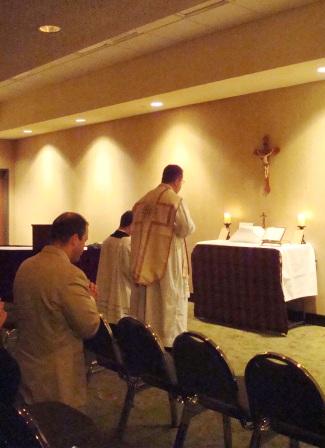
The Most Reverend Robert J. McManus, Bishop of the Worcester Diocese, has given his approval for this new regularly scheduled Traditional Latin Mass. 
 
The following is the press release:

In response to Pope Benedict XVI’s Summorum Pontificum, Reverend Father Thien Nguyen, pastor at Immaculate Conception Church in Fitchburg, Massachusetts, has generously invited Reverend Father David Phillipson to offer the  Extraordinary Form Mass (the Traditional Latin Mass) every Sunday at 8am, beginning on June 28th and also on Holy Days according to the Traditional Calendar.  Father will hear confessions at 7:30am before Mass, and the Rosary will be prayed aloud at that time.  Father will also hold spiritual conferences and traditional devotions, and administer the Sacraments according to the Extraordinary Form of the Roman Rite.  For more information, visit the parish website at www.immaculateconceptionfitchburg.com.     Immaculate Conception Church is located at 59 Walnut Street in Fitchburg, Massachusetts.  The parish will also continue to keep its regular schedule of Masses in the Ordinary Form (Novus Ordo Masses).

Posted in Brick by Brick |
19 Comments

Some speculations about the SSPX and Holy See

You know about the dust up over the upcoming SSPX ordinations scheduled in Germany, and the Holy See’s tisk-tick press release.

I have had a few conversations about these things lately.

There is some suggestion flowing to me from different sources, whom I cannot name, that SSPX Bishop Bernard Fellay may be prepared to accept some sort of "provisional status". 

Soon after the excommunications were lifted, Bp. Fellay seems to have refused to sign a document asking for the lifting also of the suspensions.

If this is true, I can understand why that would be, in light of the problems brewing in Germany.

For some background…

We all know that the SSPX leadership wants to resolve doctrinal issues before the canonical.  However, given the new exigencies, perhaps some provisional or transitional status could help advance the rapprochement.

This is a good time to offer some prayers and ask the guardian angels of all involved to help them come to a good solution, soon.

Posted in SESSIUNCULA |
25 Comments

Holy See Press Office on SSPX June ordinations

There was a communique from the Holy See Press Office today about the scheduled SSPX ordinations to take place in Germany.

In English:

COMMUNIQUÉ OF THE HOLY SEE PRESS OFFICE
REGARDING THE ORDINATIONS ANNOUNCED BY THE FRATERNITY OF SAINT PIUS X

In response to frequent questions which have come to this office in the last days regarding the priestly ordinations of the Society of St. Pius X scheduled at the end of June, there is nothing else to do but refer to what the Holy Father affirmed in his Letter to Bishops of the Catholic Church from last 10 March: "As long as the Society (of Saint Pius X) does not have a canonical status in the Church, its ministers do not exercise legitimate ministries in the Church (…) until the doctrinal questions are clarified, the Society has no canonical status in the Church, and its ministers (…) do not legitimately exercise any ministry in the Church". The ordinations are, thus, still to be considered illegitimate.

    In the same letter, the Pope announced his intention to provide a new status for the Commission "Ecclesia Dei", joined to the Congregation for the Doctrine of the Faith. There are reasons to believe that the definition of this new status is close. This constitutes the premise for the beginning of the dialogue with those responsible for the Fraternity of Saint Pius X in view of the desired clarification of the doctrinal, and, in consequence, of the disciplinary questions which still remain open.


Well… the statement is correct.  The priests of the SSPX do not have permission to exercise ministry for the Church.  Valid orders is not enough.  They need authorization to exercise those orders from legitimate authority.  They have valid orders.  They don’t have permission.  Period.  There are no "emergency powers".

At the same time, the moves of the German bishops can hardly be seen as friendly to the Holy Father’s work to reintegrate the SSPX.  Perhaps there are cultural factors at work.  In addition to their fear of the style of liturgy they would bring, they are probably afraid of the furor in the press that will erupt from accusations of anti-semitism, etc.

The Holy See Press Office cannot say, "Hey, its okay that the SSPX have ordinations!" Clearly, it is wrong for the SSPX to do this.  On the other hand, the Holy Father, and Cardinal Castrillon would like – and we would all like – that the SSPX come in as a body rather than piecemeal. For the sake of such a plan, it may be necessary to tolerate an otherwise unacceptable act, such as additional ordinations.  Pressuring the SSPX not to have ordinations at this point might work to tear apart the internal unity of the SSPX priests and their followers.

Istthere negativity being transmitted on the part of those who craft the language of these types of press releases?  What counts is what the Holy Father communicated to the leadership of the SSPX by his actions and through his lieutenants in this matter, Card. Castrillon and now, soon, Card. Levada.

The point about the Pontifical Commission "Ecclesia Dei"…

It seems pretty clear that the Commission will soon go under the CDF.  The doctrinal discussions with the SSPX will have to be worked out at the CDF.

It seems to me that the liturgical component of the Commission will now be shifted to the CDW.  Under Card. Canizares, and with Archbp. DiNoia, the older forms will have some sympathy in the CDW.  There are also a few very good men in the CDW who will be able to handle questions and issues.  I wouldn’t be surprised if, when it is really time for the CDF to take up the PCED for the doctrinal discussion, men such as the experienced Msgr. Perl wouldn’t go back to the CDW where he was before 1988 and the formation of the PCED.  That would make sense.

Posted in SESSIUNCULA |
74 Comments

NCR’s attack on the Year of the Priest: heresy and arrogance

The weekly National Catholic Reporter is one of the most dissident publications calling itself Catholic.

This week NCR attacks Pope Benedict’s decision to inaugurate a special Year for Priests, which begins on Friday, 19 June, the Feast of the Sacred Heart.

My emphases and comments.

Don’t tell the pope
By Nicole Sotelo

Created Jun 11, 2009

Pope Benedict has declared June 19 as the beginning of the Year of the Priest. He has proclaimed that “without priestly ministry, there would be no Eucharist, no mission and even no church.” [And now Nicole is going to enlighten us about how the Vicar of Christ went wrong….] I hate to be the one to inform him, but Eucharist, mission and church existed long before the rise of priesthood.  [Just.Plain.Silly.]

According to the Gospels, Jesus was not a priest, nor were his disciples. We do see reference to Jesus as a priest in the Letter to the Hebrews. The author uses the word to refer to Jesus as the new and last “High Priest,” ending a long line of Jewish leaders. The author claims that priests are no longer necessary because no more sacrifices are needed. Jesus was the ultimate sacrifice and is our final high priest.

Perhaps the pope has forgotten that Jesus was not focused on priesthood. He was focused on ministry. [Nicole is completely clueless about what "ministry" means, I think.]  He called people to minister alongside him, [bzzzzzz]  regardless of their status in society. He called out to fishermen and tax collectors and the woman with seven demons. [So… the woman with seven demons was a minister alongside Him?]  Everyone was responsible for engendering the kingdom of God. ["engendering"?]

All were invited to minister and they did so with various titles given to them by the community based on their gifts. Some were called prophet, others teacher and still others apostle. It was only later that we begin to see the emergence of a formal ministry structure and corresponding terminology as the followers of Jesus were influenced and integrated into the Roman Empire. It is not until 215 A.D. that we have evidence of an ordination ritual for bishop, priest and deacon.  [I see… so… there were no priests, no bishops, in the Church before that.  I get it.  Boy, did Benedict screw this up!]

The emergence of the clerical structure eventually led to a division of the Christian faithful into “clergy” and “laity.” In the early years of Christianity’s emergence, however, Paul reminded Jesus’ followers, “There is no longer Jew or Greek, there is no longer slave or free, there is no longer male and female; for all of you are one in Christ Jesus” (Galatians 3:28).  [Heavens… this is so bad as to be embarrassing.]

After the rise of ordination and priesthood, there develops a hierarchical order among the faithful. The word “ordination” derives from the Latin “ordinare” which means “to create order.” It developed from the Roman usage of the words “ordines” that referred to the classes of people in Rome according to their eligibility for government positions. [Ehem… the evolution of terms are one thing, but the reality they express is another.  Before the word "sacrament" for example, or a clear understanding of "person" in reference to the Persons of the Trinity, they were still facts.]

The laity became “dis-ordered” from the clergy. [HUH?  Nice try.  The clergy does not have orders to bring "order" merely to themselves, but to the whole Church.]  The word “laity” originates from the word “laikoi” that referred to those in Greco-Roman society who were not “ordered,” or “ordained” within the established political structure. The word “clergy” comes from the word “kleros,” meaning “a group apart.”
While many Christians continued to minister within the church and even some women carried the titles of deacon, priest and bishop, most carrying this title were part of a limited group of men commissioned within the context of a particular socio-political and religious order. [Get it?  See how clever she is?  This is all culturally conditioned.  See?]

[Okay… now we are going to learn that Vatican II got rid of that old stuff.  Another manifestation of seeing the Council as a rupture with the past.] This endured until 1964 when the Second Vatican Council reminded the church that the role of minister, or priest, was not limited to the ordained, but was a call to all the baptized. The document, Lumen Gentium, proclaimed that the laity were “made sharers in the priestly, prophetical and kingly functions of Christ; and they carry out for their own part the mission of the whole Christian people in the Church and in the world” (31).  [Nicole probably purposely left out the strong affirmation of the Church’s teaching that there is a qualitative difference between the priesthood of the baptized and the priesthood of the ordained.]

Priesthood, which arose out of the foundation of the early ministries of Jesus’ followers, was now returned to all Jesus’ faithful. All people are called to ministry again. All Christians are meant to share in the prophetic, sovereign and, yes, even priestly roles within the mission of the church.

So while the pope is exhorting ordained priests to reflection in this Year of the Priest, the call goes out to all of us to reflect on how we are living out our ministry in the church and world.

I wouldn’t worry about telling the pope that Eucharist, mission and church existed long before the priesthood, [Oh brother.] nor that the Year of the Priest should really be a year dedicated to all the laity. Instead, we need to understand this ourselves.

The Year of the Priest is an opportunity for the entire Christian faithful to reflect on priestly ministry, and in so doing, to claim our own.

Nicole Sotelo is the author of Women Healing from Abuse: Meditations for Finding Peace, published by Paulist Press, and coordinates www.WomenHealing.com [1]. A graduate of Harvard Divinity School, she currently works at Call To Action.

Nicole is deeply confused. 

She is a heretic, it seems, since she does accept the Church’s teaching that the priesthood of the ordained is qualitatively different from that of the baptized.  The Council is clear on this.  There is virtually no way she hasn’t read that or heard that.

She is also rather arrogant, for presuming to correct the Vicar of Christ about the very nature of the Church. 


Am I wrong?  Was that not heresy?  Was the not arrogant?

I imagine some of you will have comments.  I suppose they will be pretty harsh, for the most part. 

Try to restrain yourselves.

Stick as much as possible with picking apart the errors of fact and the errors of reasoning.  You will still have plenty to write about!
 

Posted in Classic Posts, SESSIUNCULA, The Drill, Year of Priests |
224 Comments

Report on Acton U – II

Acton University, an annual event held in Grand Rapids, MI, is the most authentically ecumenical event I have ever attended. It doesn’t set up to be obviously ecumenical, of course. Perhaps that why you find an authentic ecumenism here.

Most of the participants have a base of common principles to work from and, therefore, conversation can be frank, tough and civil… and fascinating.

While there are some Muslim and Buddhist participants, I believe, the balance is – if I am not mistaken 60/40 Protestant/Catholic. There are some 30 protestant ministers here this year and quite a few priests, including some well-known names.

Each day there are Masses available for participants.

For example, the first morning Mass was offered in the Extraordinary Form at 0630 by H.E. Most Rev. Bp. Fernando Arêas Rifan, the Apostolic Administrator of São João Maria Vianney, Rio de Janeiro, Brazil. Over 20 participants attended.

Report on Acton U - II

UPDATE: 15:27 GMT

I am on break between morning classes.

The first session was The Economic Thought of Augustine and Aquinas

The next session will be Economic Science and the School of Salamanca.

UPDATE

A friend, the great Fabrizio, has come from Rome for Acton U.

Report on Acton U - II

Report on Acton U - II

UPDATE:

Mr. Azzola and Fr. Sirico

Report on Acton U - II

Fr. de Mariana (deceased):

Report on Acton U - II

UPDATE

In a class: Truth and Fiction: Economic History of the Great Depression

Report on Acton U - II

UPDATE:

Enjoying an evening talk by Robert George.

Report on Acton U - II

Posted in SESSIUNCULA |
12 Comments

Report on Acton U – I

Quite a few interesting people are here at Acton University.

There are people from 40 countries, including Nepal. There are many denominations and faiths. This is perhaps the most authentically ecumenical gathering I have ever been to. There are many Protestant and Catholic clergy, including Bishop Rifam from Brasil. Fr. Sirico the head of the institute is up. It promises to be a rich few days.

Report on Acton U - I

Posted in SESSIUNCULA |
12 Comments

Off to Acton University

Last year I attended the fascinating Acton University, held annually by the Acton Institute.

It was so good, the people so interesting and happy, that I am back for more.

More later!

Off to Acton University

Posted in SESSIUNCULA |
10 Comments

Big news for the Archdiocese of St. Paul!

UPDATE: By now you have seen the news. 

Vatican Designates Cathedral of Saint Paul as National Shrine

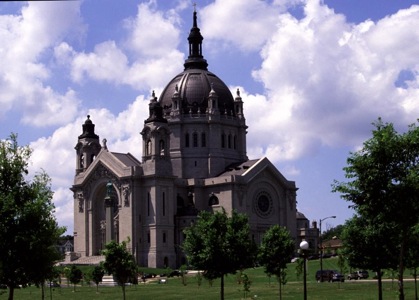
The Vatican has designated the Cathedral of Saint Paul to be the first national shrine in honor of the Apostle Paul. This special distinction was granted by the Office of the Holy See [That would probably be the CDW.] and the United States Conference of Catholic Bishops, following a request by The Most Rev. John C. Nienstedt, Archbishop of Saint Paul and Minneapolis.

This will be the first national shrine in the State of Minnesota and the only national shrine in North America dedicated to honor Saint Paul.

According to canon (church) law, “The term shrine signifies a church or other sacred place to which the faithful make pilgrimages for a particular pious reason with the approval of the local ordinary (bishop).”

Those wishing to participate more fully in the life of the National Shrine can become members of the Archconfraternity of the Apostle Paul.

Tens of thousands of people, particularly tourists, already visit the Cathedral of Saint Paul every year. Bus loads of children also come to learnabout the role of the Mother Church of the Archdiocese. The number of visitors is expected to increase significantly as a result of this designation as a national shrine dedicated to Saint Paul.

Over the decades, the Cathedral developed as a catechism in stone and glass by evangelizing through its grandeur and beauty. The patron Saint Paul is particularly honored through a series of bronze grills that depict major events in his life, from his conversion to his martyrdom. The Shrine of the Nations, which features patron saints of ethnic groups from Europe who settled the area, serves as a reminder that the work of the Apostle to the Gentiles continues through every age.

I think the Cathedral of St. Paul may be one of the most spectacular church buildings in North America. 

I am delighted that this Cathedral gains this honor as a fruit of the Pauline Year, which soon draws to a close.  Too bad it couldn’t have been organized before the Pauline Year began, so that more people might have benefited.

I am interested to know if there will be special concessions for the Cathedral now that it is a National Shrine.

Tomorrow there should be a big news on the website of the Cathedral of St. Paul in the Archdiocese of St. Paul, Minnesota.

Be sure to check it out during the course of the day.

____________________

ORIGINAL POST
____________________

It might not be posted until tomorrow afternoon.

Big news for the Archdiocese of St. Paul!

Posted in SESSIUNCULA |
15 Comments

National Shrines

Now that the Cathedral of St. Paul in St. Paul Minnesota has been made the National Shrine of St. Paul in this Year of St. Paul….

… what are some of the other National Shrines?  In the USA?  In your countries?

Just official National Shrines, please.

Posted in SESSIUNCULA |
76 Comments

More social communications joy in the Vatican

More social communications news from the Vatican!

MySpace, Facebook users at Vatican hit firewalls

By Carol Glatz
Catholic News Service

VATICAN CITY (CNS) — Vatican employees are now banned from accessing some social networking sites like Facebook and MySpace while at work.  [You know the old story.  John XXIII was asked how many people work in the Vatican.  He said, "About half."  But I don’t imagine that Facebook et al. are really going the reduce productivity that much.  The coffee breaks, maybe.]

People trying to poke a friend or post a status update on their Facebook page from a computer connected to the Vatican network will instead hit a powerful firewall that says the requested page cannot be viewed because it does not fulfill the network’s "access protection criteria."  [I have experienced this infuriating page in a residence for priests who travel to Rome, a sacerdotal hotel as it were.]

The Vatican spokesman said the move is a "normal and prudent" measure that reflects similar strategies taken by other companies around the world that have blocked employee usage of social networking sites on office networks.

Jesuit Father Federico Lombardi, the spokesman, told Catholic News Service June 16 that "there is nothing surprising" about the new ban.  [You can say that again.]

Like many employers, the Vatican has long had firewalls installed on its network to block access to pornography, online gambling, and, according to the firewall warning page itself, any site that contains "inappropriate material." [Apparently the internet office of the Vatican doesn’t consider anyone adult enough to budget their time properly.  There is, of course, the risk that some idiot would use the internet connect provided the Holy See to visit bad sites.  Someone who cared and who was checking IP addresses of visitors might be amused to see that the IP sis registered to "Amministratizione della Patrimonia della Santa Sede".  But this is being too restrictive by a long shot.]

Some Vatican employees noticed in late May that social networking sites like Facebook and MySpace were now being blocked. Other information sharing sites like Twitter, YouTube and Flickr were still accessible as of June 16.  [I suspect their days are numbered.]

Msgr. Paul Tighe, secretary of the Pontifical Council for Social Communications, told CNS June 16 that the ban on social networking sites on an office computer network "is a fairly normal and prudential measure."

His office has been strongly encouraging the church to get more involved in using new digital media. It unveiled a new "Pope2you" Facebook application [Which Vatican employees cannot see now.] in May which lets people send and receive "virtual postcards" of the pope along with inspiring text culled from his various speeches and messages.

Pope Benedict XVI has urged everyone, especially young people, to use the new media in positive ways.  [Except if you are in a Vatican office.]

When asked why the Vatican would institute the bans after it has been promoting these new forms of communication, Father Lombardi said the two things were not related. [They sure aren’t!]

Extending the firewall to include some social networking sites "is a rule concerning the internal use of work-related equipment in the office," he said.  [Fair enough.  If someone was spending the whole day online, that would be wrong: in justice employers deserve work for the wage they pay, etc.]

Msgr. Tighe said he believed online social networking is more appropriate from home and not the office.

Some Vatican employees said they were amused or outright angered by the Facebook ban.

One employee who asked not to be named said, "It’s understandable that people who grew up without computers would be upset that people are using (these social networking sites) on work time, but Facebook has replaced e-mail and has become a major news source."  [Yes… and these tools could, potentially, by a major leak source as well.]

The Vatican employee said a ban on Facebook makes it much harder to keep in contact with individuals and issues that are intricately tied to their work. Also, when phone lines are down in Italy or in a country they are trying to call, Facebook is the way they can get in contact, the employee told CNS.  [As the rest of the world surges ahead in the use of new tools of communication, the Holy See is crawling into the 21st century.]

Banning Facebook indicates a lack of knowledge about how the Internet functions and how it can be a valuable work tool, the employee said.

[This is good…] For example, Facebook users immediately posted news that in an interview aired Jan. 21 traditionalist Bishop Richard Williamson of the Society of St. Pius X had claimed that reports about the Holocaust were exaggerated and that no Jews died in Nazi gas chambers.  [But… now employees of the Vatican won’t be able to access some tool, in their offices, which could help them stay in contact with certain sources of information and therefore avoid embarassing moments.  I am not thinking so much of Facebook, but other tools.]

One Vatican employee said he read about the interview on his Facebook newsfeed Jan. 22, two days before the Vatican made public Pope Benedict’s decree to lift the excommunication of Bishop Williamson and three other bishops.  [Oppps.]

"If Vatican cardinals had had their Facebook newsfeed going, they could have nipped that one in the bud," he said, referring to the controversy that erupted about why the Vatican would go forward with lifting an excommunication after the bishop’s objectionable comments had been televised.

"Given the Vatican’s foul-up with communication in the past, (the online networking ban) shows they haven’t learned their lesson," the employee said.

Well… I guess the old technology battle-cry I coined years ago when working there still applies!
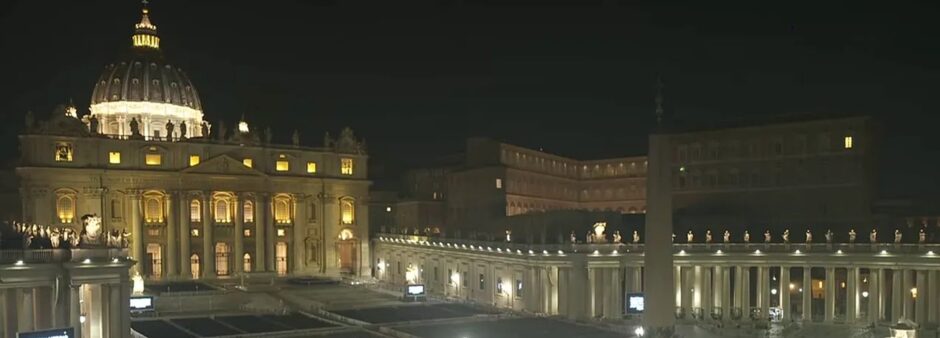
"Yesterday’s technology tomorrow!"

Posted in SESSIUNCULA |
29 Comments