Usually when I received an e-mail that contains only a link, without other comments, I just delete the e-mail and move on. But I am glad that I opened this one.
A reader alerted me to the following from a Catholic newspaper in Ireland called Alive. My comments and emphases:
Bishop tells students: challenge false teachings
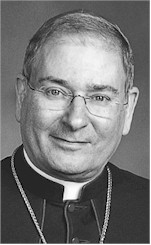
Cork-born Bishop Patrick O’Donoghue urged Catholic students at Oxford University to have “an enquiring fidelity” [Faith seeks understanding.] to the teaching of the Church and to abandon “the fictions foisted on us by some clergy, religious and laity who are disobedient and arrogant in their will-to-power.” [I am glad he included clergy and religious.]
It was, for him, he said, a “great joy” being part of a Church “that has left behind the ghetto and the siege mentality,” [When was the Church in a ‘ghetto’ mentality?] in order to “proclaim to the world the liberating power of Christ’s Gospel.”
But he was distressed by “the pathetic situation of catechetics in this country, and the extent of ignorance and apostasy among generations of Catholics since the Vatican Council.” [My! Not holding back. But he is dead right. Do you remember not long after Pope Benedict took over, he had an ad limina with the, I think, Swiss bishops in which he left his prepared text and hammered the issue of bad catechetics?]
The UK’s most outspoken bishop, he regretted “the diminishment of the Catholic understanding of sin, man’s need for redemption, the sacrificial nature of the Mass.”
This had led to “the virtual abandonment of Confession, the marginalisation of devotion to Mary, the intercession of the saints, and adoration of the Blessed sacrament.” [And he is a bishop in the UK?]
The bishop is the author of the 2-part plan for renewal called Fit for Mission? Schools and Fit for Mission? Church [sic] which has created a stir not just in Britain but around the English-speaking world.
He believed that full renewal will only happen when Catholics, particularly leaders in “schools, seminaries, parishes, and dioceses,” stop obstructing the authentic implementation of the Council and “positively engage with it.” [But… in continuity with the Church’s centuries of tradition, not in rupture as if Vatican 2 were the only possible departure point.]
Another problem for the Church is the way “the secular mindset has gained a foothold in the lives of many Catholics, clergy and laity.” [This sounds a little like Pope Benedict’s comments at Corpus Christi. Benedict has been dealing with this question for a long time.]
It is seen in “a certain scepticism or embarrassed reserve about the supernatural dimension of the Faith.” [Because many of them have truly become modernists, who seek to reduce the supernatural to the natural.]
This has led to essential Church doctrines being downplayed: the divinity of Christ, the Real Presence, the Trinity, the Immaculate Conception.
“These bedrocks of the faith are either ignored or passed over quickly as unintelligible, irrelevant to our young people,” he told the Newman Society. [At Oxford. I spoke to them once. A GREAT group!]
Many Catholics cannot get beyond the human. “We have clergy and laity criticising the Church as if she were only a human institution, not one that originates in the divine will,” he said, while “Christianity is reduced to an agency for the social betterment of mankind.” [Right! The late Malachi Martin, for all of his oddities, drilled into this in his book Windswept House as did Michael O’Brien in Father Elijah and other books.]
The bishop gave a list of recommendations to the students, urging them to “embrace sacrifice as the hallmark of our lives and our spirituality.”
He invited them to “re-discover the devotions of the Church, such as praying the rosary, the Stations of the Cross, Benediction and regular confession. The Holy Father goes every week, so why not us also.”
He asked them to [This is good:] “start from the assumption” that the Church has good reasons for what she teaches, and to “search out those reasons” in the Scriptures and the Catechism. [Fides quaerens intellectum!]
[Bless this man.] A Catholic who says or teaches anything contrary to Church teaching should be politely but firmly challenged, “be they a lay catechist, teacher, deacon, priest or even a bishop.” [More on this below.]
The students should take seriously the teaching “that you have a totally unique, immortal soul directly created by God, that when you die you will experience purgatory, and heaven, or hell.” [He said the H-WORD!]
And they should “reject that wrong-headed view that dominates theology and New Testament studies that Jesus did not know himself to be the divine, the incarnate Son of God.” [There are some people who really do propose this modern take on adoptionism.]
High WDTPRS kudos to Bp. O’Donoghue!
I believe this is the bishop people have nickname "POD".
About his comment on challenging those who err….
Sometimes the errors people make are obvious. Nevertheless, one must be civil when addressing them.
In 1 Peter 3:16 we read that we should always be ready to give reasons for the hope that is in us, doing so with gentleness and charity.
Therefore, we have to know our Faith. Then we have to have charity, sacrificial love that desires the true good of others.
About the correction. St. Augustine wrote about a rare type of person in the Church who, not being a bishop or even a priest, may nevertheless teach and even correct a bishop. This is the homo spiritalis, a person of great holiness and helped with many graces. This is a rare figure to be sure.
I think it is necessary not to fall into the trap of assuming that you are one of them.
Learn your Faith well. I am talking about the Faith in which we believe. There is also the Faith by which we believe which is the theological virtue. They are connected, but distinct. We can learn many things on an intellectual level, but there is the other sort of understanding as well. In both cases we must seek understanding with humility. True faith seeks understanding. So, "being right" or "winning" is not ultimately the goal of a challenge. Truth and the true good of others must be the goal.



 Keep in mind…
 Text and photo from a reader with my emphases and comments:













 Fr. John Zuhlsdorf on Pope Leo XIV airplane interview: remarks about relaxing Traditional Latin Mass restrictions: “NB: Some of you might have a tendency immediately to get frothy about this. Keep in mind that we’ve been…”




























