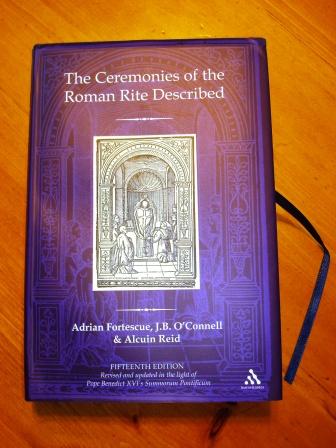
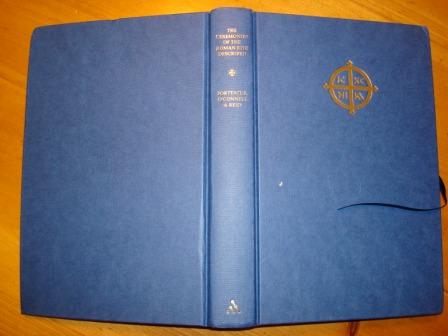
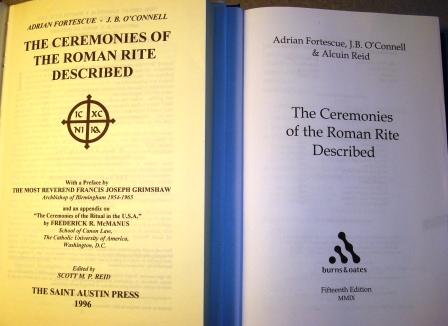
 I received a copy of the new, updated edition of The Ceremonies of the Roman Rite Described by Adrian Fortescue, J.B. O’Connell & Alcuin Reid. Burns and Oates / Continuum, 2009, 496 pp.
This is the "Fifteenth Edition: Revised and Updated in the light of Pope Benedict XVI’s Summorum Pontificum"
The bottom line: people who are really interested in the Roman Church’s liturgy, people who want to "Say the Black and Do the Red", in the newer form or the older form, will be able to learn a great deal from this book. It is a rich resource.
Buy it HERE through amazon.com.
It’s list price: $70.00. But it is on sale through Amazon right now before it ships for $51.69 (save $18.31 – 26%)
If you don’t have the previous edition of Fortescue/O’Connell, stick the crowbar into your wallet and do it.
The Cardinal President of the Pontifical Commission "Ecclesia Dei", His Eminence Dario Card. Castrillon Hoyos wrote a short preface. He states, "It is now clear that Catholics have a juridical right to the more ancient liturgical rites, and that parish priests and bishops must accept the petitions and the requests of the faithful who ask for it. This is the express will of the Supreme Pontiff…" (p. 15). Moreover, "all seminaries should provide such training as a matter of course".
This book will be indispensable for that training, as well as for responding, as the Cardinal says, "in a spirit of pastoral generosity and love" in their ministry.
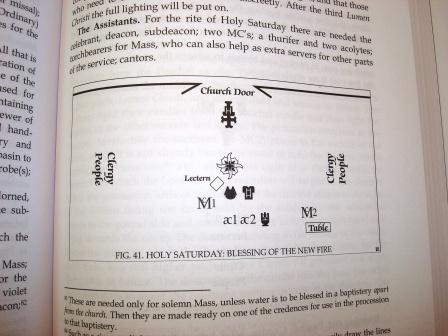
The book has a very useful ribbon marker. The slip cover is very attractive. The binding seems quiet sturdy and meant to last. The good quality paper is a sharp white. The typeface is crisp and updated and the figures are new.
Many people will already have an earlier reprinted edition of Fortescue/O’Connell.
This edition has some additional information not in the previous edition.
First, this edition states that it is, "Revised and updated in the light of Pope Benedict XVI’s Summorum Pontificum".
Summorum Pontificum didn’t make any changes to the older form of Mass and sacraments other than to state that vernacular readings can be used without reading them in Latin beforehand (Intro., p. 17). Reid states that the Pope’s letter accompanying SP envisioned the use of additional prefaces from the newer rite and observance of some saints in the new calendar.
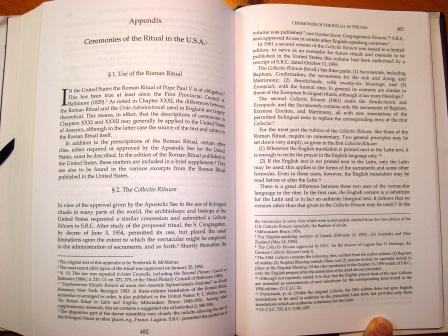
In the introduction Reid raises the question of how we use the older forms of Mass and sacraments given more recent legislation for the Latin Church. What do we do about, for example, girls and women substituting for acolytes, Communion in the hand where approved, EMCHs? He thus proposes principles to follow: pastoral and canonical. In the first place, the Supreme Pastor of the Universal Church’s Motu Proprio is pastoral. Thus, "The salvation of souls may not be served well by imposing liturgical practices on the ancient rites" (p. 18). I think that argument could be used the other way as well. In the second place, since the rites in the older books and older laws are "not readily disentangled" (p. 19), thus "the mens legislatoris is that usus antiquior be celebrated with respect for its integrity, in continuity with its tradition, and not have later – and sometimes controversial – changes imposed on it. The older liturgical books cannot exist in a legal vacuum." With that in mind, throughout the book the references to the 1917 Code are retained and the relevant canons of the 1983 are also given.
He also states that "the date ‘1962’ is arbitrary" (p. 19), and that it necessary to study the value of the reforms in force in 1962. I believe his intent here is to crack the door open for pre-1962 uses which some people put great stock in.
This would be a useful point for study with seminarians in classwork in seminaries when they are being trained in the older rites.
Reid has included some clarifications on questions which have popped up in recent times, such as "whether a layman should act as MC at pontifical ceremonies". Also, the "section on ecclesiastical rank has been rewritten in the light of the prevailing legislation". He also expands some descriptions of things which might have been clear in times past but, in the intervening dark years, have become less so to a younger generation.
One of the areas in which there have been many changes in the Church’s legislation and practice since the Council is in the sphere of sacred liturgical music. A scan of the table of contents reveals the insertion of a new chapter: "XIV. The Music of Solemn and Sung Mass" (p. 169ff) which "draws from O’Connell, The Celebration of Mass (1964)" (p. 169 n. 1). In the note Reid says, "Care must be taken not to use resources created for the usus recentior that do not accord with theliturgical books in force in 1962, howsoever worthy their execution".
"The official music of the Roman Tire is Gregorian Chant" (p. 169). It is "obligatory for Mass in the Roman Rite", and in the Vatican edition of the Graduale Romanum (reproduced in the Liber Usualis).
You can hear in the following an echo of the work of great proponents of Church music such as the late Msgr. Richard Schuler: "All other religious music should have the qualities proper to the sacred liturgy; it must be holy – excluding all that seem trivial or profane. It must have true artistic quality – it must be able to uplift mind and hearts of those who hear it to Almight God and facilitate their contemplation of Him in the liturgical rites. It must be universal in character – suited to the variety of peoples that make up the Church of Christ." (p. 170)
He speaks about polyphonic settings for Ordinary and Proper settings, adding that " vernacular and metrical hymns are excluded during the liturgy proper.
So much for the four hymn sandwich!
Reid speaks to the pace of the singing of the texts by the sacred ministers and presents information on the standard tones for singing prayers and readings and invitations to prayer, etc.
When he gets to "The Use of Musical Instruments" he says, "Whilst the music of the Church is purely vocal and idelly unaccompanied the use of organ is permitted on all Sundays and feast days." Also, "Other instruments may be used when the organ is generally permitted but not on those occasions when the organ is only allowed to accompany. These instruments must not be connected with profane music and all automatic and mechanical instruments are forbidden". I believe it is Reid’s intent to argue against orchestral Masses, but he doesn’t not state that purpose explicitly. Many slippery questions arise when we start talking about sacred and profane connotation of instruments, which can shift – but only slowly – over time. I wonder if many people today don’t associate the pipe organ more with a certain Broadway musical or a ball game than they do with Church. On the other hand, the pipe organ clearly has the power to invoke an association with churches. But in Vienna, perhaps so do violins and trumpets and tympani. A tough topic. The Church’s post-Conciliar legislation provided for flexibility. Had the principles given by Reid – echoing his elders – been embraced and observed, I doubt we would be having this conversation. But – they weren’t. Instead, the idea of sacred music was twisted far from the Church’s true intent and we got rubbish. Perhaps an entrenching is in order. Also, practically speaking, just about any parish could feasibly have a schola but not an orchestra. But I disgress.
In any event, this section gets into what is "more correct" or "less correct" depending on one’s point of view. The prescriptive tone here is wisely relaxed.
Another new aspect of this edition is Chapter XX: The Faithful at Mass, which was effectively a non-issue in the older editions.
Reid has a section of "Rules for the Laity at Mass", a) at a "private" Mass, and b) at Solemn or Sung Mass.
Everyone knows that Summorum Pontificum makes a distinction between "public" and "private" Masses and some bishops have tried to use this as a weapon against the Holy Father’s provisions. Also, since the time of the Liturgical Movement, when more responses from the congregation were invited, people want to know if it is okay to sing or speak during Mass.
For Reid, a "private Mass" is one not publicly scheduled. There are indications for standing, kneeling, etc. He correctly points out that there are no rubrics for lay people in the older form of the Solemn Mass. The assumption is that they do what the clergy in choir do. He provides these guidelines.
He digs into the "Dialogue Mass" issue (p. 244ff), citing the important 1958 instruction Musica sacra which deals with active participation.
Included in this section is what to do when there are civil dignitaries at the Mass. So, when you have the king or the president at your Mass, you will know how to set up a prie-dieu, what happens if they show up late, what to do at the kiss of peace, etc. I hope the University of Notre-Dame is paying attention…
Reid also mentions the fact that some bishops have sought to restrict the Pope’s norms (p. 18).
This book will make that a lot harder!
If you are a parish priest, a seminarian, or involved in the training and execution of worship in any way in your parish or institution, you should have this book. You would not make a mistake in giving it as a gift to the same.
Buy it HERE through amazon.com.


 in the older books and older laws are "not readily disentangled" (p. 19), thus "the mens legislatoris is that usus antiquior be celebrated with respect for its integrity, in continuity with its tradition, and not have later – and sometimes controversial – changes imposed on it. The older liturgical books cannot exist in a legal vacuum." With that in mind, throughout the book the references to the 1917 Code are retained and the relevant canons of the 1983 are also given.
 n the sphere of sacred liturgical music. A scan of the table of contents reveals the insertion of a new chapter: "XIV. The Music of Solemn and Sung Mass" (p. 169ff) which "draws from O’Connell, The Celebration of Mass (1964)" (p. 169 n. 1). In the note Reid says, "Care must be taken not to use resources created for the usus recentior that do not accord with theliturgical books in force in 1962, howsoever worthy their execution".

 th profane music and all automatic and mechanical instruments are forbidden". I believe it is Reid’s intent to argue against orchestral Masses, but he doesn’t not state that purpose explicitly. Many slippery questions arise when we start talking about sacred and profane connotation of instruments, which can shift – but only slowly – over time. I wonder if many people today don’t associate the pipe organ more with a certain Broadway musical or a ball game than they do with Church. On the other hand, the pipe organ clearly has the power to invoke an association with churches. But in Vienna, perhaps so do violins and trumpets and tympani. A tough topic. The Church’s post-Conciliar legislation provided for flexibility. Had the principles given by Reid – echoing his elders – been embraced and observed, I doubt we would be having this conversation. But – they weren’t. Instead, the idea of sacred music was twisted far from the Church’s true intent and we got rubbish. Perhaps an entrenching is in order. Also, practically speaking, just about any parish could feasibly have a schola but not an orchestra. But I disgress.



 mibethda on Pope Leo XIV airplane interview: remarks about relaxing Traditional Latin Mass restrictions: “The prime rationale underlying Traditionis Custodes and the restriction of the Vetus Ordo Missae as declared by Pope Francis, Cardinal…”




























