Archbp. Burke on Kathleen Sabelius

This is on the website of Catholic Action for Faith and Family:

Archbishop Raymond L. Burke Discusses the Canonical and pastoral Aspects of Archbishop Joseph Naumann’s Public Reprimand of Governor Kathleen Sebelius and Her Nomination as Secretary of Health and Human Services 

Some emphases in the original (questions).

        “As a Roman Catholic, her appointment is the source of the greatest embarrassment because she has publicly and repeatedly betrayed her Catholic faith…”

                                               Archbishop Raymond L. Burke

Catholic Action for Faith and Family

March 10, 2009

Interviewed by Thomas J. McKenna

Your Excellency:

The Governor of Kansas, Kathleen Sebelius, has a long history of supporting abortion rights while holding public office. As a result of her actions, last year the Archbishop of Kansas City, Archbishop Joseph Naumann, publicly requested that she refrain from receiving Holy Communion because of public scandal she was giving. As her bishop he first carried out a prolonged dialogue with her over many months where he tried to reason with her and make her aware of the seriousness of her actions supporting abortion.

Last week President Obama nominated Governor Sebelius to serve as Secretary of Health and Human Services. Archbishop Naumann, as well as many prominent Pro-life organizations across the country, is decrying the appointment as being detrimental to the Catholic and Pro-life causes in the United States.

Is Your Excellency aware of this controversy?

Yes, I am quite aware of the case of Governor Sebelius. She is well known for her support of the right to procured abortion and for her public association with some of the more notorious agents of the culture of death. She has also favored other anti-life legislation, especially legislation which denies the right to life to the innocent and defenseless unborn.

What is your opinion of her appointment to this influential position?

Her appointment saddens me on several scores. First of all, it is sad for our nation to have a person who favors the right to kill the unborn in the womb placed in charge of the federal office with responsibility for health and human services. No matter how good Governor Sebelius’ record regarding other human life concerns may be, if she is not committed to the safeguarding of human life from its very inception, she should not be entrusted with the questions of health and human services for our nation.

As a Roman Catholic, her appointment is the source of the greatest embarrassment because she has publicly and repeatedly betrayed her Catholic faith, in the most fundamental tenet in the most fundamental tenet of the moral law, that is, the law to safeguard and foster human life from the moment of its inception to the moment of natural death. What is more, she has obstinately remained in her moral error after being admonished by, at least, three of her Bishops, including her present Bishop, Archbishop Joseph F. Naumann of Kansas City in Kansas. Her position on the question of procured abortion is the source of the greatest scandal to Catholics and to all who uphold the natural moral law. 

In your opinion did Archbishop Naumann proceed in accordance with canon law?

Archbishop Naumann proceeded in perfect accord with Canon Law and the sound pastoral practice it embodies. He steadfastly tried to help Governor Sebelius recognize her grave error and to correct herself. When she refused to do so, he had no choice but to remind her that the Church’s discipline requires that persons who publicly and obstinately remain in serious sin must be denied Holy Communion. When the Governor did not respect the Archbishop’s instruction that she not present herself to receive Holy Communion, he was obliged to make it public that the Governor had been instructed not to present herself to receive Holy Communion. Archbishop Naumann acted with exemplary pastoral charity in the matter, protecting the Body and Blood of Christ from unworthy reception, preventing the Governor from the commission of the most serious sin of sacrilege, and ending the great scandal caused by the Governor’s unworthy reception of the Body and Blood of Christ.  

Under these circumstances was he justified in asking her to refrain from receiving Holy Communion and do you believe this was a pastoral approach?

Not only was Archbishop Naumann justified, he was fulfilling one of his most solemn duties as a pastor, namely, the care of the Most Blessed Sacrament and of the worthy reception of Holy Communion. As I mentioned above, his action, in my judgment, could not have been more pastorally correct. He has spoken the truth with love. More than that cannot be asked of any shepherd of the flock.

If Governor Sebelius was to be confirmed as Health and Human Services secretary and move to Washington D. C., would the Archbishop of Washington or any surrounding diocese where she might take up residency, be obliged to enforce in their diocese the sanction imposed by her bishop in Kansas?

To be accurate, Archbishop Naumann did not impose a sanction upon Governor Sebelius. He simply made clear her canonical status in regards to reception of Holy Communion anywhere.  No Catholic who publicly and obstinately remains in serious sin can receive Holy Communion.  For her sake and for the sake of the Church, Archbishop Naumann made clear that Governor Sebelius is in the condition of unworthiness to receive Holy Communion, until she reforms her public actions regarding procured abortion.

As I said above, Archbishop Naumann only did what was his duty as Bishop. Every Bishop is held to the same universal Church discipline which has been in force since the time of Saint Paul the Apostle and is stated in canon 915 of the Code of Canon Law.  Whether Governor Sebelius is in the Archdiocese of Kansas City in Kansas, or in any other diocese, she should not present herself for Holy Communion because, after pastoral admonition, she obstinately persists in serious sin.
Posted in SESSIUNCULA |
15 Comments

Card. Ruini on the Holy Father’s Letter- very good

The 14 March number of L’Osservatore Romano is on the stands.  It comes out around 1700 in Rome the day before.  In this issue, the former Vicar of Rome, His Eminence Camillo Card. Ruini, speaks his piece about the Holy Father’s Letter about the SSPX excommunications and what he has seen going on.

To my mind, few men in Rome are in closer harmony with the thought of Benedict XVI than Card. Ruini.  Would that he were younger.

Here is the last part of Card. Ruini’s article in my translation and emphases:

Within the supreme priority of God one finds immediately placed the priority of love and of communion between ouselves: in concrete terms the prioty of unity of believers in Christ and the priority of peace among men.

From this the suffering Benedict XVI does not hide in the face of inclinations to "bite and devour one another" unfortunately today present among us as it was amongst the Galatians to whom St. Paul wrote.

We touch here a raw nerve of Catholicism of the last centuries, fraglie point of suffering of which we must become more and better aware.  I refer to the weakening, and at times nearly extingushing of a sense of ecclesial belongning, thus of the joy and of gratitude of being part of the Catholic Church.  This isn’t something secondary or minor, which should be rightly give way before out individual liberty and our personal relationship with God, or also before many other affiliations which seem more concrete and more gratifying.

It is necessary, instead, to rebuild within us that conviction of faith which characterized Christianity from its very beginning, according to which the sense of the Church is an essential element of our belonging to Christ.  Here are the roots of the reception of the Magisterium of the Church and the exertion to conform our lives to its teachings, but also an attitude which embraces the sphere of feelings and which is translated spontaneously into a love for those who in the faith are fathers and brothers. ["padri e fratelli"]  If these sentiments will be lived in us, we will remain far from the bitter taste of finding fault in our presumed adversary, who in reality is our brother, which alas emerge in many words, gestures or silences, as the Pope’s letter, with honesty and suffering, helps us to understand.

Posted in SESSIUNCULA |
3 Comments

UK Bishops’ Conference statement-summary of the Pope’s Letter

The Bishops’ Conference of England and Wales issued a statement-summary of the Holy Father’s Letter on the SSPX excommunications.

Read this and assess whether it is a true statement of the context of the Pope’s Letter.

12/03/2009

Press release

Issued by the Catholic Communications Network
Letter from Pope Benedict XVI concerning the remission of the excommunication of the four Bishops consecrated by Archbishop Lefebvre

His Holiness Pope Benedict XVI has sent a letter to the Bishops of the Catholic Church concerning the remission of the excommunication of the four Bishops consecrated by Archbishop Lefebvre.

Statement from the Catholic Bishops’ Conference of England and Wales:

“The Pope’s letter is a collegial act to the Bishops of the Catholic Church. In a deeply humble letter, the Pope explains his decision to lift the excommunications of the four Bishops consecrated by Archbishop Lefebvre and offers a heartfelt apology for the mistakes made and the unintended consequences of that decision. He thanks ‘our Jewish friends’ for quickly helping to clear up the misunderstanding and to restore the friendship and trust that has existed throughout his pontificate and that of John-Paul II.

“The Pope expresses his strong commitment to inter-religious dialogue, especially with those of the Jewish faith and ecumenical dialogue with other Christians. He reveals his passion for reconciliation and in a rallying call to all in the Church to give better witness, the Pope emphasises that the fundamental priority of the Church is to lead men and women to God.

“Essential to this task is the need for unity and it is the Petrine Office that is the centre and promoter of the unity of the Church and, as such, a prophetic voice as to how individuals and nations across the world should relate. As part of our Lenten journey the Pope calls on all of us to put our trust in the Lord who protects us and guides our steps along the way to peace.”

Posted in SESSIUNCULA |
Comments Off on UK Bishops’ Conference statement-summary of the Pope’s Letter

Connecticut Senate Judiciary Committee: “Death with Dignity” Act

From a reader:

After all of the hubbub of this past week, I learned that this morning, the Connecticut Senate Judiciary Committee has raised Senate Bill 1138, or the "Death with Dignity" Act.  The bill is basically an assisted suicide bill.

Text of the legislation is available here

Posted in SESSIUNCULA |
14 Comments

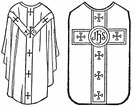
POLL: chasubles

POLL: chasublesWhile the texts and gestures of Holy Mass are fixed in the official liturgical books, many other elements of the sacred action may be adapted to circumstances, cultures and customs.


We have great, though not unlimited, freedom with music, architecture, vessels and vestments.

Consider, for example, the various shapes of the vestment the priest wears during Holy Mass: the chasuble. 

There are the fuller "gothic" style and its many variations, the "Roman" style and its multiple alterations.  They can be full, long, wide narrow, elaborate or simple.  But all are possible for Holy Mass.

The Church has from time to time designated preferences among the vessels, but flexibility was always recognized.  Today, we are not restricted by law to any particular style of vestments, though law does require a chasuble to be worn, when one is available, by the priest celebrant.

What is your preference and your reasons for your preference?

POLL CLOSED

Which style of priest’s chasuble do you prefer?

  • "Roman" and its variants (narrower and more open) (55%, 940 Votes)
  • "Gothic" and its variants (full and draping) (45%, 770 Votes)

Total Voters: 1,710

Posted in POLLS |
60 Comments

Weigel on the Pope’s Letter: getting it wrong in an important detail

George Weigel has predictably chimed in on the Pope’s Letter about the lifting of the SSPX excommunications.  He wrote on the site of National Review.

My emphases and comments.

March 12, 2009, 0:00 p.m.

Pope Benedict Explains — and Challenges
His March 10 letter reveals a man of exquisite manners and deep pastoral sensitivity.

By George Weigel

One wishes that Pope Benedict XVI’s letter to the world’s Catholic bishops on the controversy surrounding the lifting of the excommunications of four dissident Lefebvrist bishops — which was dated March 10 and released publicly today — had not been necessary. Benedict was badly served by the Curia in this affair. A different kind of man and a different kind of pope might have been inclined to take the Olympian view and simply ignore the firestorm caused by the fact that one of the Lefebvrists, an international crank named Richard Williamson, was a longtime Jew-baiter who had recently indulged in the most grotesque form of holocaust denial. For all that the world media’s Rottweiler Brigade has been nipping at his heels ever  since the Lefebvrist storm broke, [longer] however, Benedict XVI is not that kind of man, and he’s not that kind of pope. He is, in fact, a man of exquisite manners and deep pastoral sensitivity, who knew that something unprecedented was required of him to set things aright. Both of those qualities are amply displayed in his letter.

[So far so good.]
 
The letter makes several crucial points. 
 
The pope candidly acknowledges that what he had intended as a gesture of mercy backfired badly [Well… the story isn’t over yet.  It hasn’t backfired until it has failed, which is by no means the case yet.] : “A gesture of reconciliation with an ecclesial group engaged in a process of separation . . . turned into its very antithesis: an apparent [apparent is the key here] step backwards with regard to all the steps of reconciliation between Christians and Jews taken since the council — steps which my own work as a theologian had sought from the beginning to take part in and support.” 
 
The pope further acknowledged that this fiasco was in part the fault of inept work by the Curia, and that it was “our Jewish friends who quickly helped to clear up the misunderstanding and to restore [an] atmosphere of friendship and trust. . . .”
 
As for ensuring against such problems in the future, the pope made the necessary bureaucratic move: [Weigel now assumes that the PCED is to be blamed and that the Pope blames the PCED for the "fiasco".] the Ecclesia Dei Commission, established as an independent agency by John Paul II afer [sic] the Lefebrvist [sic] schism in 1988, and charged with reconciling Levebvrists [sic] and others who wanted to return to full communion, has been [will be, I believe, not "has been", or am I missing something?] put under the authority of the Congregation for the Doctrine of the Faith. There will be no more free-lancing [interesting… an image also used by John Thavis of CNS… ] from Ecclesia Dei, which had become a loose cannon careening around the ecclesial deck.  [Do you accept the premise that the PCED was a loose cannon?  I don’t.  Perhaps this is simple prejudice on the part of the writer.  Instead, I think that the Card. Castrilon did in fact in the main keep Pope Benedict informed about the over all vector of his pursuits.]
 
The reining in of Ecclesia Dei and its subordination to the Catholic Church’s principal doctrinal office also sends an important signal to the Levebvrist leadership, which has continued to insist throughout this affair that it represents “the Tradition” (always capitalized) and that it continues to have the gravest doubts about the Second Vatican Council’s teaching on religious freedom, [Which itself is not sinful, I think.] on the nature of the Church, [Does the SSPX have doubts about the "nature of the Church"?  I can think of a few progressivists who do, but I thought the SSPX was pretty clear about the nature of the Church. Therein lies part of the conflict with many in the mainstream.  Or am I getting this wrong?] and on the Church’s relationship with other religious communities. [Again… I think the SSPX has a few doubts on this score.  But, what seems to be going on here is that the writer is painting the SSPX with a very broad brush indeed, and in the colors he chooses, rather than those which accurately depict it.] Benedict XVI’s letter makes clear that, while he recognizes that most of the Lefbvrist [sic] faithful couldn’t care less about Catholic church-state theory and simply want to worship in the manner of their grandparents, [Does the Holy Father recognize this in the Letter?  Surely it is true, but is that in the Letter?] he also understands that the leadership of the Society of St. Pius X [SSPX], which is the embodiment of the Lefebvrist [sic] movement, tilts toward forms of doctrinal dissent more typically found on the Catholic Left. [This is left unexplained by Weigel, but it may be in some way true.  I have mused about this possibility elsewhere.] The unmistakable implication is that there will be no reconciliation or restoration of full communion until the Lefebvrist leadership acknowledges Vatican II as an authentic expression of Catholic faith. One might suggest that this process would be advanced were the leadership of the SSPX to cease referring to itself as the incarnation of “the Tradition,” [Yes, that is annoying and unhelpful.] as if it were the rest of the Catholic Church that went into schism in 1988.

At the same time, the pope’s letter reminds Catholic progressives that Catholicism did not begin at Vatican II, or even begin anew at Vatican II. The Council’s documents have to be read in the light of 2,000 years of Christian tradition, not read against that tradition. The Church began with the Paschal Mystery of Christ’s suffering, death, and resurrection, which Christians will celebrate one month from now on Good Friday and Easter; the Church did not begin on December 7, 1965, when Paul VI promulgated the “Pastoral Constitution on the Church in the Modern World.”
 
The papal letter also includes a powerful plea to Catholics to re-focus on the real issues of the day: “In our days, when in vast areas of the world the faith is in danger of dying out like a flame which no longer has fuel, the overriding priority [for everyone in the Church] is to make God present in this world and to show men and women the way to God. Not just any god, but the God who spoke on Sinai . . . that God whose face we recognize . . . in Jesus Christ, crucified and risen. The real problem at this moment of our history is that God is disappearing from the human horizon, and with the dimming of the light which comes from God, humanity is losing its bearings, with increasingly evident destructive effects.” Thus the pope puts into the proper context the problems posed by both the Lefebvrist schism [Note that in the Letter, the Holy Father speaks of "danger" of schism, not its fact.  Also, Card. Castrillon, presently the favorite scapegoat, has been saying what the Holy Father said: there is danger of schism.  Now… believe me… I am a strong proponent of the duck argument in these matters.  But when I hear more than once from the President of the PCED and now the Pope a particular manner of speaking of the SSPX and schism, I tend to accept it more easily.  But "Lefebvrist" is spelled correctly here.  Read on, however…] and the psychological schism in which some Catholic progressives live [NB: I am willing to accept "psychological schism" on both sides, but at this time not the implication that the SSPX is in formal schism.] — both forms of schism [problem: I don’t think there are twor forms of schism at work here.  Weigel suggests that there are similarities between the progressivists’s errors and those of members of the SSPX.  Fine.  I think his train of thought derails with the implication of a formal schism on the part of the SSPX.  Also, I would ask: If there is a schism on both sides, which side would really be harder to reconcile?  The SSPX or the progressivists.  I think we are talking about very different attitudes, all in all.  Simply to place them on opposite extremes isn’t quite right.] impede the evangelical mission of the Church at a moment when that mission has acquired a new urgency. [If I am not mistaken, the Holy Father in his Letter implies that the SSPX members, once reconciled, have something positive to contribute.  I don’t get that same sense from the contributions of the other type of rupture Catholics.]
 
It remains to be seen whether Benedict XVI will now take in hand a reform of the personnel and practices of the Roman Curia, which is essential if the evangelical brilliance of this pontificate is to fulfill its great potential. [That is fair.  A change in personel is very much needed.  I think Rodari’s assessments are useful in understanding this.] For the moment, however, the Rottweiler Brigade [and ironic and nice turn of phrase, considering that Papa Ratzinger for a long time was contunamciously nick-named "God’s Rottweiler".] has been put in its place; a major flaw in the Roman bureaucracy has been fixed; the Church has been reminded of the dynamic relationship between tradition and development in Catholic self-understanding; Catholics living in both formal and informal schism [there it is again… the wrong move that undermines Weigel’s argument] have been told, politely but firmly, that they are impeding the Church’s mission; the psychological path has been cleared for a successful papal pilgrimage to the Holy Land in May; and, as Jews approach Passover and Christians approach Easter, both have been reminded that their inevitable entanglement is of the will of God, as St. Paul tried to explain to the Romans two millennia ago. That’s accomplishment enough for one letter. 
 
— George Weigel is distinguished senior fellow at the Ethics and Public Policy Center, where he holds the William E. Simon Chair in Catholic Studies. 

The piece has marks of haste, including the typos we who work under stress often slip into with the willing pushes of Titivillus.

I sense at the back of this both haste – and therefore a not entirely well-considered argument –  and a measure of intolerance.  Am I being unfair if I wonder if Mr. Weigel is harder on the "rupture" that comes from lack of continuity with the present and future than he is on the rupture that comes from lack of continuity with the past?

Posted in SESSIUNCULA |
79 Comments

South African update

An update on the dust-up in South Africa over the use of the new English translation of the Missale Romanum… this was forwarded to me from a reader.  It is a note by the Secretary General of the South African Bishops’ Conference as sent by the Information Officer of the same:

The Congregation for Divine Worship and the Discipline of the Sacraments has accepted the explanation by the President of the Southern African Catholic Bishops’ Conference regarding the early implementation of the new translation in English of the People’s parts of the Roman Missal.

The Congregation has agreed that the implementation continue along with continued catechesis explaining the changes. This catechesis should include preparation of music for singing the new texts.

The other approved texts of the mass (e.g. the Eucharistic Prayers) will be implemented when the rest of the English Speaking world implements the changes.

A fuller statement may be issued by the President on his return from Rome.

Fr Vincent Brennan SMA
Secretary General

_____

Fr Chris Townsend
Information Officer of the Southern African Catholic Bishops Conference.
Southern African Catholic Bishops’ Conference (SACBC
…

www.sacbc.org.za

Posted in SESSIUNCULA |
8 Comments

Where you are

I am always fascinated to see the places people are when they visit the blog.  These are not always perfectly accurate, of course.  Sometimes only areas are registered.  Still…

I cut out all the "Unknown" and vague entries such as "Canada".

Here is a snapshop of a few minutes of visits.

Amazing… how we can network across the globe in the blink of an eye.

Saint Mary, Missouri
Halifax, Nova Scotia
Absecon, New Jersey
Baltimore, Maryland
London, London, City of
Winter Park, Florida
Cleveland, Ohio
Ozone Park, New York
Tunapuna, Saint George
Uncasville, Connecticut
Boones Mill, Virginia
Ozone Park, New York
New York
Detroit, Michigan
Deep River, Connecticut
Pretoria, Gauteng
Buffalo, New York
Pittsburgh, Pennsylvania
Glasgow, Glasgow City
Toronto, Ontario
Chicago, Illinois
Fargo, North Dakota
San Fernando, Pampanga
Miami, Florida
Sydney, New South Wales
Cebu, Cebu City
Dublin
Aurich, Niedersachsen
Vankleek Hill, Ontario
Houston, Texas
Portland, Oregon
Milwaukee, Wisconsin
Grand Rapids, Michigan
Riverdale, Georgia
Naperville, Illinois
Makati, Rizal
Lake Mary, Florida
Ft Mitchell, Kentucky
Kansas City, Missouri
Traverse City, Michigan
South Bend, Indiana
Dallas, Texas
Cape Coral, Florida
Perryville, Missouri
Woodbridge, Virginia
Largo, Florida
Manchester
Warrenton, Virginia
Australia
Ratisbon, Bayern
Tacoma, Washington
Hemel Hempstead, Hertford
Yonkers, New York
Oxford, Connecticut
Washington, District of…
Berlin
Munich, Bayern
Slough
Mc Lean, Virginia
Macon, Georgia
Columbia, South Carolina
New City, New York
Jacksonville, Florida
Oxford, Oxfordshire
Orlando, Florida
Santiago, Region Metrop…
Cape Coral, Florida
Wellington
Andernach, Rheinland-Pf…
Baton Rouge, Louisiana
Brighton, East Sussex
Stratford, Wisconsin
Bronx, New York
Glenrock, Wyoming
West Monroe, New York
La Crosse, Wisconsin
London, London, City of
Moulineaux, Haute-Norma…
Burke, Virginia
Makati, Rizal
Newark, New Jersey
Orland Park, Illinois
Anderson, South Carolina
Basel, Basel-Stadt
Mount Kisco, New York
Weston, Connecticut
Chattanooga, Tennessee
East Providence, Rhode …
Saint Louis, Missouri
Sidney, Nebraska
Philadelphia, Pennsylva…
Portland, Oregon
Manchester
Lexington, Virginia
Moscow, Moscow City
Rijeka, Primorsko-Goran…
Hagerstown, Maryland
Brussels, Brussels Hoof…
Winston Salem, North Ca…
Bethpage, Tennessee
Morwell, Victoria
Upperville, Virginia
Aguascalientes
Washington, District of…
Rocklin, California
Bakersfield, California
Madrid
Lafayette, Colorado
Newburgh, New York
Hartford, Connecticut
Melbourne, Victoria
Brooklyn, New York
Buenos Aires, Distrito …
Geneseo, New York
New Haven, Connecticut
Leominster, Massachusetts
Jacksonville, Florida
Wellesley Hills, Massac…
London, London, City of
Sydney, New South Wales
Cedar Grove, New Jersey
York
Keller, Texas
Rome, Lazio
Vantaa, Southern Finland
Cologne, Nordrhein-West…
Jacksonville, Florida
Staten Island, New York
Oakham, Rutland
Melbourne, Florida
Pittsburgh, Pennsylvania
Clarendon Hills, Illinois
New York
Madrid
Brighton, East Sussex
Alexandria, Virginia
Bergen, Hordaland
High Wycombe, Buckingha…
Dublin
Reading
Mc Rae, Arkansas
Sydney, New South Wales
Fairfield, Ohio
Cleveland, Ohio
Leasburg, Missouri
London, London, City of
Dublin
Washington, District of…
Manassas, Virginia
Spring, Texas
Chesterfield, Derbyshire
Melrose, Massachusetts
Cambridge, Cambridgeshire
Wallingford, Connecticut
Stratford, Wisconsin
Dallas, Texas
Fitjar, Hordaland
Philadelphia, Pennsylva…
Minneapolis, Minnesota
Birmingham, Alabama
Bombay, Maharashtra
Fitjar, Hordaland
Philadelphia, Pennsylva…
Minneapolis, Minnesota
Birmingham, Alabama
Bombay, Maharashtra
Solihull
London, London, City of
Rome, Lazio
Brainerd, Minnesota

Posted in SESSIUNCULA |
59 Comments

Benedict XVI to Plenary of the CDWDS

The Holy Father lately addressed the Plenary Meeting of the Congregation for Divine Worship and Discipline of the Sacraments.

The address is on the Vatican website. 

However, … a friend sent this:

thought you’d be interested. Reports all fail to quote a couple of passages of the latest address of the Holy Father to CDWDS, which sound rather interesting in these days’ context:

[…]Therefore, I welcomed with pleasure your proposal that the Plenary assembly dedicated itself to the subject of eucharistic adoration, with the confidence that a renewed collegial reflection on this practice could contribute to clarify – within the limits of the competence of the Dicastery – the liturgical and pastoral means with which the Church of our time can promote the faith in the Real Presence of the Lord and to guarantee the full dimension of adoration in the celebration of the Holy Mass. I underlined this aspect in the Apostolic Exhortation Sacramentum Caritatis where I[…], to stress the importance of the intrinsic relation between the celebration of the Eucharist and adoration (n. 66), cited the teaching of St. Augustine "Nemo autem illam carnem manducat, nisi prius adoraverit; peccemus non adorando" (Enarrationes in Psalmos, 98, 9: CCL 39, 1385). The Synodal Fathers did not fail to express their concern for a certain confusion that was generated – following the Second Vatican Council – as regards the relationship between Mass and adoration of the Most Holy Sacrament (SC 66). This echoed what my Predecessor, Pope John Paul II, had already said about the deviations which at times tampered with (literally inquinato = polluted) the post-conciliar liturgical renewal, revealing "an extremely reductive understanding of the Eucharistic mystery" (Ecclesia de Eucharistia, n. 10).[…]

The Holy Father continues with a succinct but clear reaffirmation of the authentic teachings of the Council and the Popes and concludes:

[..]The doctrine of Transubstantiation of the bread and the wine and of Real Presence are truth of faith already evident in Sacred Scripture and then confirmed by the Fathers of the Church. In this regard, Pope Paul VI reminded that "the Catholic Church has not only always taught, but also lived the faith in the presence of the body and the blood of Christ in the Eucharist, adoring such a great Sacrament always with the cult of latria, which is due only to God"[…]

Posted in SESSIUNCULA |
5 Comments

A reflection on rupture

Let me propose something to think about.

The Holy Father has made his pontificate in part a reflection on continuity. 

This commitment to restore a proper interpretive principle is the fruit of decades of observation and reflection from a unique, privileged vantage point.

Will you stipulate now that "rupture", lack of "continuity" is a bad thing? 

The obvious type of rupture and discontinuity is in the form of a break with the past.  Progressivists see the Council, for example, as a break with the past, a new theological, ecclesiological starting point.  They do great harm by working from this view.  If you take insufficient positive consideration of the past, you work great harm.

Another type of rupture, less obvious, comes from those who defend the past while not taking sufficient account of present progress or the possibility of authentic development without substantive change in doctrine.  Those who freeze the Church and deny the possibility of broadening our theological reflection do great harm.  The world does in fact present new exigencies even if human nature doesn’t "mature" out of its perennial needs – as many progressivists falsely assume.

Rupture from the past.  Rupture from the future.

Rupture from the future is easier to correct.  Rupture from the past is the more dangerous.

After all, it is part of the warp and weft of the Church’s nature to tend toward the unchanging, to resist the effects of that which shifts and is never fixed, and to guide the  wider world toward her Lord, who is the same yesterday, today and tomorrow.

Posted in SESSIUNCULA |
62 Comments






















