Connecticut State Legislature introduced bill #1098/2009

This sounds like something directly from a Michael O’Brian novel:

Dear Fr. Z,

The Lord’s peace.   You are going to be one of the first to hear about this.  Nothing like this in the history of the US has ever been proposed as far as I know.

Yesterday, Connecticut Judiciary Committee of the Connecticut State Legislature
introduced bill #1098/2009 that directly attacks the Roman Catholic Church (please see attached copy of it).  Should it pass, the bishop and pastors will be deprived of any administrative, financial and legal power over their parishes. 

The bishops of CT are trying to rally the troops this weekend.  I think your readers, and Catholics all over the US should be concerned.

In Christ,
 
Fr. Greg J. Markey

Fr. Greg J. Markey has been the topic of posts on this blog.

He is pastor of St. Mary’s Church in Norwalk, CT.

Posted in SESSIUNCULA |
157 Comments

QUAERITUR: blessed salt

saltFrom a reader:

Recently a Protestant friend of mine sent me an article you might find interesting about someone hawking “Christian salt.” I don’t know much about the Catholic tradition of blessed salt, except that my mom keeps some near her statue of St. Philomena. The salt in this article is blessed by an Episcopal priest. Apparently the “inventor” dreamed it up as an alternative to the Kosher salt those TV chefs are always talking about.  “An unspecified percentage of the revenue will go toward supporting Christian charities, and if the line proves profitable, Godlewski will attempt to expand the product line with Christian branded rye, pickles and bagels, reports Examiner.com.”
Hmmmm. At best this seems like a tacky attempt at creating a sacramental. At worst, it borders on simony and anti-semitism. What do you think? Is blessed salt a legitimate devotion? Do kosher delis undermine Christian culture?

My comments:

I don’t think this has any anti-Semitic dimension.  Kosher salt is used in cooking.  It has a larger grind, or grain.  It is “kosher” or “koshering” salt, not because it’s kosher in itself but because it is used in the processing of kosher meats.  It usually doesn’t have additives, which is why it is handy in cooking.  It is amazing, by the way, how many different sorts of culinary salt you can get, and how different they taste.

The episcopal priest do what he wants, but the salt is not blessed.  Only someone with valid priestly orders can bless this with constitutive blessings.

But he can commit a sin of scandal by giving the impression of peddling sacred things.

But if he could bless the salt and make it a sacramental, it would be a sacrilege to sell it.

In ancient times (as today) salt was extremely important.  People depended on it for health.  Without the right balance of salt our bodies cannot regulate body moisture properly.  It was precious at times.  The Romans named an important road after salt, the Via Salaria, for salt trade – tied to Rome’s very earliest origins.  Roman soldiers would sometimes be paid in salt, thus “salary” in English.  Think about the upheavals in India when a tax was imposed on salt, and Ghandi led a protest illegally to make salt at the ocean.

Salt is all over Scriptures, from the lot of Lot’s wife to Our Lord calling His disciples the “salt of the earth”.

In the Old Testament God established a covenant of salt with the people.  Cf. Numbers 18:19: “All the firstfruits of the sanctuary which the children of Israel offer to the Lord, I have given to thee and to thy sons and daughters, by a perpetual ordinance. It is a covenant of salt for ever before the Lord, to thee and to thy sons.”  Remember, salt was precious.  When you shared salt with someone, you created a bond between you.

We say that someone is “worth his salt”.  That also means that he is esteemed.  You would invite someone your favor to sit closer to the salt cellar cellar on the table.  You would invite him even to “come a little higher”, as Christ speaks of in the parable in Luke 14:10.

Salt is a sign of a bond, but also of permanence, because salt preserves food and keeps water from getting nasty with algae.  In Leviticus 2:13 God tells the Jews that all their offerings must also have salt.  Salt is, in a sense, something that is irrevocable.

The Lord’s words then about His disciples as being salt, and His warning about salt “losing its flavor”, take on greater meaning.  There is a permanence expected in discipleship.

St. Paul talks about how, when we answer people, our words should be “salty”: “sermo vester semper in gratia sale sit conditus ut sciatis quomodo oporteat vos unicuique respondere… Let your speech be always in grace seasoned with salt: that you may know how you ought to answer every man.”  This means that our words should be engaging, but with more than mere dazzle.  If food is not seasoned with salt, it is boring and we are not getting a necessary nutrient.

Let’s leave the whole low-sodium stuff aside.  Although, that is an interesting metaphor for what happened in liturgy, doctrine and practice in the Church…

In the Church we bless salt and use it for various things.  It is a sacramental.  You can cook with it, of course.  You can also sprinkle it in places as a protection from the attacks of the Enemy.  The Enemy does not like blessed salt!

As in all sacramentals blessing salt is serious business.  Salt is especially serious, however.

You might know that exorcised and blessed salt was used in the rite for blessing water.  The exorcism and blessing for salt is a fearsome thing.

Salt is of those few things actually personally addressed as a creature of God and then exorcised.

Exorcizo te, creatura salis, per Deum + vivum, per Deum + verum, per Deum + sanctum, per Deum, qui te per Eliseum Prophetam in aquam mitti jussit, ut sanaretur sterilitas aquae; ut efficiaris sal exorcizatum in salutem credentium; et sis omnibus sumentibus te sanitas animae et corporis; et effugiat, atque discedat a loco, in quo aspersum fueris, omnis phantasia et nequitia vel versutia diabolicae fraudis, omnisque spiritus immundus, adjuratus per eum qui venturus est judicare vivos et mortuos, et saeculum per ignem.  R. Amen.

O you creature of salt, I purge you of all evil by the living + God, by the true + God, by the holy + God, who commanded by the Prophet Elisha that you be put into water in order that the sterility of the water would be healed: so that you might be rendered a purified salt for the salvation of believers, and so that you might be a healthiness of soul and body to all who consume you, and so that you may put to flight and drive out from a place in which you will have been scattered every phantom and wickedness, and cunning trap of diabolical deceit, and every unclean spirit be solemnly banished by command through Him Who shall come to judge the living and the dead, and the world by fire.  R. Amen.

Holy Church does not kid around in these exorcisms and blessings …. in the older, traditional Rituale Romanum at least.  I will not speak of the newer “Book of Blessings” which is nearly useless and should be entirely scrapped.

Finally… I think it is a profoundly dangerous thing to give the appearance of peddling sacred things.  I would be afraid for that person’s spiritual well-being and ultimate fate.

I think the Enemy would be pleased by this mockery of blessing salt and selling it.
Posted in ASK FATHER Question Box |
49 Comments

Pope Benedict’s fascinating Q&A

My friend Mr. John L. Allen, Jr., the nearly ubiquitous fair-minded columnist for that instrument of dissent, the National Catholic Reporter, has done us a great service in translating and transcribing the Q&A Pope Benedict XVI held with priests of the Diocese of Rome on 26 February.

You can find it here.

Allen’s comments are here.  They are useful.

This Pope is amazing in that he holds these Q&A sessions in different locations and occasions.

I would be interested in your comments about the Q&A.  I won’t reproduce the text here.  Read it there and come back.

Posted in SESSIUNCULA |
22 Comments

WDTPRS: Friday 1st Week of Lent – Post communionem (2002MR)

We continue our project of looking at the Post communions of Lent:

Friday – 1st Week of Lent

This prayer was more or less the Postcommunio on the 1st Sunday in Lent in the 1962MR.  Changes were made.  It is an ancient prayer, however, to be found in various manuscripts of the Gelasian and Gregorian sacramentaries.  The ancient form, however, has libatio for refectio, as does the 1962MR.

POST COMMUNIONEM
Tui nos, Domine, sacramenti refectio sancta restauret,
et, a vetustate purgatos,
in mysterii salutaris faciat transire consortium.

We have seen refectio before, from reficio.  The more ancient prayer had libatio, which is "a drink-offering, libation".  This is found in the Vulgate in the Old Testament in Num 28:24.  Think of Genesis 35 when Jacob poured a drink offering on the pillar he set up.  A libation offering was common to all ancient cultures. 

In Isaiah 53 the "Suffering Servant" pours out his life as a sacrifice.

I think the cutter/snipper experts of the Consilium decided that libatio was not merely too "pagan" in sound, but also too sacrificial.  They chose refectio, an "eating, refeshment".  They chose a "filling" rather than an "emptying".

The older libatio helps us make better sense of the purgatos which follows.

Consortium comes from the preposition cvm (“with”) and sors (“any thing used to determine chances”). Sors is “fate, destiny, chance, fortune, condition, share, part.” It thus means also a “community of goods” and by extension “fellowship, participation, society.” A consortium is a situation in which you have “cast your lot” with a group and with whom you are sharing a common outcome or fate. We hear the word consortium near the end of the Roman Canon when we are praying to have a share in the lot, the reward, of the great martyrs named therein.

The concept of vetustas, which also appeared in our Advent prayers fairly often, refers to the "state of oldness", which pertains to the "old man" afflicted by the sin of our First Parents

LITERAL VERSION:
May the holy refreshment of Your Sacrament restore us, O Lord,
and, let it bring us, having been cleansed of the old state of being,
over into the sharing of the saving mystery.
 

That consortium is hard to get into English with out a circumlocution.  It is meant to convery a sharing of company and condition with others of a similar lot.  In English we sometimes talk about "that lot" or "his lot" to describe a person and the sort of person he is.  In this case it is the company or lot of those whose lot it is to participate in the saving mystery that flows form the Passion and Resurrection of the Lord, sacramentally bestowed on us in the Eucharist. Participate in the Eucharist in the more perfect participation of reception of Communion, and you join the lot of the saved.
 
Daily Missal (Baronius Press, 2007):
May the holy reception of Thy Sacrament, O Lord,
so restore us that we may be purified from our former ways
and join the company of the redeemed.

Posted in LENT, WDTPRS |
Comments Off on WDTPRS: Friday 1st Week of Lent – Post communionem (2002MR)

QUAERITUR: in a bind about eating meat in a Friday in Lent

QUAERITUR: in a bind about eating meat in a Friday in LentFrom a reader:

Yesterday I brought a ham sandwich for lunch.  I had forgotten however that my firm was sponsoring a lunch on that day. It would have been somewhat awkward and unseemly to bring my own lunch to that sponsored lunch.  Eating the sandwich for supper would have been inconsiderate as my wife would have been disappointed had I not enjoyed the meal she prepared.  Certainly I could have planned things better and I take responsibility for that.  I could have for example not eaten the provided lunch and eaten the sandwich at my desk later, but at my office for a variety of reasons that is not so easy to do. So now I am left with the procrustean options of eating a ham sandwich on Friday (I would rather not do that) or throwing the sandwich away as I don’t think it will keep until tomorrow (not a particularly good choice either but preferable from certain perspectives).  What do you think?  Thanks.


The present legislation concerning penance states that you can substitute another form of penance.

The law for the Latin Church says:


Canon 1253  It is for the conference of bishops to determine more precisely the observance of fast and abstinence and to substitute in whole or in part for fast and abstinence other forms of penance, especially works of charity and exercises of piety.


I don’t know what country you are from, your local conference may have established norms concerning abstinence on Fridays of Lent.

Generally, however, if a person who is of the age and heath that he is bound to do the established Lenten Friday penance, including abstinence from meat, for a good reason a person can substitute another penance.

That would require a measure of honesty and a careful assessment of the circumstances.  There are so few obligations placed on Latin Catholics today in this regard.

I will assume from your scenario that you are not in a financial position such that you can responsibly throw away food, which is not good in any case.

Another scenario might be: being invited to a home and being served meat and not wanting to offend or embarrass.

Still, the reason why the Church relaxed the laws on fasting and penance was because we need to make thoughtful decisions about penance and engage in it in a meaningful way.   For some people fasting or abstaining from food really isn’t very hard.  I know a couple people who have to be reminded to eat.  On the other hand, were they away from a, say, radio or other noise maker, or cut off from the internet, they would be hard pressed. 

I am guessing that where you live, you may have the option of substituting a penance.

Finally, your parish priest, the pastor, under canon law has the ability to dispense you from your obligation of abstinence on Friday.  You might give him a call.  He would probably be interested to learn that one of his parishioners wanted to do the right thing.

Posted in "How To..." - Practical Notes, ASK FATHER Question Box |
65 Comments

Rose vestments for sale

I really don’t want to turn this blog into a college campus telephone pole, but this is an attempt at a good deed.

A priest who is in need wrote to say that he wants to sell an "Iberian" style set of rose vestments.

He sent some photos.  They are not the best, but here are a couple.

He has all the pieces, including stole, burse and maniple.

Rose vestments for sale

Rose vestments for sale

If you are interested, drop me a line and I will forward your e-mail.  He is asking $800.  You can work it out with him.  Put IBERIAN VESTMENTS in the subject line so I don’t delete your mail as junk.

Posted in Mail from priests |
Comments Off on Rose vestments for sale

Risible in the City of Angels

Roughly 3000 people have sent me a note about how Card. Mahony of LA has "banned" SSPX Bp. Williamson from the Archdiocese.

It is to laugh.

Posted in SESSIUNCULA |
59 Comments

Return of sparrows and finches

Return of sparrows and finchesNew comers to the feeder.

First, our cardinal is shedding his winter plumage and acquiring his colors again.

Return of sparrows and finches

There are many pairs of doves.

Return of sparrows and finches

The birds must be migrating back to the area.  I have not seen the House Finch since the fall.

Return of sparrows and finches

Return of sparrows and finches

And the sparrows are returning as well.

Return of sparrows and finches

They are literally draining every feeder I have in a single day now.

Return of sparrows and finchesI suspect they are both recovering from migration and also getting ready for nesting.

Yesterday I was out to get more feed.  Feel free to help.

This stuff is more than "tuppence a bag"!

Posted in My View |
13 Comments

A seminarian learns about and is changed by the TLM

Pope Benedict has a vision for the Church.  We must revitalize our Catholic identity.  We must know who we are as Catholics so that we can contribute properly to the public square and shape the world around us according to Christ’s mandate to the Church.

This will impossible without a reinvigorating of the Church’s worship according to a principle of continuity with our tradition and the proper starting points.  Liturgy must be God-centered first and foremost before it can focus on man.

Summorum Pontificum was an important tool in this "Marshall Plan" for the Church.

Young priests will learn more fully about who they are and what Mass is through learning and celebrating also the older form of Holy Mass.  Young people in all walks of life will learn also the older, traditional forms.  They will never be the same thereafter.  They in turn will shape their parishes.

The "Marshall Plan" will be accomplished "brick by brick".

On the site of the Marians of the Immaculate Conception there is an interesting article for the "brick by brick" category.

My emphases and comments.

"A Mass-ive Change: My Experience with the Tridentine Mass"

By Br. Thaddeus Lancton, MIC

Several years ago, in conversations with my father, I remember his voice: "Et cum spiritu tuo we would say to the priests in Latin." Translation: "And with your spirit."  [Immediately this suggests an entirely different theology than what is expressed in "and also with you".]

He would say this in his role as altar server. Today I find myself, like him, an altar server. But unlike my late father, I had never served a Tridentine Mass, the Mass that was codified at the Council of Trent and changed very little in the way it was celebrated until Vatican II, when a new form of the Latin Rite was introduced.

Thanks to Pope Benedict XVI, however, the extraordinary form of the Latin Rite is now available to all!

As my fellow Marians and I were preparing to celebrate the extraordinary form for All Souls’ Day in our chapel in Steubenville, Ohio, I recall perusing the many paintings on our chapel walls. There was Blessed Stanislaus Papczynski (1631-1701), the founder of the Congregation of Marian Fathers of the Immaculate Conception of the Blessed Virgin Mary. There was Blessed George Matulaitis-Matulewicz (1871-1927), the Marian Renovator. And there were the Marian Martyrs of Rosica, Belarus, Blessed George Kaszyra (1904-1943) and Blessed Anthony Leszczewicz (1890-1943).

"This is the form of the Mass that they all celebrated," Fr. John Larson, MIC, remarked.

In our Steubenville house, I have been privileged to altar serve some Low Masses. But on Feb. 1, I was gifted to be the "epistle side" altar server for a High Mass. Once a month at the 4 p.m. Mass on Sundays, Franciscan University of Steubenville asks a priest to celebrate the extraordinary form.

As I served the Mass, I became transfixed on the San Damiano crucifix and the Statue of Mary, our Mother. I realized the dignity of the priest: Fr. John, with whom I eat, pray, and play Uno and Scrabble. There he was, offering the Sacred Body and Precious Blood of Jesus! I am struck by the reverence, attention, and devotion of those who attend. They all have the patience to wait as Fr. John singe handedly distributes Holy Communion to some 200 students.

During the Mass, there is an opportunity for silence. While I love the Novus Ordo, or regular Mass, this silence has taught me how to truly pray the Mass. It has taught me how St. Faustina experienced the Mass, and how the Divine Mercy originally began. As I perused our concordance of St. Faustina’s Diary for the word "Mass," I noticed that many of her visions of Jesus were during the Sacred Liturgy, including:

    June 4 [1937]. Today is the Feast if the Most Sacred Heart of Jesus. During Holy Mass, I was given the knowledge of the Heart of Jesus and of the nature of the fire of love with which He burns for us and of how He is an Ocean of Mercy.

    [March 22, 1937] During Holy Mass, I saw the Lord Jesus nailed upon the cross amidst great torments. A soft moan issued from His Heart. After some time, He said, "I thirst. I thirst for the salvation of souls. Help Me, My daughter, to save souls. Join your sufferings to My Passion and offer them to the heavenly Father for sinners."

The language of this extraordinary form speaks of a mystery, a mystery of mercy. [mystery] While there is less "participation" by the laity, there is much more silence. [I am glad he at least included the ‘ ‘  around ‘participation’.  The fact is that there is in no real sense less participation in the older form of Mass.] In Isaiah 30:15, "For thus the Lord God, the Holy One of Israel, has said, "In repentance and rest you will be saved, in quietness and trust is your strength."

I am learning that during these quiet moments, I should pray with the Holy Spirit, uniting my prayer to the prayer of the priest. Romans 8:26: "In the same way the Spirit also helps our weakness; for we do not know how to pray as we should, but the Spirit Himself intercedes for us with groanings too deep for words …"

Thus, I have learned to truly plead with a loving Savior for the salvation of the world. As I see the Hidden Jesus lifted up by Fr. John, I contemplate what is truly happening: Calvary is being made present. Christ’s love, His Sacred Heart, is being offered by Fr. John to the Father for my own salvation, and the salvation of the entire world.

The shift from the Novus Ordo to this extraordinary form is rather difficult, but I am learning to combine this quiet with the groanings of the Holy Spirit, to truly experience the salvation won for me at Calvary. I am grateful that Fr. John is so interested in learning this form of the Mass, because I am learning to appreciate the Mass in a new way — as a sacrifice. Certainly it is a sacrifice on Christ’s part, but it is a sacrifice of mine, too. When I step into the extraordinary form, I learn to leave my own time and my own concerns. Truly, I learn to rest as the priest says his silent prayers, and I am able to gaze upon Jesus on the Cross. This is not a time to rush, but a time to pray, to beg God for mercy upon us sinners.

"Why?" I ask myself during the Mass. The change is massive on the exterior level, but on an interior level, Christ is the same "yesterday, today, and forever." By experiencing the extraordinary form, I am learning about the ordinary form, and the change from one to the other helps me never to take for granted the wonderful gift of every Mass: the Divine Mercy Himself to us sinners.

Brother Thaddeus Lancton, MIC, is a seminarian living in Steubenville, Ohio.

Posted in Brick by Brick, SESSIUNCULA |
60 Comments

USCCB CDW progress report on the new translation of the Missale Romanum

In the USCCB’s Committee on Divine Worships newsletter for February 2009 there is an update on the status of the new translation of the Missale Romanum now in preparation.

Holy See to Facilitate Expeditious [gotta love it… only a church committee of some kind] Approval for the Roman Missal

The Committee on Divine Worship, at its November 2008 meeting, indicated that the USCCB would complete its review and approval of the texts of the third edition of the Roman Missal by the end of 2010, and noted that once the recognitio was issued by the Congregation for Divine Worship and the Discipline of the Sacraments, publishers would need as much as one year to prepare, publish, and distribute the Roman Missal for use in parishes. On December 15, Francis Cardinal George, O.M.I., USCCB President, received a letter from Antonio Cardinal Cañizares Llovera, Prefect of the Congregation, in which he expressed a desire to facilitate a more expeditious completion of the approval process for the English translation of the Missale Romanum, editio typica tertia, and see the publication of the Roman Missal in English by the end of 2010.

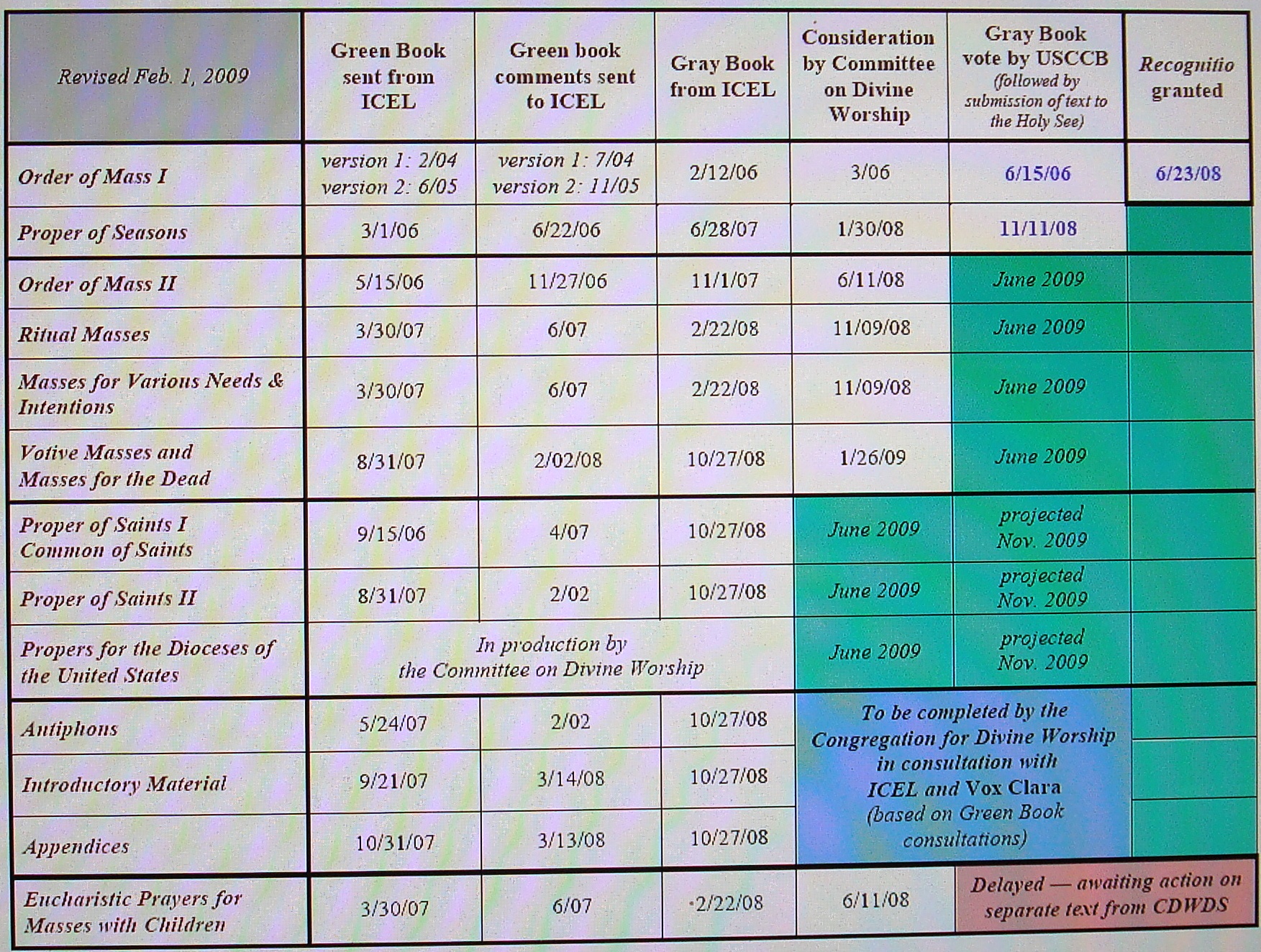
USCCB CDW progress report on the new translation of the Missale RomanumSo, the Prefect of the CDW, Card. Cañizares, wants a new edition of the Roman Missal published by the end of 2010.  The USCCB’s CDW is saying it can finish their work of approving texts by the end of 2010.

Just give the job to me.  I’ll get it done by the end of next month.

There is an interesting table in the newsletter, a timetable of what has been done and what must be completed.

The table suggests that voting on several "gray books" will take place at the June 2009 meeting and then again at the November 2009 meeting. 

I find it very interesting that the work on Antiphons, introductory material and Appendices is to be "completed by the Congregation for Divine Worship in conjunction with ICEL and Vox Clara".

The table indicates that work on "Eucharistic Prayers for Masses with Children" is "Delayed – awaiting action on separate text from CDWDS."

Also of note in the USCCB CDW newsletter:

Mass in Thanksgiving for the Gift of Human Life

After receiving a request from Archbishop Michael Sheehan of Santa Fe, the Committee considered the possibility of adding a Mass formulary concerning Thanksgiving for the Gift of Human Life to the Gray Book of the Masses for Various Needs and Intentions as a U.S. adaptation of the text. The Bishops of the United States had adopted this Mass formulary in November 1992 and submitted it to the Holy See for recognitio. The Congregation for Divine Worship and the Discipline of the Sacraments commended the text for further study and consideration, but it is noted that in the new Missale Romanum, editio typica tertia, there is no formulary for such a Mass.

Posted in SESSIUNCULA |
25 Comments