Archbp. Ranjith’s observations about today’s state of the liturgy

We haven’t heard much from His Excellency Archbishop Malcolm Ranjith lately.  He is the indomitable and clear-thinking Secretary of the Congregation for Divine Worship and Discipline of the Sacraments.

CWN has posted that Archbp. Ranjith wrote a forward to a book by Nicola Giampietro, a CDW staffer, about the personal papers of the late Ferdinando Card. Antonelli, OFM, one time Secretary of a previous incarnation of the CDW, the Congregation of the Discipline of the Sacraments (1965-69). Antonelli was no fan of Bugnini’s Consilium or what it did.

The book will be published in English by Roman Catholic Books next September under the title True Development of the Liturgy.

In his ten page forward, Archbp Ranjith makes pointed observations about what happened after the Council mandated a reform of the liturgy. 

PERTAINENT DIGRESSION: There is a huge disconnect between what the Council’s document on the liturgy, Sacrosanctum Concilium, actually mandated, and what we actually got after the Council.  The body called the Consilium, set up under the leadership of Card. Lercaro and Fr. Annibale Bugnini, had their own ideas about what liturgy was all about.  They were able to use the authority of the Council to batter away at the Church’s ecclesiology and sacramental theology set forth by the Council of Trent.  You can get an insider (favorable) view of what happened in the book that came out under the name of Archbp. Piero Marini, once the papal MC and apprentice of Bugnini. 

I haven’t read the book by Giampietro yet, but I suspect it in part balances Marini’s book.

Thus endeth the disgression. 

Here are some quotes of Ranjith’s forward included in the CWN entry.  You readers will probably resonate with these observations.

Some practices which Sacrosanctum Concilium had never even contemplated were allowed into the Liturgy, like Mass versus populum, Holy Communion in the hand, altogether giving up on the Latin and Gregorian Chant in favor of the vernacular and songs and hymns without much space for God, and extension beyond any reasonable limits of the faculty to concelebrate at Holy Mass. There was also the gross misinterpretation of the principle of "active participation." … 

Basic concepts and themes like Sacrifice and Redemption, Mission, Proclamation and Conversion, Adoration as an integral element of Communion, and the need of the Church for salvation–all were sidelined, while Dialogue, Inculturation, Ecumenism, Eucharist-as-Banquet, Evangelization-as-Witness, etc., became more important. Absolute values were disdained. …

An exaggerated sense of antiquarianism, anthopologism, confusion of roles between the ordained and the non-ordained, a limitless provision of space for experimentation– and indeed, the tendency to look down upon some aspects of the development of the Liturgy in the second millennium– were increasingly visible among certain liturgical schools. …

Clear and accurate.

Ranjith observes that we need a "reform of the reform" inspired not merely by a "desire to correct past mistakes".  It must be "true to what the Liturgy in fact is and means to us and what the Council itself defined it to be."

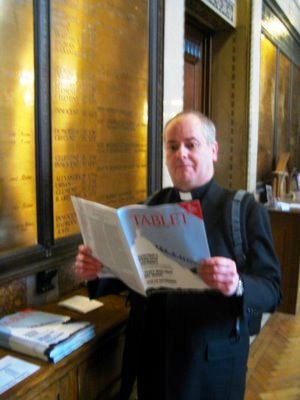
I wonder if The Tablet will review the book.

Posted in SESSIUNCULA |
54 Comments

The Colonel

A tip of the biretta to Vincenzo for alerting us to this glimpse of Mel Gibson’s new movie!

THE COLONEL

(WARNING: Some scenes may be disturbing.)

Play video

Posted in SESSIUNCULA |
30 Comments

The Tablet attacks Fr. Finigan, then tries to silence his response

This is hilarious.  His Hermeneuticalness, Fr. Tim Finigan, who was recently the object of a mean-spirited hit-piece by Elena Curti in the pages of The Tablet, writes:

CENSORED!

The Tablet have asked me to remove this post because it is a breach of copyright for me to quote their article in full. A new copyright-compliant version is available at the post: Responding to the Tablet – legally compliant version

It is hilarious to see the Tablet failing utterly to grasp the concept of publishing on the internet.

The Tablet attacks Fr. Finigan, then tries to silence his responseDuring a recent cordial phone chat about this sad affair, Fr. Finigan and I predicted that The Pill would come after him for responding in detail.

Right on schedule.

This says a great deal about The Tablet.

First, they drag him on a hurdle through the liberal parishes and chanceries willing to swallow the their message.

Then they whine when he frees an arm and bloodies their noses with his bonds.

They want him to go quietly.

Bullies are ever craven.

The Tablet attacks Fr. Finigan, then tries to silence his responseSecond, they are stuck not only in the washed-up ecclesiology of the ’70’s, they are stuck in the ’70’s tools of social communication.

They think they are going to contain what they did to Fr. Finigan.

I checked Wikipedia for The Tablet and found that in 2006 it had a circulation, if the number is accurate, of 23,628.  I suppose most of that involves the copies off-loaded in parish churches.

I get more readers than that every day.

And I hope everyone of them will visit Fr. Finigan’s site!

You know… if they all sent Fr. Finigan £ 1.00 … just to, you know, offset the expense of his ultra-right wing clerical garb …. imagine what The Pill could write about next?  Imagine how irritating that would be to the progressivists. 

Posted in SESSIUNCULA |
81 Comments

QUAERITUR: removing holy water during Lent

I have had a couple questions via e-mail already about dopey plans in some parishes to empty holy water fonts during Lent and even dopier plans to replace the holy water with sand or dirt.

Anyway, some time ago I wrote an Ask Father response to this which I now repost.

_________________

Lately I have read some items about the blogosphere that the , persists in some places. 

Q:  Our Sunday bulletin states that Holy Water will be removed from Ash Wednesday on during Lent to remind us that we are in a desert. What is the latest rule for removing Holy Water? It used to be done on Good Friday.

A: Good question! Thanks for asking this. No doubt thousands.. maybe millions of people will be subjected to all kinds of rubbish during Lent. One day I should relate the stupid things we had to endure in seminary about this very thing of sand in the holy water stoup.

Any way… This is a response from the Congregation for Divine Worship and Discipline of the Sacraments about this question. Enjoy.

The emphases are mine:

    Prot. N. 569/00/L

    March 14, 2000

    Dear Father:

    This Congregation for Divine Worship has received your letter sent by fax in which you ask whether it is in accord with liturgical law to remove the Holy Water from the fonts for the duration of the season of Lent.

    This Dicastery is able to respond that the removing of Holy Water from the fonts during the season of Lent is not permitted, in particular, for two reasons:

    1. The liturgical legislation in force does not foresee this innovation, which in addition to being praeter legem is contrary to a balanced understanding of the season of Lent, which though truly being a season of penance, is also a season rich in the symbolism of water and baptism, constantly evoked in liturgical texts.

    2. The encouragement of the Church that the faithful avail themselves frequently of the [sic] of her sacraments and sacramentals is to be understood to apply also to the season of Lent. The "fast" and "abstinence" which the faithful embrace in this season does not extend to abstaining from the sacraments or sacramentals of the Church. The practice of the Church has been to empty the Holy Water fonts on the days of the Sacred Triduum in preparation of the blessing of the water at the Easter Vigil, and it corresponds to those days on which the Eucharist is not celebrated (i.e., Good Friday and Holy Saturday).

    Hoping that this resolves the question and with every good wish and kind regard, I am,

    Sincerely yours in Christ,
    [signed]
    Mons. Mario Marini [Now the Secretary of the Pontifical Commission Ecclesia Dei]
    Undersecretary

One of these days I will tell you about the hijinx over holy water in Lent we had in seminary, the infamous Saint Paul Seminary, in Minnesota, where I did a couple years of hard time. But that’s another story.

About the holy water thing. 

Holy water is a sacramental. 

We get the powerful theology of its use in the older ritual in the prayers for exorcism of the water and salt used and then the blessing itself.  I wrote about this in an article for the WDTPRS series and it is on this blog. 

The rite of blessing holy water, in the older ritual, is powerful stuff.  It sounds odd, nearly foreign to our modern ears, especially after over 30 years of being force fed ICEL pabulum.

Holy Water is a power weapon of the spiritual life against the attacks of the devil. 

You do believe in the existence of the Enemy, … right? 

You know you are a soldier and pilgrim in a dangerous world, … right? 

So why… why… why would these liturgists and priests REMOVE a tool of spiritual warfare precisely during the season of LENT when we need it the most?? 

Holy water is a sacramental. 

It is for our benefit. 

It is not a toy, or something to be abtained from, like chocolate or television.

Posted in ASK FATHER Question Box |
60 Comments

24 Feb: Comet Lulin and Saturn converge! … but wait…. there’s more!

From SpaceWeather.com

COSMIC COINCIDENCE: What are the odds? On Tuesday, Feb. 24th, Saturn and Comet Lulin will converge in the constellation Leo only 2 degrees apart. At the same time, Comet Lulin will be making its closest approach to Earth – the comet at its best! – [… but wait…. there’s more!] while four of Saturn’s moons transit the disk of the ringed planet in view of backyard telescopes. Oh, and the Moon will be New, providing dark skies for anyone who wishes to see the show.

The best time to look is around 1 a.m. Tuesday morning (your local time) when the planet-comet combo ascend high in the southern sky. To the unaided eye, Comet Lulin looks like a faint patch of gas floating next to golden Saturn. Point your backyard telescope at that patch and you will see a lovely green comet with a double tail.

Visit http://spaceweather.com for full coverage including photos, sky maps, and a live webcast.

Geographic Notes: Comet Lulin is visible from all parts of the globe–all longitudes and both hemispheres. Directions are reversed in the southern hemisphere; there the comet is located in the northern sky around 1 am.  Saturn is globally visible, too, [… but wait…. there’s more!]  but the special quadruple transit of Saturn’s moons starting around 3 a.m. PST on Feb. 24th is visible only to observers around the Pacific Rim.  Details may be found here: http://science.nasa.gov/headlines/y2009/19feb_quadrupletransit.htm

Posted in Just Too Cool |
6 Comments

Cards. Ruini and Scola on “secularism”

I parsed Kmiec in TIME.

Take a look at these pieces by Card. Ruini and Card. Scola on secularism.  They are posted by Sandro Magister.

Lead off:

Here is how they see the Church’s role in the public sphere: if it were silent, for example, about life and death, "it would not contribute to the good of all"


Another great quote from an Eastern bishop:


"The West must decide to understand what influence faith has in the public life of its citizens, it cannot dismiss the problem."


Some people, I think Kmiec included, presume that the Church has been effectively defeated in the public square and it she is vociferous in defending certain doctrines, she will be completely marginalized.  Therefore churchmen shouldn’t "interfere" too much in public affairs.  Otherwise, just chime in on the "acceptable" issues, avoiding those which are too thorny.

These two pieces might also be interesting for the discussion of religious liberty: how the Church with her clear conviction and doctrine interacts with the state.

Posted in SESSIUNCULA |
1 Comment

A parish car, perhaps?

Lot’s of parishes have a car, for the practical use of the staff.

This could have been parked along side the Railians at St. Mary’s in Brisbane last Sunday.

A parish car, perhaps?

From one of my daily sites, Engrish.

Posted in SESSIUNCULA |
16 Comments

I want to put a stop to something

Not a few people have written me e-mails along the lines:

"How could the Holy Father appoint to New York a bishop who celebrated Mass wearing a ‘cheesehead’ hat?"

The reference is to Archbp. Timothy Dolan who has been moved from Milwaukee to New York.

Back in 2002, right after he arrived in Milwaukee, the new Archbishop, very aware of the relationship people in Wisconsin have with the Green Bay Packers, momentarily put on a ‘cheesehead’ hat at the beginning of his sermon time.

He did not say Mass wearing a ‘cheesehead’ hat.

Should he have done that?  I wouldn’t have.  To my mind it was infra dignitatem, both for the moment, the congregation and his person. 

But I am not the brand new Archbishop of Milwaukee, just arrived after years and years of mismanagement under Weakland and the scandal at the end.  Facing these circumstances, he made a decision at the moment to brighten the atmosphere in a time of pain and uncertainty.  It is hard to fault his reasoning.

One lives and one learns.

Even bishops have to have some on the job training.  They must learn from reactions to their decisions.  They make mistakes and hopefully, with grace, grow in their ministry.

So if you are really upset about the ‘cheesehead’ hat thing, I suggest that you cast your first rock at yourself. 

Unless of course you have never made a mistake you eventually learned from.

Good luck to Archbishop Dolan!  He’ll need both luck and prayers.

Posted in SESSIUNCULA |
64 Comments

Mickens of The Tablet: more bitter fear about continuity and true unity

The Tablet is dedicated to attacking the Holy See on the matter of the unity of the Church if that unity includes traditional Catholics.

For The Tablet and some of its contributors, the Church is for the liberally pure. Continuity is not welcome, even in the back of the bus.

An example of The Tablet‘s agenda was produced by Rome-based Tablet correspondent Robert Mickens’s recent offering about the Fraternity of St. Peter, or FSSP.  The FSSP is approved and in harmony with Rome.

My emphases and comments.

Kudos to Vincenzo for the photoshopped shot, below.

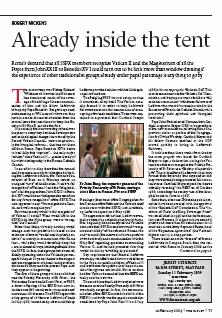
Mickens of The Tablet: more bitter fear about continuity and true unity14 February 2009 | THE TABLET

ROBERT MICKENS

Rome’s demand that all SSPX members recognise Vatican II and the Magisterium of all the Popes from John XXIII to Benedict XVI could turn out to be little more than window dressing if the experience of other traditionalist groups already under papal patronage is anything to go by

Already inside the tent  [From this headline, take an important key for reading the following: liberals want a smaller tent.  They prefer to exclude rather than include.]

The controversy over Bishop Richard Williamson’s views on the Holocaust has dominated much of the coverage of the lifting of the excommunication of him and his fellow Lefebvrist bishops by Pope Benedict. But grotesque and embarrassing as Williamson’s views are, they have in a sense distracted attention from the central issue that continues to keep the Society of St Pius X outside the fold.

It is actually their unwavering refusal over the years to accept key doctrinal developments and ecclesiological changes introduced by the Second Vatican Council – most conspicuously the liturgical reforms – that has cut them off from Rome. Pope Benedict XVI’s desire to heal fully this “rupture” – the only major “schism” since Vatican II – speaks clearly of his wish to bring unity to the Roman Catholic Church.  [Mickens obviously knows that the Holy See does not say that the SSPX is in schism. He knows that Card. Castrillon says they are not now in schism but, rather, are at risk of true schism.  Mickens has asked the reader to accept as a premise something which he himself knows is not true.]

In an effort to allay fears that the council could become a casualty [How dramatic.  How could any serious person think that the Second Vatican Council would be a "casualty" were there to be a reconciliation of the SSPX?  What progressivists are really afraid of is that they might have to start viewing the Council in a more realistic way, abandon their view of the Council, actually the "spirit" of the Council and then read the documents in continuity with the Church’s past teachings.] in talks aimed at healing the Lefebvrist schism, the Vatican’s Secretariat of State on 4 February issued an unsigned “note” of clarification. It said “a full recognition” of Vatican II and the “Magisterium” of all the popes from John XXIII to Benedict XVI would be an “indispensable condition for any future recognition” of the SSPX. The note appeared to say: “You recognise the Council, and we’ll recognise you.”  [NB: If acceptance of the Church’s past teachings is a sine qua non for being in manifest harmony with the Holy See, then also progressivists had better make an examination of conscience.]

But what exactly would “a full recognition”of Vatican II entail? What would life in the SSPX look like if the group were to “recognise” the Council?  [This is where Mickens wants to create fear in The Tablet’s readers.]

More than likely, virtually nothing would change. And that prediction is based on the existence of several “traditionalist priestly societies” currently in communion with Rome that – while they would forcefully deny this – are, in almost all ways, [but not in some very important ways] indistinguishable from the SSPX. In fact, these groups have been officially operating under the Vatican’s patronage for the past 20 years, thanks to the support and encouragement of a small number [You see, Tablet readers?  This is a minority of wrong-thinking clerics.  But it is still small enough to be stopped!] of cardinals and bishops and the present Pope.  [And what follows is the real point of Micken’s article…] And they appear to be growing.  {insert scary pipe organ music here}

The first of these groups to be established was the Priestly Fraternity of St Peter – the Fraternitas Sacerdotalis Sancti Petri, or FSSP, a direct offspring of the SSPX that now includes some 350 members in 17 countries and more than 100 dioceses. The FSSP began with a tiny group of 15 “former Lefebvrists” back in July 1988, immediately after Archbishop Lefebvre provoked schism with his illicit episcopal ordinations.

The fledgling FSSP was not set up, nor has it flourished, all by itself. [An admission that it has flourished?]  The Vatican actually formed it in order to help Lefebvre’s followers enter into full communion after accepting a few basic conditions. These were contained in a protocol that Cardinal Joseph Ratzinger (then head of the Congregation for the Doctrine of the Faith and the Vatican’s chief interlocutor with the SSPX) and Archbishop Lefebvre signed on 5 May 1988. 

The agreement did not last. Lefebvre eventually broke it by ordaining his four bishops.

But, originally, he had accepted the Vatican’s demands that SSPX members would “recognise the validity” of the reformed Roman rite [I think most members of the SSPX do think the newer rites are valid.  They simply don’t like them.] and “commit [themselves) to have a positive attitude of study and communication with the Holy See” regarding questions surrounding Vatican II. And he had promised that they would do this by “avoiding all polemics”.  [Wait a minute.  If the "positive attitude" was lacking in the years after 1988, it wasn’t lacking only on the part of the SSPX.  If polemics were not avoided by the SSPX, neither were they avoided by others.  Now we are seeing from the SSPX the grow of a far more positive attitude and a change from the earlier polemical style of rhetoric.  The atmosphere is definitely changing.  THAT is what terrifies writers like Mickens and those who embrace The Tablet‘s rupture agenda.   The SSPX is expressing a positive mesage about serious "study and communication", and the liberals are frightened.]

Key requirements that Marcel Lefebvre eventually rebuffed boiled down to obedience to the Pope, no public criticism of Vatican II and least some recognition that the post-conciliar liturgy was not invalid. But at no time had the Vatican demanded that the SSPX actually use the new rite.

The conditions that Lefebvre rejected were the same ones the Priestly Fraternity of St Peter eventually accepted. In fact, the excommunication of the SSPX marked the birth of the FSSP. Its midwife was the papal coMickens of The Tablet: more bitter fear about continuity and true unitymmission established by Pope John Paul II on 2 July 1988 in his motu proprio, “Ecclesia Dei”. This soon became known as the “Ecclesia Dei” Commission and its purpose was to facilitate “full ecclesial communion” with those followers of Lefebvre who wanted “to remain united to the Successor of Peter in the Catholic Church, while preserving their spiritual and liturgical traditions”.

Pope John Paul selected German-born Cardinal Augustin Mayer OSB to be president of the new commission, relieving him of his previous duties as prefect of the Congregation for Divine Worship. Cardinal Mayer and his fellow German cardinal at the CDF moved quickly to bring in Lefebvre’s followers.  [What is Mickens trying to accomplish by stressing the German nationality of Card. Mayer and the Holy Father?]

It took less than three weeks from the day the motu proprio was issued for Cardinal Mayer to sign a declaration stating the Vatican’s readiness to recognise the Priestly Fraternity of St Peter as a “Society of Apostolic Life”. The 15 disaffected Lefebvrists had only formed their fraternity four days earlier and they were already being promised full canonical status. Cardinal Mayer signed the decree officially “erecting” the FSSP on 18 October 1988, conceding the society “use of the liturgical books in force in 1962”.

Since then, other neo-Tridentine [a curious phrase] priestly societies have been erected with the approval of the “Ecclesia Dei” Commission. The “Institute of Christ the King, Sovereign Priest” was established in 1990 and has its headquarters near Florence. It claims to have some 50 priests and more than 60 seminarians in 10 countries. Archbishop Raymond Burke, head of the “Segnatura Apostolica” (the Vatican’s highest court), is a key patron.  [And I imagine the writer dislikes Archbp. Burke too.  That is just a guess, of course.  What other reason would he have for bringing in his name?]

There is also an entire “diocese” of former Lefebvrists in Campos, Brazil, that was reconciled with Rome in January 2002 as the Personal Apostolic Administration of St Jean Marie Vianney. And there are several groups in communion with Rome that have been inspired by the traditionalist movement championed by the late Archbishop Lefebvre.

The Society of St Pius X has no great love for them and the sentiment is mutual. Take the Fraternity of St Peter. Most people in the SSPX have tended to see the FSSP as traitors or as “modernists” cloaked in traditionalist garb.

And while the Fraternity of St Peter may be particularly more focused on the aesthetics of the Tridentine rite, [Mickens reduces this to "aesthetics", a common liberal slam.  He is suggesting that those interested in these things are either shallow or effete.] students at its two seminaries – one in Germany, the other in the United States – are given a similar classical training based on apologetics and St Thomas Aquinas as the SSPX, with little or no proper treatment of the Second Vatican Council.  [Really? Are the Council documents not studied in FSSP seminaries?  Also, the 1983 Code of Canon Law requires that seminaries provide training in the teaching of St. Thomas Aquinas, who is named in the Code.  So how is focusing on Thomism in a seminary bad?]

However, some in the FSSP would argue that they are not opposed to ecumenism or religious liberty. 

One official in Rome said his fraternity was particularly open to the Orthodox. [And Pope Benedict, and Pope John Paul II and Pope Paul VI were open to the Orthodox "particularly".  The Orthodox Churches, real Christian Churches and really in schism (whereas the SSPX is not so formally), are more and more open to Rome.  Also, being "particularly" open to the Orthodox doesn’t mean that they are not open to other Christians.  On the contrary.] And he said the very existence of FSSP as a modern apostolic society connected to the Tridentine rite was in itself an “example of religious liberty” and the “spirit of tolerance”. [And he is right.]

That is not exactly an example of religious freedom that one would find in the Vatican II declaration Dignitatis humanae.  [Is that a fact?  Robert Mickens knows what religious freedom is according to Dignitatis humanae.  That’s sorted, then.]

This official was also quick to point out that the FSSP was motivated not so much by the political and sociological ideologies he claimed were at the heart of the Lefebvrist movement, rather by their love for the “old” Mass, which was the heart of their “charism”.  [Keep in mind that the SSPX in France has rightly or wrongly been tied up with "right wing" politics.]

But others, especially former members and associates of the FSSP, refute that. [Now we turn to the dissatisfied.] One of the group’s former seminary professors said that while the FSSP “was supposedly created to be an instrument that might contribute to restoring a certain depth and richness to the liturgy”, experience has shown that “ideological fixation on the 1962 rubrics is in no way going to promote attainment of this end”. He said groups like the FSSP saw themselves as an insulated “elite” within the Church and world at large.  [Earlier Mickens used the term "aesthetics", which is code for "elite".  That aside, I know several FSSP priests who hope that the Novus Ordo will be celebrated well and in continuity with the Church’s liturgical tradition.  I have had long conversations about this point with more than one FSSP priest.  The fact that there has been some internal tension in the FSSP over the Novus Ordo suggests that the picture Mickens is painting is incomplete at best.]

The former professor added that they “do not particularly concern themselves with anything or anyone outside their ranks, since they identify being a recipient of salvific grace with mastering and maintaining rubrical and ritualistic integrity in an atmosphere often tainted with traces of Jansenism and a rigidly neo-Platonised, clericalist vision of the dispensation of divine grace”. [Sounds like some sour grapes are being shared there.  But more importantly, the FSSP has actually made it a point of their apostolate not train priests to say the older form of Mass.  They are not cutting themselves off to those outside their ranks.  They are actively opening up and supporting priests who are not in their ranks.  BUT!  They are helping priests learn the older Mass, which is the unforgivable sin for the Tablet crowd.  As for the traces of Jansenism and Neo-Platonism,… I think we can easily counter with the observation that most liberals are tainted with the far more serious Arianism and Docetism, along with a whole raft of other heretical notions.]

“It is also worthy of note that the laity supporting these institutes often think of their ‘clerics’ as a privileged caste, while all others occupy a markedly lower grade of status before the Church and God,” the FSSP professor said.  [This is, in some cases, a fair observation.  I have encountered a measure of snootiness among traditionalist Catholics.  Even a strong measure in some cases.  But shall we talk about the smug superiority of the liberals for a while?  If you want elitism at its worst, an elitism without the support of sound doctrine, tradition, law, or true aesthetics, let’s cast the net from the left gunwale.]

That was not exactly the vision presented by Vatican II. The irony is that by establishing these so-called “Ecclesia Dei” communities, the Vatican has also helped perpetuate and even legitimise the schismatic movement founded by Archbishop Lefebvre.  [If a group is in harmony with the Holy See, as is the FSSP, then it is not in schism, right?  Unless Mickens really means de facto schism, rather than de iure.  But if that is his point, it is even more ironic that liberals who are in de facto schism are savaging those whom they claim to be schismatics.]


Another hit piece from The Tablet.  This time directly attacking the Holy Father.

Posted in SESSIUNCULA |
65 Comments

What did Kmiec really say in the TIME article?

The Pope’s enemies have skulked out of the forest and are forming packs.  They seek to hound the Pope, bite at him, drive him from the direction he is leading the Church.

A couple days ago I posted about the article in TIME by the squishy Doug Kmiec, a professor of law.  During the last presidential campaign Kmiec worked to undermine the Catholic view that concern for lives of the unborn outweighs other burning social concerns.

Kmiec, whom I suspect wants to be appointed to something by the Obama Administration, some time ago issued a +3000 word jeremiad/apologia about how badly he was was treated in the blogosphere.

Kmiec’s recent piece in TIME follows the meeting pro-abortion "Catholic" Speaker of the House Nancy Pelosi (D-CA) had with Pope Benedict XVI in Rome.  Subsequent to that fifteen minute meeting, both Pelosi’s office and the Holy See issued very different statements about what was discussed.

In the Holy See’s statement, released by the Press Office, we read: "His Holiness took the opportunity to speak of the requirements of the natural moral law and the Church’s consistent teaching on the dignity of human life from conception to natural death which enjoin all Catholics, and especially legislators, jurists and those responsible for the common good of society, to work in cooperation with all men and women of good will in creating a just system of laws capable of protecting human life at all stages of its development."

Kmiec wrote in his recent TIME article that this statement effectively changes the Church’s teaching and obliges also jurists in the same way legislators are obliged by the Church.

Now that some other bloggers are picking up on Kmiec’s article in TIME, and since that article was still bugging me, I need to add something.

The real problem with Kmiec’s article is that he dissimulates about what the Holy See’s statement actually says.

Leave aside the question of the original Italian, if the statement said in Italian guiristi or guidici.  That is interesting, but it’s not the real problem.

Kmiec wants the reader to accept the premise that the Pope is imposing a new moral duty imposed on jurists, a duty to "undertake an activist, law-changing role".  

The Pope didn’t say that at all.  The statement does not say that jurists must be activists.  It says that jurists should "work for a system of law capable of protecting human life at all stages of its development".

Kmiec says that there is now a "new directive" from Rome.  There isn’t.

Here is the slight of hand: Kmiec says the Pope says that judges must use judicial activism in order to limit abortion, implying that they should "legislate from the bench" as judges do when they interpret the US Constitution broadly instead of narrowly or strictly).  Kmiec reasons that the Pope is saying that if judges don’t oppose abortion by employing this kind of activism, then they are guilty in the same way as Catholic legislators are when they promote abortion rights.

Again, that is not what the Holy See’s statement says.

The statement did not, as Kmiec claims, impose "moral duties on Catholic jurists that are incompatible with their envisioned judicial role".

Kmiec wrongly interprets the papal statement as putting jurists and legislators in the same category so that their responsibilities about protecting human life must be exercised in the same way.  Kmiec says the pope doesn’t recognize that there are different roles. 

Remember that Kmiec is writing for the for TIME/CNN machine, which has its expectations.  He is using "activist" as the polar opposite of "originalist".  I think he uses "originalist" because it sounds more like "fundamentalist" than "strict constructionist" would.  On the surface, Kmiec is trying to make it seem that the Pope came out against originalism embraced by Justice Scalia.  In other words, you can no longer hide behind originalism.  Kmiec says the Pope says you MUST become a judicial activist.

Rubbish.

All of that said….

My biggest problem with Kmiec’s article is how he seeks to undercut the Pope’s authority.  He is suggesting that the Pope is being unreasonable.  The Pope can’t possibly mean what is said in that statement.  It would be a disaster for Catholic jurists.  Strong pro-life/anti-abortion statements were already disaster for legislators, after all.   Catholics will have to opt out of juridical life, indeed any public role, if the Pope meant what he said because they would be caught between too many rocks and hard places.

The diabolical side of this is that a dimension of what Kmiec is saying veers close to the truth: it is not going to be easy to square the demands of faith in the context of public responsibilities. 

How will Catholics be able to participate in public life when our systems reject natural law in favor of a utilitarian ethic?

Must we either opt out of the public square or lead a revolution?  Will Catholicism end up being a curious sect, like the Amish?  

So, in that sense, and that sense only, Kmiec raises a good point. 

But what he is really saying is false and dangerous: "See what an impossible situation the Pope has created even for my enemies the originalists?  We are now all in the same sinking boat of extremism because of what the Pope said.  We must, for the sake of having a Catholic role in the public square carefully filter out the extremism of the Pope and other Catholic leaders who parrot his hard line position."

That, folks, is Kmiec’s real agenda.

Catholic theologians and pastors are looking at ways of keeping our voice in the public square.  This is a major component of Pope Benedict’s vision for his pontificate.  He is trying to revitalize Catholic identity so that within the Church we know who we are and what we believe so that to the outside we have something worth while to say and contribute in the public square. 

Kmiec’s article is set against this vision: Catholic teaching matters for Catholics, but it shouldn’t bind Catholics in public discourse.

What Kmiec is really saying (as he proceeds from a false reading of the Holy See’s statement) is that if the Pope said what he said, then once your Catholic faith impedes you from reaching compromises with people who don’t share your religious views, you can no longer meaningfully participate in public life.

We all admit that some laws will provoke hard consequences for some Catholics in public life (e.g., governors, prison wardens, doctors paid by the state, workers in adoption agencies, etc.). The really tricky thing to understand is that not everything you believe with Catholic faith requires you to become an activist solely because of the Church’s teaching. 

There is no question that Justices are not free to do what they want to do on the bench and still be good Catholics.  They are called to be Catholics on the bench also.  That is not new.   The Pope’s statement to Pelosi didn’t alter that.

Caveat: Some people will surely make the mistake of thinking I am saying that Catholics don’t have to fight abortion.  That is a misstep.  A trap.  I am not saying that.

There is a difference between legislators who promote abortion and people active on the judicial side who are not activists. 

Kmiec fogs this distinction and tried to make the Pope look like an extremist.  Savvy Catholics, like Kmiec and Pelosi and Kerry and Kennedy and Cuomo and Sebelius and Granholm and Dodd and Biden, etc., must set aside the urgings of extremists and filter out the interpretations of hard-liners in order to save their version of the Church’s message in the public square.

That is his true agenda.

Posted in SESSIUNCULA |
10 Comments