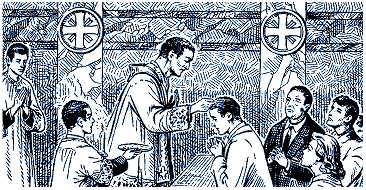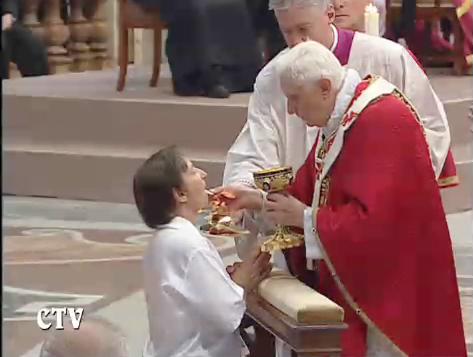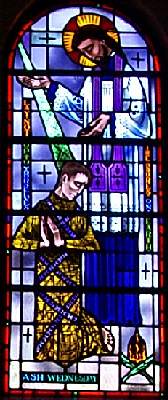
QUAERITUR: ashes for infants

From a priest reader:

Dear Father Z.

The "mad dash" for ashes has begun here.  A question I have, that you  may know the answer to or at least have an opinion of, is, does it  make sense to impose ashes on infants or toddlers (ie –  those who do  not yet have an awareness of sin)?  Aren’t the ashes an exterior sign  that implies an interior desire for repentance? 

But, on the other  hand, is there any merit to imposing ashes on the very young for the  "teaching moment", or for the immersion into the Catholic heritage and  culture that it brings?

I know, there are several questions there.  Answer as many or few as  you wish.

You raise good points, Father.

Since this is a sacramental and not a sacrament, I think we can have some leeway.

You are right that, from the point of view of the sacramental and what it represents, there is little point to imposing ashes on an infant.

On the other hand, our Catholic identity is rooted in more than what we grasp from the light of reason.  Deep memories and emotions, implanted impressions, also play their role.

I have had several discussions with older converts who, entirely independently, make the observation that adult converts really aren’t quite "Catholic" until they have been a practicing for some 15-20 years.  It may be that it takes that long for things to sink in, settle in at the root of your mind, at your starting points of which you may not be consciously aware as you view the world and make decisions.

Hmmm… that was pretty good.  I am also reminded that some books are deeply Catholic, not because they deal with priests and stuff, but because of the world view in the book, which might remain unexpressed in an explicit way.

In that case, there is something to be said about imposing ashes on the very young, as you suggest.

Another practical point: It is worth doing it simply to avoid the ridiculous discussions you will have to have if you don’t.  Inevitably some anxious mom will be upset that junior didn’t get the ashes, especially because they are so cute with that smudge, etc. Who cares if it "means something".  No reason involved,… just emotion you can’t possibly address.

Though I am being a little facetious…. well… not too facetious really… there is another point to consider.

Ash Wednesday and Palm Sunday seem to be big days, especially because people "get something".  But not only that, they get to go forward to the rail (in traditional circumstances) and get something.  I have spoken with a number of folks who are unable to receive Holy Communion for one reason or another.  On a very deep level it is important for them to go forward to the rail, with everyone else, and receive them precisely what everyone else gets.  Even in those places where a blessing is given at Communion time, they still are getting the same thing as everyone else.

In any event, your question was good and its raises interesting points about the ineffable consequences of receiving ashes on Ash Wednesday.

Posted in ASK FATHER Question Box, Mail from priests |
38 Comments

Holy Father at Santa Sabina

The Holy Father has processed from Sant’Anselmo on the Aventine Hill to Santa Sabina for the Station Mass of Ash Wednesday.

As I write he is vesting for Mass.

It is live on various streams.

I have the sermon and will post some notes on it as soon as he has pronounced it.

UPDATE: The Holy Father departed from his text quite a few times and added additional comments.  I’ll see what I can do later if I have some time.  Busy day.

09-02-25 Benedict XVI’s Ash Wednesday sermon

Posted in SESSIUNCULA |
7 Comments

The Tablet: no dissent allowed

Damian at Holy Smoke reports that The Tablet, after launching bitter personal attacks on Fr. Finigan of The Hermeneutic of Continuity, will not publish a contrasting letter by a once favored contributor, the fine composer James MacMillan.

Since The Tablet won’t publish it, here it is:

Dear Ms Curti,

I am a Scottish Catholic composer who has on many occasions contributed articles to your magazine, The Tablet. I have always seen the journal as an important and sensible Catholic voice in the media. Nevertheless, I have been alarmed at the  drift of the paper in recent months, especially relating to matters to do with the liturgy, which is a special interest of mine. Your latest article on Fr Tim Finigan has unfortunately plumbed new depths that I thought I would never see in a Christian publication. The whole tone was disrespectful, mischief-making and opportunistic, lacking no palpable sense of Christian charity. The Tablet has a special responsibility not to allow these issues to develop into a "civil war" between Catholics. Our liturgy is in a deplorable state and, in the spirit of Vatican II, it is imperative that steps are taken to reform the reform for the good of the faithful. There is no attempt by the Pope, or Fr Finigan for that matter, to turn back the clock. The limited reappearance of the Extraordinary Rite will contribute to a renewal and blossoming in our wider liturgical education and awareness, and in the process advance the faith of Catholics starved of good practice in this regard.

The implied assaults on the character of Fr Finigan were a disgrace, and at one point, when you suggest financial impropriety, may be  actionable. I hope the good parishioners of Our Lady of the Rosary can find it in their hearts to forgive you and pray for you.

Yours sincerely,

James MacMillan CBE

Posted in SESSIUNCULA |
32 Comments

WDTPRS: Ash Wednesday

Ash WednesdayToday’s Roman Station is Santa Sabina.

The Collect in the 2002 Missale Romanum, is an ancient prayer found in the Gelasian Sacramentary for the Vigil of Pentecost. It is also among the prayers for the 4th day of the 4th month, which more than likely involved the traditional fast of the fourth month (there were fasts in the 4th, 7th and 10th months).  This prayer is in the Veronese Sacramentary under the title In ieiunio quarti mensis. 

This prayer was in the 1962 Missale Romanum but at the end of the section for the blessing of and imposition of ashes, before the Introit of the Mass itself. 

Let’s see what the prayer really says.

COLLECT:
Concede nobis, Domine, praesidia militiae christianae
sanctis inchoare ieiuniis,
ut, contra spiritales nequitias pugnaturi,
continentiae muniamur auxiliis.

Praesidium has a powerfully military connotation.  It means fundamentally "defense, protection, help, aid, assistance" and thus it refers to "soldiers who are to serve as a guard".  Thus, by extension, it comes to mean "any place occupied by troops, as a hill, a camp, etc.; a post, station, entrenchment, fortification, camp".  Munio is equally military: "to build a wall around, to defend with a wall, to fortify, defend, protect, secure, put in a state of defense".  As you can imagine pugno, "to combat, give battle, engage, contend", is a military term.  Are you getting the picture?  Of course auxillium means "help, aid, assistance, support, succor", but when in the plural it is also "auxiliary troops, auxiliaries (mostly composed of allies and light-armed troops; hence opposed to the legions)".  Then there is militia, which is "military service, warfare, war" and also specifically in the genitive militiae "in military service, or on a campaign, in the field".  

LITERAL TRANSLATION:
Grant us, O Lord, to commence the defenses of the Christian field campaign by means of holy fasts,
so that, we who are about to do battle against spiritual negligences,
may be fortified by the support of continence.

WDTPRS: Ash WednesdayThis is a mighty prayer.   Several things come to mind. 

First, most of us when we were confirmed were reminded in some way that we are soldiers in this pilgrim Church.  We must be ready to suffer for the Faith. 

Militaristic imagery informs much of the history of Christian spirituality. 

Next, while we are soldiers we are on the march, pilgrim soldiers.  We are on campaign.  When the Roman legions were on the march, they would build a fortified camp when they halted.  They took no chances.  We are on the march in a vale of tears where anything and everything can happen to us and around us. 

Thirdly, when we make mistakes, the results can be deadly.  The word nequitia means "bad quality, badness" but that is because it is "bad moral quality, of all degrees, idleness, negligence, worthlessness, vileness".  It usually refers to a lack of attention that duty and prudence require, resulting in negative consequences.  Moreover, the virtue of continence is described with the same word used to describe the auxiliary troops that supported the legion’s regulars.  While it could simply refer to "abstinence", continence is the virtue which restrains the will from consenting to strong impulses of sexual desire.  So, this prayer could have a special focus. 

SUPER OBLATA:
Sacrificium quadragesimalis initii sollemniter immolamus,
te, Domine, deprecantes,
ut per paenitentiae caritatis labores
a noxiis voluptatibus temperemus,
et, a peccatis mundati,
ad celebrandam Filii tui passionem
mereamur esse devoti.

This prayer also has roots in the ancient Gelasian and the Gregorian Sacramentary.  Notice, however, how long, wordy it is.  Hardly in the style of the terse prayers of the Romans.

REALLY LITERAL VERSION:

Praying to You, O Lord,
we solemnly raise up the Sacrifice of the beginning of Lent,
so that through the exertions of the charity of penitence
we may abstain from harmful pleasures,
and, cleansed from sins,
we may be worthy to be dedicated
to celebrating the Passion of Your Son.

St. Leo the Great refers to the time of the Lenten fast as a sacramentum, preparing us for the mysterium of the dying and rising of the Lord.  

Here at the threshold of Lent, let us make our "Lenten start". In the sacrament of Penance, Christ will cleanse your slate and you may make a renewed beginning.

POST COMMUNION:
Percepta nobis, Domine,
praebeant sacramenta subsidium,
ut tibi grata sint nostra ieiunia,
et nobis proficiant ad medelam.

A VERSION:
May the sacramental mysteries which we have received, O Lord,
afford us help,
that our fasts may be pleasing to You,
and may be profitable for us unto a remedy.

I am delighted that in the 2002 Missale the tradition of the "Prayer over the people" was revived in Lent.  This is an important custom.

The origin of the Oratio super populum is quite complex and hard to pin down.  Turning to Fr. Joseph A. Jungmann’s monumental two volume The Mass of the Roman Rite: Its Origins and Development we find a history of this prayer at the beginning of the section concerning the close of the Mass (II, pp. 427ff).  Something Jungmann emphasizes that caught my attention is the fact that we are at a “frontier” moment, the threshold of the sacred precinct of the church and the world.  When properly formed we want the influence of our intimate contact with the divine to carry over into the outside world.  The use of this prayer is very ancient, found in both the Eastern liturgies of Syria and Egypt and in the West.  

Unlike the Postcommunio, the object of the prayer is not “us”.  Instead, the priest prayers for and over the people, not including himself as he does in the prayer after Communion. 

By the time of Pope Gregory the Great this was only in the Lenten season, probably because this is perceived to be a time of greater spiritual combat requiring more blessings.  Indeed it was extremely important for those who were not receiving Holy Communion, as was the case of those doing public penance before the Church, the ordo poenitentium.  

How important was this prayer to the Romans?  In 545, when Pope Vigilius (537-55) was conducting the station Mass at St. Cecilia in Trastevere, troops of the pro-Monophysite Byzantine Emperor Justinian arrived after Communion to take the Pope into custody and conduct him to Constantinople.  The people followed them to the ship and demanded “ut orationem ab eo acciperent… the they should receive the blessing prayer from him”.  The Pope recited it, the people said “Amen” and off went Vigilius who would return to Rome only after his death.

ORATIO SUPER POPULUM:
Super inclinantes se tuae maiestati, Deus,
spiritum compunctionis propitius effunde,
ut praemia paenitentibus repromissa
misericorditer consequi mereantur.

Who wants to take a crack at it?

As we begin our lenten observance, like a soldier on the march, on a mission from your great Captain, be sure you have your objectives clearly defined. Get clear in your head whatever strategies and tactics will win for you your prize. 

What will you want to gain from this Lent? 

Posted in LENT |
9 Comments

Bp. of East Anglia (England) comments on SSPX excommunications

His Excellency Most Rev. Michael Evans, Bishop of the Catholic Diocese of East Anglia has commented on his website about the lifting of the excommunications of the four SSPX bishops.

Shall we have a look?  My emphases and comments:
 

STILL IN SCHISM AND VIEWS REJECTED [Has His Lordship really not heard that the Holy See does not consider the SSPX formally to be in schism?]

There has understandably been much reaction, mostly very negative, to the news of the lifting of the excommunication of four bishops associated with Archbishop Lefebvre’s Priestly Fraternity of St Pius X, particularly in relation to one of those bishops, Richard Williamson, who has denied the full reality of the Holocaust, suggesting that ‘only’ 300,000 rather than 6 million Jews were killed by the Nazis, and none in gas chambers.  Dismay and anger sums up the response of many, especially members of the Jewish community, but also ordinary faithful Catholics.
 
The media presentation of the lifting of the excommunications has certainly helped to distort the meaning of this gesture [Catholic media included, as well as the erroneous statements of some high ranking churchmen] by the Holy Father, who wished to remove one important impediment standing in the way of opening the door to dialogue with this schismatic group [again, the Holy See does not consider the SSPX to be in formal schism, though that is the fear as time passes] which has long refused to accept key teachings of the Second Vatican Council. The media has generally confused ‘lifting an excommunication’ with ‘reconciliation with the Catholic Church’, and therefore suggested that these four bishops and their groups are now fully restored to the Catholic Church.  This is not the case.  [The fact is, the lifting of the excommunications means that those four men may now enter a church and go to confession or Last Rites, and if they are in the state of grace receive Communion like everyone else.]
 
In recent years, various excommunications have been lifted as first steps in the hope of ending schisms and enabling unity.  The lifting of the excommunications between Rome and the Patriarchate of Constantinople in 1965, by Pope Paul VI and Patriarch Athenagoras, was a good example: this great gesture of friendship has not yet led to full communion between the two Churches.   [The problem is that the Orthodox were a real Church in formal schism.  The SSPX is neither in the eyes of the Holy See.]

Although the lifting of the excommunication has freed these bishops from a grave canonical penalty, it has not changed the juridical situation of the Priest Fraternity of St Pius X, which does not have canonical recognition within the Catholic Church.   The four bishops, although no longer excommunicated, have no canonical function within the Church and cannot licitly exercise ministry within it.
 
The Holy See has made clear that an indispensable condition for any future recognition of the Fraternity of St Pius X is the full acceptance of the Second Vatican Council and the teaching of Popes John XXIII, Paul VI, John Paul I, John Paul II and Benedict XVI.  This is a vital point!  [And it is a point which hasn’t been made very clear, either.  It is hard to know what "acceptance" means.]
 
The positions of Bishop Williamson on the Holocaust are absolutely unacceptable and firmly rejected by the Holy Father.  In order to function as a bishop in the Church in the future, [why would he have to do that?] he would have to distance himself – in an absolute, unequivocal and public way – from his present position on the Holocaust.
 
The Lefebvrist movement is schismatic, [But it is not in schism.  It might be schismatic in the sense that it is tending toward schism if this goes on, but it is not in schism formally, according to the Holy See.] and cannot be restored to full communion with the Catholic Church until it accepts the teaching of the decrees of the Second Vatican Council and the Magisterium of all Popes after Pope Pius XII as well as those they accept before then.

Your Excellencies… please get this straight?  Otherwise, it was a fairly sound letter.

Posted in SESSIUNCULA |
33 Comments

QUAERITUR: changing words near the consecration

From a reader:

When I travel I frequently have to attend NO Masses.  Such was the case last Sunday.  The parish is liberal and so is the “guest” priest, but I was with a friend, so on I went.

The priest changed the words of the consecration by substituting the words “friends” for “disciples”.  He did that for both the bread and the wine.  I recognize that words are important and I think it is a poor but not surprising substitution to use the word “friends”  given the social action personality of this priest (He broke bread and gave his friends….).  I checked the actual version in the weekly (monthly???) pew missal,  while listening.  The missal uses the word “disciples”.

My question is does this in any way invalidate the Mass.  If not, fine.  I am subject to this Mass on occasion and really can’t get out of going so it is good to know that at least I satisfied my Sunday obligation (on Sat, naturally).  Mostly I am curious.

First, isn’t it wonderful that you can go to Mass when you travel?

Second, the priest had NO authority to change those words.  What he did was just plain wrong.  The pastor of the parish or his superior/bishops should admonish him in this regard.  By changing the words he caused people to wonder about the Mass. 

Third, the change you related did NOT make the Mass invalid.  Be at ease about that.

We must not ever fall into the trap some minimalists had dug, namely, that as long as the bare bones essentials are left untouched, we can do what we want with the Church’s liturgy.  

Just because that Mass wasn’t invalid, doesn’t mean that what he did was okay.

You also start appreciating Mass in Latin more: for most priests it is a little harder to ad lib, and those who are able to wouldn’t generally be the type who would.


Posted in ASK FATHER Question Box |
32 Comments

A convent dilemma

I had an e-mail which is both sad and uplifting.

Sad because the obvious decline of religious life.

Uplifting because of the potential and the fact that someone wants to do something about it.

Parishes far and wide are trying to figure out what to do with their schools and convents.

Here is the note I received.  My emphases and comments.

I have recently been appointed to chair a committee to figure out what to do with the 9,000 square foot convent at our parish.  It currently has 3 elderly nuns living their and it also houses the before and after school program for our parochial school.  It originally housed 26 nuns from the daughters of Wisdom who staffed our school up until 1994.  Our committee has come to the conclusion that the best use of the space would be to house a Day Care staffed hopefully by an order of young or younger nuns.  We have the full support of our pastor so long as the nuns are as he put it “real nuns who are in habit”.  [excellent]

So this is where you come in, do you know of any such nuns that might be interested?  We would have a lot to offer them.  The convent has 4 kitchens (one could be commercial if they wanted to set-up a business of some sort) a beautiful chapel that seats 35-40, a residential neighborhood, 2 garages, one minute walk to the church or school, a very active parish with over 1,600 households and regular weekend attendance of 1,300, a rather youthful and kind pastor in his 50’s, a parish school that has 215 students from PK thru grade 8, and the opportunity to share in the daycare business. 

We conservatively estimate that if we can obtain 30 full time children at $20 a day per child at 5 days per week, year round would bring in over $150,000 in income per year.  The $20 per day would undercut all the other day cares in the area by $18 to $31 per day so we could charge more.  Also, there is a great need for day cares in our area so we believe we would get many more than 30 children.  There would also be opportunities for the nuns to staff the school and other positions in the parish and in the City.

Our parish is Our Lady of Mount Carmel (ethnic Italian) in Waterbury, CT and our city has 5 Catholic Grammar Schools, 2 Catholic High Schools, 19 catholic churches, and a Catholic Hospital St. Mary’s.  The city is 90 minutes from NYC and 2 hours from Boston, and 40 minutes from Bradley Int’l airport.  The city population is about 105,000 of which 2/3’s are Roman Catholic.  So I would think an order of nuns especially younger nuns would have a ton of opportunity here. If you can point me in a direction I would be very grateful.

Anyone who wants to respond can write to me and I will forward it.  Put CT CONVENT in the subject line.

I wish the fictional groups of the Rubricians and the Sacristines actually existed so they could go there.

Teaching rubrics is sort of like day care… right?

Posted in SESSIUNCULA |
42 Comments

Book Change

Do you say the office, from either devotion and/or obligation?

Change your volume and get your ribbons set up.

Posted in SESSIUNCULA |
63 Comments

Reponse to a reponse on question of insisting on Communion in the hand

Reponse to a reponse on question of insisting on Communion in the handI have gotten some e-mail about the question sent me about the man who, at the Communion rail during a TLM, stood insisting to the priest that he be given Communion in the hand.

Originally I had the combox open on that entry.  I closed it when people started chiming in about the location of the place and the identity of those involved.

I want to make it clear that I did not know where those events occurred or who was involved.  I also did not want for any of that to be known.  That is why I closed the combox and removed the comments.

Still, mail about that entry has continued, from priests and laypeople.

Here is one I will share:

Dear Father,

In all the time I’ve been reading your blog, I have never been as surprised as I was by your comments regarding receiving on the hand at a TLM.

Say the Black, Do the Red.  The rubrics call for reception on the tongue. Yes, the priest can handle it differently, but giving in the hand is a violation of the rubrics.  

Yes, the Church currently allows reception on the hand in the US, (but not in other places, like the Phillipines). But it also allows for the vernacular, the priest facing away from God, lay readers and EMC, etc etc…. 

I live in an area where there is some sad and regrettable hybridization occurring. Where I come out of the TLM and I think I may have perhaps just attended a Mass closer to the NO than the TLM.   Anything we can do to prevent this is worthwhile.     We must never forget how destructive Communion in the hand is to our Belief in the True Presence of the Most Blessed Sacrament of the Altar . As a former EMC, I can attest to this firsthand.

Thank you so much for reading my comment.

A few things.

First, the writers says "The rubrics call for reception on the tongue."

No.  The rubrics do not say this.  The rubrics in the Missal do not describe how Communion is to be distributed.  Moreover, the rules guiding the "who, where and when" for Communion were laid out in the old 1917 Code of Canon Law, cc. 845-869.  Nothing in those canons prescribes Communion on the tongue.  In any event, the 1917 Code is no longer in force.  The 1983 Code is in force now for the Latin Church.

Reponse to a reponse on question of insisting on Communion in the handPlacing Communion directly on the tongue comes from the sound theological conviction that only consecrated hands (those of a priest) should touch the Most Holy Eucharist.  It didn’t have to be laid out in the rubrics that Communion had to be on the tongue.  It was otherwise pretty much unthinkable. 

That shows how far we have strayed, I suppose.

Anyway… if you say that Communion on the tongue is in the "rubrics", I would ask you to send me the exact text so that I can correct my error.  Good luck.

Second, the writer offered "the Church currently allows reception on the hand in the US, (but not in other places…)"

Two things here.  Rome allowed conferences of bishops decide if Communion could be given in the hand.   I think the original concession was granted in a 1969 document called Memoriale Domini, … if memory serves.   Sadly, very few conferences have not subsequently permitted Communion in the hand.  That "not in other places" is really very few places, alas.

The CDW document Redemptionis Sacramentum speaks to this issue.  Remember: Redemptionis Sacramentum applies to the Roman Rite.  The Roman Rite, considered juridically, has two uses.  So, Redemptionis Sacrament also applies, in this regard, to the Extraordinary Use of the Roman Rite.  Here is the paragraph (my emphases):

[92.] Although each of the faithful always has the right to receive Holy Communion on the tongue, at his choice, if any communicant should wish to receive the Sacrament in the hand, in areas where the Bishops’ Conference with the recognitio of the Apostolic See has given permission, the sacred host is to be administered to him or her. However, special care should be taken to ensure that the host is consumed by the communicant in the presence of the minister, so that no one goes away carrying the Eucharistic species in his hand. If there is a risk of profanation, then Holy Communion should not be given in the hand to the faithful.

Recapping: where permission has been given, then permission is given.  Dura lex sed lex, I guess.  I hope permission will be withdrawn.  Until it is, people have the right to receive in the hand unless there is risk of profanation.

You can (should?) argue that any Communion in the hand is a profanation.  That seems not to be the mind of the Legislator at the moment, even though we see that the Legislator does not ever distribute Communion at his Masses unless it is directly on the tongue.  Mixed signals? Sure.  And they are signals which do not favor Communion in the hand!  But the law stands and it was repeated in Redemptionis Sacramentum.

The point is this: In those places where Communion in the hand is permitted, unless there is a compelling reason, it should not be denied to people who want to receive in the hand.

In the e-mail question I had received, there were indications that the person may have been trying to make a protest of some sort.  If that is the case, the real question is should he be given Communion at all, much less on the hand.  But that is the stuff of another entry.

Thirdly, cases of hybridization going on doesn’t change the law about Communion in the hand. 

As a matter of fact, hybridization goes both ways, doesn’t it.  Think about those places where things which were suppressed by 1962 are still being done.  That is another kind of hybridization.

Anyway, I understand the argument that Communion in the hand is just another thing that chips away at a traditional expression of our Catholic faith.  I understand that argument and I agree with it.  

Is avoid hybridization a compelling reason to refuse to distribute Communion in the hand?  I don’t know.  My inclination is to say no, that’s not a good enough reason. 

That is why we need catechesis and an eventually change in the law.  Law and practice should come to reflect a better understanding of the encounter with mystery at the core of each act of getting involved with the Eucharist at whatever level.

If we want the Church’s laws to be upheld by others, we should uphold them for others. 

Let’s work through good example, persuasion, preaching, catechesis, civil discussion to end Communion in the hand voluntarily by as many people as possible. Law will follow, slowly but surely.

If we are going to do that, we have to get things right.  Let’s not say that the rubrics require X, if they don’t require X, or they permit Y, if they don’t in fact permit Y.

And that’s all from Fr. Z for the moment.

To keep the knuckle-headed stuff to a minimum, and to avoid people jumping in with the usual "I know where that happened!" comments, I will take your e-mail comments, rather than open the combox. 

If e-mails are good, I will share them.

Posted in ASK FATHER Question Box, SESSIUNCULA, SUMMORUM PONTIFICUM |
1 Comment

An unspeakably ironic note

A reader sent a fun note:

Father,

I saw this prayer on the website of the Federation of Diocesan Liturgical Commissions.  As you are well-aware, many members of the Federation are the same people who are on the “progressive” side of the Translation wars. 

This is a Christmas prayer, but I thought you and your readers may find it a bit ironic…at least, you may find the sixth word ironic.  Enjoy.

Let us listen to the ineffable melody
that fills the silence of that night. ….

I am sure no one could understand that!

As a matter of fact, by the time I got to the end of the "prayer", which I cut off here, I was still scratching my head.

Posted in SESSIUNCULA |
12 Comments