Preview of a book-interview with SSPX Bp. Fellay

Here is an interesting piece from APCOM.  My translation from the Italian original:

My emphases and comments.

16:53 – POLITICA- 17 FEB 2009

Book interview with Fellay: The Vatican neutralizes papal authority

Roma, 17 Feb. (Apcom) – The Pope "is not alone": words from the Superior of the Lefebvrites, [Bp.] Bernard Fellay.  "All true Catholics, and they are not a few, stand with the Pope, they cannot stand anywhere else", affirmed the bishop, for whom an excommunication was recently revoked, in a book interview "Tradition, the true face: who are the heirs of Lefebvre and what do they think" …

"We are true Catholics and we are and we will continue to be great supporters of the Vicar of Christ.  We cannot do otherwise.  Those who described us as rebels are not doing service to the truth."  [I find this a little ironic, actually.]

Of course, Fellay continues, there are very important points of discussion, very profound, but this does not undermine our love and our dedication for the Holy Father.  We love the Pope, we want the Pope.  We want the Pope in the fullness of his functions.  Unfortunately we ascertain that the prevailing theology of the last decades has brought about a true and real coup against his authority.  Today, bishops and bishops conferences often are involved in everything, from garbage emergencies to economic crises, but not in the teaching of doctrine and the transmission of the faith.  They have acquired a purely horizontal vision and have forgotten the vertical.  

This explains the disobedience to the Holy Father:  [chuckle… Do we need to ask the obvious question here?] if they deal with purely human questions, it is logical that they have different points of view, even opposed.  Our Lord did not institute the Church in this way, He did not found bishops conferences.  When you say "the Vatican", you should mean the instrument at the service of papal power… In reality, the impression is that it has transformed into a burocratic conglomeration which in part neturalizes papal authority and in parte exercises its own power.  So much so, that often you say "the Vatican said", "the Vatican does", but in reality you don’t even known who said or sustained or did something." Today you see even the absurdity of priests who arrive in a parish and declare that they are not there to teach but to learn.  It’s doubly drammatic. The concept of the ‘people of God’ has functioned as an anti-institutional myth generating the idea that the true problem in the Church is to be freed from its institutional figures, beginning with the papacy.  That’s why the role of the priest has been diminished: because it has always been the hinge of the institution in a territory, amongst the faithful.  It is not by chance if the only priests who, at a certain point, began to enjoy a good reputation were the so-called "troublesome priests", who contested the institution."   For Fellay, the Church has undergone a process of "protestantization".  Luther, Kant, Mark are "the three figures who marked history in a tragic way."  An preview of the book-interview with the superior of the Lefebvrites was published today in il Foglio.


There are, in this piece, moments of delicious irony.

But you have to admit that Fellay says some very good things.

I look forward to the day when Bp. Fellay has to attend plenary meetings of, say, the USCCB and the priests of the SSPX will be attending diocesan deanery meetings and getting elected by their neighboring priests to the presbyteral councils.

You might review this.

Posted in SESSIUNCULA |
91 Comments

POLL: face to face or behind the screen

POLL: face to face or behind the screenCatholics should make a good habit of regular confession for the whole year, of course, but Lent is a privileged season for penance and reconciliation.

Alas, the sacrament has fallen into desuetude in many places.  Many priests, of a certain age and formation, abandoned their confessionals and imperiled the souls entrusted to their care. 

May God be merciful to them for their deadly neglect.

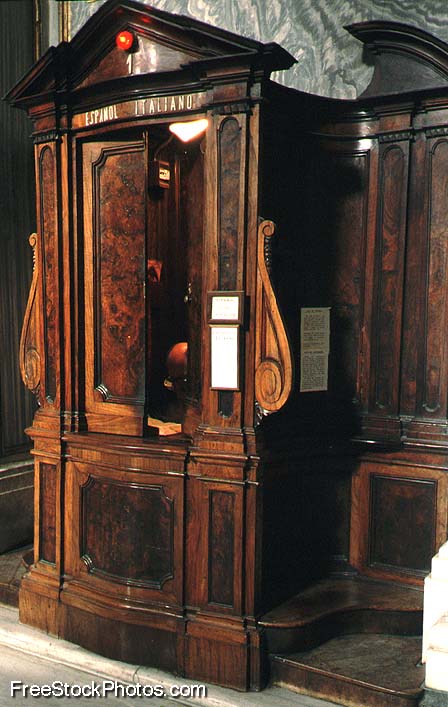
One of the things which changed around about confession was the development of the "reconciliation room" with "face to face" confession. 

Frankly, I won’t use those.  Unless there is a very good reason, I usually won’t hear confessions if there is not a screen available, preferably a full and fixed barrier, like the old fashioned confessionals.  

POLL: face to face or behind the screenI want people to have anonymity and there must be the security of propriety.

The situation in Italy is a little different, of course.  Many Italian confessionals have an open window in front.

That said, what do you prefer?    Give us your answer and your reasons why!

POLL CLOSED

Which way do you prefer to go to confession?

  • behind a screen or grate (88%, 1,924 Votes)
  • face to face (12%, 264 Votes)

Total Voters: 2,188

Posted in POLLS, SESSIUNCULA |
159 Comments

NYT: priest revives confession in his parish, liberal loser runs it down

This is in from the New York Times.

Securly in the "Brick by Brick" department, but there is an interesting dimension to this which you should not miss. There will always be a liberal loser in the mix.

February 21, 2009
On Religion
In One Church, Confession Makes a Comeback
By SAMUEL G. FREEDMAN

STAMFORD, Conn. — The day after Msgr. Stephen DiGiovanni was installed in June 1998 as the pastor of St. John the Evangelist Roman Catholic Church here, he walked through the quiet sanctuary, appreciating the English Gothic grandeur and tallying all the repairs it required.

One particular sight seized him. The confessional at the rear of the pews had been nailed shut. The confessional in the front, nearer the altar, was filled with air-conditioning equipment. And these conditions, Monsignor DiGiovanni realized, reflected theology as much as finance.  [Theology, yes! This gets it exactly right!  The writer has hit this … ehem… nail on the head.]

In the wake of the Second Vatican Council in the mid-1960s, the Catholic Church began offering confession in “reconciliation rooms,”  [I know these awful rooms are prevalent, but NOTHING in the documents of the Church required that.  As a matter of fact I believe there are still some conditions for the construction of confessionals including a fixed grate, no?  Am I wrong?] rather than the traditional booths. Even before the setting changed, habits had. The norm for American Catholics was to make confession once a year, generally in the penitential period of Lent leading up to Easter.  [I think a lot of Catholics went to confession pretty regularly and not just once a year.  Didn’t they?]

Monsignor DiGiovanni, though, soon noticed that there were lines for the St. John’s reconciliation room the only time it was open each week, for two hours on Saturday afternoon. So within his first month as pastor, he pried open the door to the rear confessional, wiped off the dust of decades and arranged for replacing the lights, drapes and tiles.  [Well done!]

Then, in the fall of 1998, Monsignor DiGiovanni rolled back the clock of Catholic practice, having St. John’s priests hear confession in the booths before virtually every Mass. [This is NOT rolling back the clock.  What sort of view is behind this?  Again, I think it is a interpretive principle of rupture.] By now, as another Lent commences next week with Ash Wednesday, upwards of 450 people engage in the Sacrament of Reconciliation, as confession is formally known, during 15 time slots spread over all seven days of the week. Confessions are heard in English, Spanish, French, Italian and Portuguese.

“As humans, we’re always deciding that we are God and breaking his commandments,” said Monsignor DiGiovanni, 58, during an interview this week in his rectory. “But God is savvy enough to know that. And God wants us to come back to Him if there’s a contrite heart. Salvation is not just a one-time deal.” [Did you get that, you Born-Agains?]

His message has stirred scores of consciences at St. John’s. And while the frequency of confession, and the return to booths from the reconciliation room, puts the pastor and the parish on the conservative end of the Catholic spectrum, [having a sense of sin and going to confession, hearing confessions, makes you "conservative".] St. John’s is a standard diocesan church with a varied congregation — corporate executives, Haitian and Hispanic immigrants, Stamford’s longtime Irish and Italian middle class.  [Right… it’s just a Catholic parish.]

Rosa Marchetti, an events planner for a family-owned chain of restaurants, had grown up dreading the rite of confession. The reconciliation room, while intended to allow priest and penitent to meet in a reassuring face-to-face manner something like analyst and analysand, filled her with anxiety and shame. Six years ago, Ms. Marchetti began attending St. John’s, and these days she makes a confession at least twice a month. Speaking to an unseen priest through a screen seems to her a comfort.  [As it is for the vast majority of people.]

“I’d always feared that the priests would know it was me, and I never wanted to think I’d done something wrong,” she recalled of her earlier experiences. “But at St. John’s, it was explained to me that I go to the doctor for my physical well being and I have to go to confession for my spiritual well being.”

Even so, she recognizes how the practice sets her apart from a national popular culture of celebrity magazines, talk shows, Facebook pages and Twitters that is relentlessly confessional and rarely contrite.  [nice phrase: "relentlessly confessional and rarely contrite".]

“You turn on Oprah and you have women crying to her, confessing what they’ve gone through,” Ms. Marchetti said. “Everyone is so quick to tell the world their problems, but they won’t tell a priest.”  [And they risk their souls as a result.]

In the hope of reversing those engines, the Catholic diocese of Bridgeport, Conn., has mounted what it calls a “Lenten Confession Campaign.” The diocese’s 87 churches, which include St. John’s, will be offering confession for two hours every Tuesday night in addition to the usual Saturday afternoon or Sunday morning periods.  [EXCELLENT]

To promote the campaign, the Knights of Columbus is paying for highway billboards, bus placards and radio and TV commercials — all using a slogan drawn from Corinthians, “Be Reconciled to God” — as well as the printing and distribution of 100,000 pamphlets about confession.

It remains to be seen, of course, whether the multimedia effort can change behavior on a grand scale. Monsignor DiGiovanni has changed it within his parish through a theological version of retail politics: reaching individuals and families through a decade of homilies, conversations and columns in the church bulletin.

The movement to revive confession, using the traditional booth, no less, has plenty of skeptics within American Catholicism.

[Now which progressivist aging-hippe will the writer drag in for counterpoint?]

“Confession as we once knew it is pretty much a dead letter in Catholicism today,” the Rev. Richard P. McBrien, a professor of theology at the University of Notre Dame, wrote in an e-mail message.  [Yah… you knew it had to be one of these defeatists.]

Father McBrien, whose support of female ordination and married priest puts him on the theological left wing of the Catholic Church, added in a subsequent e-mail message that “the practice at the Stamford parish is an anomaly, not a sign of anything else” and at best “part of a small minority” of churches.  [What would you bet he is happy that it is an anomaly?]

Majority or minority, the congregants at St. John’s firmly believe they are onto something. John F. X. Leydon, Jr., a lawyer in Stamford, has increased his pace of confession from once a year to once a month. The eldest of his four children, Mary, will be making her first confession this spring.

“The explanation we’ve given as parents is that none of us is perfect,” said Mr. Leydon, speaking also for his wife, Stacey. “However, we have to aspire to be perfect. And that should be a lifelong pursuit.”

E-mail: gfreedman@nytimes.com

An interesting article.

In the balance, McBrien looks just as foolish as he always does.

Posted in Brick by Brick, SESSIUNCULA |
64 Comments

Discovery of a new element!

From a priest reader:

New Element Discovered

Lawrence Livermore Laboratories has discovered the heaviest element yet known to science. The new element, Governmentium (Gv), has one neutron, 25 assistant neutrons, 88 deputy neutrons, and 198 assistant deputy neutrons, giving it an atomic mass of 312.

These 312 particles are held together by forces called morons, which are surrounded by vast quantities of lepton-like particles called peons.

Since Governmentium has no electrons, it is inert; however, it can be detected, because it impedes every reaction with which it comes into contact. A tiny amount of Governmentium can cause a reaction that would normally take less than a second, to take from four days to four years to complete.

Governmentium has a normal half-life of 2- 6 years; it does not decay, but instead undergoes a reorganization in which a portion of the assistant neutrons and deputy neutrons exchange places. In fact, Governmentium’s mass will actually increase over time, since each reorganization will cause more morons to become neutrons, forming isodopes.

This characteristic of moron promotion leads some scientists to believe that Governmentium is formed whenever morons reach a critical concentration. This hypothetical quantity is referred to as critical morass.

When catalyzed with money, Governmentium becomes Administratium , an element that radiates just as much energy as Governmentium since it has half as many peons but twice as many morons.

May God help us survive this growing mass before it becomes a black hole that sucks us all in.

Scary stuff.

Posted in SESSIUNCULA |
14 Comments

D. of Orlando memo: errors concerning the status of the SSPX

A reader sent an interesting piece of news from a memo for the Diocese of Orlando.

As you can see, even official offices of the Church still refer to the SSPX as being in "schism", even though the Holy See says that it is not.

My emphases and comments.

There has been much effort on the part of the Holy See to clarify the context of the lifting of the excommunication against four bishops of the schismatic "Pius X Association". Unfortunately, this has not been given much coverage in secular media. The website of the Holy See, www.vatican.va <http://www.vatican.va/> , can provide better clarification.

a) "Lifting of excommunication" did not reinstate these bishops or their followers. They still remain in schism  [I know it is tempting to apply the "duck argument", but the Holy See now says that the SSPX is not in schism.] – for rejecting the Second Vatican Council and in defying authority of the Pope. The lifting of the excommunication was a gesture towards encouraging them to reconcile with the Church. A similar gesture [opps] took place about 30+ years ago, between the then Pope and then Greek Orthodox Patriarch. Mutual excommunications were lifted – however that schism has not yet been healed – but there is greater communication between the two religious bodies and dialog continues.  [Here is the problem.  The Orthodox are in schism.  The SSPX is not in schism.  The gesture is not similar.]

b) The rift between this schismatic group is still far from being healed – it would require them to accept the teachings of the Second Vatican Council, and submit themselves to authority of Bishop of Rome (which would mean adhering to the Catechism of the Catholic Church and the degrees of the Council, both of which unequivocally condemn anti-Semitism and all forms of genocide.

First, I think there is a very incomplete understanding of what needs to be determined about the Second Vatican Council here.

Second, I am concerned that this sort of erroneous information, probably being distributed to priests and parish workers, will distort what they say to their parishioners or others who might ask what is going on with the SSPX and what is behind the whole Williamson thing they see in the press.

They should diligently double-check their facts.

Posted in SESSIUNCULA |
17 Comments

QUAERITUR: fingers together after the consecration

From a seminarian:

In the Tridentine Rite of the Holy Mass, the Priest, after touching the Sacred Host, would then henceforth not seperate his fingers from the manner of keeping them together (thumb and index fingers). He would also keep his hands sixteen inches apart.

My question would then be: is this still permissible in the Novus Ordo or has this been suppressed? Any clarification you could give me would be helpful as I will be Ordained in a few years.


I am not so sure about the 16 inches thing.  I believe that the point is to keep your fingers over the corporal in case some particle might drop.  It would drop onto the corporal.

It is certainly okay for the priest to hold his "canonical digits" together in the Novus Ordo after the consecration and to keep them over the corporal.  As a matter of fact, I think he ought to.

Posted in ASK FATHER Question Box |
35 Comments

Charlottesville VA: Dominican Rite Missa Cantata scheduled

From a reader:

DOMINICAN RITE MASS IN CHARLOTTESVILLE VA

By an initiative of the pastor, Fr. Luke Clark, O.P., in response to requests by parishioners, St. Thomas Aquinas University Parish in Charlottesville VA, will host a Dominican Rite Missa Cantata (Sung Mass) on an experimental basis each third Sunday of the month during the rest of the academic year. The dates will be March 15, April 19, and May 17. The Mass will be celebrated at 10:15 a.m. in the Our Lady of Perpetual Help Chapel of the parish center at 401 Alderman Road, which is attached to the church.

Music will be provided by a group of parishioners singing from the Dominican Gradual, and the celebrant will be Fr. Augustine Thompson, O.P., S.T.M., professor of Religious Studies and History at the University, a member of the Western Dominican Province. Depending on the response, this offering may become a regular offering after the summer recess.

Posted in SESSIUNCULA |
14 Comments

Kmiec on Holy See’s Pelosi visit statement, Justice Scalia, duties of jurists

This is in from TIME.  

You might go back and review this entry before reading ahead.

My emphases and comments.

Friday, Feb. 20, 2009
Catholic Judges and Abortion: Did the Pope Set New Rules?
By Douglas W. Kmiec

Much has been made of the statement on abortion that Pope Benedict XVI issued earlier this week after meeting with Nancy Pelosi. But the Vatican’s choice of words as they related to the Speaker of the House was quite predictable, [I don’t know… I wasn’t sure any remarks would come from the Vatican.] given her pro-choice stance and her position as a high-ranking Catholic Democrat. The Holy Father simply made clear their differences on the issue and reminded the American politician of her responsibilities as a Catholic to protect life "at all stages of its development."  [Notice how he framed that?  He put that in such a way as to make it sound as if the Pope simply agreed to disagree with Nancy Pelosi.  They just "differ" with each other.]

What was quite surprising, and overlooked, had to do with a different branch of the U.S. government. If you read it carefully, the statement is actually quite radical [?  Let’s see where he goes with this.] — perhaps unintentionally so. The brief message — just two short paragraphs — draws no distinction between the moral duties of Catholic policymakers and Catholic judges to work against abortion. (See pictures of Pope Benedict XVI’s trip to America.)  [hmmm…. why would Catholic teaching not apply also to Catholic judges who advance abortion rights?]

As a lifelong Catholic, Pelosi could not feign surprise at being called upon by the Church to use her gift for persuasion to restrict abortion legislatively, or at least not to be its advocate. But until now, the Church had not formally instructed judges in a similar fashion. [Okayyyy…. but, should the Church have to?  Perhaps judges haven’t been on the radar screen as much unless they are high profile positions, such as SCOTUS.]  As written, the Pope’s statement has the potential, at least theoretically, to empty the U.S. Supreme Court of all five of its Catholic jurists and perhaps all other Catholics who sit on the bench in the lower federal and state courts.   [You see what Kmiec is doing here, right?  He is basically saying, back off pro-abortion politicians or you will have to also pressure your darling originalist (strict interpretation) Justices.  Watch where he goes.]

"His Holiness," the statement read, "took the opportunity to speak of the requirements of the natural moral law and the church’s consistent teaching on the dignity of human life from conception to natural death which enjoin all Catholics, and especially legislators, jurists and those responsible for the common good of society, to work in cooperation with all men and women of good will in creating a just system of laws capable of protecting human life at all stages of its development." (See the top 10 religion stories of 2008.)

To get a sense of just how sharp a break with the past this is, all one has to do is take a look at what Supreme Court Justice Antonin Scalia, himself a Roman Catholic, wrote in 2002 in an essay in First Things. "[Abortion involves] … private individuals whom the state has decided not to restrain. One may argue (as many do) that the society has a moral obligation to restrain. That moral obligation may weigh heavily upon the voter, and upon the legislator who enacts the laws; but a judge, I think, bears no moral guilt for the laws society has failed to enact," he wrote. "Thus, my difficulty with Roe v. Wade is a legal rather than a moral one … [I]f a state were to permit abortion on demand, I would — and could in good conscience — vote against an attempt to invalidate that law for the same reason that I vote against the invalidation of laws that forbid abortion on demand: because the Constitution gives the federal government (and hence me) no power over the matter."

Until the Pelosi statement, the prior instruction from the Church’s Congregation of the Doctrine of the Faith and encyclical writing seemed to confirm Scalia’s reasoning. There was an implicit understanding that the Church’s admonition to its faithful to change the law permitting the choice of abortion had to be understood and applied in light of the scope of office. Catholic legislators make policy and could be so instructed, but judges, as Scalia wrote, had "no moral responsibility for the laws [their] nation has failed to enact."

It is, of course, quite possible that the Holy Father was not intending to impose a new moral duty on Catholic jurists at all, and that in the rush of the event, someone in the Vatican press office mistakenly included the judicial terminology. But taken at its word, the Pope’s new admonition to "jurists" to undertake an activist, law-changing role suggests that the concept of Originalism (adhering to the textual meaning of laws at the time of adoption) subscribed to by Scalia and often by three of the four other Catholics on the Supreme Court (Clarence Thomas, Samuel Alito and John Roberts) is a morally deficient method of constitutional interpretation.   [So, Kmiec is using the Holy See’s statement about the Pelosi visit to attack an originalist interpretation of the Constitution.]

No doubt Scalia would insist that since abortion is not in the constitutional text, disavowing an abortion right would square Scalia and the other Catholic jurists with the Church. But not so fast; Scalia says abortion can be legislatively permitted or not as the people choose, and he will enforce whatever is democratically chosen. That’s hardly what the Church is hoping from Catholic jurists, is it? 

If the Holy Father is pointedly telling not only Congresswoman Pelosi but also judges that they must use their office to undo the legal protection for abortion, how is this consistent with their judicial oath, or with the fact that the Constitution in Article VI puts religious belief off-limits for selection or qualification for office, including judicial office? In particular, precisely what is a Catholic jurist to do when confronted with the application of laws restricting abortion that, as interpreted by the courts in rulings like Roe v. Wade, would be unconstitutional? If a Catholic judge invalidated laws restricting abortion in conformity with the constitutional precedent, he or she would presumably be cooperating with the evil of abortion. On the other hand, [here it comes] if a Catholic judge ignored the precedent — perhaps seeking to avoid Church sanction, such as the threats of communion denial aimed at pro-choice Catholic lawmakers by some bishops in the past election [Kmiec’s big problem, it seems.] — there would likely be increasing claims of religious bias.

In 2002, when discussing the death penalty and his faith, Scalia expressed relief that the Church had yet to find the death penalty categorically immoral since that was neither his personal conclusion nor the Originalist position on the Constitution. "I like my job, and would rather not resign," he wrote in 2002. "[I]n my view, the choice for the judge who believes the death penalty to be immoral is resignation, rather than simply ignoring duly enacted, constitutional laws and sabotaging death penalty cases. He has, after all, taken an oath to apply the laws and has been given no power to supplant them with rules of his own. Of course if he feels strongly enough he can go beyond mere resignation and lead a political campaign to abolish the death penalty — and if that fails, lead a revolution. But rewrite the laws he cannot do."

Why does Scalia recognize a duty to resign were the law of the Constitution dealing with the death penalty to become inescapably at odds with Catholic teaching, but not in like circumstance for abortion? [Can he know that Justice Scalia doesn’t think that about abortion?]  For Scalia, it is the difference between two qualitatively different constitutional claims — a textual one (the death penalty being clearly anticipated by the Constitution) and a nontextual one (abortion). But under Rome’s new direction to jurists  [For a guy who wants to drill into an issue, how is it that he is so sloppy with his categories at this point?  He calls the statement released by the Vatican Press Office "Rome’s new direction".  But the Holy See has proper means and instruments for giving "direction" to jurists.  And that means isn’t going to be a press release!  Did that escape Kmiec’s notice?  Or has the change to attack Justice Scalia gotten him all excited?] to get busy correcting the law, that interpretative nicety won’t cut it. The duty for Scalia and the other Catholic jurists turns on what faith requires, not what the text does or does not explicitly say. No more Pontius Pilate.  [In case you missed it, Kmiec just likened the Catholic Justice Scalia to Pilate.]

Might there be a different, less intrusive course for the Church? [Doug to the recuse!] Yes: clarify the Pelosi statement by continuing to observe the difference between a jurist and a legislator. [?] That may be awkward from the standpoint of the unyielding lines of moral rather than political principle, but it has the merit of following the instruction of St. Thomas Aquinas, who argued that "all should have some part in the government; for in this way peace is preserved among the people, and all are pleased with such a disposition of things and maintain it."  [I am not sure how that quote of the Angelic Doctor actually supports what he is saying.  Maybe a well-trained Thomist can fill us in.]

Few are pleased with the abortion jurisprudence as it is. But imposing moral duties on Catholic jurists that are incompatible with their envisioned judicial role in a democracy is hardly likely to make it better.  [Why?  Does Kmiec believe jurists shouldn’t be expected to make judgments also based on God’s law?  Are jurist to adhere only to man’s positive law?  Is he telling the Holy See that it should says jurists need not consider the Church’s moral teaching.]

Kmiec is chair and professor of constitutional law at Pepperdine University and author of Can a Catholic Support Him? Asking the Big Question about Barack Obama (Overlook/Penguin 2008).


What is this really all about?

It could be that this is really a message to the Obama Administration about what sort of input he, Kmiec, would offer to the Holy See when future stick situations arise… if only he, Kmiec, were to be selected as the next… say… perhaps…. Ambassador to the Holy See?  Maybe?

Posted in SESSIUNCULA |
45 Comments

Archbp. of Brisbane: bomb threat for removing Fr. Kennedy from St. Mary’s

You know about the flap in Brisbane, Australia.  The Archbishop of Brisbane has finally… finally acted to check the renegade priest Fr. Peter Kennedy, heretic and perhaps soon to be schismatic, who has been warping the parish of St. Mary for years.

This is now in from the Sydney Morning Herald.  My emphases and comments.

Qld Archbishop warned of bomb threat
David Barbeler
February 21, 2009 – 6:34PM

Archbishop John Bathersby has been the target of a bomb threat following the sacking of a rebel priest at St Mary’s church in South Brisbane.

A spokesman for the Catholic Archdiocese of Brisbane said on Saturday the threat was received at the Archbishop’s office on Friday.

He confirmed that the Archbishop’s residence was the target in the letter.

"It made mention of St Mary’s, but that’s now in the hands of police," the spokesman said.

He refused to confirm whether the letter was written by someone who supported sacked 71-year-old rebel priest Father Peter Kennedy, or a supporter of the Catholic Archdiocese.  [Excuse me… but why would a supporter threaten to bomb what he supports?]

Fr Kennedy was sacked from his ministry at St Mary’s parish on Thursday by Brisbane Archbishop Bathersby for breaching church rules.

A police spokesman confirmed a bomb threat had been made and investigations were continuing.

St Mary’s has been the centre of controversy in recent months, with Fr Kennedy attracting the stern eye of the Vatican itself.

The congregation of 700 has a unique ministry in the inner-city suburb of South Brisbane, widely acknowledged as a haven for the poor, the marginalised, indigenous people, homosexuals and broken families. [aren’t they wonderful?]

Fr Ken Howell has been appointed to replace Fr Kennedy, and the two recently met face to face.

At that meeting, Fr Kennedy refused to hand over the keys to the parish buildings, including the church, and told Fr Howell that he would officiate at all masses this weekend.  [what a guy]

Fr Kennedy said he expected the church to be packed to the rafters during the church’s concert on Saturday night and at the 7am and 9am Sunday masses.

"I’m expecting probably a thousand people here on Sunday morning – I wouldn’t be surprised," Fr Kennedy said.

"I have to tell you our collection on Sunday morning is usually $2,100 – last Sunday it was $5,400 – so that says a lot."  [indeed… what it says, however, is not to clear yet]

Fr Howell has been advised by the Queensland Police Service not to attend this weekend’s masses at St Mary’s for his own safety.  [A real sign of the spiritual nature of Fr. Kennedy’s work]

"I have also been contacted by a number of people, saying they would like to attend the services but are hesitant to do so because they are concerned about their own, and their families’ safety," Fr Howell said.

Despite the bomb threat made to his residence, Archbishop Bathersby said the Brisbane Catholic Archdioceses’ priority was to ensure the proper transition of the parish to the new administrator.

"In this difficult situation, I believe a sensible next step would be to have an experienced, independent and eminent mediator meet with the Archdiocese and Fr Kennedy to attempt to achieve a peaceful and dignified outcome," [a little late for that, I think] the Archbishop said.

In the meantime, I hear Fr. Kennedy has some strong support from an interesting quarter.  The site Perth Now tells us that the UFO crowds thinks Fr. Kennedy is their sort of guy!

A small party of Raelians, who believe that alien beings have intervened in earthly affairs, were outside St Mary’s with signs supporting Fr Kennedy.

And in case you were thinking that this all sounds familiar, Fr. Kennedy clears it up:

"But we can take heart from the words of Jesus himself, who was judged harshly for his unorthodox behaviour – ‘By their fruits you will know them’."

Indeed.  The fruits are standing outside with signs.

Posted in SESSIUNCULA |
92 Comments

Interesting “Declaration” from the Holy See’s Press Office

This is pretty interesting, from the Holy See Press Office Bolletino today:

My translation from the Italian original:

DECLARATION BY THE DIRECTOR OF THE PRESS OFFICE OF THE HOLY SEE, REV. FR. FEDERICO LOMBARDI, SJ

In the late morning the Director of the Press Office of the Holy See, Rev. Fr. Federico Lombardi, SJ, gave the journalists the following declaration:

Not rarely the information media attribute to the "Vatican", intending by that the Holy See, comments and points of view which cannot be attributed to it automatically.  The Holy See, in fact, when it intends to express itself authoritatively, uses the proper ways and appropriate means (communiques, notes, declarations).

No other pronouncement has the same merit.

Also recently, inopportune attributions have been made.  The Holy See, in its representative branches, shows respect toward civil authorities, which in their legitimate autonomy have the right to provide for the common good.

Interesting. 

Also, if you know something about Italian, you know how turgid the style can get when the writers want to strike a high tone or sound official.  Here is the last part in the original:

Anche di recente, si sono verificate attribuzioni non opportune. [gotta love that!] La Santa Sede, nei suoi organi rappresentativi, [excellent phrase, that] manifesta rispetto verso le autorità civili, che nella loro legittima autonomia hanno il diritto e il dovere di provvedere al bene comune.

Clearly a defensive move.

I am sure you readers will jump in and supply the backdrop for this Declaration.


Posted in SESSIUNCULA |
13 Comments